
How Much Does Augmented Reality Cost? AR Pricing by Project Type (2026)
Aug 20, 2026

13 MIN READ
How much does augmented reality cost? Between $5,000 and $300,000-plus to build, depending on how the experience runs and how much 3D content it carries. A simple WebAR or marker-based experience runs $5,000–$40,000. A mid-complexity native app on ARKit or ARCore, with custom 3D content and analytics, runs $50,000–$120,000. An enterprise deployment with a backend, CMS, and managed device fleet starts near $120,000 and often passes $300,000.
Three variables decide where a project lands: the volume of 3D assets, the tracking type, and the number of platforms the app has to support. Most first AR budgets get one of those three wrong, and it is almost always the 3D content.
Key Takeaways
- A basic WebAR or marker-based AR experience costs $5,000–$40,000; a mid-market native ARKit/ARCore app costs $50,000–$120,000.
- Enterprise AR with a backend and managed device fleet starts near $120,000 and frequently exceeds $300,000.
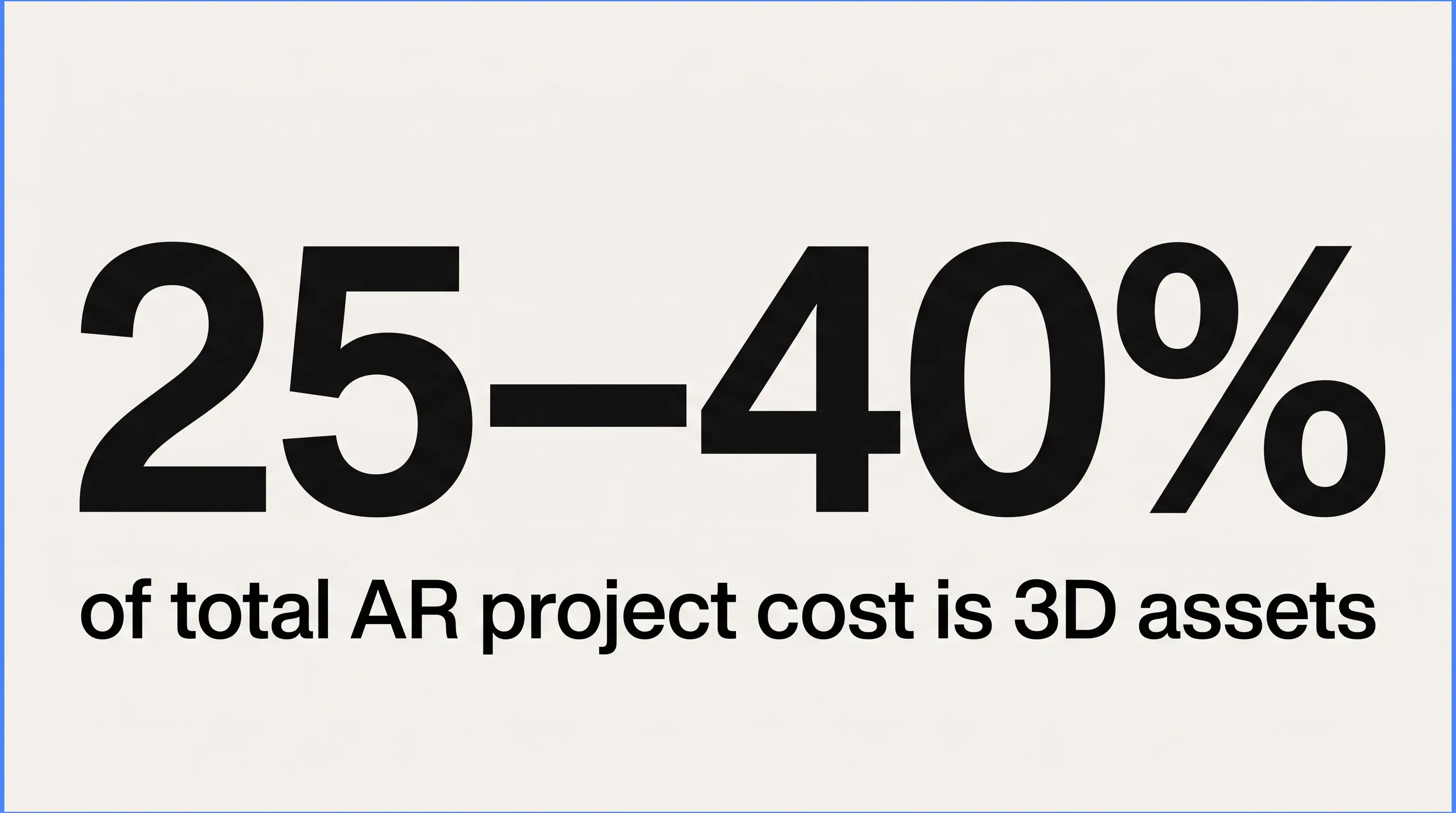
- 3D asset production accounts for 25–40% of an AR budget and 50–70% of development hours, per Coders.dev’s December 2025 analysis.
- Post-launch AR maintenance runs 15–20% of the build cost per year, before hardware fleet costs.
- The enterprise AR market reached $112.9 billion in 2025 and is projected at $146 billion in 2026, per Mordor Intelligence.
What Does a Basic AR App Cost to Build?
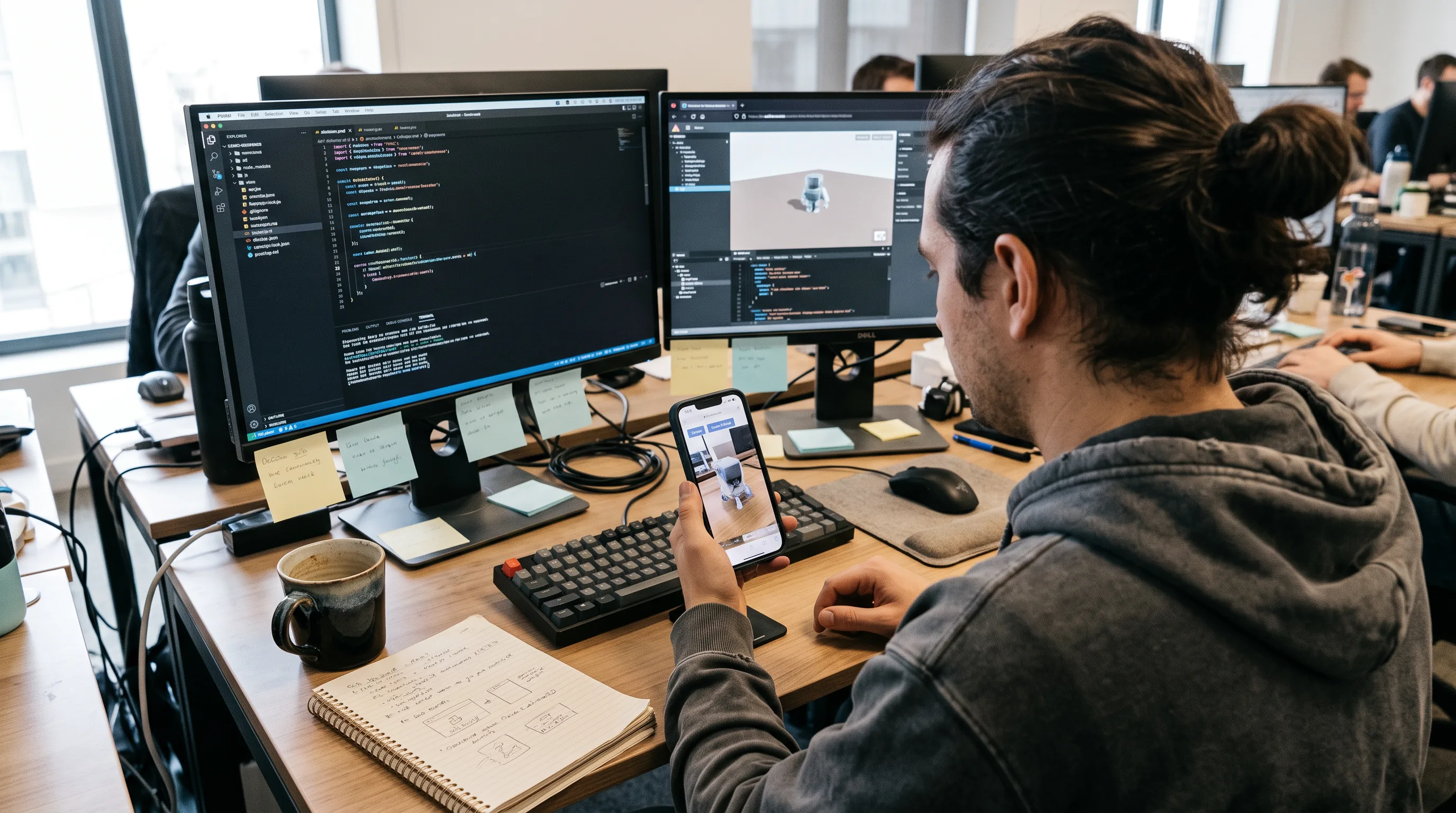
A basic AR app costs $5,000–$40,000, and most mid-market native apps land between $50,000 and $120,000. The floor buys a marker-based or WebAR experience: point a phone at an image or QR code, load a few 3D models, and interact in the browser. The ceiling of the mid tier buys a native app with markerless tracking, a content pipeline, and analytics.
| Project type | Typical cost range | Typical timeline | What you get | Best fit |
|---|---|---|---|---|
| WebAR | $8,000–$40,000 | 4–12 weeks | Browser-based AR, no install, QR or link entry | Retail and marketing campaigns, broad reach |
| Marker-based AR | $5,000–$15,000 | 4–8 weeks | Image/QR-triggered 3D overlay | Packaging, print, museum and event pieces |
| Native ARKit/ARCore app | $50,000–$120,000 | 3–5 months | Markerless tracking, custom 3D, analytics, offline | Product apps, field tools, branded experiences |
| AR product visualization / try-on | $30,000–$150,000 | 2–5 months | 3D catalog, room or body placement, configurator | Furniture, cosmetics, footwear, eCommerce |
| Enterprise AR (backend + device fleet) | $120,000–$300,000+ | 6–12+ months | CMS, backend, integrations, managed headsets | Field service, manufacturing, training |
What separates the entry tier from the mid tier is tracking and platform count, not polish. Marker-based AR keys off a known image, which is cheap to build and reliable to run. Markerless AR on ARKit or ARCore has to understand a room it has never seen, which means more engineering, more testing, and more edge cases. HQSoftwareLab’s January 2026 breakdown puts a marker-based build near $3,000 in raw hours and a custom app with a backend around $63,000, which tracks with what we quote. If you want to see the delivery side of that number, our AR app development work covers the native iOS and Android path in detail.
Why Is WebAR Cheaper Than a Native AR App?
WebAR is cheaper than native AR because it runs in a browser: no app-store submission, no SDK install, no per-platform build. That narrower scope is why a WebAR campaign runs $8,000–$40,000 while a native app starts around $50,000. Virtual Verse Studio’s 2026 pricing places WebAR at $8,000–$40,000 for a reach-first experience, and our own quotes sit in the same band.
The WebAR platform landscape shifted in early 2026. According to Blippar’s April 2026 platform review, 8th Wall shut down its paid hosted service on 28 February 2026 and open-sourced its XR Engine, ending the $700-per-project-per-month plan that many agencies built on. Teams have moved to Zappar’s ZapWorks (paid plans from about $58/month), Blippar, Hololink, and custom WebAR builds.
WebAR is the right first spend for most retail and marketing work, because reach beats depth when the goal is a campaign a customer opens from a link. Native wins when the experience has to persist on the home screen, work offline, or use the deeper capabilities of ARKit and ARCore. Our WebAR development page walks through where the browser approach fits.
Verdict: Choose WebAR for broad-reach campaigns and product try-ons; choose native AR when the app must persist, run offline, or use advanced device tracking.
What Drives AR Development Cost Up or Down?
Three levers move an AR budget more than any other: the volume of 3D assets, the complexity of tracking, and the number of platforms the app must support. A single-platform WebAR piece with five stock-quality models is a fraction of a two-platform native app with twenty custom models and object recognition. Feature scope compounds fast. DesignRush’s December 2025 cost guide prices object recognition at $10,000–$50,000 and gesture control at $20,000–$50,000 as add-ons, so a feature checklist is really a price list.
Developer Rates by Region
Developer rates set the base cost of every AR project, and they vary by a factor of ten across regions. According to Appinventiv’s July 2026 cost analysis, North American AR rates run $40–$250 per hour, with senior agency work at the top of that band; Western Europe runs $35–$180, Eastern Europe $25–$110, and India and Asia $20–$80.
| Region | Typical hourly rate |
|---|---|
| North America | $40–$250/hr |
| Western Europe | $35–$180/hr |
| Eastern Europe | $25–$110/hr |
| India / Asia | $20–$80/hr |
Rate is not the same as cost. A cheaper hourly rate that ships slower, or needs a rebuild, is not cheaper. Building the whole team in-house is its own line: Agilesoftlabs’ June 2026 breakdown puts a lean five-role AR/VR team (Unity developer, 3D artist, technical artist, QA engineer, project manager) near $490,000 per year fully loaded. For how the iOS side of that team is priced, see our guide to hiring ARKit developers.
Platform and Licensing Fees
Platform and licensing fees are the recurring costs buyers leave out of the initial scope, and they compound every year the app is live. The core SDKs are free: Apple’s ARKit and Google’s ARCore cost nothing to use, though shipping requires an Apple Developer Program membership ($99/year) and Google Play registration. The paid layers sit above them.
- Vuforia Engine Cloud: $1,000/month for up to 100 image targets (DesignRush, December 2025).
- Unity Pro: about $1,800/year per seat.
- ZapWorks (Zappar): paid WebAR plans from roughly $58/month.
- 8th Wall: no longer a paid option after its February 2026 open-source transition.
A build quote that omits these lines understates the true first-year number. On a mid-market app using Vuforia and two Unity seats, licensing alone adds roughly $15,000 in year one before a single hour of maintenance. We itemize licensing separately in every estimate for exactly that reason.
How Much Do 3D Assets Add to an AR Budget?
3D assets are the single largest and most underestimated line in an AR budget, accounting for 25–40% of total cost and 50–70% of development hours. Per Coders.dev’s December 2025 analysis, 3D modeling and optimization routinely consume a quarter to two-fifths of the entire project. The app is the frame; the 3D content is the picture, and the picture is what takes the time.
In our AR work at Frame Sixty, an AR/VR and spatial computing development studio, the content pipeline is the part of a quote that surprises new buyers most. A retail try-on with twenty products is not one app with twenty models bolted on; it is twenty modeling, texturing, and optimization jobs, each of which has to hold a frame budget on a mid-range phone. We model, retopologize, bake textures, and compress to USDZ and glTF so the assets load fast and render clean, and that pipeline, not the AR code, sets the timeline.
Per-Asset Cost Benchmarks
Per-asset 3D costs scale with fidelity, from a few hundred dollars for a simple prop to tens of thousands for a hero asset. According to Innovecs Games’ December 2025 pricing guide, production-ready models break down roughly as follows:
| Asset class | Example | Typical cost |
|---|---|---|
| Basic prop | Chair, desk lamp, simple packaging | $300–$1,200 |
| Stylized character/product | Branded item, game-style skin | $800–$3,500 |
| Realistic hero asset | Vehicle, detailed furniture, machinery | $2,000–$8,000 |
| Film-grade / architectural | Hero building, cinematic vehicle | $5,000–$30,000 |
Senior 3D artists charge $100–$200+/hour in the US and $15–$50/hour in Asia, so a catalog of realistic assets can outweigh the software budget on its own.
Here is the reframe most first-time buyers need: for a multi-product retail try-on, the 3D library is the project. The AR shell is a solved problem; twenty photoreal, frame-budget-safe models are not. Scope the content first and the engineering second, and the quote stops surprising you. Our 3D animation and asset services exist because this line item deserves its own pipeline.
Need help scoping your AR project cost?
We are here to help!
What Does an Enterprise AR Deployment Cost?
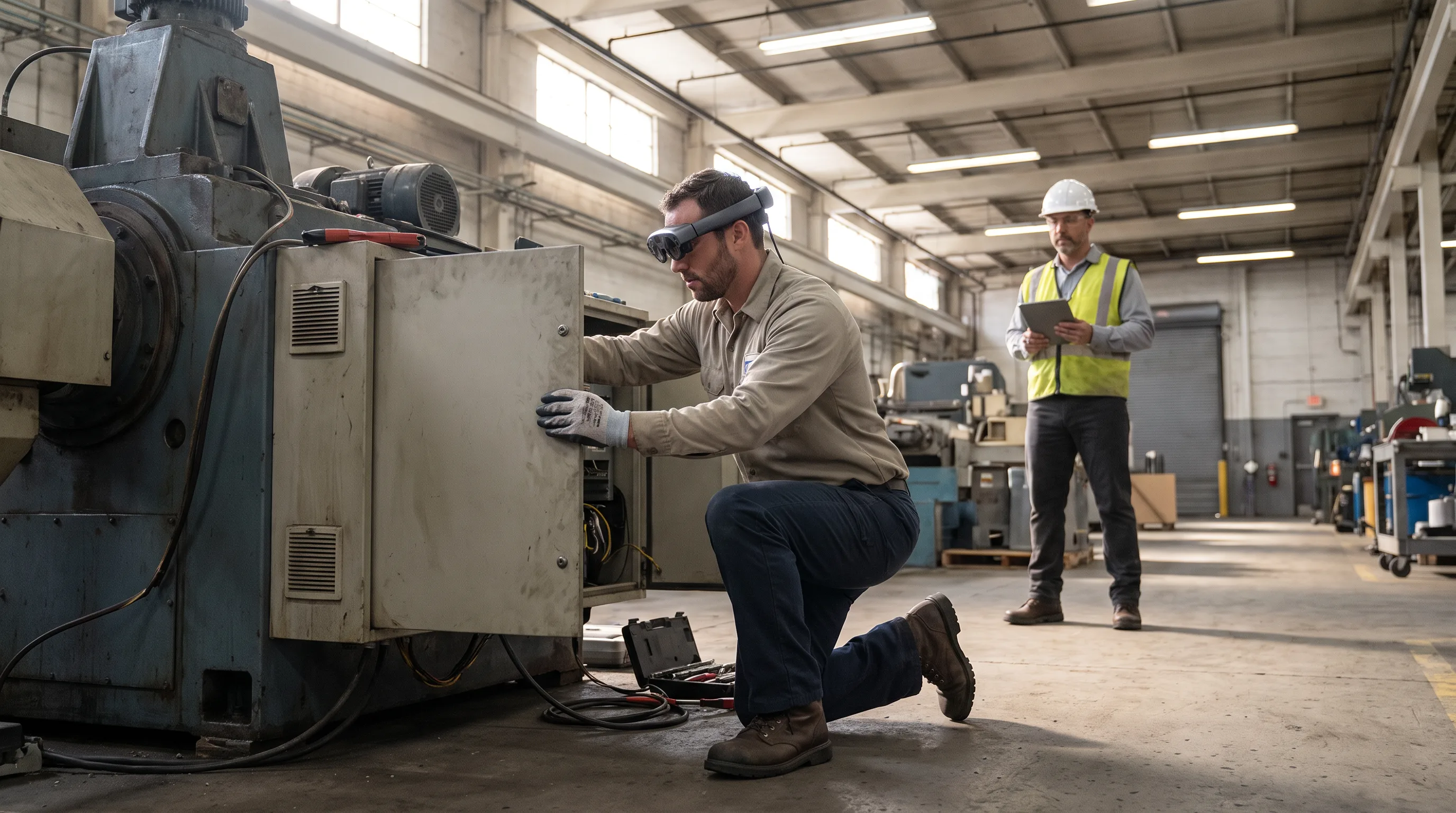
An enterprise AR deployment costs $120,000 to $300,000-plus, and content development alone can reach $150,000–$500,000 for fully custom modules. Enterprise scope means a backend, a CMS for non-technical staff to update content, integrations with existing systems, and a fleet of headsets someone has to manage. Agilesoftlabs’ June 2026 breakdown tiers content as off-the-shelf ($2,000–$8,000 site license), semi-custom ($30,000–$80,000 per module), and fully custom ($150,000–$500,000+ per module).
| Delivery model | Typical build cost | Device reach | Key capability |
|---|---|---|---|
| WebAR | $8,000–$40,000 | Any smartphone browser | Broad reach, zero install friction |
| Native mobile AR (ARKit/ARCore) | $50,000–$120,000 | iOS and Android | Persistent, offline, full SDK access |
| Wearable AR (Vision Pro, HoloLens 2, Magic Leap 2) | $60,000–$300,000+ | Managed headset fleet | Hands-free, spatial overlay, enterprise integration |
Hardware is its own budget. The Magic Leap 2 runs $3,299 per unit, and Apple Vision Pro development costs roughly three to four times a Meta Quest-only build because of the distinct visionOS stack. A 50-headset fleet then carries $35,000–$65,000 per year in operational costs for device management, support, and accessories, before any software maintenance. The payoff is measurable: enterprise AR earns back through throughput and error reduction, and our overview of how augmented reality is used in businesses covers where field-service and manufacturing deployments hit a 9-to-12-month payback.
Most enterprise AR pilots stall for one reason: they are scoped as training demos, not throughput tools. A single-scene proof of concept is cheap and impressive and proves nothing about the recurring cost of keeping content current across a fleet. Scope the pilot against the production math from the start, or the pilot becomes the whole project.
How Long Does AR Development Take, and How Does Timeline Affect Cost?
AR development takes 4–12 weeks for basic WebAR and marker-based apps, 3–5 months for mid-market native apps, and 6–12+ months for enterprise deployments with a backend and device fleet. Timeline and cost move together, because cost is largely team size multiplied by weeks. The long pole is almost never the AR code.
Compressing a timeline usually raises the cost rather than lowering it. Squeezing a five-month build into three months adds roughly 40–60% through overtime and the overhead of running parallel workstreams, and it rarely lands sooner, because 3D asset production sits on the critical path and does not parallelize cleanly. Adding people to a late AR project tends to extend it, a pattern our guide on how long it takes to build an app documents in detail: scope sets the timeline, not headcount. Client review cycles and app-store submission add the rest of the calendar.
What Does AR Cost to Maintain After Launch?
AR costs 15–20% of the build price per year to maintain, so a $100,000 app carries $15,000–$20,000 in annual upkeep. That covers iOS and Android OS updates, ARKit and ARCore SDK changes, bug fixes, performance tuning, and support for new devices. Perimattic’s January 2026 analysis and Coders.dev both land on the same 15–20% band, and it holds across most mobile AR projects.
Two costs sit outside that percentage. An enterprise headset fleet adds $35,000–$65,000 per year in device management, technical support, and accessory replacement, per Agilesoftlabs. And for retail or marketing AR, the 3D library needs refreshing every product cycle, which the original build quote never includes. Recurring platform licensing, like Vuforia at $1,000/month, compounds on top. Maintenance is not a rounding error; it is a standing line in the annual budget, and treating it as optional is how a working app quietly rots.
Is AR Cheaper Than VR to Develop?
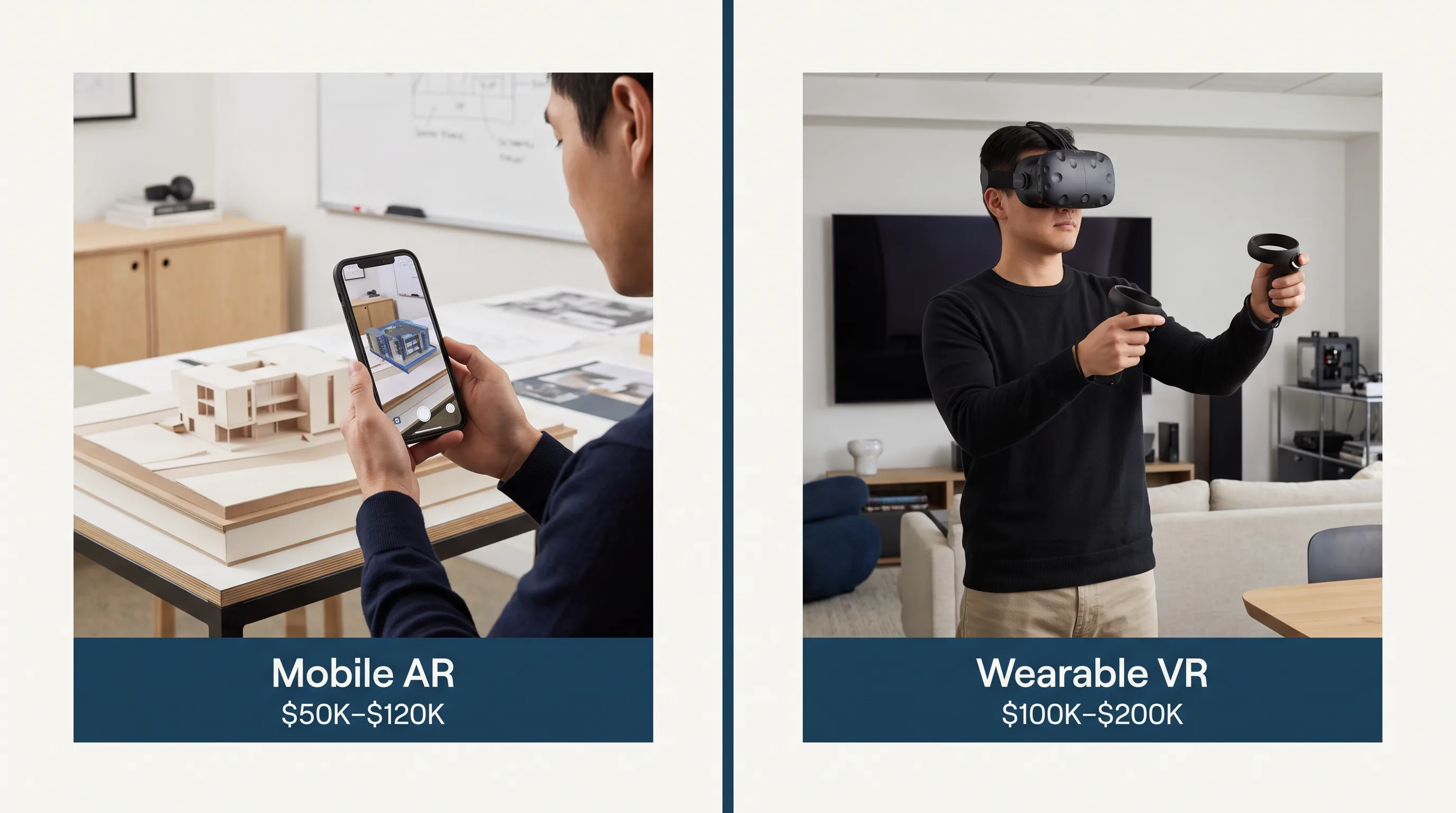
Mobile AR is cheaper than VR at comparable scope, mainly because it runs on smartphones customers already own instead of a dedicated headset. According to VR Vision Group’s May 2026 analysis, AR cost varies more by form factor than by feature set, and mobile AR’s use of existing hardware is the structural reason it undercuts VR.
| Approach | Typical build cost | Hardware requirement |
|---|---|---|
| Mid-market mobile AR | $50,000–$120,000 | User’s own phone |
| CG interactive VR | $100,000–$200,000 | Dedicated headset |
| Wearable AR (Vision Pro, HoloLens 2) | $60,000–$150,000+ | Enterprise headset |
| Immersive VR simulation | $100,000–$400,000+ | Dedicated headset |
The gap narrows at the top. Wearable AR on Apple Vision Pro or HoloLens 2 costs about the same as mid-range VR, and Apple Vision Pro development specifically runs three to four times a Meta Quest-only build. Our VR development cost breakdown covers the VR side in the same detail, and our guide to hiring VR developers shows how team composition drives the number.
Verdict: Choose mobile AR when reach and budget matter and the phone is enough; choose VR when full immersion is the point, such as training simulations, safety scenarios, or 360-degree narrative where blocking out the real world is the feature.
How Do You Choose an AR Development Partner Without Overpaying?
The fastest way to overpay for AR is to judge agencies on pitch decks and render reels instead of shipped, on-device work. A polished video proves the studio can render; a published app you can download and run on your own phone proves it can ship. Ask for the second one.
When we quote a project at Frame Sixty, the estimate itemizes engineering hours, 3D asset production as its own line, platform and licensing fees, QA on physical devices, and post-launch support, because a single blended number hides exactly the risks a buyer needs to see. We test on real hardware rather than the simulator, since a marker that tracks perfectly in Xcode can drift on a three-year-old Android phone in a warehouse. Publishing our ranges is deliberate: a buyer who walks in knowing what their scope costs has a better conversation than one anchored to a mystery number.
Watch for a few signals when comparing quotes:
- Fixed price with no scoping questions. A quote that does not ask about 3D asset count, tracking type, and platforms is guessing, and you will pay for the guess later.
- No shipped AR titles. “We use Unity” is not a portfolio; downloadable ARKit or ARCore apps with real performance are.
- 3D content buried in the total. If asset production is not a separate line, it is either underscoped or hidden.
Our augmented reality agency work is built around itemized, on-device delivery, and for eCommerce specifically, our AR product visualization service scopes the 3D catalog as its own deliverable.
Conclusion
Augmented reality costs $5,000–$40,000 for a WebAR or marker-based experience, $50,000–$120,000 for a mid-market native app, and $120,000–$300,000-plus for an enterprise deployment. Those are real numbers you can quote against, but the range within each tier is decided by 3D asset volume, tracking complexity, and platform count, in that order. As Mohamed Essam, Co-Founder and CTO of Virtual Verse Studio, put it in 2026, AR cost “ranges from roughly $5,000 for a basic marker-based app to $300,000 or more” for enterprise work.
The stance we would defend on any client call: most first AR projects are over-scoped, WebAR is the right first spend for the majority of retail and marketing use cases, and 3D asset production is the line item buyers systematically underestimate. Get those three right and the budget stops surprising you. The market is large enough to reward getting it right, with the enterprise AR segment projected at $146 billion in 2026 per Mordor Intelligence data reported by Virtual Verse Studio and mobile AR users expected to pass 1.19 billion by 2028 per Appinventiv’s July 2026 forecast.
If you want a line-itemized estimate for your project rather than a mystery number, get in touch with our team at Frame Sixty. We will scope the 3D content, the tracking, and the platforms honestly, and tell you where your project actually lands.
FAQs
Common cost questions buyers ask when scoping an augmented reality project. Each answer gives concrete dollar ranges drawn from current 2025–2026 agency and platform pricing.
Building an AR app for a single platform, iOS or Android, runs $50,000–$120,000 for a mid-market native app on ARKit or ARCore. Supporting both roughly adds 30–50% to engineering, since ARKit and ARCore are separate SDKs requiring their own builds and device testing. Shipping also needs an Apple Developer membership at $99/year plus Google Play registration.
Augmented reality is affordable for a small business at the entry tier, where a WebAR or marker-based experience costs $5,000–$40,000 and runs in a customer's browser with no app to install. That range covers most retail and marketing campaigns. Costs climb only when you need a native app, custom 3D catalogs, or enterprise headset hardware.
Retail and eCommerce AR costs $8,000–$40,000 for a WebAR campaign and $30,000–$150,000 for a product-visualization or try-on experience. The 3D catalog drives the price: each product needs its own modeling, texturing, and optimization job, and 3D asset production accounts for 25–40% of the total budget. AR try-ons can lift conversion meaningfully, so the catalog is the investment.
AR software integration typically takes 4–12 weeks for a basic WebAR or marker-based experience, 3–5 months for a mid-market native ARKit or ARCore app, and 6–12+ months for an enterprise deployment with a backend and device fleet. The long pole is rarely the AR code; 3D asset production sits on the critical path and does not parallelize cleanly.
Choosing reliable AR software starts with matching the platform to the goal: use ARKit and ARCore (both free) for native mobile, WebAR tools like Zappar's ZapWorks (from about $58/month) for browser reach, and Vuforia ($1,000/month for 100 targets) for image-target tracking. Note that 8th Wall closed its paid hosted service in February 2026, so verify a platform is still actively supported.
WebAR offers the broadest AR revenue reach because it runs on any smartphone browser with zero install friction, making it strong for retail and marketing at $8,000–$40,000 per campaign. Native ARKit and ARCore apps monetize deeper, persistent experiences, while wearable AR on Apple Vision Pro or HoloLens 2 ($60,000–$300,000+) targets high-value enterprise field-service and training use cases.
Hiring a VR or AR developer costs $40–$250 per hour in North America, $35–$180 in Western Europe, $25–$110 in Eastern Europe, and $20–$80 in India and Asia, per Appinventiv's July 2026 analysis. A lean in-house five-role AR/VR team runs about $490,000 per year fully loaded, per Agilesoftlabs, which is why many buyers use an agency.
Look for an AR development partner that shows shipped, downloadable, on-device apps rather than render reels, and that itemizes 3D asset production as its own line in the quote. A quote with no questions about asset count, tracking type, or platform count is guessing. Frame Sixty itemizes engineering, 3D assets, licensing, and on-device QA separately in every estimate.
AR maintenance costs 15–20% of the build price per year, so a $100,000 app carries $15,000–$20,000 in annual upkeep for OS updates, ARKit and ARCore SDK changes, bug fixes, and new-device support. Two costs sit outside that: an enterprise headset fleet adds $35,000–$65,000 per year, and recurring platform licensing like Vuforia at $1,000/month compounds on top.