
How Is Augmented Reality Used in Businesses? Use Cases, ROI, and Getting Started
Aug 15, 2026
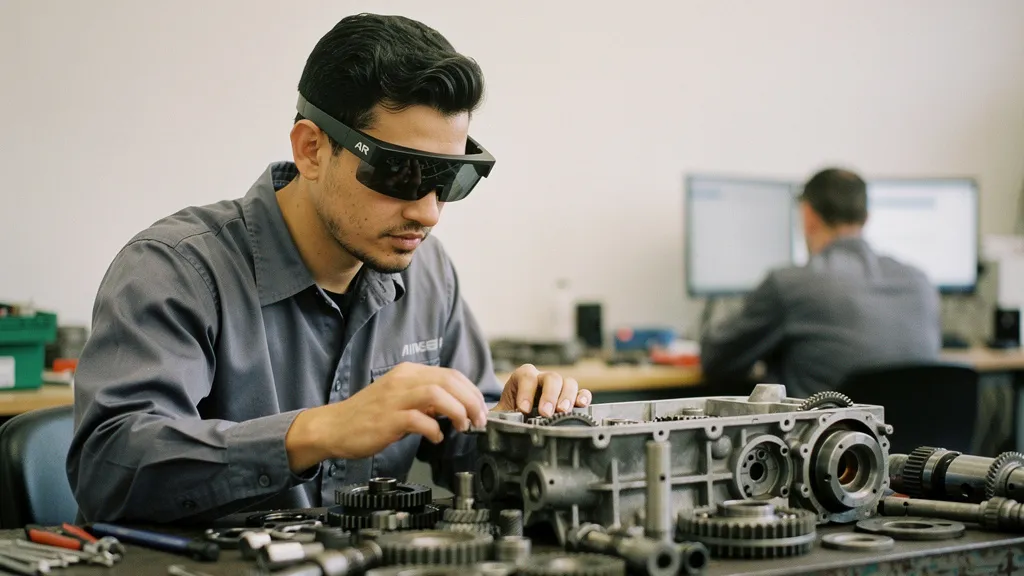
13 MIN READ
Businesses use augmented reality to overlay digital information onto the real world across five functions: product visualization, employee training, hands-free field service and remote assistance, manufacturing and warehouse guidance, and marketing. Retailers using AR product previews report up to 94% higher conversion and up to 40% fewer returns (BrandXR, 2025), while manufacturers use AR overlays to cut assembly time and on-site error rates.
Key Takeaways
- Products with 3D/AR content convert at 94% higher rates, per Shopify data reported by BrandXR (2025).
- AR remote assistance cut mean time to repair by 30% and raised first-time fix rates by 20% (Katalyst, 2025).
- 72% of manufacturers report positive ROI in the first year of an industrial AR deployment.
- Boeing reduced wire-harness assembly time 25% after switching to AR work instructions (Katalyst, 2025).
- A WebAR pilot costs $8,000–$40,000 and ships in 6–12 weeks, versus $100,000+ for enterprise native AR (Virtualverse, 2026).
One position guides everything below. Most business AR does not fail because the technology is immature; it fails because companies scope it as a novelty demo instead of tying it to one measurable operational number, whether that is return rate, training hours, or mean time to repair. The deployments that pay back share a trait: they start with a metric, not a headset.
What Is Augmented Reality in a Business Context?
Augmented reality in a business context is technology that overlays digital content — data, 3D models, or step-by-step instructions — onto a live view of the real world, usually through a phone, tablet, or smart glasses. Augmented reality differs from virtual reality in one way that matters operationally: VR replaces the environment entirely, while AR keeps the worker or customer grounded in their actual surroundings and adds a layer on top.

That distinction decides which hardware fits. Most business AR runs on the phones and tablets employees and customers already own, which is why smartphone AR carries the majority of live deployments. Smart glasses such as the Ray-Ban Meta and Magic Leap 2 free a technician’s hands for repair work, and headsets like the Meta Quest 3 suit seated training and design review. Meta held 72.2% of AR hardware sales in 2026, mostly through glasses, according to a roundup from Frame Sixty, an AR/VR and spatial computing development studio, of the leading augmented reality companies. For a fuller breakdown of where AR sits among VR, MR, and spatial computing, see Frame Sixty’s guide to immersive technology.
How Is Augmented Reality Used in Businesses?
Businesses use augmented reality across five functions: product visualization for shoppers, employee training and simulation, hands-free field service and remote assistance, manufacturing and warehouse guidance, and marketing. Each function attaches to a different metric — conversion rate, time to proficiency, repair time, defect rate, or engagement — which is what makes AR straightforward to justify once you pick the right starting point.
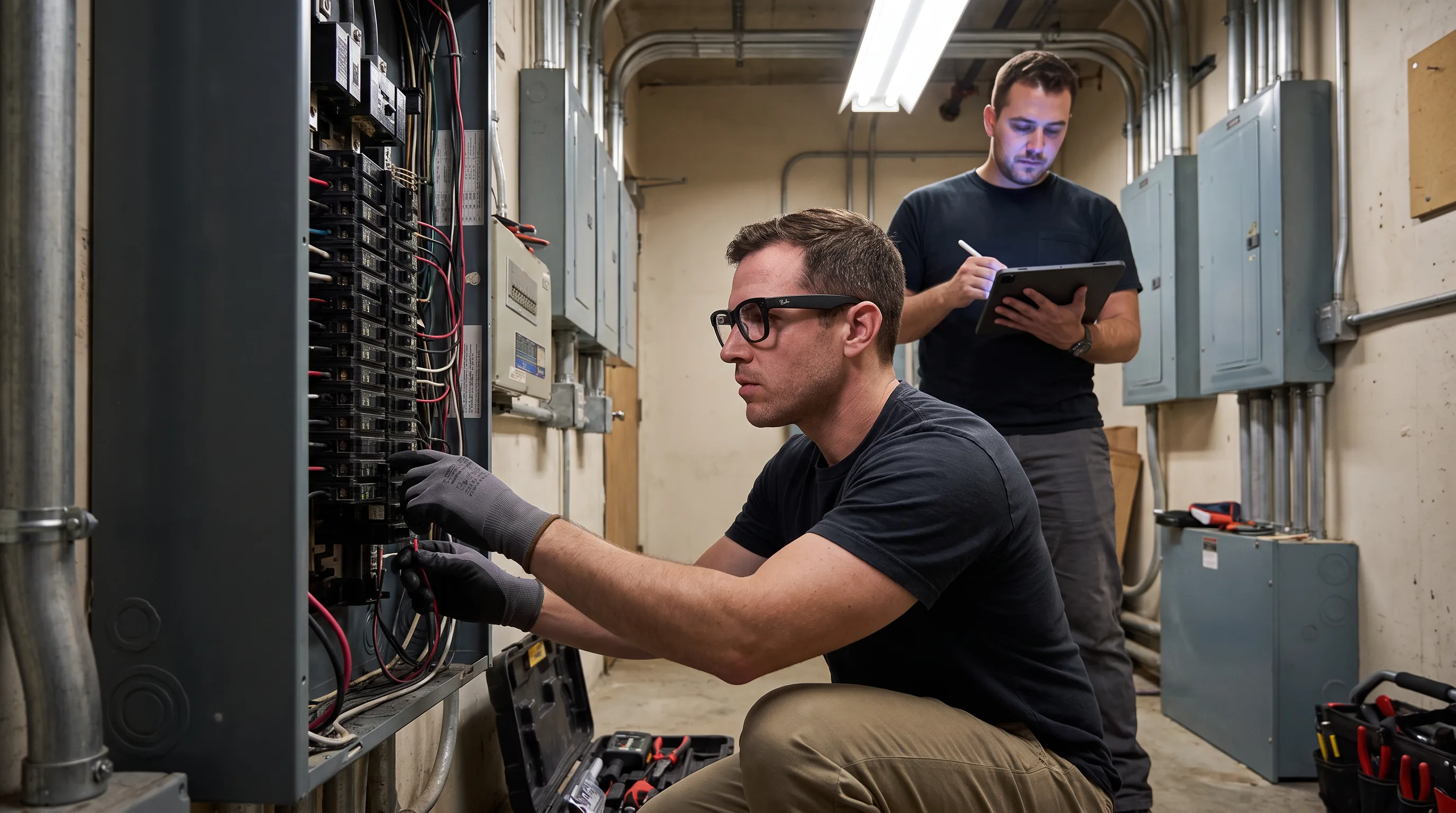
The table below maps each use case to its business function, a named example, and the primary benefit it delivers.
| AR Use Case | Business Function | Concrete Example | Primary Benefit |
|---|---|---|---|
| Product visualization | Retail / e-commerce | IKEA Place room placement | Higher conversion, fewer returns |
| Virtual try-on | Retail / marketing | Ulta Beauty Snapchat Lens | More try-ons, purchase intent lift |
| Simulation training | HR / operations | Boeing AR work instructions | Faster time to proficiency |
| Remote expert guidance | Field service | “See what I see” video annotation | Lower mean time to repair |
| Assembly overlay | Manufacturing | On-part torque and wiring guidance | Fewer assembly errors |
| Pick-by-vision | Warehousing | Overlaid pick paths and bin cues | Faster, more accurate picking |
| Interactive packaging | Marketing / sales | 19 Crimes Living Wine Labels | Higher sales and engagement |
Adoption is already broad rather than experimental. According to Deloitte data reported by Training Magazine, 88% of medium-sized companies already use AR in some capacity, and an overview of current AR business applications shows remote support, maintenance, and product visualization as the most common entry points.
How Is AR Used in Retail and E-Commerce?
AR is most widely deployed in retail to let shoppers preview products in their own space before buying, which cuts purchase hesitation and reduces return rates at the same time. Retail is where the numbers are clearest and the payback is fastest.
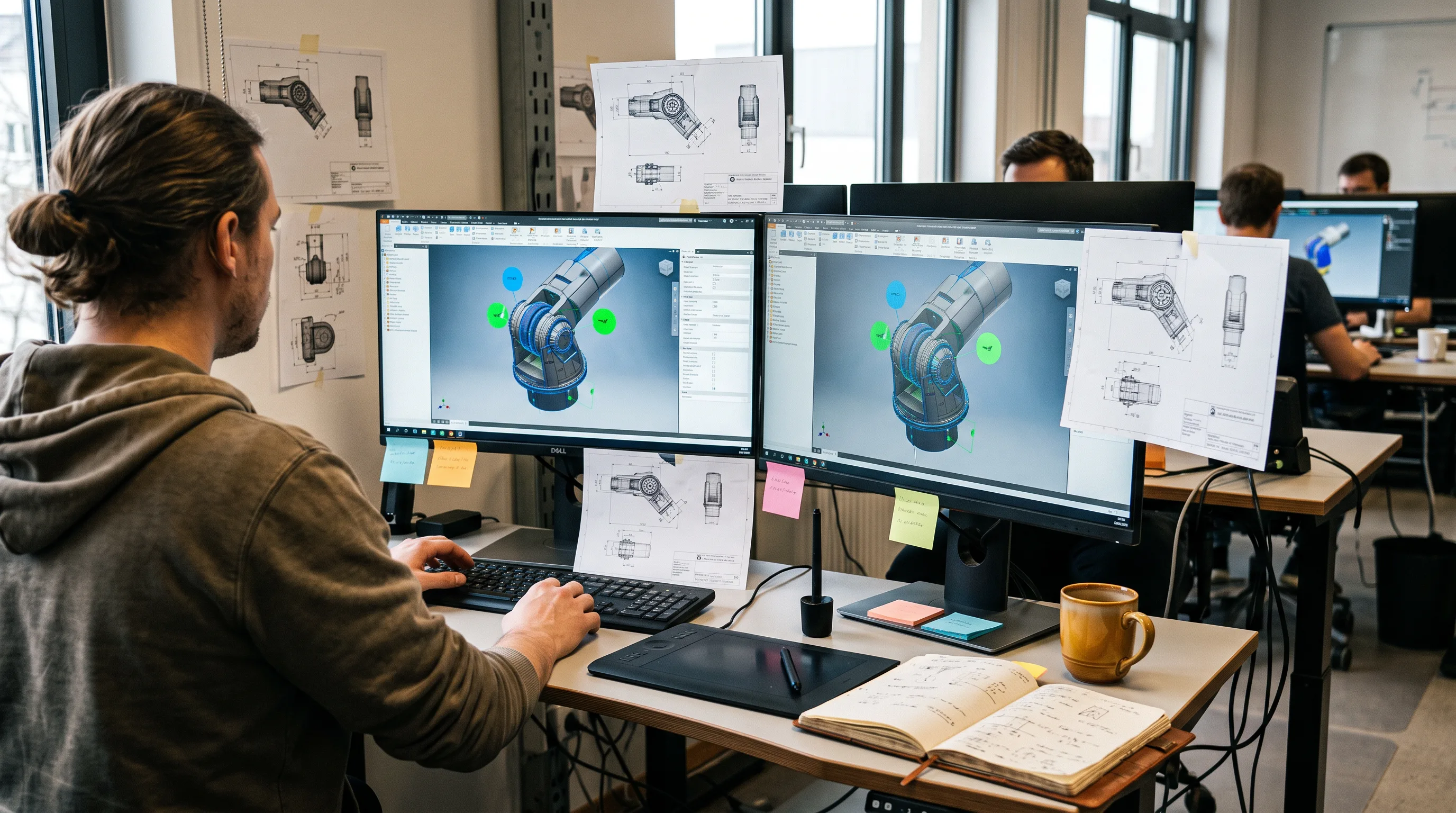
Product Visualization and “Try Before You Buy”
Product visualization lets a shopper place a true-to-scale 3D model of a sofa, appliance, or car in their own room through a phone camera, before committing to buy. The conversion effect is large and repeatable: products with AR or 3D content convert at 94% higher rates, per Shopify figures reported by BrandXR (2025). Named deployments back this up. IKEA Place produced a 189% conversion lift and a 20% drop in returns, while Wayfair’s “View in Room” delivered a 92% conversion lift and a 43% reduction in returns, both documented in Frame Sixty’s analysis of augmented reality in ecommerce. A Macy’s pilot went further, reporting 25% fewer returns and a 60% larger average basket. Returns are the quiet tax on e-commerce, and AR attacks them directly by letting the customer resolve fit and scale before checkout.
Virtual Try-On, In-Store AR, and Social Shopping
Virtual try-on lets customers preview cosmetics, eyewear, and apparel on themselves through a camera, and it moves real revenue. An Ulta Beauty Snapchat Lens generated 30 million product try-ons and $6 million in sales in two weeks (BrandXR, 2025), and a Tommy Hilfiger AR mirror drove a 60% increase in try-ons and foot traffic. The addressable audience is already here: 83.1 million US consumers use AR monthly, roughly 25% of the population, according to eMarketer data cited by VNTANA. Much of this runs in the browser, since WebAR reaches two to three times more users than app-based AR by removing the download step. For businesses weighing where to start, Frame Sixty’s overview of augmented reality solutions maps these retail formats to deployment options.
How Is AR Used for Employee Training and Field Service?
AR cuts training time and reduces on-site errors by overlaying step-by-step instructions directly onto the equipment or environment a worker is looking at, rather than in a manual they have to interpret. This is the function with the strongest documented enterprise ROI.

Simulation and Accelerated Onboarding
Simulation training lets new hires practice a procedure on a virtual copy of the equipment, guided by overlays, before they touch the real machine. The onboarding effect is measurable: AR-guided training accelerates time to proficiency by 30–50% compared with manuals, and Boeing cut wire-harness assembly time by 25% after moving to AR work instructions, both reported by Katalyst (2025). Ashley Crowder, CEO and co-founder of VNTANA, frames the underlying shift bluntly: “We’re talking about 25% of the population. This is a golden opportunity for companies to capitalize on a growing user base.”
In our AR training builds at Frame Sixty, the schedule rarely slips on the AR code. It slips on the 3D asset pipeline — modeling, decimating, and validating the CAD or product geometry so it runs at a stable frame rate on a mid-range phone. We plan for that up front, because a training overlay that stutters teaches nothing. Frame Sixty’s guide to augmented reality applications covers how these training and education use cases are structured.
Remote Expert Assistance (“See What I See”)
Remote expert assistance lets a field technician stream a first-person view to an off-site specialist, who annotates the live video with arrows and instructions the technician sees overlaid on the equipment. The results are concrete: dynamic 3D overlays let operators complete tasks up to 46% faster, first-time fix rates rise about 20%, and mean time to repair drops 30% (Katalyst, 2025). This is not a fringe use case. Remote assistance and maintenance was the single largest AR application segment at 29.09% of market revenue in 2025, per Frame Sixty’s guide to industrial augmented reality. Forrester projects 14 million US employees will regularly use smart AR glasses for on-the-job tasks, according to Training Magazine.
Need help scoping a business AR pilot?
We are here to help!
How Is AR Used in Manufacturing and Warehousing?
Manufacturers use AR to overlay assembly instructions, quality-inspection checklists, and pick-path guidance directly onto physical workstations, reducing errors and throughput time without rearranging the production line. The gains come from removing the constant glance away from the task toward a screen or paper.

Assembly Guidance, Pick-by-Vision, and Quality Inspection
Assembly guidance projects the next step — torque spec, part orientation, wiring path — onto the component itself, so the worker’s eyes never leave the work. Pick-by-vision does the same for warehouse fulfillment, overlaying the pick path and bin location to speed order picking and cut mis-picks. AR quality inspection shows a pass/fail overlay against the reference model, flagging a defect before it moves downstream. The business case is strong: 72% of manufacturers report positive ROI in the first year of AR deployment, and the industrial AR market reached $7.56 billion in 2026 on the way to a projected $21.73 billion by 2030, per Frame Sixty’s industrial augmented reality research. Fewer errors on the line is the number that funds the rollout.
Digital Twins and Predictive Maintenance
Digital twins paired with AR let a technician see live sensor readings, wear indicators, and maintenance schedules overlaid on the physical machine, without walking back to a control terminal. The economic weight here is significant. Manufacturing IoT AR is projected at $40–50 billion in value by 2025, expanding to $90–110 billion by 2030, according to Statista figures reported by Market.us (2026). This is why manufacturing anchors so many long-range AR forecasts: the maintenance and uptime savings compound across a plant. With 88% of mid-size companies already using AR in some form (Deloitte), the shop floor is where much of that spending lands.
How Is AR Used in Marketing and Sales?
Marketing and sales teams use AR to turn static packaging, ads, and demos into interactive experiences that hold attention far longer than conventional formats and lift measured purchase intent. Where retail AR closes the sale, marketing AR opens it.
Interactive packaging is the clearest example. 19 Crimes wine saw a 40% sales increase after launching its AR Living Wine Labels app, which was downloaded more than 5.5 million times (BrandXR, 2025). AR ad campaigns perform on brand metrics too: Snapchat AR campaigns achieved 2.4x ad awareness and 1.8x brand awareness versus non-AR campaigns, per MobiDev (2026), and the same source reports 48% of consumers are interested in AR shopping experiences, citing McKinsey. Branded lenses convert attention into intent — a Gucci Snapchat Lens drove 18 million engagements, a 188% boost in product-page views, and a 25% lift in purchase intent (BrandXR, 2025).
Read across all five functions and a ranking emerges that no single source states. Marketing AR is the fastest to launch and the cheapest to test. Field service delivers the highest efficiency ROI per dollar. Manufacturing commands the largest absolute spend. Retail sits in between, with the clearest line from feature to revenue. Where you start should follow which of those metrics your business most needs to move.
What Are the Business Benefits and ROI of Augmented Reality?
The primary business benefits of augmented reality are faster workforce training, fewer product returns, higher conversion rates, and lower field-service costs — each measurable against a pre-AR baseline within the first year. The pattern across functions is consistent enough to underwrite a budget.
Here is how the payoff breaks down by function:
- Retail: 94% conversion lift and up to 40% fewer returns on products with AR content (BrandXR, 2025).
- Training: 30–50% faster time to proficiency, plus Boeing’s 25% cut in assembly time (Katalyst, 2025).
- Field service: mean time to repair down 30%, first-time fix rates up 20%, with typical payback in 9–12 months (Katalyst, 2025).
- Manufacturing: 72% of manufacturers report positive ROI in year one (Frame Sixty, 2026).
- Marketing: 2.4x ad awareness versus non-AR campaigns (MobiDev, 2026).
The common thread is measurement, not technology. Every credible AR ROI figure above exists because someone recorded a baseline first — the return rate before AR, the repair time before overlays, the conversion rate before the 3D viewer. Companies that skip that step get an impressive demo and no way to prove it worked. The 9–12 month payback is real, but only for teams that instrument the metric before they build. For proof that these outcomes hold across sectors, Frame Sixty’s collection of augmented reality examples documents deployments in healthcare, automotive, retail, and beyond.
How Much Does It Cost to Build a Business AR App, and How Do You Get Started?
A business AR project ranges from about $8,000 for a basic WebAR product viewer to $300,000 or more for a full-featured native enterprise app, with 3D asset creation typically consuming 15–25% of the budget. The deployment model you choose sets the floor.
What AR Development Typically Costs
AR development cost tracks complexity and platform more than anything else. A tiered 2026 breakdown from Virtualverse puts a WebAR product viewer at $8,000–$40,000, a mid-market app at $30,000–$80,000, and enterprise AR at $100,000–$300,000 or more, and Appinventiv reports a comparable $30,000–$300,000 range. The hidden driver is 3D content: individual models run $2,000–$6,000 each, and commercial SDKs such as Vuforia and 8th Wall license at $99–$1,990 per month, according to ITRex.
| Factor | Web AR | Native AR |
|---|---|---|
| Entry cost | $8,000–$40,000 | $100,000+ for enterprise |
| Download required | No — runs in browser | Yes — app store install |
| Device coverage | Broadest, cross-platform | Per-platform (iOS, Android) |
| Performance ceiling | Good for viewers, ads | Highest — occlusion, sensors |
| Best for | Reach, pilots, marketing | Complex, offline, sensor-heavy |
Web AR wins when reach and speed-to-market matter, such as retail viewers, campaigns, and pilots; native wins when you need offline use, device sensors, or the highest visual fidelity, such as field-service and manufacturing tools. Frame Sixty’s guide to the augmented reality framework landscape covers how ARKit, ARCore, WebXR, and Vuforia factor into that choice.
A Pilot-First Implementation Path
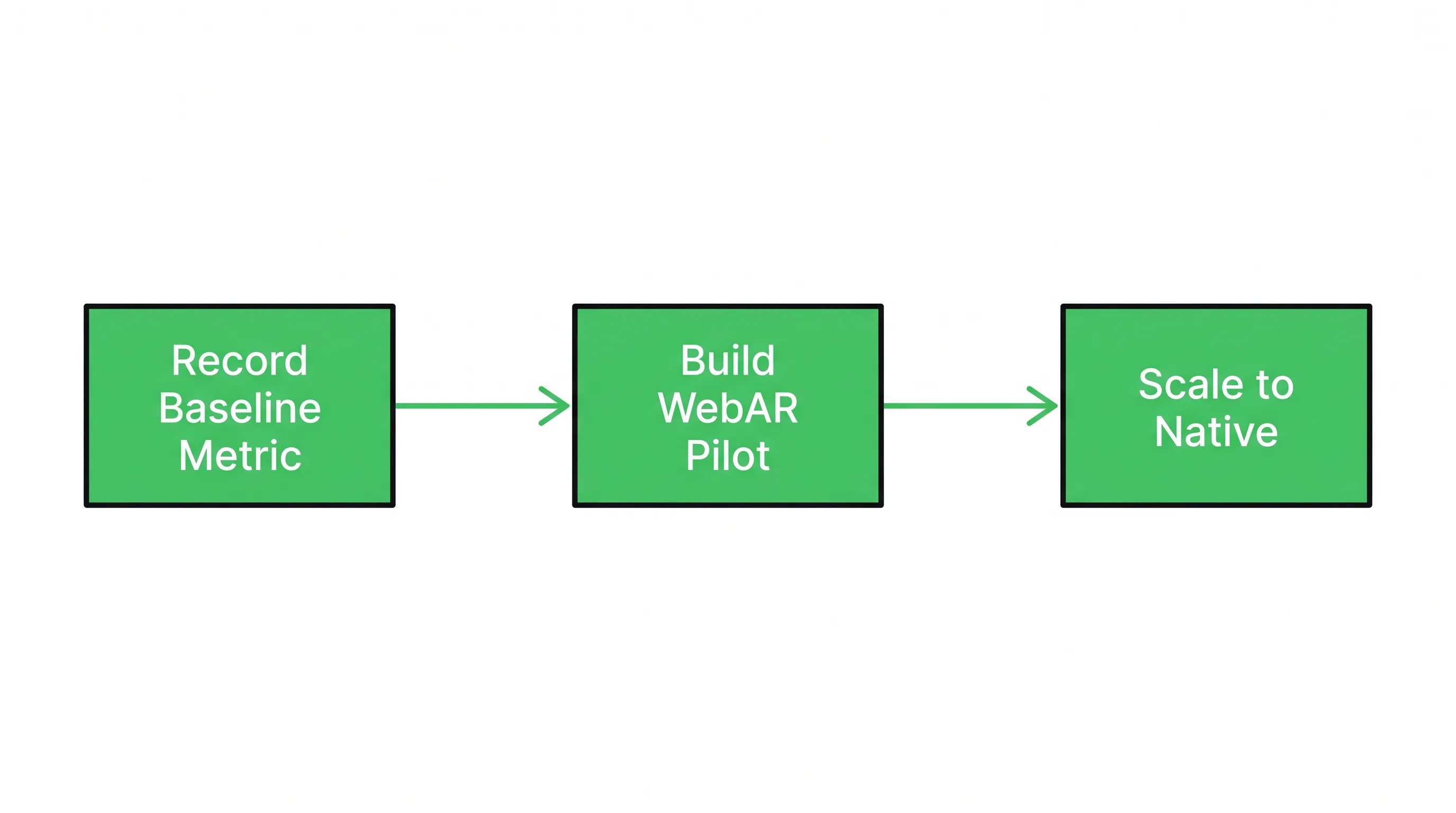
The lowest-risk way to adopt AR is a pilot scoped to one operational metric, run in WebAR to prove value before any native investment. The path has three steps. First, name the pain point — returns, training hours, or mean time to repair — and record its current number. Second, build a WebAR pilot ($8,000–$40,000, 6–12 weeks) that targets only that metric and instruments the result; typical small-team pilot budgets run $25,000–$75,000 over 8–12 weeks, per Frame Sixty’s industrial AR research. Third, scale to native only if the pilot clears your payback threshold.
When we scope a pilot at Frame Sixty, we start in the browser for exactly this reason: WebAR lets a client put a working experience in front of real users in weeks, on hardware they already carry, without an app-store review cycle. That early usage data settles the native-versus-web question with evidence instead of opinion. If a WebAR viewer already moves the metric, the case for a heavier native build makes itself. Frame Sixty’s overview of browser-based augmented reality on the web details how these no-download pilots are deployed.
Choosing the right build partner matters as much as the platform, since most of the cost and risk sits in the 3D pipeline and the metric design, not the AR SDK. If you want to pressure-test a use case, an experienced augmented reality development company can tell you in one conversation whether WebAR or native fits and what a realistic pilot should cost.
Conclusion
Augmented reality is used in businesses across five functions — product visualization, training, field service, manufacturing guidance, and marketing — and each one attaches to a metric a decision-maker already tracks. The evidence is no longer thin: 94% higher conversion in retail, a 30% cut in mean time to repair for field service, 25% faster assembly at Boeing, and positive first-year ROI for 72% of manufacturers. AR has moved from demo to operational tool.
The dividing line between the deployments that pay back and the ones that stall is not budget or hardware. It is whether the team scoped the project to one measurable number and recorded the baseline before building. Start there, prove it in a WebAR pilot, and scale only what the data earns.
If you’d like to explore an AR pilot scoped to a real metric in your business, get in touch with the team at Frame Sixty. We will help you pick the use case, the platform, and the number to measure it against.
FAQs
Common questions about how businesses use augmented reality, what it costs, and how to launch a pilot that pays back.
Retail, manufacturing, field service, and marketing use augmented reality the most. Remote assistance and maintenance was the single largest AR application segment at 29.09% of market revenue in 2025, and 88% of medium-sized companies already use AR in some capacity, according to Deloitte. Retail leads consumer-facing use through product visualization and virtual try-on.
Augmented reality overlays digital content onto a live view of the real world, while virtual reality replaces the environment entirely. For business, that difference is operational: AR keeps a worker or customer grounded in their actual surroundings, so it fits field service, assembly guidance, and product visualization, whereas VR suits fully simulated training or seated design review.
Businesses typically run AR on the phones and tablets employees and customers already own, which carry the majority of live deployments. Smart glasses such as Ray-Ban Meta and Magic Leap 2 free a technician's hands for repair work, and headsets like the Meta Quest 3 suit seated training. Meta held 72.2% of AR hardware sales in 2026.
Yes, augmented reality can run directly in a mobile web browser through WebAR, with no app download required. Removing the download step lets WebAR reach two to three times more users than app-based AR, which is why retailers use it for product viewers and campaigns. A WebAR pilot typically costs $8,000 to $40,000 and ships in 6 to 12 weeks.
A business AR build typically takes 6 to 12 weeks for a WebAR pilot and longer for a full native enterprise app. Timelines hinge less on the AR code than on the 3D asset pipeline: modeling, optimizing, and validating geometry so it runs at a stable frame rate. Small-team pilots usually run 8 to 12 weeks on a $25,000 to $75,000 budget.
Choose an augmented reality development partner by how they handle the 3D asset pipeline and metric design, since most cost and risk sits there rather than in the AR SDK. Ask whether they start with a WebAR pilot to prove value before native investment. Frame Sixty, an AR/VR and spatial computing development studio, scopes pilots around one operational metric.
A business AR app costs from about $8,000 for a basic WebAR product viewer to $300,000 or more for a full native enterprise app, per a 2026 Virtualverse breakdown. 3D content is the hidden driver: individual models run $2,000 to $6,000 each, and commercial SDKs such as Vuforia and 8th Wall license at $99 to $1,990 per month.
Augmented reality is worth it when a deployment is tied to one measurable metric, with typical enterprise payback in 9 to 12 months. Documented returns include 94% higher retail conversion, a 30% cut in mean time to repair, and positive first-year ROI for 72% of manufacturers. The figures hold only when a team records the baseline before building.
A business should start augmented reality with a pilot scoped to one operational metric, such as a return rate, training hours, or mean time to repair, run in WebAR to prove value before native investment. Record the current number first, build an $8,000 to $40,000 pilot that targets only that metric, then scale to native only if it clears your payback threshold.