
Augmented Reality Framework Guide: Building Scalable, Cross‑Platform AR Experiences in 2026
Apr 8, 2026
Updated
11 MIN READ
An augmented reality framework is a comprehensive software infrastructure that enables the creation of immersive digital experiences by integrating computer vision, sensor data, and 3D rendering to align virtual objects with the physical world. Modern frameworks such as ARKit, ARCore, and Vuforia manage spatial mapping, tracking, and rendering pipelines to deliver accurate, real-time interactions across devices. They differ from AR SDKs by orchestrating the entire AR workflow, supporting scalability and interoperability through standards like WebXR and OpenXR. These frameworks underpin spatial computing ecosystems, driving applications in mobile, enterprise, and web environments while evolving toward AI-enhanced, cross-platform performance.
Understanding the Role of an Augmented Reality Framework
An augmented reality framework is the software infrastructure that enables developers to create AR applications by combining computer vision, sensor data, and 3D rendering. It defines how digital objects interact with the physical environment and ensures consistent performance across devices.
What Is an Augmented Reality Framework?
An augmented reality framework is a collection of tools, libraries, and APIs that simplify mixed reality development by managing SLAM technology (Simultaneous Localization and Mapping), 3D object tracking, and real-time rendering. It provides the underlying logic for spatial awareness, allowing virtual objects to appear anchored in the real world.
Unlike standalone apps, frameworks like Apple ARKit (official documentation) and Google ARCore (developer resources) integrate deeply with device hardware—leveraging cameras, IMUs, and depth sensors to map environments. They handle complex mathematical models so developers can focus on content creation and user experience.
Core components include:
- Computer vision SDKs for object recognition and environmental understanding
- SLAM algorithms for spatial tracking and mapping
- Rendering engines for displaying 3D assets in real time
These frameworks form the backbone of modern spatial computing ecosystems, powering applications in retail, manufacturing, education, and entertainment.
How AR Frameworks Differ from AR SDKs
While AR SDKs (Software Development Kits) provide specific tools or APIs for AR features, an AR framework offers a higher-level abstraction that integrates rendering, tracking, and data synchronization. SDKs like Wikitude SDK or Vuforia Engine focus on discrete capabilities—such as object recognition accuracy or markerless AR—whereas frameworks manage the entire AR pipeline.
For developers, SDKs are modular add-ons; for enterprises, frameworks represent scalable infrastructure. For example, PTC Vuforia Studio allows enterprises to integrate AR into product lifecycle management systems, while ARKit and ARCore serve as foundational frameworks for mobile ecosystems.
Key takeaway: An augmented reality framework orchestrates the entire AR experience, while SDKs extend its capabilities with specialized functions.

Need help with AR framework development?
We are here to help!
Core Technologies Behind Modern AR Frameworks
Modern AR frameworks rely on advanced spatial mapping, tracking, and rendering pipelines to ensure immersive and stable experiences. These technologies define the performance, accuracy, and realism of AR applications.
Spatial Mapping and Tracking
Spatial mapping enables AR systems to understand and reconstruct the physical environment in three dimensions. Markerless AR uses natural feature detection instead of predefined markers, while 3D object tracking aligns digital content with real-world objects.
SLAM technology plays a central role by continuously updating the device’s position relative to the environment. Frameworks like ARCore use AR cloud synchronization to persist spatial data across sessions, enabling shared multi-user experiences. According to Niantic Labs’ developer updates (official blog), cloud-based spatial anchors are critical for maintaining consistency in location-based AR.
Accuracy metrics such as spatial mapping precision and tracking accuracy determine the realism of AR overlays. Enterprise-grade frameworks like Vuforia (developer portal) achieve millimeter-level precision in industrial use cases, supporting tasks like assembly guidance and quality inspection.
Rendering and Performance Optimization
Rendering in AR frameworks involves balancing frame rate, render latency, and battery consumption. Real-time rendering pipelines must process complex 3D scenes while maintaining smooth performance on mobile devices.
Frameworks integrated with Unity (Unity XR documentation) or Unreal Engine (Unreal Engine AR development hub) leverage GPU acceleration and optimized shaders for efficient rendering. NVIDIA Research (research publications) continues to push the boundaries of real-time rendering and GPU optimization, enabling photorealistic visuals even on lightweight devices.
Developers monitor metrics such as memory footprint and thermal efficiency to ensure sustained performance. Adaptive rendering techniques dynamically adjust resolution and detail based on device capabilities, improving both battery life and user experience.
Key takeaway: Efficient spatial mapping and optimized rendering pipelines are essential for delivering high-performance, visually stable AR experiences.
Leading Augmented Reality Frameworks and Platforms
The AR landscape in 2026 features a mix of mobile, enterprise, and cross-platform solutions. Each framework offers unique strengths for different use cases—from gaming and retail to industrial design and education.
Mobile‑Focused Frameworks
Apple ARKit and Google ARCore remain the dominant mobile AR frameworks. ARKit integrates seamlessly with iOS hardware, supporting LiDAR scanning, plane detection, and motion tracking. ARCore provides similar capabilities on Android, including geolocation AR and environmental understanding.
| Framework | Platform | Key Features | Device Compatibility Score |
|---|---|---|---|
| Apple ARKit | iOS | LiDAR, face tracking, motion capture | 95% |
| Google ARCore | Android | Geolocation AR, depth API, cloud anchors | 90% |
Developers can explore ARKit’s official documentation (Apple Developer) and ARCore’s resources (Google Developers) to understand system requirements and device compatibility.
Niantic Lightship, highlighted in the Niantic Labs blog (official source), extends ARCore’s capabilities with large-scale, location-based AR experiences. Meanwhile, 8th Wall enables web-based AR deployment directly through browsers, removing the need for app installations.
For insights into Apple’s broader spatial ecosystem, Frame Sixty’s article A Developer’s Perspective on the Apple Vision Pro explores how ARKit integrates with advanced headset experiences.
Cross‑Platform and Enterprise Solutions
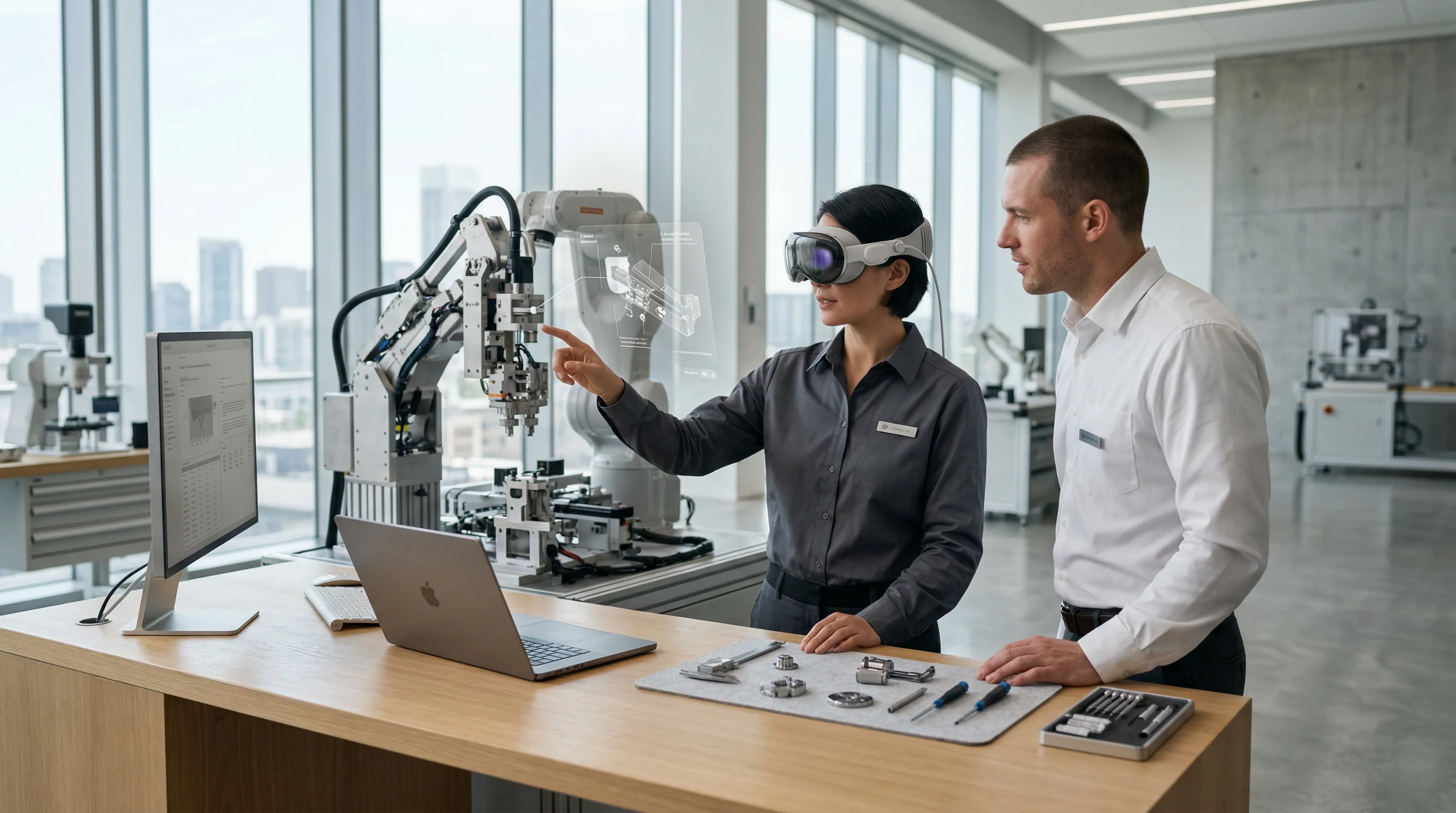
Enterprise AR frameworks focus on scalability, integration, and precision. Vuforia and PTC Vuforia Studio enable manufacturers to overlay digital instructions onto real-world machinery. Their object recognition accuracy and CAD model support make them ideal for industrial environments. Frame Sixty’s 3D Modeling for Manufacturing & Industrial Design demonstrates how accurate 3D assets enhance these workflows.
Wikitude SDK and Meta Spark AR cater to developers building cross-platform and social AR experiences. Snap Lens Studio powers AR filters for Snapchat, emphasizing immersive experience design and real-time face tracking.
Enterprise developers often collaborate with agencies like Frame Sixty to integrate AR into digital ecosystems, combining 3D model design services (link) with AI-driven automation.
Game Engine Integration
Game engines like Unity and Unreal Engine have become core to AR development. Unity’s XR Plugin (Unity XR documentation) provides a unified API for ARKit, ARCore, and OpenXR integration. Unreal Engine’s AR Template (Unreal Engine AR hub) simplifies project setup with optimized rendering pipelines.
Integrating ARKit with Unity involves importing the AR Foundation package, configuring camera settings, and optimizing shaders for real-time performance. Developers can reference Frame Sixty’s Android App Development Agency page for insights into cross-platform deployment and testing on Android devices.
Key takeaway: The best AR framework depends on project goals—mobile frameworks excel in accessibility, while enterprise and game engine integrations provide scalability and realism.

Open Standards and Interoperability in AR Development
Open standards ensure that AR experiences are portable, consistent, and future-proof across devices and platforms.
Emerging AR Standards
Standards like WebXR (W3C specification) and OpenXR (Khronos Group) define APIs for cross-platform AR and VR experiences. They allow developers to build once and deploy across browsers, mobile devices, and headsets.
The ISO/IEC 23090 standard (ISO reference) establishes compliance for immersive media formats, ensuring interoperability between AR and VR systems. Common file formats such as USDZ, glTF, and ARML streamline 3D asset exchange between tools like Blender, Reality Composer, and Three.js.
By adhering to these standards, developers can reduce fragmentation and guarantee consistent spatial computing behavior across ecosystems.
Cross‑Platform Deployment Strategies
Cross-platform deployment requires frameworks that support both iOS and Android, as well as emerging headsets like Microsoft HoloLens. OpenXR plays a crucial role in unifying these environments under a single API layer.
Developers evaluate device compatibility scores and spatial mapping precision to ensure consistent performance. Agencies like Frame Sixty’s AI Developer team integrate AI-driven spatial understanding to enhance cross-device consistency.
Frame Sixty’s insights on Agentic Spatial Computing highlight how open standards and intelligent agents are shaping the next generation of AR interoperability.
Key takeaway: Open standards like WebXR and OpenXR are the foundation for scalable, cross-platform AR ecosystems that ensure interoperability and long-term viability.

Designing Immersive AR Experiences
Designing effective AR experiences requires balancing realism, usability, and engagement. The best AR designs guide users intuitively through digital interactions that feel natural in physical space.
User‑Centric AR Design Principles
User-centric design focuses on creating intuitive, context-aware experiences. Developers measure user engagement rate and session duration to assess usability and retention. For instance, AR retail apps that let users virtually try products show higher engagement when spatial mapping precision and lighting consistency are optimized.
Principles of effective AR design include:
- Contextual relevance: Align digital overlays with the user’s environment.
- Minimal cognitive load: Avoid clutter and ensure clear visual hierarchy.
- Feedback loops: Provide real-time responses to user actions.
- Accessibility: Ensure compatibility with diverse devices and input methods.
Frame Sixty’s AI in Virtual Reality Development explores how AI-driven personalization enhances mixed reality development by adapting content to user behavior.
Tools for AR Content Creation
Developers use a variety of tools to build and optimize AR content:
- Reality Composer (Apple) for quick prototyping
- Blender for 3D modeling and animation
- Three.js and AR.js for web-based AR
- ZapWorks Studio for interactive storytelling
Integrating 3D assets efficiently is critical. Frame Sixty’s 3D Model Design Services help teams optimize models for render latency and memory footprint. Combining these assets with frameworks like ARKit or ARCore ensures smooth performance and high visual fidelity.
Key takeaway: Successful AR design merges technical precision with human-centered creativity, ensuring immersive yet accessible experiences.
Evaluating and Choosing the Right AR Framework
Selecting the right AR framework depends on project goals, platform requirements, and scalability needs.
Selection Criteria
When evaluating frameworks, consider:
| Criterion | Description | Example Frameworks |
|---|---|---|
| Platform support | iOS, Android, Web, or headset compatibility | ARKit, ARCore, WebXR |
| Developer ecosystem | Community size, documentation, and support | Unity, Unreal Engine |
| Enterprise scalability | Integration with existing systems | Vuforia, PTC Vuforia Studio |
| Performance metrics | Tracking accuracy, frame rate, memory footprint | ARCore, Unity XR Plugin |
Developers can use Frame Sixty’s About Us page to learn more about the company’s expertise in AR framework integration and spatial computing consulting.
Future‑Ready Considerations
Future AR frameworks will increasingly integrate AI-driven scene understanding and agentic spatial computing to automate environment recognition and object interaction. Preparing for next-generation hardware—like Apple Vision Pro and future AR glasses—requires flexible architecture.
Frame Sixty’s article on 8 Apps for Apple Vision Pro demonstrates how developers can design for emerging AR ecosystems. Leveraging AI and spatial computing ensures that applications remain adaptable as hardware evolves.
Key takeaway: Choose AR frameworks based on long-term scalability, ecosystem maturity, and readiness for AI-enhanced spatial computing.
Limitations and Future Directions of AR Frameworks
Despite rapid progress, AR frameworks still face technical and operational challenges that limit widespread adoption.
Current Technical Constraints
Current limitations include occlusion handling, spatial mapping precision, and battery consumption. Mobile devices struggle with sustained AR sessions due to thermal constraints and limited GPU capacity. Even advanced frameworks like ARKit and ARCore can experience drift in tracking accuracy under poor lighting or reflective surfaces.
Developers mitigate these issues by optimizing render latency and leveraging cloud-based processing. However, achieving perfect real-time rendering and environmental consistency remains a challenge.
The Road Ahead
The future of AR frameworks lies in the convergence of AI, SLAM, and AR cloud technologies. As NVIDIA Research continues to innovate in GPU acceleration, rendering will become more efficient. OpenXR and WebXR will further unify cross-platform development, while ISO/IEC 23090 ensures compliance and interoperability.
Frame Sixty’s AI Developer and Agentic Spatial Computing initiatives are pioneering this integration—bridging AI automation with spatial computing to create adaptive, intelligent AR systems.
Key takeaway: The next generation of AR frameworks will merge AI, cloud computing, and open standards to deliver seamless, intelligent, and context-aware experiences.
Conclusion
In 2026, the augmented reality framework landscape represents the intersection of AI, spatial computing, and cross-platform interoperability. From mobile ecosystems like ARKit and ARCore to enterprise-grade solutions like Vuforia and PTC Vuforia Studio, developers have more tools than ever to craft immersive, scalable experiences.
The key to success lies in selecting frameworks that align with project goals, leveraging open standards like WebXR and OpenXR, and optimizing for performance metrics such as tracking accuracy, frame rate, and render latency. Integrating AI-driven scene understanding and agentic spatial computing ensures future readiness as AR hardware continues to evolve.
Enterprises and developers seeking to build next-generation AR solutions can benefit from expert guidance and technical integration. Frame Sixty’s multidisciplinary team specializes in 3D modeling, AI development, and AR framework consulting, helping brands transform ideas into immersive realities.
To explore how your organization can harness the power of AR frameworks for scalable, cross-platform experiences, get in touch with Frame Sixty today.
Augmented Reality Framework Insights
This FAQ addresses common questions about augmented reality frameworks, offering practical guidance for developers, enterprises, and designers working with spatial computing and cross-platform AR technologies.
An augmented reality framework provides the core infrastructure that combines computer vision, sensor data, and 3D rendering so digital objects stay anchored in the physical world. Frameworks like ARKit and ARCore handle SLAM-based spatial tracking and mapping through device cameras, IMUs, and depth sensors, letting developers focus on content and user experience rather than low-level tracking math.
An augmented reality framework orchestrates the entire AR pipeline, including tracking, rendering, and data synchronization, while an SDK adds specific capabilities on top. ARKit and ARCore are frameworks that manage spatial awareness across devices; tools like the Vuforia Engine or Wikitude SDK are SDKs that extend functionality such as object recognition or markerless tracking.
Yes, modern augmented reality frameworks support shared sessions through cloud-based spatial anchors that persist spatial data across devices and sessions. ARCore's cloud anchors and Niantic's Lightship tools synchronize a common map of the environment, so multiple users see the same digital content anchored in the same physical place, which is the basis of collaborative and location-based AR.
Spatial mapping lets an augmented reality framework reconstruct real-world geometry in three dimensions, which is what keeps virtual objects stable and correctly aligned with physical surfaces. SLAM continuously updates the device's position relative to the environment, and enterprise-grade frameworks like Vuforia achieve millimeter-level precision for industrial tasks such as assembly guidance and quality inspection.
Choose an augmented reality framework by matching platform support, developer ecosystem, enterprise scalability, and performance metrics to the project: ARKit for iOS, ARCore for Android, WebXR for browser delivery, Unity or Unreal Engine for cross-platform builds, and Vuforia for industrial integration. Tracking accuracy, frame rate, and memory footprint are the benchmarks to compare candidates on.
Interoperability keeps AR experiences consistent across devices and platforms and protects the investment as hardware evolves. Open standards like OpenXR and WebXR let developers build once and deploy across mobile, browser, and headset targets, while shared file formats such as USDZ and glTF move 3D assets cleanly between tools, reducing fragmentation and long-term maintenance cost.
Get in touch
We’re interested to see how we can help. Send us a message and we will get back to you within 24 hours.