
Top Augmented Reality Solutions Transforming Businesses in 2026
Apr 30, 2026
Updated
14 MIN READ
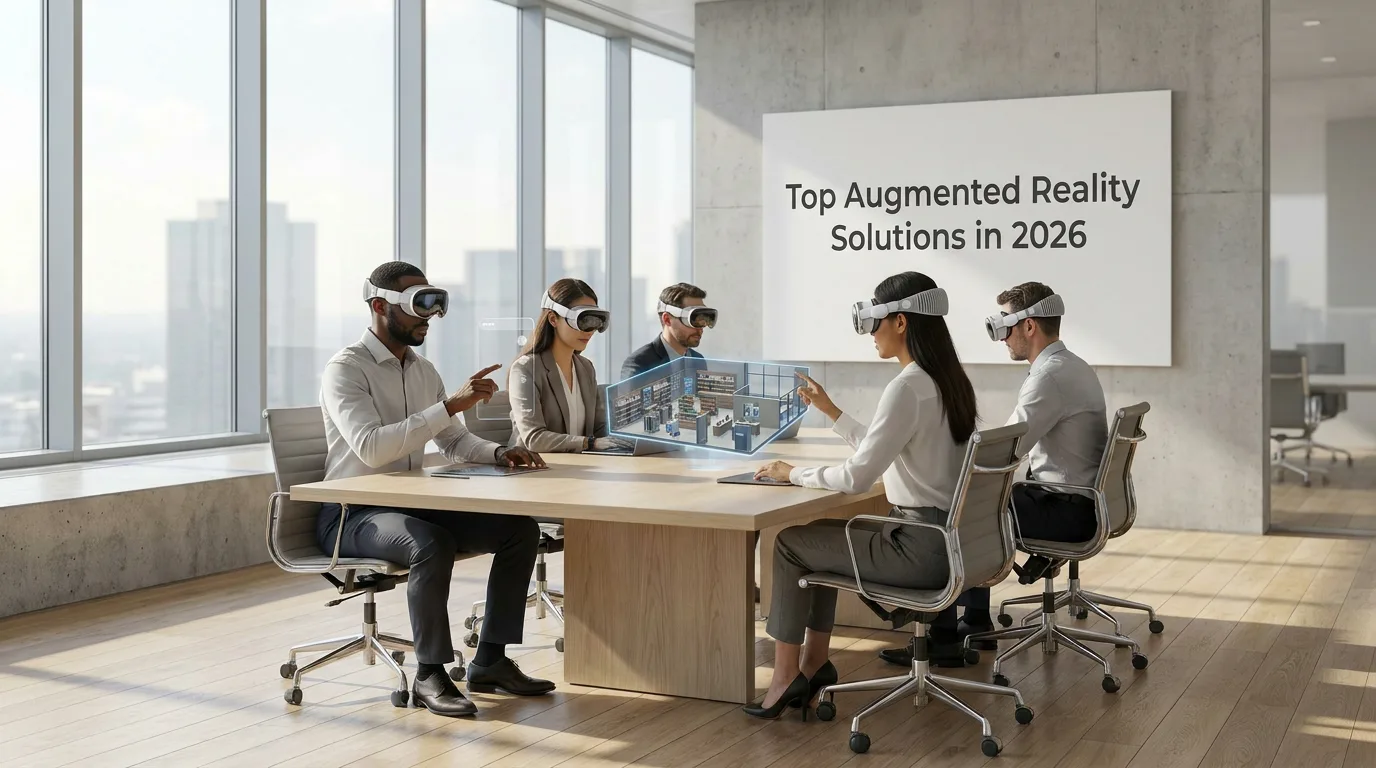
Augmented reality solutions are hardware, software, and content systems that overlay digital information onto the physical world so workers, customers, and clinicians can act on it in real time. In 2026 they have moved from pilots to production. The global AR market reached $120.21 billion in 2025 and is projected to hit $1,050.56 billion by 2033, growing at a 29.7% CAGR, according to Grand View Research data cited by Zoho.
That growth is not hype anymore. Deloitte describes the industry as having shifted “from experimentation to measurable impact,” and IBM reports that companies using AR have seen average productivity improvements of 32% across training and operational workflows. This guide covers the leading AR hardware platforms, the enterprise software behind them, and the use-case ROI across manufacturing, retail, healthcare, and field service.
Here is the position we will defend throughout: most enterprise AR pilots stall not because the technology fails, but because they are scoped as demos instead of production workflows tied to a single measurable operational metric. The programs that succeed pick one number to move, such as first-time fix rate or assembly error rate, and instrument it from day one.
Key Takeaways
- The AR market hit $120.21 billion in 2025 and is forecast to reach $1,050.56 billion by 2033 (Grand View Research).
- 72% of manufacturers report positive ROI in the first year of AR deployment, with payback in 6 to 18 months (PTC, 2025).
- AR-supported maintenance cut task errors from 53% to 13%, a 75% reduction, across 80 studies (Springer Nature, 2025).
- Microsoft Dynamics 365 Guides and Remote Assist reach end of support on December 31, 2026, forcing migration.
- 58% of consumers now use AR before buying, and products with AR content convert 94% higher (Clutch 2026; Deloitte Digital x Snap).
Top Augmented Reality Solutions for Enterprise in 2026
The best augmented reality solutions for enterprise in 2026 pair a managed device with software that plugs into systems a company already runs, such as its ERP, PLM, or CRM. Enterprise readiness now means four things: IT management through zero-touch provisioning and mobile device management, device-agnostic deployment across headsets and phones, on-device AI, and integration with existing business data. A solution missing any of these tends to stay stuck in the pilot phase.
Two delivery models dominate. Headset-based AR suits precision industrial and field work where a technician needs both hands free. Mobile and WebAR run on the smartphones a workforce or customer base already carries, which makes them the cheapest way to test an idea. Meta for Business reports AR deployments can deliver up to 340% productivity uplift, and global XR shipments are forecast to grow 33.5% in 2026, led by smart glasses, per Market.us.
The 2026 shift worth naming: IT-manageability has become table stakes rather than a bonus. When Samsung added Android Enterprise support to Galaxy XR in April 2026, it signaled that headsets are now expected to be enrolled, locked down, and patched like any corporate phone. Solutions that cannot be managed at fleet scale are being quietly dropped from serious procurement.
AR Hardware in 2026: Which Headset Fits Your Use Case?
AR hardware in 2026 spans premium spatial computers, managed mixed-reality headsets, rugged field devices, and lightweight display glasses, and the right pick depends entirely on the job. Precision design work rewards high resolution and on-device AI. Frontline field work rewards ruggedness and hands-free operation. Buying the wrong tier is the most common and most expensive early mistake.
The Apple Vision Pro M5 sits at the premium end. IDC research manager Jitesh Ubrani calls it “a business-first product” deployed for training, collaboration, and design, and notes that in spatial computing “latency can break immersion.” The M5’s 16-core Neural Engine runs AI features up to 2x faster for third-party apps than the prior chip, which IDC frames as moving AI workloads from the cloud onto the device. The Samsung Galaxy XR, built for enterprise workflows on an Android base, became fully IT-manageable in April 2026. Meta Quest 3 and the cost-entry Quest 3S anchor the accessible tier, Magic Leap 2 targets healthcare and defense, and Xreal Glasses plus Meta Ray-Ban smart glasses cover lightweight wear. AR glasses revenue reached $35.06 billion in 2026, up from $1.85 billion in 2021, according to ARtillery Intelligence.
| Device | Best for | Standout capability | Category |
|---|---|---|---|
| Apple Vision Pro M5 | Design, training, collaboration | 16-core Neural Engine, 2x faster on-device AI | Premium spatial computer |
| Samsung Galaxy XR | Managed enterprise fleets | Android Enterprise and Knox management (April 2026) | Managed mixed reality |
| Meta Quest 3 | Broad enterprise VR and MR | Dominant enterprise install base | Accessible headset |
| Meta Quest 3S | Cost-sensitive rollouts | Lowest-cost mixed-reality entry | Entry headset |
| Magic Leap 2 | Healthcare and defense | Optical see-through clinical use | Specialist AR |
| Xreal Glasses | Lightweight extended wear | Compact display glasses | Display glasses |
Enterprise AR Software: Platforms and Development Frameworks
Enterprise AR software is the layer that turns a headset into a workflow, covering authoring platforms, remote-assistance tools, and the engines developers build on. The platform choice usually matters more than the device, because software determines how fast content gets built and how cleanly it connects to existing data.
PTC Vuforia Engine 11 leads industrial deployment because it builds on CAD and PLM data companies already own, so a first work instruction can go live in days. Scope AR WorkLink, now under Flatirons Solutions, combines remote assistance and step-by-step work instructions in one application. TeamViewer Frontline, Zoho Lens, and the AI-guided Augmentir round out the frontline category. For custom builds, developers rely on Unity and Unreal Engine alongside Apple’s ARKit and Google’s ARCore.
Two standards are worth tracking. OpenXR lets one build target many headsets, and the WebXR Device API runs AR in a browser with no app install, using USDZ and glTF 2.0 as the 3D content formats. One caution: Vuforia Chalk was discontinued, though the core Vuforia Engine remains actively maintained. Choosing a maintained platform matters as much as choosing a capable one.
What Is the ROI of Augmented Reality in Manufacturing?
The ROI of augmented reality in manufacturing is now well documented: 72% of manufacturers report positive ROI in the first year of deployment, with payback periods ranging from 6 months for remote assistance to 18 months for quality-control inspection, according to PTC’s 2025 data. Full deployments across assembly, training, and field service tend to return 100% to 300% within 18 to 24 months. The gains come from three places: fewer errors, faster training, and eliminated travel.
Manufacturing is the most mature AR category because the value is easy to measure. A plant already tracks assembly time, defect rates, and rework. AR drops onto those existing metrics, which is exactly why manufacturing programs clear the “demo trap” more often than customer-facing ones.
Assembly Guidance and Quality Control: Boeing and GE Aviation Results
Assembly guidance and quality control are where AR posts its hardest numbers, because overlaying the next step directly on the part removes the lookup, the guesswork, and most of the mistakes. Boeing cut wire harness assembly completion from 45 days to 25 days, a 45% reduction, using AR guidance. GE Aviation achieved a 90% reduction in errors on AR-guided engine assembly tasks, per KGT’s 2026 analysis.
Those outcomes track a broader research finding. A 2025 Springer Nature systematic review of 80 studies found maintenance task errors dropped from 53% with paper-based methods to 13% with AR support, a 75% reduction, reported by Zoho. The payback math follows the workflow: remote assistance recovers cost in 6 to 10 months, assembly guidance in 8 to 14, and QC inspection in 12 to 18. If a plant wants a quick win, guided assembly on a high-defect line is the place to start.
AR for Workforce Training: Faster Onboarding, Fewer Incidents
AR for workforce training shortens onboarding and cuts on-the-job errors by letting new hires learn on the real equipment with digital guidance layered on top, instead of on paper or by shadowing. Boeing reduced assembly training time by 75% using AR guidance, and BMW cut production planning time by 30% across 31 factories using immersive tooling, according to Reality Atlas.
The mechanism is retention. When instructions appear on the part rather than in a binder, workers make the correct motion the first time and repeat it. IBM’s 32% average productivity improvement spans exactly this kind of operational training. On the tooling side, PTC Vuforia Studio generates work instructions from existing CAD, Augmentir adds AI guidance for frontline workers, and Samsung Galaxy XR supports clinical and technical simulation without real-world risk. Training AR pays back slower than assembly AR, at 10 to 16 months, so it should be scoped as a workforce investment, not a quarterly cost cut.
AR Solutions for Retail and Ecommerce
AR solutions for retail and ecommerce let shoppers place products in their space or try them on their body before buying, which lifts conversion and cuts returns. The behavior is now mainstream: 58% of consumers use AR before making a purchase, and 54% plan to increase their use of AR over the next two years, according to Clutch’s 2026 data cited by Shopify. Products with AR content convert 94% higher than those without, per Deloitte Digital and Snap.
The revenue case is concrete. Rebecca Minkoff saw a 65% purchase lift on AR-enabled product pages, with customers 27% more likely to place an order after interacting with a 3D model. Healthcare and manufacturing get the headlines, but retail AR has the shortest path to launch because it runs on the phone already in the shopper’s hand.
Here is the sequencing we would recommend to any retailer: prove the conversion lift on mobile and WebAR first, then decide whether a headset program is even warranted. WebAR through ARKit and ARCore needs no app install, and USDZ or glTF product models feed both mobile viewers and any future headset build. A brand can validate the 94% conversion claim against its own catalog before committing a dollar to hardware. That test costs little and answers the only question that matters.
In our retail AR work at Frame Sixty, an AR/VR and spatial computing development studio, the deciding factor is almost always the 3D asset pipeline, not the viewer. A brand with clean product geometry can ship a WebAR try-on or room-placement experience quickly, while a catalog of inconsistent or missing models becomes the real project. We build to USDZ for Apple devices and glTF for the web so a single asset set serves iOS, Android, and browser, and we keep model complexity inside a strict polygon and texture budget so scenes load fast on mid-range phones rather than stalling at the moment of intent.
Need help scoping an augmented reality program?
We are here to help!
How Augmented Reality Is Used in Healthcare
Augmented reality is used in healthcare for preoperative planning, intraoperative guidance, medical device training, and remote specialist consultation, giving clinicians a 3D view of anatomy and procedures that flat screens cannot match. The healthcare AR market is estimated at more than $4 billion in 2026, per GlobeNewswire and ITIF data cited by Banuba, and it is among the fastest-growing enterprise AR segments.
The clinical appeal is risk reduction. Trainees can rehearse a procedure on an anatomically accurate model with no patient present, which is exactly what Samsung Galaxy XR is positioned for in clinical simulation. For visualization and device onboarding, the Apple Vision Pro M5’s faster on-device AI makes interactive 3D anatomy and equipment models responsive enough for real use.
One planning note for healthcare teams specifically: many hospitals ran remote surgical and field consultation on Microsoft Dynamics 365 Remote Assist, which reaches end of support on December 31, 2026. Those organizations need a migration plan now, not in the fourth quarter, because clinical workflows cannot tolerate a tool that stops functioning overnight.
AR Remote Assistance and Field Service Solutions
AR remote assistance and field service solutions let a remote expert see what a technician sees and annotate the live view, so a fix happens on the first visit instead of the third. Demand is climbing fast. AR remote assistance is forecast to grow at a 43.7% CAGR through 2030, reaching 132.5 million users globally, according to ABI Research cited by Zoho, and 38% of field service organizations have already embedded remote assistance into their standard service contracts, per TSIA.
The value is avoided truck rolls and captured expertise. A senior technician near retirement can guide a dozen junior staff without leaving the office, which turns scarce knowledge into a repeatable service. This is the AR use case with the fastest payback, at 6 to 10 months, which makes it the right first program for most service organizations.
Remote Assistance Platforms for 2026 and Beyond
Remote assistance platforms for 2026 differ mainly in device flexibility and price point, so the choice follows the field environment more than the feature list. TeamViewer Frontline runs device-agnostic across headsets and phones. Zoho Lens is mobile-first and reaches small and mid-size teams without hardware spend. Scope AR WorkLink unifies work instructions with live assistance, and VSight positions itself explicitly as a Dynamics 365 Remote Assist replacement.
Device choice tracks the setting. RealWear Navigator is hands-free and rugged for IP-rated field environments, Meta Quest 3S offers a cost-accessible entry for lighter industrial work, and Xreal Glasses suit long wear. For teams not ready to buy hardware, a smartphone running an ARKit or ARCore app delivers most of the remote-assistance value today. Microsoft Teams Mobile’s spatial annotation feature also covers lightweight guidance, which matters given the platform change coming at the end of 2026.
Microsoft Is Retiring Dynamics 365 Guides and Remote Assist: What to Do Now
Microsoft is retiring Dynamics 365 Guides and Remote Assist, both of which reach end of support on December 31, 2026, per the official Microsoft Learn announcement published in October 2025. After that date the apps stop functioning entirely rather than merely losing support, though data remains retained in Dataverse. The last day to purchase or renew a subscription was November 1, 2025, and Microsoft has announced no successor product.
The root cause is hardware. Microsoft halted HoloLens manufacturing in late 2024 with no next-generation device, and the two apps depended on it. Any organization still running HoloLens-based workflows after January 1, 2027 will be operating non-functional software.
There is a clean way to choose a replacement, and it maps to what the workflow actually does rather than to brand preference:
- Audit every workflow that touches Guides or Remote Assist, and name the operational metric each one supports.
- Export data from the Guides PC app before the December 31, 2026 cutoff so nothing is stranded.
- Replace by use case: route live remote assistance to TeamViewer Frontline or Zoho Lens, move step-by-step work instructions to Scope AR WorkLink or PTC Vuforia, and cover lightweight collaboration with Teams Mobile spatial annotation.
When we scope a migration like this at Frame Sixty, the hidden work is rarely the new app. It is porting the authored content, because a Guides sequence encodes years of tribal knowledge about how a specific task is done. We treat the export as a content-modeling exercise, rebuilding each step as device-agnostic instructions in USDZ or glTF where 3D is involved, so the same authored procedure survives the next platform change too. Organizations that start this in the third quarter have room to test on real devices; those that wait until December are choosing a rushed cutover.
How Much Does an Augmented Reality Solution Cost?
An augmented reality solution costs anywhere from a low monthly subscription to a six-figure custom build, depending on how much is off-the-shelf. Pre-built AR apps start around $39 per month, while custom enterprise AR development runs $30,000 to $300,000, according to Shopify’s 2026 breakdown. Hardware sits on top of that, spanning premium spatial computers like Apple Vision Pro M5 and Magic Leap 2, mid-tier managed headsets like Samsung Galaxy XR, accessible units like Meta Quest 3 and Quest 3S, and lightweight Xreal Glasses.
The number most budgets get wrong is not the build, it is everything around it. Real total cost of ownership includes 3D content creation, software licensing, integration into ERP, PLM, or CRM systems, IT enrollment and provisioning, and the change management to get workers actually using the tool. A cheap headset with an unmanaged content pipeline costs far more over three years than a well-integrated program on premium hardware. Budget for the workflow, not the device.
The stakeholder case is easier to make than it looks, because the return figures are documented. With 72% of manufacturers hitting positive ROI in the first year and remote assistance paying back in 6 to 10 months, the honest recommendation is to start narrow. Run a mobile or WebAR pilot on the existing smartphone base, tie it to one metric, prove the lift, then scale to headsets where the work genuinely needs both hands.
Conclusion
Augmented reality solutions in 2026 are production tools with documented returns, not experiments. The market is on track from $120.21 billion in 2025 toward $1,050.56 billion by 2033 (Grand View Research, via Zoho), manufacturers are seeing first-year ROI at a 72% rate (PTC, 2025), and retail conversion lifts of 94% are being validated against real catalogs (Deloitte Digital x Snap, via Shopify). The technology works. What separates the programs that scale from the ones that die in the pilot phase is scope.
Return to the position we opened with: AR pilots fail when they are built as demos instead of production workflows tied to a measurable metric. Pick the number you intend to move, whether that is assembly error rate, first-time fix rate, or product-page conversion, and instrument it before you buy anything. Start on the phones your people and customers already carry, prove the lift, and reserve headsets for the tasks that truly need them. And if you run Dynamics 365 Guides or Remote Assist, treat the December 31, 2026 deadline as this year’s problem, not next year’s.
If you would like to scope an AR program, plan a Dynamics 365 migration, or pressure-test the ROI case for your own operation, reach out to us at Frame Sixty. We build augmented reality solutions that connect to the systems you already run and to the metrics your business is measured on.
FAQs
Common questions about augmented reality solutions in 2026 — market size, adoption, hardware, cost, and how to start. Each answer stands on its own with concrete figures.
The augmented reality market reached $120.21 billion in 2025 and is projected to hit $1,050.56 billion by 2033, growing at a 29.7% CAGR, according to Grand View Research. AR glasses revenue alone reached $35.06 billion in 2026, up from $1.85 billion in 2021, and global XR shipments are forecast to grow 33.5% in 2026, led by smart glasses.
Manufacturing, retail, healthcare, and field service are the fastest-adopting industries for augmented reality. Manufacturing leads because the value is easy to measure, with 72% of manufacturers reporting positive first-year ROI. Retail moves quickest to launch since AR runs on existing smartphones, and 58% of consumers now use AR before a purchase. Healthcare AR is estimated at more than $4 billion in 2026.
Small businesses can use augmented reality without large budgets or headsets. Pre-built AR apps start around $39 per month, and WebAR runs in a browser through ARKit and ARCore with no app install or hardware purchase. A small retailer can launch a mobile try-on or room-placement experience on customers' existing phones, then scale only if the conversion lift justifies further spend.
The Apple Vision Pro M5 is a premium spatial computer for design, training, and collaboration, with a 16-core Neural Engine running on-device AI up to 2x faster than the prior chip. The Meta Quest 3 anchors the accessible tier with the dominant enterprise install base and a far lower price. Vision Pro suits high-resolution precision work; Quest 3 suits broad, cost-sensitive VR and MR rollouts.
AR and VR serve different enterprise training jobs rather than one simply beating the other. AR overlays guidance on real equipment so workers learn on the actual part, and Boeing cut assembly training time by 75% this way. VR builds fully simulated environments for high-risk rehearsal with no real-world consequence. IBM reports 32% average productivity gains across AR training and operational workflows.
Several AR platforms work without a headset by running on smartphones people already carry. WebAR through the WebXR Device API runs in a browser with no app install, using USDZ and glTF as its 3D formats. Zoho Lens is mobile-first for remote assistance, and any ARKit or ARCore app delivers most remote-assistance and product-visualization value on an existing phone.
Deployment time for an augmented reality solution depends on how much is off-the-shelf. Platforms like PTC Vuforia build on existing CAD and PLM data, so a first work instruction can go live in days. A pre-built app deploys almost immediately, while custom enterprise AR development runs weeks to months. The 3D asset pipeline, not the viewer, is usually the longest part.
A company should start with a narrow augmented reality pilot tied to one measurable metric, run on the smartphones its people or customers already carry. Mobile or WebAR proves conversion lift or first-time fix rate before any headset spend. Remote assistance has the fastest payback, at 6 to 10 months, which makes it the right first program for most service organizations.
Choosing an augmented reality development partner comes down to workflow integration and 3D asset expertise, not demo polish. Look for a partner that connects AR to systems you already run, such as ERP, PLM, or CRM, and builds to open formats like USDZ and glTF. Frame Sixty, an AR/VR and spatial computing development studio, builds AR solutions that tie to the metrics a business is measured on.
Get in touch
We’re interested to see how we can help. Send us a message and we will get back to you within 24 hours.