
Augmented Reality in Ecommerce: Benefits, Costs, Examples and ROI in 2026
Jun 23, 2026
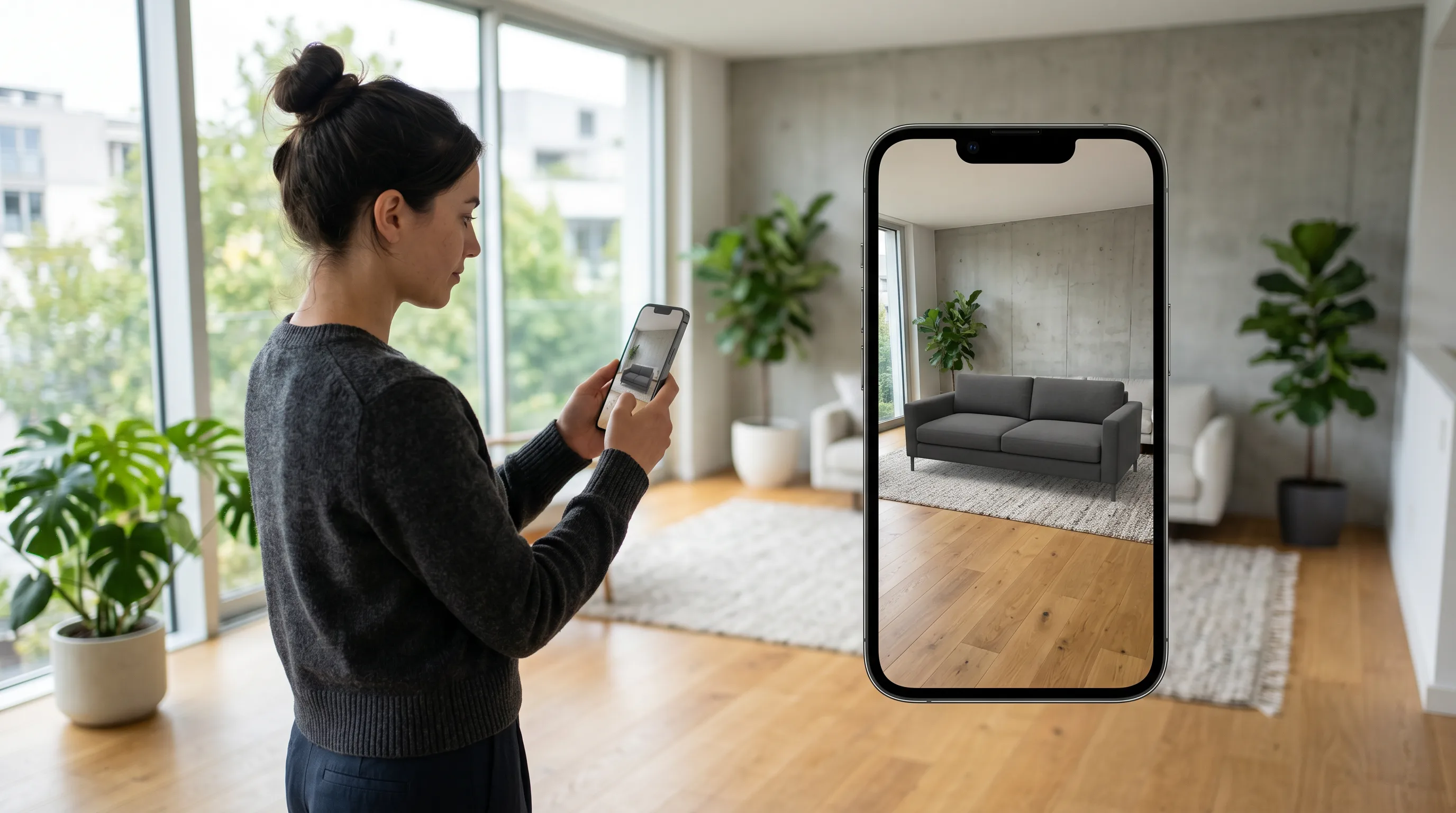

15 MIN READ
Augmented reality in ecommerce overlays interactive 3D product models onto a shopper’s real-world camera view, letting buyers place furniture in a room or try on glasses before purchase, directly through a browser or mobile app. It measurably improves retail performance: products with AR content convert at 94% higher rates, and AR cuts product return rates by 22% to 40% by closing the gap between online images and physical reality. The market reached $6.62 billion in 2024 and is projected to hit $139.1 billion by 2034. Furniture, fashion, beauty, and configurable products show the strongest results, with brands like Wayfair and IKEA reporting double-digit conversion gains.
Key Takeaways
-
The AR ecommerce market was worth $6.62 billion in 2024 and is projected to reach $139.1 billion by 2034 (Market.us, 2025).
-
Products with AR content convert at 94% higher rates than non-AR equivalents (Shopify, 2022).
-
AR cuts product return rates by 22–40%, addressing a $849.9 billion U.S. returns problem (Banuba, 2024).
-
Wayfair’s room-placement AR delivered +92% conversions and −43% returns (Zolak, 2026).
-
Most merchants should start with WebAR (from $140/month) before committing to a native app ($50,000+).
-
The AR ecommerce market was worth $6.62 billion in 2024 and is projected to reach $139.1 billion by 2034 (Market.us, 2025).
-
Products with AR content convert at 94% higher rates than non-AR equivalents (Shopify, 2022).
-
AR cuts product return rates by 22–40%, addressing a $849.9 billion U.S. returns problem (Banuba, 2024).
-
Wayfair’s room-placement AR delivered +92% conversions and −43% returns (Zolak, 2026).
-
Most merchants should start with WebAR (from $140/month) before committing to a native app ($50,000+).
Need help building AR for your ecommerce store?
We are here to help!
What Is Augmented Reality in Ecommerce?
Augmented reality in ecommerce places digital 3D models of products into a shopper’s physical environment through a phone or tablet camera. Unlike virtual reality, which replaces the real world with a simulated one, augmented reality keeps the shopper’s actual surroundings and adds the product on top. It is a practical sales tool, not an immersive escape.
The category is growing quickly. The AR in ecommerce market was valued at $6.62 billion in 2024 and is forecast to reach $139.1 billion by 2034 at a 35.6% CAGR, according to Market.us (2025), with North America holding 41.6% of global share. Adoption tracks the technology: Statista counted 1.7 billion active mobile AR users in 2024, up from 1.1 billion in 2022, as reported in Imagine.io’s 2025 AR trends roundup.
Retailers are following demand. Gartner projected that 80% of retailers would deploy AR as part of their customer experience by 2025, a figure cited in BrandXR’s 2025 retail research report. Two delivery methods make this possible, WebAR in the browser and native AR apps, compared in detail later in this guide. To see the range of what production AR looks like, browse these augmented reality solutions. The takeaway: AR has moved from novelty to a measurable retail channel.
AR Product Visualization vs. Virtual Try-On: What’s the Difference?
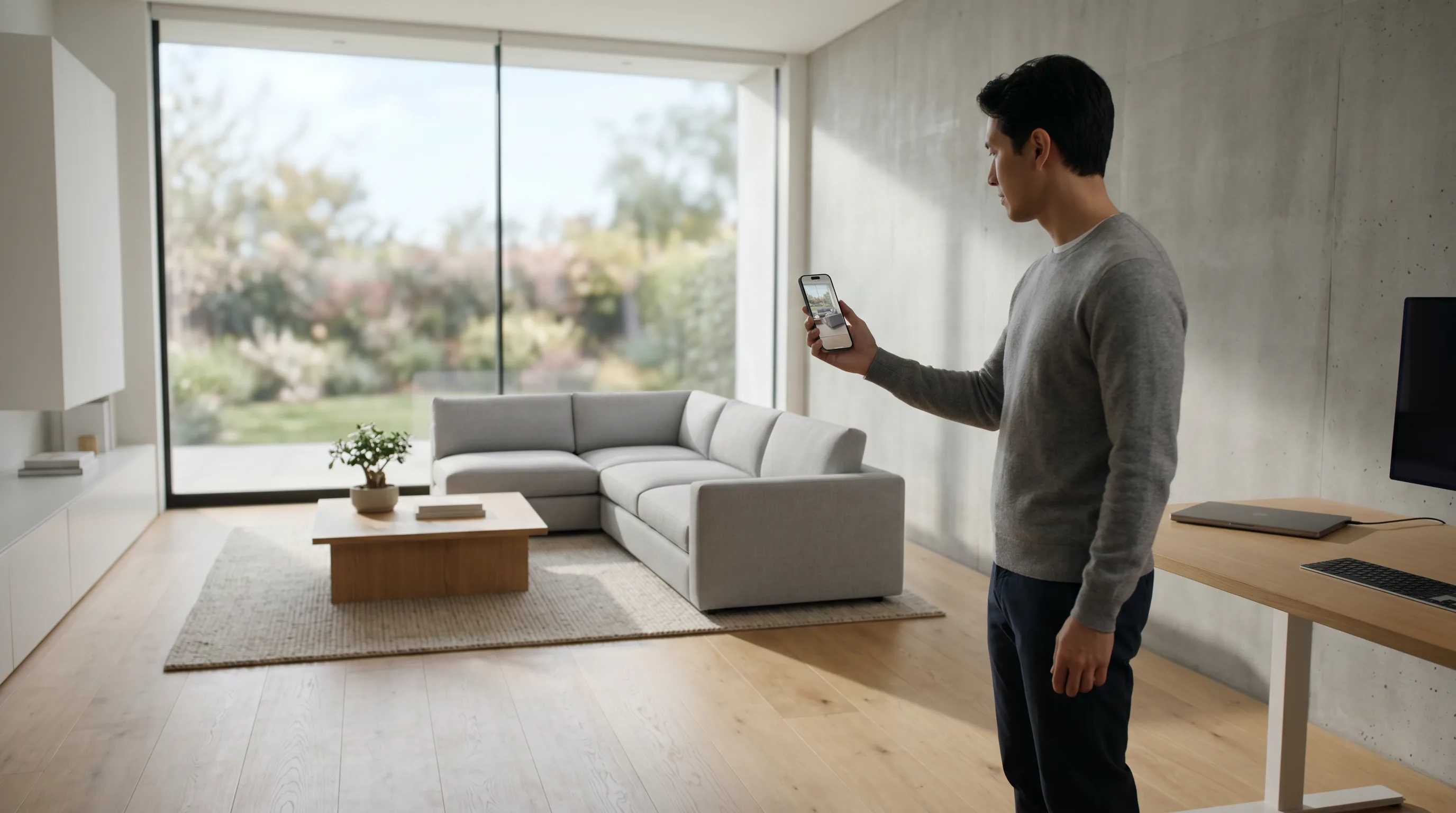
AR product visualization and virtual try-on are two distinct techniques. Product visualization anchors a 3D model to a surface or space, so a shopper can place a sofa on their floor or a speaker on their desk. Virtual try-on anchors a product to the body, so a shopper can see glasses on their face, a shoe on their foot, or a lipstick shade on their lips.
The difference is technical and practical. Product visualization relies on markerless SLAM tracking to map the room and lock the model to real-world scale, using 3D files in glTF or USDZ format, a pipeline our guide to AR product visualization walks through step by step. Virtual try-on relies on face, hand, foot, or body tracking to follow the shopper in real time.
A simple rule helps decide which to build:
- Static or large products (furniture, appliances, electronics, décor) call for product visualization.
- Wearable products (eyewear, makeup, shoes, clothing, jewelry) call for virtual try-on.
- Both suit retailers with mixed catalogs, and many large brands run the two side by side.
The underlying engines are ARKit on iOS, ARCore on Android, and the WebXR Device API in the browser. Either technique starts with quality 3D assets, which is why 3D model design services are the first dependency in any AR project. For a sense of finished work, these augmented reality examples show both visualization and try-on in context. The takeaway: match the technique to whether the product sits in a space or on a body.
How AR Shopping Improves Conversion Rates and Reduces Returns
AR shopping improves two business metrics at once: it lifts conversion rates and lowers return rates. Shoppers who interact with a product in AR buy more often because they understand what they are getting, and they return less often because the product matches their expectation. Shopify reported that products with AR content convert at 94% higher rates than products without it (2022), a benchmark since confirmed across multiple 2025 sources. Retail is only one of the five functions where that pattern shows up — see how businesses use AR across training, field service, and warehouse operations as well.
How AR Lifts Conversion Rates
AR lifts conversion rates because it closes the confidence gap that holds online shoppers back. Reydar’s 2025 analysis found AR users are 90% more likely to convert than shoppers who do not engage with AR, and that revenue per visit rises 106% for AR interactions. Engagement runs deep: AR ad formats hold attention for 75 seconds on average versus 2 to 3 seconds for static ads, per BrandXR (2025).
Named results back the pattern. Rebecca Minkoff recorded a 65% increase in orders after adding AR product views, according to Shopify’s AR shopping report (2022). Houzz saw an 11x conversion boost and Overstock.com reported up to 200% higher conversions after adding AR product visualization, both documented in AR-Go’s 2025 review of AR ecommerce impacts.
Demand is there to capture. Imagine.io’s 2025 data shows 71% of shoppers would buy more often if retailers offered AR, 61% prefer AR-enabled retailers, and the American Marketing Association measured a 17% lift in purchase intention from AR. Russ Maschmeyer, Product Lead for AR at Shopify, framed the shift this way in 2022: “We’re entering a phase experiencing products on faces, homes, and bodies, bringing us back to in-person retail—but better.” The takeaway: AR turns browsers into buyers by letting them inspect products before checkout.
How AR Reduces Product Returns
AR reduces product returns by letting shoppers verify size, color, and fit before they order, which closes the expectation gap that drives most returns. The problem is large: U.S. retail returns exceeded $849.9 billion in 2025, and the online return rate ran at 19.3%, more than double the brick-and-mortar rate, according to Banuba’s returns research (2024). Roughly 45% of returns trace to size, fit, or color mismatch, the exact gaps AR addresses.
The results are measurable. AR experiences reduce return rates by 22% to 40%, 66% of AR users say they are less likely to return an item, and 80% report greater confidence in their purchase, per Banuba (2024). Specific programs show the effect:
- Wayfair’s “View in Room” cut returns 43% (Zolak, 2026).
- Nike Fit AR sizing cut returns 20% (Zolak, 2026).
- L’Oréal’s ModiFace try-on cut returns 31% (Zolak, 2026).
- Gunners Kennels cut returns 5% after adding 3D and AR content (Shopify, 2022).
Lower returns protect margin more directly than higher conversion, because every avoided return saves shipping, restocking, and write-off costs. Frame Sixty, an AR/VR and spatial computing development studio, builds these experiences through its AR app development practice. The takeaway: AR pays back twice, once on the sale and again on the return that never happens.

AR Ecommerce Use Cases by Product Category
AR delivers the clearest ROI in categories where the gap between online images and physical reality is widest. Furniture, fashion, beauty, and configurable products each show strong published results, though the technique and the payoff differ by category.
Furniture and Home Décor
Furniture and home décor see the largest conversion gains from AR because room-placement visualization answers the questions catalog photos cannot: will it fit, will it match, and how big is it really. IKEA Place delivered a 189% conversion lift, a 20% drop in returns, sessions 3.5 times longer, and a 35% increase in average order value, with 8 million-plus downloads and 98% size accuracy, according to Zolak’s 2026 product visualization data and BrandXR (2025).
Wayfair’s “View in Room” feature produced a 92% conversion lift, a 43% reduction in returns, and a 28% increase in average order value (Zolak, 2026). The economics scale across the industry: Goldman Sachs estimated AR 3D visualization would save the furniture sector more than $1.6 billion in returns and lost sales. Room-scale markerless AR and accurate glTF or USDZ models make these gains possible. The takeaway: for big-ticket home goods, AR removes the single biggest barrier to buying online, which is doubt about scale and fit.
Fashion, Beauty, and Accessories
Fashion, beauty, and accessories rely on virtual try-on, which anchors products to the face or body so shoppers see them on themselves before buying. In fashion, Gucci’s Snapchat AR shoe try-on reached 18 million users, lifted product page views 188%, and raised purchase intent 25%, per BrandXR (2025), while Nike Fit grew online sales 15% (Zolak, 2026). Frame Sixty covers this vertical in depth in its guide to AR in fashion.
Beauty shows some of the strongest figures in ecommerce. Ulta Beauty’s Snapchat AR makeup lens drove 30 million try-ons and $6 million in sales in two weeks (BrandXR, 2025). Perfect Corp’s case studies (2024) document a 14x sales uplift at Benefit Cosmetics, a 320% conversion increase plus 33% AOV growth at Avon, and a 2.5x conversion rate at Estée Lauder across 8,000-plus monthly AR users. L’Oréal’s ModiFace lifted conversions 72% and time-on-page 117% (Zolak, 2026). The takeaway: when the product goes on a body, try-on converts skeptics that flat imagery never could.
Configurable and Technical Products
Configurable and technical products benefit from AR configurators that let buyers preview every option (color, finish, size) in their own space before committing. Electronics brands including LG and Samsung reported higher add-to-cart rates, fewer returns, and reduced support volume after adding AR, according to Zolak (2026). Automotive brands such as Toyota, Audi, and Porsche saw 20% to 25% of AR viewers proceed to a test drive or dealer inquiry (Zolak, 2026). A configurator like that is one piece of a wider virtual showroom, which can display every trim and color combination without a brand stocking physical inventory for each one.
The pattern extends to B2B sales. Research cited in Imagine.io’s 2025 report found 82% of B2B buyers say AR demos improve decision-making, and AR cut sales-cycle time by 30%. Complex or high-consideration products gain the most because AR compresses a long evaluation into a single confident view. Teams planning this kind of work can start with Frame Sixty’s augmented reality development services. The takeaway: the more options or technical detail a product carries, the more an AR configurator earns its keep.
WebAR vs. Native AR App: Which Is Right for Your Store?
WebAR and native AR apps solve the same problem through different channels, and most merchants should start with WebAR. WebAR runs in a mobile browser with no download, so a shopper taps a link or scans a QR code and sees the product in AR within seconds. A native AR app requires an install but delivers higher performance and deeper device access. The right choice depends on friction tolerance, complexity, and budget.
| Factor | WebAR | Native AR App |
|---|---|---|
| Access | Browser, no download | App store install required |
| Friction | Zero (link or QR code) | High (install step) |
| Performance | Good for most product AR | Superior for complex scenes |
| Tracking | Markerless, face, image | Full SLAM, multi-plane, body |
| Technology | WebXR, WebGL, HTML5/JS | ARKit (iOS), ARCore (Android) |
| Time to deploy | Days to weeks | 3 to 12 months |
| Cost | From $140/month or custom | $50,000–$300,000+ custom |
| Update cycle | Instant (server push) | App store review required |
| Best for | Discovery, first-time buyers, campaigns | Loyalty apps, complex configurators |
BrandXR’s WebAR versus AR apps comparison (2025) identifies WebAR as the lower-friction option for first-time shoppers and native apps as the choice for resource-intensive experiences and repeat users. A hybrid model works well: serve WebAR to first-time visitors and reserve a native app for logged-in, loyal customers. Frame Sixty builds both browser-based experiences through WebAR development and installable ones through augmented reality mobile app development. The takeaway: lead with WebAR to capture the most shoppers, and add native only when complexity or loyalty justifies the install.
How Much Does AR Development Cost for Ecommerce?
AR development cost for ecommerce depends on the delivery model and the complexity of the experience, ranging from a few hundred dollars a month for a hosted platform to $300,000 or more for a custom native app. Every tier shares one cost input that is easy to overlook: 3D model production for each product in the catalog.
AR Ecommerce Cost by Delivery Model
AR ecommerce costs fall into three tiers by delivery model. Each suits a different stage of investment, and the figures below come from Zolak’s 2026 cost data.
- SaaS WebAR platforms run from roughly $140 to $500 per month for hosted tools, suited to merchants testing AR on a small set of SKUs. 3D models are usually priced separately.
- Custom WebAR or single AR features run $25,000 to $75,000 for a bespoke experience, such as a cosmetics try-on or a furniture room viewer, on a 6 to 16 week timeline.
- Custom native AR apps or enterprise integrations run $50,000 to $300,000 and up, with a 6 to 12 month build for a full iOS and Android AR shopping app using ARKit and ARCore.
3D model production is the variable that ties the tiers together. Individual SKUs can cost as little as a few hundred dollars using photogrammetry or AI generation, while hero products that need studio-quality models cost more. Plan to set aside 15% to 25% of the build cost each year for maintenance, new SKUs, and OS updates. Frame Sixty scopes this work as an AR app development company. The takeaway: start small with SaaS WebAR, then graduate to custom builds once AR proves its lift.
Typical Development Timeline
The typical development timeline for an AR ecommerce experience runs from one week for a hosted setup to a year for a full native app. The schedule depends far more on the delivery model and the 3D model pipeline than on the AR code itself.
- SaaS WebAR setup: 1 to 4 weeks, mostly platform onboarding and 3D model production.
- Custom WebAR experience: 6 to 16 weeks across discovery, design, build, and QA.
- Native AR app, built new: 6 to 12 months, including dual iOS and Android builds and app store review.
A phased rollout reduces risk: launch WebAR on the top 10 SKUs, measure the conversion and returns lift, then expand to the full catalog or invest in a native app once the numbers justify it. The recurring dependency is the 3D model workflow, since a 500-SKU catalog needs a repeatable photogrammetry or AI-generation process rather than one-off modeling. Frame Sixty manages these rollouts as an augmented reality agency. The takeaway: ship a small WebAR pilot first, because the 3D pipeline, not the AR engine, sets the pace.
How to Calculate the ROI of AR for Your Product Catalog
ROI for an AR ecommerce project is the new revenue from higher conversion plus the cost saved on avoided returns, minus the build cost. The formula is straightforward: (conversion-lift revenue + returns saved) − AR investment = net ROI. Conservative inputs from published benchmarks produce a clear picture.
Consider a store with 1,000 monthly visitors, a 2% conversion rate, and a $100 average order value, generating $2,000 a month. Applying a conservative 30% AR conversion lift (well below the 94% headline figure) raises that to $2,600 a month. If the return rate on AR-touched orders falls from 19% to 14%, the saved restocking and shipping costs add to the gain. Zolak (2026) documents one worked example where an $11,000 AR investment produced $22,500 in net profit over six months, roughly a 205% ROI.
Four numbers from your own analytics drive the calculation:
- Current conversion rate.
- Current return rate.
- Average order value.
- Average cost to process one return.
Marketing efficiency strengthens the case further. AR-Go’s 2025 report cites Meta research showing 90% of brands that combined AR with traditional marketing achieved nearly 3x brand lift at 59% lower cost. The takeaway: AR ROI is calculable before you build, so measure your baseline conversion and return metrics first, then size the investment against the lift those benchmarks predict.
Conclusion
Augmented reality in ecommerce has crossed from experiment to proven channel. The market reached $6.62 billion in 2024 and is on track for $139.1 billion by 2034 (Market.us, 2025), and the reason is simple: AR raises conversion rates by letting shoppers inspect products with confidence, and it cuts the 22% to 40% of returns that drain margin (Banuba, 2024). Furniture, fashion, beauty, and configurable products show the strongest published results, with named brands like Wayfair, IKEA, Estée Lauder, and Nike reporting double-digit gains.
The practical path is sequential. Start with WebAR to reach the most shoppers at the lowest friction, build a repeatable 3D model pipeline, measure the conversion and returns lift on a small set of SKUs, then expand or add a native app once the ROI is clear. Calculate the return before you commit, using your own conversion rate, return rate, average order value, and cost per return.
Frame Sixty builds AR shopping experiences across WebAR and native platforms, from 3D model production to full app development — our augmented reality for retail and e-commerce page covers the full set of experiences we ship, from virtual try-on to in-store activations. If you want to find out whether AR is commercially viable for your product catalog, get in touch with our team at Frame Sixty for a feasibility review with a recommended approach, timeline, and preliminary budget range.
Augmented Reality in Ecommerce FAQ
Common questions about AR ecommerce, covering costs, platforms, devices, 3D models, and how leading retailers use augmented reality to lift conversions and reduce returns.
AR ecommerce is worth it for small businesses because hosted WebAR platforms start around $140 per month, far below the $50,000-plus cost of a custom native app. A small merchant can add AR to its top 10 SKUs, measure the conversion and returns lift, then expand once the numbers justify it. Products with AR content convert at 94% higher rates, so even a modest pilot can pay back quickly.
Retailers like IKEA and Wayfair use AR room-placement visualization that lets shoppers see furniture at true scale in their own homes before buying. IKEA Place delivered a 189% conversion lift and a 20% drop in returns, while Wayfair's "View in Room" produced a 92% conversion lift and a 43% reduction in returns. Beauty retailers instead use virtual try-on, anchoring makeup or eyewear to the shopper's face.
An AR ecommerce development partner should offer end-to-end capability, from 3D model production to both WebAR and native app delivery, since the 3D pipeline, not the AR code, sets the project pace. Frame Sixty builds across WebAR and native platforms and produces glTF and USDZ models in-house. Ask for measurable case results, a phased rollout plan, and a maintenance budget of 15% to 25% of build cost per year.
WebAR for shopping runs on most modern smartphones and tablets through a mobile browser, with no app download required. It uses the WebXR Device API, WebGL, and HTML5/JavaScript, and supports markerless, face, and image tracking on current iOS and Android devices. Because a shopper only taps a link or scans a QR code, WebAR reaches the widest audience with zero install friction.
Shopify supports AR through 3D product models that shoppers can view in their own space directly from a product page on supported devices. Shopify's own data found products with AR or 3D content convert at 94% higher rates, and merchant Rebecca Minkoff reported a 65% increase in orders after adding AR product views. Merchants supply glTF or USDZ 3D files for each SKU.
Calculating the ROI of an AR ecommerce project means adding the revenue from higher conversion to the cost saved on avoided returns, then subtracting the build cost. You need four numbers from your analytics: current conversion rate, current return rate, average order value, and cost to process one return. Zolak (2026) documents one example where an $11,000 AR investment produced $22,500 in net profit over six months, about a 205% ROI.
Get in touch
We’re interested to see how we can help. Send us a message and we will get back to you within 24 hours.