
The Future is Browser-Based: 7 Augmented Reality Web Trends to Watch in 2026
Apr 10, 2026

15 MIN READ
Augmented Reality Web technology overlays computer-generated information onto a user’s view of the real world directly through a web browser on mobile devices and mixed-reality headsets. It enhances reality by using a device’s cameras and sensors to map the physical environment, which is why it cannot run on standard desktop computers that lack this hardware. In contrast, virtual reality (VR) completely replaces a user’s surroundings with a fully digital world, an immersive experience that can be powered by a desktop. This fundamental difference is why AR requires devices that can see the world, while VR creates its own.
1. The Rise of Geospatial Web AR
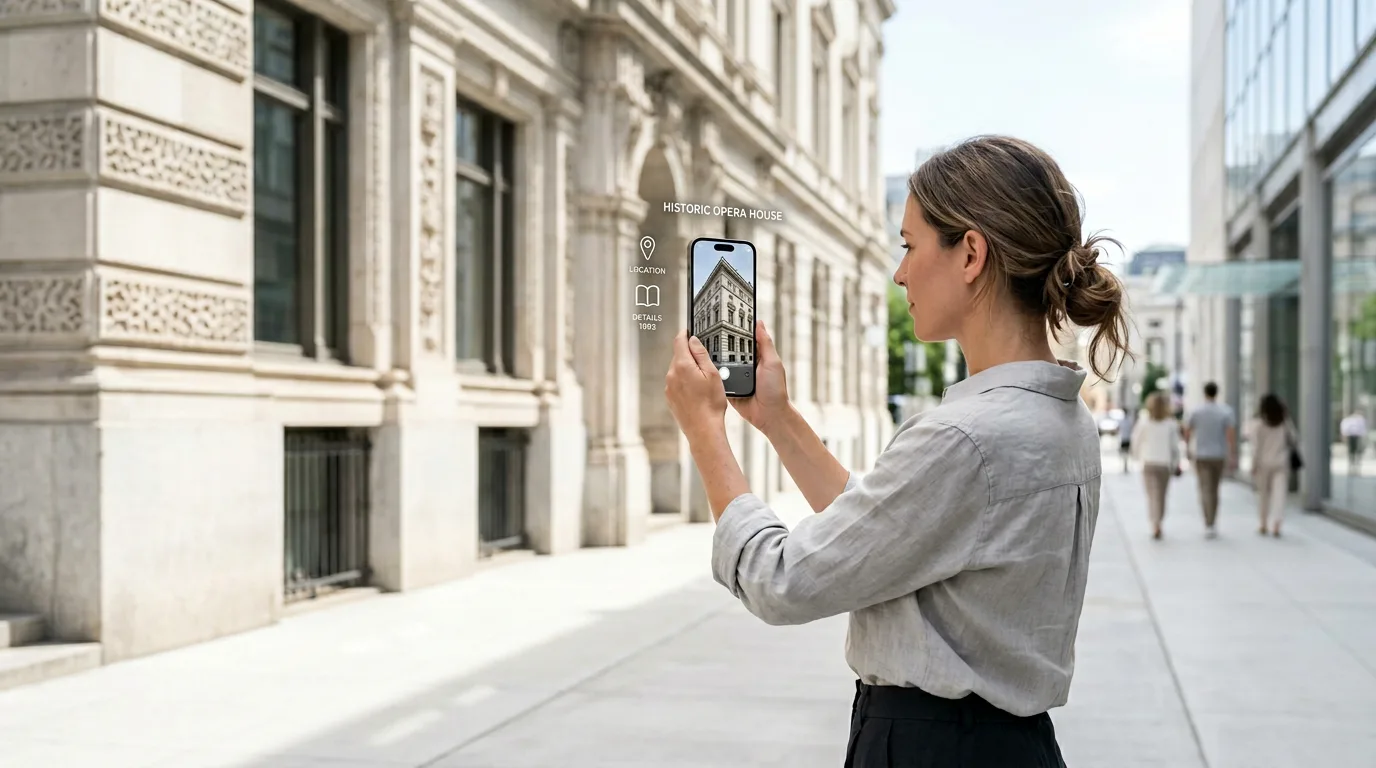
Geospatial Web AR is technology that anchors persistent digital content to real-world locations, which can then be viewed through a browser. This trend expands AR from a personal, room-scale experience to a shared, city-scale platform for information, art, and navigation. By 2026, our cities will likely be layered with interactive digital information accessible to anyone with a smartphone.
This is made possible by a combination of Visual Positioning Systems (VPS), GPS, and advanced sensor fusion. Unlike simple marker-based AR, geospatial AR understands a user’s precise location and orientation in 3D space by recognizing surrounding buildings and landmarks. This allows for experiences that are tied to a specific place and are also persistent, meaning they can be viewed and interacted with by multiple users over time. Google’s Geospatial Creator is an example of a tool that makes this more accessible, allowing developers to anchor content to millions of locations worldwide using Google Maps data.
The applications are wide-ranging. Tourism could feature self-guided historical tours where figures from the past appear on the streets they once walked. In retail, a virtual sign could point to a flash sale down the block. For civic engagement, people could visualize proposed architectural changes on-site. Companies like Niantic have been pioneers in this space with technology acquired and evolved from 8th Wall. The Niantic developer platform continues to advance world-scale AR, even after sunsetting the 8th Wall brand.
Geospatial Web AR effectively transforms the world into a canvas for shared digital experiences, moving AR out of the living room and into the public square.

2. AI-Powered Content Creation and Interaction
Generative AI is changing how Web AR content is created and experienced, making the process faster, more intuitive, and more personal. This trend uses AI algorithms to generate 3D models, textures, and animations from simple text prompts or 2D images. It also enables more natural user interactions, such as voice commands and gesture controls, within the AR scene.
Creating high-quality 3D assets has traditionally been a bottleneck in Web AR development, requiring specialized skills, expensive software, and a lot of time. By 2026, AI tools will be deeply integrated into development workflows. A marketer could type “a photorealistic red armchair in a mid-century modern style” and receive a browser-ready 3D model in seconds. This greatly lowers the barrier to entry, allowing small businesses and individual creators to produce professional AR experiences. Our own 3D model design services are increasingly using AI to speed up workflows for clients.
Beyond content creation, AI is also redefining interaction. Instead of tapping buttons on a screen, users will be able to speak to virtual characters, resize a virtual sofa by pinching their fingers in the air, or ask an AR assistant questions about a product they are viewing. This is possible because of advancements in Natural Language Processing (NLP) and computer vision models that can run efficiently in the browser through technologies like WebAssembly. This shift from explicit commands to natural interaction will make Web AR feel less like a tool and more like an extension of our senses.
AI will make creating Web AR content more accessible and will make interacting with it feel as natural as interacting with the real world.
Need help with Web AR development?
Frame Sixty is a full-service digital innovation studio specialising in AR/VR, mobile, and web development.
3. Hyper-Realistic 3D Models and Environments
The visual quality of Web AR is improving dramatically, with browser-based experiences approaching the level once limited to native apps and high-end gaming consoles. This trend is driven by better 3D asset standards, real-time rendering in web browsers, and more powerful mobile hardware. By 2026, the line between a real product and its digital twin in your living room will become very thin.
The glTF (GL Transmission Format) is central to this change. Maintained by the Khronos Group, glTF has become the “JPEG of 3D,” an efficient and interoperable standard for delivering 3D models on the web. It supports Physically Based Rendering (PBR) materials, which simulate how light interacts with real-world surfaces. This results in realistic textures for materials like metals, fabrics, and woods, which is important for e-commerce, where accurate product representation affects consumer trust and sales.
These models are rendered in the browser using WebGL, a JavaScript API for 2D and 3D graphics. As detailed in the Khronos Group’s WebGL overview, this technology gives web developers low-level access to a device’s GPU. This allows for complex lighting, shadows, and post-processing effects directly in a browser tab. When used with tools like Google’s
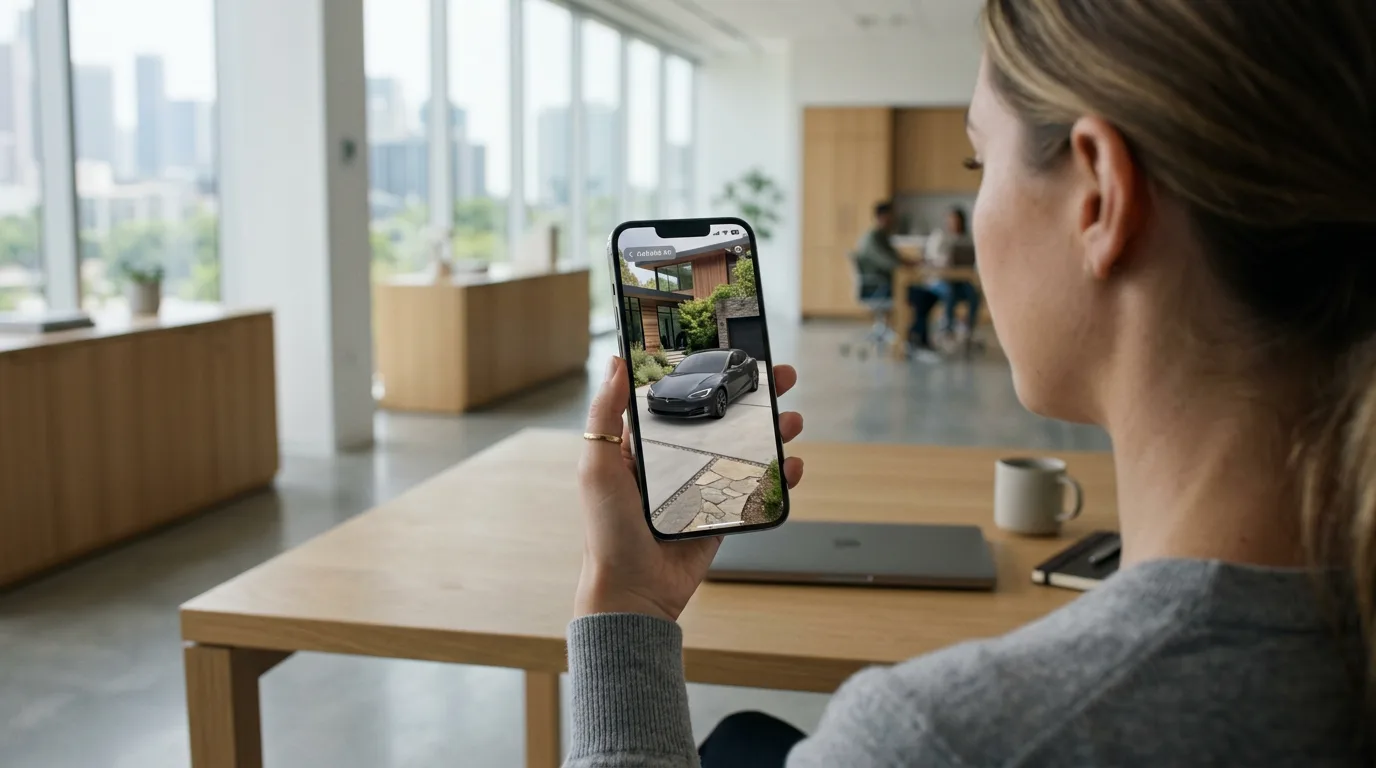
The impact of this trend is significant. Furniture retailers can let customers visualize a leather sofa with accurate lighting and texture in their home. Automotive brands can allow potential buyers to inspect the metallic paint and detailed interior of a new car in their driveway. This level of realism builds confidence and improves the user experience, leading to higher engagement and sales.
Advancements in standards like glTF and APIs like WebGL are making photorealism in Web AR not just possible, but the expected standard.
4. Seamless E-commerce Integration and Virtual Try-On
Web AR is evolving from a marketing novelty into a core part of the e-commerce customer journey. This trend involves integrating AR functions like virtual try-on (VTO) and product visualization directly into product pages. This removes friction and helps consumers make more informed purchasing decisions without leaving the browser.
The main problem Web AR solves for online retail is the “imagination gap”—the uncertainty a customer feels when they can’t physically see or handle a product. Will that dress fit? Is that television too big for the wall? A Harvard Business Review article on AR explains that this technology can bridge that gap by providing a richer shopping experience. By 2026, a “View in your space” button will be as common on product pages as “Add to cart.”
The technology has matured. For apparel and accessories, advanced body and face tracking enables realistic AR in fashion, letting you try on sunglasses, makeup, or sneakers with good accuracy. For home goods, SLAM (Simultaneous Localization and Mapping) technology correctly scales and places furniture in a room, respecting real-world lighting and occlusion (for example, a virtual chair appearing behind a real table). Platforms from companies like Snap Inc. have advanced VTO, and this technology is now becoming widely available for the open web.
The business case is strong. Brands that use Web AR see improvements in conversion rates, time on page, and a reduction in returns. A customer who has virtually placed a sofa in their living room to confirm it fits and matches the decor is far less likely to return it. This creates a clear ROI, justifying the investment in creating 3D digital twins of product catalogs. As one of the top augmented reality companies in 2026, we see this as the largest driver of AR adoption in the enterprise sector.
Web AR is becoming an essential tool for e-commerce, helping to increase sales and customer satisfaction by removing purchase uncertainty.

5. The Convergence with Mixed Reality Headsets
The future of Web AR is not limited to phones; it is also converging with the next generation of mixed reality (MR) headsets. This trend will make browser-based AR experiences accessible on devices like the Apple Vision Pro and Meta Quest 3. These headsets use high-resolution passthrough cameras to blend the digital and physical worlds, offering a more immersive and hands-free way to interact with web content.
While smartphones brought AR to the masses, they have limitations. Holding up a device occupies a hand and offers a small field of view. Mixed reality headsets solve this by providing a persistent, heads-up display where digital information can be overlaid onto your world. You could follow a recipe with instructions floating next to your mixing bowl, or assemble furniture with a 3D guide hovering over the parts. This is the promise of spatial computing, and the web is positioned to be a primary platform for delivering these experiences.
The Apple Vision Pro is leading the way by treating web content as a core part of its visionOS. WebXR, the API for creating immersive web experiences, allows developers to build a single AR experience that can run on a phone’s screen or in a fully immersive headset. This “build once, deploy anywhere” approach is very efficient. A user could start an AR product visualization on their iPhone and then switch to their headset for a more detailed, hands-on inspection.
This convergence will be driven by the standards that govern the web. The W3C Immersive Web Working Group is actively defining the specifications for the WebXR Device API, ensuring that developers have a consistent target to build for, regardless of the hardware. This open approach is a core strength of the web, contrasting with the closed ecosystems of native app stores.
As mixed reality headsets become more common, the web will serve as the universal platform for delivering AR experiences across phones, tablets, and next-generation eyewear.
6. Advanced Interactivity and Gamification
Web AR is moving from passive viewing to fully interactive and gamified applications that run in the browser. This trend is supported by the increasing performance of mobile browsers, mature web development frameworks, and the ability to run code at near-native speed through WebAssembly. By 2026, browser-based AR will support complex physics, multiplayer interactions, and sophisticated game mechanics.
Early Web AR was often limited to placing a static 3D model in your space. Now, developers can build rich, interactive scenes using powerful open-source libraries. One key tool is A-Frame, a web framework for building 3D and VR/AR experiences with simple HTML-like tags. It simplifies much of the complexity of WebGL and WebXR, allowing developers to create scenes with just a few lines of code. For those needing more control, libraries like Three.js and Babylon.js offer direct access to the graphics pipeline. You can explore a breakdown of these tools in our guide to the top 5 web-based augmented reality solutions.
The performance needed for these interactions comes from WebAssembly (WASM). WASM is a binary instruction format that allows code written in languages like C++ and Rust to run in the browser at near-native speed. This is a major development for Web AR, enabling features like realistic physics engines, complex character animations, and real-time multiplayer networking that were previously only possible in native applications.
The applications of this trend are broad. Brands can create AR mini-games for marketing campaigns to increase engagement. Educational institutions can build interactive AR science experiments. For example, a user could conduct a virtual chemistry experiment on their kitchen table, mixing chemicals and observing reactions in real-time. This level of interactivity makes learning more effective. Platforms like Zappar provide tools for creating these kinds of interactive and gamified campaigns for brands.
Web AR is becoming a full application platform, capable of delivering rich, game-like interactive experiences that capture user attention.
7. Standardization and Cross-Browser Compatibility
The long-term success of Augmented Reality Web depends on strong, open standards and reliable cross-browser support. This trend ensures that developers can create an experience once and have it work predictably for most users, whether they are using Chrome on Android or Safari on iOS. By 2026, the foundational standards for Web AR will be mature and widely implemented.
The central standard is the WebXR Device API, which provides the necessary hooks for web pages to communicate with AR hardware. It handles motion tracking, understanding the real-world environment, and rendering content correctly. Google’s developer documentation for WebXR provides a good overview of its capabilities. The API is the result of years of collaboration within the W3C, the main international standards organization for the web, with updates tracked on sites like the Mozilla Developer Network.
On iOS, Apple’s AR Quick Look has been a key driver for “no-app AR.” As detailed in Apple’s developer documentation, it allows users to launch AR experiences directly from Safari with a single tap on a 3D model file. While not a full implementation of WebXR, it provides a simple experience for the large number of iPhone and iPad users, making it an important part of any Web AR strategy. In the future, Apple will likely embrace the open WebXR standard more fully, which would unify the developer landscape.
This push for standardization is important for developer confidence and investment. When developers know their work won’t break with the next browser update, they are more willing to build ambitious projects. This reliability will allow Web AR to move from niche campaigns to an everyday utility. As reported by firms like Gartner and publications like WIRED, standardization is a key sign of a maturing technology. Choosing the right web augmented reality framework that navigates these standards is essential for success.
Strong standardization through the WebXR Device API is making Web AR a reliable and future-proof platform for building immersive experiences.
Conclusion
Augmented reality’s journey from a niche, app-dependent technology to an open, browser-based platform is accelerating. The trends we’ve explored, including city-scale geospatial experiences, AI-driven content creation, hyper-realism, and e-commerce integration, are not futuristic concepts. They are the building blocks for the next version of the web, being assembled today by a global community of developers, designers, and standards bodies. By 2026, the Augmented Reality Web will be more accessible, powerful, and integrated into our daily digital lives.
The convergence with mixed reality headsets will offer new, more immersive ways to interact with this content. At the same time, the maturation of standards like WebXR will ensure these experiences are reliable and consistent across all devices. For businesses, this marks a major shift in how they connect with customers, offering new ways to demonstrate value, build engagement, and drive commerce. The browser, the world’s most common application, is becoming a window onto a digitally enhanced reality.
The future is about interacting with digital content in the context of our own world, not just viewing it. As these trends continue to develop, the possibilities will expand. The era of no-app AR is here, and it is set to become a standard part of our online experience.
Ready to bring your ideas to life with the Augmented Reality Web? Get in touch with our team at Frame Sixty to discuss how we can build the future of your brand’s customer experience together.
Frequently Asked Questions about Augmented Reality Web
Learn the essentials of browser-based augmented reality (Web AR). These FAQs cover the fundamental concepts, technology, and future trends shaping how we interact with digital content in the real world.
Augmented reality web, or Web AR, is augmented reality delivered directly through a web browser on a compatible device, with no app to download or install. The browser uses the device's cameras and sensors to map the physical environment and overlay digital content onto the real world in context.
Web AR runs on smartphones and tablets with AR-capable browsers, and on mixed reality headsets with passthrough cameras such as Apple Vision Pro and Meta Quest 3. Standard desktop computers cannot run AR because they lack the outward-facing cameras and sensors needed to see the physical environment, though they can power VR.
The WebXR Device API is the web standard that lets a browser page communicate with AR and VR hardware, handling motion tracking, environmental understanding, and rendering. Because of WebXR, developers can build one augmented reality web experience that runs on a phone's screen or in a mixed reality headset, a build-once, deploy-anywhere approach.
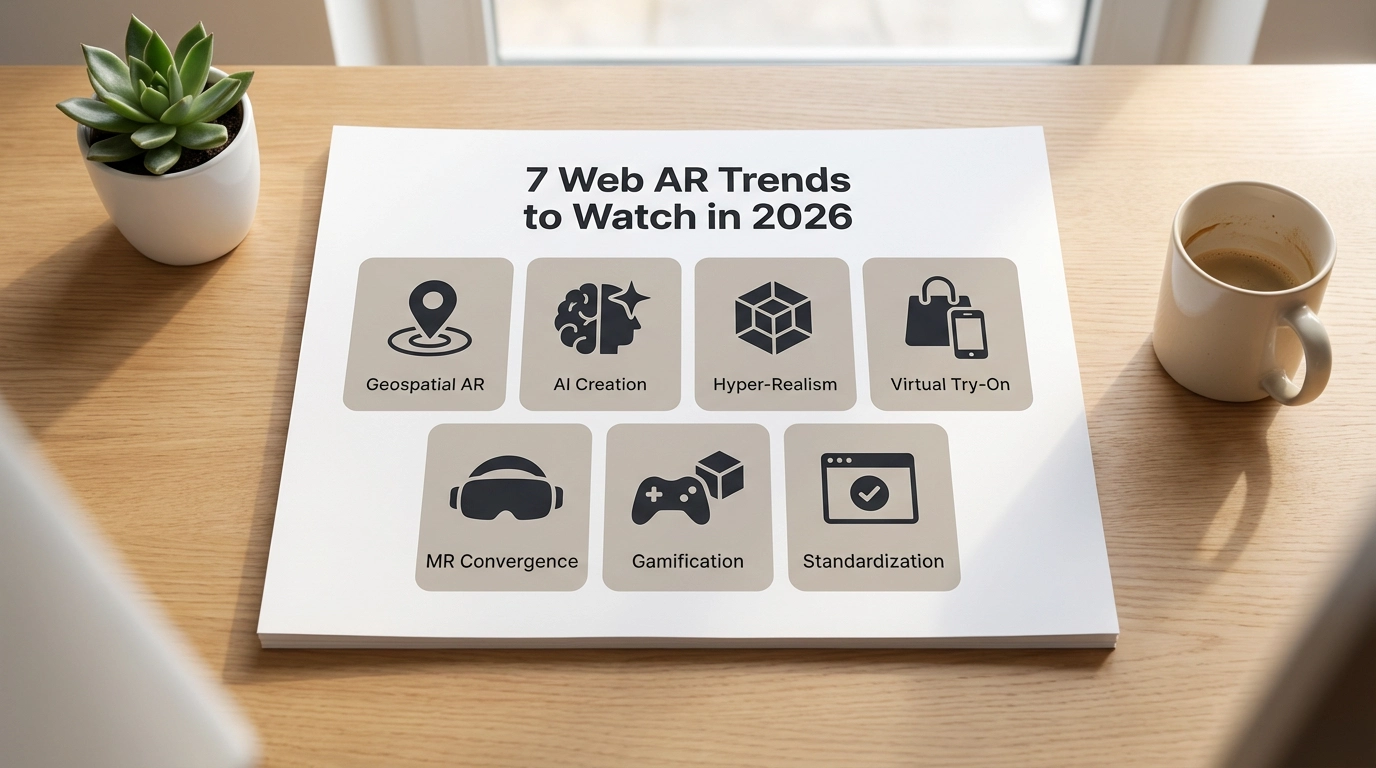
Seven Web AR trends define 2026: geospatial AR anchored to real-world locations, AI-generated 3D content, hyper-realistic models via glTF and WebGL, virtual try-on in e-commerce, convergence with mixed reality headsets, gamified interactivity powered by WebAssembly, and maturing WebXR standardization across browsers. Together they move browser-based AR from marketing novelty to everyday utility.
Web AR increases e-commerce engagement and conversion rates while reducing product returns, because customers can see products in their own space before buying. Virtual try-on covers items like sunglasses and makeup, while product visualization places furniture or appliances at accurate scale in the customer's home, removing purchase uncertainty.
Most businesses start Web AR by creating 3D digital twins of their products, then building a browser-based experience around them. Frame Sixty pairs 3D model design services with custom Web AR development to take brands from product catalog to a working browser experience.
Get in touch
We’re interested to see how we can help. Send us a message and we will get back to you within 24 hours.