
Top Augmented Reality Companies 2026: Leaders & Innovators
Feb 24, 2026
Updated
14 MIN READ
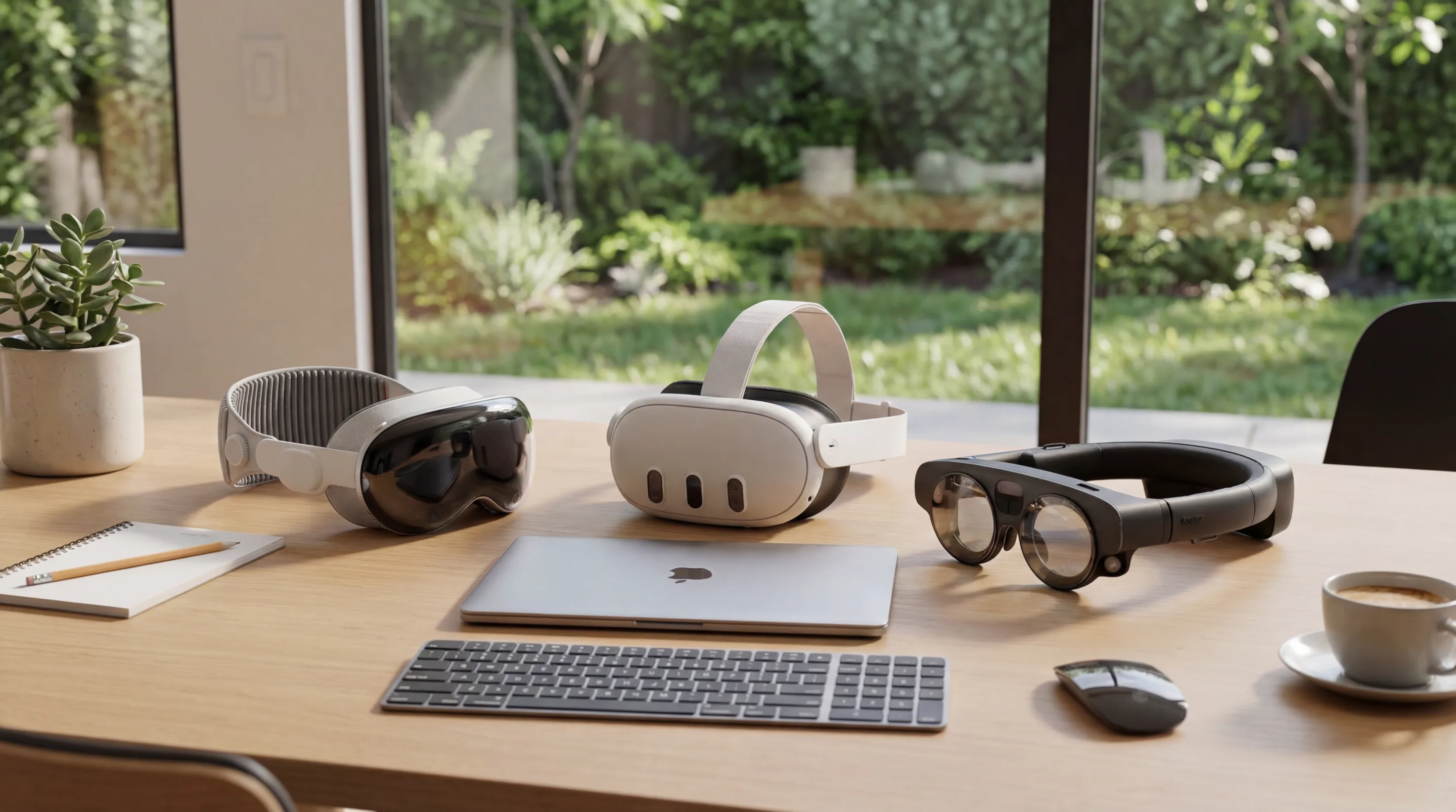
The top augmented reality companies in 2026 are Meta, Apple, Snap, Google, Samsung, and Magic Leap on the hardware side, with PTC, Scope AR, and Niantic leading enterprise software. The market crossed a real threshold this year: smart glasses passed headsets as the dominant form factor, one major player exited hardware entirely, and three new consumer platforms shipped inside twelve months.
That churn matters because the ranking you knew in 2024 no longer holds. Microsoft stopped building HoloLens. Apple stopped developing Vision Pro. Meanwhile Meta, Snap, and Google raced glasses to market, and Samsung launched the first headset on a brand-new operating system. This article covers who leads augmented reality now, what changed, and how to read the field if you are choosing a device, a platform, or a development partner.
Here is the position worth stating up front, because it shapes everything below: most augmented reality buying decisions go wrong because teams pick hardware first and software second. The company that ships the best spec sheet rarely predicts a working deployment. The software ecosystem does.
Key Takeaways
- The global AR market reached USD 99.81 billion in 2025 and is projected at USD 125.11 billion in 2026, a 25.35% CAGR through 2031 (Mordor Intelligence, 2026).
- Meta held 72.2% of the global XR device market in 2025, driven by an estimated 6.5 million Ray-Ban Meta glasses sold (IDC, March 2026).
- Smart glasses reached roughly 50% of all XR shipments in 2025, up from about 25% in 2024 (IDC via Treeview, 2026).
- Apple shipped about 600,000 Vision Pro units total, then cancelled development in 2026; enterprise buyers were roughly 75% of sales (MacRumors, 2026).
- Microsoft exited AR hardware; HoloLens 2 receives software support only through December 31, 2027 (Redmond Channel Partner, 2025).
The AR Market in 2026: Size, Growth, and the Smart Glasses Shift
The augmented reality market reached USD 99.81 billion in 2025 and is projected to hit USD 125.11 billion in 2026, growing at a 25.35% compound annual rate through 2031 according to Mordor Intelligence’s 2026 market report. Growth is broad, but the interesting story is where the units are going.
Device shipments tell it plainly. Global XR shipments grew 44.4% year over year in 2025 to 14.5 million units, and IDC forecasts a 26.5% compound annual growth rate through 2030, per aggregated IDC tracker data. Growth alone is not new. The composition is.
Smart glasses reached roughly 50% of all XR device shipments in 2025, about 7.25 million units, up from around 25% in 2024, according to Treeview’s 2026 industry statistics. Read that as a signal, not a footnote. In one year, the center of gravity moved from the headset on a desk to the glasses on a face. Ray-Ban Meta alone sold an estimated 6.5 million units, more than every headset combined. The AR glasses segment specifically is forecast at USD 35.06 billion in 2026, up 50.6% from USD 23.27 billion in 2025 (ARtillery Intelligence, 2026).
Enterprise interest is wide but shallow. Roughly 75% of Fortune 500 companies have run XR pilot programs, yet only 22% of large enterprises operate deployments at scale (Treeview, 2026). The gap between pilot and production is where most AR budgets stall. That gap, not the hardware, is the real market.
The takeaway: 2026 is a consolidation year, and glasses are the shape the money is taking.
Top Augmented Reality Companies in 2026
The augmented reality field in 2026 splits into two tracks. One is consumer-facing platform builders racing to own the face-worn computer: Meta, Apple, Snap, and Google. The other is enterprise ecosystem players selling AR as a production tool: Magic Leap, PTC, Scope AR, and Niantic. A new operating system, Android XR, cuts across both and is quietly reshaping which names belong on the list. The four companies below define the consumer and platform tier.
Meta: Consumer AR Dominant
Meta is the dominant augmented reality company by volume in 2026, holding 72.2% of the global XR device market in 2025 according to IDC’s March 2026 tracker. No competitor is close. That lead rests on glasses, not headsets.
Ray-Ban Meta smart glasses sold an estimated 6.5 million units in 2025, the best-selling XR device of the year. Meta then raised the ceiling with the Meta Ray-Ban Display, which launched September 30, 2025 at $799. Per Meta’s product announcement, the Display carries a 600×600-pixel full-color in-lens screen, weighs 69 grams, runs about 6 hours mixed-use, and ships with the Meta Neural Band, an EMG wristband that reads subtle hand gestures for control. On the headset side, Meta Quest 3 and Quest 3S remain the leading standalone mixed-reality devices; Quest lifetime sales have passed 20 million units and Meta funds Reality Labs at roughly $20 billion a year, according to Treeview’s 2026 industry data.
That scale sets the baseline every other company has to clear.
Apple: The Premium Pivot
Apple is retreating from headsets and pivoting toward glasses. The Apple Vision Pro M5 launched October 22, 2025 at $3,500, and per Road to VR’s launch coverage it added the M5 chip, a 120Hz refresh rate, 10% more rendered pixels, and visionOS 26 with expanded Apple Intelligence. The specs improved. Demand did not follow.
Apple shipped roughly 600,000 Vision Pro units across both generations, with enterprise buyers accounting for about 75% of sales and return rates higher than any modern Apple product, according to MacRumors’ April 2026 report. Apple then cancelled Vision Pro development, shelved the cheaper Vision Air, and moved the team to other work including Siri and smart-glasses research.
What survives is the platform. visionOS and ARKit remain first-class developer targets, and 50-plus Fortune 100 organizations still run Vision Pro in production workflows. Apple’s next AR act is lightweight glasses, not a third headset.
Snap: The Post-Smartphone Challenger
Snap is betting that face-worn AR replaces the phone, and it shipped hardware to prove it. Snap Specs launched in June 2026 at $2,195, lighter than the previous Spectacles, with see-through lenses, an onboard AI assistant, and about four hours of battery, as reported by CNBC at the reveal.
“The tiny smartphone limited our imagination,” said Evan Spiegel, CEO of Snap Inc., unveiling Specs at the Augmented World Expo. It is a bold framing for a $2,195 device with a niche initial audience.
Snap’s advantage is not the glasses. It is distribution. Snapchat reached 460 million daily active users in Q1 2025, and its AI-generated Lenses drew more than 2 billion impressions, per Snap’s Q1 2025 figures compiled by SQ Magazine. Snap already owns the largest consumer AR audience on earth before a single pair of Specs ships at volume. That is a starting position Apple and Google would pay dearly for.
Niantic: Location-Based AR at Scale
Niantic runs the world’s largest location-based augmented reality infrastructure, and in 2026 it rebranded that stack from Lightship to the Niantic Spatial Platform, decommissioning Lightship.dev on February 27, 2026. The company’s asset is a city-scale, persistent 3D map of the real world.
That map powers Niantic’s Visual Positioning System, which anchors digital content to physical places with centimeter-level precision and survives across sessions. Recent releases added real-world multiplayer through co-localization, so multiple users share one AR scene without scanning a QR code or trading a join code. A partnership with Qualcomm brings VPS to Snapdragon Spaces headset development.
Niantic’s use cases run through tourism, retail wayfinding, training, and location-based games. Its differentiator is simple to state and hard to copy: it is the only AR company with a global outdoor map that hardware makers actually need.
Which AR Glasses Can You Buy Right Now?
Mid-2026 is the first moment buyers have a genuine spread of AR devices to choose from, spanning $299 audio glasses to a $3,500 spatial computer. The choice now splits cleanly between consumer glasses meant for all-day wear and enterprise headsets built for a work task. The comparison below covers the consumer tier.
Consumer AR Glasses: A 2026 Comparison
Consumer AR glasses in 2026 range from audio-only frames to full see-through displays, and price tracks capability closely. The table gives the fast read on what ships today and who each device suits.
| Device | Price | Display | Battery | Best for |
|---|---|---|---|---|
| Meta Ray-Ban (audio) | $299 | None | ~36 hrs (with case) | Everyday AI assistant, capture |
| Meta Ray-Ban Display | $799 | 600×600 in-lens | ~6 hrs | Notifications, navigation, calls |
| Xreal Glasses | ~$400 | OLED tethered display | ~3 hrs | Mobile-tethered AR, budget viewing |
| Snap Specs | $2,195 | See-through AR lenses | ~4 hrs | AR content, early adopters |
| Samsung Galaxy XR | $1,800 | Dual 3,552×3,840 Micro-OLED | ~2–2.5 hrs | Spatial computing, premium MR |
| Apple Vision Pro M5 | $3,500 | High-res passthrough | ~2.5 hrs | Enterprise, professional spatial work |
Two patterns stand out. Battery life falls as displays get richer, and the sub-$800 tier is where real consumer volume lives. Beyond these, Google’s Android XR audio glasses with Warby Parker and Gentle Monster frames are expected in fall 2026 at pricing Google has not announced. For most buyers, the honest answer in 2026 is a $299 to $799 pair of Meta glasses; the rest are for specialists.
Enterprise AR Headsets: Purpose-Built Hardware
Enterprise AR headsets are a separate class, chosen for field of view, content ecosystem, and IT manageability rather than price. The Magic Leap 2 leads this tier. It offers a 70-degree diagonal field of view, the widest in enterprise AR, plus dynamic dimming that darkens the lens so holograms stay readable in bright rooms, and it runs LuminOS on an Android base that supports standard Android Enterprise device management.
Magic Leap 2 arrives with off-the-shelf integrations for PTC Vuforia, Scope AR, and Salesforce, and recent software raised hand-tracking accuracy sixfold (Knox Labs, 2025). Its verticals are surgical guidance, manufacturing assembly, field service, and defense. RealWear and Vuzix round out the tier with rugged, voice-first head-mounted displays for hands-free frontline inspection.
The buying point is consistent: enterprise AR hardware is selected on how well it fits a workflow, not on whether the spec sheet wins.
Need help choosing an AR platform?
We are here to help!
What Is Android XR — and Which Companies Are Behind It?
Android XR is Google’s operating system for spatial devices, built with Samsung and Qualcomm, and it treats both headsets and smart glasses as first-class Android platforms. Its significance is structural: Android XR gives any hardware maker a ready path to a full AR operating system, the way Android gave phone makers one in 2008.
Samsung shipped the first Android XR device. The Samsung Galaxy XR launched October 21, 2025 at $1,800, and per Road to VR’s specs coverage it runs a Snapdragon XR2+ Gen 2, 16GB of RAM, dual 3,552×3,840 Micro-OLED displays, a 109-degree horizontal field of view, iris recognition, and deep Google Gemini integration. Its UK rollout begins July 8, 2026 at £1,699.
Google then extended Android XR to glasses. At Google I/O on May 19, 2026, per Google’s own announcement, the company revealed two form factors: audio glasses arriving fall 2026 and display glasses to follow, made with eyewear houses Warby Parker and Gentle Monster and pairing with both Android and iOS. “Get directions, send texts and snap photos, without taking out your phone,” said Shahram Izadi, Google’s VP and GM of XR, framing a fashion-first, technology-second strategy. A live demo of Android XR at Google I/O 2026 shows the Gemini-driven interface in use.
Here is the part the launch coverage misses. By separating the operating system from the hardware, Android XR makes the company rankings unstable on purpose. A frame maker no longer needs to build an OS to compete, so the list of “top AR companies” will churn faster over the next three years than it did in the last five. Betting your roadmap on today’s leaderboard is a mistake.
Which Companies Lead Enterprise AR Deployments?
Enterprise augmented reality has two layers, and the leaders differ by layer. Hardware is worn by the worker; software decides what the hardware shows. Magic Leap leads enterprise hardware, while PTC, Scope AR, and Niantic lead the software that makes it useful. The scale of interest is real: about 75% of Fortune 500 companies have run XR pilots (Treeview, 2026), and enterprise is the fastest-growing commercial segment. Turning those pilots into production is where the software layer earns its keep.
Magic Leap 2: The Enterprise Hardware Benchmark
Magic Leap 2 is the benchmark enterprise AR headset in 2026, a position it inherited when Microsoft stopped making HoloLens. Its 70-degree diagonal field of view and dynamic dimming remain unmatched for see-through industrial work, and LuminOS supports enterprise device management through standard Android tooling. Magic Leap now ships in two tiers, a Standard Edition and an Enterprise Edition, after folding the discontinued Developer Pro features into the standard model.
The uncomfortable truth beneath that leadership is a supply gap. Magic Leap has not announced new hardware, HoloLens is gone, and neither Samsung’s Galaxy XR nor Meta’s Quest for Business was built for a factory floor or an operating theater. Enterprises standardizing on AR headsets in 2026 are choosing from a thinner shelf than the market’s growth rate suggests. That scarcity, not any single product, is the defining feature of enterprise AR hardware right now.
Industrial AR Software: PTC Vuforia, Scope AR, and Niantic Spatial
The software layer is where most enterprise AR value is created, and three companies anchor it. PTC Vuforia leads industrial AR authoring and remote assistance, with deep ties to IoT and digital-twin systems, and it is widely deployed across aerospace, utilities, and field service. Scope AR competes directly in guided work: its WorkLink platform delivers step-by-step AR instructions and live remote-expert support. Augmentir adds an AI-native angle, generating work instructions that adapt to a worker’s skill level.
Niantic Spatial sits apart from the headset stack. It is the mapping layer you reach for when a use case needs outdoor location precision, such as utilities, logistics, or field operations, rather than a device platform.
The decision that trips up buyers is assuming software and hardware are one purchase. They are not. Most enterprise AR software runs across Magic Leap 2, RealWear, and increasingly Meta Quest for Business, so the software choice should lead and the headset should follow.
Is Microsoft Still in AR? What Happened to HoloLens?
Microsoft is no longer making AR hardware. The company stopped producing HoloLens 2 in December 2024 and confirmed it will not build a HoloLens 3, ending the enterprise headset line it introduced in 2019. “We are transitioning away from hardware development but will continue to provide support for HoloLens2 hardware and software through 2027,” said Robin Seiler, Corporate Vice President of Microsoft Mixed Reality, per Redmond Channel Partner’s February 2025 report.
Support has a clock on it. HoloLens 2 receives software updates through December 31, 2027, and existing units keep working, but there is no successor and no new stock beyond current supply. Microsoft also handed the U.S. Army’s Integrated Visual Augmentation System program to Anduril Industries, which now leads the hardware while Microsoft contributes cloud and AI.
The new Microsoft AR strategy is to be the platform, not the device. Azure spatial services, Dynamics 365 Guides, Microsoft Teams, and Microsoft’s AI tools are meant to run on other vendors’ headsets. For teams still on HoloLens 2, the practical read is about 18 months of guaranteed support and two sensible migration paths: Magic Leap 2 for optics-first field work, or Meta Quest for Business for software breadth and lower per-seat cost.
Microsoft’s exit does not shrink enterprise AR. It concentrates hardware spending at Magic Leap, Samsung, and Meta while Microsoft repositions above the device.
How to Choose an Augmented Reality Company
Choosing an augmented reality company in 2026 means matching a vendor to your use case, budget, and platform, not chasing the highest-spec headset. The right partner looks different for a consumer marketing campaign than for a factory maintenance rollout. When the deliverable is a shipped application rather than a hardware rollout, the criteria for evaluating an AR app company, such as portfolio depth, framework coverage across ARKit and ARCore, and post-launch analytics, matter more than the device spec sheet. A few criteria separate a working engagement from a stalled pilot.
- Lead with software, not hardware. Decide what the AR experience must do, then pick the device that runs it. The reverse order is the most common cause of stalled deployments.
- Match the platform to the audience. Consumer reach favors WebAR and Meta glasses; regulated enterprise work favors Magic Leap 2 with Vuforia or Scope AR.
- Check ecosystem lock-in. Android XR, visionOS, and LuminOS impose different long-term costs. Portable content protects you as the leaderboard churns.
- Weigh support timelines. A device with a fixed end-of-support date, like HoloLens 2, changes the math on any multi-year program.
At Frame Sixty, an AR/VR and spatial computing development studio, our work spans this whole spread of devices, and the platform tradeoffs are a daily judgment call rather than a one-time decision. Building for Apple Vision Pro and visionOS is a different discipline than building a Meta Quest 3 mixed-reality app, which is different again from shipping WebAR that has to load fast on a mid-range phone. We hold experiences to a steady frame rate because a dropped frame in a head-worn display is not a cosmetic issue; it is what makes people take the headset off. That constraint drives real decisions about polygon budgets, texture sizes, and how much the device renders per frame.
The same discipline shapes how we scope AR projects for clients. For broad consumer reach we lean on WebAR and Apple’s AR Quick Look, which lets someone view a product at true scale on an iPhone or iPad without installing anything, because the friction of a download kills conversion. For enterprise work the calculus flips toward headset platforms and the Vuforia or Scope AR software layer, where the payoff is throughput on a repeated task rather than reach. Getting that match right at the scoping stage, before a line of code, is what separates an AR pilot that graduates to production from one that ends as a demo.
Conclusion
The top augmented reality companies in 2026 are no longer defined by who builds the most impressive headset. Meta leads on volume, Apple retreated to glasses, Snap is betting on distribution, Google rewrote the rules with Android XR, and Magic Leap holds the enterprise hardware crown almost by default after Microsoft left. Underneath the hardware, PTC, Scope AR, and Niantic run the software that turns a device into a working tool.
The through-line is the position stated at the start. AR buying decisions fail when teams pick hardware first, because the spec sheet does not predict a working deployment; the software ecosystem and the fit to your use case do. That is why 75% of Fortune 500 companies have piloted XR while only 22% run it at scale (Treeview, 2026). The gap is not a hardware problem. It is a matching problem.
If you are weighing which augmented reality platform fits your product, your audience, and your budget, reach out to us at Frame Sixty. We build across Apple Vision Pro, Meta Quest, Android XR, and WebAR, and we would rather help you scope the right approach than sell you the flashiest device. Ready to turn an AR idea into something people actually use? Get in touch with our team.
Augmented Reality Companies in 2026: FAQ
Common questions about the leading augmented reality companies in 2026, the devices they ship, and how to pick a platform or development partner.
Apple cancelled Vision Pro development in 2026 after shipping roughly 600,000 units across both generations, with enterprise buyers making up about 75% of sales. Apple is not leaving AR, though. visionOS and ARKit remain first-class developer platforms, and Apple has shifted its team toward lightweight smart glasses rather than a third headset.
Enterprise sectors lead AR adoption, with roughly 75% of Fortune 500 companies running XR pilot programs, though only 22% of large enterprises operate at scale (Treeview, 2026). The most active verticals are manufacturing assembly, field service, surgical guidance, defense, and retail, where headsets like Magic Leap 2 pair with software from PTC Vuforia and Scope AR.
Meta Quest 3 and Quest 3S are standalone mixed-reality headsets built for mainstream reach, with Quest lifetime sales past 20 million units. Apple Vision Pro M5, launched October 22, 2025 at $3,500, is a premium spatial computer aimed at enterprise and professional work. Quest wins on price and install base; Vision Pro wins on display fidelity but sold only about 600,000 units.
The choice depends on your audience: visionOS and ARKit for premium Apple spatial apps, Meta's platform for the largest headset install base, and Google's Android XR for cross-hardware reach across headsets and glasses. For broad consumer campaigns, WebAR and Apple's AR Quick Look avoid app-install friction. Because Android XR separates the OS from hardware, portable content protects you as vendors change.
Choose an augmented reality development studio by matching it to your use case, budget, and platform rather than the highest-spec headset. Look for a partner that leads with software decisions, works across devices, and maintains a steady frame rate in head-worn displays. Frame Sixty, an AR/VR and spatial computing development studio, builds across Apple Vision Pro, Meta Quest, Android XR, and WebAR.
Enterprise AR development cost depends mainly on the software layer, not the headset, since most platforms like PTC Vuforia and Scope AR run across Magic Leap 2, RealWear, and Meta Quest for Business. The larger risk is scope: about 75% of Fortune 500 firms piloted XR but only 22% reached scale, so budget for the pilot-to-production gap where most spending stalls.
Get in touch
We’re interested to see how we can help. Send us a message and we will get back to you within 24 hours.