
AWE 2026 Recap: Snap Specs, VR Training, Agentic XR.
Jun 19, 2026

13 MIN READ
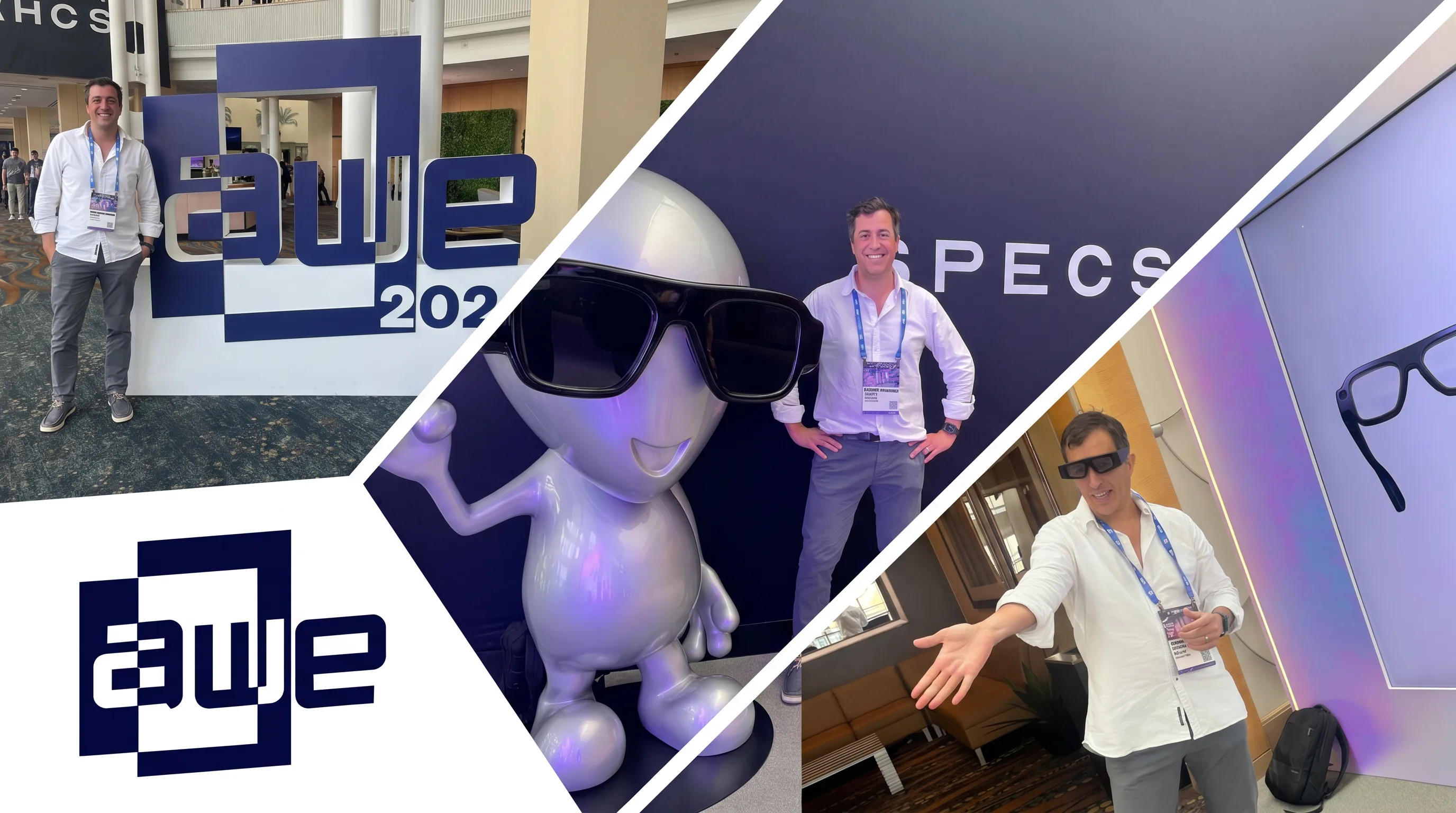
AWE 2026, the Augmented World Expo held June 16–19 in Long Beach, California, drew more than 5,000 attendees and made three trends clear: smart glasses have strong hardware momentum but a thin application ecosystem, enterprise VR training has moved from pilots into measured deployment, and agentic AI tools now shorten how XR teams build. Snap unveiled its sixth-generation AR glasses, Specs, at $2,195, while Meta Quest 3 remained the most-deployed VR headset at $499 and Samsung Galaxy XR ($1,799) took the mid-market. Amazon reported a 70% knowledge-retention gain training 400,000+ delivery drivers a year with combined AI and VR.
Key Takeaways
- Snap unveiled its sixth-generation AR glasses, Specs, at $2,195, shipping fall 2026 with a 51° field of view and full standalone operation.
- Meta Quest 3 remained the most-deployed VR headset at AWE 2026 at $499, with Samsung Galaxy XR ($1,799) taking the mid-market between Quest 3 and Apple Vision Pro.
- The smart glasses market reached $13.18 billion in 2026 and is projected to hit $62.64 billion by 2035, an 18.5% CAGR (Grand View Research, 2026).
- Amazon’s AI-plus-VR program trains 400,000+ delivery drivers a year and reported a 70% knowledge-retention gain and 30% faster prep-to-readiness.
- Meta’s agentic tools — Horizon Debug Bridge and Unity MCP Extensions — are production-ready for Quest development today.
Need help shipping an AR/VR product?
Frame Sixty is a full-service digital innovation studio specialising in AR/VR, mobile, and web development.
What Are Snap Specs and How Much Do They Cost?
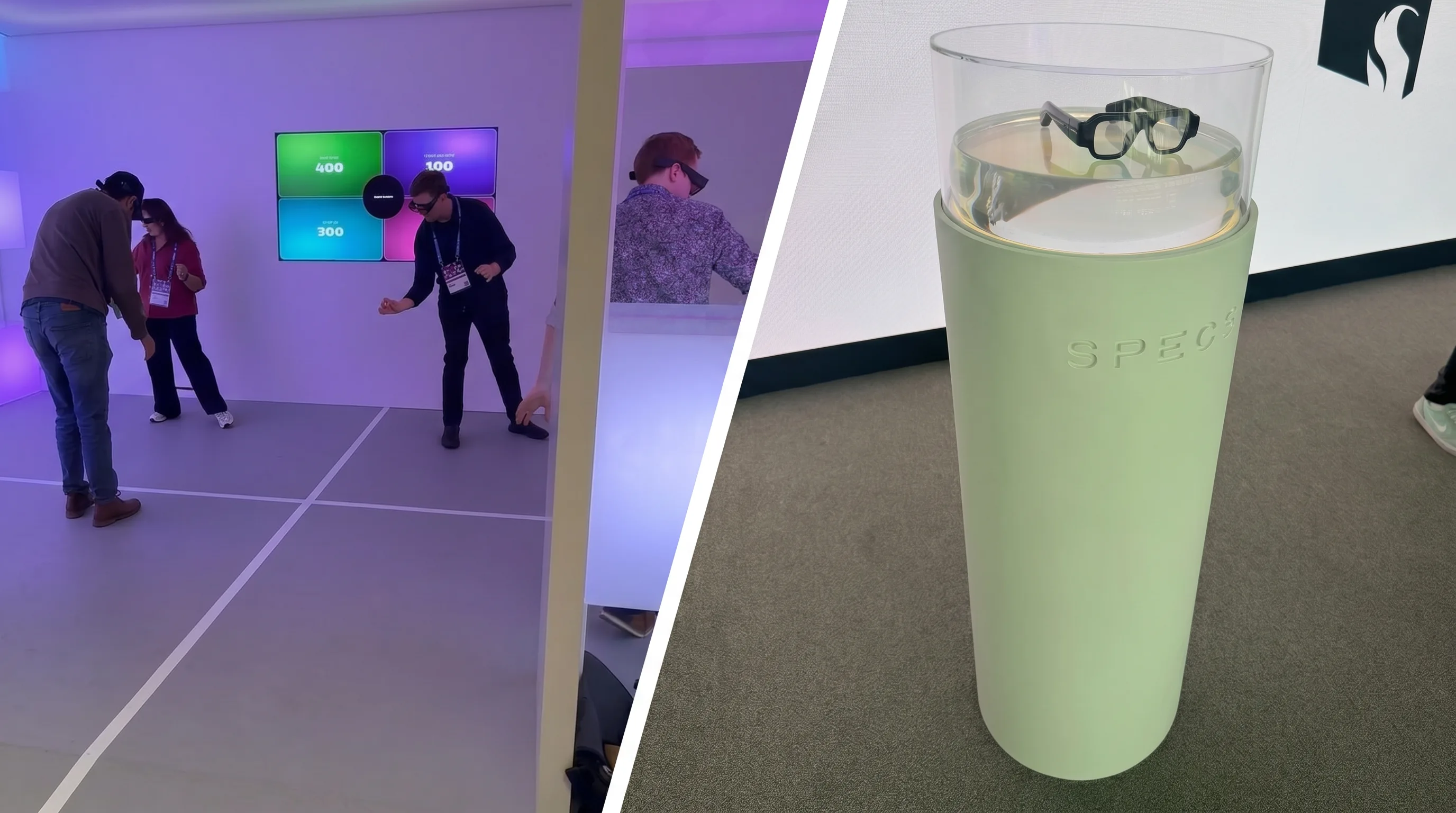
Snap Specs are Snap’s sixth-generation augmented reality glasses, unveiled by CTO Evan Spiegel as the headline hardware moment of AWE 2026. They cost $2,195, ship in fall 2026 across the US, UK, and France, and preorders are open now. Spiegel described Specs as “a computer that understands the world around you,” designed to fit “naturally into the flow of your day” (Engadget AWE 2026 live blog, 2026).
The hardware is built for standalone use, with no tethered compute puck. Road to VR’s specification breakdown (2026) lists a 51-degree field of view, an LCoS display rendering 16 million colors, dual Qualcomm Snapdragon processors, and 7-millisecond motion-to-photon latency. Battery life runs about four hours of mixed use, extended to roughly 20 hours with the charging case. Hand tracking is the primary input, and an AI assistant drawing on OpenAI and Google Gemini answers questions about what the wearer is looking at.
On the floor I tried the current-generation unit. The display quality was genuinely good, but hand-gesture interaction glitched in ways I’m not used to on Meta Quest or Apple Vision Pro, where gestures feel settled. Snap Specs won Best Headworn Device at the 2026 Auggie Awards, so the industry clearly rates the package highly — the interaction model just needs more time. The takeaway: Snap Specs are the most credible consumer AR glasses to date, but at this price they remain a developer and early-adopter device.
How Snap Specs Compare to the Previous Generation
Snap Specs improve on the fifth-generation Spectacles (2024) on nearly every axis that matters for all-day wear. The previous Spectacles weighed 226 grams, were tethered, and were never sold commercially. The new Specs weigh 132–136 grams — roughly 40% lighter — offer a 30% larger field of view, and operate fully standalone. The contrast explains why AWE treated this as a genuine product launch rather than a developer preview.
| Specification | Gen 5 Spectacles (2024) | Gen 6 Snap Specs (2026) |
|---|---|---|
| Weight | 226 g | 132–136 g |
| Field of view | Baseline | 51° (30% larger) |
| Operation | Tethered | Fully standalone |
| Availability | Developer-only | Commercial (fall 2026) |
| Price | Not sold | $2,195 |
| Sizes | Single | 47 mm and 52 mm |
Specs also add electrochromic lenses that shift from clear to tinted, prescription-insert support, and a design meant for both indoor and outdoor use. Snap’s developer base is a real asset here: the Lens Studio platform has 450,000 developers, and Snap added agentic coding tools using Claude and Codex to lower the cost of building Lenses (Engadget AWE 2026 live blog, 2026). For a deeper look at where this category is heading, see our guide to Android XR glasses and the next generation of spatial wearables. Snap Specs are the lightest, most self-contained glasses Snap has shipped, and the price keeps them aimed at builders for now.
Is Meta Quest 3 Still the Top VR Headset in 2026?
Yes — Meta Quest 3 remained the most widely deployed VR headset at AWE 2026, anchored by its $499 price, mature app ecosystem, and broad developer tooling. It showed up in more demos, developer sessions, and enterprise deployments than any other headset on the floor. Years of platform investment and a large installed base keep Quest 3 the default choice for studios and buyers who need volume.
That dominance is no longer uncontested. Samsung Galaxy XR is winning enterprise and creator interest on display quality, Apple Vision Pro holds the premium ceiling, and Snap Specs target a different use case in consumer AR. The competitive picture is healthier than it has been in years, but for shipping VR at scale, Quest 3 is still the safe bet. Our comparison of the best mixed reality headsets breaks down where each device fits.
Samsung Galaxy XR vs. Meta Quest 3: Specs and Price Compared
Samsung Galaxy XR and Meta Quest 3 target different buyers. Galaxy XR is a $1,799 premium headset with micro-OLED displays, eye tracking, and Android XR; Quest 3 is a $499 mainstream headset built for gaming, training, and volume enterprise deployment. The price gap reflects that split: Galaxy XR competes on fidelity, Quest 3 on reach.
| Spec | Samsung Galaxy XR | Meta Quest 3 |
|---|---|---|
| Price | $1,799 | $499 |
| Display | Micro-OLED, 3,552 × 3,840 per eye | LCD, 2,064 × 2,208 per eye |
| Cameras | 6 motion-tracking | 4 |
| Eye tracking | Yes | No |
| Operating system | Android XR | Meta Horizon OS |
These figures come from Android Central’s Galaxy XR versus Quest 3 comparison (2026). Galaxy XR suits professionals and content creators who want display fidelity and Samsung ecosystem integration, while Quest 3 fits enterprise VR training, gaming, and high-volume rollouts. Apple Vision Pro sits above both as the premium reference point. On the AWE floor, Samsung Galaxy XR looked like the player filling the middle of the market — more capable than Quest 3, far more affordable than Vision Pro. Teams planning Android XR projects can read our breakdown of Samsung Galaxy XR development.
Smart Glasses Were Everywhere at AWE 2026 — But the App Ecosystem Lags
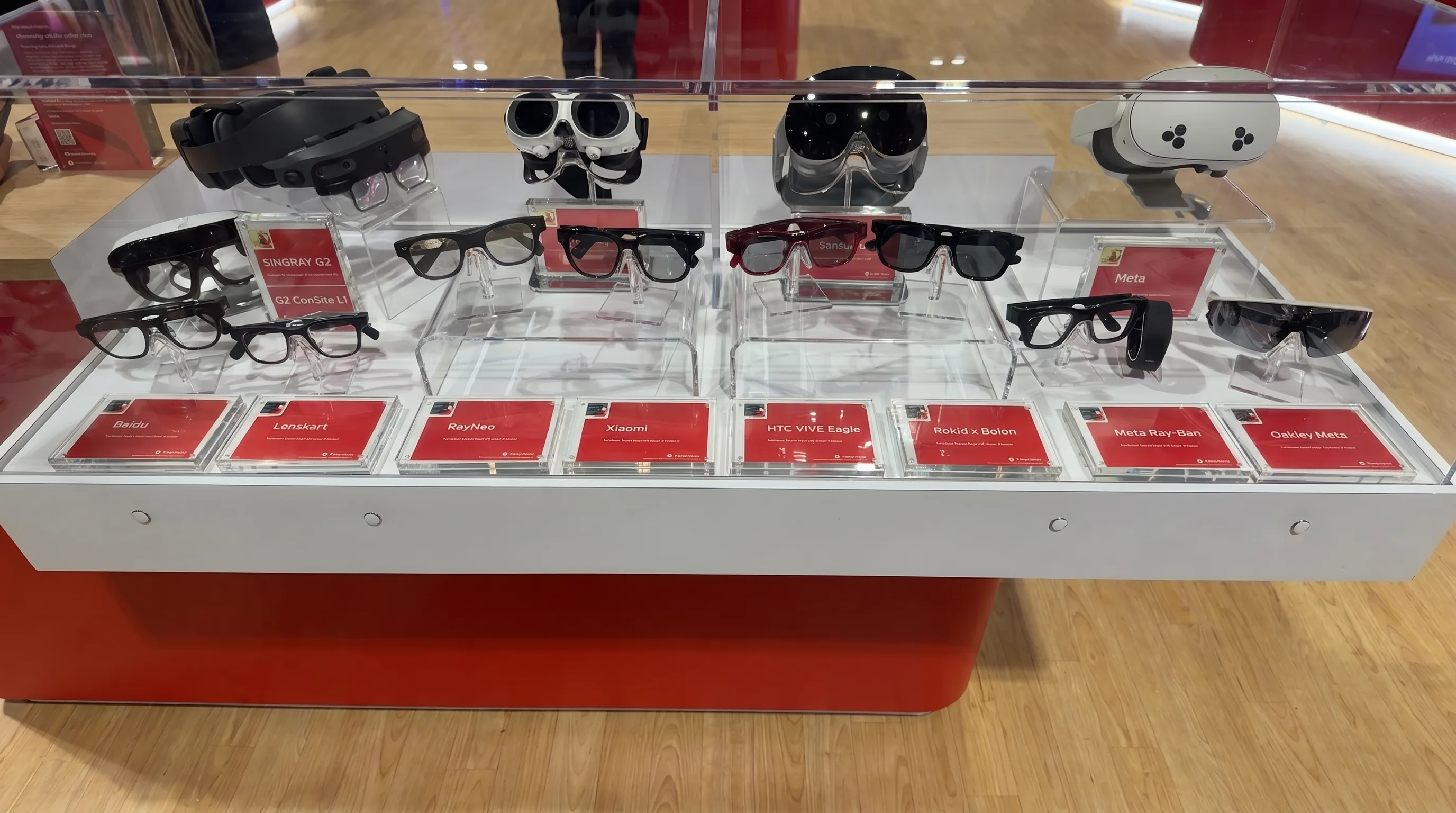
Smart glasses were the dominant hardware category at AWE 2026, with Google, Samsung, Qualcomm, XREAL, and Snap all showing models, alongside smaller firms building vertical-specific glasses for healthcare, logistics, and industrial work. The momentum on the hardware side is real. The gap is software: very few developers are building applications that actually run on these glasses, which leaves the most valuable layer of the stack wide open.
The market data backs the hardware story. The global smart glasses market reached $13.18 billion in 2026 and is projected to hit $62.64 billion by 2035, an 18.5% CAGR (Grand View Research via Market.us, 2026). Enterprise demand drives much of it:
- 45% of US smart glasses adoption comes from enterprise and defense applications (Market.us, 2026).
- 58% of US logistics companies use smart glasses for warehouse navigation and real-time tracking (Market.us, 2026).
- Healthcare accounts for about 22% of adoption, mostly surgical visualization and remote consultation, and 49% of surgeons believe smart glasses can reduce operating-room complications from human error (Vuzix Corporation, 2026).
That mix points to where the near-term value sits: purpose-built applications for hands-free work in warehouses, clinics, and factories. Building those experiences well is exactly the kind of work we cover in spatial computing for enterprise. Smart glasses hardware is ready; the applications are not, and that is the opportunity.
How Is Amazon Using VR for Delivery Driver Training?
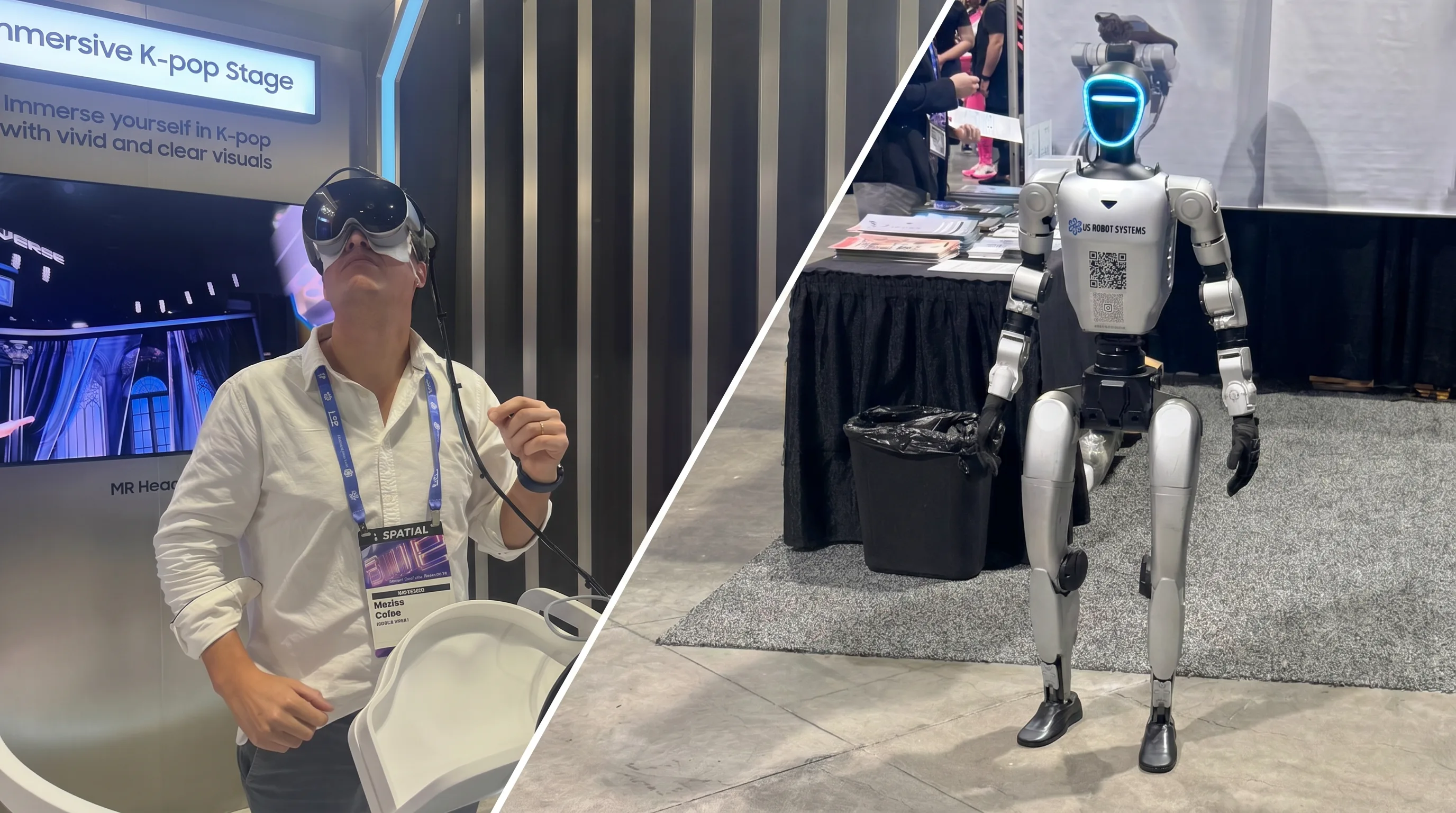
Amazon trains more than 400,000 delivery drivers a year using a stack that combines large language models, agentic AI, speech and text recognition, and immersive VR, according to the company’s AI-plus-XR session at AWE 2026. Amazon reported that the approach improved knowledge retention by 70% and cut prep-to-readiness time by 30%, while delivering personalized, accessible training across many languages and conditions. The session emphasized architectural patterns, measuring real impact, and keeping human expertise central.
Those internal results line up with broader VR-training research. VirtualSpeech’s 2026 training statistics report that VR learners are 275% more confident applying skills on the job than classroom learners (PwC, 2026) and complete courses four times faster than with classroom instruction (Finance Online, 2026). The pattern is consistent: immersive practice builds retention and confidence faster than slides or video.
What makes Amazon’s program notable is the combination, not VR alone. Pairing language models and agentic systems with immersive simulation is how training becomes personalized at the scale of hundreds of thousands of workers. That AI-plus-VR pairing is the focus of our work in AI in virtual reality development, and it is reflected across our broader VR training practice. The takeaway for enterprise buyers: the ROI case for VR training is now documented by a company operating it at massive scale.
THW: Scaling XR Across Federal Emergency Services
THW, Germany’s Federal Agency for Technical Relief, presented one of the strongest enterprise-scaling stories at AWE 2026. In a talk titled “Beyond Pilots and Headsets: Scaling XR in Federal Emergency Services,” Leon Pietschmann argued that XR should be treated as training infrastructure rather than a tool. THW scaled immersive, asynchronous, risk-free training across a decentralized organization supporting thousands of responders, without central classrooms, by integrating it into existing curricula and governance.
The session focused on where pilots usually fail — scaling — and addressed organizational buy-in, trainer trust, device logistics, and accessibility across a diverse, time-constrained user base. Pietschmann presented real-world outcomes including training success rates, adoption, and ROI, framing the work as a blueprint for public-sector XR. Delivered on the Enterprise track (sponsored by Lenovo) on June 18, 2026, the talk made the same point Amazon’s did from a different angle: the hard part of enterprise XR is no longer proving the concept, it is operationalizing it. THW showed that decentralized organizations can run XR training at scale when it is treated as infrastructure.
What Are the Agentic AI Tools for Unity XR Development?
Agentic AI tools for Unity XR development are AI-agent workflows that take a project from idea to a running Quest build faster by automating setup, scaffolding, and testing. At AWE 2026, Dilmer Valecillos, a Developer Advocate on Meta’s MR platform, presented “Accelerating Quest Development with Agentic Tools” to a packed room on June 17. The session walked through Meta MCP Extensions, the Unity AI Gateway, AI coding assistants, and the skills published in Meta’s Agentic Tools GitHub repository.
The workflow is practical: plan a project, scaffold core systems, build features, and iterate, with the AI agent handling the repetitive parts. Valecillos demonstrated going from a game idea to a playable Quest prototype inside this loop. The full session is available as Meta’s “Accelerating Quest Development with Agentic Workflows” video, presented with Unity’s Mike Geig and Meta engineers.
At Frame Sixty, an AR/VR and spatial computing development studio, we use Unity daily for XR work, so this is not a future bet for us — we are already adopting these workflows internally. If you build with Unity, our overview of game development in Unity covers the foundation these agentic tools sit on top of. The takeaway: agentic XR development is a shipping workflow in 2026, not a research demo.
Meta MCP Extensions and Horizon Debug Bridge in Practice
Horizon Debug Bridge (hzdb) is Meta’s CLI and Model Context Protocol server that gives an AI agent direct control over Quest development. Meta’s developer documentation on agentic tooling for VR describes a server with more than 40 tools that let an agent manage the device, control apps running on the headset in real time, capture and interpret Perfetto performance traces, search Meta’s official docs, and debug errors while the app runs. Work that traditionally takes hours of manual profiling becomes a fast diagnostic loop.
Meta’s Unity MCP Extensions package adds XR-specific capabilities on top of the base Unity MCP, including camera-rig setup, interaction-rig configuration, and on-device testing — all drivable by an AI agent. The tools work with Cursor, Claude, Copilot, and open-source models, so a studio can keep its existing assistant. For teams already building in Unity for Quest, the cost to adopt is low and the payoff is faster iteration. We explore the broader shift toward agent-driven XR in our piece on agentic spatial computing. The takeaway: hzdb and the Unity MCP Extensions turn AI agents into capable XR build-and-debug partners today.
Three Signals from AWE 2026 That XR Teams and Buyers Should Act On
AWE 2026 sent three signals worth acting on now, each backed by what was on the floor and in the sessions.
- Smart glasses hardware is outpacing its software. Every major brand showed glasses, the market is on track from $13.18 billion in 2026 to $62.64 billion by 2035 (Grand View Research, 2026), yet almost no one is shipping applications for them. The near-term advantage goes to teams that build apps before the category crowds.
- Enterprise VR training ROI is documented and repeatable. Amazon’s 70% retention gain across 400,000+ drivers and THW’s federal-scale rollout are published blueprints. The blocker is no longer proof of concept; it is vendor selection and integration.
- Agentic XR tooling is production-ready. Horizon Debug Bridge, Meta MCP Extensions, and the Unity AI Gateway are usable today and meaningfully shorten the build-and-debug loop.
Frame Sixty has tracked this trajectory across multiple AWE cycles, including our coverage of the 2025 Auggie Awards, and the throughline is consistent: the hard problems in XR are shifting from “can we build it” to “can we build the right thing well.” That favors teams with real production experience.
Conclusion
AWE 2026 confirmed that XR is moving from early adoption into everyday use, but unevenly. Snap Specs raised the bar for consumer AR glasses, Meta Quest 3 held its lead while Samsung Galaxy XR claimed the mid-market, and the smart glasses category drew billions in projected growth even as its application layer stayed thin. The hardware is arriving faster than the software to run on it.
The clearest near-term value lives in two places: applications for smart glasses that solve real hands-free work, and AI-plus-VR training that organizations like Amazon and THW have already proven at scale. Both depend on teams that can turn capable hardware into products people actually use. The agentic development tools shown at AWE 2026 make that build cycle faster than it has ever been.
If you’d like to turn any of these AWE 2026 signals into a shipping product — smart glasses apps, enterprise VR training, or agentic Unity workflows — reach out to our team at Frame Sixty. As an AR/VR and spatial computing development studio, we build on these platforms every day and can help you decide where to invest.
AWE 2026 Questions Answered
Common questions about AWE 2026 — the hardware, market data, and enterprise XR trends from the Augmented World Expo. Each answer pulls directly from what was shown and announced at the show.
AWE 2026 drew more than 5,000 attendees, 250 exhibitors, and 400 speakers to the Long Beach Convention Center in California from June 16-19, 2026. The Augmented World Expo ran under the theme "I, Spatial: Humans Empowered by Spatial AI," making it the largest gathering of AR, VR, and spatial computing professionals that year.
Snap Specs are full augmented reality glasses with a 51-degree field-of-view LCoS display, hand tracking, and standalone compute, priced at $2,195. Meta's Ray-Ban line targets a different category - camera-and-audio smart glasses without an immersive AR display - at a far lower price. Specs aim at spatial AR builders; Ray-Ban targets mainstream everyday wear.
For enterprise volume deployment, Meta Quest 3 remained the safe choice at AWE 2026, priced at $499 with a mature ecosystem and broad tooling. Samsung Galaxy XR ($1,799) suits fidelity-focused work with micro-OLED displays and eye tracking, while Apple Vision Pro holds the premium tier. The right pick depends on whether reach or display fidelity matters more.
Horizon Debug Bridge (hzdb) is Meta's CLI and Model Context Protocol server that gives an AI agent direct control over Quest development. It exposes more than 40 tools for managing the device, controlling apps on the headset in real time, capturing Perfetto performance traces, and searching Meta's docs. It works with Cursor, Claude, Copilot, and open-source models.
Amazon trains more than 400,000 delivery drivers a year using a stack that combines large language models, agentic AI, speech and text recognition, and immersive VR. Presented at AWE 2026, the program reported a 70% knowledge-retention gain and 30% faster prep-to-readiness. The value comes from pairing AI personalization with VR practice, not VR alone.
Frame Sixty, an AR/VR and spatial computing development studio, builds the products AWE 2026 pointed to: smart glasses applications, enterprise VR training, and agentic Unity workflows. The team builds in Unity daily and already uses Meta's agentic tools, including MCP Extensions, internally. See AR/VR app development or get in touch to scope a project.
Get in touch
We’re interested to see how we can help. Send us a message and we will get back to you within 24 hours.