
How to Identify and Evaluate a Top Augmented Reality Developer
Apr 8, 2026
Updated
14 MIN READ
A top augmented reality developer is a software engineer who builds applications that overlay digital content onto the physical world, combining 3D graphics, computer vision, and platform-specific SDKs such as ARKit or ARCore. Evaluating one is hard because that skill set spans four disciplines a general mobile developer rarely holds together. This guide gives you the criteria, tests, and cost benchmarks to hire the right one.
The stakes are rising with the market. The AR/VR market reached $99.81 billion in 2025 and is on track for $125.11 billion in 2026, according to Mordor Intelligence data. XR device shipments hit 14.5 million units in 2025, up 41.6% year over year per IDC’s 2025 figures reported by Treeview Studio. More money and more devices mean more developers claiming AR expertise, and more ways to hire the wrong one.
Here is the position worth defending: the most expensive mistake in AR hiring is matching a generalist to a specialist problem. “AR experience” in the abstract tells you almost nothing. A developer who ships polished phone try-on apps may be the wrong hire for a SLAM-based industrial inspection tool, and the gap only shows up after you have paid for the wrong build. Evaluate for the specific track your project needs.
Key Takeaways
- The AR/VR market reached $99.81 billion in 2025 and is projected at $125.11 billion in 2026 (Mordor Intelligence).
- AR/VR job postings grew 154% over five years and are projected to reach 2.32 million U.S. roles by 2030 (Treeview, 2026).
- AR development splits into five distinct tracks; hiring across track boundaries is the most common costly mismatch.
- A 2–4 hour on-device build test filters experienced AR developers from resume inflators better than any portfolio review (KORE1, 2026).
- Simple marker-based AR apps cost $5,000–$15,000; complex markerless apps run $50,000–$250,000+ (DesignRush, 2025).
What Does an Augmented Reality Developer Do?
An augmented reality developer builds software that renders digital content onto a live view of the real world, delivered through smartphones, smart glasses, or headsets. The role combines 3D content creation, computer vision, real-time rendering, and spatial tracking. A strong AR developer does not just place a 3D model on screen. They keep it anchored, lit correctly, and responsive as the user and the environment move.
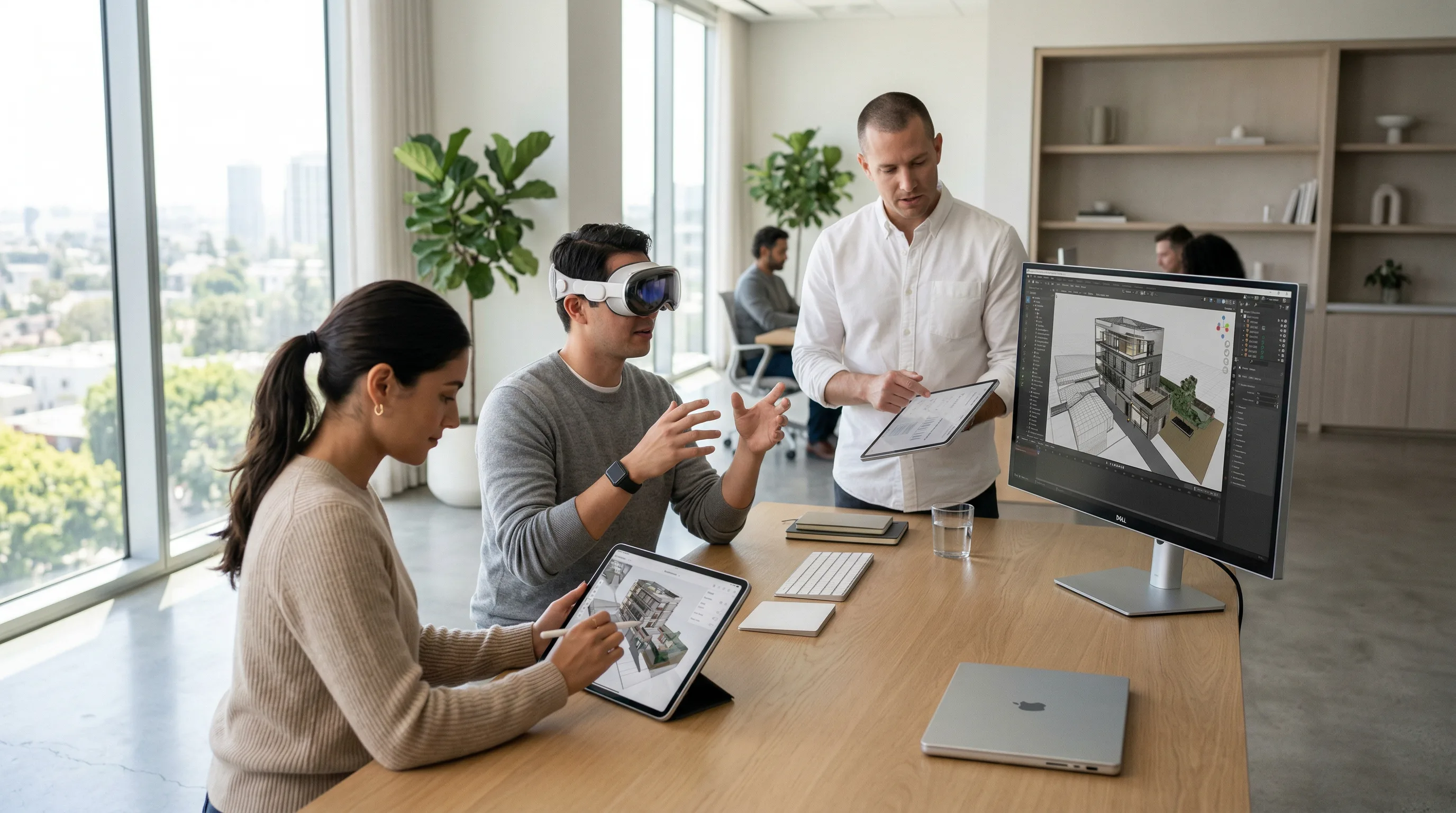
The output depends on the target device, and the device list in 2026 is wide. Mobile AR developers ship iOS and Android apps. Smart glasses developers build for Meta Ray-Ban Display and Xreal Glasses. Headset developers target Meta Quest 3, Meta Quest 3s, Apple Vision Pro, and Samsung Galaxy XR. Enterprise developers work on industrial and medical overlays for Magic Leap 2.
One shift matters more than the rest. The line between an AR developer and a spatial computing developer has effectively disappeared. With cross-platform ARKit, a single machine-learning model can run on an iPhone field app and an Apple Vision Pro M5 headset from shared code, so the same hire may need to reason about a handheld camera and a head-worn display at once. A developer who understands only one form factor is now under-qualified for serious Apple-platform work. For a fuller picture of the role itself, see our breakdown of what it means to be an augmented reality developer.
What Technical Skills Should a Top AR Developer Have in 2026?
A top AR developer in 2026 needs fluency in at least one 3D engine, one platform-native language, a 3D asset pipeline, and the performance discipline to hold a frame budget on real hardware. Skills cluster into two layers: the engine-and-language foundation every AR developer shares, and the spatial computing knowledge that separates current-generation builders from those still shipping marker-based work.
Core Programming Languages and Engines
The foundation is a language paired with an engine. C# drives Unity. C++ drives Unreal Engine. Swift and SwiftUI drive ARKit and visionOS, while Kotlin or Java drive ARCore on Android. A credible mobile AR developer owns at least one platform-native language plus one engine, not a passing familiarity with both.
Unity dominates mobile AR and rapid prototyping. Unreal Engine leads high-fidelity enterprise and defense work. Cross-platform projects sometimes use both, which raises the bar for the hire.
Beyond the engine sits the 3D pipeline. Look for comfort with a tool like Blender for asset creation, glTF for real-time delivery, and level-of-detail systems that cut polygon counts to hit device performance targets. Apple’s ARKit and RealityKit documentation and Google’s ARCore developer documentation define the current feature sets a serious candidate should reference by name. A strong developer can also state their targets without prompting: 60 frames per second sustained, tracking latency low enough to avoid visible drift, and enough memory headroom for the operating system to keep running behind the experience.
Spatial Computing and the 2026 Platform Landscape
Spatial computing knowledge is what separates a current AR developer from one whose skills stopped at marker tracking. On the Apple side, that means RealityKit for rendering and Reality Composer Pro for authoring. visionOS 27, which reached production in fall 2026, added cross-platform ARKit and a Spatial Accessories SDK, detailed in our visionOS 27 overview.
Markerless tracking is the practical dividing line for enterprise work. SLAM (simultaneous localization and mapping) and LiDAR scanning let an app anchor content to the physical world without printed markers or GPS. Most industrial AR depends on it.
Cross-device standards matter for anyone buying at scale. OpenXR lets one codebase target Magic Leap 2, Samsung Galaxy XR, and Meta Quest 3 without per-device rewrites. WebXR delivers AR in a browser with no install, at lower fidelity, which makes it the fastest route to a pilot. On-device AI has also become a baseline expectation: object recognition, scene understanding, and predictive tracking now distinguish a modern build from a legacy one. Apple’s push to reposition these tools as enterprise infrastructure is covered in our analysis of spatial computing at WWDC 2026.
Which AR Developer Specialization Does Your Project Actually Need?
The specialization you need depends on your project’s core technical problem, not on a generic “AR developer” title. The AR labor market has split into five distinct tracks, each with its own interview screens, portfolio signals, and pay bands. Matching the track to the problem is the single highest-leverage decision in the hiring process.
The Five AR Developer Career Tracks
According to the staffing firm KORE1’s May 2026 hiring analysis, AR/VR work now separates into five tracks, each requiring a different technical screen. The compensation figures below are U.S. base-plus-equity ranges from that same KORE1 report.
| Track | Owns | Mid-level | Senior |
|---|---|---|---|
| Engine/rendering (C++) | Rendering pipeline, performance architecture | $165K–$210K | $220K–$295K |
| Gameplay/interaction (Unity, Unreal) | Interaction, animation, experience logic | $145K–$185K | $190K–$250K |
| Spatial UX/visionOS | Eye, hand, and voice interaction model | $170K–$215K | $225K–$300K |
| Computer vision/SLAM | Tracking, depth sensing, scene reconstruction | $175K–$225K | $235K–$310K |
| WebXR/lightweight AR | Browser-delivered experiences | $115K–$150K | $155K–$195K |
The tracks explain the mismatch problem in concrete terms. Put a gameplay developer on a SLAM-based inspection tool and the demo will look fine right up until it has to hold a stable anchor on a factory floor in changing light. That failure surfaces late, after the budget is committed. If your project lives or dies on tracking accuracy, hire a computer vision engineer, not a generalist who lists “AR” on a resume. For Apple-specific projects, our guide to hiring ARKit developers breaks the screens down further, and our Apple Vision Pro developer guide covers the spatial UX track in depth.
ARKit, ARCore, OpenXR, or WebXR: Matching Platform to Project
The right SDK follows from where your users are and how the experience ships. ARKit, ARCore, OpenXR, and WebXR are not interchangeable, and a developer strong in one is not automatically strong in another. The table below maps each to the project type it fits best.
| Platform | Choose it for | Watch for |
|---|---|---|
| ARKit | iOS, iPadOS, visionOS; LiDAR features; App Store and Apple Vision Pro M5 deployment | Verify visionOS work separately; iOS skill does not guarantee it |
| ARCore | Android-first or cross-platform mobile; Geospatial API anchored to Google Maps locations | Confirm depth and occlusion experience, not just plane detection |
| OpenXR | Enterprise deployments across Magic Leap 2, Samsung Galaxy XR, Meta Quest 3 | Look for OpenXR runtime experience, not just Unity or Unreal familiarity |
| WebXR | No-install consumer pilots, retail try-on, proof of concept | Accept lower fidelity as the trade for reach |
The practical rule: pick the platform from the distribution and hardware constraints first, then hire for it. A retail team validating a try-on concept wants WebXR and a fast pilot. A manufacturer deploying to mixed headsets wants OpenXR and a developer who has shipped on it.
Need help hiring an AR developer?
We are here to help!
How to Evaluate an Augmented Reality Developer’s Portfolio
Evaluate an AR developer’s portfolio by prioritizing shipped, playable products over concept reels, then probing the technical decisions behind each build. Shipped App Store and Google Play listings prove the developer finished the full cycle: requirements, build, optimization, and platform certification. A rendered highlight video proves none of that.
Ask for a playable build, not footage. Studios that show only polished reels may never have carried a product through review and post-launch maintenance. When you review a real project, dig into the hard parts with specific questions. What was the toughest technical problem on this build? How did you hold your frame rate on older devices? What happens to tracking when the lighting is poor, and how did you handle that failure state?
In our own AR work at Frame Sixty, an AR/VR and spatial computing development studio, portfolio review always ends at an on-device session rather than a screen recording. A model that looks flawless in the editor can drift, stutter, or blow the memory budget once it is running on the actual Meta Quest 3 or Apple Vision Pro hardware, competing with the operating system for resources. We check anchor stability under movement, frame pacing during interaction, and how the experience degrades when tracking is lost, because those are the moments users actually notice.
The strongest single filter is a small, real, on-device build. KORE1’s May 2026 analysis recommends replacing the generic coding screen with a two-to-four-hour on-device task, which it calls the most effective way to separate experienced builders from resume inflators. Robert Ardell, Co-Founder of KORE1, notes that “the strongest part of the current pool” includes engineers who left Apple’s Vision Products Group after April 2026, whose résumés look thin only because the work was NDA-protected. For that group, a structured build tells you far more than a project list.
Rigorous screening is genuinely selective. Toptal reports that fewer than 3% of AR developer applicants clear its five-stage process, which includes a live expert interview and a one-to-three-week test project. You do not need Toptal’s funnel, but you do need a bar. Our roundup of top augmented reality companies shows what a shipped-work portfolio looks like at the studio level.
Red Flags When Hiring an Augmented Reality Developer
The clearest red flags fall into three groups: an unprovable portfolio, vague technical answers, and loose contract terms. As Reality Atlas put it in its May 2026 partner guide, “The single biggest predictor of success is not the headset or the budget. It is the partner you choose to build with.” Watch for these signals before you sign.
Portfolio red flags:
- Only rendered videos, with no playable builds and no App Store or Google Play links.
- No shipped products, only prototypes, internal demos, or “concept experiences.”
- Work in a single modality, such as all phone AR, when your project needs headset expertise.
Technical red flags:
- Cannot discuss performance limits concretely, including frame rate, memory headroom, and battery draw.
- No clear method for testing across the hardware matrix, where cameras, depth sensors, and OS versions differ by device.
- Modality blindness, treating AR on iPhone, Meta Quest 3, and Magic Leap 2 as the same problem.
Process and contract red flags:
- Vague or unwritten IP terms. Code and asset ownership must be defined before work starts.
- Timelines that skip optimization, cross-device testing, and platform certification.
- Senior staff who appear only in sales calls while junior developers do the delivery.
The Reality Atlas guide also stresses that AR and VR demand distinctly different expertise, so strength in one modality does not carry over to the other. Treat any of these signals as a reason to slow down, not a detail to overlook.
How Much Does It Cost to Hire an Augmented Reality Developer?
AR developer costs depend on project complexity, engagement model, and location, ranging from a few thousand dollars for a marker-based pilot to six figures for enterprise builds. The sections below separate project-level pricing from hourly and salary figures so you can budget against the right baseline.
Project-Level Cost Ranges
Project cost scales with technical complexity. According to DesignRush’s cost guide updated in December 2025, a simple marker-based AR app runs $5,000–$15,000, while a complex markerless app with object tracking and SLAM runs $50,000–$250,000 or more. Enterprise AR that adds AI, IoT connectivity, or multi-user spatial anchoring starts in six figures.
Feature-level pricing from the same DesignRush guide helps you scope. Object recognition adds $10,000–$50,000. Gesture control adds $20,000–$50,000. 3D modeling and rendering adds $5,000–$30,000. Platform licensing is a separate line: Unity Pro is $1,800 per seat per year, and Vuforia Cloud starts around $1,000 per month.
The cost is easier to justify when you tie it to return, not to the technology. Manufacturers report a 72% rate of positive ROI in the first year of AR deployment, per the 2025 AR trends analysis from Imagine.io, and businesses using AR see conversion rates rise by up to 40% according to McKinsey. Those returns hold when the project is scoped to a real workflow. They evaporate when AR is bought as a demo. Our overview of augmented reality development services walks through scoping a build to a measurable outcome.
Hourly Rates and Engagement Models
Hourly AR rates in 2026 run from roughly $50 to $280, depending on seniority, model, and geography. Time-and-materials engineering falls in the $50–$200 range. Contract rates from KORE1’s May 2026 data run $110–$185 per hour for mid-level roles and $185–$280 per hour for senior roles on W2 terms.
Other models trade flexibility for predictability. A fixed-price arrangement for a clearly scoped deliverable typically lands at $5,000–$50,000. A dedicated team, whether through an agency or staffing firm, runs $100,000–$500,000 per year. Geography moves the numbers sharply: North American senior rates reach $275 per hour, while offshore teams with comparable capability start far lower.
Full-time salaries anchor the top of the market. Senior spatial UX and visionOS developers command $225K–$300K in total compensation, and computer vision and SLAM specialists reach $235K–$310K, per the KORE1 report. Those figures reflect demand: AR/VR job postings grew 154% over the past five years and are projected to reach 2.32 million U.S. roles by 2030, according to Treeview Studio’s 2026 industry data. Broader adoption backs the trend, with mobile AR users reaching 1.7 billion in 2024 on the way to a projected 2.6 billion by 2027, per Market.us statistics drawn from Statista, and 1.4 billion active AR devices recorded in 2023 in the Market.us market report.
AR Development Agency vs. Freelancer: How to Choose
Choose a freelancer for a defined, short-scope deliverable; choose an agency for complex or ongoing work that needs a multi-track team; build in-house when AR is a core product capability. Neither model wins in the abstract. The right one depends on scope, IP ownership needs, how long you need the capability, and whether one specialization can cover the job.
In our project work at Frame Sixty, the deciding factor is usually whether a build spans more than one track. A WebAR retail pilot can be one skilled developer for a few weeks. A visionOS enterprise app that needs a computer vision engineer for tracking, a spatial UX specialist for the interaction model, and a rendering engineer for the frame budget cannot be. Staffing a multi-track problem with a single generalist is the same mismatch that sinks portfolios, moved up to the hiring-model level. Studios that already stock the full range of AR services carry that coordination for you; see how we structure our augmented reality services.
Decision Framework: Agency, Freelancer, or In-House
Use the framework below to match the engagement model to your project. Each row is a factor buyers weigh; the guidance under the table translates the rows into concrete choices.
| Factor | Freelancer | Agency/Studio | In-house |
|---|---|---|---|
| Typical scope | Defined, short-term | Multi-phase to ongoing | Continuous |
| IP ownership | Negotiated per contract | Transfers on payment | Employer owns all |
| Multi-track depth | Single track | Full team across tracks | Builds over time |
| Post-launch support | Limited | Structured SLAs | Owned internally |
| Cost structure | Lowest upfront | Mid-range blended | Highest total cost |
Read the framework by matching model to project. A one-time WebAR retail pilot suits a senior freelancer or a small agency on fixed scope. An enterprise spatial computing or Apple Vision Pro M5 deployment suits a specialized studio that can field every track at once. An ongoing AR product, where the capability is a lasting differentiator, suits an in-house team or a long-term agency retainer. If you are comparing studios, our roundup of top augmented reality companies lays out selection criteria in detail, and our look at how businesses apply augmented reality shows the ROI baselines worth scoping against.
Conclusion
Hiring a top augmented reality developer comes down to one discipline: match the hire to the problem. The market is large and growing, from $99.81 billion in 2025 toward $125.11 billion in 2026 per Mordor Intelligence data, which means the pool of people claiming AR skills is larger and noisier than ever. The five-track split, the platform-by-project SDK choice, and the shipped-work portfolio bar all exist to answer the same question: can this specific developer solve this specific problem on real hardware?
The most expensive mistake is still the one named at the start. A generalist on a specialist problem produces a demo that works and a product that does not. Guard against it with a real on-device build test, concrete performance questions, written IP terms, and an engagement model sized to whether your project spans one track or several. Those checks cost far less than a rebuild.
If you are planning an AR build and want a team that spans every track from computer vision to spatial UX, get in touch with Frame Sixty. We will help you scope the project to a measurable outcome and staff it with the specialization it actually needs.
FAQs
Common questions about how to hire, evaluate, and budget for an augmented reality developer in 2026. Each answer stands on its own, grounded in current market and cost data.
An AR developer builds experiences that overlay digital content onto the real world, while a VR developer creates fully enclosed virtual environments. The skills do not transfer cleanly: AR demands real-time tracking, occlusion, and lighting that match live surroundings, whereas VR prioritizes immersion and comfort. Reality Atlas notes AR and VR require distinctly different expertise, so strength in one modality rarely carries to the other.
Manufacturing, industrial inspection, retail, and enterprise training drive the most augmented reality development work in 2026. Manufacturers report a 72% rate of positive ROI in the first year of AR deployment, per Imagine.io's 2025 analysis, and businesses using AR see conversion rates rise by up to 40% according to McKinsey. Industrial AR built on SLAM and markerless tracking is the fastest-growing segment.
AR app development typically takes a few weeks for a simple marker-based pilot and several months for a complex markerless build with SLAM or multi-user anchoring. Timeline scales with the same complexity that drives cost: a $5,000–$15,000 marker app ships quickly, while a $50,000–$250,000 enterprise app needs time for optimization, cross-device testing, and platform certification. Beware timelines that skip those steps.
Ask an augmented reality developer how they hold 60 frames per second on older devices, what happens to tracking in poor lighting, and how they recover a lost anchor. Probe the toughest technical problem on a real shipped build. KORE1's May 2026 analysis recommends replacing the generic coding screen with a two-to-four-hour on-device task, the most effective way to separate experienced builders from resume inflators.
ARKit is Apple's SDK for iOS, iPadOS, and visionOS; ARCore is Google's SDK for Android and cross-platform mobile; OpenXR is a cross-device standard for enterprise headsets like Magic Leap 2, Samsung Galaxy XR, and Meta Quest 3. The difference matters when hiring because a developer strong in one is not automatically strong in another, so verify visionOS and OpenXR runtime experience separately.
Spatial computing has merged the AR developer and spatial computing developer roles, so augmented reality developers now need both handheld and head-worn expertise. visionOS 27, which reached production in fall 2026, added cross-platform ARKit that lets one machine-learning model run on an iPhone field app and an Apple Vision Pro M5 headset from shared code. A developer fluent in only one form factor is now under-qualified for serious Apple-platform work.
Verify an augmented reality developer's claimed experience by asking for a playable, on-device build rather than a highlight reel, then testing anchor stability, frame pacing, and how the experience degrades when tracking is lost. Shipped App Store or Google Play listings prove the developer finished the full cycle. Note that some strong candidates, such as ex-Apple Vision Products Group engineers, have thin résumés only because their work was NDA-protected.
Look for an AR/VR development partner that fields every specialist track, including computer vision, spatial UX, and rendering, rather than one generalist stretched across all of them. Confirm shipped on-device work, written IP terms, and a testing plan that covers the hardware matrix. Frame Sixty, an AR/VR and spatial computing development studio, staffs multi-track builds and scopes each project to a measurable outcome.
You need an ARKit specialist when your project targets iOS, iPadOS, or visionOS and depends on LiDAR, RealityKit, or Apple Vision Pro deployment, because a generalist augmented reality developer rarely carries that depth. Match the hire to the project's core technical problem: if tracking accuracy decides success, hire a computer vision engineer, not someone who simply lists AR on a résumé.
Get in touch
We’re interested to see how we can help. Send us a message and we will get back to you within 24 hours.