
AR for Manufacturing: Use Cases, Proven ROI, and How to Run a Pilot
Oct 21, 2026
12 MIN READ
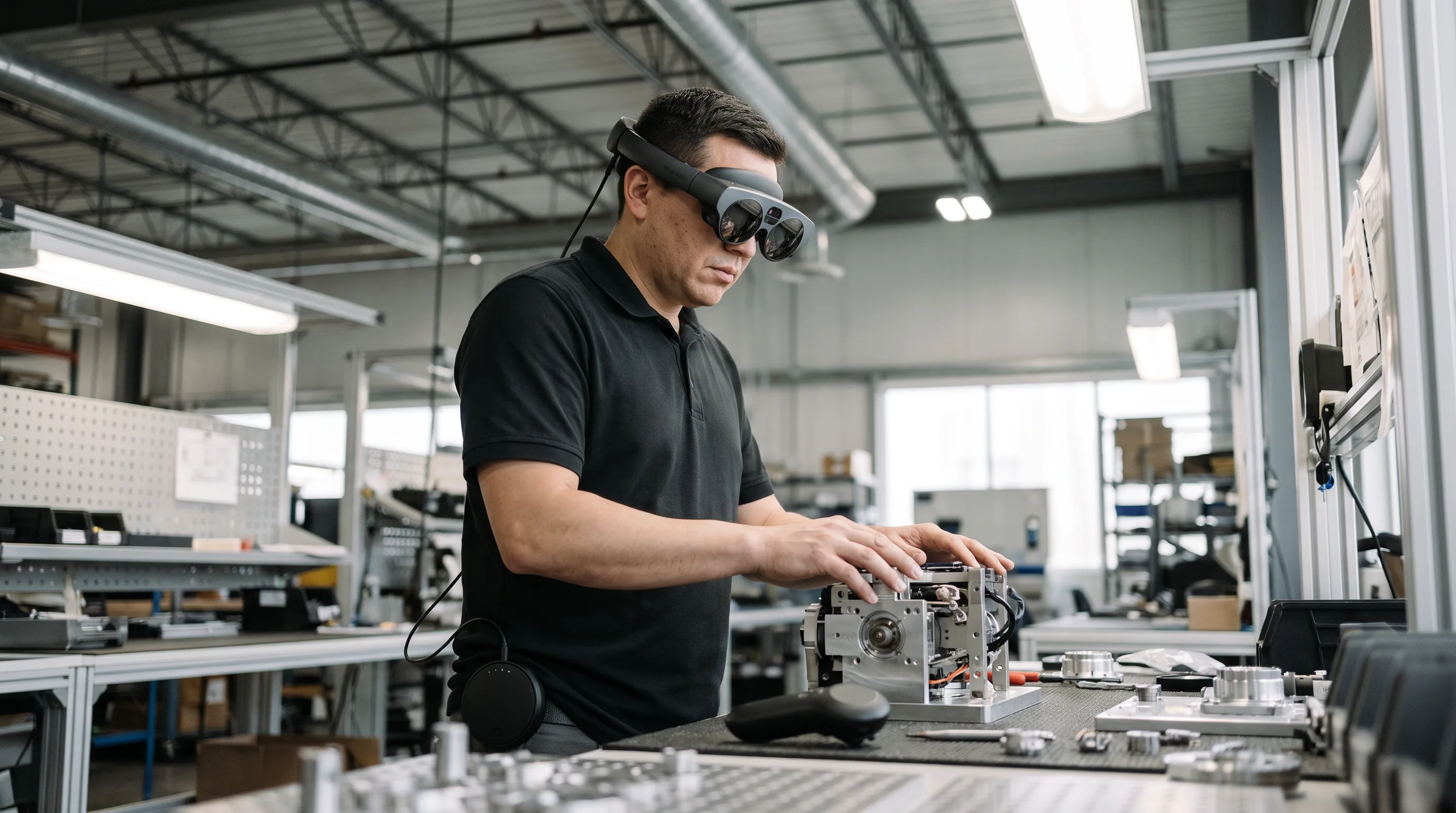
AR for manufacturing is the use of augmented reality to overlay digital information — assembly steps, inspection criteria, remote expert annotations — directly onto physical equipment, parts, and workstations, viewed through smart glasses, tablets, or phones. On the shop floor it supports four proven uses: assembly guidance, quality inspection, remote expert assistance, and worker training. Manufacturers adopt it to cut assembly errors, shorten onboarding, and reduce expert travel.
One position worth stating plainly: the manufacturers who get value from AR start with a problem, not a platform. The ones who stall start by licensing an enterprise AR suite, then hunt for a workflow to justify the spend. Pick one workflow with a number you can move. Assembly error rate, inspection time, dispatch count. Scope everything around moving that single number, and the business case writes itself.
Key Takeaways
- Boeing reached 88% first-pass accuracy and a 20% cut in task time using Microsoft HoloLens 2 for wiring harness assembly across 15 facilities.
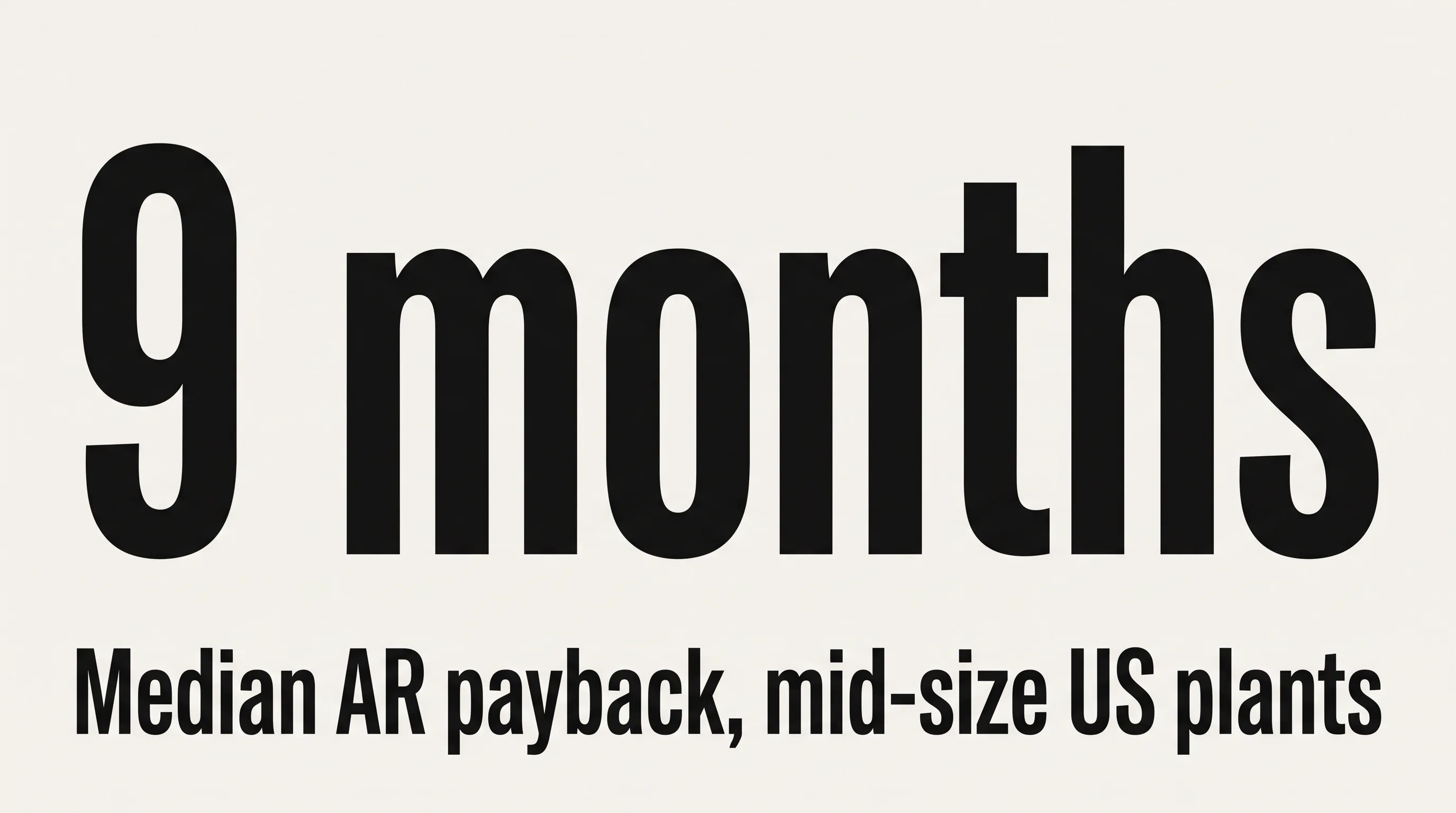
- 72% of manufacturers that deployed AR reported positive ROI within the first year, and mid-size US plants report a 9-month median payback.
- An AR pilot for 5 to 10 workers costs $25,000 to $75,000 over 8 to 12 weeks; a full plant rollout runs $200,000 to $500,000.
- Safran achieved a 4x gain in incoming inspection efficiency and a 7x cut in paint-masking non-quality costs with DELMIA augmented reality.
- Microsoft Dynamics 365 Guides and Remote Assist lose support on December 31, 2026, forcing a migration decision for any plant running them.
What are the main use cases of AR in manufacturing?
The main use cases of AR in manufacturing are assembly guidance, quality inspection, remote expert assistance, and worker training. Each maps to a measurable shop-floor cost: error rates at the workstation, defects that reach the customer, expert travel between sites, and the months it takes to bring a new hire up to speed. The sections below cover each with outcome data, not projections. For a wider view of the category, see our guide to industrial augmented reality use cases.
How does AR reduce assembly errors?
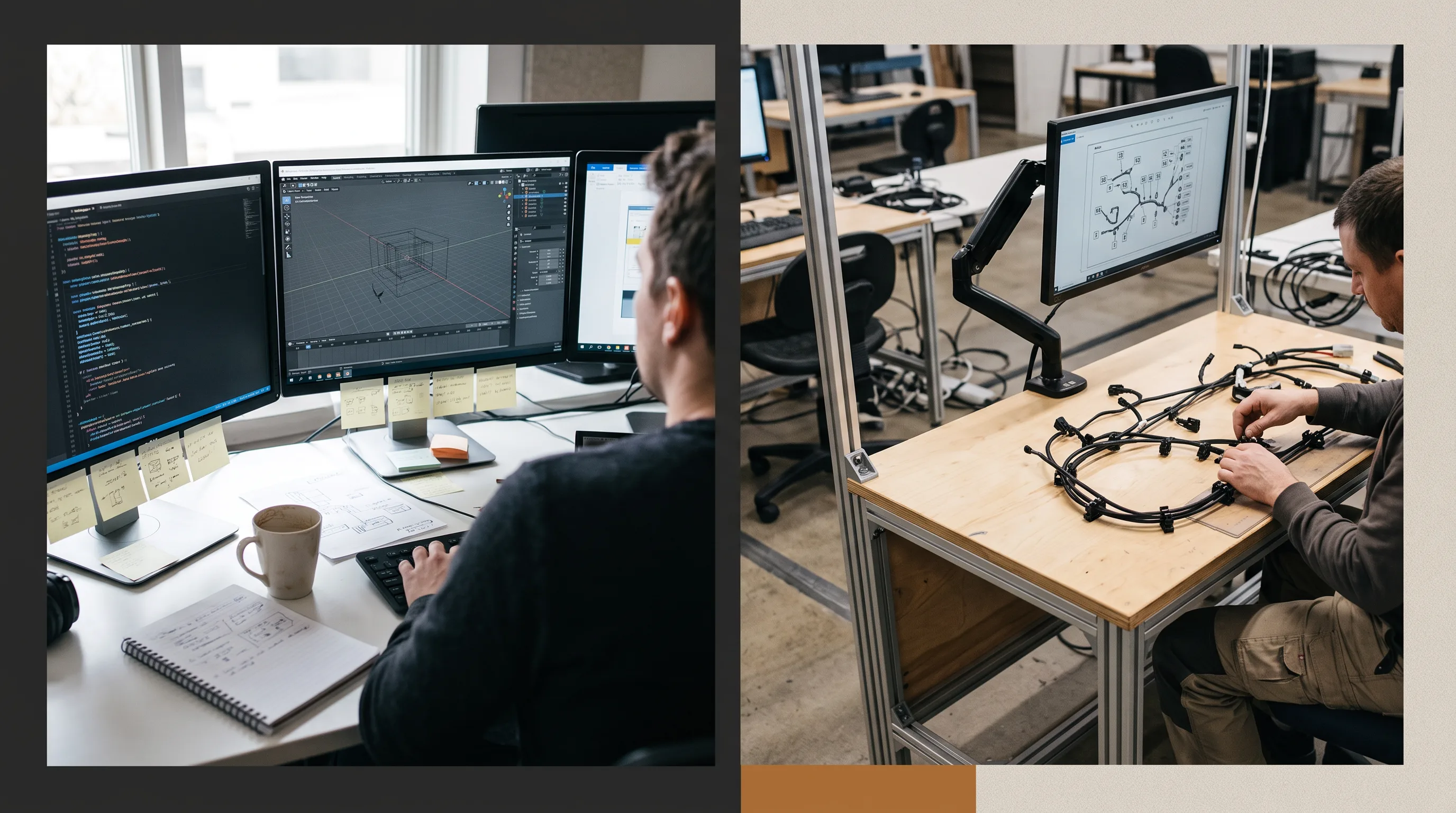
AR reduces assembly errors by projecting step-by-step instructions onto the actual part at the actual workstation, so an operator never looks away to a paper manual or a screen. The overlay confirms the right component, position, and sequence before the next step. Boeing deployed HoloLens 2 for wiring harness assembly across 15 global facilities and hit 88% first-pass accuracy with a 20% reduction in task completion time, AR Insider documented in 2022. Lockheed Martin went further on the training side, cutting instruction interpretation time by 95% and saving $38 per fastener, Treeview Studio reported in 2026.
The gain holds up under scrutiny. A 2024 MDPI meta-analysis of 14 industrial AR studies found a standardized mean difference of 0.79, a statistically significant performance gain across assist and training, Kivicube summarized in 2026. Accurate overlays depend on accurate source geometry, which is why 3D modeling for manufacturing sits upstream of any assembly AR project.
How does AR improve quality inspection?
AR improves quality inspection by overlaying a digital reference model onto the physical part in real time, flagging gaps, misalignment, and missing components that a visual check would miss. Inspectors compare the virtual reference against the actual part without a paper checklist. Safran used DELMIA augmented reality to achieve a 4x improvement in incoming inspection efficiency and a 7x reduction in non-quality costs for paint masking, Dassault Systèmes reported in 2025. Latecoere cut aerostructure inspection times by 30% with the same approach.
The aerospace numbers are striking. Airbus reduced inspection of 60,000 A380 fuselage brackets from three weeks to three days using its MiRA overlay system, per the same 2026 Kivicube analysis. Automotive plants see comparable gains on gap-and-flush and weld verification, which we cover in our work on augmented reality in car manufacturing.
How does AR remote expert assistance work?
AR remote expert assistance works by letting an off-site expert see an on-floor technician’s exact field of view through smart glasses and annotate it in real time, with the annotation locking onto the physical equipment as the technician moves. It replaces a flight and a hotel with a video session. OxMaint’s 2026 maintenance guide puts the average avoided expert travel cost at $12,000 per resolved incident and the MTTR reduction at 50% for first-line triage.
Adoption follows the savings. Henkel rolled out AR remote assistance across more than 30 plants and saw over 200 employees adopt it within six months, Kivicube noted in 2026. AIDAR Solutions reported in 2025 that manufacturers cut annual travel budgets by up to 75% and onboard new technicians 40% faster. For the build-versus-buy detail on this use case specifically, see our breakdown of AR field service economics.
How does AR speed up worker training?
AR speeds up worker training by overlaying guidance onto the real machine a new hire will operate, so skills are learned in context rather than in a classroom. The timing matters: nearly 500,000 US manufacturing jobs sat unfilled as of May 2025, ManageXR reported, citing Bureau of Labor Statistics data. Carolyn Lee, President and Executive Director of the Manufacturing Institute, framed the bottleneck in that reporting: “The challenge is that there is no one walking around on the street with these skills, and it takes one to two years to teach those skills and another one to two years to contextualize those skills to the specific plant environment.”
AR compresses that second window. Lockheed Martin cut technician ramp-up time by 85%, and the economics of training content follow a clear threshold, which we unpack in our guide to AR training software build-vs-buy.
What ROI can manufacturers expect from AR?
Manufacturers can expect positive ROI within the first year from a well-scoped AR deployment. 72% of manufacturers that deployed AR reported first-year ROI, and iFactory’s 2026 field guide puts the median payback at mid-size US facilities at nine months, with 48% of Tier 1 US manufacturers now running active wearable pilots. ROI varies by use case, so the starting point shapes the timeline.
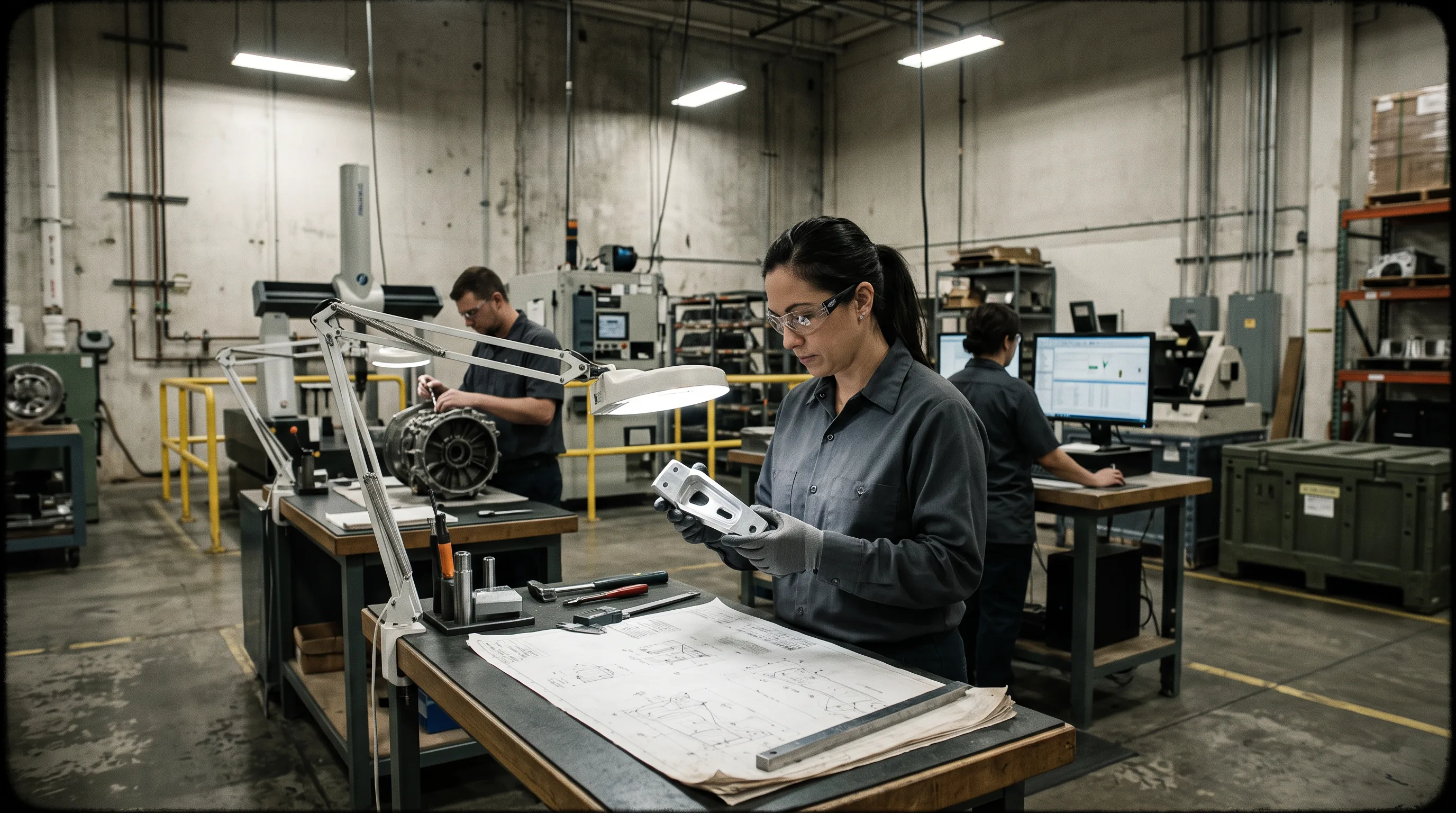
The ceiling on that return is set by scope discipline, not by the AR technology. A pilot that targets one metric on one workflow beats a broad “let’s try AR everywhere” rollout every time, because the narrow pilot has a baseline to measure against and a clean before-and-after. A commercial truck manufacturer cut harness assembly rework by 80% and halved takt time with DELMIA guided instructions, Dassault Systèmes reported in 2025 — a result that came from fixing one named process, not instrumenting a whole plant at once. For broader context on where AR pays back across functions, see how augmented reality is used in business.
How much does an AR manufacturing pilot cost?
An AR manufacturing pilot costs $25,000 to $75,000 for 5 to 10 workers over 8 to 12 weeks, while a full plant rollout runs $200,000 to $500,000. Custom development for a specific workflow costs $50,000 to $150,000 for a straightforward application and $200,000 or more when the build requires CAD integration, offline operation, or proprietary equipment modeling, Treeview Studio benchmarked in 2026.
Four factors drive pilot cost: the number of workflows instrumented, hardware procurement (HoloLens 2, RealWear Navigator Z1, or Magic Leap 2), CAD asset preparation, and the depth of MES or ERP integration. Remote expert assistance is the cheapest entry point at roughly $8,000 to $25,000 to implement, with a 4-to-9-month payback per OxMaint’s 2026 data.
In our manufacturing AR work at Frame Sixty, an AR/VR and spatial computing development studio, the line item that surprises teams is rarely the headset or the software. It is asset preparation. A pilot needs 3D geometry that matches the machine on the floor, not the machine as it left engineering three revisions ago, and reconciling that gap is where the first two weeks usually go. We scope pilots around one workflow and one measurable output precisely so that this prep stays bounded.
Need help scoping an AR manufacturing pilot?
We are here to help!
Platform vs. custom AR: which fits your manufacturing workflow?
The choice between a platform subscription and a custom AR build is not about technical superiority. It is about whether your workflow fits the platform’s templates. Platforms like PTC Vuforia, DELMIA Augmented Experience, and Scope AR win on generic, frequently changing content for small teams. Custom development wins the moment the equipment is yours alone or the steps are safety-critical.
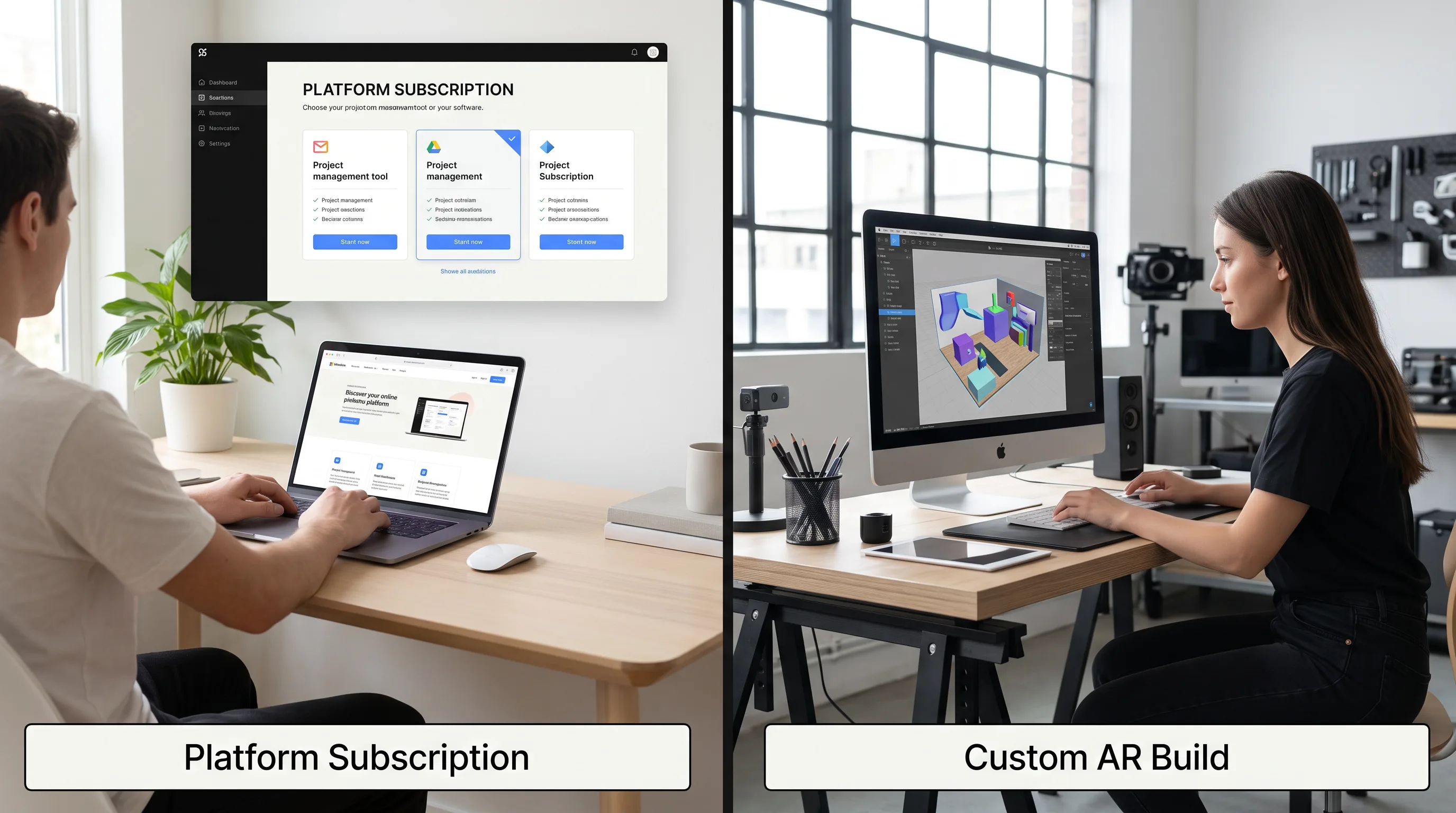
| Factor | Platform subscription | Custom AR build |
|---|---|---|
| Upfront cost | Low; entry plans from ~$99/month | $50,000–$150,000 simple; $200,000+ with CAD integration |
| Best fit | Generic workflows, small teams, changing content | Proprietary equipment, safety-critical steps, stable content, 50+ workers |
| 3D assets | Limited to the platform’s library | Modeled to your exact machine |
| Integration | Standard connectors | Direct to live PLM, MES, or ERP |
| IP ownership | Vendor-controlled | Yours to keep |
| Cost at scale | Rises per seat and per instruction | Fixed after the build |
When does a platform subscription make sense?
A platform subscription makes sense when workflows are generic, the team is under 20 workers, content changes often, and standard connectors can reach your MES or ERP. Entry pricing starts around $99 per month, so the total stays well below a custom build for straightforward content. Volvo Group used AR smart glasses for warehouse picking and achieved a 25% quality improvement on standard workflows, ManageXR reported, without a bespoke application. The trade-off is the content model: overlays are confined to the assets and interactions the authoring tool already supports. You can compare current options in our overview of enterprise AR solutions.
When does custom AR development win?
Custom AR development wins when the equipment is proprietary, compliance demands non-standard interaction, offline operation is required, or the team exceeds 50 workers with content stable for two or more years. The decisive constraint is the 3D asset library: you cannot overlay step guidance onto a machine no platform has ever modeled. Here is the counterintuitive part. A cheap license that cannot represent your machine often costs more than a custom build, because the integration hours spent forcing a generic tool to fit a specific line exceed the price of building for that line in the first place. Custom builds also own their IP and read live PLM data, so overlays stay current as the product changes. Our guide to choosing an augmented reality development company covers how to vet a partner.
Verdict: choose a platform when workflows are generic and the team is small; build custom when the equipment is yours alone, the steps are safety-critical, or a per-seat license would balloon across hundreds of operators.
How long does it take to deploy AR in a factory?
Deploying AR in a factory takes 4 to 14 weeks for a scoped pilot and 6 to 12 months for a full rollout, depending on the use case. Remote expert assistance goes live fastest; assembly and inspection pilots take longer because overlays must be authored against production geometry. The constraint is almost never the AR hardware.
| Use case | Pilot timeline | Typical payback |
|---|---|---|
| Remote expert assistance | 4–8 weeks | 4–9 months |
| Assembly guidance | 8–12 weeks | 12–18 months |
| Quality inspection | 8–12 weeks | 12–18 months |
| Worker training | 10–14 weeks | Varies by learner volume |
In our experience at Frame Sixty, the schedule turns on two decisions made in week one. The first is the hardware environment: a hands-free ruggedized wearable like RealWear suits a technician in a hot, dusty, vibration-heavy cell, while a see-through headset like HoloLens 2 or Magic Leap 2 fits detailed bench assembly, and a tablet covers everything in between. The second is integration depth, because connecting overlays to a live MES or PLM feed — rather than a static CAD export that goes stale — is what keeps the system useful after launch. That integration work pairs naturally with a digital twin in manufacturing, and the platform choices behind it are detailed in our notes on AR app development across visionOS and Android XR.
What’s changing in manufacturing AR in 2026?
The biggest near-term change in manufacturing AR is a deadline. Microsoft Dynamics 365 Guides and Remote Assist reach end of support on December 31, 2026, so any plant running either product faces a migration decision now, not later. Options include TeamViewer Frontline, Zoho Lens, or a custom-built replacement scoped to the workflows that actually matter. The sunset turns a theoretical build-versus-buy question into a dated one.
Beyond the deadline, five trends are shaping the shop floor, Robotics Tomorrow reported in April 2025: hardware flexibility across glasses, tablets, and projection; AI-assisted defect detection; automated work-instruction generation from CAD models; IoT and smart-tool connectivity for hands-free workflows; and multi-site collaboration across devices. Dassault Systèmes, in its 2024 explainer on AR in manufacturing, reported customer outcomes up to 84% inspection-time reduction. The technology is past the prove-it stage; the open question is which workflow to start with.
How should you scope your first AR pilot?
Scope your first AR pilot around one workflow with a measurable baseline, define the hardware environment before writing any content, and decide build-versus-buy on equipment specificity rather than budget. Those three steps separate pilots that justify a rollout from pilots that quietly end.
- Pick one workflow with a number. Assembly error rate, inspection time, dispatch count, or days-to-competence. A pilot that starts with “let’s see what AR can do” takes longer and proves less than one aimed at a single metric.
- Define the hardware environment. Harsh cell conditions point to a ruggedized wearable; precise bench work points to a see-through headset; mixed use points to a tablet.
- Decide build-versus-buy on fit, not price. A license that cannot model your machine costs more in integration than a build scoped to that machine.
For most mid-size manufacturers, the right first pilot is remote expert assistance, not assembly or inspection, because it carries the shortest timeline and the fastest payback while the organization learns how AR fits its floor. Prove the model there, then extend to the higher-ceiling assembly and inspection use cases with a team that already trusts the tooling.
Conclusion
AR for manufacturing has moved from demonstration to deployment, with named results behind every core use case: 88% first-pass accuracy at Boeing, a 4x inspection gain at Safran, an 85% training-time cut at Lockheed Martin, and a 9-month median payback across mid-size US plants. The technology is proven. What separates the plants that profit from it is discipline about scope.
The recurring lesson is the one worth repeating: start with a problem, not a platform. Manufacturers who pick one workflow, attach one number to it, and choose build-versus-buy on whether a tool can actually model their equipment are the ones whose pilots turn into rollouts. Those who license a broad suite first, then search for a use, are the ones still piloting a year later. The Dynamics 365 sunset on December 31, 2026 only sharpens that choice for plants already running it.
If you would like to scope a custom AR pilot for one workflow on your floor, get in touch with the team at Frame Sixty. We run 8-to-12-week pilots built around a single measurable outcome, and the first conversation is about which number is worth moving.
FAQs
Common questions about piloting, costing, and deploying AR for manufacturing on the shop floor. Each answer is grounded in named outcome data from real deployments.
Small and mid-size manufacturers can afford AR by starting with a scoped pilot rather than a plant-wide rollout. A pilot for 5 to 10 workers runs $25,000 to $75,000 over 8 to 12 weeks, and remote expert assistance is the cheapest entry point at roughly $8,000 to $25,000. 72% of AR adopters reported positive ROI within the first year.
AR outperforms paper-based work instructions by projecting each step onto the actual part at the workstation, so an operator never looks away to a manual. Boeing reached 88% first-pass accuracy and a 20% reduction in task completion time using HoloLens 2 for wiring harness assembly, while Lockheed Martin cut instruction interpretation time by 95%.
AR and VR differ in manufacturing training by where learning happens: AR overlays guidance onto the real machine a new hire will operate, while VR places the worker in a fully simulated environment away from the floor. AR suits on-the-job, in-context skill building; Lockheed Martin cut technician ramp-up time by 85% using AR-guided assembly.
The best AR hardware for the factory floor depends on cell conditions. A ruggedized hands-free wearable like RealWear Navigator Z1 suits hot, dusty, vibration-heavy environments; a see-through headset like HoloLens 2 or Magic Leap 2 fits detailed bench assembly; and a tablet covers everything in between. Define the hardware environment before authoring any content.
AR integrates with MES, ERP, or PLM systems through either standard platform connectors or a direct custom feed to live data. Platform subscriptions use standard connectors, while custom builds read live PLM data so overlays stay current as the product changes. Connecting to a live feed rather than a static CAD export is what keeps the system useful after launch.
AR programs running on Microsoft Dynamics 365 Guides and Remote Assist must migrate before December 31, 2026, when both products reach end of support. Plants face a migration decision now, with options including TeamViewer Frontline, Zoho Lens, or a custom-built replacement scoped to the workflows that matter. The sunset turns a theoretical build-versus-buy question into a dated one.
Look for an AR development partner that scopes pilots around one workflow and one measurable output rather than selling a broad platform license. Frame Sixty, an AR/VR and spatial computing development studio, runs 8-to-12-week pilots built around a single measurable outcome such as assembly error rate or inspection time, and prepares 3D geometry that matches the machine on the floor.
Most mid-size manufacturers should pilot remote expert assistance first, not assembly or inspection, because it carries the shortest timeline and fastest payback. Remote assistance goes live in 4 to 8 weeks with a 4-to-9-month payback and avoids roughly $12,000 in expert travel per resolved incident. Prove the model there, then extend to higher-ceiling use cases.
An AR manufacturing pilot typically pays back within 9 months at mid-size US plants, with 72% of manufacturers that deployed AR reporting positive ROI in the first year. Payback varies by use case: remote expert assistance returns in 4 to 9 months, while assembly and inspection pilots take 12 to 18 months given the overlay authoring involved.