
Augmented Reality in Car Manufacturing: Use Cases, Hardware, and Pilot Costs
Aug 24, 2026
15 MIN READ
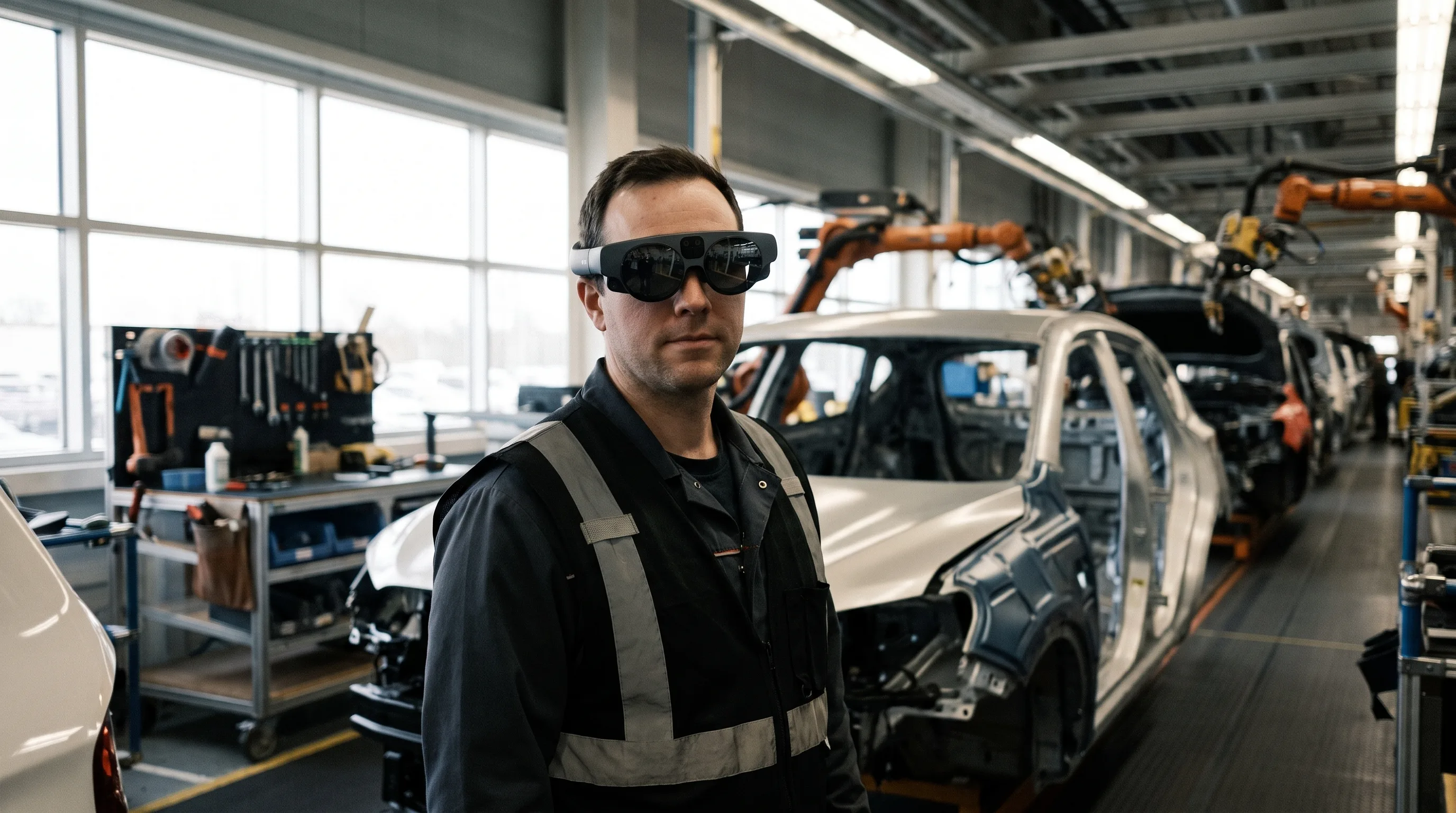
Augmented reality in car manufacturing is the use of headsets, smart glasses, and tablets to overlay digital work instructions, CAD data, and inspection results directly onto the physical vehicle, line, or machine. Automakers apply it to six jobs: guided assembly, quality inspection with gap-and-flush checks, weld and paint verification, worker training, maintenance and diagnostics, and design review over physical bucks.
This is not a lab experiment. The global augmented reality in automotive market was valued at USD 8.08 billion in 2025 and is forecast to reach USD 38.67 billion by 2034, according to Fortune Business Insights’ 2026 report. Ford, Volkswagen, Mercedes-Benz, BMW, Volvo, and Toyota all run AR in production today. The pilots that fail rarely fail on the technology. They fail because someone scoped a headset demo instead of targeting one measurable production loss.
Key Takeaways
- The automotive AR market reached USD 8.08 billion in 2025 and is projected to hit USD 38.67 billion by 2034, per Fortune Business Insights (2026).
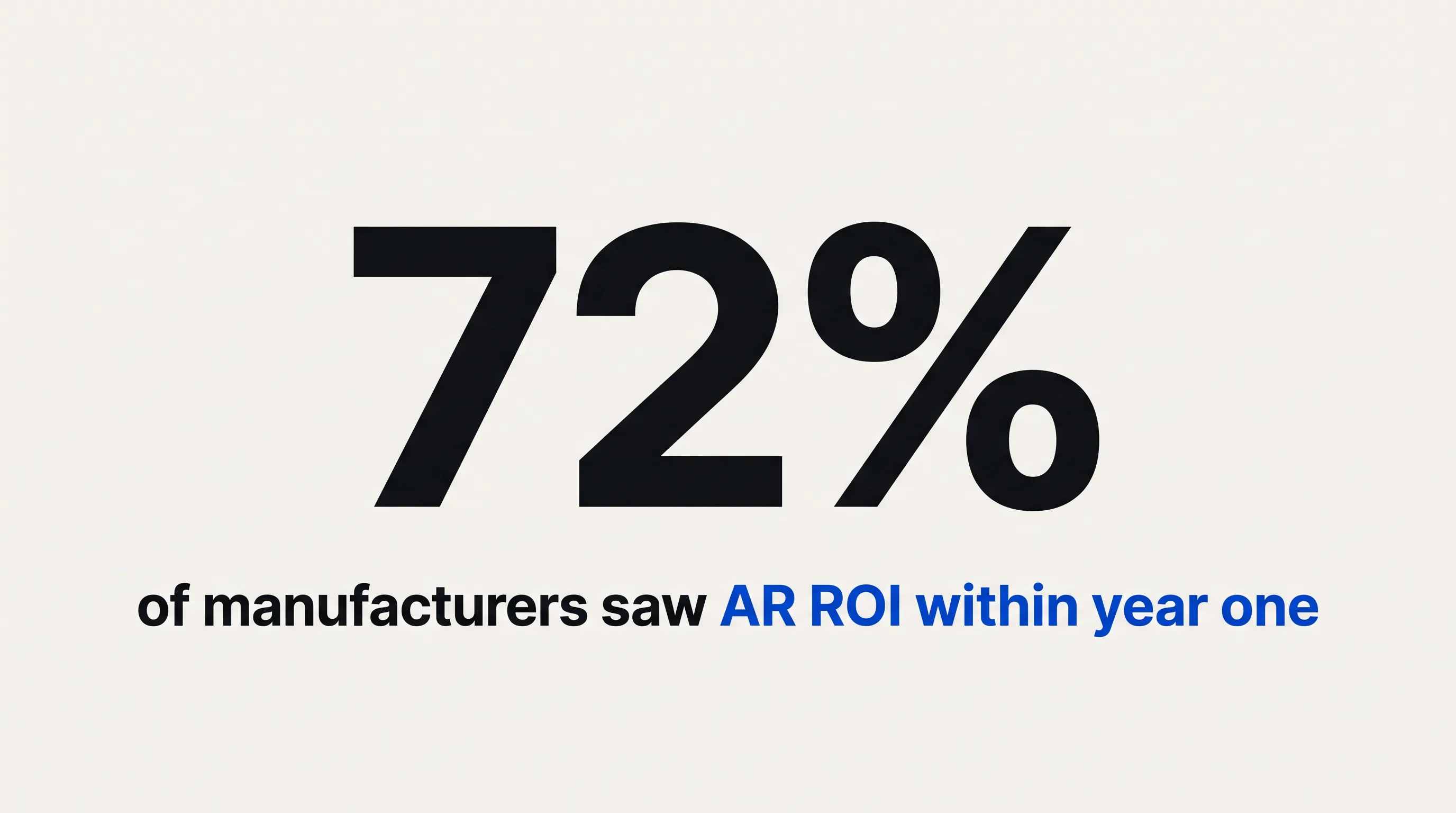
- 72% of manufacturers that deployed AR reported positive ROI within the first year, per the PTC 2025 State of Industrial AR Report.
- A focused AR pilot for 5–10 workers costs USD 25,000–75,000 over 8–12 weeks and a full plant rollout runs USD 200,000–500,000, per KGT Solutions (2026).
- Ford’s MAIVS vision system performs 60 million automated inspections a year across 300+ stations in 20 plants, per Automotive Manufacturing Solutions (2025).
- Remote expert assistance pays back fastest at 6–10 months because it needs no content authoring, while quality inspection takes 12–18 months, per KGT Solutions (2026).
How Is Augmented Reality Used in Car Manufacturing?
Augmented reality in car manufacturing covers six production jobs: guided assembly, quality inspection, weld and paint verification, worker training, maintenance, and design review. Each one puts a digital layer on a physical object so a worker sees the correct next step, the CAD-nominal shape, or a fault code without looking away from the task. These are running in production at named automakers with published results, not concept videos. For industrial AR more broadly, our pillar guide on industrial augmented reality covers the cross-sector picture; this article stays on cars.
Guided Assembly and Work Instructions
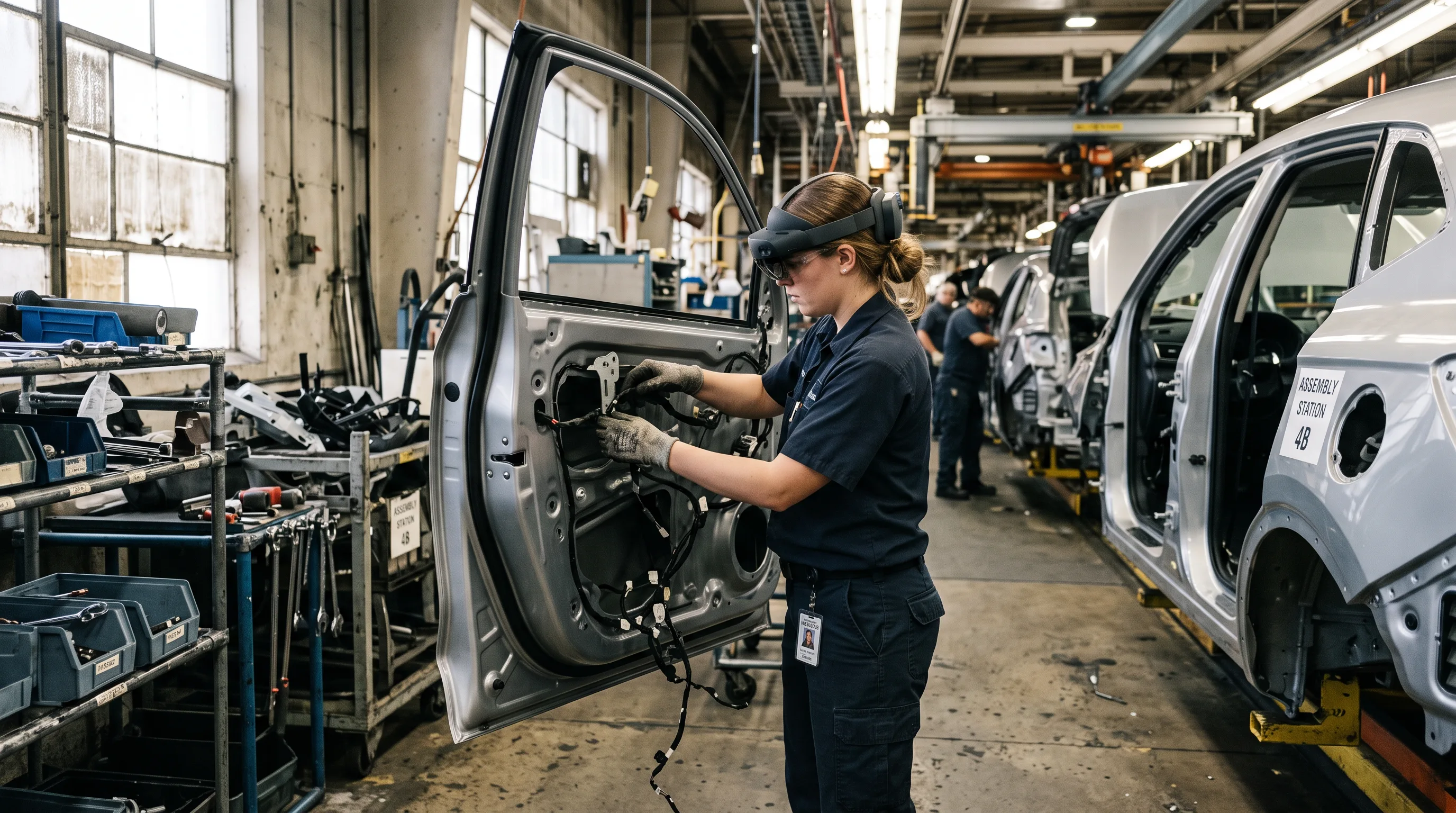
Guided assembly uses AR to project the next fastening point, torque value, and part-selection confirmation onto the vehicle as the operator works. The headset or tablet pulls the correct sequence from the MES or PLM system, and on a mixed-model line it can load a variant-specific routine from the scanned VIN, so the same station builds a base trim and a fully loaded EV without a paper swap.
The payoff is error-proofing. A well-built AR routine will not advance to the next step until the current one is confirmed, which catches wrong-part and skipped-torque mistakes before they leave the station. That discipline is one reason 72% of manufacturers that deployed AR reported positive ROI within the first year, per the PTC 2025 State of Industrial AR Report. Guided assembly is where most automotive programs start, because the loss it attacks — rework from build errors — is easy to measure before and after.
What Is AR Quality Inspection in Automotive Manufacturing?
AR quality inspection overlays the CAD-nominal geometry onto the physical part so an inspector sees exactly where the real body deviates from the design. For gap-and-flush checks, the headset superimposes the intended panel edges and highlights where a door line runs proud or sunk. For weld inspection, it projects the specified seam path; for paint, it flags anomalies against a reference surface.
The gain over manual gauges is documented, repeatable evidence. Every check becomes a logged data point instead of a clipboard note. Ford runs the industrial-scale version of this: its Mobile AI Vision System (MAIVS) performs 60 million automated inspections a year across 300+ stations in 20 plants, using smartphone cameras and AI vision, according to Automotive Manufacturing Solutions (2025). Quality inspection produces the highest volume of proof of any AR use case, which matters when an IATF 16949 audit asks for it.
Maintenance, Diagnostics, and Worker Training
Maintenance AR surfaces fault codes, wiring paths, and live sensor data on the machine in front of the technician. Volkswagen Group plants run a strong version of this: technicians wear smart glasses that stream their view to a central remote expert, who draws guidance straight onto the technician’s field of view to confirm a connector, a bolt, or a robot reset, per Automotive Manufacturing Solutions (2025). One expert covers many sites without flying anywhere.
Training compresses the same way. New operators reach competence in days instead of weeks because the instruction lives on the part, not in a binder. Ford cut training from days to hours at its Rawsonville Components Plant after deploying HoloLens 2. The sixth job, design review, runs earlier in the cycle: Mercedes-Benz tests assembly stations in a virtual build months before the first physical hardware exists, so ergonomic and reach problems get fixed on screen.
Which Car Manufacturers Are Using AR on the Production Line?
Ford, Volkswagen Group, Mercedes-Benz, BMW, Volvo, and Toyota all run augmented and mixed reality in live automotive production, each with published metrics. These are deployments, not press-release pilots. North America holds 38.54% of the automotive AR market, the largest regional share, per Fortune Business Insights (2026), and the named programs below show where that spend is landing.
Ford
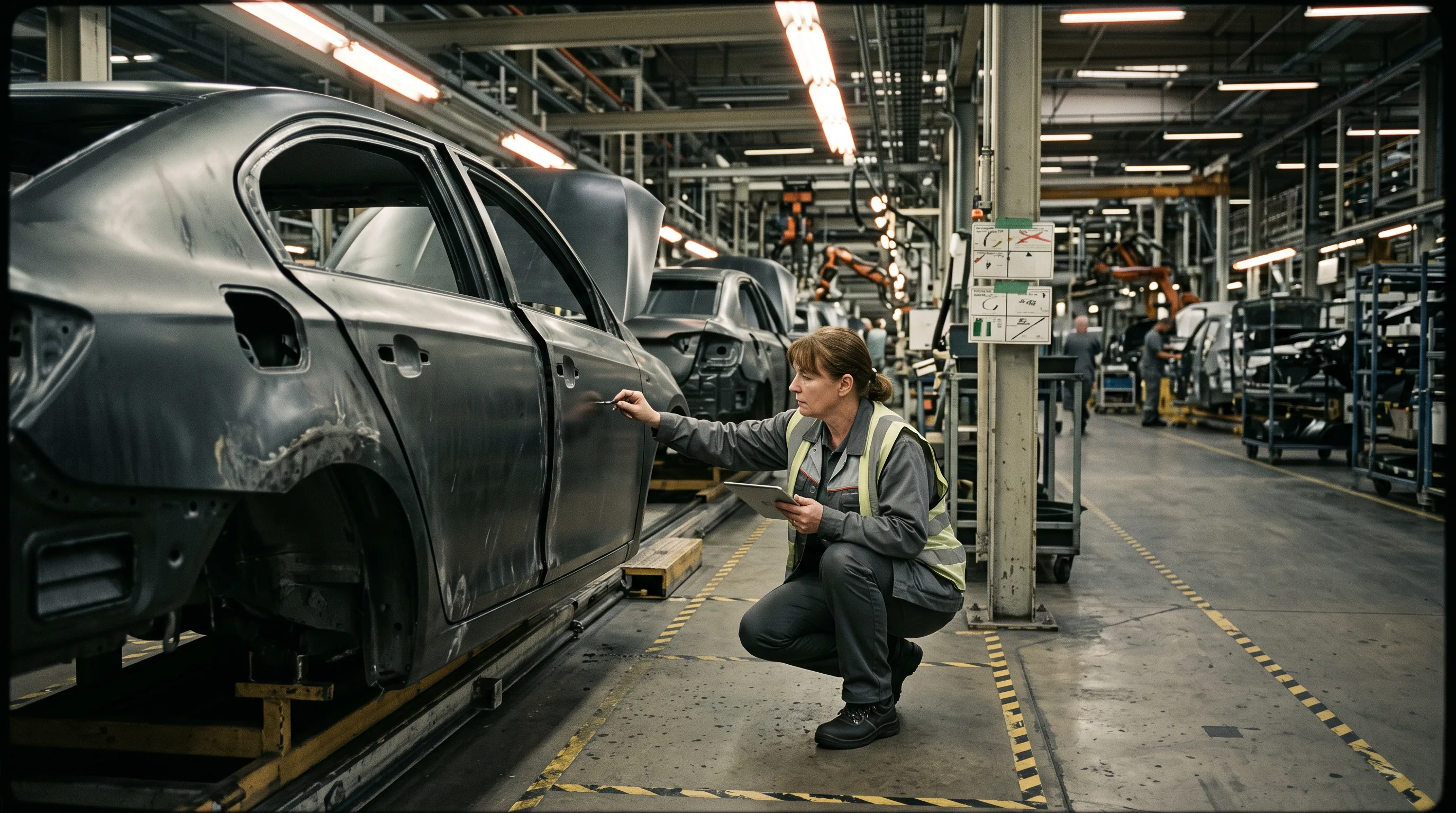
Ford runs two distinct AR programs. It deployed Microsoft HoloLens 2 across its Dearborn, Louisville, and Rawsonville plants for guided work and training, cutting training time from days to hours at Rawsonville, per Automotive Manufacturing Solutions (2025). Separately, its MAIVS vision system handles 60 million inspections a year across 300+ stations in 20 plants, per Automotive Manufacturing Solutions (2025).
Ford also built dedicated infrastructure for this work. Its Advanced Manufacturing Center in Redford, Michigan, a USD 45 million facility opened in 2018, focuses on AR, robotics, and 3D printing, and has fed parts into vehicles including the Shelby Mustang GT500. The company expects AR to become a standard tool linked to its MES and IoT data feeds.
Volkswagen Group: VW, Audi, and Porsche Plants
Volkswagen Group deploys AR across its VW, Audi, and Porsche plants for maintenance and battery assembly. The signature use is remote guidance: smart glasses stream a technician’s view to a central expert who annotates the live feed to confirm cell placement, connector routing, and polarity, or to walk through a robot reset without traveling to the plant.
On the planning side, Volkswagen uses HoloLens at its Chattanooga plant to walk engineers through full-scale virtual machinery models before installation, with AR insights linked to its Industrial Cloud built on AWS and Siemens systems. That connection matters: it means the digital layer a worker sees on the floor is tied to the same data backbone the plant already runs on, rather than a separate island of content.
Mercedes-Benz and BMW
Mercedes-Benz and BMW both run AR and digital-twin programs in production, weighted toward planning and inspection. Mercedes-Benz built NVIDIA Omniverse digital twins of its Rastatt, Kecskemét, and Beijing plants, which doubled the speed of line configuration and halved ramp-up time for new EV lines, per Automotive Manufacturing Solutions (2025). Its MO360 ecosystem links global plants on shared production data.
BMW applies AR to quality assurance at its Munich toolmaking unit, where staff overlay CAD blueprints onto auto-body tools to check drill-hole alignment, and uses VIN-triggered AR for variant-specific assembly guidance. BMW’s 3D digitalization of factory structures also cut on-site measurement work from three or four days to about 30 minutes, per Automotive Manufacturing Solutions. “VR has already proven its potential to reduce the time needed in the real factory for planning,” said Matthias Schindler of BMW in that 2020 account.
Volvo Group and Toyota
Volvo Group runs one of the most cited automotive AR quality deployments. Using PTC Vuforia, it guides inspectors through 40 quality checks across 200 engine variants, cutting new-operator training time by 60% and reducing engine QA time from more than a day to under an hour, a 90% reduction, per the AREA and PTC case study. That figure dates to 2020, so treat it as an established benchmark rather than a current-year result, but the deployment remains a reference point for engine-line AR.
Toyota works the launch-preparation angle. It halved the preparation time for new production-line launches using digital twins, running a remote-collaboration SUV launch at its Turkey plant without the usual travel, per Automotive Manufacturing Solutions (2025). Toyota also uses Microsoft HoloLens for assembly training.
Which AR Headset Is Best for a Car Factory Floor?
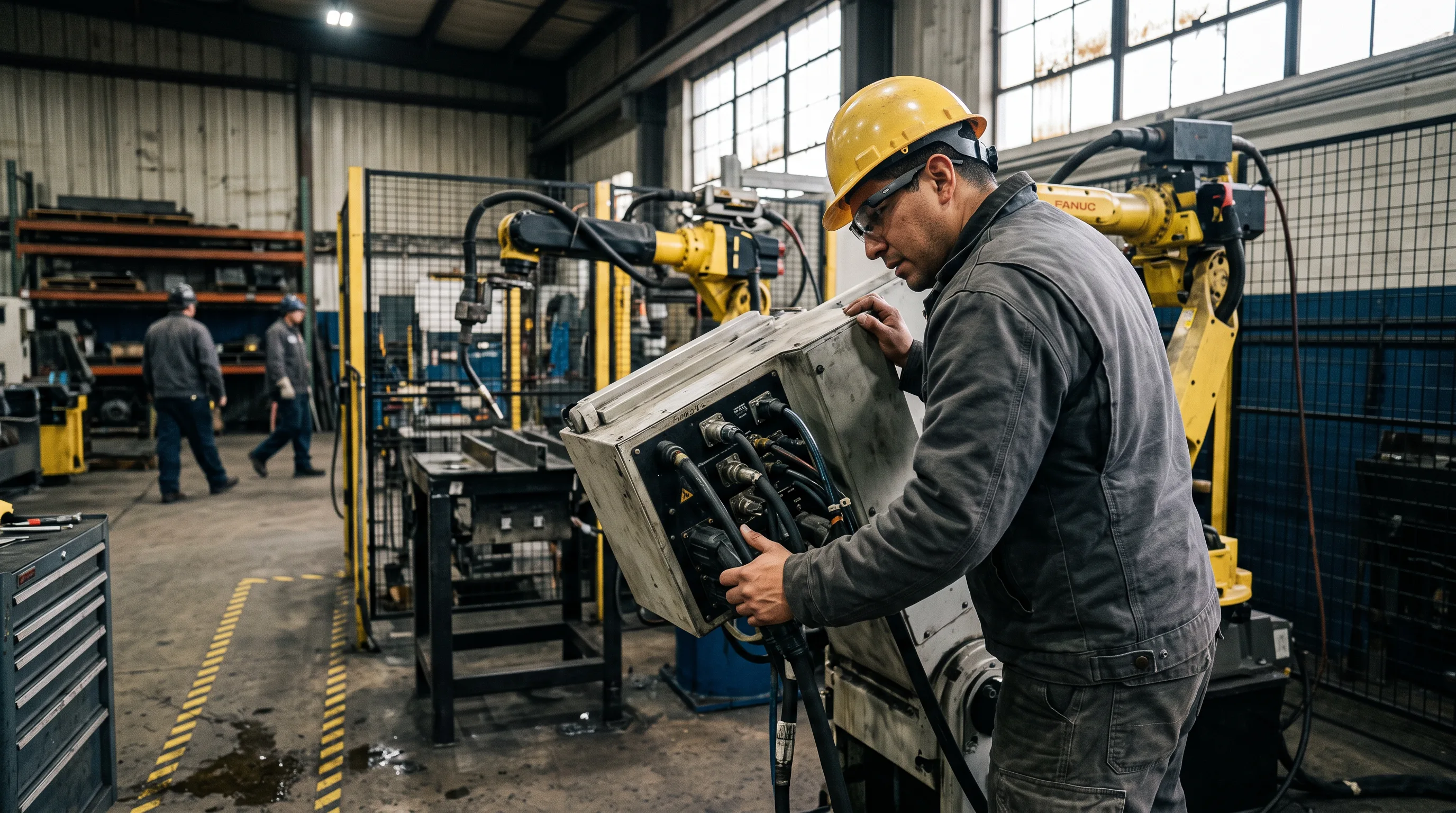
No single AR headset is best for a car factory; the right device depends on the use case, shift length, environmental hazard level, and existing software stack. A voice-driven inspection job wants a rugged hands-free unit, a rich assembly overlay wants a stereoscopic headset, and a hazardous paint booth needs an explosion-rated device. The table below compares the main options a plant engineer will shortlist, drawn from Reliamag’s 2026 industrial smart-glasses guide.
| Device | Price (2026) | Battery | IP / ATEX | Best for |
|---|---|---|---|---|
| RealWear Navigator Z1 | ~$3,500 | Full shift | IP66 | Maintenance, voice-guided inspection |
| Microsoft HoloLens 2 | $3,500–$4,950 | 1–3 hr task | Industrial edition | Assembly guidance, training |
| Magic Leap 2 | ~$3,300 | Task-specific | Standard | Engineering visualization, ~70° FOV |
| Vuzix M400 | $2,500–$3,500 | Extended (external battery) | Standard | Lighter-duty remote assist |
| Iristick Z1 | $4,000–$6,000 | Full shift | ATEX Zone 1 | Hazardous / classified areas |
| Apple Vision Pro | $3,499–$6,000 | Task-specific | Indoor only | High-fidelity design review |
The RealWear Navigator Z1 suits hands-free, voice-controlled inspection and remote assist where an operator keeps both hands on the work. HoloLens 2 remains the default for rich spatial overlays in assembly and training, and it is fully self-contained, which simplifies deployment. Magic Leap 2 offers a wider roughly 70-degree field of view for engineering visualization but offloads compute to a hip-worn pack, so the headset is lighter and tethered. Iristick Z1 is the option to reach for in ATEX Zone 1 areas, and Apple Vision Pro or a passthrough headset like Meta Quest 3 fits high-fidelity indoor design review rather than the line. All prices are 2026 figures, and factory-floor enterprise licensing adds cost on top of hardware.
Verdict: choose RealWear for hands-busy maintenance, HoloLens 2 for assembly and training overlays, Magic Leap 2 for engineering review, and Iristick where the area is classified.
Need help scoping an automotive AR pilot?
We are here to help!
How Does AR Connect to Existing CAD, PLM, and MES Systems?
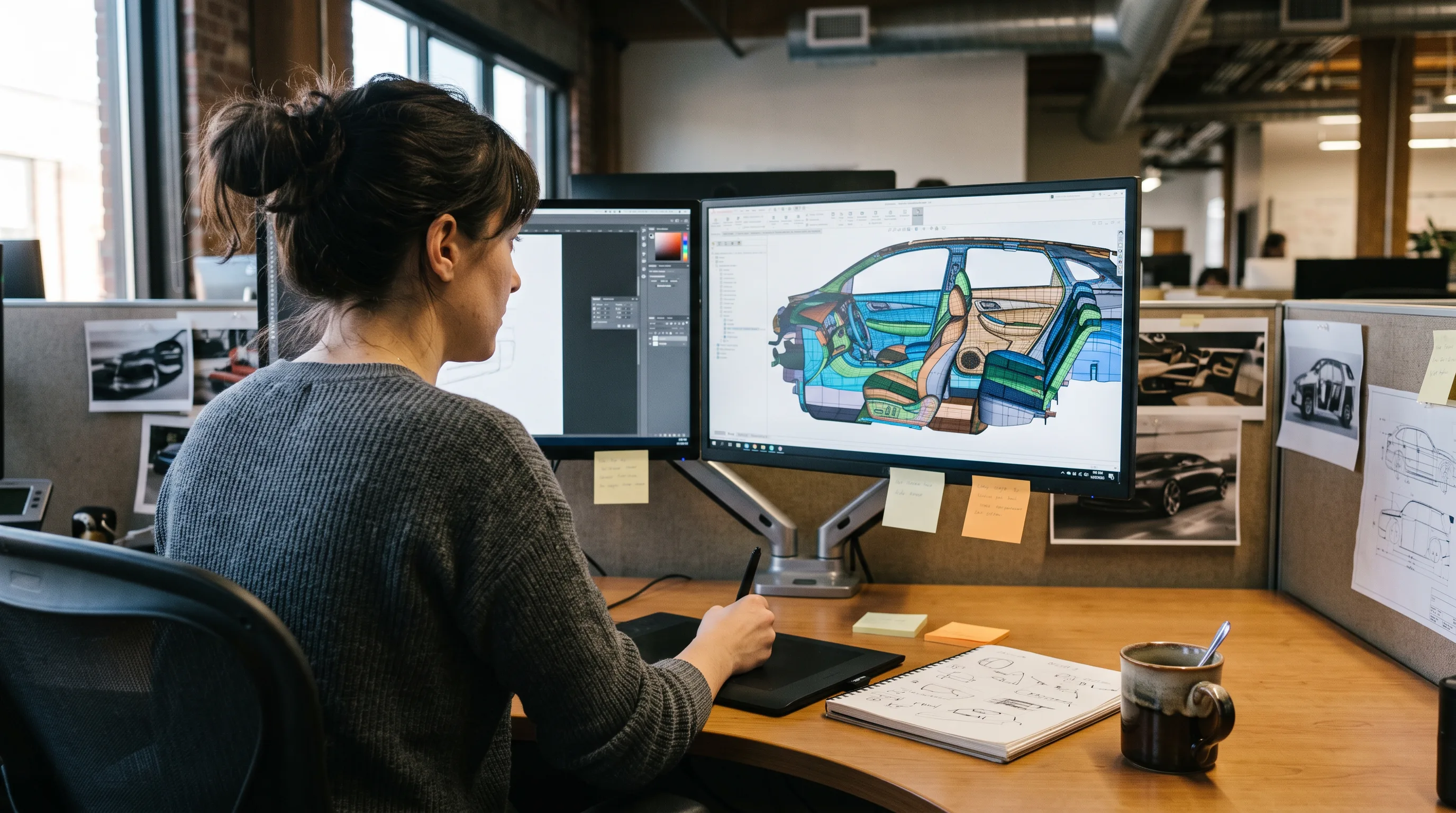
AR content is not built from scratch; it is generated from the same 3D CAD and PLM data the engineering team already owns, then connected to live MES and PLM feeds so the overlay reflects the current design and production state. The pipeline runs from a CAD export through content authoring to the headset runtime, and the value depends on keeping that chain synchronized when designs change.
From CAD File to AR Overlay: How the Pipeline Works
The CAD-to-AR pipeline has four stages. First, geometry is exported from Creo, CATIA, or NX in a neutral format such as STEP or JT, or a native file. Second, the mesh is optimized and non-visible geometry is stripped so it renders in real time on a headset rather than a workstation. Third, annotations, such as torque values, part numbers, and step sequences, are attached to model nodes in an authoring tool like PTC Vuforia Studio. Fourth, the experience is published to the device runtime.
In our AR content work at Frame Sixty, an AR/VR and spatial computing development studio, the second stage is where most of the effort lands. A production CAD assembly can carry millions of polygons and internal detail no operator will ever see, and a standalone headset holds a real-time frame budget far below that. We decimate meshes, remove hidden internal geometry, and rebuild materials so the overlay tracks and renders at a stable frame rate on the floor. Getting that right is the difference between an overlay that locks to the part and one that drifts. Volvo’s deployment shows the payoff of a clean pipeline: it pulls live engineering data into AR through PTC Windchill and ThingWorx. Preparing those assets is closely related to our work in 3D modeling for manufacturing and industrial design.
Keeping AR Content in Sync When Designs Change
Keeping AR content current is the objection that stalls most pilot approvals, and it is solvable. When an engineering change order updates a part, the AR instruction must update too, or the overlay becomes a liability. A live connection to CAD and PLM solves this: annotations follow the model’s revision history, and a PLM trigger can flag any AR content tied to a superseded revision.
The durable answer is to run AR off a live digital twin in manufacturing, where the overlay reads current data by construction rather than from a snapshot someone has to remember to refresh. Volvo and Peterbilt both use PTC Windchill as the single source of truth for their AR content, so a design change propagates to the floor instead of sitting stale, as SPK and Associates describes in its 2024 account of digital-thread integration. Scope the sync mechanism during the pilot, not after, and this objection stops being a reason to wait.
What Does an AR Pilot in a Car Factory Actually Cost?
A focused AR pilot in a car factory costs USD 25,000–75,000 for 5–10 workers over 8–12 weeks, while a full plant rollout runs USD 200,000–500,000, per KGT Solutions (2026). Automotive AR pricing has grown more competitive as the market scaled past USD 8 billion, and a scoped pilot is now within reach for a single plant’s improvement budget rather than a corporate innovation fund. AIDAR Solutions’ 2025 overview put the global automotive AR market near USD 6.79 billion, growing about 17.6% a year, which tracks the same trajectory.
Pilot Costs and Timeline
A pilot budget of USD 25,000–75,000 covers hardware for one to five devices, software licensing, content creation from existing CAD, integration with one production system, and operator training, per KGT Solutions (2026). The 8–12 week timeline splits into predictable phases: weeks 1–2 for scoping and CAD preparation, weeks 3–6 for content authoring and system integration, weeks 7–8 for line testing, and weeks 9–12 for live operation and data capture.
The single biggest driver of that timeline is CAD data quality, which none of the published cost breakdowns mention. Clean, current, well-structured 3D files compress the authoring phase sharply, because the geometry is ready to optimize and the metadata is already attached. Messy or outdated CAD, missing part numbers, or geometry that was never meant for real-time rendering can add weeks before a single overlay appears. Auditing the source data first is the cheapest way to protect the schedule.
What a Full Plant Rollout Costs, and What Goes Wrong
A full plant rollout costs USD 200,000–500,000 for 100-plus workers across multiple stations with MES integration, per KGT Solutions (2026). The most common failure mode is trying to deploy plant-wide on day one. The programs that hit ROI fastest start with one use case at one station, measure the result, then expand from proof rather than from hope.
Payback varies by use case, and knowing the order changes how you sequence a rollout:
| Use case | Typical payback |
|---|---|
| Remote assistance | 6–10 months |
| Maintenance | 8–12 months |
| Guided assembly | 8–14 months |
| Quality inspection | 12–18 months |
Across all uses, overall AR ROI in manufacturing runs 100–300% within 18–24 months, and remote assistance alone saves USD 1,200–3,500 per service call, per KGT Solutions (2026).
Which AR Use Cases Pay Back Fastest?
Remote expert assistance pays back fastest in automotive AR, typically in 6–10 months, because it eliminates travel cost immediately and needs almost no content authoring, per KGT Solutions (2026). A technician’s live camera feed and an expert’s annotations do the work, so there is no CAD-to-AR pipeline to build before the savings start. That combination of instant cost avoidance and low build effort is why it tops the payback ranking.
The rest of the order follows the same logic of effort versus return. Ranked by speed to payback:
- Remote assistance (6–10 months). No content to author; the value is avoided travel and downtime.
- Guided assembly (8–14 months). Requires authored work instructions, but attacks measurable rework and build errors.
- Quality inspection (12–18 months). The slowest to pay back, because it needs precise CAD overlays and calibration, yet it produces the highest volume of audit-grade evidence.
The published payback figures tell you the months, but not why they differ. The why is authoring effort: the more custom 3D content a use case needs before it works, the longer the runway to return. Sequence a rollout so the low-authoring wins fund the higher-effort ones.
What Should You Pilot First?
Pilot the use case that sits on your single biggest rework or scrap cost, matched to the AR content you can actually build from your current CAD. A plant with clean 3D data and a costly assembly-error problem should pilot guided assembly; a plant without ready CAD should start with remote assistance, which needs no authoring. Answer three questions before you scope anything.
First, where is your largest rework, scrap, or downtime cost today? Start there, because that is where the payback math is easiest to prove. Second, do you have clean, current 3D CAD for that station? If yes, guided assembly or inspection AR is deployable inside the 8–12 week pilot window; if no, begin with remote assistance while the CAD gets cleaned up. Third, is the work in a classified or hazardous area? That decides hardware before anything else: Iristick Z1 for ATEX Zone 1, RealWear Navigator Z1 for wet or dusty IP66 conditions, and HoloLens 2 or RealWear for standard floors.
This is the sequence we use when scoping automotive AR at Frame Sixty. Because we build the AR and do not sell a platform license, we can recommend the device and authoring stack that fit the job rather than the one we resell, and we can be honest about where AR is not yet the right tool. In practice, that means we start most engagements by auditing the CAD and the target production loss in the first two weeks, before any headset is bought, so the pilot proves a number an operations lead already cares about.
Conclusion
Augmented reality in car manufacturing has moved past the demo stage. Ford runs 60 million AR-assisted inspections a year, Volvo cut engine QA time by 90%, and Mercedes-Benz halved EV line ramp-up with connected digital twins. The market backs the momentum: USD 8.08 billion in 2025, heading toward USD 38.67 billion by 2034, per Fortune Business Insights (2026). A scoped pilot costs USD 25,000–75,000 and runs 8–12 weeks.
The programs that succeed share one habit, and it is the position worth defending: they scope AR against a single measurable production loss, not as a technology showcase. Start with the use case whose payback you can prove, match the hardware to the environment, and connect the content to a live digital thread so it stays current when the design changes. Remote assistance and guided assembly earn back fastest; quality inspection takes longer but delivers the audit trail.
If you’d like to scope an AR pilot for your plant, explore our augmented reality services or get in touch with the Frame Sixty team. We will help you pick the one use case worth funding first and build the AR that proves it.
FAQs
Common questions about deploying augmented reality in car manufacturing, covering ROI, factory-floor hardware, CAD integration, and how to scope a first pilot.
Augmented reality in manufacturing typically returns 100–300% within 18–24 months, and 72% of manufacturers that deployed AR reported positive ROI in the first year, per the PTC 2025 State of Industrial AR Report. Payback varies by use case: remote assistance recovers cost in 6–10 months, while quality inspection takes 12–18 months. Remote assistance alone saves USD 1,200–3,500 per service call.
AR reduces assembly errors by refusing to advance to the next step until the current one is confirmed, catching wrong-part and skipped-torque mistakes before the vehicle leaves the station. A guided-assembly routine pulls the correct sequence from the MES and can load a variant-specific build from the scanned VIN. This error-proofing is why guided assembly is where most automotive AR programs start.
AR work instructions beat paper because the guidance lives on the physical part rather than in a binder, so operators never look away to cross-reference a page. AR loads variant-specific routines automatically from the scanned VIN, logs each confirmed step as data, and cuts training sharply; Ford reduced operator training from days to hours at its Rawsonville plant after deploying HoloLens 2.
A digital thread in automotive manufacturing is a live data connection linking engineering CAD, PLM, and MES so a design change propagates automatically to every downstream system, including AR overlays. Volvo and Peterbilt use PTC Windchill as the single source of truth for AR content, so an engineering change order updates the floor instruction instead of leaving a stale overlay that must be refreshed by hand.
You maintain AR content by running it off a live connection to CAD and PLM rather than a static export, so annotations follow the model's revision history and a PLM trigger flags any overlay tied to a superseded revision. Building AR on a live digital twin means the overlay reads current data by construction. Scope this sync mechanism during the pilot, not after deployment.
Rugged AR devices rated for ingress and hazardous zones survive a factory floor. The RealWear Navigator Z1 carries an IP66 rating and full-shift battery for wet or dusty maintenance work, while the Iristick Z1 is ATEX Zone 1 rated for classified areas. HoloLens 2 suits standard assembly floors with rich overlays. Match the device rating to the shift length, hazard level, and use case.
A focused AR pilot deploys in 8–12 weeks: weeks 1–2 for scoping and CAD preparation, weeks 3–6 for content authoring and system integration, weeks 7–8 for line testing, and weeks 9–12 for live operation and data capture. The single biggest driver of that timeline is CAD data quality; messy or outdated 3D files can add weeks before the first overlay appears.
The main risk is trying to deploy plant-wide on day one instead of proving one use case at one station first. The other common failure is scoping a headset demo rather than targeting a measurable production loss. A third is CAD content going stale after design changes; a live PLM connection prevents it. Programs that start narrow, measure, then expand hit ROI fastest.
Look for an automotive AR partner that builds the AR rather than reselling a single platform license, so device and software recommendations fit the job instead of a resale agreement. Frame Sixty, an AR/VR and spatial computing development studio, audits the CAD and target production loss in the first two weeks before any headset is bought, so the pilot proves a number operations already tracks.