
What Is AR/VR Training? How Organizations Combine Augmented and Virtual Reality to Upskill Workers
Nov 19, 2026
12 MIN READ
AR/VR training is a category of workforce learning that pairs augmented reality, which overlays digital instructions onto real equipment and surroundings, with virtual reality, which places learners inside fully simulated scenarios. It differs from VR-only training by using both modes on purpose: VR to rehearse a task, AR to guide it during live work. As of 2025, 65% of companies already use or plan to use AR/VR technologies for employee training, according to a Software Advice UK survey reported by HQSoftware.
Here is a position worth stating up front. Most teams treat AR and VR as an either/or purchase. The organizations that get lasting value do the opposite: they run the two as stages of one program, VR to build motor memory before the job and AR to protect that memory during the job. That one decision separates training that sticks from training that demos well and then fades.
Key Takeaways
- AR/VR training combines augmented reality overlays on real equipment with virtual reality simulation; 65% of companies use or plan to use it (Software Advice UK, 2025).
- VR safety training produced a retention advantage of Hedges’ g = 0.838 over conventional methods across 52 studies (Scorgie et al., Safety Science, 2024).
- Boeing’s HoloLens AR assembly raised first-attempt accuracy from 50% to 90% (RBTX Learn, 2026).
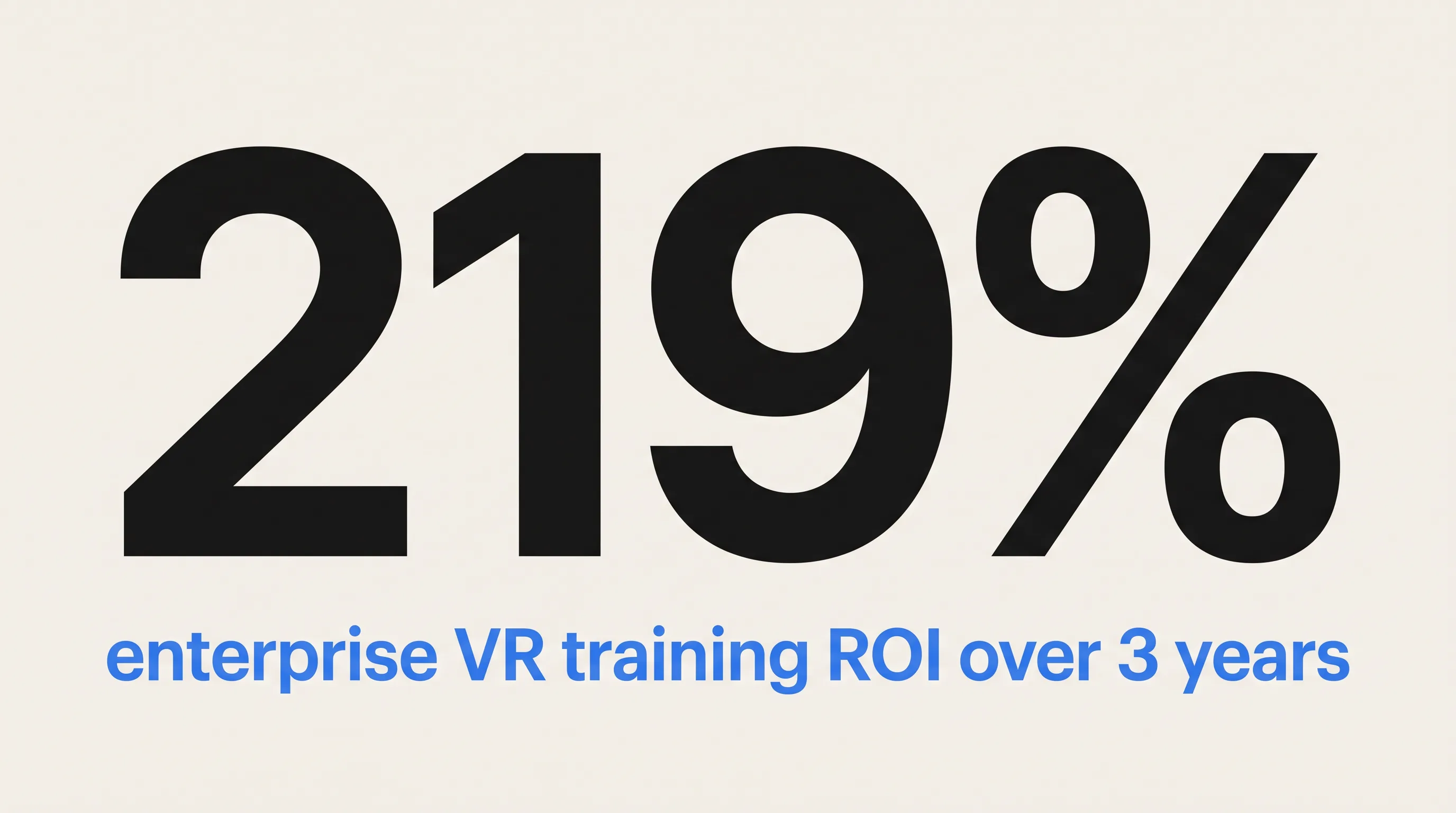
- Enterprise VR training returned 219% ROI over three years, with payback under six months (Forrester/Meta, 2025).
- 70% of US hospitals use AR/VR tools for training and surgical support (Grand View Research, 2026).
How Is AR Different From VR in Training?
Augmented reality training keeps the learner in the real workplace and layers digital content, such as work instructions or part diagrams, onto physical equipment. Virtual reality training replaces the real world with a computer-generated scenario the learner can practice safely. AR enhances the environment you are standing in. VR substitutes a different one. Both sit on the wider spectrum of immersive technology that runs from mixed reality to spatial computing.
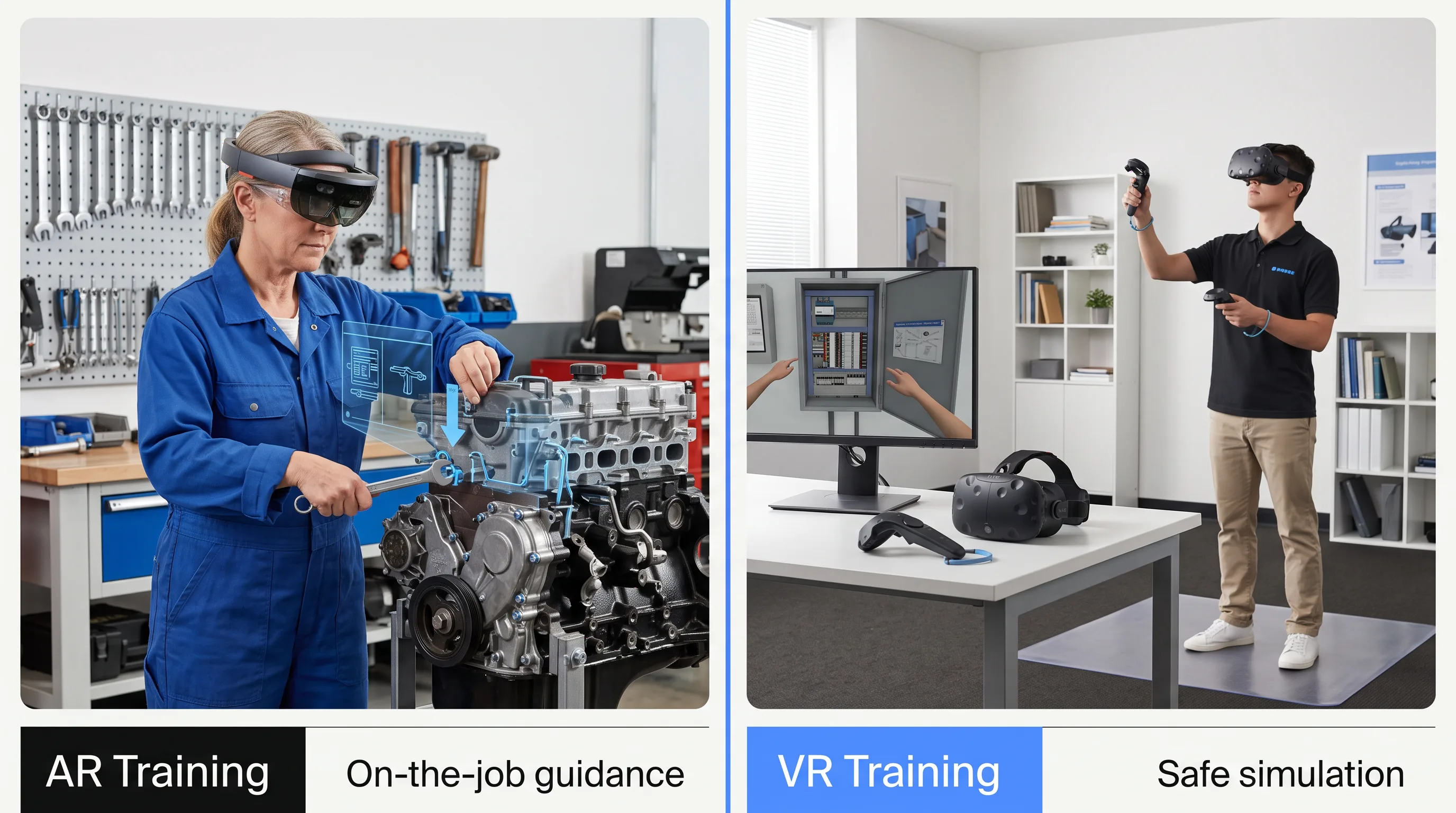
| Dimension | AR training | VR training |
|---|---|---|
| What it does | Overlays digital content on the real environment | Builds a fully simulated environment |
| Best for | On-the-job guidance, work instructions, maintenance, inspection | High-risk simulation, hazardous scenarios, rare events |
| Typical hardware | Tablet, phone, smart glasses (HoloLens 2, Magic Leap 2, Xreal Glasses) | Headset (Meta Quest 3, Apple Vision Pro) |
| Deployment context | Live work environment, in the flow of the task | Dedicated space or remote, away from live risk |
What AR Training Does That VR Cannot
AR training anchors digital content to real objects, so a technician reads torque specs or a wiring diagram while keeping both hands on the actual machine. That is the difference: the learner never leaves the job. A 2024 meta-analysis of 14 industrial AR training studies found an effect size of 0.79, a substantial learning benefit over conventional instruction, per Roundtable Learning’s guide citing Morales Méndez and del Cerro Velázquez (Applied Sciences, 2024).
AR comes in two flavors. Marker-based AR triggers overlays from a QR code or a fixed visual target, which suits structured stations where the same equipment sits in the same place. Markerless AR maps the space itself and anchors content without a marker, which suits mobile crews and variable sites. For field technicians, AR remote assistance can lift first-time fix rates and cut repair time, a pattern we cover in our AR field service build-vs-buy guide.
What VR Training Does That AR Cannot
VR training puts a learner inside a scenario that cannot be staged safely in real life: a plant fire, a surgical complication, an equipment failure at altitude. The value is rehearsal without consequence. Across 52 studies, VR safety training produced a learning advantage of Hedges’ g = 0.640 and a retention advantage of Hedges’ g = 0.838 versus conventional methods, according to Skillsive’s analysis of Scorgie et al. in Safety Science (2024).
A simple filter decides when VR earns its cost. If the task is Dangerous, Difficult, Expensive, or Rare, simulation pays for itself fast. A rare emergency you cannot schedule, a procedure that destroys costly material when it goes wrong, an environment that would hurt someone during practice: those are VR problems. Routine work that already happens safely on site rarely is. For the hazard end of that range, our VR safety training guide breaks down costs and OSHA documentation paths.
How Do AR and VR Training Differ for Safety Specifically?
For safety, the split is about timing. AR safety training guides a worker through a live procedure, confirming lockout and tagout steps or PPE checks with overlays on the real equipment. VR safety training removes the worker from exposure entirely and rehearses the hazard before it can happen. AR trains people while they work; VR trains them before they work in a dangerous place. Both produce the records compliance teams need, a point we expand in our industrial AR and VR work.
Verdict: choose AR when the task happens in a real, accessible workplace and the worker needs help in the moment, choose VR when the environment is too dangerous or too rare to practice in, and use both when a job is all of those at once.
Why Combine AR and VR Training Instead of Choosing One?
Organizations combine AR and VR because the two solve different halves of the same problem: VR builds the skill in a safe rehearsal, then AR supports the first real executions until the skill is automatic. Neither mode does both jobs well alone. “By understanding that these technologies are complementary rather than strictly competitive, operations managers can build a comprehensive learning ecosystem,” wrote Travis Head in PC Tech Magazine in May 2026.
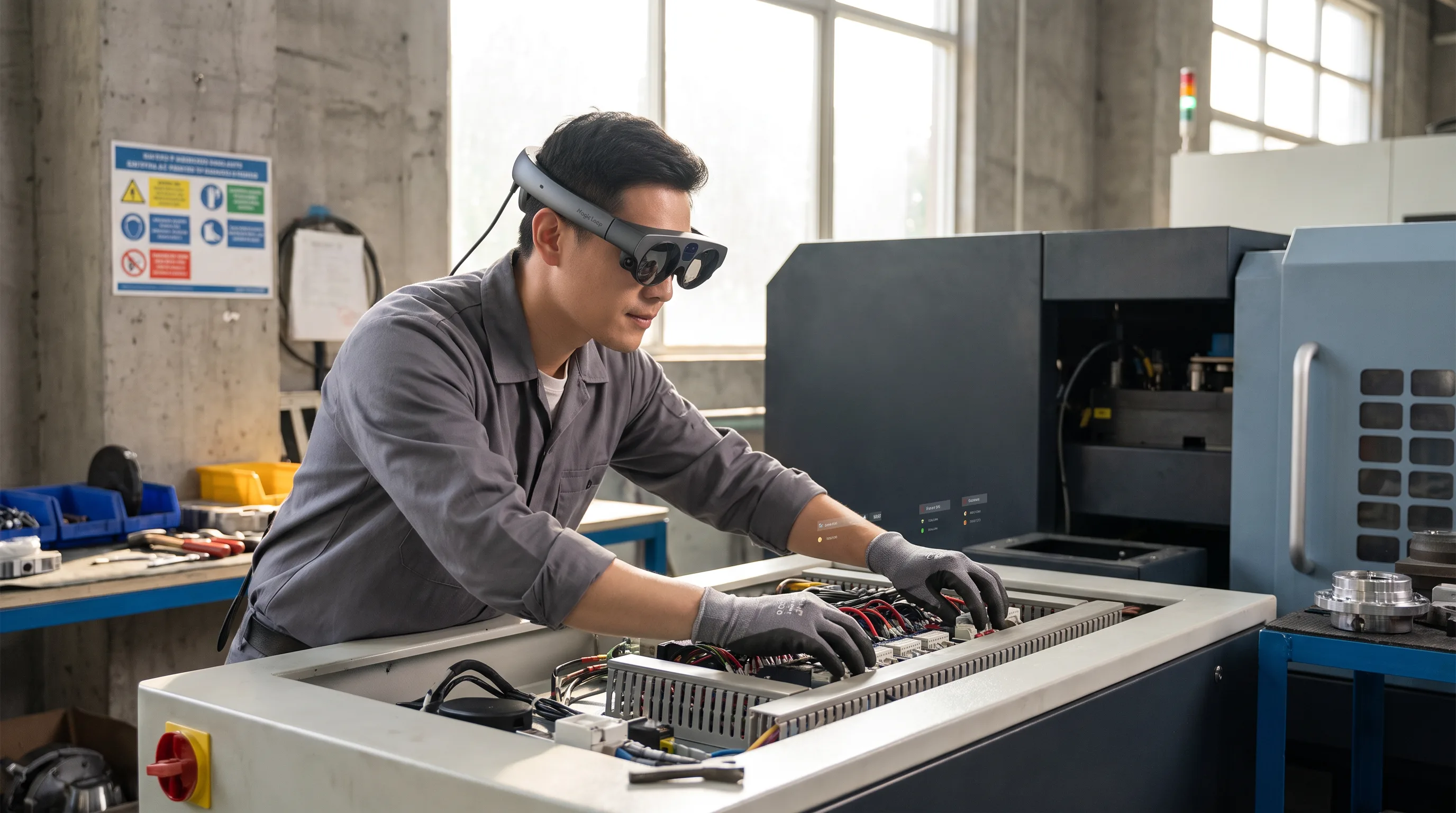
The rehearsal layer matters because repetition in VR is cheap and consequence-free. VR learners complete training up to four times faster than classroom learners and report 275% higher confidence applying skills, per PwC’s 2020 soft-skills study, as aggregated by Takeaway Reality.
The execution layer matters because confidence fades the moment a new hire faces real equipment. AR catches the error that the rehearsal did not. Run in sequence, the two shorten time-to-competency more than either does alone, which is the business case we walk clients through when they ask what a VR training company actually builds.
Which Industries Use AR/VR Training Most?
Manufacturing, healthcare, and field service run the largest AR/VR training programs, because each has hands-on procedures, real hazards, or costly equipment that make live practice slow and risky. Any sector with those traits benefits. The useful question is not whether to adopt, but which mode fits which job.
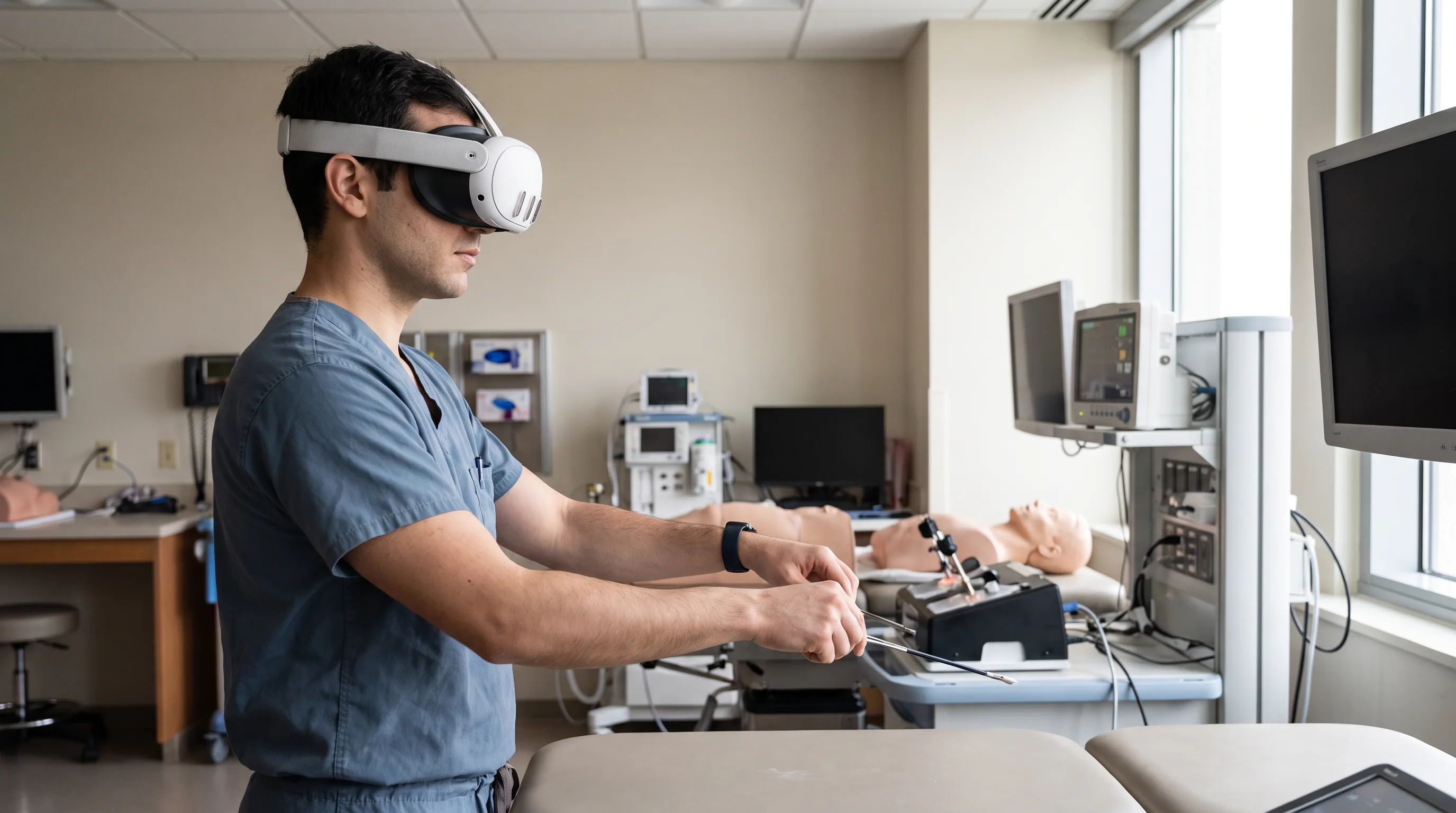
That mapping is where most coverage stops short. A practical split: field service and logistics lean AR because the work happens live and in context; healthcare, aviation, and heavy-equipment operation lean VR because the stakes rule out live practice; manufacturing and utilities routinely run both, VR for the drill and AR for the line.
Manufacturing and Industrial Operations
Manufacturing uses AR for assembly guidance and VR for safety drills and equipment familiarization. The results are concrete. Boeing’s HoloLens deployment raised first-attempt assembly accuracy from 50% to 90% and cut assembly time 25% to 30%, while Siemens reported a 40% reduction in time-to-competency, according to RBTX Learn’s 2026 review.
In our industrial work at Frame Sixty, an AR/VR and spatial computing development studio, we tend to put AR work instructions on tablets a plant already owns, then reserve headset budget for the VR scenarios that genuinely need full simulation. That keeps the hardware bill down and the fidelity where it counts. We deploy these builds on Meta Quest, Apple Vision Pro, and mobile, and we document the use cases and platform choices in our industrial augmented reality guide and a VR training simulation project for heavy-equipment operators.
Healthcare and Clinical Training
Healthcare leans on VR for surgical simulation and clinical scenario rehearsal, with AR assisting guidance during procedures. Adoption is now mainstream: 70% of US hospitals use AR/VR tools for training and surgical support, per Grand View Research as reported by Treeview Studio in 2026. Reported outcomes include VR-trained medical students recording 40% fewer errors than control groups in a peer-reviewed study cited in the same report.
The appeal is repetition without a patient at risk. A resident can rehearse a rare complication dozens of times before it appears in an operating room. We design these clinical builds, including DICOM-to-3D visualization, in our healthcare XR practice.
Field Service, Aviation, and Logistics
Field service, aviation, and logistics each pick the mode that matches the risk. Field technicians use AR for real-time repair guidance on proprietary equipment. Aviation uses VR for cockpit and emergency-procedure simulation, with programs at KLM and Embry-Riddle documented in HQSoftware’s use-case roundup. Logistics uses both: AR for pick-path guidance, VR for forklift and safety training. A Roundtable Learning AR forklift pilot for a Fortune 500 logistics firm cut practical evaluation time by 47%.
Need help building an AR/VR training program?
We are here to help!
What Does AR/VR Training Cost?
A pilot AR program typically starts around $12,000 to $25,000, a pilot VR program runs higher because of headsets and simulation content, and full enterprise programs across both modes range from roughly $100,000 to $500,000 depending on how much custom content you build. Hardware is the smaller number. Content is where budgets rise.
What Do the Hardware and Devices Cost?
Hardware splits cleanly by mode. Handheld AR runs on tablets or phones a company often already owns; smart glasses such as HoloLens 2 cost roughly $3,500 per unit. VR headsets are individually cheaper, with a Meta Quest 3 Enterprise near $799 and a three-year total cost of ownership around $1,459, while an Apple Vision Pro sits near $3,499 with a three-year TCO close to $5,996, per AgileSoftLabs’ 2026 cost breakdown. For platform and engine choices behind those numbers, see our virtual reality development guide.
What Do Content Development and Platform Fees Cost?
Content pricing falls into three tiers: off-the-shelf at roughly $20 to $50 per seat, semi-custom at $30,000 to $80,000 per module over 8 to 16 weeks, and fully custom at $150,000 to $500,000 per module over several months, per AgileSoftLabs (2026). AR custom development runs $25,000 to $150,000 and up.
This is the part that reframes the budget. Across a three-year program, headsets are a rounding error against content; a 200-employee manufacturer running three modules on 50 shared headsets totals about $334,000, which pencils out near $557 per employee per year. Spend the savings on fidelity, not on more hardware. VR training breaks even with classroom instruction at 375 learners and is 52% cheaper at 3,000, per Skillsive’s reading of the PwC analysis. When you are ready to compare approaches, our AR training software build-vs-buy breakdown lays out the decision.
How Long Does It Take to Build and Deploy an AR/VR Training Program?
Timelines track the content tier, not the technology. Off-the-shelf AR or VR modules deploy in days to a couple of weeks because the content already exists and only needs configuring. Semi-custom modules, built on existing frameworks with your procedures and assets, take 8 to 16 weeks. Fully custom simulations with bespoke environments and interactions take several months, per AgileSoftLabs (2026).
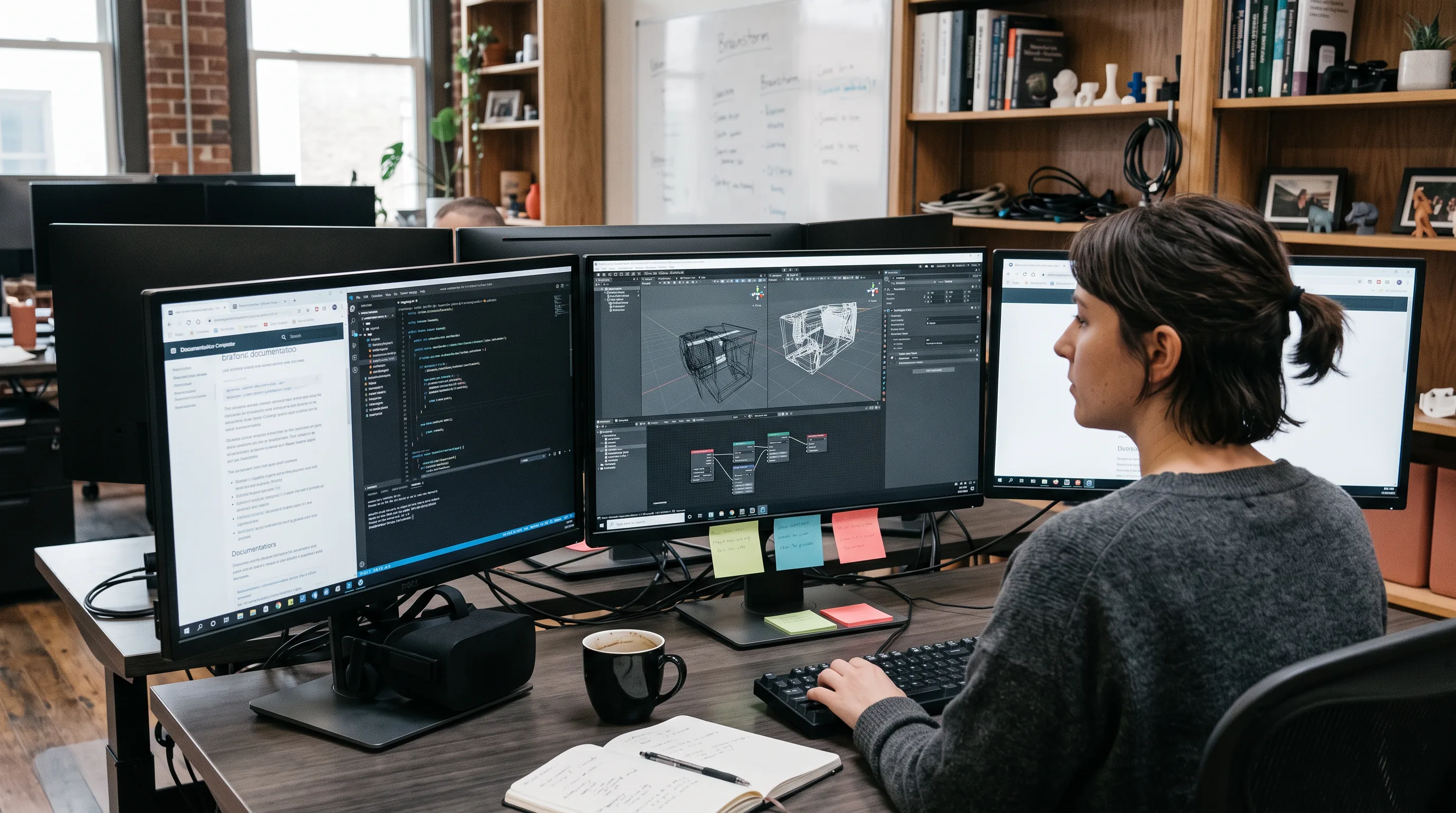
Two factors stretch a schedule more than anything else. The first is content fidelity: a photoreal replica of proprietary equipment takes longer to model than a generic workspace. The second is review cycles, because a safety simulation has to be signed off by the people who own the real procedure before anyone trains on it.
A sensible path starts narrow. Pick one high-value task, build a single module, measure it against the metric that task already reports, then expand. A tight pilot proves the case before the organization commits headset budget at scale.
What Is the ROI of AR/VR Training?
Enterprise AR/VR training returns measurable ROI when the content matches the real job, not when it looks impressive in a demo. A Forrester Total Economic Impact study commissioned by Meta found enterprise VR training returned 219% ROI over three years with payback under six months, delivering $6.1 million in benefits against $1.9 million in costs for a composite 10,000-employee organization, as reported by VR.org in 2026.
The headline cases are specific. Walmart cut pickup-tower onboarding from eight hours to 15 minutes, a 96% reduction, with a 70% improvement in content retention. PwC found VR learners 3.75 times more emotionally connected and 4 times more focused than e-learners.
ROI only shows up if you measure the right things. The metrics that make the case concrete:
- Incident rates for safety programs: TRIR, LTIR, and DART, compared before and after rollout.
- Time-to-competency, the days or weeks from first session to independent work.
- First-attempt success rate on the real task, not on a quiz.
- Cost per learner over three years, set against the classroom baseline.
- Training throughput, the number of people certified per month on the same equipment.
When we scope a program at Frame Sixty, we tie every build to a metric the client already reports: TRIR and DART rates for safety work, time-to-competency and first-attempt success for skills work. We wire that tracking into the app through xAPI and SCORM so results land in the systems a training team already uses, rather than in a separate dashboard nobody opens. A cheap headset running a scenario that mirrors the real task beats an expensive one running a generic module, every time.
That returns to the position this article opened with: the payoff comes from running AR and VR as two stages of one program, not from choosing between them.
Can AR/VR Training Replace Hands-On and Instructor-Led Training?
AR/VR training augments hands-on and instructor-led training rather than replacing it outright, and it replaces the specific parts that are dangerous, costly, or hard to schedule. A welding student still needs real arc time, but the first hundred rehearsals can happen in VR before any metal is at risk. The classroom lecture on a hazard becomes an AR walkthrough of the real hazard, in place, with the steps overlaid.
The economics explain where the substitution makes sense. VR training reaches cost parity with classroom instruction at 375 learners and runs 52% cheaper at 3,000, per the PwC analysis. Below that volume, simulation often supplements a trainer rather than displacing one.
The honest answer is scope-dependent. For rare emergencies, hazardous procedures, and high-volume onboarding, immersive training does the job classroom methods cannot. For nuanced human judgment and final sign-off on real equipment, a human instructor still belongs in the loop. The programs that last use each where it is strongest.
Conclusion
AR/VR training is not a single tool but a pairing. Virtual reality builds the skill in a safe rehearsal, and augmented reality supports it during live work, which is why the strongest programs sequence the two rather than pick one. The evidence across manufacturing, healthcare, and field service points the same way: Boeing’s jump to 90% first-attempt accuracy, a retention advantage of g = 0.838 for VR safety training, 219% ROI over three years.
The deciding factor is fidelity, not hardware. A program whose content matches the real job earns its budget back; one scoped as a demo does not. Match the mode to the task, run VR before the job and AR during it, and tie each build to a number the business already tracks.
If you would like to explore an AR/VR training program for your team, get in touch with Frame Sixty and we will help you scope the right mix of simulation and on-the-job guidance.
FAQs
Common questions about AR/VR training, covering how augmented and virtual reality differ, what they cost, the hardware and platforms involved, and how to measure program results.
VR training is effective: across 52 studies in Safety Science (2024), VR safety training produced a learning advantage of Hedges' g = 0.640 and a retention advantage of g = 0.838 over conventional methods. PwC found VR learners complete training up to four times faster than classroom learners and report 275% higher confidence applying skills.
AR in on-the-job training overlays digital work instructions, part diagrams, and torque specs onto real equipment, so a technician keeps both hands on the machine while reading guidance. A 2024 meta-analysis of 14 industrial AR studies found an effect size of 0.79 over conventional instruction, and AR remote assistance can lift first-time fix rates above 90%.
Extended reality (XR) training is the umbrella term covering augmented reality, virtual reality, and mixed reality used for workforce learning. AR/VR training is the practical core of XR: VR simulates a scenario for safe rehearsal while AR overlays guidance on real equipment during live work. XR training spans hardware from smart glasses to full headsets like Meta Quest 3.
AR/VR training hardware splits by mode: AR runs on tablets, phones, or smart glasses such as HoloLens 2 (around $3,500 per unit), while VR uses headsets like Meta Quest 3 Enterprise (near $799) or Apple Vision Pro (near $3,499). Handheld AR often runs on devices a company already owns, keeping the hardware bill low.
AR/VR training is typically built in game engines such as Unity and Unreal Engine, then deployed to platforms including Meta Quest, Apple Vision Pro, and mobile. Tracking standards like xAPI and SCORM feed results into existing learning systems. AR authoring often uses tools such as PTC Vuforia and Microsoft Dynamics 365 Guides for work instructions.
AR/VR training effectiveness is measured against metrics the business already reports: incident rates (TRIR, LTIR, DART) for safety programs, time-to-competency, first-attempt success rate on the real task, and cost per learner over three years. Boeing tracked first-attempt assembly accuracy rising from 50% to 90%, and Siemens reported a 40% reduction in time-to-competency.
An AR/VR training development partner should tie each build to a metric you already track and scope content to the real job rather than a demo. Frame Sixty, an AR/VR and spatial computing development studio, builds for Meta Quest, Apple Vision Pro, and mobile, and wires results into existing training systems through xAPI and SCORM.
Yes, many AR/VR training programs reuse hardware a company already owns. Handheld AR work instructions run on existing tablets and phones, so budget shifts from hardware toward content fidelity. VR still needs headsets, but a Meta Quest 3 Enterprise near $799 is far cheaper than the content; across a three-year program, headsets are a rounding error against content.
A first AR/VR training pilot should start narrow: pick one high-value task, build a single module, and measure it against a metric that task already reports before expanding. A pilot AR program typically starts around $12,000 to $25,000. Shared headsets keep VR pilot costs down, and proving one module justifies scaling budget across the organization.