
What Does a VR Training Company Build — and Is It Right for You?
Jul 8, 2026

16 MIN READ
A VR training company builds custom immersive simulations that let employees rehearse real job tasks inside a headset when physical practice is too dangerous, difficult, expensive, or rare — a fit test known as the DDER framework. The business case is documented: a Forrester Total Economic Impact study for Meta found 219% ROI over three years with payback in under six months, and Amazon trains over 400,000 delivery drivers annually in VR with 70% better knowledge retention. Cost per learner drops below instructor-led training above a few hundred learners, reaching 64% cheaper at 10,000. Under a work-for-hire model, the client owns the source code outright with no recurring licensing fees.
Key Takeaways
- The global VR enterprise training market reached $10.96 billion in 2026 and is forecast to hit $212.7 billion by 2035, a 44.88% CAGR (IndustryResearch.biz, 2026).
- A Forrester Total Economic Impact study for Meta found 219% ROI over three years with payback in under six months (VR.org, 2026).
- VR training fits four conditions: Dangerous, Difficult, Expensive, and Rare — the DDER framework.
- Amazon trains 400,000+ delivery drivers annually in VR, with 70% better knowledge retention and 30% faster time-to-readiness (AWE USA 2026).
- Custom development means you own the source code outright, with no recurring licensing fees.
Need help with custom VR training?
Frame Sixty is a full-service digital innovation studio specialising in AR/VR, mobile, and web development.
What Does a VR Training Company Actually Build?
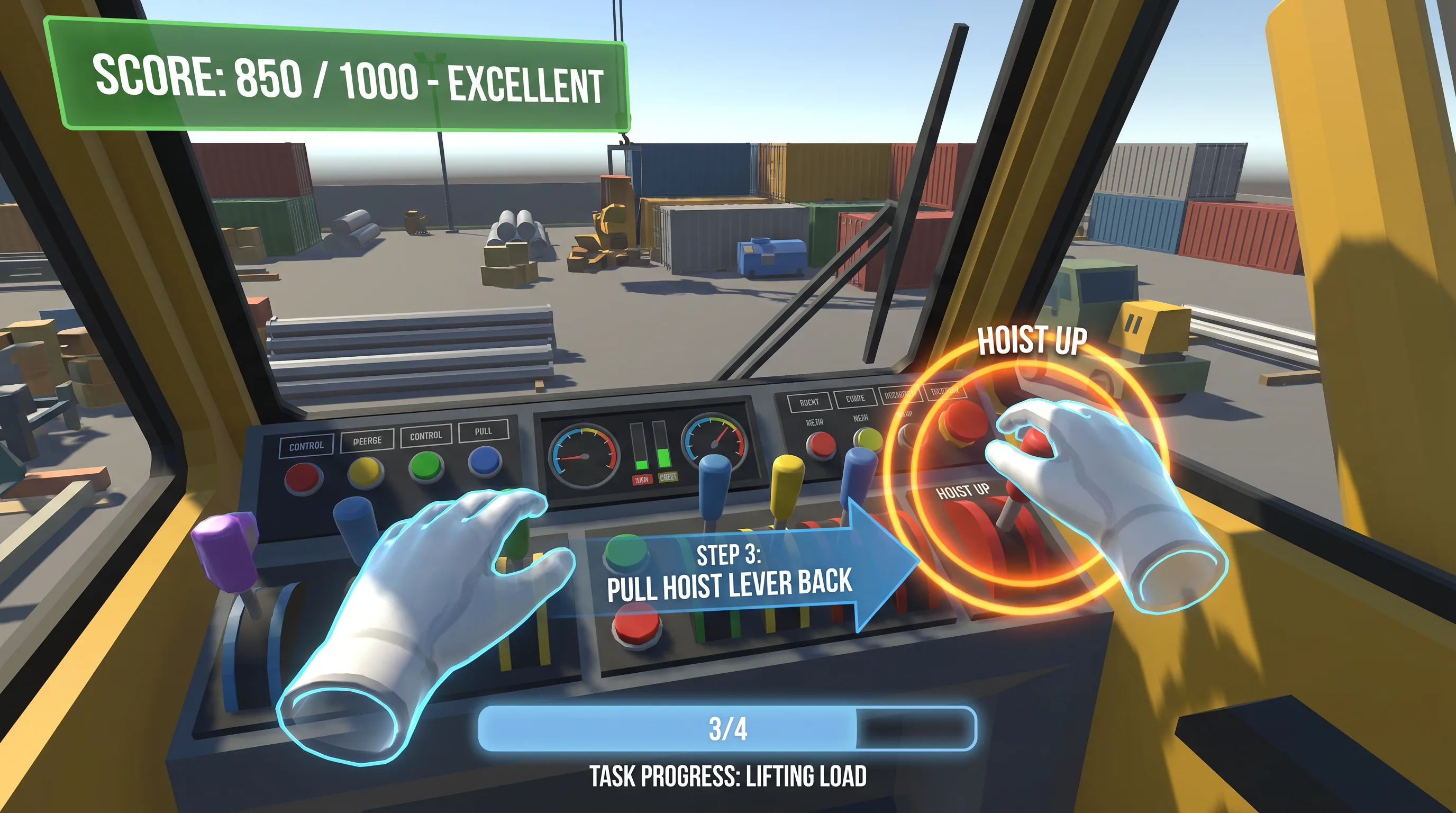
A VR training company builds custom interactive simulations: 3D environments that replicate a real worksite, scenario logic that responds to trainee actions, real-time performance feedback, and reporting that flows into your learning systems. These are software products built on engines like Unity or Unreal Engine and deployed to standalone headsets such as the Meta Quest 3 or HTC Vive Focus 3, or to enterprise XR hardware.
The distinction that matters is building versus licensing. An off-the-shelf platform gives you pre-made modules on general topics. A custom build reconstructs your specific haul truck, your specific control room, or your specific surgical procedure, with the exact steps and failure modes your people need to rehearse. For a fuller primer on the format and its core benefits, ArborXR’s overview of what VR training is walks through how immersive practice saves time, raises engagement, and improves retention.
A typical custom program includes several components:
- High-fidelity 3D models of the equipment and environment, with realistic mechanical behavior.
- Task-based workflows that let trainees move naturally and perform steps in sequence.
- Real-time feedback and scoring so learners see mistakes as they happen.
- Supervisor dashboards for tracking proficiency across a workforce.
- Standards-based reporting through xAPI or SCORM, so results land in your existing LMS.
The takeaway: a VR training company delivers owned software tailored to your operation, not a subscription to someone else’s content.
When Does VR Training Make Sense? The DDER Framework
VR training makes sense when real-world practice is dangerous, difficult, expensive, or rare — a test summarized by the DDER framework. As the Learning Guild puts it in its analysis of immersive training fit, “If it’s too difficult, too expensive, or too dangerous to do the training in the real world, immersive training is a good fit.” When none of these conditions apply, classroom or e-learning usually wins on cost and simplicity. Readers wanting a broader grounding in the discipline can start with Frame Sixty’s VR training guide, which covers strategies, tools, and ROI in more depth.
The framework traces to Jeremy Bailenson, founder of the Stanford Virtual Human Interaction Lab, who identifies scenarios where VR is justified rather than novelty: situations that are dangerous (“people learn by doing, making mistakes, getting feedback, and iterating — that process is dangerous in a plane”), impossible to stage physically, counterproductive to rehearse for real, or too expensive to repeat. The four conditions below each carry their own evidence.
Dangerous: Training Without Putting People at Risk
VR training removes physical risk from high-hazard work: electrical systems, heavy machinery, chemical handling, and emergency response. Trainees make and correct mistakes in a simulation where the only cost of failure is a lower score, then carry that judgment into the real task. This is the clearest case for immersive training, because the alternative is either expensive supervised practice or learning on the job with real consequences.
The safety results are documented. Intel reported a 300% return on its VR electrical safety program over five years, with 94% of participants requesting additional VR training, according to VirtualSpeech’s case study collection. Mining safety training cut lost-time injuries by 43%, per Minesafe International Conference data reported in VirtualSpeech’s 2026 statistics roundup. A 2025 quasi-experimental study of 200 participants in Scientific Reports found VR-based occupational safety training raised safety awareness by 30% over traditional methods and improved risk perception in Industry 4.0 settings. The takeaway: in dangerous work, VR converts fatal mistakes into teachable ones.
Difficult: Skills That Take Years to Develop Safely
VR training compresses the time to develop difficult procedural skills — surgery, aircraft maintenance, complex equipment operation — by removing the limits on how often a trainee can practice. These skills normally require scarce supervised access to real patients or machines, which caps repetition. A simulation removes that cap, so a trainee can run the same procedure dozens of times in a week.
Surgical training shows the effect most clearly. Johnson & Johnson’s Osso VR program produced students who scored 233% higher than passive learners and completed 252% more procedural steps, per VirtualSpeech, and surgeons trained with VR make 40% fewer errors. GE Healthcare faced a related bottleneck in radiography: CT scanners were too costly and scarce to use for practice, so the company moved training into VR where decisions are made against real scan data. The takeaway: when a skill is hard because practice opportunities are scarce, VR manufactures unlimited practice.
Expensive: High-Cost Assets You Cannot Spare for Practice
VR training pays off when the equipment people must learn on is too valuable to take offline for practice — aircraft, turbines, CT scanners, haul trucks. A digital twin of that asset costs nothing per training session once built, so an organization can run thousands of sessions without consuming fuel, causing wear, or removing equipment from production.
The scaling numbers are striking. Delta Air Lines raised daily training capacity from 3 to more than 150 trainees, a 4,900% increase, by moving procedures into VR rather than tying up physical aircraft, according to ArborXR’s 2025 effectiveness review. The same review reports UPS cut driver and logistics training time by 75%, from 8 hours to 2. Building a realistic virtual replica is itself a specialized job; creating a digital twin in VR is the mechanism that makes expensive-asset training repeatable at near-zero marginal cost. The takeaway: VR turns a costly, contested physical asset into an unlimited training resource.
Rare: Scenarios That Are Hard to Rehearse
VR training prepares people for rare but critical events — equipment failures, evacuations, edge-case faults, uncommon medical complications — that almost never occur during normal operations and so cannot be learned on the job. A simulation lets an organization script these events and have every worker rehearse them on demand, before the real thing happens.
The emotional realism of VR matters here. PwC’s cross-modality study found VR learners are 3.75 times more emotionally connected to the content than classroom learners, a difference that counts when the scenario involves stress and high stakes, as reported by ArborXR. Amazon’s driver-training program, presented at AWE USA 2026, was built to handle exactly this kind of rare-but-critical situation across a dispersed workforce. Krista Wharton, AI/ML Senior Product Manager at Amazon, described designing it for “connectivity limitations, language diversity, and varied technical capabilities across geographically dispersed learners” in the AWE USA 2026 session. The takeaway: VR is the only practical way to give every worker repeated practice at events that rarely happen.
What ROI and Performance Numbers Should You Expect?
VR training ROI is documented across multiple independent studies, with the headline figure coming from a Forrester Total Economic Impact study commissioned by Meta. That study found 219% return on investment over three years, with payback in under six months, generating $6.1 million in benefits against $1.9 million in costs for a composite 10,000-employee organization, as reported by VR.org in 2026. The business case no longer rests on novelty; it rests on retention, speed, and cost at scale.
Speed and Knowledge Retention Gains
VR training is consistently faster and stickier than classroom or e-learning. PwC’s study of more than 1,600 managers across 12 US locations found VR learners complete training up to 4 times faster than in a classroom, are 275% more confident applying skills afterward, and are 4 times more focused than e-learning peers, per VirtualSpeech’s 2026 roundup.
Real deployments back the lab numbers. Walmart trained over one million employees in VR and cut Pickup Tower onboarding from 8 hours to 15 minutes, a 96% reduction, while content retention rose 70%, according to VR.org, 2026. Amazon reports 70% better knowledge retention and 30% faster time-to-readiness across its 400,000+ drivers trained annually. The takeaway: VR training shortens time-to-competency while improving what trainees remember.
Training Cost per Learner at Scale
VR training cost per learner falls below traditional methods once the learner count is high enough to amortize the build. PwC’s analysis sets the crossover points clearly: VR reaches cost parity with classroom training at 375 learners, becomes 52% cheaper than classroom at 3,000 learners, and is 64% cheaper than instructor-led training at 10,000 learners, per VirtualSpeech, 2026. The Forrester study puts the per-learner VR cost at roughly $115 over three years.
The market reflects this economics. The VR enterprise training market reached $10.96 billion in 2026 and is projected to grow to $212.7 billion by 2035 at a 44.88% CAGR, with enterprises reporting a 30% improvement in retention and a 25% reduction in instructor hours, according to IndustryResearch.biz, 2026. The question for a buyer is not whether VR is cheaper, but where their headcount sits relative to the breakeven point. The takeaway: above a few hundred learners, the cost argument inverts in VR’s favor.

Which Industries Use VR Training Most?
VR training is used most heavily in industries where the DDER conditions stack up: energy, healthcare, logistics, aviation, and manufacturing. These sectors share a common problem — the highest-stakes training is also the hardest to deliver safely and affordably with traditional methods. The table below maps each industry to the conditions that drive its VR adoption.
| Industry | DDER conditions | Representative use case |
|---|---|---|
| Energy and heavy industry | Dangerous + Expensive | Haul truck, crane, and diesel system operation |
| Healthcare and medical | Difficult + Rare | Surgical simulation, rare-complication rehearsal |
| Logistics and distribution | Expensive + Rare | Driver hazard ID, warehouse onboarding |
| Aviation and aerospace | All four | Deicing, docking, emergency procedures |
| Manufacturing | Dangerous + Expensive | Jet engine maintenance, electrical safety |
In healthcare, immersive simulation handles both difficult procedures and rare complications that trainees might otherwise never see before a live case. Frame Sixty’s work in virtual reality in healthcare and medical VR training addresses clinical skills where repetition on real patients is impossible to schedule. In logistics, Amazon and UPS use VR to drill hazard recognition at a scale physical training cannot match. The 2025 Scientific Reports study confirms the industrial safety advantage holds up under controlled measurement. The takeaway: the more a sector’s critical training is dangerous, difficult, expensive, or rare, the more VR it adopts.
VR Training in Practice: Building a Simulation for a U.S. Energy Producer
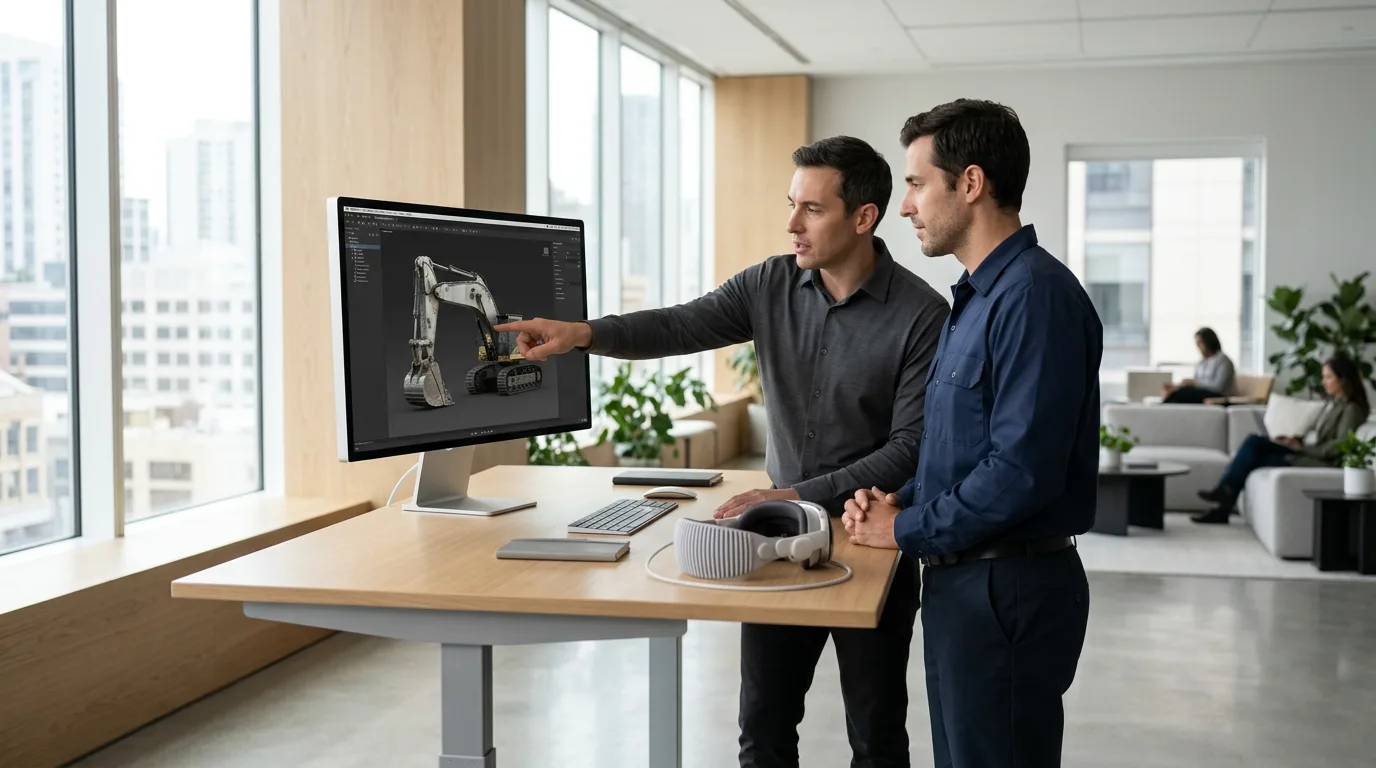
Frame Sixty, an AR/VR and spatial computing development studio, built a custom VR training simulation for a leading U.S.-based energy producer that needed to train equipment operators on haul trucks, cranes, and diesel-powered systems. This is a textbook DDER scenario: the equipment is dangerous to learn on and too expensive to spare for practice. The project shows what a custom build looks like in production rather than in theory.
The simulation included high-fidelity 3D machinery with realistic mechanical behavior, spatial task-based workflows that let operators move naturally around virtual equipment, and real-time performance feedback with evaluation tools for supervisors. Rather than license a generic safety course, the client got software modeled on their actual fleet and procedures.
The outcomes tracked the ROI patterns documented across the industry. According to the Frame Sixty VR training simulation case study, the program reduced training-related incidents through zero-hazard practice, shortened time-to-proficiency, cut operating costs by eliminating fuel use and equipment wear, and standardized task sequencing with data-driven benchmarking. In our work on this project, the supervisor evaluation tools proved as valuable as the trainee experience, because consistent scoring let the client compare operators against one objective standard for the first time. The takeaway: a custom energy-sector build converts dangerous, costly field practice into measurable, repeatable simulation.

Custom VR Development vs. Off-the-Shelf Training Platforms
Custom VR development and off-the-shelf platforms solve different problems. An off-the-shelf platform such as Strivr or EON Reality deploys quickly and costs less upfront, but limits you to pre-built scenario templates that cannot replicate your specific equipment or procedures. Custom development builds software around your exact environment, integrates with your LMS, and is owned outright. The right choice depends on whether your training is generic or operation-specific.
The table below contrasts the two approaches on the factors that drive the decision.
| Factor | Off-the-shelf platform | Custom development |
|---|---|---|
| Time to deploy | Fast | Longer (built to spec) |
| Upfront cost | Lower | Higher |
| Fits your exact equipment | No | Yes |
| Code ownership | Vendor owns runtime | You own everything |
| Recurring fees | Per-seat subscription | None after delivery |
| Updates | Vendor-controlled | You control |
For regulated industries, the ownership difference is more than financial. When a procedure or compliance requirement changes, a custom-build owner modifies their own asset on their own schedule, while a platform subscriber waits for the vendor. Buyers weighing options can compare studios through resources like top VR development companies and review the virtual reality development services a custom partner offers. The takeaway: choose off-the-shelf for generic topics and custom development when training must match your specific operation.
How Much Does a Custom VR Training Simulation Cost?
A custom VR training simulation typically costs between $75,000 and $500,000 or more, depending on scope. Entry-level single-module projects start around $75,000. Mid-range programs with branching scenarios, custom 3D assets, and LMS integration run $150,000 to $300,000. Complex multi-environment programs with custom hardware integration reach $300,000 to $500,000 and above. Industry sources such as Program-Ace cite development ranges of $50,000 to $1 million driven mainly by skilled-labor requirements.
The main cost drivers are predictable:
- Number of scenarios and the depth of branching logic in each.
- Fidelity of 3D models — photoreal equipment costs more than stylized assets.
- Platform targets — standalone headsets versus tethered or multi-device.
- System integration with existing HR and LMS infrastructure.
- Localization for language and regional variation across a workforce.
Incremental modules built on the same framework cost materially less than the first build, because the underlying systems already exist. Set development cost against the ROI data: at 10,000 learners VR is 64% cheaper per learner than instructor-led training, so the real comparison is total training cost over time, not the build price alone. Teams evaluating hardware-specific builds can review options like VR training with Apple Vision Pro to weigh device cost against capability. The takeaway: budget the first module as the investment, and expect follow-on modules to be cheaper.
Who Owns the Code After a Custom VR Training Project?
Under a work-for-hire model, the client owns all the code after a custom VR training project. At Frame Sixty, that means the client owns the source code, 3D assets, scenario logic, and documentation produced during the engagement. There are no royalties, no revenue shares, and no recurring licensing fees payable after delivery. The client can modify, extend, or redistribute the software without restriction.
This contrasts sharply with platform-subscription models, where the vendor owns the runtime and content tools and can change pricing or discontinue the product. Ownership also carries compliance weight: with a custom build, training data stays on the client’s own infrastructure rather than a third-party SaaS platform, which matters in regulated sectors. Frame Sixty signs standard work-for-hire agreements and NDAs before a project begins, so ownership terms are settled at the outset.
For decision-makers, code ownership protects against vendor lock-in. If priorities change, the client can bring the work in-house, hand it to another developer, or extend it themselves. Understanding the build process helps here; the virtual reality development guide explains what a custom engagement involves, and broader spatial computing in enterprise context helps situate VR training within a wider technology strategy. The takeaway: a work-for-hire VR project leaves you owning an asset, not renting access to one.
Conclusion
VR training earns its cost when real-world practice is dangerous, difficult, expensive, or rare. The DDER framework gives decision-makers a quick test, and the numbers back it: a 219% three-year ROI in Forrester’s study for Meta, 70% better retention at Amazon across 400,000+ drivers, and cost-per-learner that drops 64% below instructor-led training at scale. These are not projections; they are measured results from large deployments reported through 2026.
The choice between off-the-shelf and custom development comes down to specificity. Generic platforms suit generic topics. When your training must mirror your own equipment, procedures, and compliance requirements, a custom build modeled on your operation is the better fit — and under a work-for-hire model, you own the result outright, with no recurring fees and no vendor lock-in. Frame Sixty’s energy-sector simulation shows that approach producing fewer incidents, faster proficiency, and lower operating cost.
If you are weighing whether VR training fits a high-stakes program in your organization, reach out to Frame Sixty to talk through your scenario and what a custom build would involve. We will help you judge whether your training meets the DDER test before you spend a dollar on development.
VR Training Company FAQs
Common questions about hiring a VR training company, from results and hardware to cost ownership and measurement. Each answer is grounded in documented enterprise deployments and the DDER fit framework.
VR training outperforms classroom and e-learning on speed, confidence, and retention. PwC's study of 1,600+ managers found VR learners complete training up to 4 times faster than classroom, are 275% more confident applying skills, and are 4 times more focused than e-learning peers. Walmart saw content retention rise 70% after moving onboarding into VR.
Amazon, Walmart, Delta, UPS, and Intel run documented VR training programs. Amazon trains over 400,000 delivery drivers annually with 70% better knowledge retention, Walmart cut Pickup Tower onboarding from 8 hours to 15 minutes, and Intel reported 300% ROI on its VR electrical safety program over five years. These span logistics, retail, aviation, and manufacturing.
VR training typically runs on standalone headsets such as the Meta Quest 3 or HTC Vive Focus 3, which need no external PC or cabling. Custom simulations are built on engines like Unity or Unreal Engine and can target enterprise XR hardware. Standalone devices let organizations distribute training across dispersed workforces without dedicated lab setups.
VR training success is measured through time-to-competency, knowledge retention rate, error reduction, and incident frequency, with results flowing into your LMS via xAPI or SCORM. Supervisor dashboards track proficiency across a workforce. Enterprises adopting VR report a 30% average improvement in retention and 25% reduction in instructor hours, according to IndustryResearch.biz, 2026.
A custom VR training simulation typically costs between $75,000 and $500,000 or more depending on scope. Single-module projects start around $75,000, mid-range programs with branching scenarios and LMS integration run $150,000 to $300,000, and complex multi-environment builds reach $300,000 to $500,000. At 10,000 learners, VR is 64% cheaper per learner than instructor-led training.
Look for a partner that builds custom software modeled on your equipment and procedures, integrates with your LMS, and transfers full code ownership. Frame Sixty works for hire, so clients own the source code, 3D assets, and scenario logic with no recurring licensing fees, and signs work-for-hire agreements and NDAs before a project begins - the model behind its VR training simulation for a U.S. energy producer.
Get in touch
We’re interested to see how we can help. Send us a message and we will get back to you within 24 hours.