
Virtual Reality Training for Employees: Costs, Benefits, ROI, and Use Cases in 2026
Jun 23, 2026
13 MIN READ
Virtual reality training is a simulation-based learning method in which employees practice real tasks inside interactive 3D environments through a head-mounted display, eliminating real-world risk. Independent research shows measurable gains: PwC’s 2020 study found VR learners train four times faster than classroom participants and feel 275% more confident applying skills, while a University of Maryland study recorded 90% knowledge recall. Costs span three tiers, from roughly $20 per seat for off-the-shelf modules to $500,000 or more for a fully custom simulation, and reach cost parity with classroom training at about 375 learners. The economics favor scale, making learner count the key variable in any ROI calculation.
Key Takeaways
-
The global immersive training market reached $16.4 billion in 2024 and is projected to hit $69.6 billion by 2030 (Grand View Research, 2024).
-
PwC’s 2020 study found VR learners complete training 4x faster than classroom learners and feel 275% more confident applying skills.
-
VR training reaches cost parity with classroom at 375 learners and runs 52% cheaper at 3,000 learners (PwC, 2020).
-
VR training content ranges from $20 per seat for off-the-shelf modules to $500,000+ for a fully custom simulation.
-
Development timelines run from 4 weeks for a basic pilot to 18 months for a full custom build.
-
The global immersive training market reached $16.4 billion in 2024 and is projected to hit $69.6 billion by 2030 (Grand View Research, 2024).
-
PwC’s 2020 study found VR learners complete training 4x faster than classroom learners and feel 275% more confident applying skills.
-
VR training reaches cost parity with classroom at 375 learners and runs 52% cheaper at 3,000 learners (PwC, 2020).
-
VR training content ranges from $20 per seat for off-the-shelf modules to $500,000+ for a fully custom simulation.
-
Development timelines run from 4 weeks for a basic pilot to 18 months for a full custom build.
Planning a VR employee training program?
We are here to help!
What Is Virtual Reality Training for Employees?
Virtual reality training for employees is workplace learning delivered inside a headset, where workers complete simulated procedures, scenarios, and decisions in a 3D environment rather than watching video or reading slides. It differs from passive 360-degree video and from screen-based e-learning because the learner acts inside the simulation and the system responds to those actions in real time.
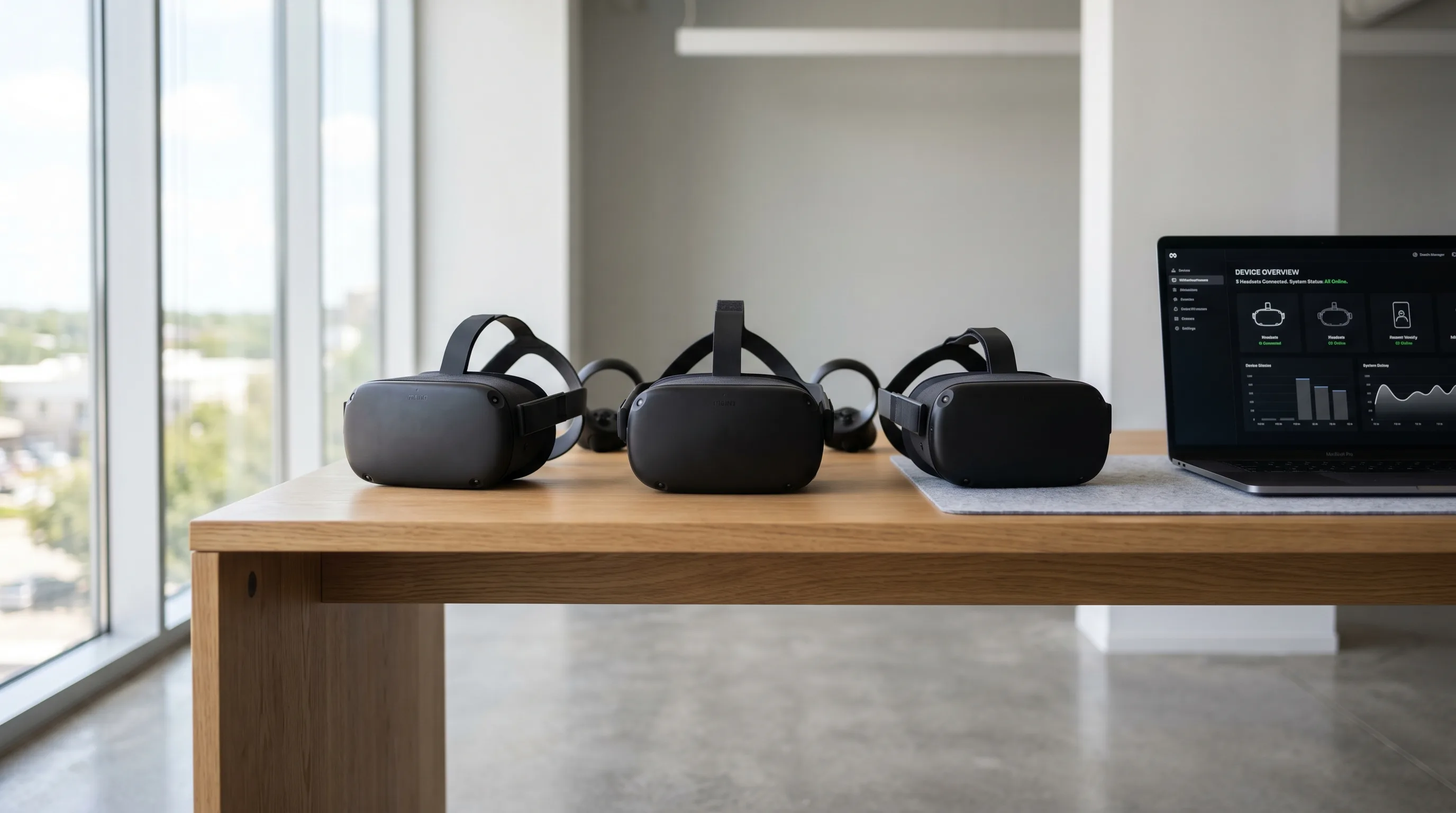
Organizations deploy VR training through three delivery models: pre-built off-the-shelf modules licensed per seat, semi-custom builds that adapt templates to company-specific procedures, and fully custom simulations developed from scratch. Hardware also varies, from standalone headsets like the Meta Quest 3 and Pico 4 Enterprise to tethered PC-VR rigs and premium devices such as the Apple Vision Pro.
Adoption has moved into the mainstream. As of 2025, 53% of global companies use VR for employee training and 77% plan to increase that investment, according to figures reported by SHRM in its 2024 analysis of VR/AR job training strategy. Readers who want a deeper implementation walkthrough can consult this VR training guide. The takeaway: VR training is now a budgeted line item, not an experiment.
Which Industries Benefit Most from VR Employee Training?
VR employee training delivers the largest returns where the work involves physical risk, expensive equipment, geographic scale, or high-stakes repetition that has no safe real-world practice option. Manufacturing, healthcare, logistics, aviation, retail, and finance all show documented gains, but the scenario types and the metrics that matter differ by sector.
Manufacturing, Logistics, and Aviation
Manufacturing and heavy-industry employers adopt VR training first because the safety stakes are concrete and costly. The U.S. Bureau of Labor Statistics recorded 355,800 workplace injuries in manufacturing in 2023, and a 2025 Nature Scientific Reports study (n=200) found VR safety training raised safety awareness 30% beyond classroom methods, as reported in Humulo’s 2026 review of VR safety training for manufacturing.
The operational results are equally specific. Boeing reported a 75% reduction in assembly training time per person (Humulo, 2026), and Airbus cut maintenance process time by 25% using VR simulations (Yord Studio, 2026). In logistics and aviation, UPS reduced driver safety training from 8 hours to 2 hours, and Delta Air Lines scaled deicing technician certification from 3 to more than 150 per day, a 4,900% increase documented in ArborXR’s 2025 review of VR training effectiveness. Many of these programs train workers on a digital twin of real equipment, so the simulated machine behaves like the one on the floor.
Healthcare and Life Sciences
Healthcare uses VR training to rehearse procedures where a mistake carries clinical consequences. VR-trained medical professionals made 6x fewer errors than traditionally trained counterparts, according to Yord Studio’s 2026 industry use-case analysis, which also notes that more than 30% of U.S. medical schools now use VR and projects the healthcare VR market at $11.3 billion by 2030.
Pharmaceutical manufacturing is another high-stakes healthcare use case for VR training. Pfizer recorded a 40% reduction in training time and a 300% improvement in training quality during its COVID vaccine manufacturing scale-up (ArborXR, 2025). Common clinical scenarios for VR training include surgical simulation, CPR practice, and anatomy visualization. Employers building clinical programs can review our work in medical VR training for scenario examples.
Retail, Finance, and Soft-Skills Training
Retail, finance, and customer-facing teams use VR training for behavioral and soft skills, not just procedures. Walmart trained more than one million employees on customer service and peak-season scenarios, and Bank of America reported that 97% of VR-trained associates felt confident applying learned skills as it rolled the program toward its 200,000-person workforce (ArborXR, 2025).
The behavioral evidence comes from PwC’s 2020 study of 1,600+ managers, which found VR learners 3.75x more emotionally connected to content than classroom learners and 275% more confident afterward. Public safety teams report comparable gains: VR-trained officers were 2.7x more successful in tactical missions (Yord Studio, 2026). Immersive practice improves judgment in customer service and conflict scenarios, which is why enterprise spatial computing programs increasingly bundle soft-skills modules into VR training.
VR Training vs Classroom and E-Learning: Side-by-Side Comparison
VR training outperforms classroom and e-learning on speed, retention, and confidence, while reaching cost parity only at scale. The table below compares the three delivery methods across the metrics that decision-makers weigh, drawing on PwC’s 2020 study and a University of Maryland recall study.
| Metric | VR | Classroom | E-Learning |
|---|---|---|---|
| Training speed | 4x faster than classroom (PwC, 2020) | Baseline | Faster than classroom, slower than VR |
| Knowledge recall | 90% (University of Maryland) | Mid-range | 78% desktop (University of Maryland) |
| Confidence uplift | +275% vs classroom (PwC, 2020) | Baseline | Below VR |
| Focus during training | 4x more than e-learning (PwC, 2020) | 1.5x more than e-learning | Baseline |
| Cost parity point | 52% cheaper than classroom at 3,000 learners | Baseline | Matches VR at 1,950 learners |
| Emotional connection | 3.75x vs classroom (PwC, 2020) | Baseline | 2.3x below VR |
The recall gap is one of the clearest signals: VR learners achieved 90% recall versus 78% for desktop learning, according to a University of Maryland study cited in AutoVRse’s 2026 comparison of VR and traditional training. PwC’s conclusion was not wholesale replacement but a blended curriculum that routes high-stakes procedural and behavioral skills to VR. VR is not the cost-effective choice for a simple policy update or a knowledge-check compliance course, a point reinforced across the statistics compiled by VirtualSpeech. The takeaway: choose VR where practice and retention matter, and keep cheaper formats for low-stakes content.

How Much Does VR Training Cost?
VR training costs vary by more than a factor of 100, from roughly $20 per seat for a licensed compliance module to $500,000 or more for a single custom simulation. The driver is content type and interactivity, but the quoted development price is only part of the budget. Hardware, LMS integration, and annual content refresh routinely turn a small estimate into a much larger three-year figure, as AgileSoftLabs’ June 2026 cost analysis found when a 500-employee manufacturer’s $80,000 estimate became $412,000 over three years.
Content Development Tiers
VR training content falls into three pricing tiers, and the right tier depends on how unique the procedure is. The table below summarizes cost, timeline, and fit, drawn from AgileSoftLabs’ June 2026 enterprise training cost breakdown.
| Tier | Cost | Timeline | Best for |
|---|---|---|---|
| Off-the-shelf | $20–$50/seat or $2K–$8K site license | Days | Standard compliance, onboarding, soft skills |
| Semi-custom | $30K–$80K per module | 8–16 weeks | Industry processes with company-specific steps |
| Fully custom | $150K–$500K+ per module | 6–18 months | Proprietary equipment, unique high-stakes procedures |
A 20-minute fully custom module requires 2,000 to 4,000 production hours, which at agency rates equals $300,000 to $1,000,000 for complex builds, according to eLearning Industry’s breakdown of VR development time. An in-house team of a Unity developer, 3D artist, instructional designer, QA engineer, and project manager runs about $490,000 per year, which only makes sense for organizations producing many modules. Employers can see a custom VR training simulation example to gauge what full-custom scope includes.
Hardware and Total Cost of Ownership
Standalone headsets dominate enterprise VR training because they need no PC tether and support fleet management at scale. The three-year total cost of ownership per headset, including device management, ranges widely by device, as the table shows (AgileSoftLabs, June 2026).
| Device | Unit cost | 3-year TCO |
|---|---|---|
| Pico 4 Enterprise | $699 | $1,024 |
| Meta Quest 3 Enterprise | $799 | $1,459 |
| HoloLens 2 | $3,500 | $3,875 |
| Apple Vision Pro | $3,499 | $5,996 |
Hardware is only the entry cost of a VR training deployment. Beyond the headset, AgileSoftLabs’ June 2026 analysis lists LMS or xAPI integration ($8,000–$60,000 one-time), mobile device management ($75–$180 per device per year), and an annual content refresh of 15–25% of build cost. A 200-employee safety program with 50 headsets totaled about $333,950 over three years, or roughly $557 per employee per year (AgileSoftLabs, June 2026). Teams weighing premium devices can compare options in our guide to VR training with Apple Vision Pro.
How to Calculate VR Training ROI
VR training ROI hinges on scale, because fixed development and hardware costs amortize across learners. PwC’s 2020 study established three break-even thresholds that decision-makers can apply directly: VR reaches cost parity with classroom training at 375 learners, matches e-learning costs at 1,950 learners, and becomes 52% cheaper than classroom at 3,000 learners.
A working ROI estimate has two components:
- Time savings: (employees trained per year x hours saved per employee x average loaded hourly rate) plus eliminated trainer salaries, travel, and facility costs.
- Risk reduction: (historical incident rate x average incident cost x expected reduction percentage). Use 43% as an evidence-based benchmark, the lost-time injury reduction a mining operator reported after VR safety training, cited in PIXO VR’s VR training statistics, which also notes that 82% of companies implementing AR/VR say benefits exceed expectations (Capgemini).
Two enterprise programs documented by ArborXR in 2025 illustrate the formula at scale. Delta Air Lines’ 4,900% jump in certification capacity drives the marginal cost of certifying a technician toward zero, and Bank of America’s 97% skill-confidence rate across a 200,000-person rollout demonstrates retention of value, not just upfront savings. A practical ROI calculator inputs headcount, current training cost, and incident rate to project a break-even point. The takeaway: model both time saved and incidents avoided, then compare against your learner count.
How Long Does a VR Training Module Take to Build?
A VR training module takes from 4 weeks for a basic pilot to 18 months for a fully custom simulation, with most enterprise builds landing in between. The timeline tracks how custom the content is: a basic pilot with a simple environment and limited branching runs 4 to 8 weeks, a semi-custom module with custom assets and LMS integration runs 8 to 16 weeks, and a fully custom simulation with original 3D environments, NPC characters, and physics runs 6 to 18 months (AgileSoftLabs, June 2026).
Every project moves through three production phases:
- Instructional design: learning objectives, scenario flowchart, and script (1 to 8 weeks).
- Asset creation: 3D models, environments, animation, and audio (4 weeks to 4+ months).
- Programming and integration: engine build, interaction logic, and LMS or xAPI plumbing (1 to 8 weeks).
Branching depth, the number of NPC animations, LMS compatibility requirements, and client review cycles are the factors that most often extend a schedule, per eLearning Industry. Teams planning a build can review our VR development guide to map scope to schedule before committing. The takeaway: pin down branching and asset complexity early, because they set the timeline more than headset choice does.
How to Choose a VR Training Development Company
Choosing a VR training development company comes down to a three-way decision: license an off-the-shelf platform, hire an agency for semi-custom work, or commission a studio for a fully custom simulation. The right path depends on whether the training involves proprietary equipment, company-specific branching, or outcomes that generic content cannot reproduce. Evaluate candidates against five criteria:
- Training-specific portfolio: real training simulations, not marketing VR or games.
- Platform expertise: Unity or Unreal Engine, proven SCORM and xAPI LMS integration, and headset-agnostic deployment across Meta, Pico, and HoloLens rather than lock-in to one vendor.
- End-to-end team: instructional design, 3D art, development, and QA under one roof, since fragmented teams add coordination cost and time.
- Total cost transparency: any partner quoting development alone, without hardware TCO, LMS integration, and content refresh, is giving a number that will move at contract stage.
- Measurable outcomes: deliverables tied to tracked learning objectives in your LMS, not just a finished module.
In a February 2026 guide, Program-Ace founder and CEO Oleg Fonarov points to a 2025 meta-analysis finding that VR-based safety programs “improve safety knowledge, increase motivation, and support safer behavior at work” compared with classroom training, summarized in his guide to VR safety training companies. For a ranked market view, see our list of top VR development companies. Frame Sixty, an AR/VR and spatial computing development studio, builds custom VR training simulations end to end, from instructional design and 3D environment creation to LMS-integrated deployment. As the field matures, AI in VR development is making adaptive, scenario-generating training practical, which is worth weighing when you assess a partner’s roadmap.
Conclusion
Virtual reality training has moved from pilot projects to budgeted enterprise programs, backed by a market that Grand View Research valued at $16.4 billion in 2024 and projects to reach $69.6 billion by 2030. The evidence for its impact is concrete: 4x faster training and 275% higher confidence in PwC’s 2020 study, a 75% cut in assembly training time at Boeing, and a 4,900% increase in certification capacity at Delta Air Lines. The economics favor scale, with cost parity against classroom training at 375 learners and 52% savings at 3,000.
The practical decisions are cost tier, hardware, timeline, and development partner. Off-the-shelf content suits standard compliance, semi-custom fits company-specific procedures at $30,000 to $80,000 per module, and fully custom simulations handle proprietary, high-stakes work. Budget for the full three-year cost, not just development, and match your learner count against the break-even thresholds before committing.
If you are planning an immersive training program and want a recommended solution, an estimated timeline, and a preliminary budget range, reach out to us at Frame Sixty for a VR training feasibility assessment. Our team builds custom VR training simulations that tie measurable outcomes to your existing learning systems.
Virtual Reality Training: Costs, ROI, and Common Questions
Practical answers for HR, L&D, and operations leaders evaluating virtual reality training. These cover when VR training pays off, what it costs per employee, and how it integrates with existing learning systems.
VR training rarely replaces in-person training entirely. PwC's 2020 study recommended a blended curriculum that routes high-stakes procedural and behavioral skills to VR while keeping cheaper formats for low-stakes content. VR is not cost-effective for a simple policy update or a knowledge-check compliance course, so most enterprises blend VR with classroom and e-learning rather than eliminating them.
VR training costs are typically justified at around 375 learners, the point where VR reaches cost parity with classroom training in PwC's 2020 study. At 1,950 learners it matches e-learning costs, and at 3,000 learners it runs 52% cheaper than classroom. Below a few hundred learners, off-the-shelf modules usually make more financial sense than a custom build.
Off-the-shelf VR training is pre-built content licensed per seat ($20 to $50 per seat or $2K to $8K site license) and deployable in days, while fully custom VR training is a simulation built from scratch ($150K to $500K+ per module over 6 to 18 months). Semi-custom sits between, adapting templates to company-specific procedures for $30K to $80K per module in 8 to 16 weeks.
A VR training development company should offer a training-specific portfolio, platform expertise in Unity or Unreal with proven SCORM and xAPI integration, and an end-to-end team spanning instructional design, 3D art, development, and QA. Frame Sixty builds custom VR training simulations end to end with LMS-integrated deployment and transparent three-year cost covering hardware and content refresh.
Enterprise VR training typically runs on standalone headsets that need no PC tether, such as the Meta Quest 3 Enterprise ($1,459 three-year TCO) and Pico 4 Enterprise ($1,024). Premium devices include the HoloLens 2 ($3,875) and Apple Vision Pro ($5,996). Standalone headsets dominate because they support fleet management at scale across many locations.
Building a VR training module takes from 4 weeks for a basic pilot to 18 months for a fully custom simulation (AgileSoftLabs, June 2026). Semi-custom modules with custom assets and LMS integration run 8 to 16 weeks. Branching depth, NPC animation count, LMS requirements, and client review cycles extend schedules more than headset choice does.
Get in touch
We’re interested to see how we can help. Send us a message and we will get back to you within 24 hours.