
Spatial Computing in Enterprise
May 30, 2025
6 MIN READ
The Tipping Point for Spatial Computing in Enterprise
When Apple announced Vision Pro, it framed the headset as the start of a new era of spatial computing in enterprise. Within weeks, companies like SAP, Cisco, Lowe’s, and KLM had launched pilot apps that put spatial computing at the center of dashboards, design reviews, and hands-on training.
Why Vision Pro Changes the Game
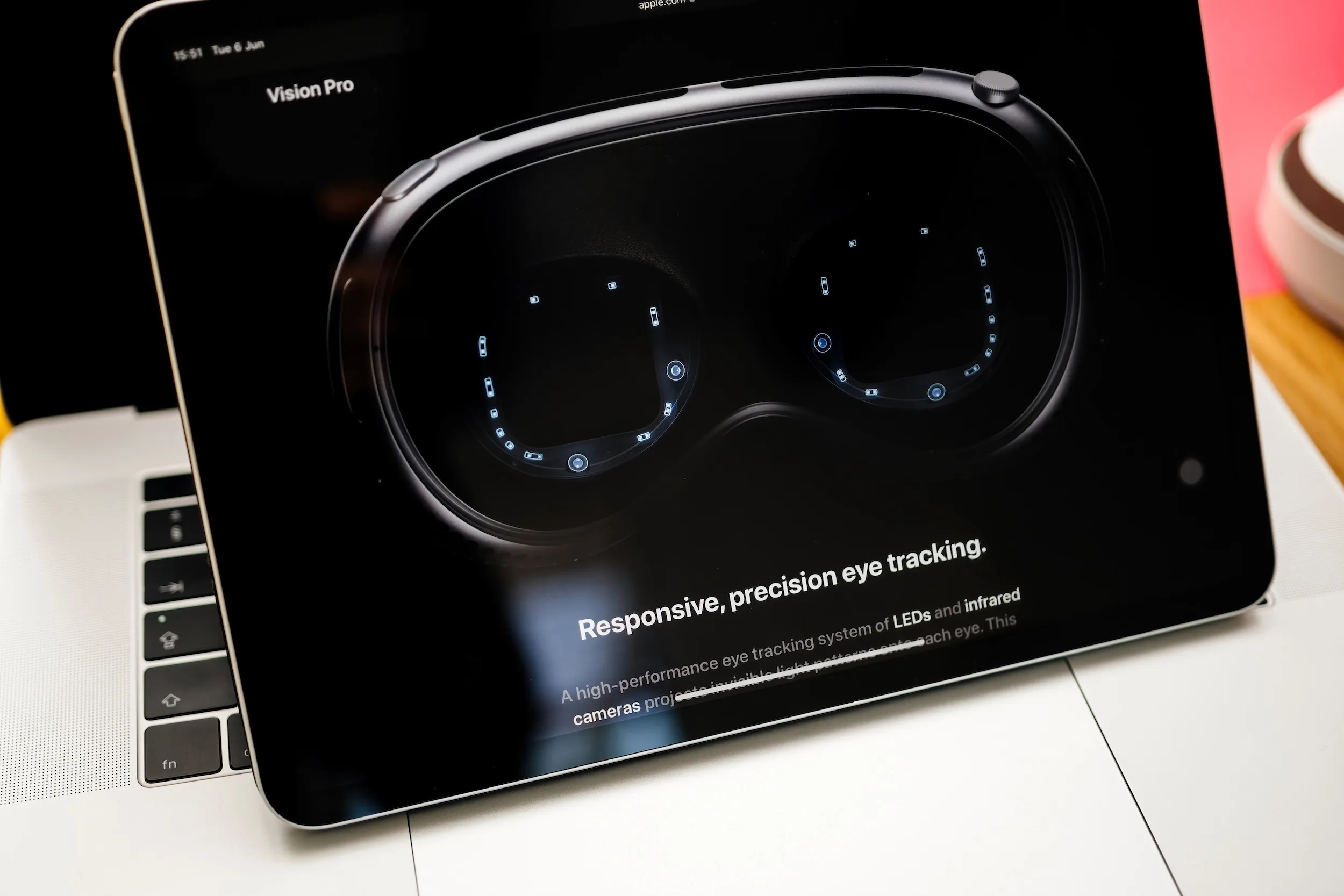
Vision Pro’s 23-million-pixel micro-OLED displays, ultra-precise eye- and hand-tracking, Optic ID security, and visionOS—built on the same foundations as iOS—give IT leaders the compliance posture they already trust while unlocking truly immersive spatial computing in enterprise.
Because MDM, SSO, and VPN controls are identical to iPhone, spatial computing deployments fit neatly into existing governance models—one more reason adoption is accelerating.
Infinite, Private Workspaces
Develop immersive training scenarios and simulations designed to improve skills, reduce risks, and enhance retention across various industries.
Need help to get your app project started?
We are here to help!
3-D Design Collaboration Without the Learning Curve
PTC’s Onshape Vision streams cloud-native CAD directly into Vision Pro so engineers and non-technical stakeholders alike can explode, inspect, and walk through full-scale assemblies. Meetings that once relied on screenshots now take place inside the model—proving again how spatial computing in enterprise shortens design cycles.
KLM’s Engine-Shop Training Success
Grounding a jet for training costs fortunes. KLM’s Engine Shop app overlays step-by-step procedures, torque specs, and wiring routes on a virtual Trent 1000 engine, letting trainees practice with authentic gestures while aircraft stay in service. Early metrics show fewer errors and faster certifications—a textbook ROI for spatial computing.
Guided Fieldwork & Remote Expertise
Front-line technicians benefit from heads-up spatial computing in enterprise, too. Vision Pro understands depth, so remote experts can anchor 3-D annotations precisely where a bolt or breaker lives, slashing truck rolls and mean-time-to-repair.
Retail Showrooms That Travel Home
Lowe’s Style Studio lets customers swap 80 billion kitchen combinations at life size in their own homes, turning flat catalogs into hyper-personal spatial computing experiences that boost conversion and shrink returns.
Economics of Spatial Workflows
Front-line technicians benefit from heads-up spatial computing in enterprise, too. Vision Pro understands depth, so remote experts can anchor 3-D annotations precisely where a bolt or breaker lives, slashing truck rolls and mean-time-to-repair.
Implementation Road-Map for CIOs
- Identify high-value spatial moments—maintenance, design reviews, data walls.
- Start with one pilot to measure ROI fast.
- Leverage Apple’s Enterprise Spatial Design Lab for rapid prototyping.
- Plan secure content pipelines (USDZ, photogrammetry, cloud CAD).
- Iterate and scale once metrics validate the investment.
Tip: Frame Sixty has deployed these pipelines end-to-end. Learn how we build Vision Pro apps.
Best-Practice Patterns Across Industries
-
Infinite data canvases for analytics teams
-
Life-size digital twins for manufacturing
-
Gesture-based SOPs for healthcare and factory floors
-
Context-aware overlays for utilities and energy
-
Immersive configurators for retail and real estate
Each pattern proves the versatility of spatial computing in enterprise, and all are in live production today.
Take the Next Step With Frame Sixty
Spatial computing in enterprise is no longer a prototype—it’s a profit center. If you’re ready to launch or scale Vision Pro solutions, Frame Sixty delivers the strategy, design, and engineering to make them real.
Contact us today at framesixty.com/contact to turn your first idea into a production-ready Apple Vision Pro application.
Spatial Computing in Enterprise FAQs
Ready to explore spatial computing in enterprise but still have questions? The FAQ below addresses the most common concerns we hear from IT leaders, heads of innovation, and business stakeholders evaluating Apple Vision Pro solutions.
Apple Vision Pro combines dual 4K-per-eye micro-OLED displays, eye-plus-hand input with no controllers, Optic ID biometric security, and visionOS built on the same foundations as iOS and iPadOS. For enterprises, that means high-fidelity visuals with the mobile device management, SSO, and VPN controls IT teams already trust from iPhone deployments.
Yes - Apple Vision Pro supports MDM, VPN, and single sign-on, plus Optic ID and on-device processing of eye-tracking data. For high-security zones, policies can disable outward-facing cameras, enforce offline mode, or require privacy shields, so deployments fit existing departmental security models.
Native visionOS apps for the enterprise are built in Swift and SwiftUI with RealityKit and Metal, while Unity PolySpatial offers a cross-platform option. Most performance-critical enterprise apps use Apple's native toolchain, which also connects to the same REST, GraphQL, and WebSocket APIs as iOS for live dashboards and digital twins.
Yes - existing CAD, BIM, and FBX assets can be converted to USDZ or Reality Composer scenes for Vision Pro. Frame Sixty provides automated conversion pipelines for Onshape, SolidWorks, Revit, and other formats, keeping enterprise asset libraries in sync as designs change.
Enterprises distribute Vision Pro apps privately through Apple Business Manager or Apple School Manager, with IT pushing visionOS apps via MDM. TestFlight covers beta distribution and enterprise certificates handle in-house deployments - the same governance model IT already runs for iPhone and iPad fleets.
Spatial computing pilots typically track cycle-time reduction in design reviews, downtime avoided through maintenance training, sales lift from retail configurators, and error rates in field service, with many clients seeing positive ROI within one or two quarters. Most enterprises start with 5-15 headsets: one or two per workflow persona plus a spare for dev and QA.
Get in touch
We’re interested to see how we can help. Send us a message and we will get back to you within 24 hours.