
What Does VR Surgical Training Cost, and How Do You Build the Right Program?
Nov 4, 2026
14 MIN READ
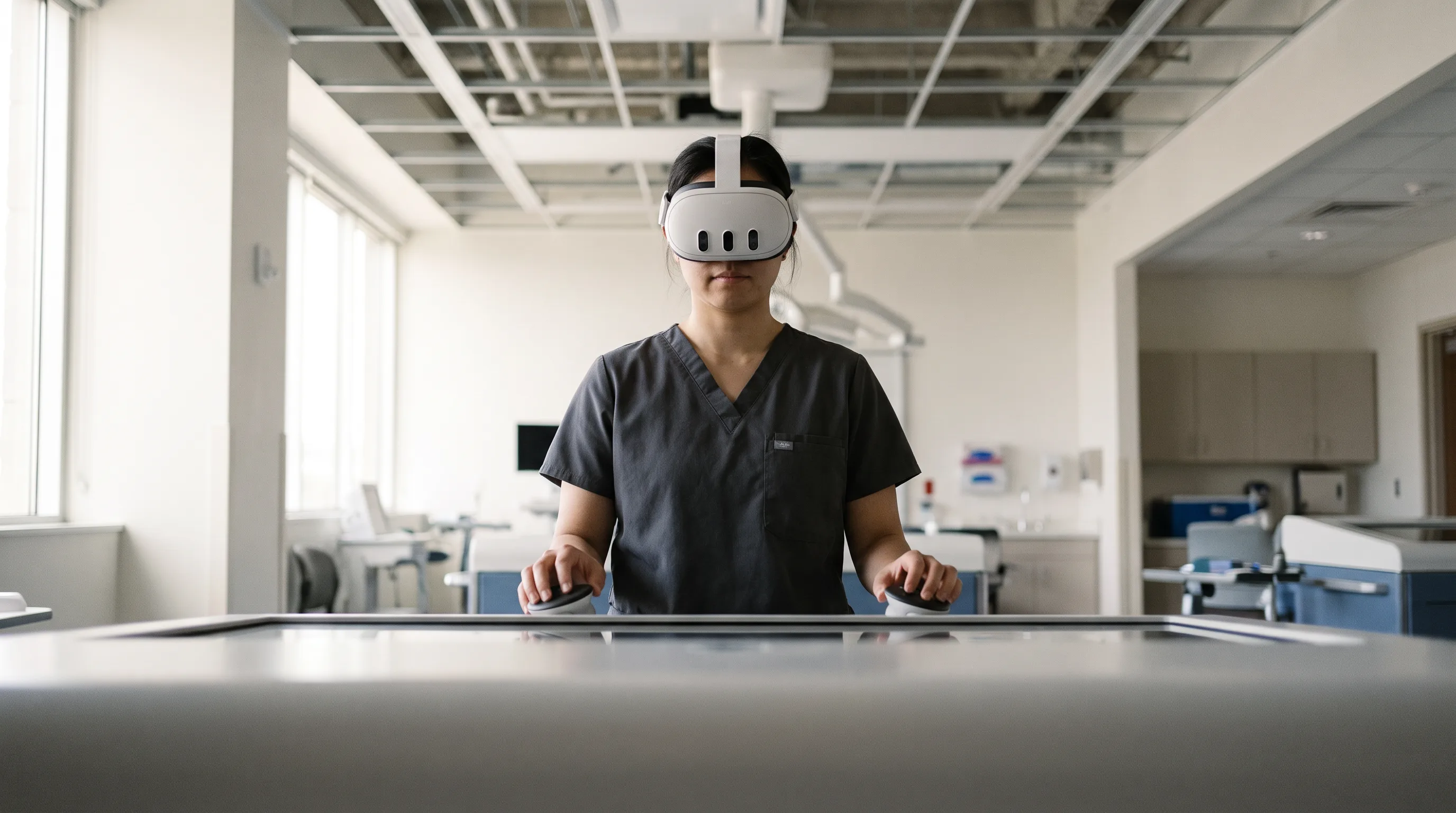
VR surgical training is immersive simulation that lets a surgeon rehearse a procedure inside a headset, with real-time feedback on accuracy and technique, before operating on a patient. A licensed platform for a 20-surgeon program runs $68,000 to $142,000 in the first year, per Fora Soft’s 2026 analysis. A custom-built simulator starts near $50,000 for one procedure and passes $1.5 million for FDA-regulated software, according to Dr. Matthew Lynch’s 2026 cost breakdown. This guide covers what you get, what it costs, and how to pick a builder.
Key Takeaways
- VR-trained surgeons are five times less likely to cause tissue injury than traditionally trained peers (World Academy of Cosmetic Surgery, 2025).
- A 20-surgeon VR surgical training program costs $68,000–$142,000 in year one on a licensed platform (Fora Soft, 2026).
- Custom VR surgical module development runs $50,000–$250,000+ per procedure, reaching $1.5M+ for FDA-regulated builds (Dr. Matthew Lynch, 2026).
- The global VR surgical training market reached $412 million in 2025 and is projected to hit $1.52 billion by 2032 (Treeview Studio, 2026).
- Below roughly 500 trainees per year, licensing an existing platform beats commissioning a custom build on cost.
What Is VR Surgical Training?
VR surgical training is immersive simulation in which a surgeon or trainee performs a procedure inside a virtual operating field, using a head-mounted display and tracked controllers or haptic instruments. The system scores accuracy, timing, and technique, then lets the trainee repeat the procedure as often as needed. It replaces scarce cadaver labs and rationed live-OR repetitions with unlimited, measured practice.

The core loop is simple. A trainee puts on a headset. They face a 3D anatomical model built to behave like real tissue, work through the steps of a procedure, and get immediate feedback on every cut, angle, and instrument path. General medical education VR covers anatomy tours and patient-communication role-play. Surgical training VR is a different animal.
What separates it are three hard requirements: procedural specificity, physical force feedback, and hard outcome data. Those three are exactly what make a surgical simulator expensive to build and valuable to own. A tool that nails all three can stand in for a cadaver. A tool that skips one is a 3D anatomy viewer with a stopwatch.
The problem it solves is access. Cadaver sessions cost hundreds to a couple thousand dollars each and cannot be repeated at will. Live-OR practice is limited by surgical schedules and patient safety. New device onboarding, such as teaching a surgeon a just-released implant or robotic tool, has no scalable rehearsal format without simulation. VR gives a program reps on demand.
The market has moved from pilot to procurement. According to Treeview Studio’s June 2026 analysis, the global VR surgical training market grew from $345 million in 2024 to $412 million in 2025, and is projected to reach $1.52 billion by 2032. Virtual reality already holds 38% of the broader surgical simulation market, which Towards Healthcare Research & Consulting valued at $3.85 billion in 2025. Hospitals now shop for VR in surgical planning and simulation the way they evaluate any clinical system. This is no longer experimental technology shopping.
One position guides the rest of this guide: fund VR surgical training for measured skill transfer, not for immersion. The programs worth the money are the ones instrumented to prove competency with data. Graphics sell demos. Outcome evidence changes patient safety.
How Effective Is VR Surgical Training Compared to Traditional Methods?
VR surgical training produces measurably better surgical performance than video instruction or lecture teaching, and it reduces errors in the operating room. Across pooled studies, VR-trained surgeons are five times less likely to cause tissue injury and perform about 19.9% better than control groups. The strongest evidence sits in orthopedics, where randomized trials show VR beating video on implant-placement accuracy.
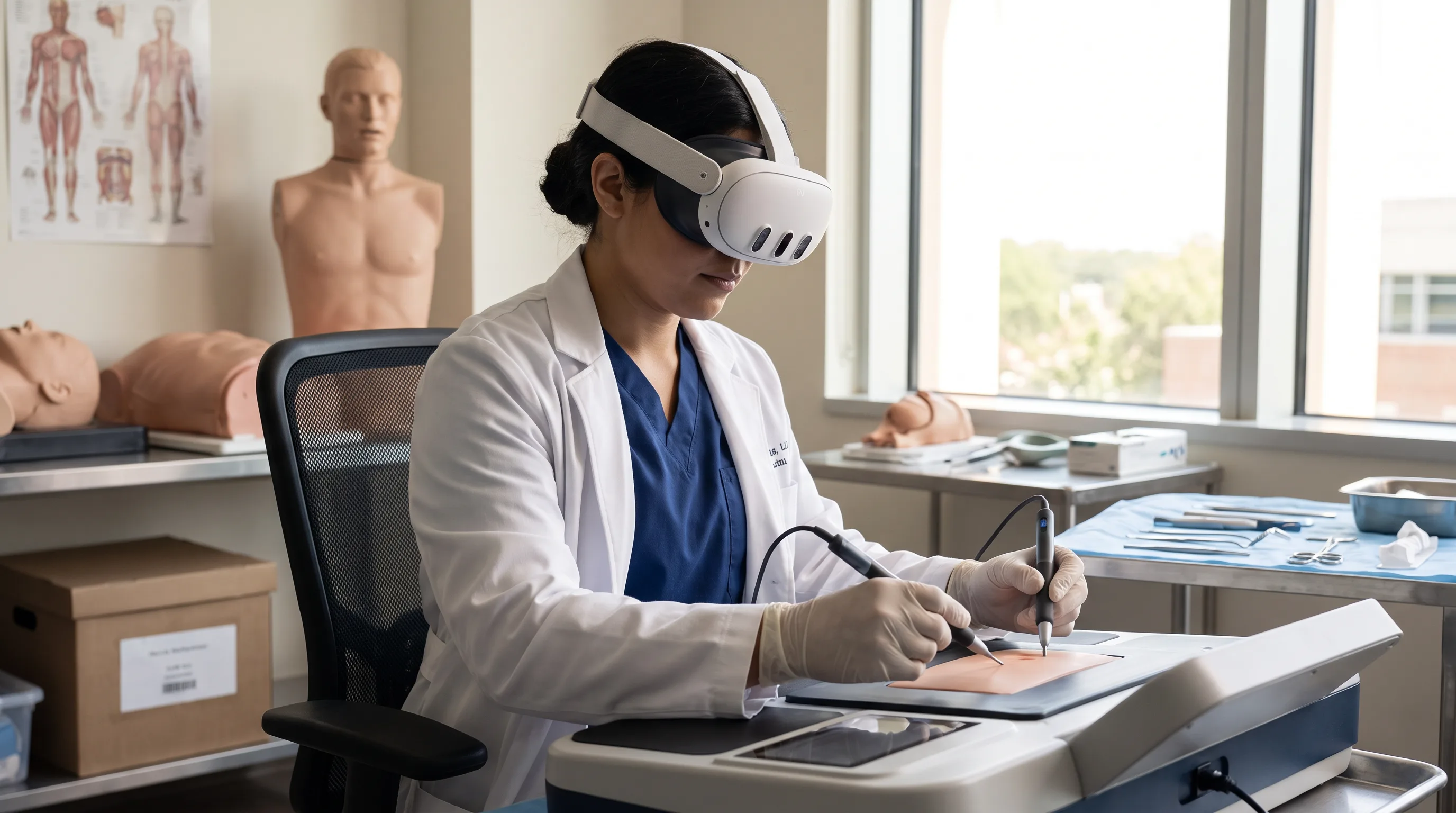
The numbers hold across specialties. According to the World Academy of Cosmetic Surgery’s December 2025 evidence review, VR-trained surgical groups outperformed controls by an average of 19.9% across 168 subjects, and VR-trained surgeons were five times less likely to cause tissue injury. A JAMA Network Open study on shoulder arthroplasty, cited in the same review, measured a 0.79 transfer ratio: 60 minutes of VR practice carried over to roughly 47 minutes of real operating-room experience. In an NIH study, VR-trained residents completed gallbladder dissection 29% faster than traditionally trained peers.
Randomized evidence backs the pooled data. A 2024 randomized controlled trial in International Orthopaedics (Kenanidis et al., n=101) found that VR-trained students placed the acetabular cup with a mean angular error of 4° versus 8° for video-trained controls (p<0.001), and femoral-stem retroversion occurred in 31.4% of the VR group versus 55.3% of controls (p=0.016). Fewer bad angles mean fewer revisions.
Platform data points the same way. Fora Soft’s 2026 healthcare guide reports VR-trained surgeons work 38% faster with 45% fewer errors, and cites a University of Illinois study in which Osso VR trainees reached 300% higher procedural competence than traditionally trained surgeons. Published research on virtual reality in medical training has repeatedly shown gains in skill acquisition, retention, and trainee confidence.
Dr. Carla Pugh of the University of California San Francisco put the mechanism plainly: “simulation systems enable resident familiarity with robotic capabilities.” Familiarity, built cheaply and repeatedly before the patient is on the table, is the point.
The economics follow from the clinical data. A single operating-room hour in the United States costs $1,500 to $4,000 all-in, so even small cuts in operating time or revision rates recover a training investment quickly. Most programs reach positive ROI within 18 to 24 months.
What Does a VR Surgical Training Program Include?
A VR surgical training program has three layers: the simulation environment, the haptic hardware, and the data infrastructure. The simulation renders the anatomy and the procedure. The haptics create the physical feel of tissue and instruments. The data layer records every action to prove competency. Build cost and difficulty climb sharply from the first layer to the third.

Haptic Feedback and Procedural Simulation
Haptic feedback in surgical VR uses force-feedback actuators in controllers, styluses, or gloves to simulate tissue resistance, cutting tension, and instrument pressure. The procedural simulation layer wraps that feel in a scripted 3D anatomical model with realistic pathology and branching complications. Together they decide how closely a rehearsal matches a real operation.
Haptic fidelity comes in tiers. Consumer headsets like the Meta Quest 3 provide vibration only, which is enough for spatial tasks and too coarse for fine dissection. Stylus haptic devices add directional force for incision and anastomosis. Full robotic haptic arms, at $10,000 to $50,000 per unit, reproduce the resistance profile of specific instruments.
The simulation layer absorbs most of the build effort. A procedural module holds a 3D anatomical model tuned to real tissue behavior, scripted pathology variations such as bleeding events and adhesions, and branching logic that reacts to the trainee’s choices. Commercial platforms show the range: FundamentalXR runs cloud-based haptic simulations for orthopedic, cardiac, and ophthalmic work; VirtaMed integrates physical anatomical models with VR; ImmersiveTouch reconstructs patient DICOM scans for neurosurgery. Voka’s 2026 roundup of innovative VR healthcare companies maps dozens more.
In our VR development work at Frame Sixty, an AR/VR and spatial computing development studio, the cross-platform question is the first budget lever we raise in scoping. A module tuned for the Meta Quest 3 does not drop cleanly onto the Apple Vision Pro M5 or the Samsung Galaxy XR. Each headset carries its own input model, rendering budget, and haptic integration path, and each needs its own QA pass. The lessons from building a medical scan viewer for spatial computing in healthcare apply directly: the earlier a program fixes its target hardware, the less rework it pays for later.
That lever is bigger than most buyers expect. Supporting a module across the Meta Quest 3, the Apple Vision Pro M5, and the Samsung Galaxy XR adds 25% to 40% to development cost. The headset decision is a budget decision, and it belongs in the scoping conversation. Our work on VR for medical training on Apple Vision Pro shows how much the device’s compliance and spatial-computing features shape what the software can do.
Performance Tracking and Competency Assessment
Performance tracking is the data layer that logs every gesture, timing, force reading, and decision a trainee makes, then turns it into a competency profile. For surgical training, this layer matters as much as the graphics, because accreditation bodies increasingly want objective evidence that a trainee hit a defined standard.
Useful outputs include time-to-competency scores, error-rate trends, comparison against peer-cohort or expert benchmarks, and pass/fail thresholds per module. ACGME simulation expectations push residency programs toward exactly this kind of objective measurement. The data also has to move: xAPI and SCORM integration lets training completion flow into a hospital’s learning management system and satisfy compliance reporting. A clear VR training program design and ROI framework treats this data architecture as a first-class requirement, not a reporting afterthought.
The data layer is also what pulls a program into HIPAA territory. Trainee performance data, tied to named clinicians inside a hospital system, falls under most institutions’ data-governance rules, which usually means the developer has to sign a Business Associate Agreement. Teams that treat analytics as a post-launch add-on find the compliance problem late, after the architecture is already set.
Need help scoping a VR surgical training build?
We are here to help!
How Much Does VR Surgical Training Cost?
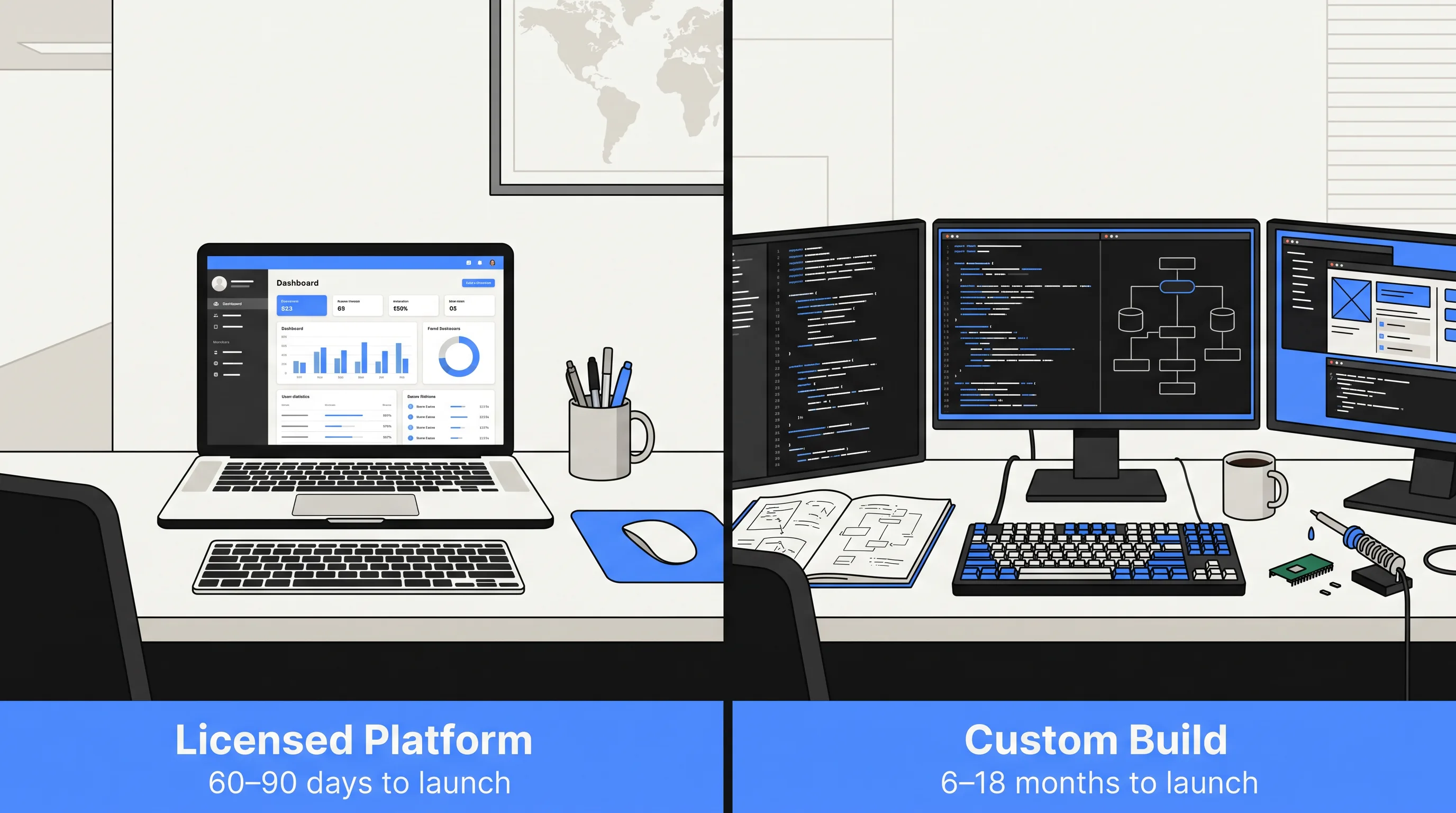
VR surgical training costs fall into three buckets: platform licensing, custom development, and hardware. Licensing an existing platform for a mid-size program runs $68,000 to $142,000 in the first year. A single custom-built procedure starts around $50,000 and passes $1.5 million for FDA-regulated software. Hardware sits on top, from a standalone headset to a $10,000–$50,000 haptic station.
Off-the-Shelf Platform Licensing
Off-the-shelf VR surgical training platforms charge per-user or institutional fees for access to a pre-built library of validated procedures. Per-user licenses typically run $5,000 to $20,000 a year. Institutional site licenses run $10,000 to $50,000 a year, including cloud hosting and support. Hardware is billed separately.
The leading platforms cluster by specialty. Osso VR runs a validated assessment engine with an orthopedic focus. FundamentalXR is haptic-enabled and multi-specialty. PrecisionOS covers orthopedics with performance analytics, and SimX handles team-based clinical scenarios. Reality Atlas’s July 2026 comparison of the best VR platforms for surgical training and Dr. Matthew Lynch’s 2026 cost breakdown agree on these ranges. On hardware, a standalone Meta Quest 3 runs $500 to $700, while high-fidelity haptic simulators like VirtaMed’s run $100,000 to $300,000 per unit. The catch is coverage: a licensed platform only trains the procedures already in its library.
Custom Development and Hardware
Custom VR surgical training development builds a simulator specific to your procedure, device, or workflow. A single bespoke module costs $50,000 to $250,000 or more. Builds with FDA-regulated software, patient-specific DICOM integration, or multi-site deployment reach $500,000 to $1.5 million-plus. The institution owns the resulting software.
Cost concentrates in a few places. 3D anatomical asset production is the single largest line. Haptic physics programming, clinical accuracy review by subject-matter experts, QA across every target headset, and regulatory documentation for FDA classification follow. Haptic device hardware adds $10,000 to $50,000 per unit on top of the software, and cross-platform support adds the 25% to 40% noted earlier.
In our custom VR builds at Frame Sixty, 3D asset production, not engineering, sets the schedule and the invoice. Modeling anatomy that deforms, bleeds, and responds to an instrument the way real tissue does is slow, specialist work, and a procedure with unusual or patient-specific anatomy needs more of it. Our broader VR development cost breakdown by project type shows the same pattern across industries: labor dominates the budget, and most of that labor is content, not code. We factor that into every scoped estimate through our virtual reality development services.
Year-One Program Budget
Fora Soft’s 2026 analysis puts a 20-surgeon program on an off-the-shelf platform at $68,000 to $142,000 in year one, including software, hardware, and setup, with ongoing costs of $43,500 to $83,500 a year. A custom-built equivalent at the same scale starts higher, near $200,000 to $400,000 in year one, but the institution owns the IP. Against an OR hour that costs $1,500 to $4,000, either path can clear its own cost inside two years.
| Cost component | Off-the-shelf platform | Custom build |
|---|---|---|
| Year-one total (20 surgeons) | $68,000–$142,000 | $200,000–$400,000+ |
| Per procedure or module | $5,000–$20,000 / user / yr | $50,000–$250,000+ |
| Haptic hardware (per unit) | $100,000–$300,000 high-fidelity | $10,000–$50,000 robotic arm |
| Standalone headset | $500–$700 | $500–$700 |
| IP ownership | Vendor retains | You own it |
| Time to first use | 60–90 days | 6–18 months |
Off-the-Shelf Platform or Custom Build: Which Option Fits Your Program?
License an off-the-shelf platform when your target procedures already exist in a vendor’s library and you train fewer than about 500 people a year. Commission a custom build when you need a proprietary device, a non-standard workflow, multi-site deployment, or full IP ownership. The crossover point sits near 500 trainees annually.
Below that line, per-user licensing usually wins on unit economics and speed, because a pilot can run in 60 to 90 days. Above it, a custom build amortizes its larger upfront cost across enough trainees to pull ahead, and it hands the institution control over the procedures, the data, and the compliance posture. A guide to evaluating medical VR companies lays out the same breakeven logic for buyers comparing their options.
| Factor | License a platform | Build custom |
|---|---|---|
| Trainees per year | Under ~500 | Over ~500 |
| Procedure in vendor library | Yes | No, or proprietary device |
| Time to launch | 60–90 days | 6–18 months |
| Year-one budget | Under $150,000 | $200,000+ |
| IP ownership | Vendor retains | You own it |
| Regulatory control (FDA/HIPAA) | Vendor-defined | Full control |
One caution applies to both paths. Fewer than 25% of medical XR applications have ever been evaluated for performance outcomes, so vendor efficacy claims should be checked against published studies before signing. If no procedure in any library fits, a custom VR development partner is the only route that reaches the training goal.
Verdict: license when your procedures are standard and your volume is modest; build when the procedure is proprietary, the volume is high, or you need to own the IP and the compliance posture.
How Long Does It Take to Build a VR Surgical Training Program?
A custom single-procedure VR surgical training module takes 6 to 10 months from kickoff to deployed training. A multi-procedure suite or an FDA-regulated build takes 12 to 18 months. A licensed off-the-shelf platform can run a pilot in 60 to 90 days once contracts are signed and headsets arrive.
A custom build runs in four phases:
- Discovery and scoping (4–8 weeks): clinical workflow analysis, procedure mapping, hardware platform selection, and the regulatory classification decision.
- Asset production and core build (12–24 weeks): 3D anatomical modeling, haptic physics integration, procedural scripting, and initial QA. This phase dominates the schedule.
- Clinical review and validation (4–8 weeks): subject-matter-expert review for anatomical accuracy, iterative testing with surgeons or trainees, and outcome-data baseline capture.
- Deployment and LMS integration (4–6 weeks): headset management, xAPI and SCORM hookup into the hospital LMS, and staff onboarding.
The single best predictor of schedule is not feature count but anatomical complexity. Because asset production dominates phase two, a procedure with unusual or patient-specific anatomy stretches the timeline more than extra scenario branches or reporting features ever will. Scope the anatomy first, and the schedule gets honest.
How Do You Vet a VR Surgical Training Development Partner?
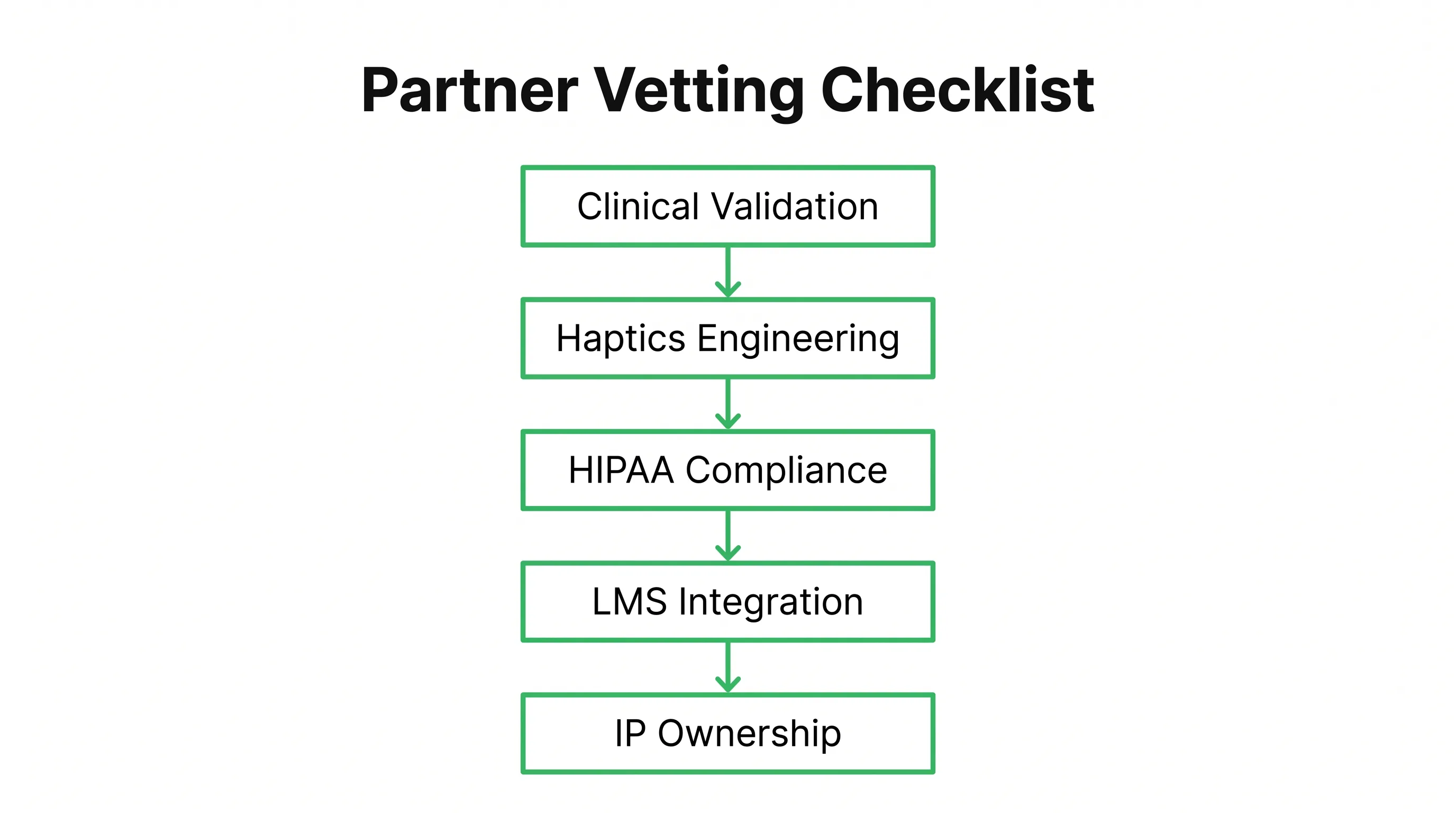
Vet a VR surgical training development partner on five fronts: medical domain experience with referenceable clinical work, haptics and XR engineering depth, HIPAA and FDA compliance readiness, LMS and outcome-data architecture, and IP ownership terms. The single best filter is evidence. Ask for clinical validation, not a demo reel.
The problem is that vendor marketing often outpaces clinical evidence, and with fewer than a quarter of medical XR applications evaluated for outcomes, claims need checking. Healthcare-specific evaluation checklists, such as the guide to choosing a VR training provider from Infuse Medical and the partner-selection guide from Oxford Medical Simulation, converge on the same priorities. Use these five criteria:
- Medical domain experience and clinical validation. The studio should show published evidence or named expert partnerships, not a screenshot gallery. Ask for references from comparable hospital systems, residency programs, or medtech manufacturers.
- Haptics and XR engineering depth. Ask which haptic SDKs they have built on, which haptic devices they have shipped against, and whether they can demonstrate a working force-feedback prototype across your target headsets.
- HIPAA compliance and data privacy. Any program capturing trainee performance data needs a developer ready to sign a Business Associate Agreement and to answer FDA software-classification questions if the product is marketed as a medical device.
- LMS integration and outcome architecture. Confirm xAPI and SCORM compatibility and a data design built for competency benchmarks from the start, not bolted on after launch.
- IP ownership and long-term support. Confirm that full IP transfers to the institution at close, and that the studio can update modules as protocols and device versions change.
A general VR shop can render anatomy. Separating one from a genuine medical builder, across the wider field of VR companies, comes down to clinical evidence and compliance readiness rather than visual polish.
Conclusion
VR surgical training has moved past the question of whether it works. The randomized trials, the measured skill-transfer ratios, and the sharp reductions in tissue injury have settled that. The live questions are procurement questions now: what to buy, what to build, and who to trust with the build.
The position worth repeating is simple. Fund the program that proves skill transfer with data, not the one with the best-looking anatomy. A simulator that cannot show competency gains is a demo, not a training tool, and with most medical XR applications never evaluated for outcomes, the burden of proof sits with the vendor. For programs under about 500 trainees a year, a licensed platform is usually the right first move. For proprietary devices, high volume, or full IP control, a custom build earns its larger upfront cost.
If you are weighing a custom VR surgical training build and want a scoped estimate grounded in realistic cost and timeline bands, get in touch with Frame Sixty. Our team can map your procedures, hardware, and compliance needs into a plan, drawing on the medical VR training work we build for healthcare and medtech organizations.
FAQs
Common questions about VR surgical training, covering effectiveness, headsets and compliance, cost, ROI, and how to choose a build-or-license path and a development partner.
Skill learned in VR surgical training does transfer to real operating-room performance. A JAMA Network Open shoulder arthroplasty study measured a 0.79 transfer ratio, meaning 60 minutes of VR practice carried over to roughly 47 minutes of real OR experience. VR-trained residents in an NIH study also completed gallbladder dissection 29% faster than traditionally trained peers.
VR surgical training reduces operating-room errors measurably. Across pooled studies reviewed by the World Academy of Cosmetic Surgery in 2025, VR-trained surgeons were five times less likely to cause tissue injury and performed about 19.9% better than control groups. A 2024 randomized trial in International Orthopaedics halved acetabular cup placement error, from 8 degrees to 4 degrees.
Leading off-the-shelf VR surgical training platforms include Osso VR, which runs a validated assessment engine with an orthopedic focus; FundamentalXR, haptic-enabled and multi-specialty; PrecisionOS for orthopedics with performance analytics; and SimX for team-based clinical scenarios. Per-user licenses typically run $5,000 to $20,000 a year, and each platform only trains procedures already in its library.
Surgical training programs most often run on the Meta Quest 3, a standalone headset costing $500 to $700 that remains the default clinical platform. Newer devices like the Apple Vision Pro M5 at $3,499 and the Samsung Galaxy XR at $1,799 are entering the market, while high-fidelity haptic simulators such as VirtaMed's run $100,000 to $300,000 per unit.
VR surgical training becomes HIPAA-relevant through its data layer, not its graphics. Trainee performance data tied to named clinicians falls under hospital data-governance rules, which usually requires the developer to sign a Business Associate Agreement. Compliant builds also need xAPI or SCORM integration so training records flow securely into the hospital's learning management system.
Haptic feedback devices for surgical training range widely by fidelity. Consumer headsets provide vibration only, stylus devices add directional force, and full robotic haptic arms cost $10,000 to $50,000 per unit, per Dr. Matthew Lynch's 2026 cost breakdown. High-fidelity haptic simulators such as VirtaMed's reach $100,000 to $300,000 per unit on top of the software.
Hospitals typically reach positive ROI on VR surgical training within 18 to 24 months. The economics follow from operating-room time: a single OR hour in the United States costs $1,500 to $4,000 all-in, so small reductions in operating time or revision rates recover the training investment quickly, according to Fora Soft's 2026 analysis.
Vet a VR surgical training development partner on five fronts: medical domain experience with referenceable clinical work, haptics and XR engineering depth, HIPAA and FDA compliance readiness, LMS and outcome-data architecture, and IP ownership terms. Frame Sixty, an AR/VR and spatial computing development studio, scopes estimates around these criteria and transfers full IP to the institution at close.
License an off-the-shelf platform when your procedures already exist in a vendor's library and you train fewer than about 500 people a year. Commission a custom build for a proprietary device, a non-standard workflow, multi-site deployment, or full IP ownership. The crossover point sits near 500 trainees annually, where a custom build's larger upfront cost starts to pay off.