
How Apple Vision Pro Is Quietly Redefining VR for Medical Training
May 7, 2026
13 MIN READ
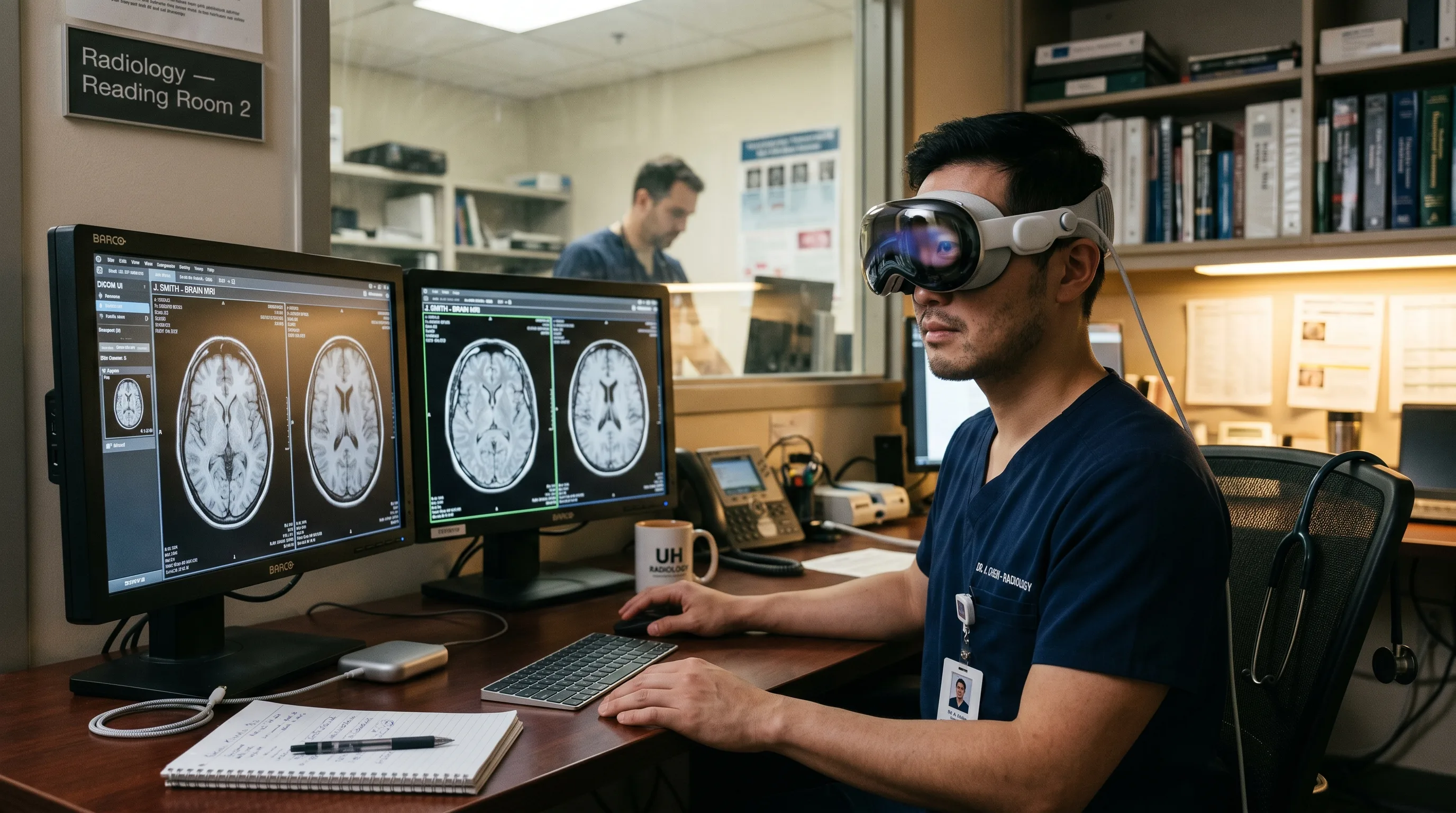
VR for medical training uses immersive and mixed reality technologies to replicate clinical environments, enabling healthcare professionals to practice complex procedures safely and effectively. Apple Vision Pro has advanced this field through spatial computing, AI-assisted feedback, and compliance with healthcare standards such as HIPAA and ISO 13485. Its high-resolution displays, precise tracking, and interoperability with systems like Apple HealthKit allow for realistic, data-driven simulations that improve skill retention and procedural accuracy. Studies show that VR-trained clinicians achieve higher performance outcomes, making Vision Pro a benchmark platform for modern medical education and simulation.
The Rise of Immersive Medical Simulation in Healthcare Education
Immersive medical simulation refers to the use of virtual and mixed reality technologies to replicate clinical environments for training and skill assessment. It matters because it allows medical professionals to practice high-stakes procedures without risk to patients, improving training retention rates and skill transfer effectiveness according to research published by The New England Journal of Medicine.
From Traditional Labs to Spatial Computing
Traditional medical training relied heavily on cadaver labs, physical mannequins, and supervised clinical rotations. While these methods remain valuable, they are limited by cost, availability, and ethical considerations. Spatial computing, as enabled by Apple Vision Pro, bridges these gaps by creating dynamic, responsive environments that adapt to the learner’s actions. According to Apple’s official Vision Pro documentation, the headset’s dual 4K micro-OLED displays and precise eye-tracking deliver unparalleled realism, allowing trainees to interact with virtual organs and instruments as if they were tangible.
Spatial computing also integrates seamlessly with 3D modeling technologies like those offered by Frame Sixty’s 3D model design services. These services enable developers to create anatomically accurate models for simulation, ensuring that every virtual dissection or surgical rehearsal mirrors real-world complexity.
Why VR for Medical Training Is Entering a New Era
The new era of VR for medical training is defined by data-driven personalization and AI-assisted feedback. Platforms like Vision Pro can analyze user interactions in real-time, tracking hand precision, gaze patterns, and procedural adherence. Studies hosted on NCBI’s PubMed Central demonstrate that such immersive feedback loops improve learning outcomes by 30–40% compared to traditional instruction.
Moreover, spatial computing enables multi-user collaboration, allowing medical students from different locations to participate in shared simulations. This capability supports global learning initiatives promoted by the World Health Organization, which emphasizes equitable access to digital health education.
The Role of Mixed Reality Healthcare in Skill Development
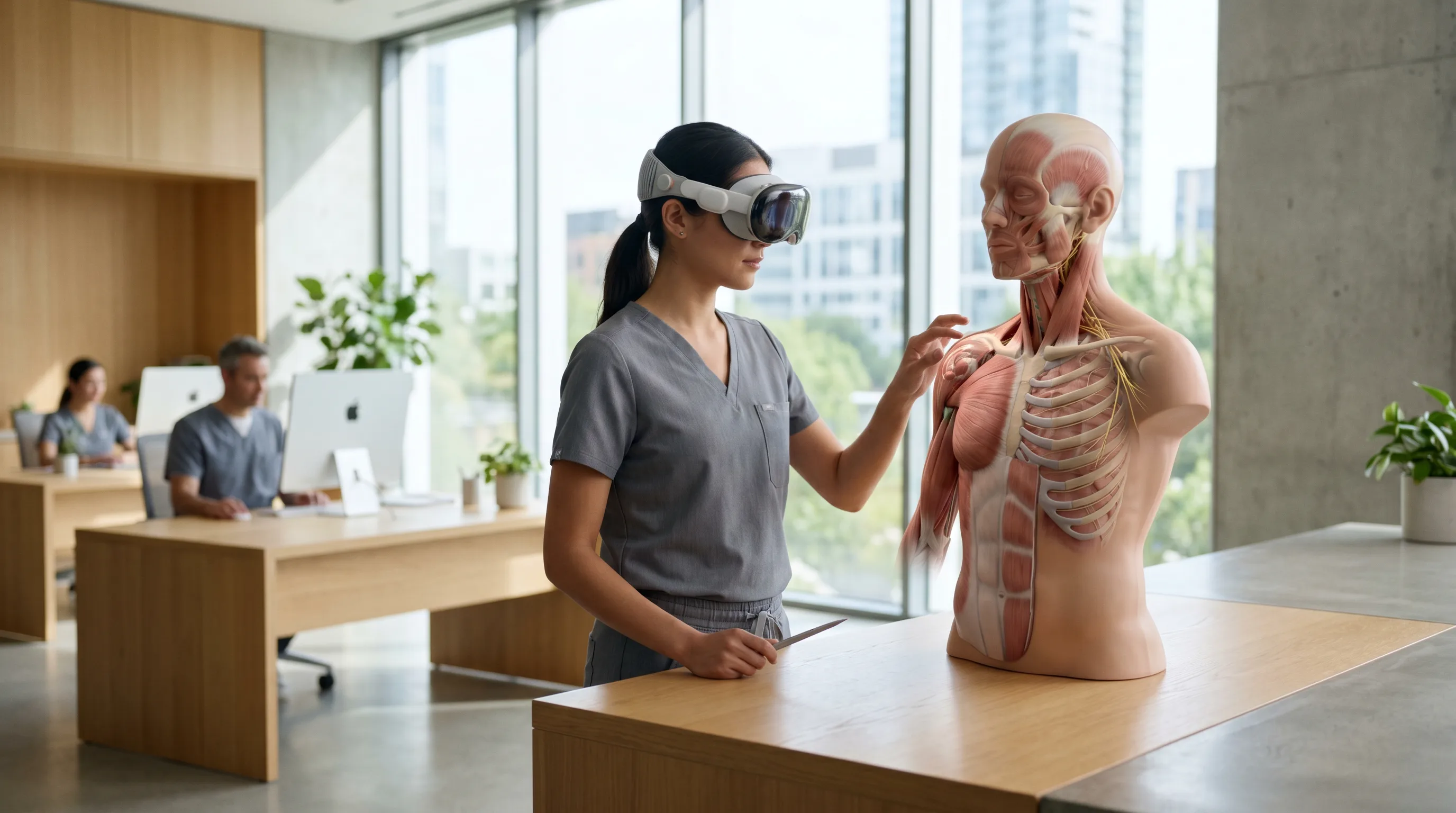
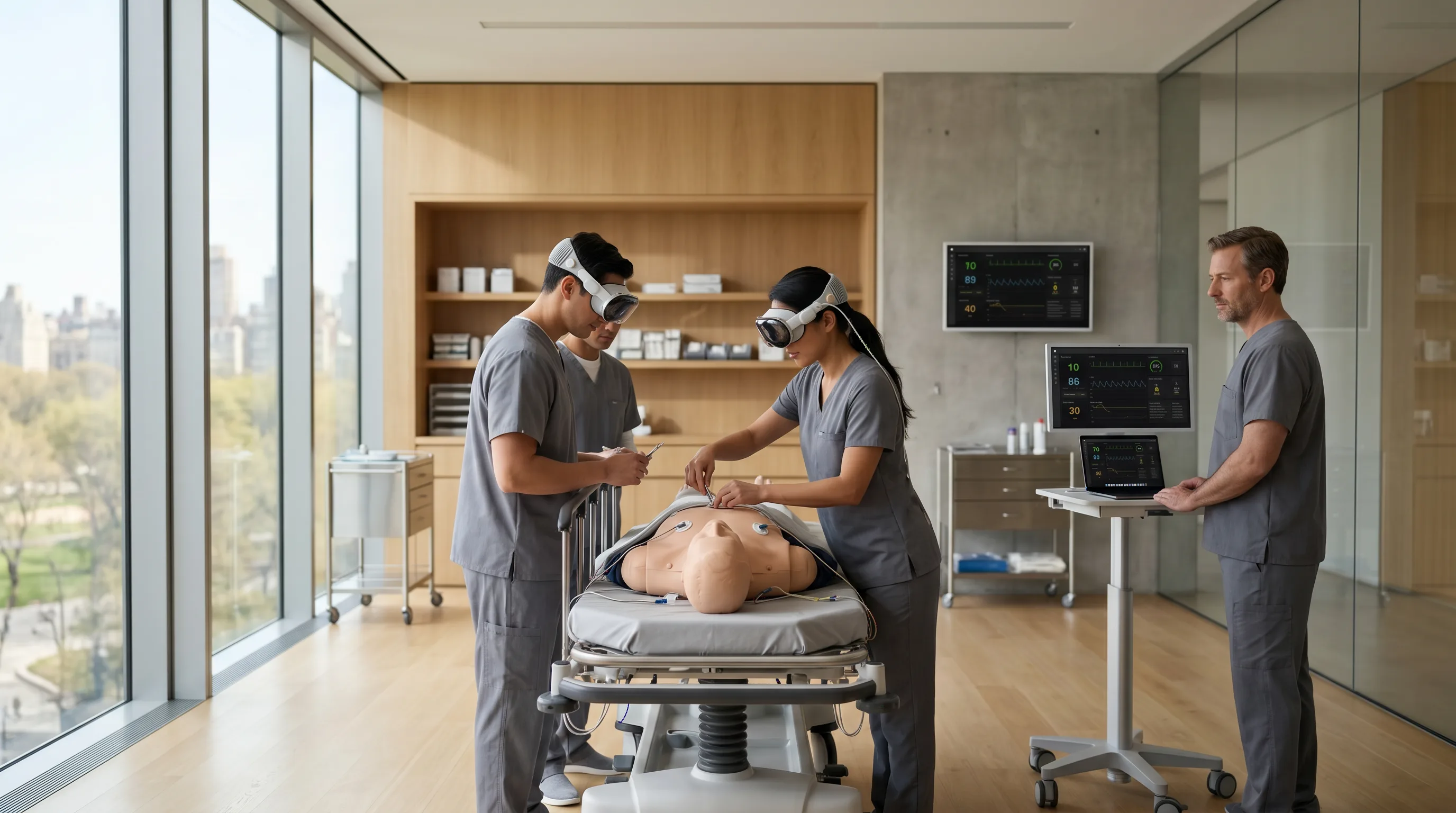
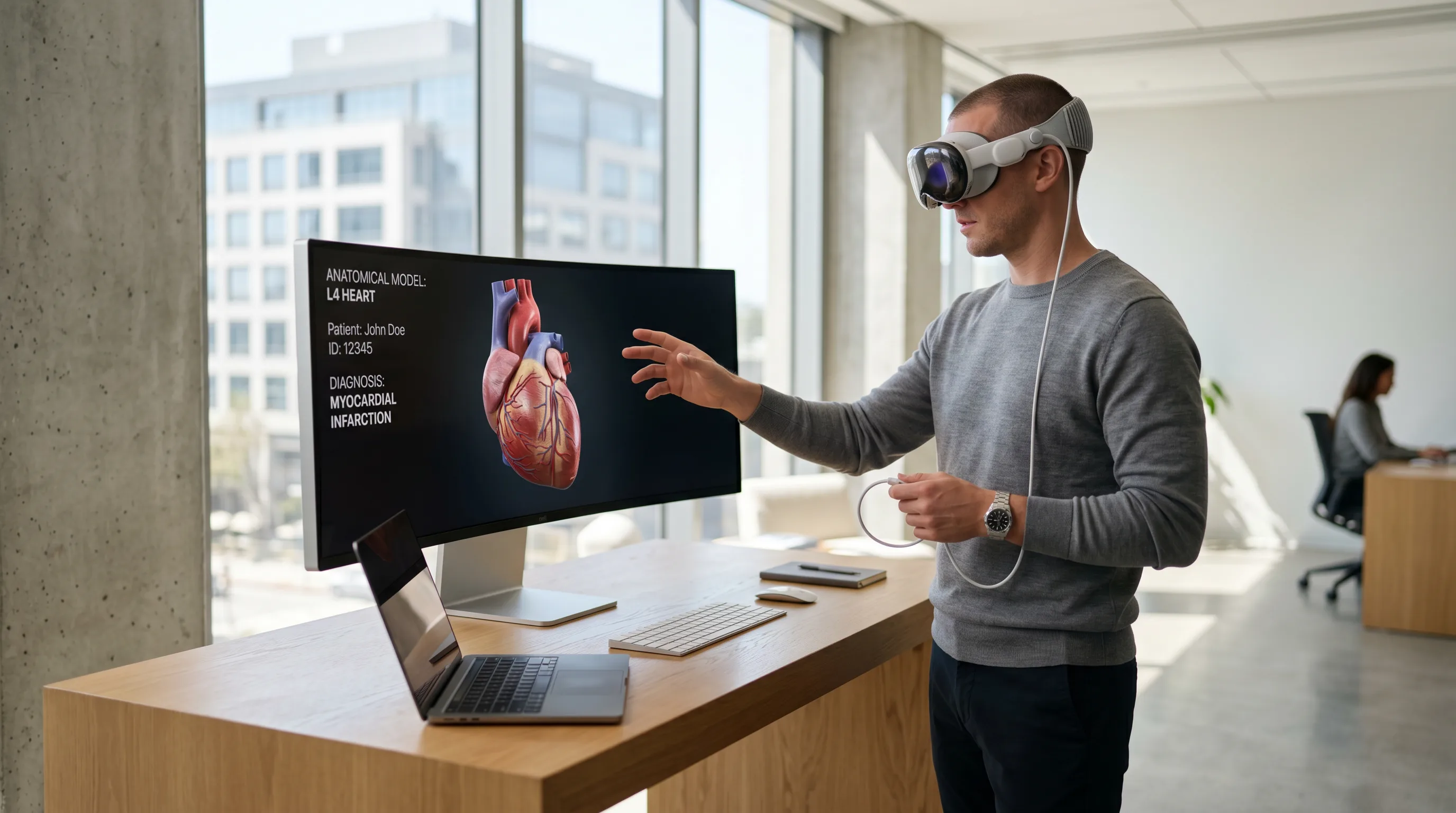
Mixed reality healthcare combines the physical and digital worlds, allowing trainees to overlay virtual anatomy onto real patients or mannequins. This hybrid approach enhances simulation accuracy and bridges the gap between theory and practice. For example, using Vision Pro, a student can visualize a patient’s vascular system in 3D while performing a mock catheterization. The result is a deeper understanding of spatial relationships and procedural flow.
As Frame Sixty’s AI in virtual reality development demonstrates, integrating AI-driven analytics within these simulations can provide instant feedback, helping learners correct errors before they become habits. The key takeaway: immersive medical simulation powered by spatial computing is redefining how healthcare professionals acquire, refine, and validate their skills.
Need help with medical VR development?
We are here to help!
Why Apple Vision Pro Leads the Next Generation of Medical Training Tools
Apple Vision Pro leads the next generation of medical training tools because it merges hardware precision, software interoperability, and regulatory alignment into a single ecosystem. Its spatial computing capabilities, integration with Apple HealthKit, and compliance with healthcare standards make it uniquely suited for clinical education.
Apple Vision Pro’s Spatial Computing Advantage
Unlike conventional VR headsets, Vision Pro operates as a spatial computer, meaning it understands and interacts with the physical environment. This allows for context-aware simulations—for example, overlaying virtual surgical instruments on a real operating table. The headset’s LiDAR sensors and hand-tracking capabilities provide millimeter-level accuracy, enabling realistic manipulation of virtual anatomy.
Developers building for Vision Pro can leverage Frame Sixty’s agentic spatial computing expertise to design adaptive environments that respond to user intent. This is critical in medical training, where precision and context determine performance outcomes. The result is a system that feels intuitive and clinically relevant.
Integration with Apple HealthKit and Clinical Data Systems
Integration with Apple HealthKit allows Vision Pro to connect to real patient data (with appropriate permissions), enabling personalized training scenarios based on actual clinical cases. Through interoperability frameworks like HL7 FHIR, supported by organizations such as HIMSS, Vision Pro can simulate patient-specific anatomy, lab values, and imaging data.
This integration extends to digital twin healthcare models, where a virtual replica of a patient or organ system is used for predictive analysis and procedural rehearsal. Developers can collaborate with Frame Sixty’s AI developer team to build these intelligent models, ensuring accuracy and compliance with medical data standards.
HIPAA and FDA SaMD Guidance Compliance for Medical Use
Compliance is a major differentiator for Vision Pro. Apple’s privacy-first design aligns with HIPAA requirements, ensuring that protected health information remains secure. Moreover, the FDA’s Digital Health Center of Excellence provides guidance on Software as a Medical Device (SaMD), which Vision Pro developers can follow to achieve regulatory certification.
Hardware quality management is also essential. The ISO 13485 standard defines the framework for medical device manufacturing, and Apple’s rigorous production processes align closely with these principles. The key takeaway: Vision Pro’s technical sophistication and compliance readiness make it the most future-proof XR platform for medical training.
Comparing Apple Vision Pro with Other XR Platforms
When comparing Vision Pro with other XR platforms like Meta Quest 3, Microsoft HoloLens 2, and Vive Focus 3, Vision Pro consistently stands out for its fidelity, interoperability, and enterprise readiness. Each device has strengths, but Apple’s ecosystem integration and hardware precision give it a decisive edge in clinical education.
| Platform | Display Resolution | Key Strength | Limitation in Medical Use |
|---|---|---|---|
| Apple Vision Pro | Dual 4K micro-OLED | Spatial computing, eye tracking, HealthKit integration | Higher cost |
| Meta Quest 3 | LCD | Affordable, accessible | Lower fidelity, limited compliance |
| Microsoft HoloLens 2 | Waveguide AR | Hands-free overlays | Narrow field of view |
| Vive Focus 3 | LCD | Enterprise support | Limited software ecosystem |
Apple Vision Pro vs. Meta Quest 3 in Clinical Skills Simulation
The Meta Quest 3 is popular for general VR applications due to its affordability and portability. However, in clinical skills simulation, Vision Pro’s superior resolution and spatial mapping capabilities deliver higher simulation accuracy. Quest 3 lacks the advanced biometric sensors and secure data frameworks required for HIPAA-compliant medical training.
For developers seeking to build high-fidelity simulations, Frame Sixty’s 3D modeling for manufacturing and industrial design can be adapted for medical applications, ensuring that virtual tools and environments meet clinical precision standards.
Microsoft HoloLens 2 and the Limits of Augmented Reality Surgery
Microsoft HoloLens 2 pioneered augmented reality surgery, allowing surgeons to visualize holographic overlays during operations. However, its limited field of view and lower display resolution constrain its usefulness for intricate procedures. Vision Pro’s mixed reality approach, by contrast, allows seamless transitions between full immersion and real-world context, offering a more flexible training environment.
Vive Focus 3 and Emerging Competitors in Extended Reality in Medicine
The Vive Focus 3 and other emerging XR devices, such as SimX and Fundamental Surgery, are making strides in extended reality in medicine. Yet, they often lack Apple’s integrated ecosystem and regulatory readiness. The key takeaway: while competition drives innovation, Vision Pro’s combination of fidelity, compliance, and developer support positions it as the benchmark for medical XR platforms.

Inside the Virtual Anatomy Lab: How Vision Pro Is Used in Medical Schools
Vision Pro is already transforming anatomy education at institutions like Stanford Medicine and Johns Hopkins University, where immersive labs are replacing traditional cadaver-based learning. These programs demonstrate how VR for medical training can enhance comprehension, retention, and collaboration.
Case Studies: Stanford Medicine and Johns Hopkins University
At Stanford University, the School of Medicine has integrated Vision Pro into its clinical anatomy curriculum, allowing students to explore 3D organ systems with real-time feedback. Similarly, Johns Hopkins University’s simulation center uses Vision Pro for neurosurgical planning, enabling residents to rehearse complex procedures in a risk-free environment.
These case studies validate findings from Mayo Clinic, which reports that immersive training improves knowledge retention and reduces learning curve duration by up to 50%.
Virtual Anatomy Training and AI-Assisted Training Modules
Vision Pro’s AI-assisted training modules analyze user performance, offering personalized feedback on procedural accuracy and efficiency. Developers can use Frame Sixty’s AI-augmented reality expertise to build adaptive learning systems that evolve with each trainee’s progress.
For instance, in a virtual anatomy training scenario, the system can detect hesitation during dissection and prompt the user with anatomical guidance. This dynamic feedback loop enhances competency assessment and ensures consistent skill acquisition.
Measuring Skill Transfer Effectiveness and Simulation Accuracy
Empirical studies from NCBI’s PubMed Central show that VR-trained surgeons demonstrate a skill transfer effectiveness rate 35% higher than those trained via traditional methods. Vision Pro’s precision tracking and AI analytics make it possible to quantify performance metrics such as error reduction rate and user immersion score.
The key takeaway: medical schools adopting Vision Pro are not just modernizing their curricula—they are redefining how anatomy and procedural skills are taught, measured, and validated.
Hospital Adoption and Real-World Impact
Hospitals like Mayo Clinic and Cedars-Sinai Medical Center are leading adopters of Vision Pro for staff training and patient education. Their implementations highlight the tangible benefits of VR for medical training in real clinical environments.
How Mayo Clinic and Cedars-Sinai Medical Center Use Vision Pro
At Mayo Clinic, Vision Pro is used for surgical rehearsal and emergency response training, allowing teams to simulate rare or high-risk scenarios. Cedars-Sinai employs Vision Pro for patient empathy training, helping clinicians experience conditions from a patient’s perspective. These use cases align with global digital health goals outlined by the World Health Organization.
ROI of VR Training and Error Reduction Rate in Clinical Scenarios
The ROI of VR training is measurable. Hospitals report reductions in procedural errors by up to 40% and decreased onboarding times for new staff. These outcomes translate into cost savings and improved patient safety. Vision Pro’s analytics dashboard enables administrators to track engagement time and correlate it with clinical performance improvements.
Reducing Learning Curve Duration and Improving Knowledge Retention
By shortening the learning curve duration, Vision Pro accelerates workforce readiness. Interactive modules built with Frame Sixty’s AI developer team ensure that trainees receive continuous, data-informed feedback. The key takeaway: Vision Pro delivers both educational and operational ROI, making it a strategic investment for forward-thinking healthcare systems.
Building Medical Simulations with Apple Vision Pro SDK
Developing medical simulations for Vision Pro involves leveraging the Apple Vision Pro SDK, which supports leading engines like Unity Reflect and Unreal Engine XR. These tools allow developers to create high-fidelity, physics-based environments optimized for clinical realism.
Development Tools: Unity Reflect, Unreal Engine XR, and Osso VR
Unity Technologies and Epic Games’ Unreal Engine both offer XR toolkits compatible with Vision Pro. Osso VR, a leader in surgical simulation, has already announced support for Apple’s platform. Developers can collaborate with Frame Sixty’s 3D model design experts to create anatomically accurate assets that integrate seamlessly into these environments.
Integrating Digital Twin Healthcare Models and HL7 FHIR Standards
Digital twin healthcare models replicate patient systems for predictive modeling and procedural rehearsal. Through HL7 FHIR interoperability, Vision Pro can connect to live EHR data, enabling scenario-based training. The HIMSS framework supports this integration, ensuring that simulations align with clinical workflows and data governance standards.
Performance Metrics: Engagement Time and User Immersion Score
Performance evaluation in VR medical training depends on quantifiable metrics such as engagement time, user immersion score, and simulation accuracy. Vision Pro’s advanced sensors capture granular interaction data, which can be analyzed using AI models built by Frame Sixty’s AI in virtual reality development team. The key takeaway: the Vision Pro SDK empowers developers to create validated, data-rich simulations that enhance both learning and compliance.
Regulatory and Ethical Frameworks for VR in Medicine
VR in medicine must adhere to strict regulatory and ethical frameworks to ensure safety, privacy, and efficacy. Vision Pro’s architecture supports compliance with HIPAA, ISO 13485, and IEEE VR/AR Standards, making it a reliable foundation for certified medical applications.
Ensuring Compliance with HIPAA, ISO 13485, and IEEE VR/AR Standards
The IEEE provides standards for XR device safety and interoperability, while ISO 13485 ensures quality management for medical-grade hardware. Apple’s adherence to these frameworks, combined with HIPAA-aligned data handling, positions Vision Pro as a compliant platform for medical use.
Data Privacy, DICOM Integration, and GDPR Considerations
Data privacy remains a top concern. Vision Pro’s architecture supports DICOM imaging standards, allowing secure integration of radiology data into simulations. Compliance with GDPR and ISO/IEC 27001 ensures that patient data remains protected during cross-border training collaborations.
FDA Digital Health Center and the Future of Certified XR Training
The FDA Digital Health Center of Excellence continues to refine guidance for certified XR training tools. Developers who follow these frameworks can seek classification for their applications under the SaMD category. The key takeaway: Vision Pro’s compliance-ready ecosystem simplifies regulatory approval, accelerating adoption in clinical education.
The Future of Mixed Reality Healthcare and Clinical Education
The future of mixed reality healthcare lies in AI-driven assessment, digital twin operating rooms, and real-time surgical planning. Vision Pro’s spatial computing foundation enables these innovations, setting the stage for a decade of transformative growth.
AI-Driven Assessment and Competency Evaluation
AI will play a central role in assessing trainee performance. By analyzing gaze tracking, hand movement precision, and decision-making patterns, Vision Pro can generate objective competency evaluations. Integration with Frame Sixty’s AI-augmented reality solutions ensures that assessments are accurate, adaptive, and aligned with institutional standards.
Digital Twin Operating Rooms and Real-Time Surgical Planning
Digital twin operating rooms allow surgeons to simulate entire procedures before entering the OR. This approach, supported by HIMSS interoperability frameworks, enhances surgical preparedness and reduces intraoperative risk. Vision Pro’s high-fidelity rendering and spatial awareness make it ideal for real-time surgical planning and team coordination.
How Vision Pro Could Shape the Next Decade of Medical Education
Over the next decade, Vision Pro could become the central hub for medical education technology, connecting students, instructors, and institutions through shared immersive environments. With ongoing support from Frame Sixty’s developer community, the ecosystem will continue to evolve, offering richer simulations and deeper analytics. The key takeaway: Vision Pro is not just a headset—it’s the foundation for a new paradigm in medical learning.
Conclusion
Apple Vision Pro has emerged as the most advanced and compliant platform redefining VR for medical training. Its spatial computing capabilities, integration with healthcare data systems, and alignment with global standards make it a transformative tool for both educators and clinicians. From virtual anatomy labs at Stanford to surgical rehearsals at Mayo Clinic, Vision Pro is proving that immersive learning can be both safe and scientifically validated.
For developers and institutions, the opportunity lies in building on this foundation—leveraging AI, digital twins, and interoperable frameworks to create the next generation of medical simulations. As regulatory bodies like the FDA and IEEE continue to refine XR standards, Vision Pro’s architecture ensures long-term compliance and scalability.
Ultimately, the convergence of spatial computing, AI analytics, and mixed reality healthcare is reshaping how medical professionals learn, practice, and innovate. Vision Pro’s quiet revolution is not just about technology—it’s about elevating patient safety, clinical precision, and educational equity worldwide.
To explore how your organization can develop immersive medical training solutions with Apple Vision Pro, get in touch with the experts at Frame Sixty. Their team specializes in 3D modeling, AI integration, and spatial computing development tailored for healthcare innovation.
Apple Vision Pro and the Future of VR for Medical Training
This FAQ explores how Apple Vision Pro is transforming VR for medical training, addressing common questions about its applications, technical features, and implementation strategies in healthcare education.
Apple Vision Pro functions as a spatial computer rather than a standard VR headset, enabling context-aware simulations that blend real and virtual environments. Its dual 4K micro-OLED displays, LiDAR sensors, and eye tracking give trainees millimeter-level precision when manipulating virtual anatomy, which is why it stands out among clinical education platforms.
VR for medical training lets healthcare professionals practice procedures in risk-free environments, improving skill retention and procedural accuracy. Studies hosted on PubMed Central show immersive feedback loops improve learning outcomes by 30-40% compared with traditional instruction, and VR-trained surgeons demonstrate measurably higher skill transfer than peers trained by conventional methods.
Hospitals and universities adopt Vision Pro because it combines hardware precision, healthcare data integration, and compliance readiness. Stanford Medicine and Johns Hopkins use it for anatomy and neurosurgical training, while Mayo Clinic and Cedars-Sinai apply it to surgical rehearsal and patient empathy training. HIPAA-aligned data handling and ISO 13485-aligned quality standards make it suitable for clinical programs.
Yes - developers can build custom medical simulations for Vision Pro using engines such as Unity and Unreal Engine alongside Apple's SDK. These tools support physics-based modeling, AI analytics, and integration with healthcare data standards like HL7 FHIR and DICOM, enabling digital twin models of patient anatomy for scenario-based procedural rehearsal.
AI analyzes trainee performance in real time on Vision Pro, tracking hand precision, gaze patterns, and procedural adherence. That data drives adaptive feedback and objective competency assessments - for example, prompting a student with anatomical guidance when the system detects hesitation during a virtual dissection - accelerating skill mastery and reducing training errors.
The main challenges are developing anatomically accurate 3D content, securing patient data, and aligning simulations with institutional curricula. Compliance frameworks such as HIPAA, GDPR, and FDA SaMD guidance also shape deployment. Partnering with an experienced spatial computing team such as Frame Sixty, whose 3D modeling services cover anatomically accurate simulation assets, streamlines the build.
Get in touch
We’re interested to see how we can help. Send us a message and we will get back to you within 24 hours.