
Which Medical VR Companies Are Worth Hiring? A 2026 Buyer's Guide for Healthcare Organizations
Oct 28, 2026
14 MIN READ
Medical VR companies fall into two groups: purpose-built simulation platforms that license validated scenario libraries, and custom development studios that build proprietary clinical simulations to order. The right fit depends on whether an off-the-shelf library already matches your protocols or you need software tied to your own devices, data, and workflows. According to Coherent Market Insights’ 2026 analysis, the VR medical training market reached $1.62 billion in 2026.
One filter sorts the field faster than any feature list: published clinical validation. A medical VR company worth hiring can show independent studies and will sign a Business Associate Agreement before kickoff. Everything else is a demo reel. That position runs through this entire guide, and it is the question most buyers ask last instead of first.
Key Takeaways
- The VR medical training market reached $1.62 billion in 2026 and is projected to hit $7.72 billion by 2033 (Coherent Market Insights).
- Osso VR trainees showed 300% higher procedural completion than traditionally trained students in a University of Illinois study.
- Fewer than 25% of medical XR applications have been evaluated for performance outcomes (Frontiers in Digital Health, 2025).
- Custom medical VR builds run from $60,000 for an MVP to $1.5 million-plus for FDA-track software (Forasoft, 2026).
- The FDA’s AR/VR medical device list grew from 39 entries in 2022 to 104 by December 2025.
Which Companies Lead Medical VR Development in 2026?
The companies leading medical VR development in 2026 include Osso VR and PrecisionOS in orthopedic surgery, SimX in multi-specialty team simulation, FundamentalVR in haptic surgical training, Oxford Medical Simulation in nursing scenarios, AppliedVR in prescription therapeutics, and custom studios such as Frame Sixty and Treeview Studio for proprietary builds. Each one fits a different clinical need, not a single ranking.
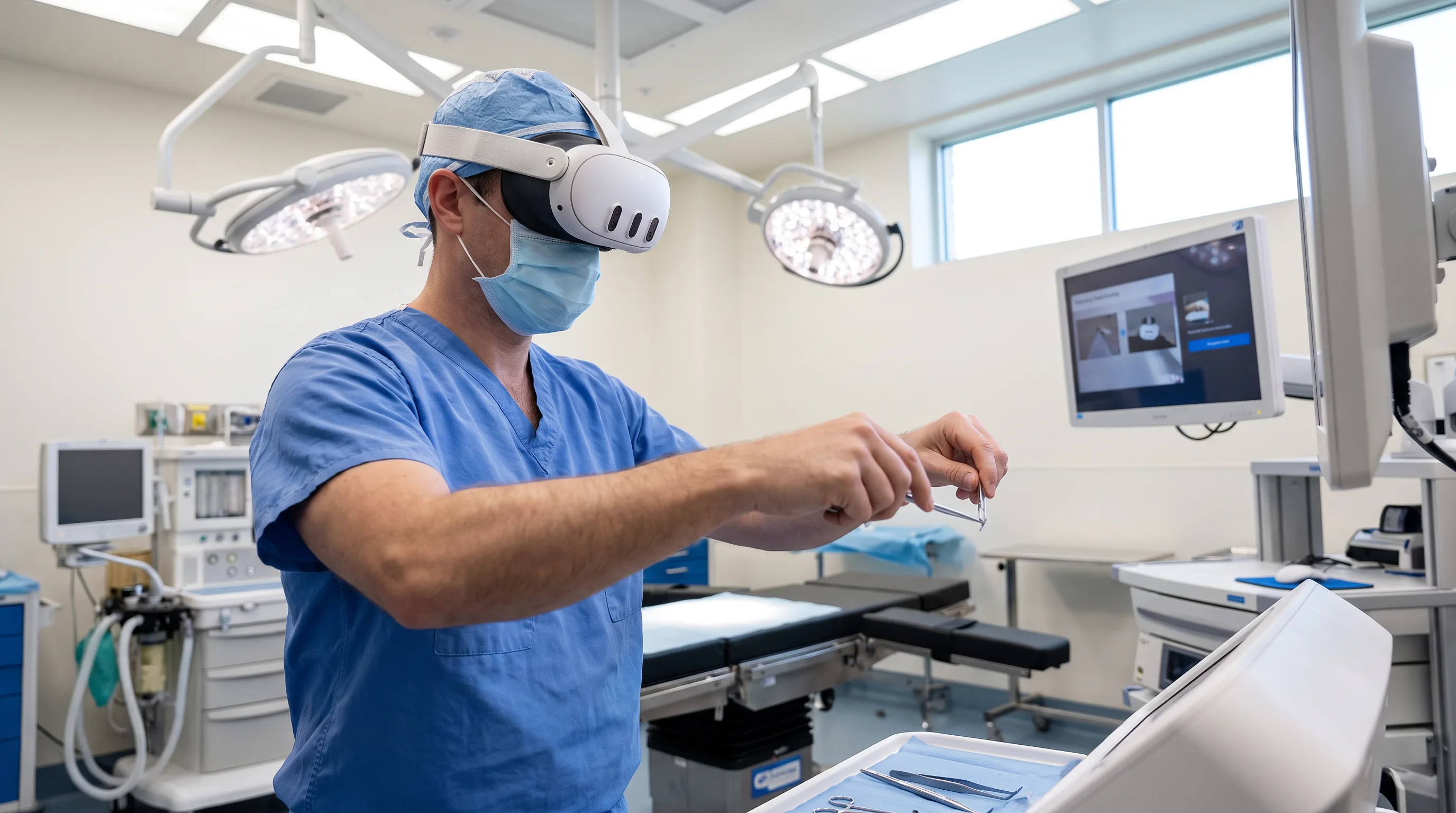
I evaluated these companies on five criteria: published clinical validation, named healthcare clients, platform and hardware support, build model (licensed platform versus custom development), and compliance posture (BAA readiness and FDA experience). Frame Sixty, an AR/VR and spatial computing development studio, publishes this guide; we include ourselves only in the custom-development category, where our work honestly sits, and the comparison below lists competitors by their real strengths rather than against a straw man.
| Company | Specialty | Primary platform | Build model | Proof points |
|---|---|---|---|---|
| Osso VR | Orthopedic and surgical skills | Meta Quest | Licensed platform | J&J MedTech, Stryker, Zimmer Biomet; FDA-cleared |
| SimX | Multi-specialty team simulation | Meta Quest 3 | Licensed platform | Cleveland Clinic, NYU Langone, Kaiser Permanente |
| FundamentalVR | Haptic surgical training | Multi-headset | Licensed platform | Laparoscopic and robotic procedures |
| PrecisionOS | Orthopedic implant training | Meta Quest | Licensed platform | Implant-specific modules |
| Oxford Medical Simulation | Nursing and emergency scenarios | Multi-headset | Licensed platform | UK NHS, US hospital networks |
| AppliedVR | Prescription pain therapeutics | Meta Quest | Off-the-shelf product | FDA-authorized RelieVRx |
| Treeview Studio | Enterprise custom XR | Multi-headset | Custom development | Medtronic, Daiichi Sankyo |
| Frame Sixty | Custom medical VR and spatial computing | visionOS, Meta Quest | Custom development | Apple Vision Pro and Meta Quest builds |
For the broader (non-healthcare) field, our companion guide to the best mixed reality development companies covers general enterprise XR studios. The sections below profile the surgical-focused companies in depth, then show how to tell a capable medical VR partner from a general XR shop.
Which Medical VR Companies Specialize in Surgical Simulation?
The medical VR companies with the strongest surgical evidence are Osso VR, SimX, FundamentalVR, and PrecisionOS among licensed platforms, plus custom studios such as Frame Sixty and Treeview Studio. Surgical training is the largest slice of the market, at 45.3% of VR medical training spend in 2026 (Coherent Market Insights). These three profiles carry the clearest published proof.
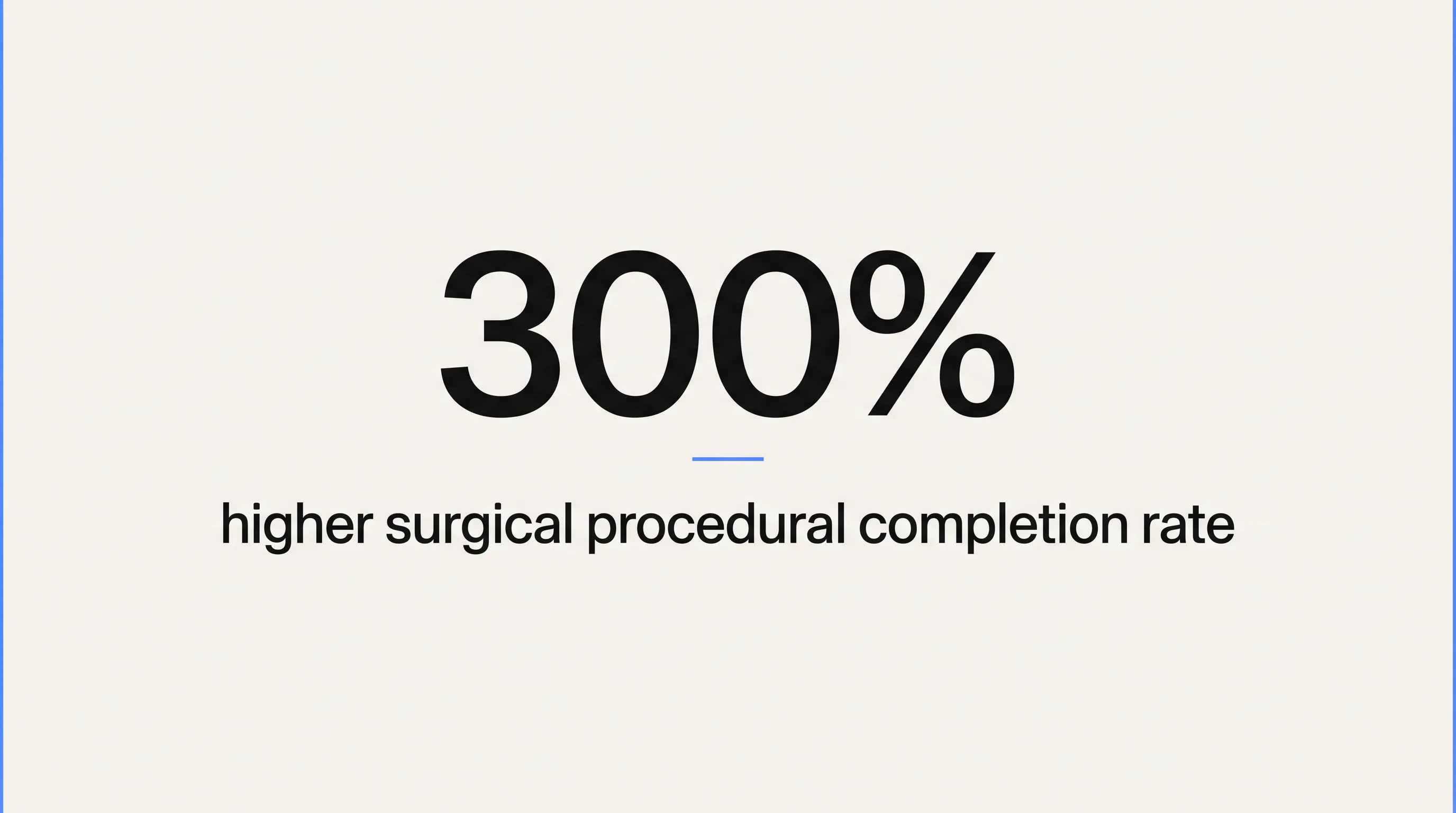
1. Osso VR. Osso VR runs an FDA-cleared surgical training platform with more than 200 orthopedic procedure simulations, used by Johnson & Johnson MedTech, Stryker, and Zimmer Biomet. The proof is independent: a University of Illinois study found medical students trained with Osso VR completed 300% more of the procedure correctly than traditionally trained peers, and a 2023 study in Advances in Medical Education and Practice found VR-trained participants finished tibial nailing faster with fewer redirections. Dr. Justin Barad, MD, orthopedic surgeon and founder of Osso VR, put the stakes plainly: “The potential impact of this technology is almost unparalleled with over 300 million major surgeries performed annually.” Verdict: Osso VR wins when your need is orthopedic and procedural, with a validated library you can deploy now.
2. SimX. SimX, founded by Stanford and UCSF physicians, runs a wireless multiplayer VR medical simulation platform on Meta Quest 3, with more than 150 scenarios across 97 virtual environments. Clients include Cleveland Clinic, NYU Langone, Kaiser Permanente, Children’s National Hospital, the US Air Force, and the VA. An April 2025 partnership with Elevate Healthcare widened its multi-specialty scenario access. Where Osso VR is procedure-specific, SimX covers team-based emergency medicine, nursing, and EMS. Verdict: SimX wins for multidisciplinary team training and high-acuity, low-frequency scenarios practiced across a whole care team.
3. Frame Sixty. Frame Sixty builds custom medical VR rather than licensing a fixed library, which matters when a health system needs proprietary protocol simulations, EHR or PACS integration, or Apple Vision Pro spatial computing in the operating room (disclosure: Frame Sixty publishes this guide). The newest hardware carries the thinnest clinical evidence so far. An October 2026 scoping review of 69 studies found Apple Vision Pro used as the primary display in 41 minimally invasive surgeries, yet only two Stage 2b confirmatory studies exist.
That evidence gap is the opportunity, not the disqualifier. A custom studio can build and instrument a Vision Pro simulation so the validation study comes with it, rather than waiting for a platform vendor to decide your specialty is worth a scenario. Our medical VR training work, our writing on Apple Vision Pro for medical training, and our healthcare XR overview describe how we approach those builds.
In our medical VR work at Frame Sixty, the first constraint on any build is the render target. A standalone Meta Quest 3 simulation has to hold 72 to 90 frames per second on a mobile chip, so an anatomically detailed organ model that looks right in the editor gets decimated and re-baked before it ever ships. Apple Vision Pro’s Micro-OLED displays let us carry far higher polygon counts and real subsurface detail, which is why we treat it as the planning-and-visualization target and Quest as the high-volume training target. The engine work is the same project; the asset budgets are not. Verdict: a custom studio wins when the scenario, hardware, or integration you need does not exist on a shelf, and losing the validation head start of an off-the-shelf library is an acceptable trade. If you want to scope a pilot, get in touch.
Does VR Training Actually Reduce Surgical Errors and Improve Clinical Outcomes?
Yes. Across independent randomized trials and validation studies, VR training improves procedural accuracy, speed, and confidence, and VR therapeutics produce measurable patient outcomes. The strongest surgical datum is the University of Illinois Osso VR study showing 300% higher procedural completion, backed by the platform’s validation in eight-plus peer-reviewed publications. On the patient-care side, AppliedVR’s RelieVRx trial (n=179) found 46% of VR patients achieved at least a 50% reduction in chronic lower back pain versus 26% on a sham device, durable at 24 months with zero serious adverse events.
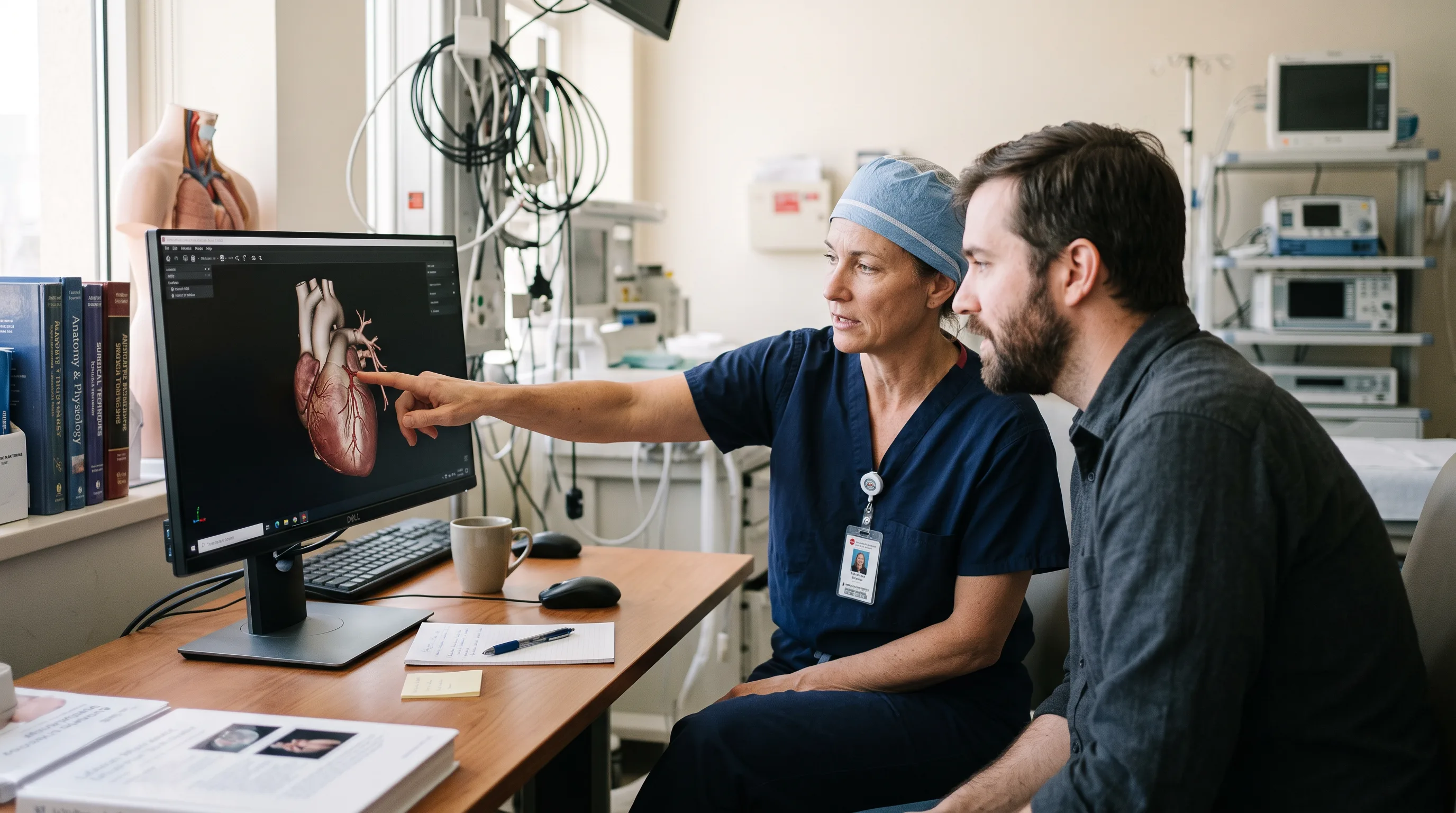
Clinical skills training shows the same direction. Our overview of VR in healthcare and surgical simulation collects the 2025 trials in nursing and critical care that report gains in knowledge and decision confidence. Dr. Brennan Spiegel, Director of Health Services Research at Cedars-Sinai, argues the science question is largely settled: “We don’t need more science to justify deploying VR in the hospital. The challenge will be staffing it, scaling it, paying for it.”
The honest caveat is a selection problem. A 2025 Frontiers in Digital Health editorial found that fewer than 25% of medical XR applications have been evaluated for performance outcomes, and only four in ten have had any usability testing.
The practical lesson is not that VR fails. It is that the burden of proof sits with you, the buyer, because most products on the market carry none. The companies worth your budget are the minority that publish results. Ask for the studies. A vendor that answers with a sizzle reel has told you where it sits in that 75%.
Need help with a medical VR build?
We are here to help!
What Should You Look for in a Medical VR Development Company?
Look for four things: demonstrated clinical accuracy, HIPAA compliance with BAA readiness, learning-management integration, and hardware-agnostic engineering. A studio can be excellent at consumer VR and still be the wrong choice for a clinical build, because none of these four are skills you acquire by accident. Each one below is a question to put directly to any vendor on the shortlist.
How do you verify clinical accuracy?
Clinical accuracy means anatomical fidelity plus scenarios reviewed by named clinical experts, not a 3D artist’s best guess. Ask for the content review process: which surgeons, nurses, or subject-matter experts signed off, and against which education standard. More than 60% of medical schools now integrate immersive simulation tools, per VR Vision Group’s 2026 overview, which raises the baseline expectation for accuracy rather than lowering it. A portfolio with no named healthcare institutions and no published validation is the clearest red flag. Our medical training VR explainer walks through how evidence-based scenario design actually differs from generic 3D content.
Will you sign a Business Associate Agreement?
Any VR application touching protected health information, whether patient data in a therapeutic app or trainee performance tied to named individuals, requires a signed Business Associate Agreement before development starts. The practitioner guidance from InfuseMed on choosing a healthcare VR provider is blunt about the red flags: self-declared “HIPAA compliance” with no documentation, and reluctance to sign a BAA before kickoff. Ask how the vendor handles PHI in development and testing, whether it uses synthetic or de-identified data, and how it implements encryption at rest and in transit. Our guide to choosing an AI healthcare app development company covers the same compliance architecture, and our VR safety training work shows how enterprise data handling carries into regulated deployments.
Can results flow into your LMS?
A clinical training program needs completion records, competency scores, and performance data in the systems your organization already runs. Ask for xAPI (Tin Can) and SCORM output, which let VR results appear in platforms like Cornerstone or SAP SuccessFactors alongside every other course. The analytics that matter go past completion: time-on-task, decision accuracy, and the number of redirections a trainee needed. Scope LMS integration as its own line item rather than a free add-on, and confirm it before signing, because retrofitting standards-compliant reporting after a simulation ships costs far more than building it in.
This is where our VR training simulations practice at Frame Sixty spends real engineering time. We instrument the simulation to emit xAPI statements at every decision node, not just a pass/fail at the end, then map those statements to the competencies a training director actually reports on. The hard part is rarely the headset. It is agreeing with the clinical team, before a line of code, on which in-headset actions count as evidence of competence, because a dashboard a training director cannot read is a dead feature no matter how good the simulation looks.
Is the build genuinely hardware-agnostic?
Hardware-agnostic means the simulation is not welded to one headset that a vendor can discontinue, as Microsoft is doing with HoloLens 2 ahead of end-of-support in 2027. Clinical settings differ: Meta Quest 3 at $499 suits high-volume training, Apple Vision Pro M5 at $3,499 suits planning and visualization with its 4K Micro-OLED optics, and Magic Leap 2 suits hands-free passthrough in the OR.
Here is the distinction most “multi-platform” marketing hides. True hardware-agnosticism is one engine project with swappable render targets and input layers, so a Quest build can be re-aimed at Vision Pro or Samsung Galaxy XR without a rewrite. The weaker version is two or three separately maintained codebases that drift apart with every update and quietly triple your maintenance bill. Ask which one you are buying. Our virtual reality development services are built the first way on purpose.
Custom Medical VR Development vs. Off-the-Shelf Platforms
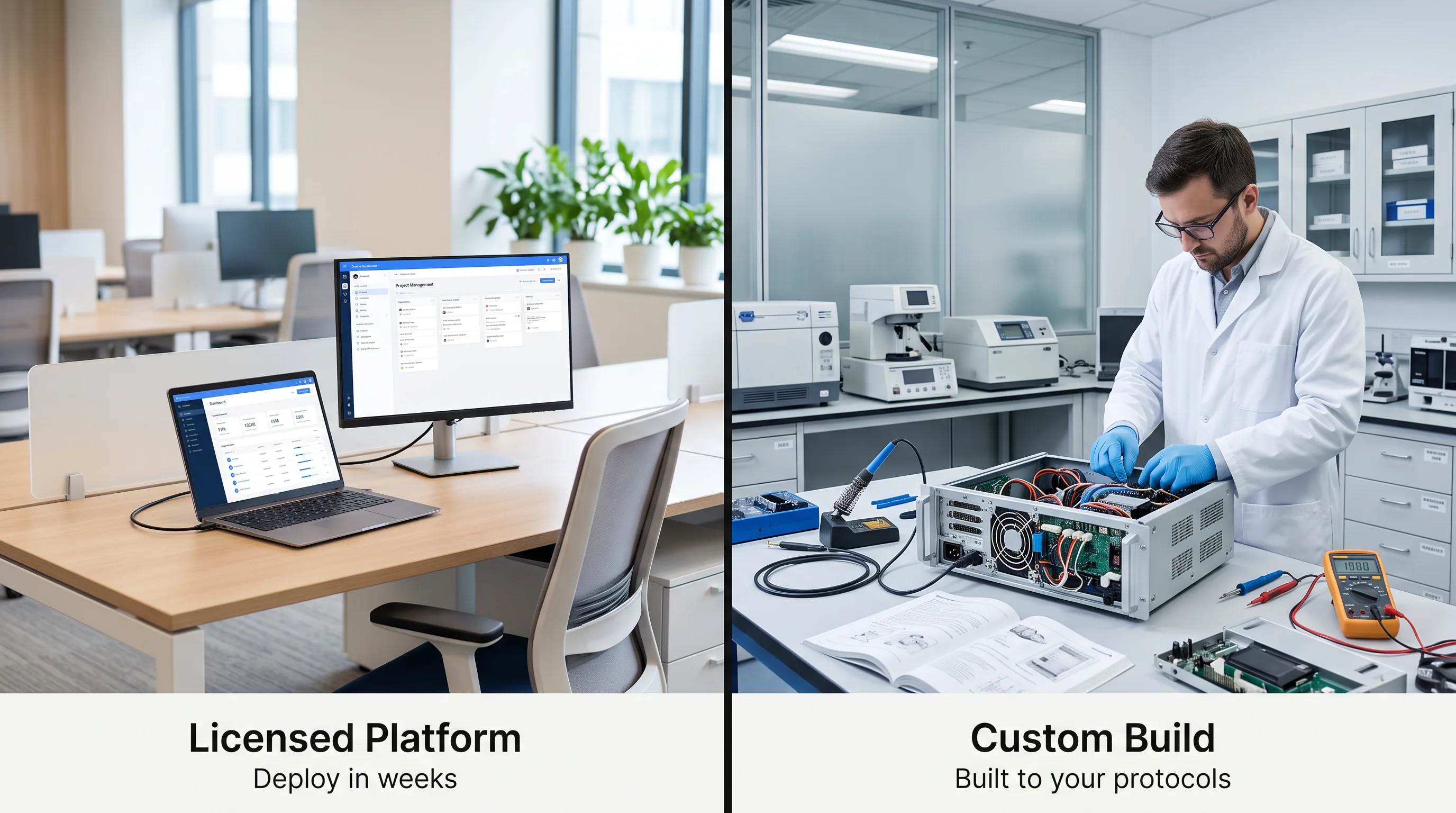
Off-the-shelf platforms license a validated scenario library you can deploy in weeks; custom development builds proprietary simulations tied to your protocols, devices, and data over months. Platforms such as Osso VR, SimX, and FundamentalVR give you known outcomes fast. Custom studios such as Frame Sixty and Treeview Studio give you control, integration, and intellectual-property ownership. The two paths serve genuinely different buyers.

| Factor | Off-the-shelf platform | Custom development |
|---|---|---|
| Upfront cost | Lower, per-seat licensing | Higher, $60K–$1.5M+ project |
| Time to deploy | Weeks | 3–24 months |
| Scenario fit | Fixed library | Built to your protocols |
| EHR / PACS integration | Rare | Available |
| Best at volume | Under ~500 trainees/year | Above ~500 trainees/year |
| IP ownership | Vendor retains | You own it |
The math has a crossover point worth naming. Per-seat platform licensing is cheap at low volume and compounds at high volume, while a custom build is a fixed cost that amortizes as more trainees use it. Below roughly 500 trainees a year a platform almost always wins on cost; above it, a custom build usually wins on both cost and control, and the gap widens every year you keep the software. Treeview Studio’s Medtronic Micra XR Trainer is a clean example of the custom path, built for a device manufacturer to train clinicians on its own transcatheter pacemaker. When you need that kind of proprietary fit, our medical VR training team starts from your protocols rather than a catalog. Verdict: license a platform when a validated library covers your specialty and volume is modest; commission a custom build when you need your own protocols, system integration, or ownership of the result.
How Much Does It Cost to Hire a Medical VR Development Company?
Custom medical VR development costs fall into three tiers by scope and regulatory track, from roughly $60,000 for a proof-of-concept to more than $1.5 million for FDA-regulated software. The figures below come from Forasoft’s 2026 healthcare VR cost analysis, and they track with Reality Atlas’s healthcare range of $50,000 for a focused module to $500,000-plus for full clinical applications with EMR integration.
| Tier | Scope | Cost | Timeline |
|---|---|---|---|
| MVP / proof-of-concept | Single specialty, basic LMS | $60,000–$150,000 | 10–16 weeks |
| Production with EHR integration | Multi-scenario, analytics, HIPAA-ready | $180,000–$400,000 | 4–8 months |
| FDA-track SaMD | Clinical validation, 510(k) or De Novo | $500,000–$1,500,000+ | 12–24 months |
For comparison on the licensing side, a surgical training program for 20 surgeons in one specialty runs about $68,000 to $142,000 in year one once you add ten Quest 3 headsets, platform licenses, and deployment. Put the two side by side before you commit. A six-figure license that recurs annually can quietly overtake a one-time custom build inside three years, which is the calculation the buy-versus-build section turns on. The number that should move your decision is cost per trained clinician over the software’s useful life, not the sticker on the first invoice.
What Compliance Requirements Apply to Medical VR Software?
Medical VR compliance depends on what the software does: handle patient data, deliver a therapeutic outcome, or inform a clinical decision. Three frameworks cover almost every case. The distinction between them decides whether a project needs a few months of security work or a multi-year regulatory program.
- HIPAA and HITECH apply to any application touching patient or trainee PHI. The requirements are a signed BAA, documented access controls and encryption, and breach-notification procedures. A training-only simulation with no identifiable data and no clinical decision support generally needs this layer and nothing heavier.
- FDA Software as a Medical Device (SaMD) applies when the VR software makes or influences a clinical decision, such as diagnosis, treatment selection, or dosing. The FDA’s AR/VR medical device list grew from 39 entries in December 2022 to 104 by December 2025, so the pathway is well-trodden now. Therapeutic apps like RelieVRx clear through 510(k) or De Novo; most training simulations fall below this threshold entirely.
- IEC 62304 and SOC 2 Type II govern the software lifecycle for FDA-track builds, and enterprise hospital systems increasingly expect SOC 2 within 12 months of deployment.
The reason fewer than 25% of medical XR apps carry performance validation is partly that the frameworks above are demanding, which is exactly why a vendor’s regulatory fluency is a buying signal, not a formality. Our AI healthcare app development guide treats compliance as foundational architecture rather than a checklist bolted on at the end.
Conclusion
The medical VR company worth hiring is the one that can prove its work and will stand behind it contractually. That is the thread through every section here: published validation over demo reels, a signed BAA over a compliance claim, and a clear answer on whether you are buying a fixed library or a custom build. Osso VR and SimX earn their place on evidence and named clients. The right choice between a platform license and a custom studio comes down to your specialty coverage, your trainee volume, and whether you need your own protocols and integrations.
Hold the line on the validation question in particular. With most products on the market carrying no performance data, “show me your studies” is the single most useful sentence in a vendor call. It separates the companies building clinical tools from the ones repackaging consumer VR, and it costs you nothing to ask.
Frame Sixty builds custom medical VR for surgical simulation, clinical training, and spatial computing on Apple Vision Pro and Meta Quest, with LMS integration and compliance built in from the first sprint. If you are weighing a medical VR pilot and want a partner who starts from your protocols rather than a catalog, reach out to our team to talk through scope, hardware, and a realistic timeline.
FAQs
Common questions about hiring medical VR companies, covering clinical evidence, headsets and integration, cost, and compliance. Each answer is grounded in 2026 market data and published validation studies.
Clinical evidence for VR simulation in medical education includes a University of Illinois study where Osso VR trainees completed 300% more of a procedure correctly than traditionally trained students, and AppliedVR's RelieVRx trial, where 46% of patients cut chronic back pain by at least half versus 26% on a sham device. Still, fewer than 25% of medical XR apps have been performance-validated.
The ROI of a hospital VR training program comes from faster time-to-competency, fewer procedural errors, and reusable scenarios that cut cadaver, travel, and instructor costs. A surgical program for 20 surgeons in one specialty runs roughly $68,000 to $142,000 in year one, including ten Meta Quest 3 headsets and licenses. Measure cost per trained clinician over the software's useful life, not the first invoice.
A medical VR development partner should demonstrate four things: published clinical validation, HIPAA compliance with Business Associate Agreement readiness, LMS integration via xAPI and SCORM, and hardware-agnostic engineering across headsets. Frame Sixty, an AR/VR and spatial computing development studio, builds custom simulations on Apple Vision Pro and Meta Quest with LMS integration and compliance built in from the first sprint.
Clinical training in 2026 mainly uses the Meta Quest 3 at $499 for high-volume skills practice, Apple Vision Pro M5 at $3,499 for planning and visualization with 4K Micro-OLED optics, and Magic Leap 2 for hands-free passthrough in the operating room. Headset choice should follow the clinical setting, and builds should stay hardware-agnostic since Microsoft is ending HoloLens 2 support in 2027.
Medical VR software integrates with hospital systems through standards and APIs: xAPI (Tin Can) and SCORM push completion records, competency scores, and analytics into platforms like Cornerstone or SAP SuccessFactors, while EHR and PACS integration connects patient data and imaging. Scope this integration as its own line item before signing, because retrofitting standards-compliant reporting after a simulation ships costs far more than building it in.
A custom medical VR training module typically takes 10 to 16 weeks for an MVP or proof-of-concept covering a single specialty, 4 to 8 months for a production build with EHR integration and analytics, and 12 to 24 months for FDA-track Software as a Medical Device requiring clinical validation. Timeline tracks scope and regulatory track, per Forasoft's 2026 cost analysis.
Yes, a VR development company can build HIPAA-compliant healthcare applications, but only one that will sign a Business Associate Agreement before development starts and document access controls, encryption at rest and in transit, and breach-notification procedures. Any VR app touching protected health information, including trainee performance tied to named individuals, needs this layer. Self-declared compliance with no documentation is a red flag.
Medical VR classified as Software as a Medical Device clears through FDA pathways such as 510(k) or De Novo, which apply when the software makes or influences a clinical decision like diagnosis, treatment selection, or dosing. Therapeutic apps like AppliedVR's RelieVRx cleared this way. The FDA's AR/VR medical device list grew from 39 entries in 2022 to 104 by December 2025.
To evaluate a medical VR vendor's clinical accuracy before signing, ask for the content review process: which named surgeons, nurses, or subject-matter experts signed off on each scenario, and against which education standard. Request published validation studies and named healthcare clients. A vendor that answers with a demo reel instead of studies has told you it sits in the unvalidated 75% of the market.