
Is the Meta Quest 3 Worth It? The 2026 Answer for Consumers and Businesses
Nov 12, 2026
12 MIN READ
The Meta Quest 3 is worth it in 2026 for regular VR users and for businesses, though it is harder to justify for casual buyers after Meta raised the price to $599.99. At that price you get a premium standalone mixed-reality headset with pancake lenses, a depth sensor, and the largest VR game library. For a company, the headset is a commodity. The training software built for it decides the real return.
Key Takeaways
- The Meta Quest 3 (512GB) costs $599.99 as of 2026, up from its $499 launch price after Meta’s April 2026 increase.
- The Meta Quest 3 beats the $349 Quest 3S on resolution (2,064 × 2,208 per eye), field of view (~110°), and a depth sensor the cheaper model lacks.
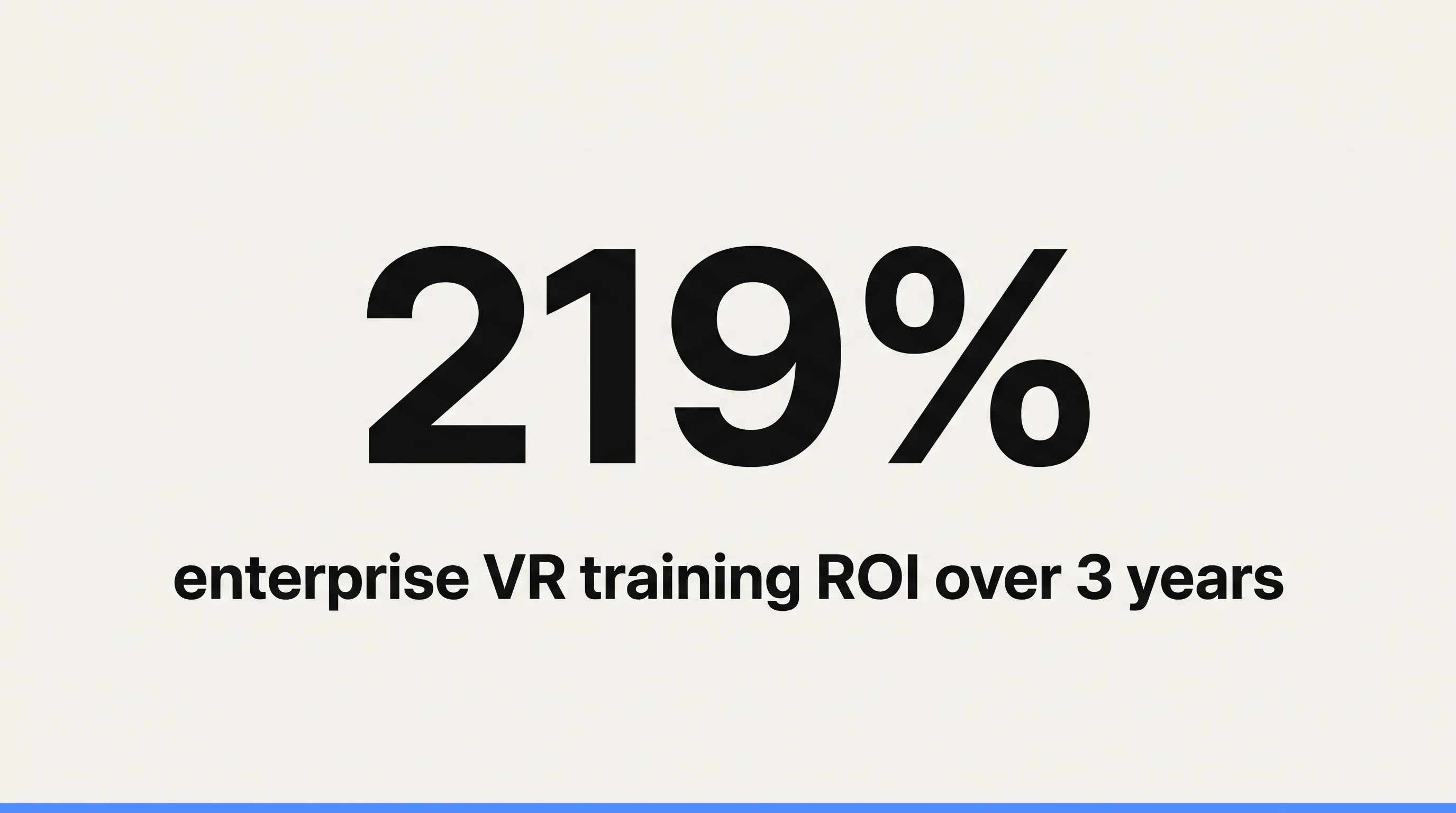
- Enterprise VR training on Meta Quest returned 219% ROI over three years with payback under six months, per a 2025 Forrester study commissioned by Meta.
- VR training runs 52% cheaper per learner than classroom instruction at 3,000 learners, according to a PwC cost model cited by ArborXR in 2025.
- Meta has cancelled its Quest 4 prototypes and announced no successor before mid-to-late 2027, which keeps the Meta Quest 3 current.
What Do You Actually Get for $599 with the Meta Quest 3?
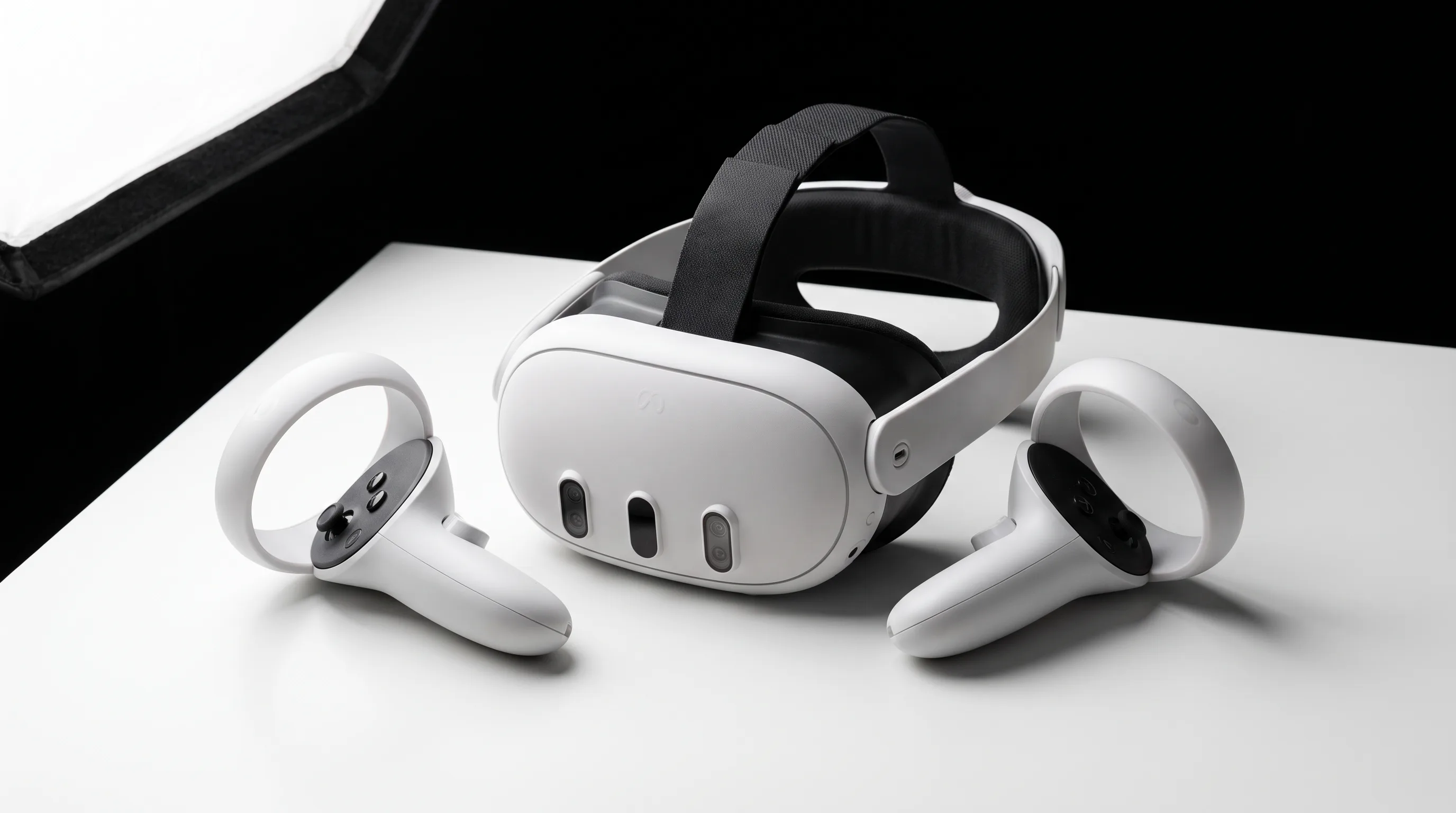
The Meta Quest 3 gives you a premium standalone mixed-reality headset for $599.99, with no gaming PC or console required. Meta discontinued the 128GB model in 2024, so the 512GB version is now the only Quest 3 you can buy. The box ships with the headset, two Touch Plus controllers, and a charging cable. This is a flagship device, not an entry-level one, and the official Meta Quest 3 specifications confirm the current configuration.
Display, Optics, and Passthrough
The Meta Quest 3 display runs 2,064 × 2,208 pixels per eye through pancake lenses, with a field of view near 110 degrees. A depth sensor drives color passthrough sharp enough for mixed-reality apps that anchor digital objects to your actual room. Continuous IPD adjustment from 53 to 75mm fits more faces than fixed-step headsets.
The pancake lenses matter more than the spec sheet suggests. They deliver edge-to-edge clarity that older Fresnel designs cannot, which is why text stays readable across the whole image. According to the space4games 2026 buying guide, Quest 3 passthrough trails the Apple Vision Pro in low light, but it remains the sharpest passthrough you can get below $3,499. The vr.org spec comparison lists the Snapdragon XR2 Gen 2 chip and 8GB of RAM as the compute core, shared with the cheaper Quest 3S.
Performance, Storage, and Real-World Limits
The Meta Quest 3 runs on the Snapdragon XR2 Gen 2 with 8GB of RAM and 512GB of storage, but battery life is the hard ceiling: two to two and a half hours under heavy use. The stock elastic strap puts all 515 grams on your face. It grows uncomfortable after 30 to 45 minutes.
Most buyers end up spending roughly $50 more on an aftermarket elite strap, a cost the headline price hides. The Quest 3 carries no IP rating, so it is not certified against sweat or dust, and Meta sells no built-in prescription lens system. The Reality Atlas 2026 review flags the strap and battery as the two weakest points. On the upside, the Meta Horizon Store holds the largest standalone VR library of any platform, and the Quest 3 streams PC VR over Air Link when you want desktop-grade graphics. For a side-by-side of where it sits against rival hardware, our full hardware comparison across this price range breaks down the field.
Is the Meta Quest 3 Worth It for Personal Use?
For personal use, the Meta Quest 3 is worth it if you play VR regularly, want mixed-reality apps, or train with fitness titles. It is overkill if you would open it twice a year. The April 2026 price increase from $499 to $599.99 tightened the consumer case, because casual users can get most of the experience from the cheaper Quest 3S.

The depth sensor is the dividing line. If you care about mixed reality, where virtual screens and objects sit convincingly in your physical space, the Quest 3 is the only one of the two Meta headsets that does it properly. Gamers who only want seated or standing VR play will rarely notice the difference.
Here is the practical test we give friends who ask. If the apps you are excited about put digital content into your real room, pay for the Quest 3. If your list is all enclosed VR games, the sensor and the sharper lenses are money you will not feel. The broader consumer market has matured to the point where that question actually has a clear answer, as our overview of how the VR ecosystem has grown lays out.
Need help scoping VR training for Meta Quest 3?
We are here to help!
How Does the Meta Quest 3 Compare to Other Options?
For most buyers, the Meta Quest 3’s real competition is the $349 Quest 3S, not premium headsets that cost several times more. The two share a processor and the entire game library, so the choice comes down to display quality and mixed-reality capability. Only specific professional needs push a buyer toward the Apple Vision Pro or the Samsung Galaxy XR.
Meta Quest 3 vs Quest 3S: Is the Extra $250 Worth It?
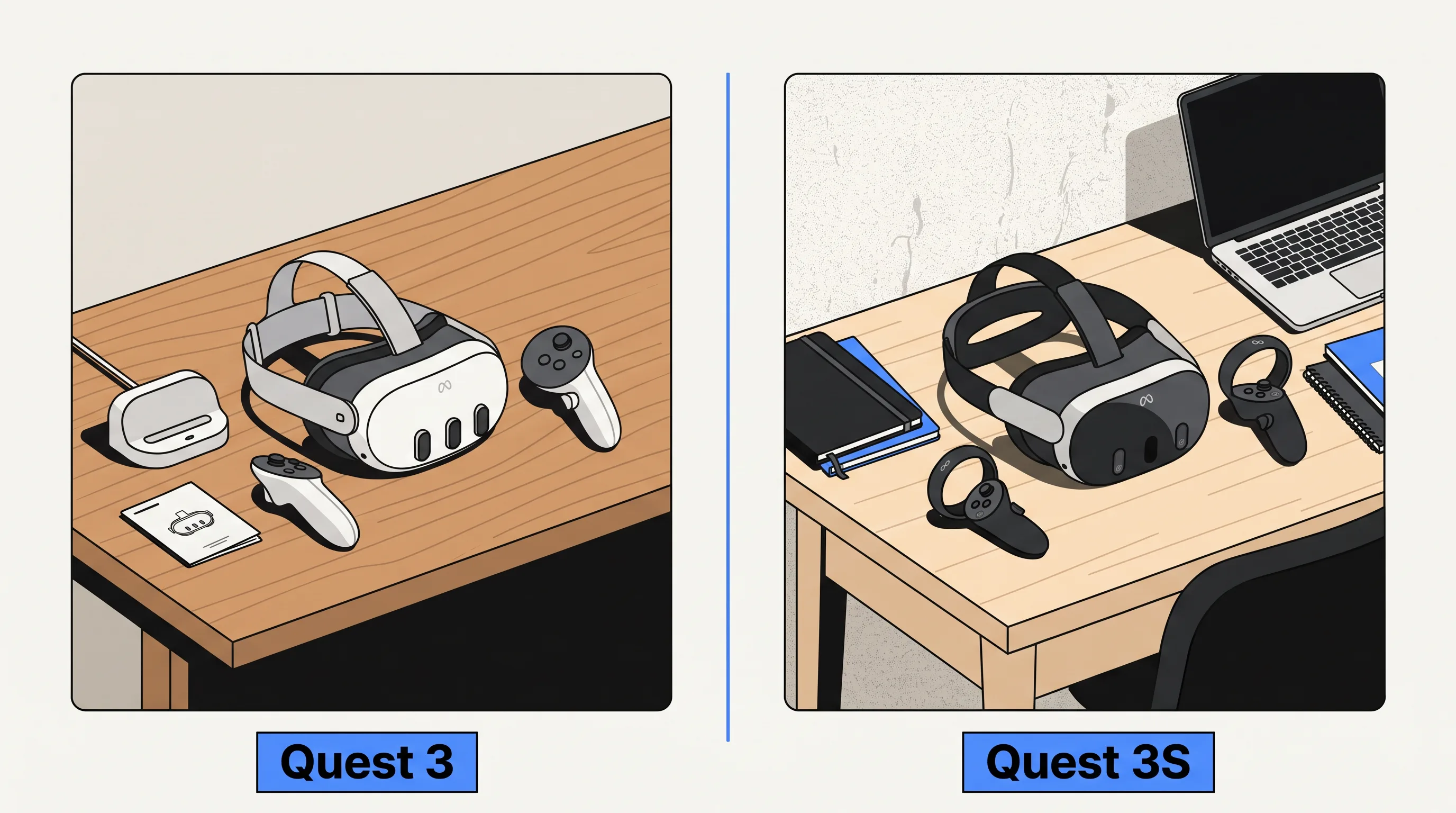
The extra $250 for the Meta Quest 3 over the Quest 3S is worth it for mixed reality, text-heavy apps, and productivity, but not for budget gaming. Both headsets run the identical Snapdragon XR2 Gen 2 chip, so a game locked at a given frame rate performs the same on each. There is no such thing as a Quest 3 exclusive.
| Spec | Meta Quest 3 | Meta Quest 3S |
|---|---|---|
| Price | $599.99 (512GB) | $349 (128GB) / $449 (256GB) |
| Display | 2,064 × 2,208 per eye | 1,832 × 1,920 per eye |
| Lenses | Pancake | Fresnel |
| Field of view | ~110° | ~96° |
| IPD adjustment | Continuous 53–75mm | 3 fixed steps (58/63/68mm) |
| Depth sensor | Yes (true mixed reality) | No |
| Processor | Snapdragon XR2 Gen 2 | Snapdragon XR2 Gen 2 |
The vr.org comparison frames the gap well: the $250 you save on the Quest 3S covers a comfort strap, a case, and a couple of games. Verdict: buy the Quest 3 for mixed reality and sharp text, and buy the Quest 3S for gaming on a budget.
Quest 3 vs Premium Alternatives
Against premium headsets, the Meta Quest 3 wins on value by a wide margin and loses only on raw fidelity. The Apple Vision Pro M5 lists at $3,499, roughly six times the Quest 3, and delivers sharper passthrough through visionOS, but it has no standalone gaming library and targets enterprise spatial computing. The Samsung Galaxy XR sits near $1,799 in the Android XR middle tier.
The Pico 4 Ultra is the closest standalone rival, though its image blurs at the edges where the Quest 3’s pancake lenses stay sharp. For anyone shopping standalone VR under $1,000, the real field is the Quest 3 and the Quest 3S. The premium tier answers a different question. Our look at how the XR hardware landscape has consolidated covers where each platform is aimed. Verdict: pick the Quest 3 for value standalone VR, and step up to Vision Pro or Galaxy XR only when a specific enterprise workflow demands it.
Is the Meta Quest 3 Worth It for Business or Enterprise Training?
For business and enterprise training, the Meta Quest 3 is worth it, but the headset is the least important part of that decision. At $599, the hardware is a commodity. The real question is whether the custom training software built for it pays back faster than in-person instructors, travel, and downtime. Teams that fixate on specs and underfund content get the worst returns.
That is the position we will defend on any client call: in an enterprise VR program, the headset is a rounding error and the content is everything. A $100 price move on the device changes a consumer’s math. It barely registers against a six-figure content build. The organizations that see 200%-plus returns are the ones that spend their attention on the simulation, not the SKU. If you want the reasoning behind that, our guide to enterprise VR training development and the breakdown of what a VR training company actually builds both start from the same premise.
In our VR training builds at Frame Sixty, an AR/VR and spatial computing development studio, the headset model is usually the quickest decision in the whole project. We standardize most training fleets on the Quest 3 or Quest 3S because the Snapdragon XR2 Gen 2 performance envelope is predictable and the Horizon tooling is well understood. The hard work lands elsewhere: designing modules that fit inside the headset’s two-hour battery window, keeping the frame budget stable so trainees never feel motion discomfort, and sizing build packages so a full curriculum fits the onboard storage.
What the ROI Data Shows
The ROI data on Meta Quest training is strong and consistent across sources. A 2025 Forrester Total Economic Impact study commissioned by Meta found enterprise VR training delivered 219% ROI over three years with payback in under six months, drawn from a composite of four organizations. The Forrester study attributed $1.77M in net present value to faster onboarding and $1.58M to a 50% cut in travel costs.
The learning outcomes back the financials. According to PwC research cited in the madxr.io cost analysis, VR learners complete training four times faster than classroom peers and report being 275% more confident applying what they learned. ArborXR’s 2025 summary of the same PwC work puts one-year knowledge retention at up to 80% for VR versus 20 to 30% for traditional methods. Accenture bought 60,000 Meta Quest headsets for onboarding, and Boeing cut assembly training time by 75%.
Two lines from the Forrester interviews capture the shift. “I’ve been working in training 25+ years, and this is the first time I’ve been asked for more,” said an XR business development manager in automotive manufacturing. A global product manager in heavy equipment manufacturing added, “Meta Quest allows us to reduce onboarding time as we hire and train new technicians.” Where this heads next, with AI layered into simulation, is the subject of our piece on where AI-driven spatial training is going.
VR Training vs. In-Person Training: The Cost Crossover
VR training beats in-person training on cost once you cross a few hundred learners, because the economics are front-loaded and then flatten. A custom module costs real money to build, but each additional learner adds almost nothing, while classroom cost rises in a straight line with every seat. According to a PwC model cited by ArborXR, the crossover sits around 375 learners.
| Learners | VR training (3-yr cost/learner) | Classroom (3-yr cost/learner) | VR advantage |
|---|---|---|---|
| ~375 | ≈ $230 | ≈ $230 | Break-even |
| 3,000 | $115.43 | $229.79 | 52% cheaper |
| 10,000 | lower still | rises linearly | 64% cheaper |
The headset cost almost disappears inside these numbers. On the programs we scope at Frame Sixty, a $599 Quest 3 is a small line item next to content development, which is where most of the budget and nearly all of the risk live. A single custom module can run from tens of thousands of dollars into six figures depending on interactivity, networking, and how deeply it ties into existing systems. The madxr.io model puts a 500-employee program at $102,000 to $111,000 over three years, against $285,000 to $315,000 for instructor-led delivery. Our guide to what VR development costs at different scopes and our XR development services walk through where that money goes. Verdict: for large, repeated, or high-stakes training, VR on the Quest 3 wins on cost; for a one-off session with a handful of people, classroom still makes sense.
Deploying Quest 3 for Business in 2026
Deploying the Meta Quest 3 for business in 2026 changed in one important way: Meta ended its dedicated commercial program but left training deployments fully workable. On February 20, 2026, Meta stopped selling Work and Edu SKUs, closed new Horizon Managed Services sign-ups, and shut down Horizon Workrooms, as the skillsive.com breakdown documents.
For most training buyers, that news is far less disruptive than it sounds. Standard consumer Quest 3 and 3S headsets still run every training app normally. Existing Horizon Managed Services access is now free and supported through January 4, 2030, and fleets can be managed through third-party MDM platforms like ArborXR, ManageXR, and Microsoft Intune. Course assignment, completion tracking, and certificates were always handled at the training-software layer, not by Meta’s service, so a well-built program carries on untouched. Adoption keeps climbing regardless: the educationxr.com 2026 data reports 75% of Fortune 500 companies have deployed VR for training. Our view on how enterprise VR has evolved traces that trajectory.
Is the Meta Quest 3 Still Worth Buying in 2026?
The Meta Quest 3 is still worth buying in 2026, because no successor is close and the current hardware stays relevant for years. Meta cancelled both of its Pismo Quest 4 prototypes, confirmed in a December 2025 internal memo, and CTO Andrew Bosworth acknowledged the delay at Davos in January 2026. Meta Connect 2026 showed no new Quest headset at all.

According to The Gadgeteer’s May 2026 report, a Quest 4 is not expected before mid-to-late 2027, with a likely shelf window of holiday 2027 to early 2028. The space4games guide judges the Quest 3 competitive through at least 2029.
For businesses, the “wait for Quest 4” question is the wrong one. Custom training content built on Horizon OS today carries forward to future Meta hardware, and the ROI clock starts the day you deploy, not on some 2027 launch date. Every month a payback-in-six-months program sits unbuilt is a month of savings left on the table. The April 2026 price bump from $499 to $599.99 weakens the casual-buyer case, but for serious users and companies, $599 for a device that will not be replaced for a year or more is a reasonable bet. Those watching the longer arc toward lightweight glasses can read our take on where XR hardware is heading beyond standalone headsets. Verdict: buy now unless you specifically want a gaming-focused upgrade and can wait 18 months or more.
Conclusion
The Meta Quest 3 is worth it for most buyers in 2026. For consumers, $599.99 buys the best standalone mixed-reality headset below the premium tier, and the depth sensor and pancake lenses are what separate it from the cheaper Quest 3S. For businesses, the verdict is clearer still, with a 2025 Forrester study putting enterprise VR training ROI at 219% and payback under six months.
The point we keep coming back to is simple. The headset is the commodity, and the software is the investment that pays back. Companies that pour their energy into a well-designed simulation, and treat the Quest 3 as the cheap, capable delivery device it is, are the ones that see real returns. The device decision is nearly solved. The content decision is where programs succeed or fail.
If you want to explore what a custom VR training program on the Meta Quest 3 could return for your organization, get in touch with our team at Frame Sixty. We will help you scope the software that turns a $599 headset into measurable payback.
FAQs
Common questions about whether the Meta Quest 3 is worth buying in 2026, covering its hardware, how it compares to alternatives, and what it returns for enterprise training.
The Meta Quest 3 is a strong standalone headset, delivering 2,064 × 2,208 pixels per eye through pancake lenses, a ~110° field of view, and a depth sensor that enables true mixed reality. It runs the largest standalone VR library and streams PC VR over Air Link. Its main weaknesses are a two-hour battery and an uncomfortable stock strap.
The Meta Quest 3's main drawbacks are battery life of two to two and a half hours under heavy use, a 515-gram weight on a stock elastic strap that grows uncomfortable after 30 to 45 minutes, and no IP rating against sweat or dust. Most buyers spend roughly $50 more on an aftermarket elite strap the headline price hides.
A Quest 4 is not expected before mid-to-late 2027. Meta cancelled both of its Pismo Quest 4 prototypes, confirmed in a December 2025 internal memo, and CTO Andrew Bosworth acknowledged the delay at Davos in January 2026. Meta Connect 2026 showed no new Quest headset, which keeps the Meta Quest 3 the current premium standalone option.
The Meta Quest 3 requires no PC or console; it is a fully standalone headset running on the Snapdragon XR2 Gen 2 chip with 8GB of RAM and 512GB of storage. You can optionally stream PC VR games over Air Link when you want desktop-grade graphics, but every app in the Meta Horizon Store runs on the headset alone.
The Meta Quest 3 battery lasts two to two and a half hours under heavy use, which is the hard ceiling on any session. This two-hour window shapes enterprise training design, where modules must fit inside it. Many buyers add a battery head strap to extend runtime, since the headset carries no swappable battery of its own.
The Meta Quest 3 costs $599.99 against the Apple Vision Pro M5 at $3,499, roughly six times more. The Vision Pro delivers sharper passthrough through visionOS and targets enterprise spatial computing, but it has no standalone gaming library. The Quest 3 wins on value and VR content; the Vision Pro suits specific professional workflows that justify its price.
VR training on Meta Quest returned 219% ROI over three years with payback in under six months, according to a 2025 Forrester Total Economic Impact study commissioned by Meta across four organizations. The study attributed $1.77M in net present value to faster onboarding and $1.58M to a 50% cut in travel costs, with learning gains to match.
Businesses manage Meta Quest 3 fleets through third-party MDM platforms such as ArborXR, ManageXR, and Microsoft Intune, even after Meta ended its commercial program on February 20, 2026. Existing Horizon Managed Services access is free through January 4, 2030. Course assignment, completion tracking, and certificates are handled at the training-software layer, so standard consumer headsets run every training app normally.
Look for a VR training development partner that treats the Meta Quest 3 as a commodity delivery device and focuses on the custom software, where nearly all the budget and risk live. Frame Sixty standardizes training fleets on the Quest 3 or Quest 3S and designs modules that fit the two-hour battery window, hold a stable frame budget, and tie into existing systems.