
Spatial AI Is the Next Big AI Trend: Why AR, VR, and Vision Pro Are the Interface for Real-World AI
Jun 17, 2026
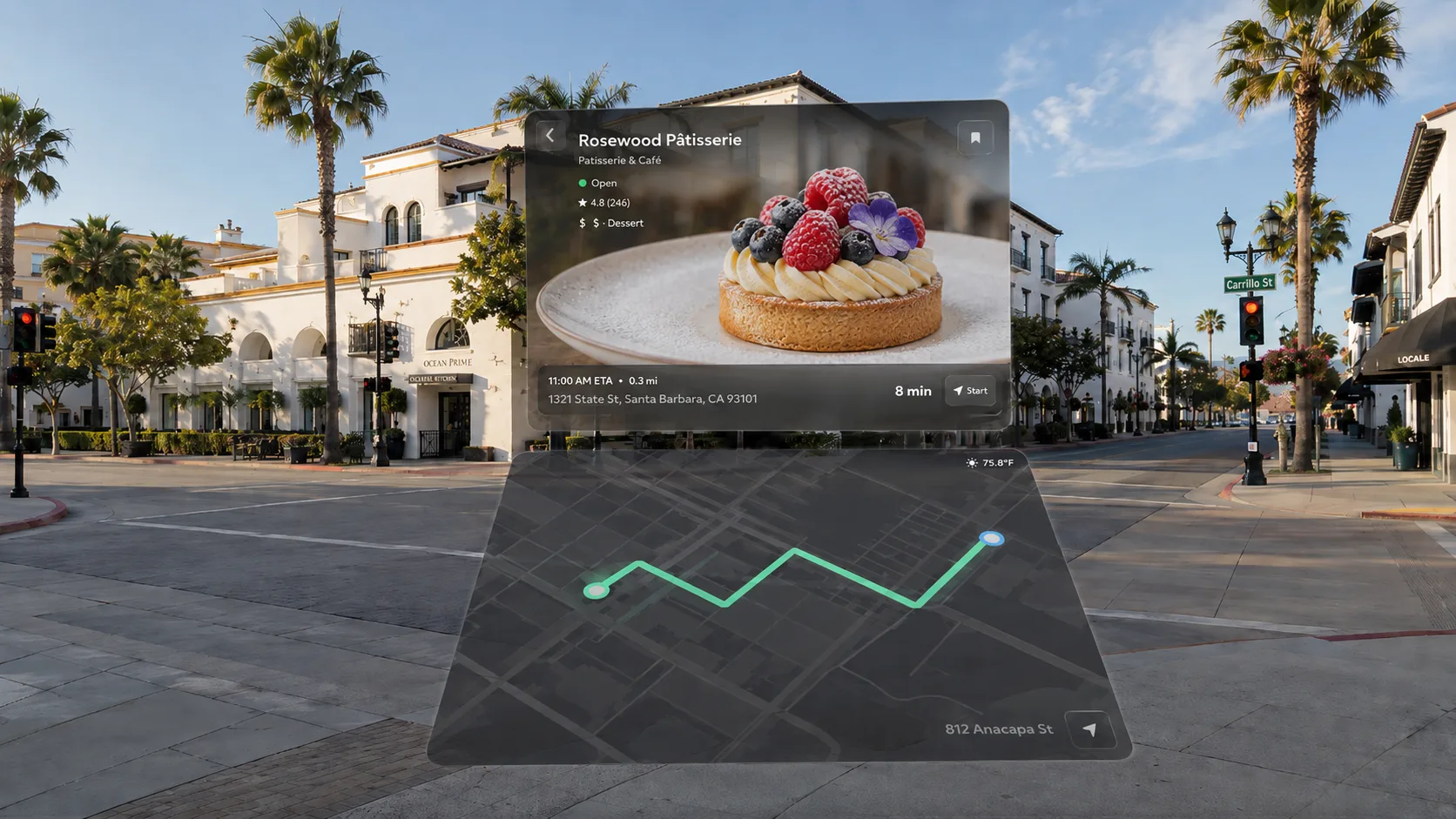
15 MIN READ
Spatial AI is artificial intelligence that understands the physical world around a user, including objects, rooms, surfaces, movement, and 3D relationships, rather than only processing text or flat images. It combines computer vision, 3D reconstruction, object tracking, and vision-language models, then delivers output through AR and VR interfaces that place answers inside a real environment. The spatial computing market is projected to grow from $20.43 billion in 2025 to $85.56 billion by 2030, and VR training already delivers four times faster learning. Apple Vision Pro is the most capable platform for building these experiences today, while lighter smart glasses continue to mature.
Key Takeaways
-
Spatial AI understands 3D space, objects, and movement, not just text and images like a chatbot.
-
The spatial computing market is projected to grow from $20.43 billion in 2025 to $85.56 billion by 2030 (Mordor Intelligence, 2026).
-
Apple Vision Pro with the M5 chip runs AI inference for third-party apps twice as fast as the prior model (Apple, 2025).
-
VR training delivers four times faster learning and 275% more confidence applying skills (Treeview, 2026).
-
Enterprises can prototype Spatial AI on headsets today and migrate to lighter AR glasses as that hardware matures.
-
Spatial AI understands 3D space, objects, and movement, not just text and images like a chatbot.
-
The spatial computing market is projected to grow from $20.43 billion in 2025 to $85.56 billion by 2030 (Mordor Intelligence, 2026).
-
Apple Vision Pro with the M5 chip runs AI inference for third-party apps twice as fast as the prior model (Apple, 2025).
-
VR training delivers four times faster learning and 275% more confidence applying skills (Treeview, 2026).
-
Enterprises can prototype Spatial AI on headsets today and migrate to lighter AR glasses as that hardware matures.
Need help building a Spatial AI app?
We are here to help!
What Is Spatial AI?
Spatial AI is artificial intelligence that perceives and reasons about three-dimensional environments, including the distance between objects, their geometry, and how people and things move through a space. Unlike a language model that processes words, Spatial AI processes depth, layout, and physical context, then produces output that fits the user’s real surroundings. It is the bridge between machine perception and the rooms, tools, and workflows people use every day.
Spatial AI combines several capabilities that have matured over the past few years. According to Roboflow’s 2025 breakdown of spatial intelligence, the core technical components are depth estimation, 3D reconstruction, object tracking, pose estimation, and vision-language models that interpret a scene and reason about it. Layered on top are AI agents, real-time context, and natural-language interaction, all delivered through an AR or VR interface.
The point of all this is grounding. “Without spatial intelligence, today’s AI is detached from the physical world,” says Lei Li, Director of the UVA Spatial AI Lab (UVA School of Data Science, 2026). For readers new to the underlying platform, our primer on what spatial computing is covers the foundation Spatial AI builds on. The takeaway: Spatial AI is the layer that lets software understand a place, not just a prompt.
How Is Spatial AI Different from Regular AI?
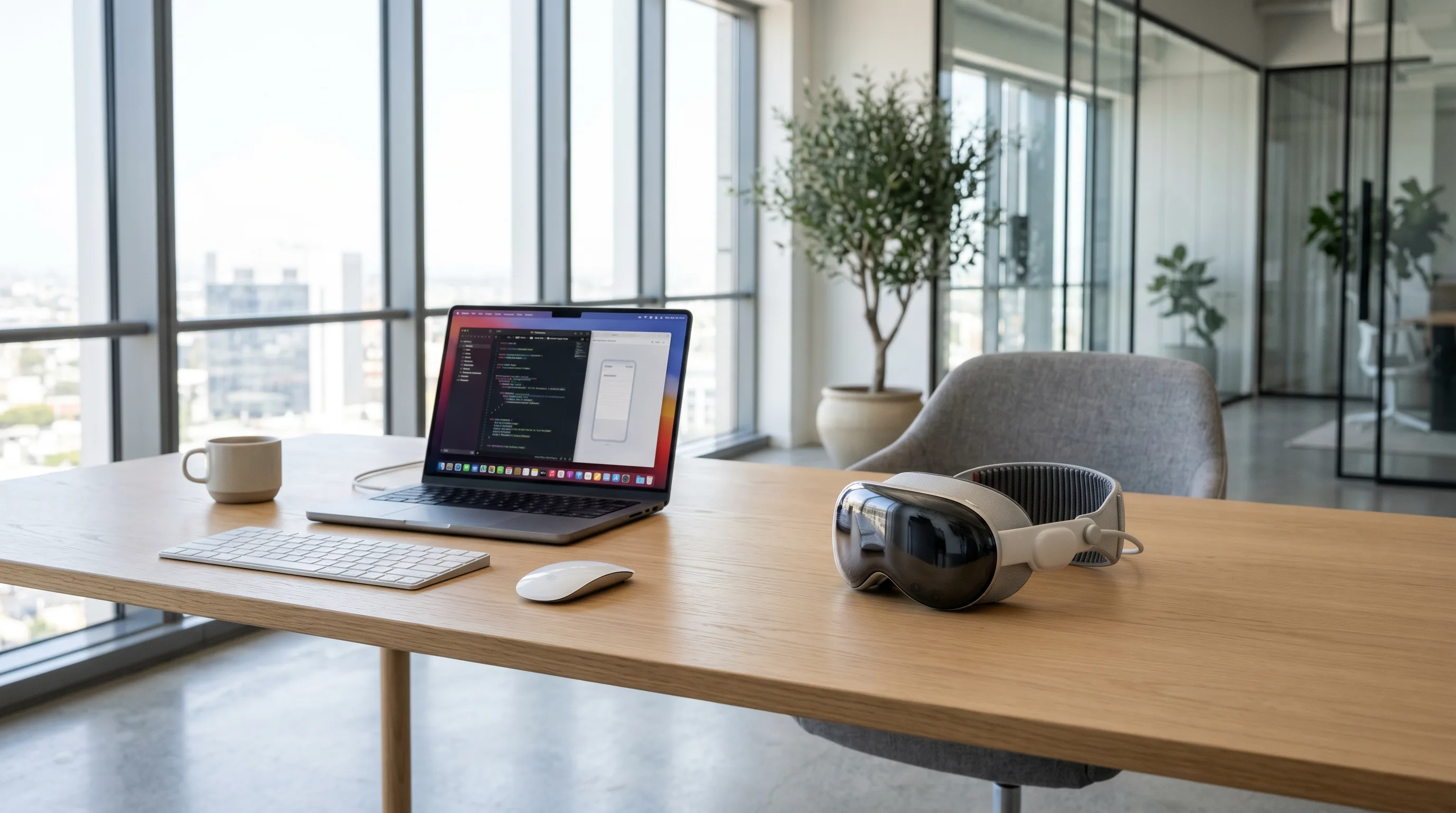
Spatial AI differs from regular AI because it maintains a model of three-dimensional space, while chatbots and image models work with text and flat pictures that carry no built-in sense of depth, scale, or position. A standard model can describe a procedure in words. Spatial AI can place step-by-step guidance onto the actual object in front of you and update it as you move.
The gap is measurable. In her essay From Words to Worlds, Fei-Fei Li, co-founder and CEO of World Labs, argues that spatial intelligence is the frontier beyond language, and she has noted that state-of-the-art language models “rarely perform better than chance on estimating distance, orientation, and size” (UVA School of Data Science, 2026). Text is a powerful medium, but it is not where physical work happens.
Three differences separate the two approaches:
- Input: regular AI reads tokens or pixels; Spatial AI reads 3D sensor data, depth maps, and tracked motion.
- Output: regular AI returns text or an image; Spatial AI returns overlays, annotations, and actions anchored to real locations.
- Context: a chatbot is largely stateless between prompts; Spatial AI maintains a persistent map of the environment, often called a world model.
That last difference is why companies exploring autonomous behavior look at agentic spatial computing, where AI agents act inside a spatial environment rather than a chat window. Spatial AI is regular AI given a body of context: the room itself.

Why Are AR and VR the Natural Interface for Spatial AI?
AR and VR are the natural interface for Spatial AI because spatial problems need a display that exists in space rather than on a flat screen. When the answer involves a physical object, a 3D structure, or a real-world workflow, a headset or a pair of glasses can place that answer exactly where the work is. A phone screen forces the user to look away from the task; a spatial display keeps the answer in context.
Spatial Problems Need Spatial Displays
Spatial problems are tasks where the user’s physical environment is part of the problem, so the solution has to appear in that environment to be useful. A flat screen breaks the task into “look at the problem, then look at the phone.” A spatial display keeps both in view at once.
Consider how this changes everyday work:
- A technician sees the next repair step overlaid on the equipment, hands free.
- A surgeon inspects 3D scan data floating at the operating field instead of on a wall monitor.
- A trainee practices inside a simulated environment with AI performance feedback.
- A museum visitor gets context about an exhibit simply by looking at it.
- A warehouse worker sees the picking route and item count without stopping to check a terminal.
- A product team views a 3D concept at real scale in the room before anything is built.
In each case, the spatial display is not a convenience. It is what makes the AI output actionable. Building these overlays for phones and tablets is where AR app development starts for many companies.
The AI Hardware Interface Shift
The AI hardware interface shift is the move from screens to spatial devices as the primary way people use AI. The smartphone was the hardware that made mobile AI, including voice assistants, image recognition, and live navigation, usable for billions of people. AR headsets, VR environments, and smart glasses are the equivalent step for Spatial AI.
The market reflects that shift. The spatial computing market is projected to grow from $20.43 billion in 2025 to $85.56 billion by 2030, a 33.16% compound annual growth rate, according to Mordor Intelligence data compiled by Treeview (2026). Smart glasses shipments grew 110% year over year in the first half of 2025, and 78% of those shipments were AI-enabled (Treeview, 2026). As glasses get lighter and cheaper, Spatial AI moves from enterprise headsets toward everyday wearables.
Is Apple Vision Pro a Spatial AI Device?
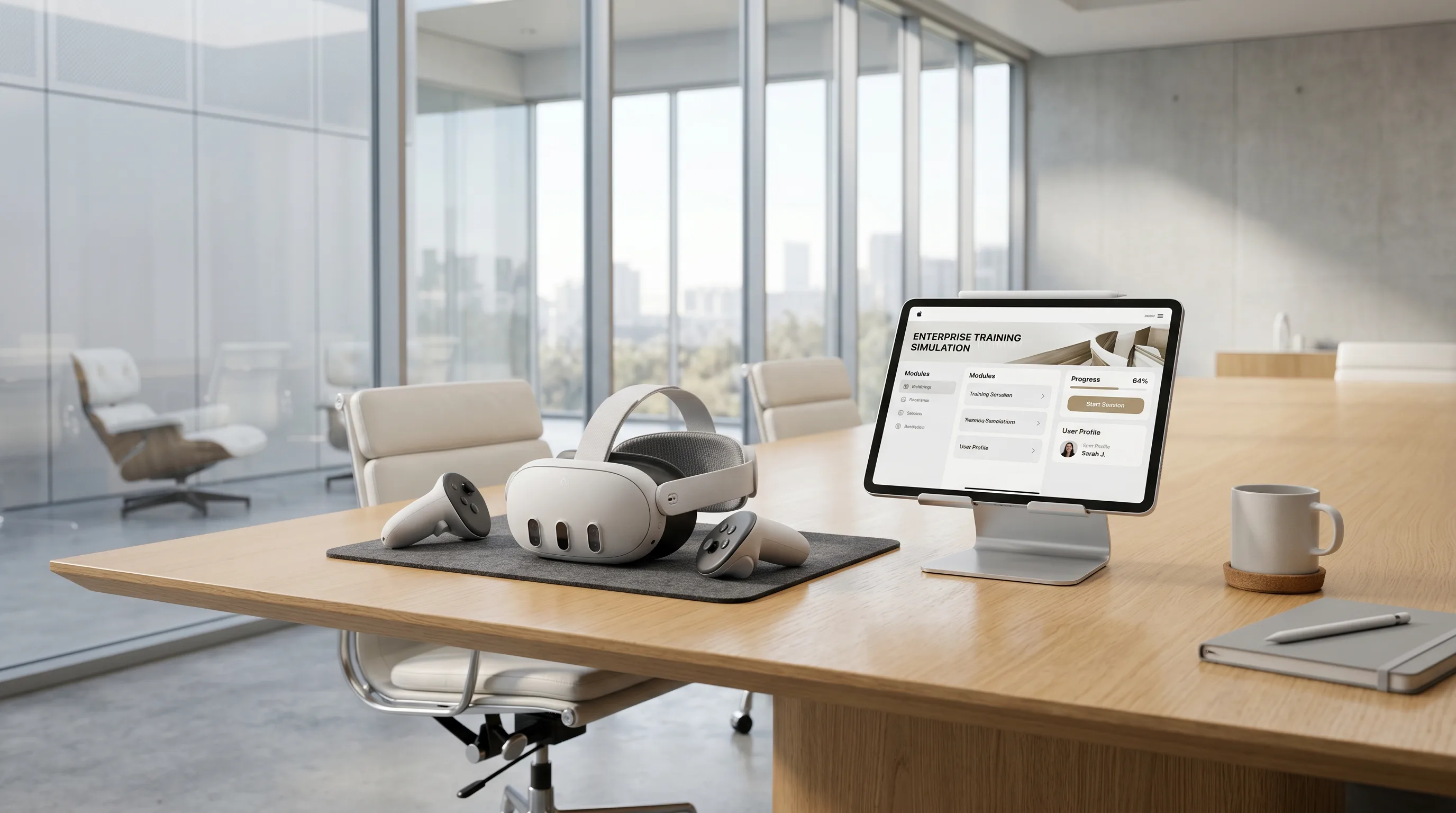
Apple Vision Pro is the most capable spatial computing platform commercially available today, which makes it the strongest current hardware for building and testing Spatial AI. It is not a lightweight pair of AR glasses, and it is not meant to be. For enterprise teams that want to validate spatial concepts now, that distinction matters less than raw capability, and Vision Pro has more of it than anything else shipping.
What Apple Vision Pro Offers Spatial AI Developers
Apple Vision Pro gives Spatial AI developers high-fidelity rendering, precise hand and eye tracking, mixed-reality passthrough, and on-device AI performance strong enough to run models locally. The October 2025 model, built on the M5 chip, includes a 16-core Neural Engine that runs AI inference for third-party apps twice as fast as the previous generation, with 12-millisecond display latency (Apple, 2025).
The software keeps pace. visionOS 26 introduced spatial scenes that use generative AI to add depth, plus team device sharing and a Protected Content API for secure enterprise deployments (Apple, 2025). More than one million apps run on Vision Pro, with over 3,000 built specifically for visionOS.
“Apple Vision Pro has defined what’s possible in this new era of spatial computing, and with visionOS 26, we’re excited to push the boundaries even further,” said Mike Rockwell, VP of the Vision Products Group at Apple (2025). Independent analysts agree on its position: IDC’s 2025 assessment of the Vision Pro M5 describes it as a business-first product that “continues to define what premium mixed reality should look like.” Teams ready to build can start with enterprise Vision Pro development.
Vision Pro as a Prototyping Starting Point
Apple Vision Pro works best as a prototyping platform, where teams validate spatial UX, test AI integration, and prove return on investment before lighter hardware exists. It is heavy and costs $3,499, so it is not a daily-wear consumer device. For enterprise prototyping, that is not the point: the goal is to learn what a spatial workflow should feel like.
A concrete example comes from our own portfolio. Frame Sixty, an AR/VR and spatial computing development studio, built the VR Medical Scan Viewer for Apple Vision Pro, letting clinicians examine MRI and CT data as interactive 3D volumes instead of scrolling through 2D slices. Vision Pro is where you prove the concept. Smart glasses are where the concept eventually scales.

What Are the Best Business Use Cases for Spatial AI?
The best business use cases for Spatial AI are in healthcare, enterprise training, field service, manufacturing, retail, and education, where the work involves physical objects, 3D data, or hands-on tasks. These sectors already show measurable returns from spatial tools, which is why enterprise adoption is running ahead of consumer adoption.
Healthcare and Medical Visualization
Healthcare is the clearest Spatial AI use case because medical work is inherently three-dimensional, from reading a scan to planning a procedure. The global VR healthcare market reached $5.62 billion in 2025 and is growing at a 31.3% compound annual rate, projected to hit $66.91 billion by 2034, according to Treeview (2026).
Practical applications include 3D scan visualization, surgical planning overlays, radiology education, patient education, AI-assisted anatomy explanation, and medical training simulations. A 3D tumor volume is harder to misread than a single 2D slice, and a simulated procedure is far lower risk to practice than a cadaver lab. Our VR Medical Scan Viewer and broader work in virtual reality for healthcare put scan data into spatial context for radiologists and trainees.
Enterprise Training and Field Service
Enterprise training and field service are high-ROI Spatial AI use cases because both depend on showing a worker exactly what to do at the moment and place they need to do it. VR training delivers four times faster learning completion, four times more focus, and 275% more confidence applying skills on the job, according to Treeview (2026). Boeing reported a 75% reduction in training time per employee using VR (Treeview, 2026), and 75% of Fortune 500 companies have used VR for training and education (Treeview, 2026).
Training scenarios include immersive onboarding, safety simulation, equipment operation, and repeatable practice environments with AI performance feedback. Field service adds hands-free repair instructions overlaid on equipment, AI-guided troubleshooting through object recognition, remote expert overlays, and maintenance checklists in view. A technician cannot safely stop to read a manual inside a turbine housing, which is exactly where a spatial overlay earns its keep. Our VR training work focuses on these repeatable, measurable scenarios.
Manufacturing, Retail, and Education
Manufacturing, retail, and education use Spatial AI to deliver information at the moment and location where it is needed, rather than on a separate screen moments later. The common thread across all three is context: the guidance appears where the work or the decision happens.
- Manufacturing and logistics: workflow guidance, assembly assistance, quality-control inspection, and warehouse picking with in-view route guidance.
- Retail and product visualization: real-scale product previews in a customer’s space, configurators, and showroom experiences without physical inventory.
- Education and museums: interactive exhibits that respond to what a visitor looks at, guided learning with spatial context, and historical or scientific reconstructions.
Companies evaluating where to start often begin with our overview of spatial computing in enterprise, which maps these patterns to specific operational outcomes.
Should You Build for Apple Vision Pro Now or Wait for Smart Glasses?
You should build for Apple Vision Pro now and design the experience so it can migrate to smart glasses later, rather than waiting for glasses hardware to mature. Enterprise return on investment does not require lightweight glasses, because headsets already deliver it. Waiting means forfeiting the time it takes to build institutional knowledge, validate use cases, and train users.
Where Smart Glasses Stand in 2026
Smart glasses in 2026 span four categories, from AI camera glasses to standalone AR glasses, and the hardware is improving quickly while still facing real constraints. Meta Ray-Ban Meta glasses have sold more than two million units since October 2023 (Treeview, 2026). The Meta Ray-Ban Display adds a full-color waveguide controlled by an EMG wristband, and Snap has opened preorders for Snap Specs, fully standalone true AR glasses priced at $2,195 and shipping in Fall 2026 (UploadVR, 2026).
| Device | Category | Key detail | Status (2026) |
|---|---|---|---|
| Meta Ray-Ban Meta | AI camera glasses | 2M+ units sold since Oct 2023 | Shipping |
| Meta Ray-Ban Display | Display glasses | Full-color waveguide, EMG wristband control | Shipping |
| Snap Specs | Standalone true AR glasses | $2,195 | Preorders open; ships Fall 2026 |
| Apple Vision Pro (M5) | Mixed-reality headset | $3,499; 16-core Neural Engine | Shipping |
The honest assessment: smart glasses are genuinely improving but still contend with short battery life, limited field of view on display models, privacy questions in public, and fragmented app ecosystems. They are a real category, not a mature one.
Why Enterprise Should Not Wait
Enterprises should not wait for perfect glasses hardware because the business case for Spatial AI is already provable on headsets, and the returns compound the earlier you start. Enterprise is projected to drive 60% of total XR industry revenue by 2030 (Treeview, 2026), which means the commercial center of gravity is already on the business side.
The strategy that works: prototype and validate on Apple Vision Pro, or on Meta Quest for lower-cost VR training, then build with cross-platform architectures such as RealityKit, Unity, and WebXR so the experience ports forward when lighter hardware arrives. When Cisco invested in World Labs in November 2025, Martin Casado, General Partner at Andreessen Horowitz, called the move from linguistic to spatial intelligence “the next revolutionary leap” in AI evolution. Companies that start now will be ready when that leap reaches their customers.
How Do You Prototype a Spatial AI App?
You prototype a Spatial AI app by picking one workflow where spatial context matters, defining a measurable outcome, and building a focused prototype on the right device before expanding. The work is more involved than a standard mobile or web project, but a first prototype is a matter of weeks, not years, when the scope stays tight.
A Practical Starting Roadmap
A practical Spatial AI roadmap starts narrow and validates before it scales. The goal of the first build is learning, not a finished product.
- Identify one workflow where the user’s physical environment is part of the problem.
- Define the measurable business outcome: training time, error rate, throughput, or satisfaction.
- Choose the right device. Apple Vision Pro suits high-fidelity spatial UX and enterprise demos; Meta Quest fits lower-cost immersive training; mobile AR reaches the widest audience; WebXR reaches many devices without an app download; smart glasses suit hands-free field work.
- Build a focused prototype covering one workflow.
- Test with real users in the target environment and measure the outcome.
- Validate return on investment before expanding scope.
- Design with cross-platform principles from day one so the experience can move to future AR glasses.
For reaching many devices without a download, WebXR development is often the most accessible entry point.
The Development Challenge and What to Look For in a Partner
The development challenge with Spatial AI is that it demands a skill set most internal teams do not have in one place, spanning spatial design, immersive platforms, and AI integration. This is not a reason to avoid building. It is a reason to choose a partner with experience across the full stack.
A capable Spatial AI team covers spatial UX design, visionOS and RealityKit development, Unity for cross-platform VR, WebXR for browser-based AR, AI model integration including computer vision and voice, 3D asset pipelines, enterprise security, and performance optimization for real-time rendering. Frame Sixty helps companies prototype Spatial AI concepts, build Apple Vision Pro and visionOS apps, develop immersive training simulations, create healthcare visualization experiences, and plan cross-platform roadmaps. For teams pushing toward autonomous behavior, our work on agentic spatial computing shows where AI agents fit inside a spatial environment.
Conclusion
Spatial AI is not another AI buzzword. It is the shift from AI that answers questions on a screen to AI that helps people understand and act inside the real world, and AR, VR, Apple Vision Pro, mixed reality, and smart glasses are the interfaces that make that shift visible and usable. The numbers back the trend: a spatial computing market projected to reach $85.56 billion by 2030 (Mordor Intelligence, 2026), VR training that produces four times faster learning (Treeview, 2026), and enterprise adoption already running ahead of consumer use.
The practical move is to start small and start now. Pick one workflow where spatial context matters, prototype it on the strongest hardware available today, measure the outcome, and design so the experience can move to lighter glasses as they mature. The companies that build this institutional knowledge early will have a real head start when AR glasses reach the mainstream.
If your company is exploring Spatial AI, Apple Vision Pro, AR/VR, or enterprise mixed reality, Frame Sixty can help you prototype and build an immersive app that works on today’s devices and is ready for tomorrow’s spatial computing platforms. Get in touch with our team to scope a focused first prototype.
Spatial AI: Frequently Asked Questions
Common questions about Spatial AI, covering how it differs from spatial computing, what it costs to build, which industries use it, and how to prototype your first app.
Spatial computing is the broader platform that blends digital content with physical space through AR, VR, and mixed-reality devices, while Spatial AI is the intelligence layer that lets that software understand objects, depth, and movement. Spatial computing provides the display and interaction; Spatial AI provides the perception and reasoning. Apple Vision Pro is a spatial computing device that can run Spatial AI applications.
visionOS is Apple's operating system for Vision Pro, built specifically for spatial computing and 3D interfaces. visionOS 26, announced in June 2025, added spatial scenes that use generative AI to add depth, team device sharing for enterprises, and a Protected Content API for secure deployments. More than 3,000 apps are built specifically for visionOS, with support for hand and eye tracking and on-device AI.
Building Spatial AI apps requires spatial UX design, visionOS and RealityKit development, Unity for cross-platform VR, and WebXR for browser-based AR. Teams also need AI model integration covering computer vision and voice interfaces, plus 3D asset pipelines, enterprise security, and performance optimization for real-time rendering. Few internal teams hold all of these skills in one place, which is why many companies work with a specialized partner.
Healthcare, enterprise training, field service, manufacturing, retail, and education benefit most from Spatial AI today because their work involves physical objects, 3D data, or hands-on tasks. Healthcare is the clearest case: the VR healthcare market reached $5.62 billion in 2025. VR training also delivers four times faster learning, and Boeing cut training time per employee by 75% using VR.
Yes, smaller companies and startups can build Spatial AI prototypes by keeping scope tight and targeting one workflow where spatial context matters. A focused first prototype is a matter of weeks, not years, and devices like Meta Quest or mobile AR keep costs lower than a $3,499 Vision Pro. Starting small lets a startup validate return on investment before expanding.
A Spatial AI development partner should cover the full stack: spatial UX design, visionOS and RealityKit, Unity, WebXR, AI and computer vision integration, and cross-platform planning so a prototype can port to future glasses. Frame Sixty, an AR/VR and spatial computing development studio, builds Apple Vision Pro apps, immersive training, and healthcare visualization, including its VR Medical Scan Viewer.
Get in touch
We’re interested to see how we can help. Send us a message and we will get back to you within 24 hours.