
How Much Does 3D Rendering Cost in 2026? Prices by Project Type, Freelancer vs. Studio, and Real-Time
Jul 29, 2026
11 MIN READ
How much does 3D rendering cost? In 2026, a single still render runs $250 to $5,000, with product shots starting at $50 to $1,500 and architectural views spanning $250 to more than $10,000. 3D animation costs $500 to $50,000+ per finished minute. Real-time interactive 3D is quoted as a build: $4,000 to $150,000+. The final price tracks scene complexity, resolution, revisions, turnaround, and whether you hire a freelancer ($25–$150/hr) or a studio ($75–$250/hr).
One position worth stating up front: the per-image price is usually the wrong number to optimize. The cheapest render is the one whose underlying 3D model you reuse across stills, animation, and an interactive viewer. For most businesses in 2026, real-time interactive 3D returns more than a taller stack of one-off images.
Key Takeaways
- A standard still render costs $250–$5,000 per image in 2026; product shots start near $50 and architectural exteriors reach $10,000+.
- 3D animation runs $500–$3,000 per minute from freelancers and $8,000–$25,000 per minute from professional studios (F Learning Studio, 2026).
- Real-time WebGL configurators are priced as software, from $4,000 for one product to $150,000+ for enterprise builds (Hon Tran, 2026).
- 3D modeling labor, not render time, drives most of the cost (Cad Crowd, 2025).
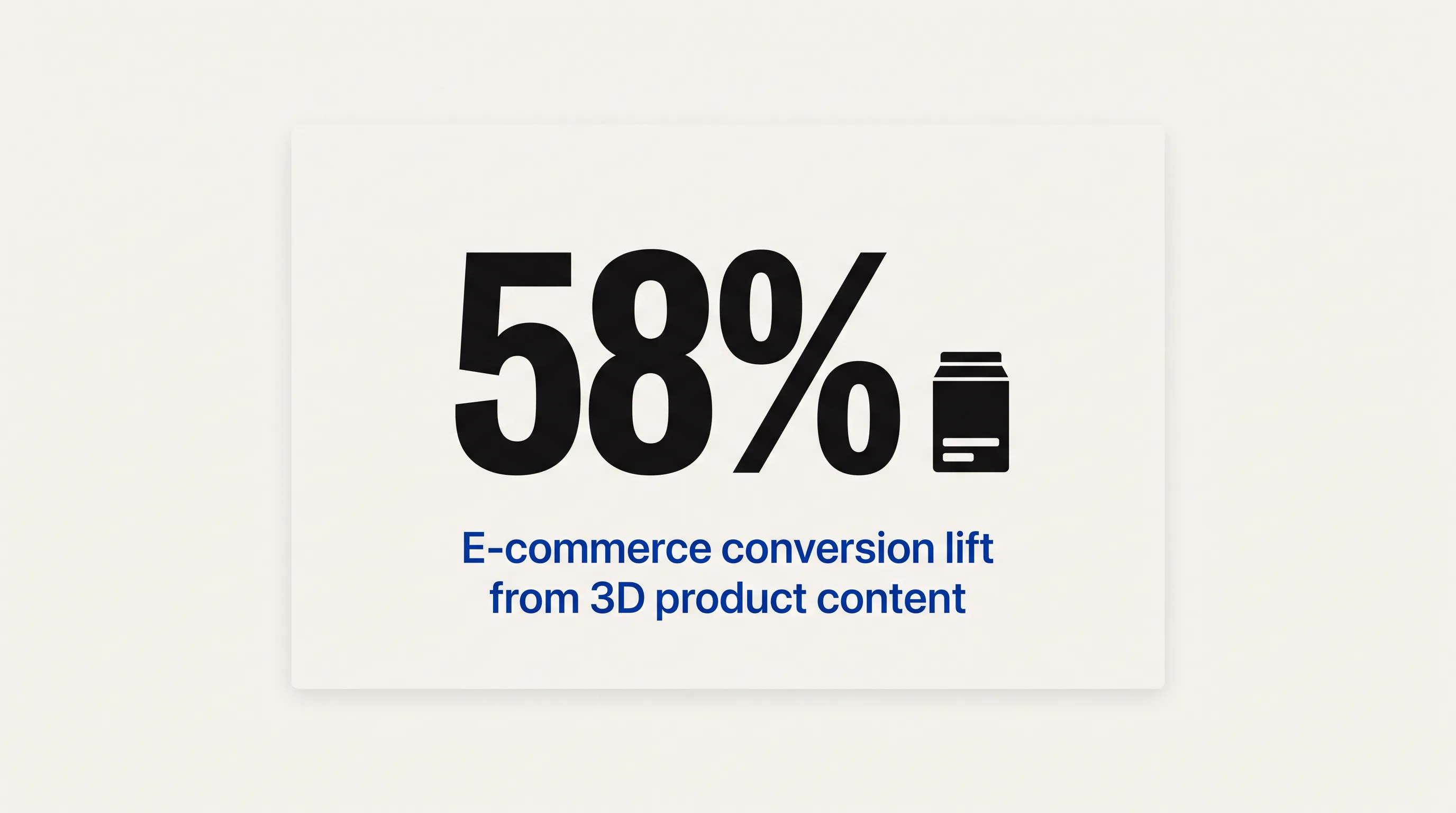
- 3D product content lifts conversion by about 94% and cuts returns by roughly 40% (Cappasity, 2024).
How much does 3D rendering cost per image?
A single 3D render costs $250 to $5,000 per image in 2026, and most small-to-medium projects land at $1,000 to $2,000 apiece, according to Cad Crowd’s 2025 pricing breakdown. High-end photoreal work exceeds $5,000. The per-image number swings mostly with subject type. An interior costs less than an exterior, a simple product costs less than a character, and a marketing hero shot costs more than a concept still.
Price by type is the useful way to budget. The sections below break down the three categories buyers ask about most: architectural, product, and character or game assets. Each has its own floor and ceiling, and each is driven far more by modeling and materials than by the minutes a machine spends rendering.
Architectural exterior and interior rendering cost
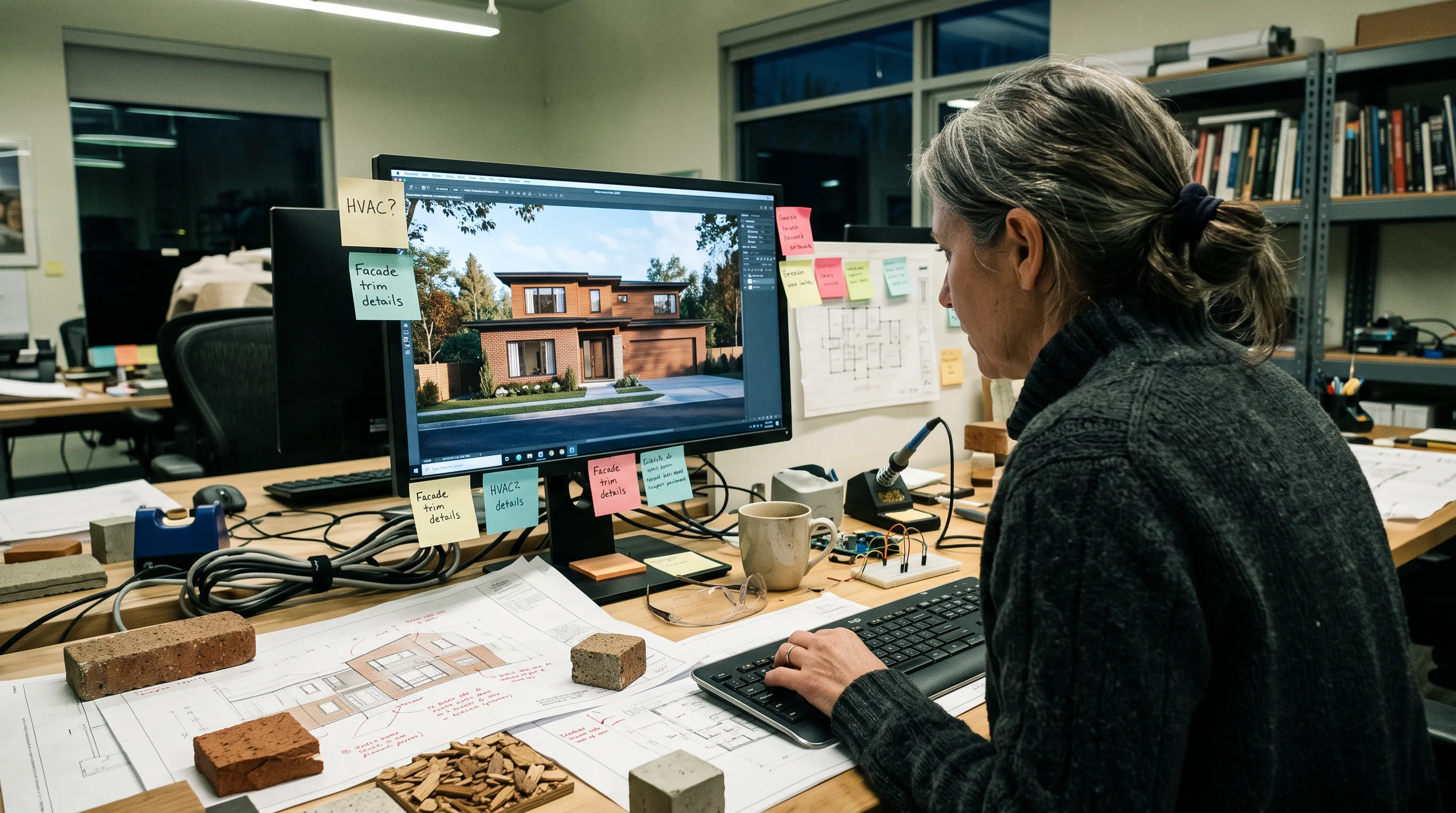
Architectural rendering costs $250 to $2,800 per image for most residential work, with commercial exteriors reaching $10,000 or more. Render3DQuick’s 2026 guide lists interiors starting at $249, exteriors at $499, floor plans at $299 per floor, and aerials at $799. More detailed scenes climb higher.
Complexity sets the ceiling. A single-family home with minimal landscaping sits at the low end, while a dusk commercial exterior with reflections, foliage, and populated context sits near the top. Interiors typically run $600 to $1,800 for standard residential work and $1,500 to $2,500 when the scene includes bespoke cabinetry or intricate lighting. Because every render starts from geometry, the 3D model design work behind the scene often costs more than the final image pass itself.
Product rendering cost
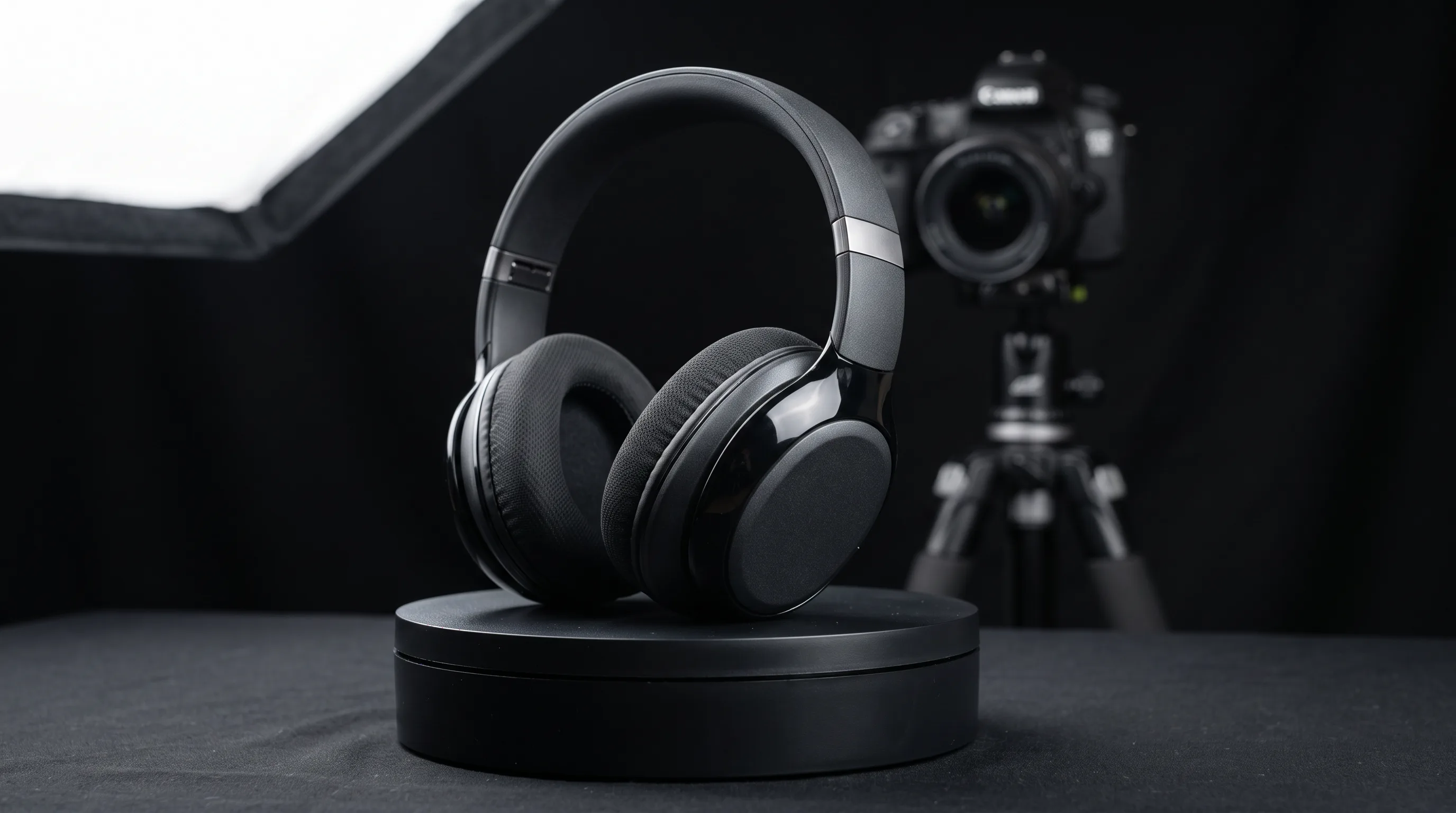
Product rendering is usually the most affordable category, tiered from $50 to $150 for basic items up to $1,200 to $3,000+ for premium, complex products, per Cylind’s 2026 guide. Mid-range work sits at $150 to $500 per image.
Material behavior sets the price. A matte-finish object with simple geometry renders cheaply. A reflective, translucent, or multi-part product needs careful shading, studio lighting, and more revision passes, which pushes a single view toward the high end. Multi-variant marketing packages, where one product ships in ten colorways and three angles, run $1,200 to $3,500 per product family. Manufacturers moving from photography to CGI often start here, and the same assets feed 3D modeling for manufacturing and industrial design pipelines downstream.
Character and game-asset rendering cost
Character and game-asset rendering is priced by modeling effort, not by a flat per-image rate, and production-ready models commonly run $150 to $1,500 each, per Hon Tran’s 2026 configurator cost analysis. Characters sit at the higher end of that band.
The reason is topology. A hero character needs clean edge flow for deformation, a rig, UV layout, texture maps, and often a normal-mapped high-poly source. That labor dwarfs the final render pass. Game assets carry an added constraint: they must hit a polygon budget and run in real time, so optimization work replaces some of the raw art time. Studios pricing this work quote the asset, not the picture, which is why hiring a specialist 3D modeler is the honest unit of cost for character and game content.
What factors affect 3D rendering pricing?
3D rendering pricing is driven by scene complexity, level of detail, output resolution, number of views, revision rounds, and turnaround speed. Two projects at the same resolution can differ 5x in price because one has finalized materials and one does not. Clarity at the brief stage is the single biggest cost control a client holds.
“The number one thing that inflates rendering costs isn’t complexity, it’s an ambiguous project brief,” says Alex Smith, co-owner of Render3DQuick. “When a client sends clear plans with finalized materials, the project almost always stays on budget.” The corollary matters just as much. As MacKenzie Brown, CEO of Cad Crowd, puts it, “rendering is impossible without 3D modeling; the amount of time and labor spent on creating the 3D assets accounts for a sizable portion of the total cost.” Pay for the model once and the render is cheap.
Revisions and speed are the other two dials. RealSpace3D’s 2026 guide notes that standard quotes include two to three revision rounds, extra rounds add $100 to $400 each, and rush timelines carry a 25% to 50% premium. Volume cuts the other way: bulk orders of four or more views typically save 15% to 30% per image. Hourly billing exists too, starting around $30 per hour per Maverick Frame’s 2026 pricing, though most studios prefer fixed per-image quotes so the client carries no meter anxiety.
How much do 3D rendering studios charge vs. freelancers?
Freelancers charge roughly $25 to $150 per hour, or $75 to $900 per image; studios charge roughly $75 to $250 per hour, or $250 to $5,000 per image. The headline gap looks large, but it narrows once revisions, art direction, and consistency across a set are counted. A freelancer is cheaper for one image. A studio usually wins on a series that must match.
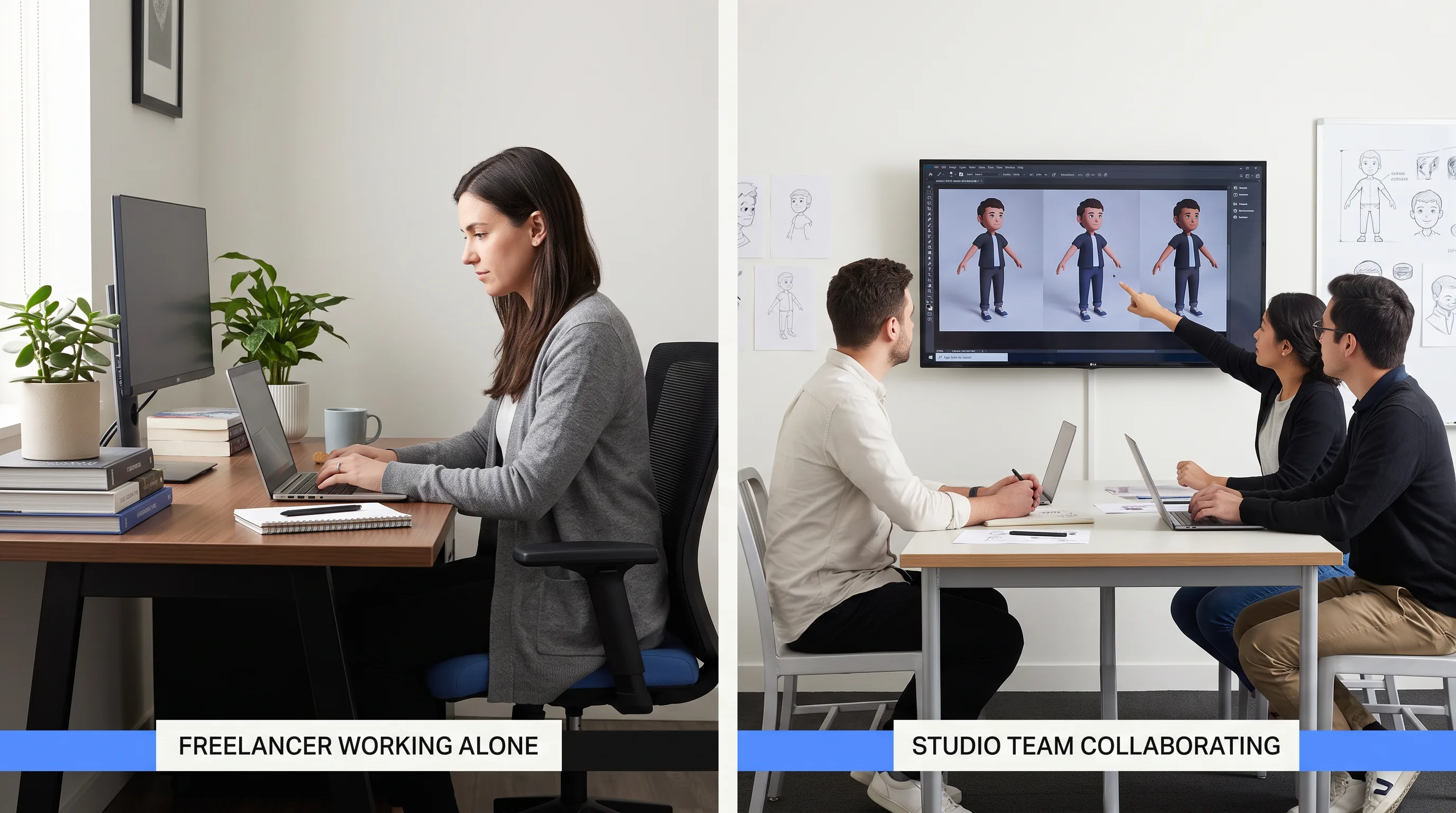
The tradeoff is coordination versus control. Freelancers offer lower rates and direct communication, but timelines and style consistency vary, and you manage the process. Studios cost more per hour and add project management, art direction, and the ability to absorb volume without quality drift. For a single concept still, that overhead is waste. For twenty product variants that must share lighting and tone, it is the thing you are actually buying. Hiring the right 3D modeler or team depends on which of those two situations you are in.
| Rendering Type | Freelancer Range | Studio Range | Typical Turnaround |
|---|---|---|---|
| Architectural Exterior | $300–$1,500 / image | $800–$2,800 / image | 10–14 days |
| Interior Visualization | $250–$1,200 / image | $600–$1,800 / image | 7–10 days |
| Product Rendering | $50–$500 / image | $250–$1,200 / image | 3–7 days |
| Character/Game Asset | $150–$900 / asset | $500–$1,500 / asset | 1–3 weeks |
| Animation (per minute) | $500–$3,000 | $8,000–$25,000 | 3–6 weeks |
| Real-time/Interactive | $2,000–$10,000 | $10,000–$150,000+ | 3–12 weeks |
Verdict: hire a freelancer for one-off, budget-flexible stills; hire a studio for volume, set consistency, and any real-time or interactive build where engineering and support decide whether the project ships.
Need help pricing a 3D or real-time build?
We are here to help!
How much does 3D animation rendering cost per minute?
3D animation costs $500 to $50,000+ per finished minute in 2026, priced in tiers. F Learning Studio’s 2026 guide puts freelancers at $500 to $3,000 per minute, small studios at $3,000 to $7,000, professional companies at $8,000 to $25,000, and cinematic or broadcast work at $25,000 to $50,000+. A still image and a minute of animation are different products, even from the same model.
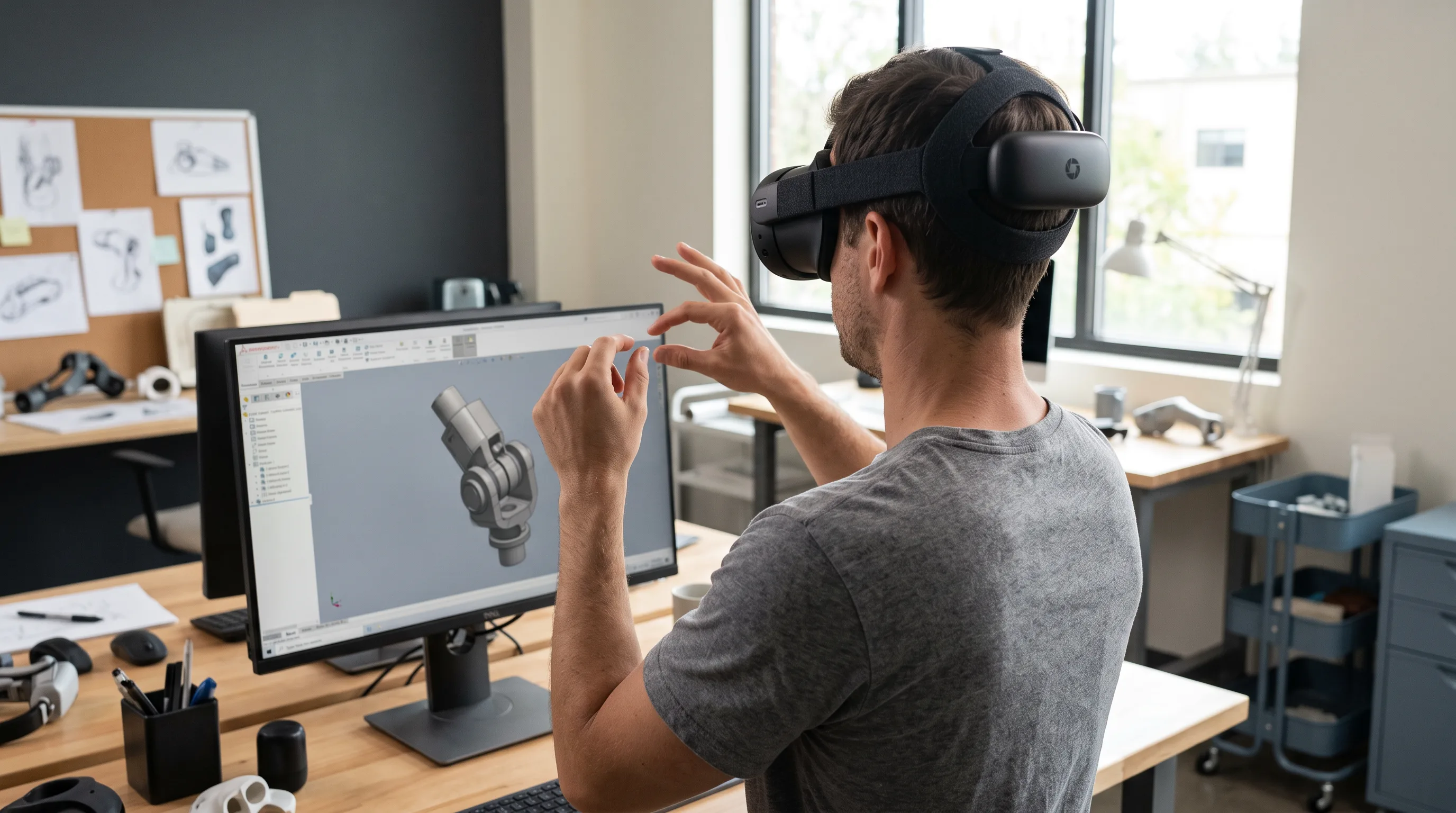
The gap comes from motion. A still resolves one frame. A minute of animation at 30 frames per second resolves 1,800, each needing consistent lighting, correct physics, and clean motion. Add rigging, camera choreography, and post-production, and cost scales with effort per frame rather than raw length. Architectural flythroughs run $4,000 to $12,000 per finished minute per RealSpace3D, sitting below character-driven commercial work.
One 2026 shift is worth pricing in. AI-assisted workflows now generate motion from still renders, trimming the render-farm hours that historically made animation expensive. That lowers the machine cost but not the art-direction cost, so the savings show up most on simple flythroughs and least on nuanced character work. The same real-time engines behind Unity game development increasingly render animation frames live, collapsing overnight render queues into minutes.
How much does real-time and interactive 3D rendering cost?
Real-time and interactive 3D rendering is priced as software engineering, not per image, and ranges from about $4,000 for a single-product viewer to $150,000+ for an enterprise system. This covers WebGL product configurators, AR try-on, and VR experiences that render live as a user rotates, zooms, or changes options. You are buying an application, not a folder of pictures.
Here is where Frame Sixty, an AR/VR and spatial computing development studio, sees the sharpest divergence from traditional rendering budgets. A pre-rendered image is a deliverable. A real-time experience is a product with a performance bar, browser targets, and integration work that a still never carries.
WebGL and product configurator cost tiers
A WebGL product configurator costs $4,000 to $150,000+ depending on scope. Hon Tran’s 2026 analysis tiers it clearly: a single-product custom build at $4,000 to $10,000, a multi-option build with a rules engine and live pricing at $10,000 to $30,000, and an enterprise or CPQ platform at $30,000 to $150,000+. Hosted SaaS tools start near $500 to $2,000 per month.
“The reason quotes swing from $2k to $150k isn’t dishonesty; it’s that ‘configurator’ describes wildly different things,” writes Hon Tran, an Awwwards jury member. A color swapper on one hero product and a catalog-wide system with ERP sync are not the same build. Each configurable option, valid combination, and commerce hook is real integration work. This is the same discipline behind web AR development and browser-based augmented reality on the web, where the model must load fast and run everywhere.
Why real-time rendering is priced differently from pre-rendered images
Real-time rendering is priced differently because the model must run live every frame, not resolve once offline. A pre-rendered image can take an hour per frame at any polygon count. A real-time asset must hold 60 to 90 frames per second on a phone or headset, which forces optimization, retopology, glTF export, and PBR materials tuned to a budget. That engineering is the cost.
In our real-time work at Frame Sixty, the render pass is rarely the expensive part; preparing the asset to survive live playback is. We retopologize dense CAD or scan geometry, bake high-poly detail into normal maps, compress textures, and target the device refresh rate for hardware like Meta Quest 3 and Apple Vision Pro, both of which run at 90Hz. A still render forgives a heavy scene. A VR product demo or digital twin in VR does not, and that constraint, not the pixels, sets the price. Pipelines like NVIDIA Omniverse for XR digital twins exist precisely to stream that optimized geometry to headsets at interactive rates.
Is 3D rendering worth the cost for businesses?
For most product, architecture, and commerce use cases, 3D rendering pays back, and the market data agrees. Adding 3D content to a product page lifts conversion by about 94% and cuts returns by roughly 40%, according to Cappasity’s 2024 research summarized by CGI Backgrounds. The category is growing fast: Mordor Intelligence’s 2026 report values the 3D rendering market at $5.23 billion in 2026, forecast to reach $13.92 billion by 2031 at a 21.63% CAGR.
The ROI differs by use case. In architecture, a $2,000 exterior can win a construction bid worth far more. In e-commerce, the conversion and return numbers above turn rendering into a revenue line, not a cost. In manufacturing, one optimized model serves engineering review, marketing stills, and an AR sales tool. In AR and VR, interactive 3D is the product itself.
The judgment we apply at Frame Sixty is reuse. Commissioning a $1,200 product model for a single web image is expensive; commissioning the same model and running it through stills, a 20-second animation, and a browser configurator spreads that cost across three revenue channels. That is the difference between treating rendering as a photo bill and treating it as an asset you own.
AI tools are reshaping the low end honestly. MyArchitectAI’s 2026 guide notes AI rendering software can produce a scene in about 10 seconds for $20 to $50 per month, and Frame Sixty’s own review of Meshy AI covers where generated 3D is usable. AI is genuinely cheaper for commodity concept stills. It does not yet replace studio-grade photoreal hero shots or, more importantly, the engineered real-time experiences that carry a performance bar. As the commodity floor drops, the value of interactive and spatial work rises.
Conclusion
3D rendering in 2026 costs $250 to $5,000 for a still image, $500 to $50,000+ per minute for animation, and $4,000 to $150,000+ for a real-time interactive build. The wide ranges are not vagueness. They reflect a real split between buying a picture and buying a product. Scene complexity, materials, revisions, and turnaround move the number, but the biggest lever is the one most buyers ignore: how many times a single 3D model gets reused.
That is the position worth defending. Optimizing the per-image price is a false economy when the same asset can feed stills, animation, and an interactive viewer at once. Real-time interactive 3D, not a bigger pile of one-off renders, is where rendering spend compounds for most businesses. Price the model, then spread it.
If you are weighing a product configurator, a VR experience, or a spatial computing build and want a straight answer on cost, get in touch with our team at Frame Sixty. For buildings specifically, our architectural visualization page covers renderings, flythroughs, VR design review, and AR for construction from one model. We will tell you where a freelancer still shot is the right call and where an engineered real-time asset earns its keep.
FAQs
Common questions about 3D rendering costs in 2026, covering per-image pricing, freelancer and studio rates, product configurators, and delivery timelines.
3D rendering ranges from affordable to expensive, spanning about $50 for a basic product shot to $5,000+ for a photoreal hero image in 2026. Cost tracks scene complexity, materials, and revisions far more than raw render time. Simple stills stay cheap, while engineered real-time experiences reach $150,000+.
People charge $250 to $5,000 per still image for 3D rendering in 2026, with most small-to-medium projects landing at $1,000 to $2,000 apiece. Freelancers bill roughly $25 to $150 per hour or $75 to $900 per image, while studios charge $75 to $250 per hour or $250 to $5,000 per image for higher-volume, consistent sets.
Architectural rendering costs $250 to $2,800 per image for most residential work in 2026, with commercial exteriors reaching $10,000 or more. Published starting prices include interiors at $249, exteriors at $499, floor plans at $299 per floor, and aerials at $799. Dusk scenes with reflections, foliage, and populated context sit at the top of the range.
3D product rendering costs $50 to $150 for basic items and $1,200 to $3,000+ for premium, complex products in 2026, with mid-range work at $150 to $500 per image. Material behavior sets the price: matte objects render cheaply, while reflective or translucent products need careful shading and more revision passes. Multi-variant packages run $1,200 to $3,500 per product family.
A 3D product configurator costs $4,000 to $150,000+ in 2026, priced as software engineering rather than per image. A single-product custom build runs $4,000 to $10,000, a multi-option build with a rules engine $10,000 to $30,000, and an enterprise CPQ platform $30,000 to $150,000+. Frame Sixty builds these as WebGL applications with defined browser and headset performance targets.
A 3D render takes 3 to 21 days to deliver in 2026, depending on type. Product renders turn around in 3 to 7 days, interiors in 7 to 10, exteriors in 10 to 14, and commercial scenes in 14 to 21. Animation runs 3 to 6 weeks, and rush timelines add a 25% to 50% premium on standard turnaround.