
3D Character Modeling Services: Pipeline, Pricing, and How to Choose a Studio
Nov 2, 2026
14 MIN READ
3D character modeling services are outsourced production engagements that turn a concept into a rigged, textured, game-ready character asset. Game studios, VR and AR developers, and metaverse platforms buy them to get characters that run in real time inside Unity or Unreal Engine 5. Pricing runs from roughly $1,500 for a simple stylized character to $25,000 or more for an AAA hero, with turnaround of two to eight weeks per character.
The biggest risk in 3D character outsourcing is not the hourly rate. It is an underspecified brief. A character quoted cheap and delivered without a polygon budget, a rig standard, or an engine target costs more to fix than a studio character that passes review on the first pass.
Key Takeaways
- 3D character modeling services deliver a rigged, PBR-textured mesh built to a set polygon budget, not a static render or concept sketch.
- A stylized character costs $1,500–$5,000 and a realistic hero $5,000–$12,000+, with AAA cinematic work above $25,000 (Kevuru Games, 2026).
- Production runs 10–20 working days for a stylized character and 25–48 for a realistic one; review delays drive most overruns (Sunstrike Studios, 2026).
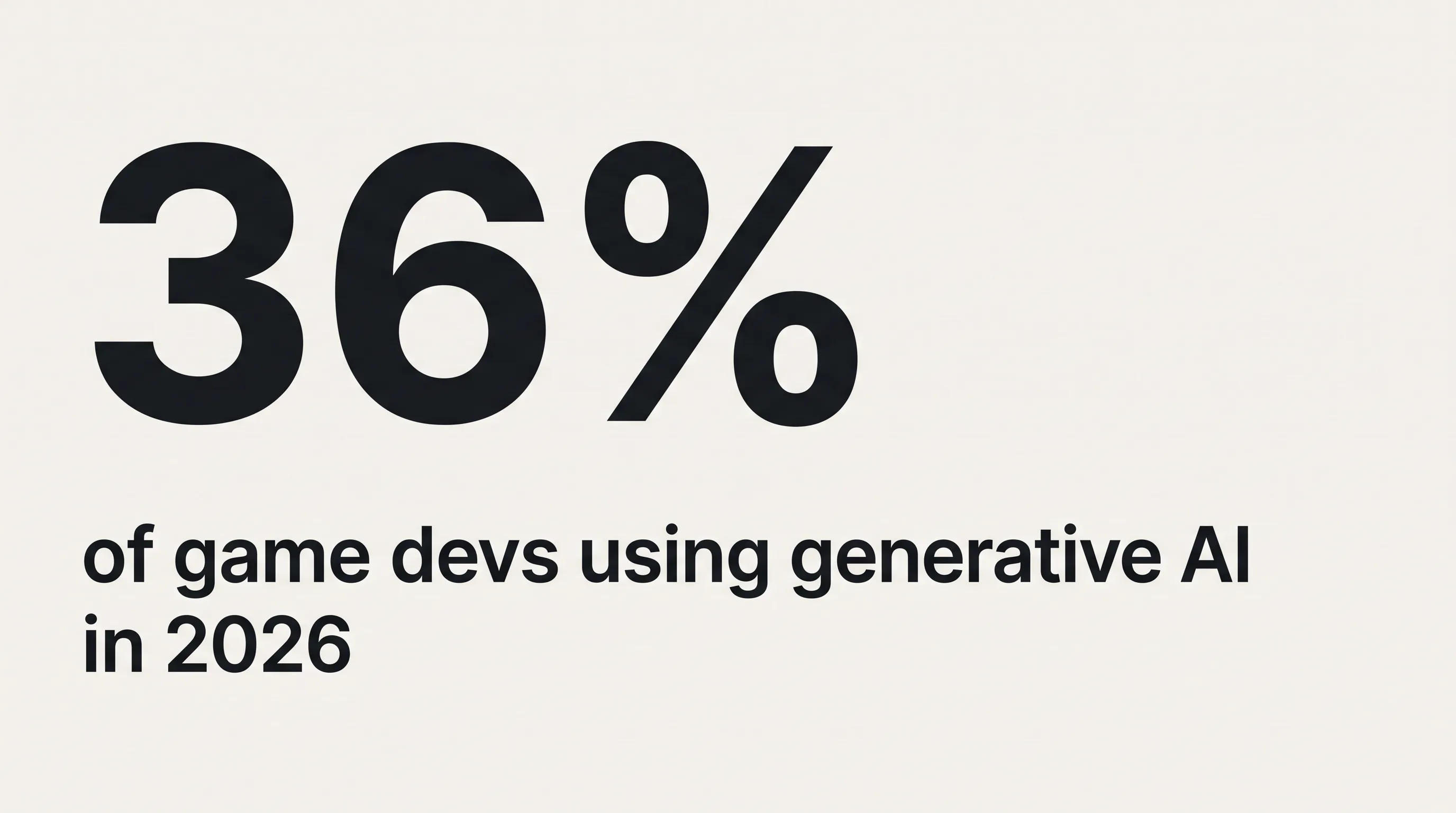
- Generative AI did not cut character costs in 2026: 36% of developers use it, 81% only for research and brainstorming (GDC, 2026).
- Meta Quest 3 characters hold 20,000–40,000 triangles at LOD0; PC cinematic heroes reach 150,000+ (Game-Ace, 2026).
What Are 3D Character Modeling Services?
3D character modeling services are production engagements that build a complete, animatable character asset from a brief or concept art. The deliverable is not a picture. It is a mesh with clean topology, a controlled polygon budget, proper UVs, PBR textures, level-of-detail variants, and a skeleton that imports cleanly into a real-time engine. Dmytro Lunov, Head of Delivery and Program Director at Game-Ace, describes it as “building a game-ready three-dimensional character mesh, from blockout and sculpt to retopology, UV mapping, texturing, and rigging-ready handover.”
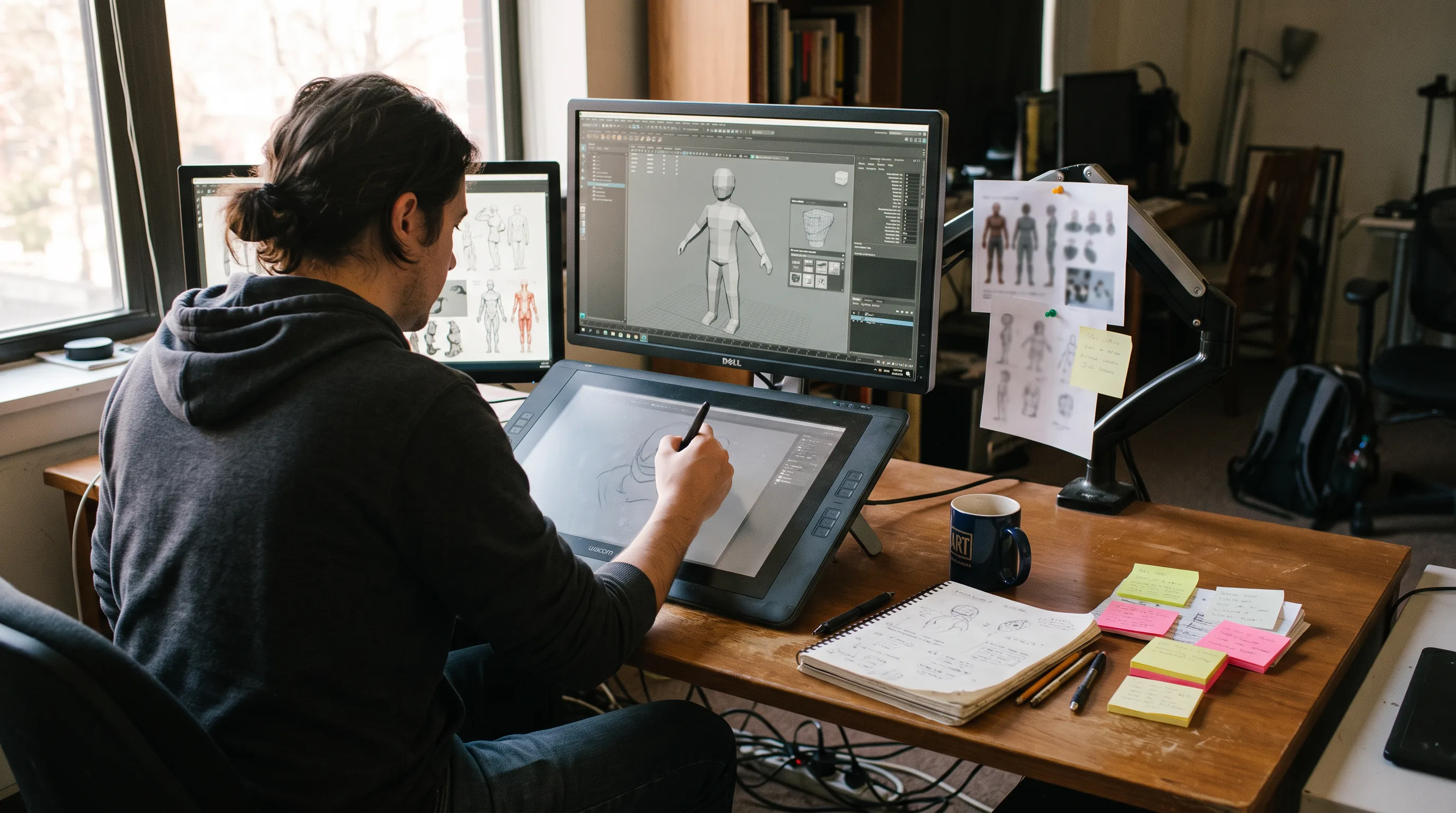
Three groups buy this work. Game studios need hero characters and large non-player-character rosters. VR and AR developers need characters tuned for Meta Quest 3 or Apple Vision Pro. Metaverse and avatar platforms need rigged, interoperable character libraries at scale.
Most buyers start on a freelancer marketplace like Upwork or Fiverr. That path works for one simple asset, but it carries no guaranteed pipeline standard, no team backup, and unclear ownership of the final files. A studio that offers 3D modeling artist services exists to remove those gaps. The takeaway: a character modeling service sells a finished, engine-ready asset, not hours at a desk.
How Does the 3D Character Modeling Pipeline Work?
The 3D character modeling pipeline runs through eight stages: concept brief, blockout, high-poly sculpt, retopology, UV mapping, PBR baking and texturing, rigging and skinning, and engine delivery. A stylized hero moves through this in two to four weeks. A realistic hero with full sculpt, retopology, and rig-ready topology takes four to eight weeks, according to Game-Ace’s 2026 production data.
One thing the stage list hides: the pipeline is a sequence of locks, and the earliest lock matters most. The brief locks the polygon budget and the engine. The concept locks the design. The sculpt locks the forms. A change requested after the sculpt is approved does not cost an email. It costs days of rebuilt work. The strongest predictor of an on-time, on-budget character is a technical spec signed off before any sculpting begins, well ahead of portfolio quality or quoted rate.
From Concept Brief to High-Poly Sculpt
The first three stages set everything that follows. A complete brief names the target engine, the polygon budget, the texture resolution, the level-of-detail count, the rig type, and a clear style reference. Blockout then locks the silhouette and proportions as rough geometry. The high-poly sculpt, built in ZBrush, adds anatomy, clothing folds, and surface detail; Blender and Maya handle hard-surface characters and base meshes.
The common failure here is approving a single front-facing illustration instead of a full front, side, and back turnaround. A turnaround removes guesswork from the sculpt. One flat image invites a redesign halfway through, and a redesign after sculpting is the most expensive edit in the whole process. Lock the concept as a turnaround before the sculptor opens ZBrush.
What Happens During Retopology, UV Mapping, and PBR Baking?
Retopology, UV mapping, and PBR baking convert an un-animatable sculpt into a production mesh. Retopology rebuilds the dense high-poly sculpt as a clean low-poly cage, with edge loops running along joints and facial muscles so the character deforms correctly when animated. UV unwrapping then lays the mesh flat in texture space with consistent texel density, so detail looks even across the body.
PBR texturing follows in Substance Painter. Artists bake and paint the maps that a real-time engine reads: base color (albedo), normal, roughness, metalness, and ambient occlusion. Those maps are what let a character hold up under the harsh, movable lighting of a VR headset. Marvelous Designer handles simulated cloth where an outfit needs it. Mobile and web characters usually ship 2K texture sets; console and PC heroes ship 4K. Done right, this stage is invisible, and the character simply looks correct in engine.
Rigging, Skinning, and Engine-Ready Delivery
Rigging and skinning make the character move, and delivery proves it runs. Rigging adds the skeleton; skinning assigns the vertex weights that bind the mesh to that skeleton. A facial rig with blend shapes and lip sync adds real cost, so include it only when the character actually needs to speak or emote on camera. Everything then ships through a delivery checklist: FBX or glTF export, a level-of-detail set from LOD0 down, materials wired in Unity or Unreal, pivot aligned, and scale validated against the engine.
Timelines are predictable once the brief is locked. A stylized 3D character runs 10–20 working days and a realistic PBR character 25–48 working days, per Sunstrike Studios in 2026. Their production team is blunt about what blows schedules: “The biggest variable is not the artist, it is the review loop.” A sign-off that waits five working days adds five days to the calendar.
How Much Do 3D Character Modeling Services Cost?
3D character modeling costs scale with realism and complexity. A stylized character runs $1,500–$5,000, a semi-realistic one $3,000–$8,000, a realistic hero $5,000–$12,000+, and an AAA cinematic hero $10,000–$25,000 or more, based on Kevuru Games’ 2026 pricing. The base model is only part of the invoice. Common add-ons sit on top of it.
| Character tier | Typical price | Production notes |
|---|---|---|
| Stylized | $1,500–$5,000 | Mid-core games, mobile, web |
| Semi-realistic | $3,000–$8,000 | Console and PC, moderate detail |
| Realistic hero | $5,000–$12,000+ | Full sculpt, PBR, rig-ready |
| AAA / cinematic | $10,000–$25,000+ | Hero detail, facial rig, LODs |
| Rigging (add-on) | $500–$2,500 | Skeleton plus skin weights |
| Basic animation set | $500–$1,500 | Idle, walk, run, a few actions |
| Rush delivery | +25–50% | Premium on a compressed timeline |
A worked example shows how the pieces add up. A $3,000 stylized hero plus rigging and a basic animation set totals $3,500–$4,500 before you add LODs, custom animation, or engine integration, per ArtLand3D’s 2026 breakdown. Hourly context helps too: studios charge $50–$200+ per hour, with North American and Western European studios at $80–$150 and Eastern European studios at $40–$70, according to RocketBrush’s 2025 pricing guide.
What Six Factors Drive the Final Price Up?
Six factors move a character’s price, and most buyers underestimate the last two. A+Plus Games Studio laid them out in 2026:
- Art style. Realistic costs more than stylized, because surface detail and anatomy take longer.
- Character importance. A background NPC is cheap; a hero carries the camera and the budget.
- Target platform. PC and console allow generous polygon budgets; mobile and VR force tighter optimization.
- Outfit customization. A fixed costume is one model; swappable parts multiply the work.
- Animation count. This is the sleeper. A character with fifty animations “can cost more in animation than in modelling.”
- Facial rig complexity. No face rig is free; a full rig with blend shapes and lip sync is a line item of its own.
You can bring the number down without cutting quality. Modular body parts, a shared skeleton rig across characters, and animation retargeting through the Unity humanoid rig or Unreal IK Retargeter all reuse work instead of rebuilding it. Volume helps as well: NPC rosters drop to $800–$2,500 per character with batch pricing (Game-Ace, 2026). The lever that matters most is reuse, not the hourly rate.
Does AI Lower the Cost of 3D Character Modeling?
No. Generative AI did not cut character modeling costs in 2026, and buyers who budget as if it did will be surprised. The GDC 2026 State of the Game Industry survey of more than 2,300 professionals found that 36% use generative AI tools, but 81% use them for research and brainstorming rather than finished assets.
Here is the part the headline numbers miss. AI compresses the cheap front end of the pipeline, concepting and early blockout, and leaves the expensive back end alone. Retopology, PBR baking, rigging, and engine integration still take the same expert hours they always did. So the stages where AI helps are the ones that were never the bottleneck, and the stages that drive your invoice are untouched. Sentiment reflects the friction: 52% of professionals say generative AI has a negative impact on the industry, up from 30% a year earlier, with visual and technical artists the most skeptical at 64% (GDC, 2026). Treat AI as a speed-up on concepting, not a discount on the character.
Need help with 3D character modeling?
We are here to help!
What Polygon Budgets and Texture Specs Does Each Platform Need?
Every target platform sets its own polygon and texture ceiling, and a character has to be built to the tightest one it will ship on. A mobile or Meta Quest 3 character lives in a far smaller triangle budget than a PC cinematic hero. The table below collects the 2026 LOD0 targets from Game-Ace and Sunstrike Studios.
| Platform | LOD0 polygon budget | Texture resolution |
|---|---|---|
| Casual mobile | 3,000–15,000 triangles | 1K–2K per set |
| Meta Quest 3 / 3S | 20,000–40,000 triangles | 2K per set |
| Apple Vision Pro | 40,000–80,000 triangles | 2K–4K per set |
| Console / PC mid-tier | 40,000–80,000 triangles | 4K per set |
| Current-gen cinematic | 150,000+ triangles | 4K+ per set |
The expensive mistake is building for the richest platform and retrofitting downward. A 150,000-triangle hero authored for PC will drop frames on a Meta Quest 3, which draws every frame at 72–120 Hz on a mobile-class GPU. Re-topologizing that character for the headset after the fact is a second production pass, not a tweak. Build to the tightest target first, then add detail for richer platforms through higher LODs. File format follows platform too: FBX for Unity and Unreal Engine 5, glTF and USDZ for web AR and Apple Vision Pro.
In our work at Frame Sixty, an AR/VR and spatial computing development studio, we set the polygon and texture budget to the target device before anyone opens a sculpting tool. When a character is bound for Meta Quest 3, we author the low-poly cage to the headset’s triangle ceiling and bake detail into normal maps rather than geometry, because geometry is what costs frames on a standalone headset. That ordering is why platform specs belong in the brief, not the post-mortem.
Studio vs. Freelancer Marketplace: Which Should You Choose?
A freelancer marketplace fits a single, well-specified character on a flexible deadline; a studio fits scaled, multi-platform, or deadline-critical production. The decision is less about price per hour and more about risk and consistency across the whole job. Both options are legitimate. They fail in different ways.
A marketplace freelancer is the right call when the job is one character, the brief is already written in full, the deadline is soft, and the budget is tight. Upwork and Fiverr give you access to artists at $15–$30 per hour for straightforward assets, and boutiques like VSQUAD and RetroStyle Games show the quality a focused small team can hit.
The risks show up at scale. A roster built by rotating freelancers drifts in topology, UV layout, and rigging standard. One artist going quiet mid-project stops the whole deliverable, because there is no backup. And marketplace default contracts often leave work-for-hire ownership ambiguous, which becomes a problem the day you want to resell or re-skin the character.
A studio answers those risks with process. It writes the technical spec before production, keeps multiple specialists on call so no single person is a single point of failure, holds one topology and naming standard across a roster, and runs the character through an engine performance pass before delivery. That is the real cost argument: the true price of a character includes the rework pass it triggers when it fails engine review. A $1,500 asset that misses the polygon budget and bounces back costs more in lost weeks than a $4,000 asset that passes the first time. Frame Sixty’s 3D artists for hire model runs on that logic, with managed teams rather than solo placements and an 85%+ first-pass approval rate.
Verdict: choose a freelancer for a one-off character with a locked brief and a soft deadline; choose a studio when you need a consistent roster, a VR or AR performance guarantee, or clear ownership of every file.
Where Are 3D Character Modeling Services Used?
3D character modeling services serve three markets: game production, VR and AR applications, and metaverse or avatar platforms. Demand on the avatar side is growing fastest. The 3D Avatar Creator market reached $4.3 billion in 2026 and is projected to hit $8.08 billion by 2030 at a 17.1% compound annual growth rate, according to The Business Research Company’s 2026 report. Each market buys the same pipeline for different ends.
Game Character Production: Heroes, NPCs, and Scalable Rosters
Game studios buy two kinds of character work: a few hero characters and a large supporting cast. A hero runs four to eight weeks and $5,000–$25,000+ depending on realism, while NPC rosters drop to $800–$2,500 each under volume pricing. A shared skeleton rig and a modular outfit system cut the per-character cost sharply across a big cast, because animation and accessories get reused instead of rebuilt.
Delivery targets the engine’s animation system directly: a Unity humanoid avatar rig or an Unreal Mannequin-compatible skeleton, so motion retargets cleanly between characters. Studios that handle full builds fold character production into a wider engagement; Frame Sixty’s Unity 3D game development services and its guide to game development in Unity show where characters sit inside a complete game pipeline.
VR and AR Characters: Optimization for Headset Platforms
VR and AR characters live or die on performance, so they are modeled to a device budget rather than a visual ideal. A Meta Quest 3 character has to hold frame rate on a standalone mobile GPU, and an Apple Vision Pro character has to render with the low latency that spatial comfort demands. A character authored without those targets fails its on-device review and needs a rework pass that a correct brief would have avoided.
At Frame Sixty, we run every headset-bound character through an engine performance pass on the target device before we call it done, because a model that looks right in a viewport can still miss frame budget once it is animating in a scene. For AR, product and brand characters embedded in web AR experiences through 8th Wall and WebXR, or in mobile apps built on ARKit and ARCore, usually need to sit under 15,000–40,000 triangles with web-optimized glTF export. Our virtual reality development and augmented reality app work ties the character directly to the experience it ships in, and our guide to how to develop a VR game covers the frame-budget math in depth.
Metaverse and Avatar Platforms: Scalable Character Libraries
Metaverse and social VR platforms need rigged, interoperable character libraries, not one-off hero assets. The requirement is consistency at volume: a glTF or USDZ export with a single shared skeleton rig so an avatar works across OpenXR, Apple Vision Pro visionOS, and Meta Horizon without a rebuild. A platform serving hundreds of variants leans on a shared base mesh plus modular accessories, which keeps quality even and cost flat as the library grows.
That same modular, real-time approach powers interactive product tools as well. Frame Sixty’s 3D configurator services deliver characters and products a user can customize live in the browser, which is the avatar-library pattern applied to commerce. The common thread across all three markets: the pipeline is identical, and the spec is what changes.
Conclusion
3D character modeling services turn a concept into a rigged, textured, engine-ready asset, and the market for that work is real and growing, with the 3D Avatar Creator segment alone on track for $8.08 billion by 2030 (The Business Research Company, 2026). Pricing is knowable, from $1,500 for a stylized character to $25,000+ for an AAA hero, and so are timelines, from two to eight weeks per character. Generative AI changed the front of the pipeline and left the expensive finishing work exactly where it was.
The position worth holding onto is the one we opened with: the risk in character outsourcing is the underspecified brief, not the hourly rate. Lock the engine, the polygon budget, the texture resolution, the LOD count, and the rig type before any sculpting starts, and most cost and schedule surprises disappear. A character that passes engine review on the first pass is cheaper than a cheaper one that does not.
That is also the honest case for a studio over a freelancer marketplace when the job is scaled, multi-platform, or deadline-critical: spec-first process, team redundancy, and clear file ownership. If you are planning characters for a game, a VR or AR app, or an avatar platform and want them built right the first time, get in touch with our team at Frame Sixty.
FAQs
Common questions about 3D character modeling services, covering deliverables, production pipeline, platform specs, and how to choose a studio. Each answer stands on its own.
A game-ready 3D character delivery includes a rigged, PBR-textured low-poly mesh with clean topology, UV maps, and a level-of-detail set from LOD0 down. The asset exports in FBX or glTF, with materials wired in Unity or Unreal Engine 5, the pivot aligned, and scale validated against the target engine. A facial rig with blend shapes is an optional add-on.
Rigging and skinning are two distinct steps in making a 3D character move. Rigging adds the skeleton; skinning assigns the vertex weights that bind the mesh to that skeleton so it deforms correctly when animated. Rigging is typically a $500–$2,500 add-on on top of the base model price. A character cannot be animated until both steps are complete.
You review a 3D character at each production lock: concept turnaround, blockout silhouette, high-poly sculpt, retopology, textures, and final engine delivery. Approve a full front, side, and back turnaround before sculpting starts, because a redesign requested after the sculpt is approved is the most expensive edit in the pipeline. A sign-off that waits five working days adds five days to the schedule.
Retopology is the stage that rebuilds a dense high-poly sculpt as a clean low-poly cage a game engine can animate. Edge loops are routed along joints and facial muscles so the character deforms correctly during movement. It matters because a raw sculpt cannot hit a platform's polygon budget, such as the 20,000–40,000 triangles a Meta Quest 3 character must stay under.
PBR texturing is the process of baking and painting the maps a real-time engine reads: base color (albedo), normal, roughness, metalness, and ambient occlusion. Real-time engines require it because those maps let a character hold up under the harsh, movable lighting of a VR headset or game scene. Mobile and web characters usually ship 2K texture sets; console and PC heroes ship 4K.
Professional 3D character studios use ZBrush for high-poly sculpting, Blender and Maya for hard-surface modeling and base meshes, Substance Painter for PBR texturing, and Marvelous Designer for simulated cloth. Characters are then delivered into Unity or Unreal Engine 5. Animation retargeting runs through the Unity humanoid rig or the Unreal IK Retargeter so motion transfers cleanly between characters.
Yes, a single 3D character asset can ship to both Unity and Unreal Engine 5 when it is exported in FBX with a standard skeleton. The mesh, UVs, and PBR maps are engine-agnostic; only the material setup and skeleton mapping differ. Delivering to a Unity humanoid avatar rig or an Unreal Mannequin-compatible skeleton lets animation retarget between both engines without a rebuild.
Studios handle 3D character IP ownership through a formal work-for-hire agreement that transfers full rights to the client on final payment. This matters because marketplace default contracts often leave ownership ambiguous, which becomes a problem the day you want to resell or re-skin the character. A clear agreement covers source files, textures, and the rig, not just the final export.
When choosing a 3D character modeling partner, look for a locked technical spec before production, a documented pipeline, team redundancy so no single artist is a point of failure, transparent pricing bands, and an on-device performance pass for VR and AR work. Frame Sixty, an AR/VR and spatial computing development studio, runs managed teams with an 85%+ first-pass approval rate.