
Unity 3D Game Development Services: What's Included, Pricing, and How to Choose a Studio
Oct 20, 2026
12 MIN READ
Unity 3D game development services are the end-to-end work a studio does to design, build, and ship a 3D game or interactive experience in the Unity engine: prototyping, 3D art and engine integration, multiplatform builds, performance optimization, quality assurance, and post-launch support. This guide explains what those services include, what they cost, and how to evaluate a studio before you sign.
Frame Sixty, an AR/VR and spatial computing development studio, wrote this guide for the buyer’s side of that decision: the founder, product lead, or marketing team weighing an outside studio against an in-house build. One position shapes everything below. The biggest cost risk in a Unity project is rarely the hourly rate. It is unlocked scope and the wrong engagement model. If you want the engineering view on building in Unity yourself instead of hiring it out, see our guide to game development in Unity.
Key Takeaways
- Unity 3D game development services span six phases: prototyping, 3D art, multiplatform builds, optimization, QA, and live operations.
- A 3D Unity game typically costs $250,000 to $1.5 million; VR and AR titles run $150,000 to $900,000 (Innovecs Games, 2026).
- Unity 6 ships to more than 20 platforms from one codebase, including Meta Quest 3, Apple visionOS, and Android XR.
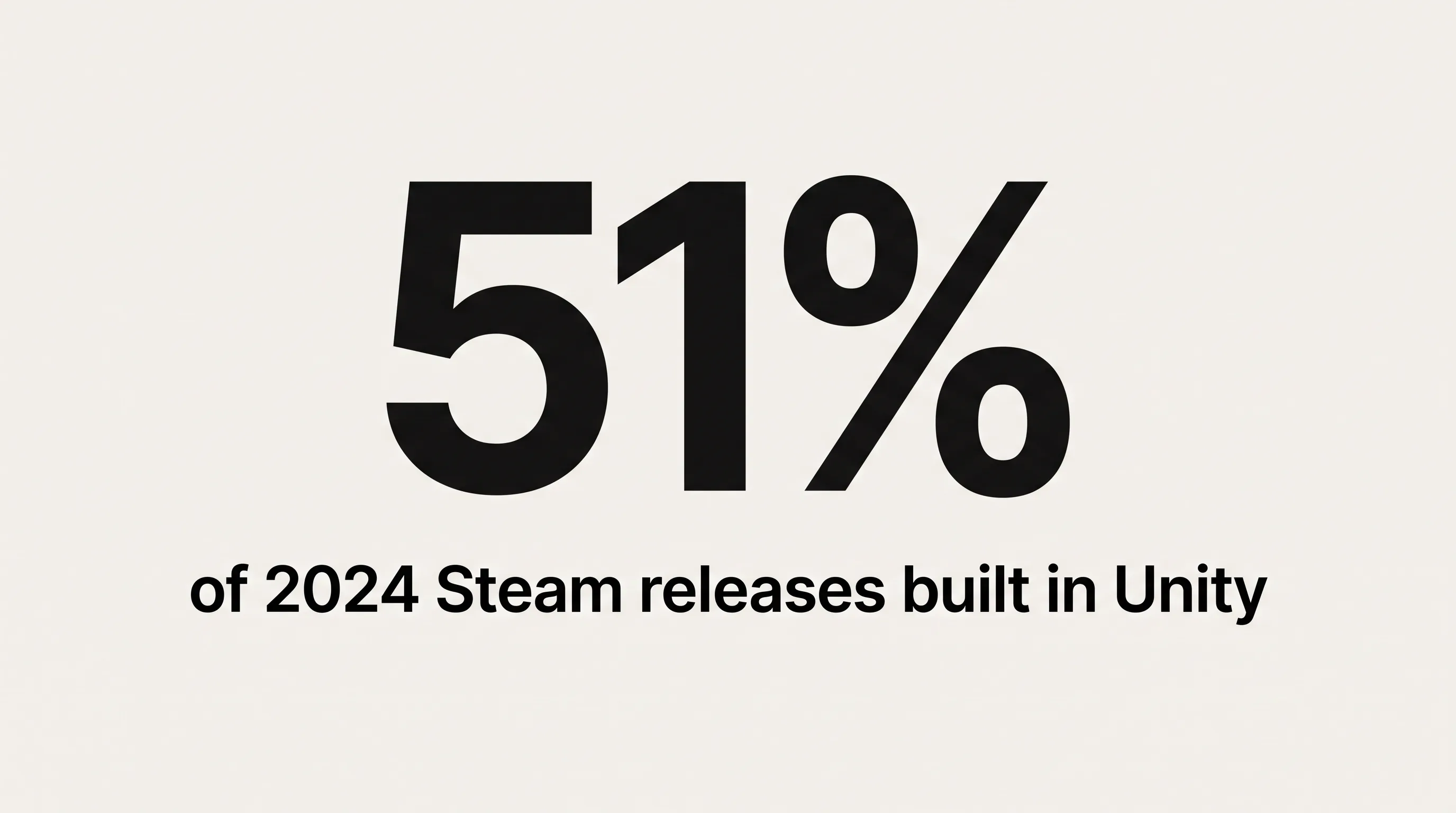
- Unity powered 51% of 2024 Steam releases and more than 60% of VR experiences (VoxBooster, 2026; Unity, 2025).
- The engagement model, not the hourly rate, drives total project cost. Choose it to match scope stability.
What Do Unity 3D Game Development Services Include?
Unity 3D game development services cover six phases of work: pre-production and prototyping, 3D art and engine integration, multiplatform builds across PC, mobile, console, and XR, performance optimization, quality assurance, and post-launch live operations. A full-cycle studio handles all six. A co-development partner handles only the phases an in-house team cannot staff.

The scope is wide because a shipped 3D game is many disciplines running in parallel. Engineers, 3D artists, animators, and QA testers work inside the same sprint. Demand for that work is large: VoxBooster’s 2026 game development statistics put the game development services market at $2.07 billion in 2026 and credit Unity with 51% of all 2024 Steam releases. The sections below break each phase into what a buyer actually pays for and reviews.
Pre-Production and Prototyping
Pre-production and prototyping is the phase where a Unity studio turns a concept into a validated plan: a game design document, a playable core-loop prototype built with placeholder art, an asset pipeline, and a milestone schedule. Change is cheap here. That makes pre-production the one phase worth over-investing in.
The prototype exists to test whether the core loop is fun before art and content lock the design in place. According to Unity’s 2026 Game Development Report, 67% of developers keep prototyping to three months or less, a signal that disciplined teams validate fast rather than polishing early. A good studio ends pre-production with something you can hold in your hands: a build, a schedule, and a fixed scope you both signed. If a studio wants to skip straight to production, treat that as a warning.
3D Art, Engine Integration, and Multiplatform Builds
Production is where 3D art and engine integration meet platform builds. A Unity studio models and integrates 3D assets, selects a render pipeline (the Universal Render Pipeline for broad reach, the High Definition Render Pipeline for high-fidelity PC and console), rigs animation, builds camera logic with Cinemachine, and writes the C# gameplay systems. Then it compiles that one project for every target platform.
Unity 6 reaches PC, mobile, console, and XR from a single codebase. Unity’s GDC 2025 announcement confirmed that Unity 6.1, released in April 2025, added Android XR and Meta Quest build profiles plus WebGPU support, extending the engine past 20 platform targets.
That single-codebase reach is itself a cost lever buyers underuse. The marginal cost of adding a second platform in Unity is optimization and QA passes, not a second build from scratch. A studio that architects input and UI for portability early can add a mobile release to a PC title for a fraction of the first platform’s cost. For projects that touch immersive hardware, Frame Sixty’s VR development services and augmented reality development sit on the same Unity foundation as flat-screen work.
Performance Optimization, QA, and Live Operations
Performance optimization, QA, and live operations are the phases that decide whether a Unity game holds up after launch. Optimization tunes frame rate, draw calls, polygon budgets, and memory for each target device. QA runs alpha, beta, and soft-launch testing. Live operations keeps the game running: updates, analytics, A/B tests, and seasonal events.
Multiplayer makes all three harder and more expensive. Unity’s 2026 Game Development Report found that 83% of studios now support online multiplayer and 72% prioritize cross-play, which adds netcode, backend services, and server costs to the QA and live-ops bill. Unity Learn’s real-time production cycle defines operations plainly as “work done after a product has been released to keep it running,” and that work is an ongoing line item, not a one-time cost. Budget for live ops before you sign, not after launch.
In our Unity XR work at Frame Sixty, performance is not a final polish step. It sets the budget before the first art asset lands. A Meta Quest 3 title targeting 90 frames per second gives you roughly 11 milliseconds per frame for everything the device must draw, so polygon counts, draw calls, and shader complexity are capped in pre-production, not negotiated at the end. On Apple Vision Pro, foveated rendering changes where detail belongs. We profile on the actual headset early and often, because a scene that runs on a PC editor can still miss frame budget on a standalone device.
How Much Does Unity 3D Game Development Cost?
Unity 3D game development typically costs between $30,000 and $3 million or more, set by game type, platform count, and where the team sits. A casual mobile game lands at the low end. A multiplayer live-service title lands at the high end. The table below, drawn from Innovecs Games’ 2026 Unity cost guide and corroborated by Juego Studio’s Unity cost breakdown, maps the common ranges.
| Game type | Cost range | Team size | Timeline |
|---|---|---|---|
| Hyper-casual / casual mobile | $30K–$120K | 2–5 | 2–4 months |
| 2D indie / puzzle | $60K–$250K | 3–7 | 4–9 months |
| 3D action / adventure | $250K–$1.5M | 8–25 | 9–18 months |
| VR / AR | $150K–$900K | 5–15 | 6–14 months |
| Multiplayer / live-service | $500K–$3M+ | 15–40 | 12–24 months+ |
Engine licensing is a rounding error against these figures. Unity Pro runs $2,310 per seat per year as of January 2026, and the Personal tier is free below $200,000 in revenue. Production labor is what you are buying.
What Drives the Price Up
Five factors move a Unity budget more than anything else: art complexity, platform count, multiplayer depth, live-ops scope, and team location. Art is usually the largest single line. Innovecs Games reported in 2026 that art production consumes 45% to 60% of a 3D game’s budget, against 25% to 35% for engineering. In 2D projects that ratio nearly flips.
Team location sets the rate. Innovecs Games put senior Unity developers in the US and Canada at $120 to $170 an hour in 2026, against $65 to $95 for senior developers in Eastern Europe. The gap is real, and it tempts buyers toward the cheapest rate.
Here is the trap in that logic. A lower hourly rate does not guarantee a lower total cost. A $170-an-hour dedicated team that owns the architecture can ship for less than a $65-an-hour augmented crew once you add the hours lost to rework, review cycles, and the management overhead of steering a team that does not own the outcome. Count the total, not the rate.
What Platforms Does Unity 6 Support?
Unity 6 targets more than 20 platforms from a single codebase, spanning traditional screens and XR hardware. The traditional group covers Windows, macOS, Linux, iOS, Android, PlayStation, Xbox, and Nintendo Switch. The XR group covers Meta Quest 3 and Quest 3S, Apple visionOS, Android XR including Samsung Galaxy XR launch titles, PlayStation VR2, and OpenXR headsets.
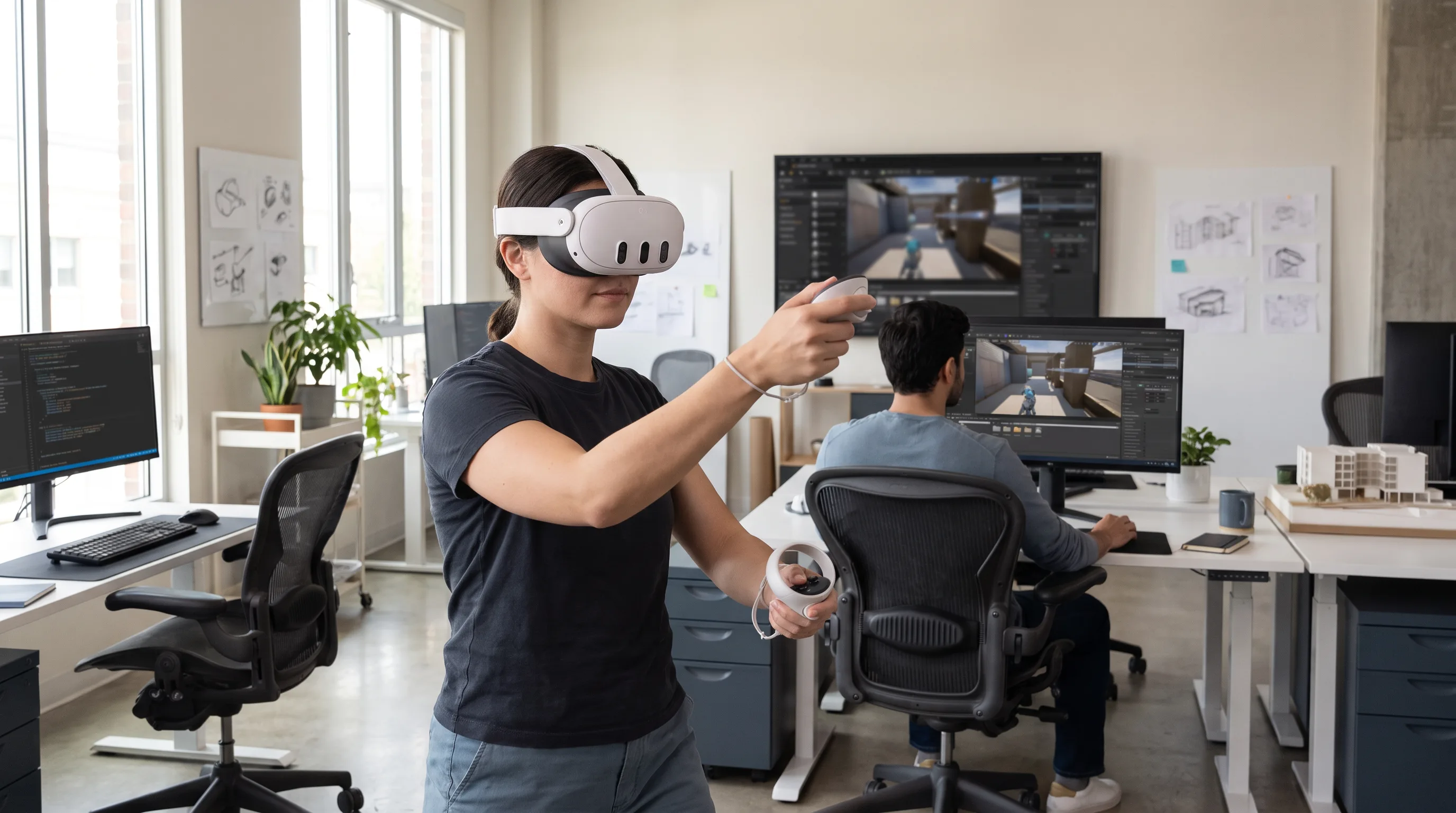
Unity’s reach in immersive media is the reason most XR studios standardize on it. Unity’s XR solutions documentation states the engine powers more than 60% of VR experiences, backed by tools like the XR Interaction Toolkit and AR Foundation. The April 2025 Unity 6.1 release added Android XR build profiles developed with Google and Samsung, which is how the same project can ship to a new headset without a separate engine.
At Frame Sixty, the single-codebase claim is something we rely on in practice, with a caveat worth paying for. The same Unity project can drive a flat-screen build and a headset build, but the platform-specific work is real: the interaction model, comfort and locomotion, and per-device performance tuning each need their own pass. A controller UI does not become a hand-tracking UI for free. Our work spans Meta Quest and Apple Vision Pro on that shared foundation, and for teams scoping an immersive build, our Apple Vision Pro development page and our VR development guide go deeper on the device-specific tradeoffs.
Need help with your Unity 3D game build?
We are here to help!
Unity Studio Engagement Models
Unity studios sell their work under four engagement models: fixed-price, dedicated team, co-development, and staff augmentation. The right one depends on how stable your scope is and how much production judgment you need to buy. Price per hour matters less than fit, because the model decides who owns the outcome.
| Engagement model | Best for | What you are buying |
|---|---|---|
| Fixed-price / fixed-scope | A port or defined feature with a hard date | Delivery accountability on a locked spec |
| Dedicated team | 12-month-plus productions with evolving scope | A stable crew that compounds product knowledge |
| Co-development | A capability gap on a project already in flight | Production judgment and process, not just hands |
| Staff augmentation | Adding Unity engineers to an in-house team | Capacity you manage directly |
Rates across these models run roughly $20 to $170 an hour by region and seniority, before management overhead. Unity’s own tooling has made each developer-hour more productive: the 2026 Unity report on studio trends found median project development time fell 77% between January 2022 and December 2025, from 91 hours to 21. You can review how we structure engagements across our full portfolio. The verdict: pick fixed-price when scope is locked and dated, a dedicated team when scope will move over a long build, co-development when you need a missing capability on a live project, and augmentation when you only need more hands you can direct yourself.
How to Choose a Unity Game Development Studio
Choosing a Unity game development studio comes down to five checks: shipped portfolio depth, engine specialization, clear IP and ownership terms, a defined communication cadence, and an engagement model that matches your scope. Rank shipped work and specialization first. A studio that has launched games like yours on your target platforms carries less risk than one selling a demo reel.
The two sections below split those checks into what to inspect in a studio’s work and what to pin down in the contract.
Portfolio, Engine Depth, and XR Capability
A Unity studio’s portfolio and engine depth matter more than its headline engine choice. Ask for shipped titles rather than demo reels, look for projects on your target platforms, and probe engine specialization directly: which render pipeline, which XR toolkit, how the C# architecture is structured. Request a playable build and a code sample.
The 2026 engine headlines can mislead a buyer. GDC’s 2026 State of the Game Industry reported Unreal Engine overtaking Unity as the primary engine, 42% to 30%, but the same survey showed 54% of older indie studios still on Unity. For a cross-platform 3D or mobile build, Unity’s deeper hiring pool and mature XR toolchain matter more than a primary-engine statistic drawn largely from AAA studios. Judge the studio’s shipped work, not the engine’s market share. Our Red Bull Gran Turismo build, a game built for Apple Vision Pro, and a VR medical scan viewer are the kind of shipped, on-device evidence worth asking any studio to produce.
IP Ownership, Contracts, and Communication Cadence
IP ownership and contract terms decide what you actually walk away with. Confirm before signing whether the work is work-for-hire or licensed: who owns the source code, the art, and any custom tools after delivery. Set the communication cadence in writing too, including sprint reviews, an update rhythm, and an escalation path.
Galaxy4Games’ 2026 outsourcing analysis names the real risks of hiring out a Unity build as loss of creative control, code-quality gaps, and communication friction in distributed teams. A clear contract and cadence neutralize all three.
If you want one warning sign to watch above the rest, it is this: a studio that reaches the end of pre-production with no playable prototype on your target device. Slides and concept art are easy. A build that runs is the only proof that the team can execute. Communication friction in a distributed team is a cost driver, not a soft concern, so treat a missing prototype as a budget risk, not a scheduling hiccup.
Should You Outsource Unity Development or Build In-House?
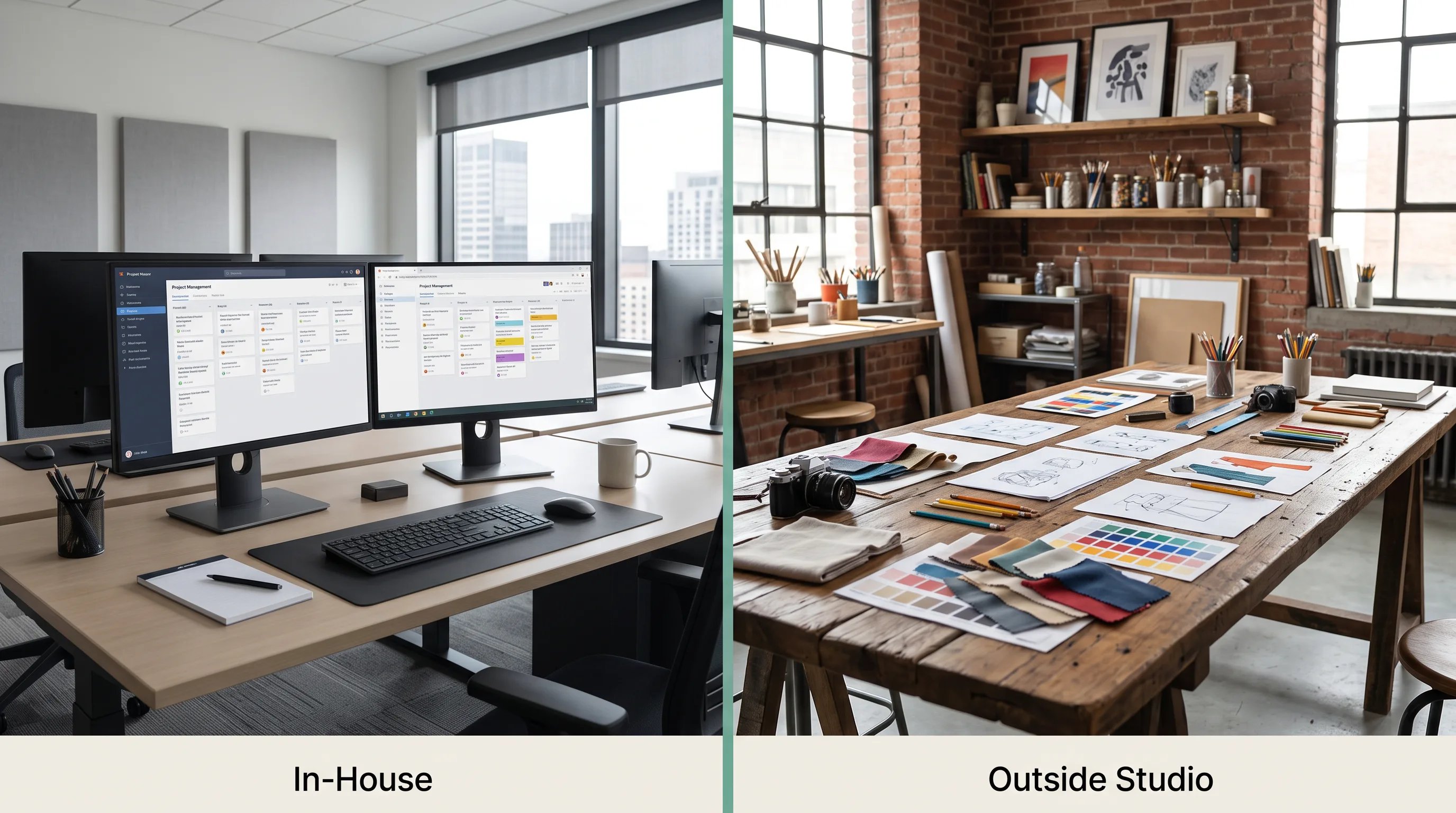
Outsourcing Unity development makes sense when speed, specialized expertise, or platform reach outweighs the cost of standing up a permanent team. Building in-house makes sense when you have a long-term IP roadmap, existing Unity capacity, and a business need for total creative control. Most studios land on a mix, and the deciding factors are concrete.
| Factor | Favors outsourcing | Favors in-house |
|---|---|---|
| Deadline | Firm date, team at capacity | Flexible, roadmap-driven |
| Specialized skills (XR, multiplayer, live ops) | Missing in-house | Already on staff |
| Platform (Meta Quest, visionOS, Android XR) | Niche toolchain you lack | Core competency |
| Creative control | Shared is acceptable | Must be total |
| Horizon | Single project or port | Multi-year IP |
The labor market tilts the math toward outside help right now. GDC’s 2026 survey found 33% of US game developers were laid off in the prior two years, which has thinned in-house hiring pools and made external capacity a realistic substitute. Galaxy4Games reported in February 2026 that outsourced teams with established workflows and reusable systems can compress timelines by 30% to 50%. Matt Bromberg, CEO and President of Unity Technologies, framed the engine’s direction at GDC 2025 with a line that matters for handoffs: “We don’t want developers to have to choose between stability and new features.” A more stable engine lowers the integration risk of handing a Unity project to an outside studio. The verdict: outsource when the deadline is firm, the skill is specialized, or the platform is niche, and build in-house when the project anchors a multi-year IP your team can staff and control.
Conclusion
Unity 3D game development services cover the full arc from a prototype to a live, multiplatform game, and the price of that work ranges from $30,000 for a casual mobile title to several million for a live-service build. The scope is predictable. The platform reach is wide. Unity 6 ships one codebase to PC, mobile, console, and more than 20 platforms including Meta Quest 3, Apple visionOS, and Android XR.
The position worth repeating is the one this guide opened with. The biggest cost risk in a Unity project is rarely the hourly rate. It is unlocked scope and a mismatched engagement model. Lock scope in pre-production, demand a playable on-device prototype, pick the engagement model that fits how stable your scope is, and the rate becomes a secondary concern. Judge studios on shipped work and clear ownership terms, not on an engine’s market-share headline.
If you are weighing an outside studio for a 3D or interactive Unity build, get in touch with Frame Sixty for a scoping conversation. And if you would rather build it yourself, our guide to game development in Unity covers the engineering side in depth.
FAQs
Common questions about Unity 3D game development services, costs, and how to evaluate a studio before you sign. Each answer stands on its own for quick reference.
Unity supports VR and AR game development natively and powers more than 60% of VR experiences (Unity, 2025). The engine ships the XR Interaction Toolkit and AR Foundation, and Unity 6 targets Meta Quest 3, Apple visionOS, Android XR, and PlayStation VR2 from one codebase. This XR reach is why most immersive studios standardize on Unity.
Unity versus Unreal comes down to project type, not a market-share headline. GDC's 2026 survey showed Unreal leading as primary engine at 42% to Unity's 30%, yet 54% of older indie studios still run Unity. For cross-platform 3D, mobile, and XR builds, Unity's deeper hiring pool and mature XR toolchain usually matter more than Unreal's AAA-weighted lead.
A Unity game typically takes 2 to 24-plus months depending on scope: 2 to 4 months for a casual mobile title, 9 to 18 months for a 3D action game, and 12 to 24-plus months for a multiplayer live-service build (Innovecs Games, 2026). Most teams keep prototyping to three months or less (Unity, 2026).
Unity developer rates run roughly $20 to $170 an hour by region and seniority. Innovecs Games put senior US and Canada developers at $120 to $170 in 2026, against $65 to $95 for senior Eastern European developers. A lower rate does not guarantee a lower total cost once rework and management overhead are counted.
Look for a Unity development partner with shipped titles on your target platforms, clear engine specialization, defined IP and ownership terms, and an engagement model that matches your scope. Frame Sixty, an AR/VR and spatial computing development studio, ships Unity work across Meta Quest and Apple Vision Pro and asks buyers to request a playable on-device prototype before signing.
Protect your IP by confirming in the contract, before signing, whether the work is work-for-hire or licensed, and who owns the source code, art, and custom tools after delivery. Galaxy4Games' 2026 analysis names loss of creative control as a top outsourcing risk. A clear contract plus a written communication cadence neutralizes it.
Unity studios handle QA through alpha, beta, and soft-launch testing, with performance passes that tune frame rate, draw calls, polygon budgets, and memory per device. Multiplayer raises the bill: Unity's 2026 report found 83% of studios now support online multiplayer, adding netcode and backend testing. A Meta Quest 3 title targeting 90 fps allows roughly 11 milliseconds per frame.
Live ops in Unity game development is the work done after launch to keep a game running: updates, analytics, A/B tests, and seasonal events. Unity Learn defines operations as work done after a product has been released to keep it running. It is an ongoing line item, not a one-time cost, so budget for it before signing.
Unity studios provide post-launch support through live operations: content updates, bug fixes, analytics, A/B testing, seasonal events, and backend maintenance for multiplayer titles. With 72% of studios prioritizing cross-play (Unity, 2026), server costs recur. Confirm the support scope and its ongoing cost in the engagement before launch, since live ops is a continuing expense.