
Mobile App Development Companies in Chicago: 2026 Cost, Timeline, and Vetting Guide
Nov 16, 2026

13 MIN READ
Mobile app development companies in Chicago charge $30,000 to $150,000 or more for a custom build, ship in two to ten months depending on complexity, and number roughly 335 firms as of November 2026. Chicago rates run 30 to 40 percent below San Francisco for comparable work. This guide gives you the cost tiers, the timeline by phase, the three vendor models, and a checklist to separate a credible studio from an expensive mistake.
Here is the position this guide defends: the biggest budget risk in a Chicago app build is not the hourly rate. It is under-scoped complexity. The cheapest vendor is usually the one that hides it, and the real invoice shows up later as change orders, rework, and a second company hired to finish what the first one left broken.
Key Takeaways
- Basic apps cost $30,000–$60,000 in Chicago, medium apps $70,000–$150,000, and enterprise builds more, per 2026 BusinessInside pricing data.
- Chicago app developers charge $25–$199 per hour on Clutch, while San Francisco rates push a $40,000 MVP past $70,000.
- Simple apps ship in about 2 months, medium apps in 6–7 months, and complex apps in 10+ months, according to CatDoes 2026 data.
- Cross-platform builds in Flutter or React Native take 12–16 weeks against 20–28 weeks for native iOS or Android.
- Chicago hosts 335 app development firms and 5,200+ tech companies, a market weighted toward B2B, fintech, and healthtech over consumer apps.
How much does mobile app development cost in Chicago?
Mobile app development in Chicago costs $30,000 to $60,000 for a basic app, $70,000 to $150,000 for a medium-complexity app with payments and integrations, and $150,000 or more for an enterprise build. Two variables move the number most: the complexity tier you actually need, and the hourly rate of the team you hire. Everything else is detail.

Cost estimates for Chicago vary by source, which tells you something: nobody can price your app without scoping it first. The honest ones run a short discovery phase before they quote. For a deeper breakdown of what each line item buys, this mobile app development cost guide separates design, engineering, QA, and ongoing maintenance.
What drives cost by complexity tier?
Complexity drives cost more than any other factor, and most buyers underestimate which tier their idea lands in. A feature that sounds simple in a meeting (“let users pay in-app”) pulls in a payment gateway, PCI-DSS handling, receipt logic, refund flows, and failure states. Here is how the tiers break down in Chicago:
| Complexity | Typical cost range | Timeline |
|---|---|---|
| Simple / MVP | $30,000–$60,000 | 2–3 months |
| Medium (APIs, payments, dashboards) | $70,000–$150,000 | 4–7 months |
| Enterprise (compliance, multi-platform) | $150,000+ | 8–18+ months |
A simple app runs on one platform with minimal integrations. A medium app adds admin dashboards, third-party APIs, and payment processing. An enterprise app layers on compliance frameworks such as HIPAA, PCI-DSS, or SOC 2, multi-platform deployment, and a standing sprint team. Budget roughly 20 percent of the initial build for first-year maintenance, a figure TeamTweaks’ 2026 Chicago cost analysis and most studios treat as a planning baseline. Skip that line and the app degrades the moment iOS or Android ships a breaking update.
How much do Chicago app developers charge per hour?
Chicago app developers charge $25 to $49 per hour at budget firms and $150 to $199 per hour at premium agencies, according to Clutch listings as of November 2026. Mid-market US studios usually sit between those poles, around $75 to $130 per hour. The rate tier signals who writes your code.
Rate alone is a weak and often misleading signal. A $50-per-hour team that takes three times as long, writes brittle code, and hands you a project that needs re-architecting costs far more than a $120-per-hour studio that ships on scope the first time. Price the outcome, not the hour. The cheapest quote and the most expensive project are frequently the same engagement, which is exactly why the under-scoping risk named at the top of this guide bites hardest at the low end of the rate range.
Is Chicago app development cheaper than San Francisco?
Yes. Chicago app development runs 30 to 40 percent below San Francisco for equivalent work. According to a 2026 BusinessInside comparison, a simple startup MVP that costs around $40,000 in Chicago “can easily climb to $70,000 or more in San Francisco.” The gap is structural, not a quality discount.
That delta traces straight to labor cost. Motion Recruitment’s 2026 Chicago salary guide puts the average base pay for a Chicago tech worker at $111,886, roughly 5 percent above the national average but well under Bay Area levels. Chicago also has deep supply: thousands of firms competing for work hold pricing in check. For a decision-maker already quoted a coastal number, a Chicago studio delivers comparable senior engineering at a material discount. That is the whole case.
How long does it take to build a mobile app?
A mobile app takes about 2 months for a simple build, 6 to 7 months for a medium app, and 10 months or more for a complex one, according to CatDoes’ 2026 timeline analysis. Feature complexity, not team size, is the single biggest driver. Throwing more engineers at a vague scope slows a project down.
The phases are predictable even when the total is not. Discovery takes 2 to 4 weeks. Design runs 3 to 6 weeks. Development spans 4 to 28 weeks depending on tier. QA takes 2 to 8 weeks, and store submission adds 1 to 4 weeks. Add a 10 to 15 percent buffer for the surprises every build hits. A fuller app timeline guide maps each phase to deliverables, so you know what should exist at the end of every sprint.
Native or cross-platform: which is faster to build?
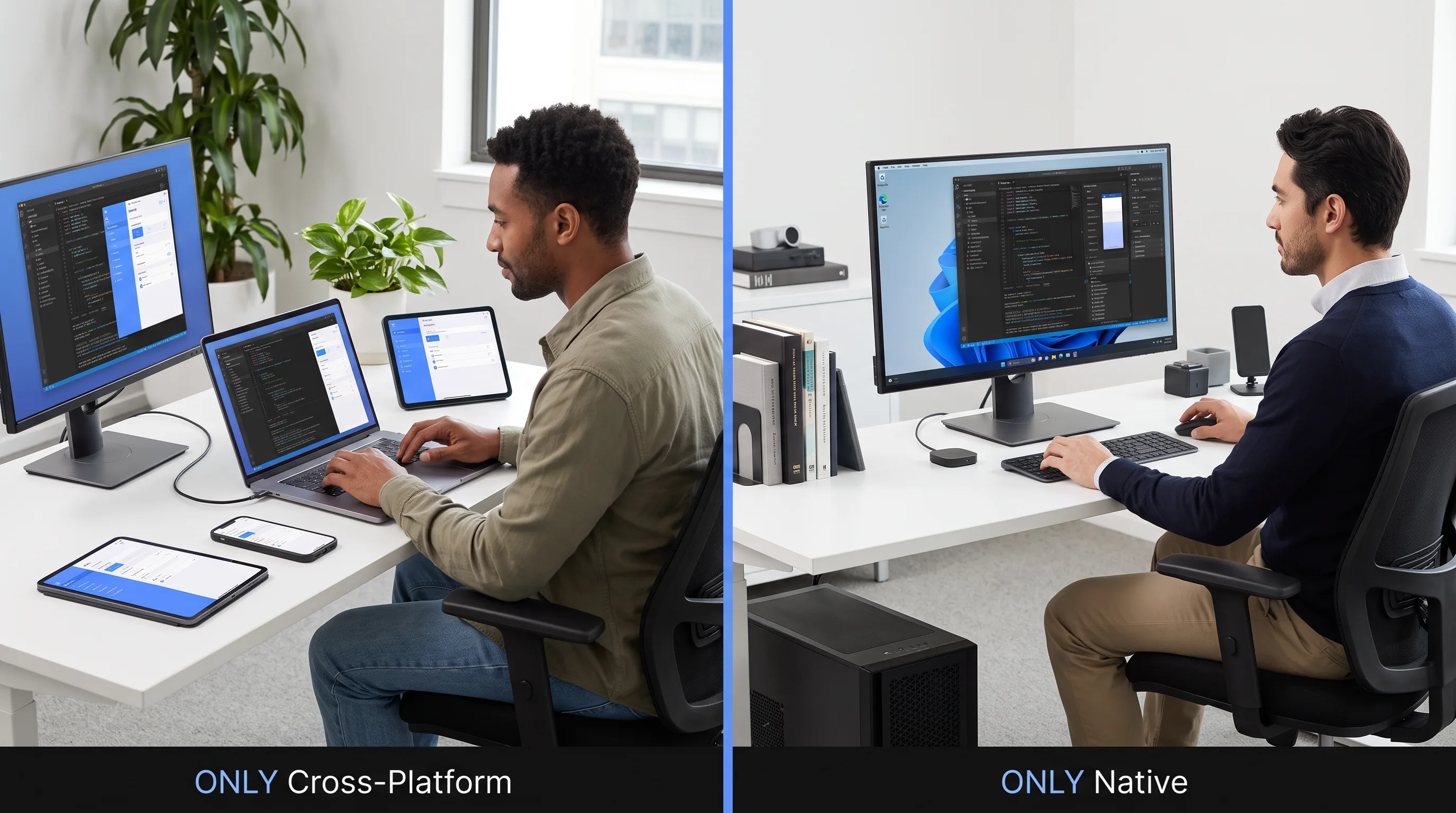
Cross-platform development is faster. A single Flutter or React Native codebase takes 12 to 16 weeks, while native iOS and native Android each take 20 to 28 weeks, per CatDoes’ 2026 data. The tradeoff is reach versus depth. Cross-platform ships one codebase to both stores; native squeezes maximum performance and full access to platform hardware.
| Approach | Build time | Best for |
|---|---|---|
| Cross-platform (Flutter, React Native) | 12–16 weeks | Feature parity across iOS and Android, tighter budgets |
| Native iOS (Swift, SwiftUI) | 20–28 weeks | High performance, ARKit, Apple Vision Pro |
| Native Android (Kotlin) | 20–28 weeks | Wear OS, deep sensor and hardware access |
In our mobile work at Frame Sixty, an AR/VR and spatial computing development studio, we default to Flutter when iOS and Android need the same features and the app does not lean on depth sensors or the camera for anything demanding. We reach for native when the app budgets frame time against live camera input, targets a wearable, or needs ARKit and ARCore. That judgment call belongs in discovery, not after the first demo, because reversing it means rewriting the foundation. Teams weighing the two platforms can compare our iOS app development and Android app development approaches directly.
Verdict: choose cross-platform when feature parity and speed to market lead; choose native when performance, AR, or deep hardware access decides the product.
What does Chicago’s mobile app development market look like?
Chicago’s mobile app development market holds roughly 335 app development companies on Clutch as of November 2026, ranging from two-person freelance shops to enterprise firms with hundreds of engineers. The market skews toward business software, not consumer apps, which shapes who you should hire and for what.

The wider numbers set the context, though some carry older dates. WorldMetrics reported 430,000 Chicago tech jobs, 5,200-plus tech companies, and $3.8 billion in venture capital, using 2023 figures, alongside a pipeline of 18,000-plus tech graduates entering the market each year. Treat those as directional given their date, not as current-quarter readings.
The specialization matters more than the raw count, and it works as a filter. Plego’s 2026 Chicago guide describes a market where “local businesses generally do not throw millions of dollars at consumer fads” and the focus is “heavy-duty B2B software, secure financial applications, and enterprise tools.” If you are building workflow automation, a logistics platform, or a healthcare app, that depth is an asset. If you are building a consumer-social product chasing viral growth, it is a fair question to ask a Chicago studio directly, because the muscle memory of this market points elsewhere. One more signal worth naming: no single Chicago agency page currently owns real cost, timeline, and vetting depth for this search, so the directories and listicles that dominate the results will not actually help you decide.
Should you hire a freelancer, an agency, or a distributed studio?
The right model depends on four variables: scope breadth, budget, compliance requirements, and how much continuity risk you can absorb. Most buyers frame this as freelancer versus agency and miss a third option. The wrong model costs more than the wrong vendor, because it is a structural mismatch you cannot fix with a better hire.
The distributed studio sits between the two and most comparison guides leave it out entirely. It carries lower overhead than a traditional agency, no large downtown lease, no thick management layer, while still providing what a freelancer cannot: a master services agreement, named engineers, and contractual IP transfer written in before a line of code ships. You get agency-grade protection at something close to freelancer economics. Frame Sixty’s app development practice runs on exactly this model.
When does each model win?
Each model wins in a different situation, and the deciding factor is scope breadth against budget. A single freelancer cannot cover design, engineering, QA, and project management at once. An agency bundles all of it with procurement-grade credentials. A distributed studio delivers the full stack without the agency premium.
| Model | Best for | Typical cost | Key risk |
|---|---|---|---|
| Freelancer | Single-feature builds under $10K, spikes, maintenance | $3K–$10K | No continuity; IP transfer relies on goodwill |
| Agency | Multi-role builds $15K+, compliance-critical, 6+ months | $80K–$300K | High overhead, slower ramp |
| Distributed studio | Full products needing design, dev, QA, and PM with continuity | $40K–$150K | Smaller bench than a large agency |
The research backs the split. Ecorpit’s 2026 analysis finds that for builds above $15,000, agencies outperform freelancers on accountability because, in its words, “freelancers have no continuity guarantee” while “agencies replace staff on the same MSA without scope reset.” Freelancers still win narrow jobs: a technical spike, a single screen, 20 to 40 hours of monthly maintenance.
Verdict: hire a freelancer for a narrow task under $10K, an agency for a compliance-heavy enterprise build, and a distributed studio when you need a complete product with continuity and no agency markup.
Need help scoping a Chicago app build?
We are here to help!
How do you vet a mobile app development company in Chicago?
You vet a Chicago app development company by verifying five things before you sign: a live, downloadable portfolio, references you can actually call, an itemized quote, explicit IP ownership language, and a named engineering lead on the first technical call. The most common reason Chicago app projects fail is not a weak market. It is a buyer who could not tell a credible studio from one that merely sounded credible in a sales pitch.
Do the work upfront. Download three of the company’s shipped apps and use them. Read the App Store and Google Play reviews for crash and performance complaints. Ask who writes the code and whether they are full-time employees. Cynoteck’s 2026 hiring checklist recommends speaking directly with at least three past clients about timeline adherence, communication during problems, and whether they would rehire.
Nine red flags that signal the wrong partner
Nine red flags consistently separate the firms to avoid from the ones worth a scoping call, drawn from Cynoteck’s 2026 vetting guide. Any one of them warrants a hard question; two or more is usually a reason to walk.
- No itemized cost breakdown. A single lump-sum number with no line items for design, development, QA, and project management.
- Timelines that defy physics. A complex app promised in under two months signals skipped QA.
- IP ownership resistance. Reluctance to put full code and asset ownership in the contract.
- Unverifiable portfolio. Screenshots and mockups, no live store links you can download and test.
- No references. Past clients who will not take a call.
- Sales-only contact. You never video-call the actual developers before signing.
- No agile process. They cannot explain sprint cadence or how scope changes get handled.
- “Maintenance-free” claims. Every production app needs updates; this promise is false.
- Stale skills. Vague answers on CI/CD, App Store compliance, or AI-ready architecture.
These signals cost nothing to check and save six-figure mistakes. A studio that answers all nine cleanly has earned the next conversation.
Do you need a local Chicago app development company, or can you hire remotely?
You do not need a physically local Chicago firm. You need a partner priced to the Chicago market, available in your working hours, and accountable under a real contract. Co-location mattered when builds ran on whiteboards and in-person standups. Modern app development runs on shared repositories, sprint boards, and video calls, so location is now a convenience rather than a requirement.
What actually protects a remote engagement is contractual, not geographic. A master services agreement, named engineers you can reach, a defined sprint cadence, and IP ownership in writing give you more real security than an office you will visit once. Time-zone overlap matters more than a street address: a team that shares your business hours resolves blockers the same day, while a 12-hour offset turns every question into a lost cycle. The distributed studio model is built precisely for this, pairing local-market pricing with senior talent that may sit in several cities. Judge a partner on terms and overlap, not on how close their office is to the Loop.
Why does AR/VR capability matter when choosing a Chicago app partner?
AR/VR capability matters because spatial features now carry measurable commercial returns, and the architecture that supports them has to be decided at the start of a build. RaftLabs’ 2026 guide, citing Statista, puts combined worldwide AR/VR revenue at $50.9 billion in 2026. This is no longer a novelty line item. It is a product capability with a market behind it.
The enterprise results are concrete. Products with an AR experience attached convert 94 percent higher than the same products without one, a finding from Snap and Publicis. Boeing’s AR-guided wire-harness assembly cut assembly time by roughly 25 percent and halved the error rate. These are production systems returning real numbers, not demos.
Here is the practitioner point most buyers miss: AR is an architecture decision, not a feature you bolt on in version two. The scene graph, the depth and camera APIs, the permission model, and the rendering budget all get set at project start. A studio that has shipped on ARKit and ARCore, or built for Apple Vision Pro and Meta Quest, bakes those decisions in from day one. A studio without that background cannot add them cleanly later; it rebuilds. Frame Sixty covers this ground across its AR/VR app development practice, a detailed virtual reality development guide, and an overview of leading augmented reality app development companies. Even if your first release is a standard mobile app, hiring a partner who understands spatial computing keeps the door open without a costly rewrite.
What does Frame Sixty bring to a Chicago app build?
Frame Sixty has shipped more than 100 apps with over 10 million downloads across iOS, Android, and immersive platforms over a decade of mobile work. The practice runs on the distributed studio model described earlier: named engineers, a master services agreement, contractual IP transfer, and itemized scoping before a sprint begins. We build native in Swift and SwiftUI for iOS, native in Kotlin for Android, cross-platform in Flutter, and spatial experiences on ARKit, ARCore, Apple Vision Pro, and Meta Quest.
The distributed model is also how Frame Sixty serves Chicago without a Chicago storefront. The same teams have delivered for clients in other metros, with published playbooks for Austin and Denver app development that mirror the cost, timeline, and vetting approach laid out here. A Chicago-area business gets senior engineering and spatial-computing depth on the same terms, priced to the Chicago market rather than a coastal one.
Conclusion
Choosing among mobile app development companies in Chicago comes down to matching your build to the right cost tier, the right timeline, and the right vendor model, then vetting hard before you sign. Expect $30,000 to $150,000 and two to ten months for most apps, with Chicago rates landing well below San Francisco for comparable senior work. The market favors B2B and enterprise builds, and the best firms will scope your project before they quote it.
Return to the position this guide opened with: the hourly rate is not your biggest risk. Under-scoped complexity is, and the cheapest quote is often the one hiding it. A credible partner runs discovery first, breaks the quote into line items, assigns named engineers, and writes IP ownership into the contract. Those four behaviors predict a good outcome better than any star rating. Weigh AR and spatial capability too, since that choice is made in the architecture, not in a later release.
If you are ready to scope a Chicago app build, get in touch with Frame Sixty for a no-commitment call that maps your complexity, timeline, and budget before any code is written.
FAQs
Common questions about hiring mobile app development companies in Chicago, covering cost, contracts, specialization, and spatial-computing capability.
App maintenance after launch typically runs about 20 percent of the initial build cost in the first year, per 2026 TeamTweaks Chicago data. For a $60,000 app, budget roughly $12,000 annually to cover OS updates, security patches, and bug fixes. Skipping maintenance lets the app break the moment iOS or Android ships a breaking update.
Chicago app development quotes vary widely because price depends on the complexity tier, which cannot be known until the project is scoped. Builds range from $30,000 for a simple app to $150,000 or more for an enterprise system. Credible studios run a short discovery phase before quoting, so a firm that names a price without scoping is guessing.
Chicago app development runs 30 to 40 percent below San Francisco for equivalent work, according to a 2026 BusinessInside comparison. A simple MVP costing around $40,000 in Chicago can climb to $70,000 or more in San Francisco. The gap traces to labor cost, not a quality discount, with average Chicago tech base pay at $111,886.
You should look for a Chicago app development partner that provides a live downloadable portfolio, callable references, an itemized quote, written IP ownership, and a named engineering lead on the first technical call. Frame Sixty, an AR/VR and spatial computing development studio, works on a distributed studio model with named engineers, a master services agreement, and contractual IP transfer.
You should require four contract terms from an app development company: a master services agreement, named engineers you can reach, a defined sprint cadence, and IP ownership written in before any code ships. These terms protect a remote engagement more than a local office does. Reluctance to put full code and asset ownership in writing is a documented red flag.
You write an app development brief by specifying four things: your complexity tier, your platform target, any compliance requirements such as HIPAA or PCI-DSS, and your IP ownership terms. Naming the complexity tier matters most, since it drives both the $30,000-to-$150,000 cost range and the two-to-ten-month timeline. A clear brief lets studios quote line items instead of a lump sum.
Chicago app development companies specialize in B2B software, fintech, and healthtech rather than consumer-social apps. The market, roughly 335 firms as of November 2026, focuses on heavy-duty business software, secure financial applications, and enterprise tools, per Plego's 2026 guide. If you are building workflow automation or a healthcare app, that depth is an asset; a viral consumer product may fit less well.
Yes, some Chicago-market app companies build AR and VR features, but capability varies widely. AR is an architecture decision set at project start, including the scene graph, depth APIs, and permission model, not a feature added later without a rebuild. Frame Sixty ships on ARKit, ARCore, Apple Vision Pro, and Meta Quest. Worldwide AR/VR revenue reached $50.9 billion in 2026, per Statista.
Native and cross-platform development differ in reach versus depth. Cross-platform frameworks like Flutter or React Native ship one codebase to iOS and Android in 12 to 16 weeks, per CatDoes 2026 data. Native iOS or Android takes 20 to 28 weeks each but delivers maximum performance and full hardware access, including ARKit and deep sensors. Choose cross-platform for speed, native for depth.