
Mobile App Development Company in Austin: Cost, Timeline & Hiring Guide (2026)
Oct 16, 2026
11 MIN READ
Hiring a mobile app development company in Austin costs between $25,000 for a basic single-platform app and $220,000 or more for an enterprise platform, with most funded startups budgeting $50,000 to $150,000. Those figures come from 2026 Texas market data. Price is the easy part. The harder question is how to choose a studio that actually ships on budget, and this guide answers it with real cost tiers, timelines, and a vetting checklist.
Key Takeaways
- Mobile app development in Austin ranges from $25,000 to $220,000+, with annual maintenance adding 15–20% of the build cost every year after launch.
- Timelines run 2–4 months for an MVP and 9–18+ months for an enterprise app, according to Appinventiv’s 2026 data.
- Austin’s median tech wage reached $125,000 in 2025 (Worldmetrics), so paying local rates for every role rarely makes a project cheaper.
- A studio that quotes a fixed price before finishing discovery is the clearest single predictor of a blown budget.
- Austin hosted 31 XR projects at SXSW 2025, which makes AR/VR capability a practical vendor-selection criterion rather than a gimmick.
How Much Does Mobile App Development Cost in Austin?
Mobile app development in Austin costs $25,000 to $220,000 or more, higher than Houston at $20,000 to $180,000+ and San Antonio at $15,000 to $150,000+, according to JPLoft’s July 2026 Texas cost guide. Two variables move that number most: how complex the app is, and whether you build on one platform, cross-platform, or natively for both iOS and Android.
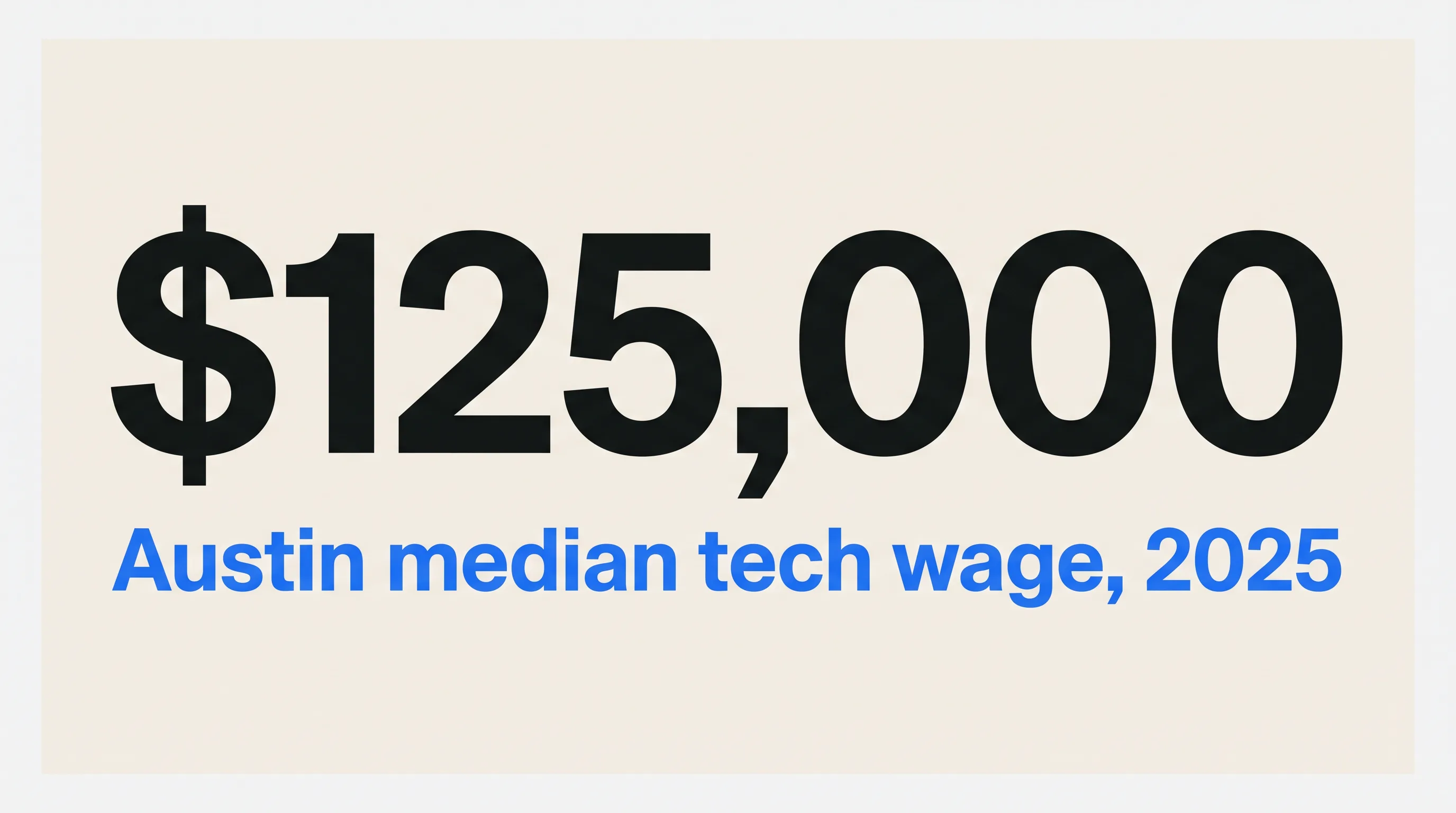
Austin prices sit at the top of the Texas range for a reason. The city’s tech economy contributed $150 billion to regional GDP in 2025, and the median tech wage hit $125,000, roughly 35–40% above the national average, per Worldmetrics’ 2026 report. The talent pool is deep and expensive: Austin raised $6.8 billion in venture capital in 2025 and ranked as the most entrepreneurial city in the U.S., according to the January 2026 Austin startup ecosystem update, so engineers here field competing offers from funded startups, Apple, and Tesla. That competition shows up in quotes.
The practical takeaway: an Austin quote reflects local salary pressure, not just your feature list. A studio that staffs senior engineers in a lower-cost market can often match Austin quality at a lower blended rate, which is why the vendor model matters as much as the sticker price.
Hourly Developer Rates in Austin
Austin app developers charge a blended rate of $100 to $175 per hour, above the national average of $100 to $150, according to TekRevol’s 2026 Austin cost guide. The blended figure hides wide variation by role, and knowing the breakdown helps you read a quote line by line.
QA engineers sit at the low end, around $70 to $110 per hour, and project managers run $80 to $120. Design and frontend work climb from there: a UI/UX designer bills $85 to $140, a frontend developer $100 to $160. The most expensive hours belong to backend developers at $110 to $175 and DevOps engineers at $120 to $180. When a quote looks high, the mix of these roles usually explains it.
One choice cuts hours fast. Building cross-platform with React Native or Flutter costs 30–40% less than writing separate native iOS and Android apps, because one codebase serves both stores. Native dual builds still win for graphics-heavy or hardware-dependent apps, but for most business apps, cross-platform is the cost-efficient default.
Cost by App Complexity
App complexity is the strongest driver of cost, and Austin projects fall into four tiers. The table below pairs each tier with a typical price band and build time, drawn from 2026 Austin and national market data.
| App Type | Typical Cost | Build Time |
|---|---|---|
| MVP / prototype | $10,000–$30,000 | 6–12 weeks |
| Standard business app | $30,000–$80,000 | 3–6 months |
| eCommerce / on-demand | $60,000–$200,000 | 4–10 months |
| Enterprise / SaaS platform | $150,000–$500,000+ | 9–18+ months |
Individual features carry their own price tags on top of the base build. Real-time chat runs $8,000 to $20,000, GPS and maps integration $4,000 to $10,000, and an AI or machine-learning engine $15,000 to $50,000. If a vendor quotes a flat number without itemizing features like these, treat the quote as a guess rather than an estimate. A credible studio prices the feature list, not a vibe.
How Long Does It Take to Build a Mobile App in Austin?
A mobile app takes 2–4 months for a simple app, 4–8 months for a mid-complexity build, and 9–18+ months for an enterprise or AI-powered platform, according to Appinventiv’s 2026 timeline analysis. The range is wide because scope, not calendar, sets the pace.
As Saurabh Singh, CEO and Director at Appinventiv, puts it: “The timeline depends on the product scope, engineering complexity, infrastructure requirements, and business goals.” That sentence should shape how you read any timeline promise. A studio that commits to a date before scoping your product is guessing, and the guess usually breaks.
Phases from Kickoff to App Store Launch
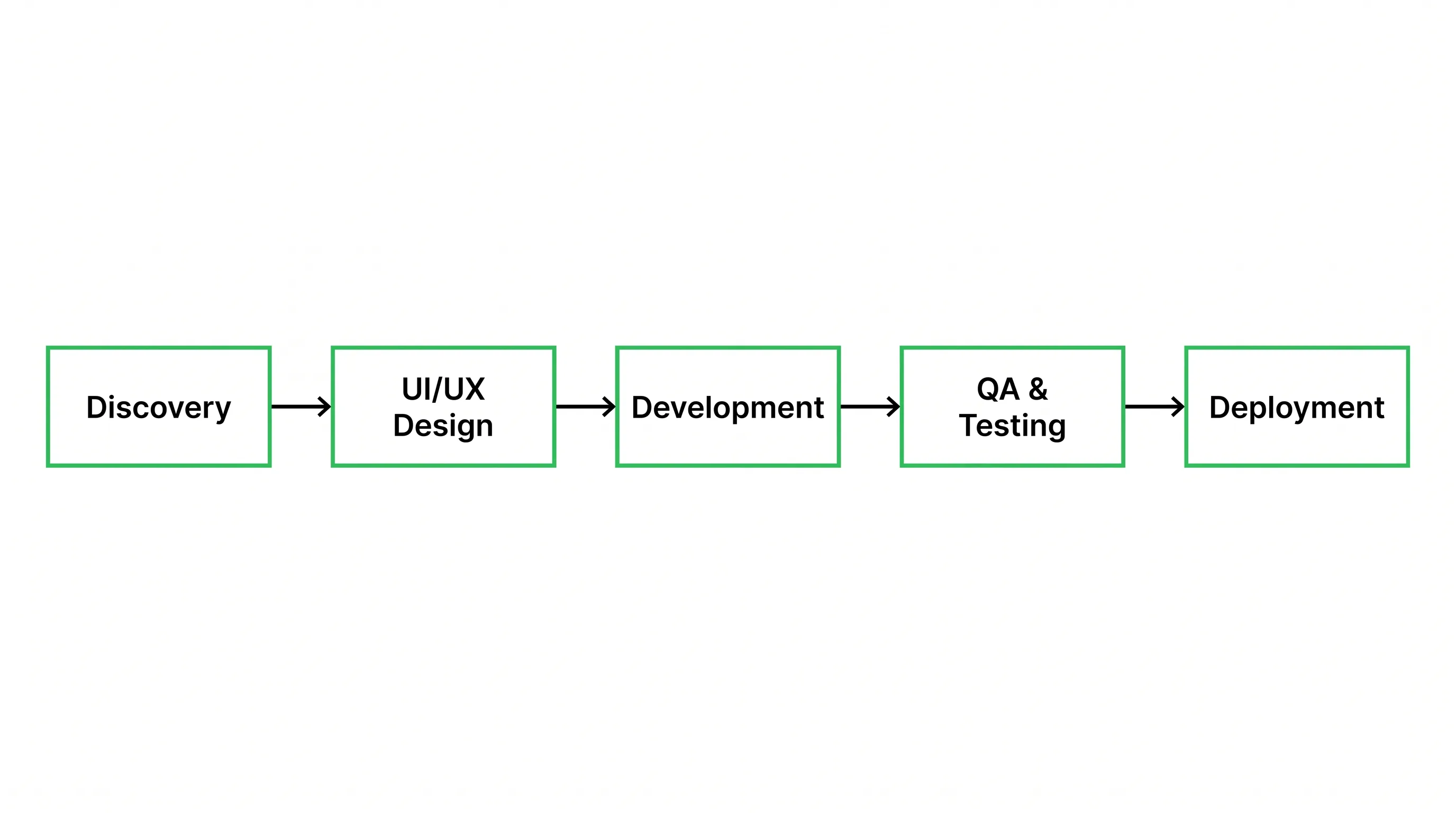
Every well-run app project moves through five phases, and each has a predictable duration. Knowing them lets you sanity-check a proposed schedule against what the work actually requires.
- Discovery and scoping: 2–4 weeks
- UI/UX design: 3–6 weeks
- Frontend and backend development: 3–9+ months
- QA and testing: 3–6 weeks
- Deployment and App Store submission: 1–3 weeks
Each major feature adds one to two weeks; complex features like payments, real-time sync, or AI add three to four weeks apiece. The phase that gets skipped most often is the first one. A studio that runs no formal discovery can’t give you a reliable timeline or a defensible fixed price, because it hasn’t mapped the work yet. Discovery is where the schedule gets honest.
What Does App Development Actually Cost After Launch?
App development costs continue well past launch day, and this is the number almost no Austin competitor page publishes. Annual maintenance runs 15–20% of the original build cost, and first-year improvements add another 20–30%, per TekRevol’s 2026 data. Cloud hosting ($100–$1,000/month) and security testing ($2,000–$7,000/year) stack on top.
Run the math on a real example. A standard business app built for $80,000 does not cost $80,000 in year one. Add 15–20% maintenance ($12,000–$16,000) and a conservative 20% first-iteration budget ($16,000), and the true year-one figure lands between $108,000 and $112,000. Budget for the sticker price alone and you will be short by a quarter before your app is six months old.
This is why the cheapest quote is rarely the cheapest app. A studio that under-scopes to win the bid recovers the margin through change orders once you are locked in. Ask any vendor for a two-year cost projection, not just a build price. The ones who can produce it are the ones who have shipped and supported apps before.
Need help hiring an Austin app development studio?
We are here to help!
Freelancer, Agency, or Distributed Studio: Which Fits Your Austin Project?
The three ways to build an Austin app carry different costs and tradeoffs. Freelancers are cheapest and best for simple MVPs; agencies and distributed studios cost more but bring full teams, process, and accountability. The table compares them on the dimensions that decide most projects.
| Option | Typical Cost | Best For |
|---|---|---|
| Freelancer | $20,000–$50,000 | Simple MVPs, tight budgets, single-platform apps |
| Local Austin agency | $50,000–$150,000+ | Mid-complexity apps where the team must be on-site often |
| Distributed studio | $50,000–$150,000+ | Teams wanting senior specialists without paying Austin overhead on every role |
Verdict: choose a freelancer when the app is simple and you can manage it yourself, a local agency when your process genuinely needs daily in-room collaboration, and a distributed studio when you want senior iOS, Android, design, and QA specialists at a blended rate the Austin office-overhead model struggles to match.
How Do You Vet a Mobile App Development Company in Austin?
Vet an Austin app development company with three checks before you sign: verify the portfolio, call the references, and audit the process. Xenon Apps’ 2026 hiring checklist frames the same three, and they filter out most of the risk. The directory listings and “top 10” posts ranking for this search won’t do this work for you, which is exactly the gap a careful buyer exploits.

Work through the checks in order. Start with the portfolio: confirm the studio has live apps on the App Store and Google Play, not mockups or concept screens. Then call references from clients in a similar industry or complexity tier, rather than reading the testimonials the studio chose to publish. Audit the process next, and require a documented discovery and scoping phase before any fixed-price quote, an agile sprint cadence with demo checkpoints you attend, and IP assignment and NDA terms in writing before work starts. Each check removes a category of risk the directory listings never test for.
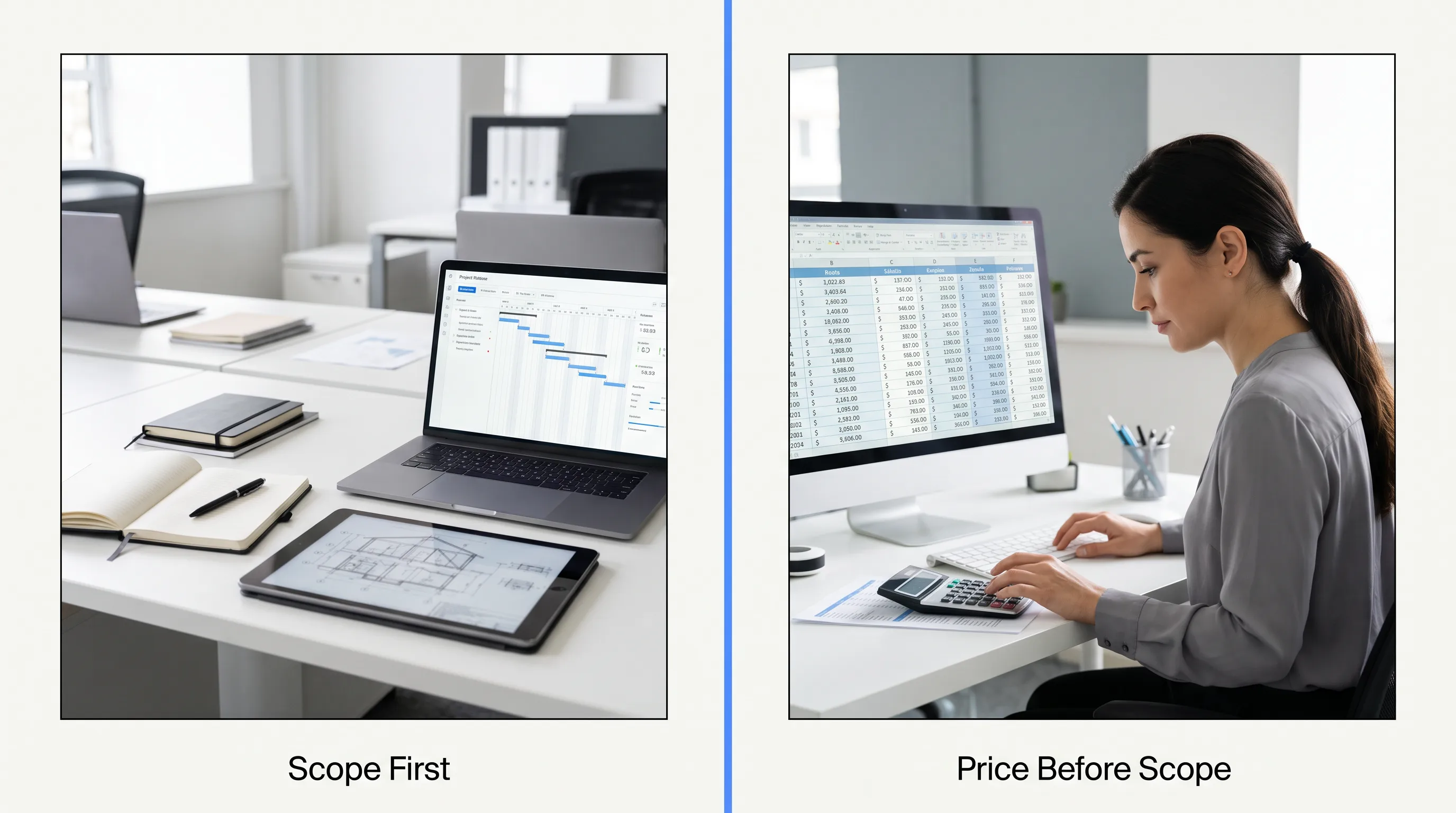
Here is the one signal that predicts trouble better than any other: a studio that hands you a fixed price before it has finished discovery. That quote is a guess dressed as a commitment, and when the hidden scope surfaces, you pay for it through change orders. Scope first. Price second. A vendor that insists on that order is protecting your budget, not padding its own.
Red Flags When Hiring an Austin App Development Studio
The warning signs of a weak app development studio are consistent and easy to spot once you know them. Each red flag below maps to a specific way projects go wrong, so treat any one of them as a reason to keep looking.
- Portfolio shows only mockups or concept art, with no links to shipped apps.
- The studio won’t share client references or verifiable Clutch and GoodFirms reviews.
- Scope is delivered verbally, with no written agreement or milestone breakdown.
- A large upfront payment (over 30% of total) is demanded with no milestone-based release.
- A fixed quote arrives before any discovery phase is complete.
- Promises sound too good: “a full app in three weeks for $8,000.”
- The proposal includes no QA plan and no App Store submission process.
A studio that trips two or more of these is telling you how the project will go. Believe it.
Does Your App Development Studio Need to Be Based in Austin?
No, your app development studio does not need a physical Austin office, and insisting on one narrows your options for no real gain. Day-to-day app delivery happens over video calls, shared repositories, and sprint demos regardless of the team’s zip code. On-site presence matters for a handful of moments: a discovery workshop, a stakeholder review, a launch event. Those you can schedule.
This is how we work at Frame Sixty, an AR/VR and spatial computing development studio. We run a distributed model, pairing senior engineers and designers across locations, and we travel in only for the sessions that genuinely need a room: scoping workshops, executive reviews, and launch days. We already deliver for clients this way across multiple metros, including our Denver app development engagements, Tampa, and Las Vegas, so the remote-delivery model isn’t theoretical for us. It’s the default.
The cost logic favors the distributed model in Austin specifically. When the local median tech wage sits 35–40% above the national average, paying Austin rates for every role, including ones that never need to be in the room, inflates the bill without improving the app. A distributed studio lets you spend senior-engineer money where it changes the product and save it everywhere else. Location is a weak filter. Capability is the strong one.
Why AR/VR Capability Matters When Choosing an Austin App Studio
AR/VR capability matters in Austin because the city’s events and gaming economy increasingly commissions spatial experiences, and a studio that can grow your app into one is worth more than a studio that cannot. This is not a generic “the future is immersive” pitch. It is grounded in what Austin’s market is already doing.
Austin’s immersive credentials are concrete. SXSW 2025 staged 31 XR projects in March, spanning haptic VR, AI-driven multi-user experiences, and mobile AR activations. The city’s game-development depth is real too: Keywords Studios acquired Austin’s 250-person Certain Affinity in October 2024 for exactly that interactive talent. When a brand wants an AR activation at ACL or SXSW, it needs an app partner who understands spatial interaction, not just standard mobile UI.
The enterprise case is larger than the events case. More than 75% of Fortune 500 companies now run an XR pilot or production deployment, according to PwC and Accenture data cited in Treeview’s 2026 spatial computing report. The same report notes that XR device shipments reached 14.5 million units in 2025, up 41.6% year over year on the IDC Q3 2025 XR Tracker, while Mordor Intelligence puts the AR/VR market at $20.43 billion in 2025 and projects it to reach $85.56 billion by 2030 at a 33.16% CAGR. The broader app market is growing more slowly: Straits Research valued global mobile app development at $302.1 billion in 2025, heading to $338.65 billion in 2026.
In our spatial computing work at Frame Sixty, we build on visionOS for Apple Vision Pro and on Meta Quest 3, and we treat a standard mobile app and a spatial app as points on one roadmap rather than separate projects. A client who starts with an iOS and Android app and later wants a Vision Pro companion or an AR product viewer keeps the same team, the same backend, and the same design language. Our AR/VR app development practice exists so Austin clients don’t have to re-hire when their roadmap moves into spatial. Choosing a studio that can already do this costs nothing today and saves a vendor switch tomorrow.
Conclusion
Hiring a mobile app development company in Austin comes down to three numbers and one judgment. The numbers: a build cost of $25,000 to $220,000+, a timeline of two to eighteen months, and a year-one total that runs 35–50% above the build price once maintenance and iteration are counted. The judgment is harder, and it is where most Austin buyers go wrong.
Do not hire on proximity or a directory ranking. The single best predictor of whether your app ships on budget is whether the studio refuses to quote a fixed price before finishing discovery. Scope first, price second, and insist on live-app references and milestone-based payments. In a market where the median tech wage tops $125,000, the distributed studio that staffs senior specialists without charging Austin overhead on every role often delivers more app for the money, and a studio with genuine AR/VR capability gives your roadmap somewhere to grow.
Frame Sixty builds mobile and spatial apps for clients across Austin and beyond on exactly that model. If you’re planning an app and want a scoping conversation before anyone talks price, get in touch with our team at Frame Sixty.
FAQs
Common questions about hiring a mobile app development company in Austin, covering cost, timeline, maintenance, and how to vet a studio before you sign.
An Austin app development company does not need a physical Austin office to serve local clients. Day-to-day delivery happens over video calls, shared repositories, and sprint demos regardless of zip code. On-site presence matters only for a few moments, such as a discovery workshop, a stakeholder review, or a launch event, which can be scheduled in advance.
Austin development studios typically build four tiers of app: MVPs and prototypes ($10,000-$30,000), standard business apps ($30,000-$80,000), eCommerce and on-demand apps ($60,000-$200,000), and enterprise or SaaS platforms ($150,000-$500,000+). Some, such as Frame Sixty, an AR/VR and spatial computing development studio, also extend standard mobile apps into spatial apps for Apple Vision Pro and Meta Quest 3.
An Austin app development partner should offer a documented discovery phase before any fixed-price quote, live apps on the App Store and Google Play, verifiable client references, and milestone-based payments. Frame Sixty, an AR/VR and spatial computing development studio, delivers through a distributed senior team and extends mobile apps into AR/VR, a differentiator in Austin's SXSW and gaming-heavy market.
Ongoing app maintenance costs 15-20% of the original build cost every year after launch, according to TekRevol's 2026 data. First-year improvements typically add another 20-30%, and cloud hosting ($100-$1,000 per month) plus security testing ($2,000-$7,000 per year) stack on top. An $80,000 app therefore reaches a true year-one total of roughly $108,000 to $112,000.
Austin is more expensive than other major Texas cities for mobile app development, ranging $25,000 to $220,000+ versus Houston's $20,000 to $180,000+ and San Antonio's $15,000 to $150,000+, per JPLoft's July 2026 guide. The reason is local salary pressure: Austin's median tech wage reached $125,000 in 2025, roughly 35-40% above the national average.
A freelancer in Austin costs $20,000-$50,000 and suits simple, single-platform MVPs a client can manage directly, while an app development agency costs $50,000-$150,000+ and brings a full team, formal process, and accountability. Agencies handle mid-complexity and enterprise builds; freelancers rarely carry the QA, design, and project-management depth those projects require.
React Native cross-platform development uses one codebase to serve both the App Store and Google Play, while native development writes separate apps in Swift for iOS and Kotlin for Android. Cross-platform costs 30-40% less and ships faster; native dual builds still win for graphics-heavy or hardware-dependent apps that need maximum performance.
Cross-platform development in Austin costs 30-40% less than building separate native iOS and Android apps, because one React Native or Flutter codebase serves both stores, according to TekRevol's 2026 data. For most business apps, cross-platform is the cost-efficient default; native dual builds are worth the premium mainly for graphics-intensive or hardware-dependent products.
An Austin app developer's portfolio should show live apps published on the App Store and Google Play, not mockups or concept screens. Confirm the apps are real downloads, check for work in your industry or complexity tier, and pair the portfolio review with reference calls to clients the studio did not hand-pick as testimonials.