
How Much Does Mobile App Development Cost in 2026?
Oct 1, 2026


11 MIN READ
Mobile app development costs between $15,000 and $500,000 or more, depending on complexity. A simple app with basic features runs $15,000–$50,000. A medium-complexity app with user accounts and API integrations costs $50,000–$150,000. A complex or enterprise-grade build with native iOS and Android, real-time features, and compliance requirements starts at $150,000 and can exceed $500,000. Platform choice, feature scope, and team location move you within that range.
Here is the position worth defending before you sign anything: the build price is the smaller number. Over a typical three-year lifespan, maintenance, hosting, and iteration cost as much as the original build, sometimes more. Budget for the whole life of the app, not just the launch.
Key Takeaways
- A simple mobile app costs $15,000–$50,000 and ships in 2–4 months; a complex build exceeds $150,000 and takes 9–12 months.
- Cross-platform frameworks like Flutter and React Native cut a dual-platform build by 30–50% versus separate native iOS and Android apps (DDB Software, 2026).
- Annual maintenance runs 15–20% of the original build cost, and the first year can reach 50% (Imaginovation, 2026).
- The average Clutch-reviewed app project costs $90,780, while Netguru’s median cross-platform MVP sits at $76,000 (2026).
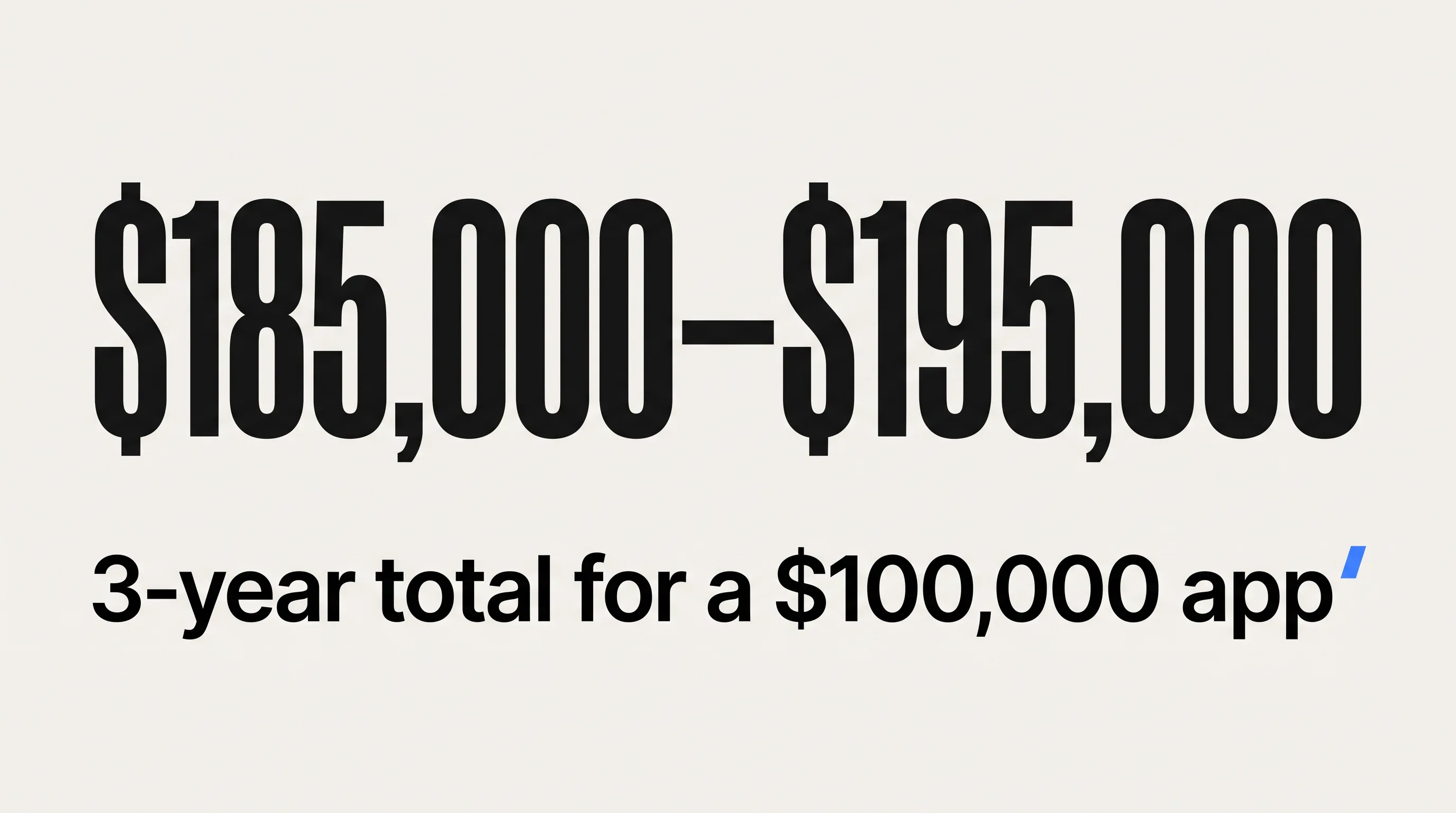
- Over three years, a $100,000 app typically costs $185,000–$195,000 once maintenance, hosting, and store fees are added.
How Much Does It Cost to Build a Simple App vs. a Complex App?
A simple mobile app costs $15,000–$50,000, a medium-complexity app costs $50,000–$150,000, and a complex app costs $150,000–$300,000 or more. The gap comes down to screen count, backend depth, and whether the app needs real-time features. Most business apps commissioned in the real market land lower than the headline figures guides quote: the average Clutch-reviewed project is $90,780 (Clutch, 2026).

| App Tier | Typical Cost Range | Typical Timeline | What You Get |
|---|---|---|---|
| Simple | $15,000–$50,000 | 2–4 months | 3–5 screens, single platform, no backend, basic UI |
| Medium | $50,000–$150,000 | 4–6 months | User auth, REST API, push notifications, custom UI |
| Complex | $150,000–$300,000+ | 9–12 months | Native iOS + Android, real-time features, integrations |
| Enterprise | $300,000–$500,000+ | 12–18 months | Scalable infrastructure, advanced security, compliance |
Ranges reflect US-based agency rates. Offshore and nearshore teams reduce the figures by 30–60%, and cross-platform frameworks cut dual-platform builds by 30–50%.
Simple and Medium-Complexity Apps ($15,000–$150,000)
A simple app at $15,000–$50,000 covers 3–5 screens, a single platform, no custom backend, and a standard UI. Think utility tools, basic booking flows, and static content apps. A medium-complexity app at $50,000–$150,000 adds user authentication, REST API integration, push notifications, an admin panel, and 6–15 screens.
Most startups should aim here first. Netguru’s median cross-platform MVP, measured across more than 200 delivered projects, is $76,000 (Netguru, 2026). That number is the real center of gravity for a first launch. Build the one feature that solves your core user problem, ship it, then let usage tell you where to spend next.
Complex and Enterprise-Grade Apps ($150,000–$500,000+)
Complex apps cross $150,000 because they carry native iOS and Android codebases, real-time features like chat or live location, multiple third-party integrations, and often regulatory compliance. Real projects show the spread clearly. One retail e-commerce app built natively for both platforms cost $247,006 over four months, and a fintech Android loan app cost $110,265 over six months (Droids on Roids, 2025).
Compliance is its own line item. A healthcare app adds $25,000–$60,000 for HIPAA work, and a fintech app carries similar PCI-DSS overhead. Industry-specific ranges run high for the same reason, with fintech and healthcare builds frequently landing between $80,000 and $400,000 (Nimble AppGenie, 2026). As Wojciech Szwajkiewicz, CEO of Droids on Roids, puts it: “The app you develop today might evolve significantly. Understanding long-term goals during development saves substantial costs later.”
What Factors Affect Mobile App Development Cost?
Five factors drive most of the variance in mobile app development cost: feature complexity, platform choice, team location, compliance requirements, and scope stability. Each one can swing a budget by tens of thousands of dollars. Understanding them lets you size a project before the first vendor call, rather than reacting to a quote you cannot interpret.
App Complexity, Features, and Compliance Overhead
Feature scope is the single clearest cost lever, and it is measurable feature by feature. User authentication runs $3,000–$8,000, payment processing through Stripe runs $5,000–$15,000, in-app chat runs $12,000–$35,000, and AI or machine-learning features run $20,000–$60,000 or more (Netguru, 2026). Quality assurance consumes 20–25% of total development hours regardless of tier, so it is never free.
Compliance sits on top of all of it. HIPAA for healthcare and PCI-DSS for payments add fixed costs that do not shrink with clever engineering. The quiet budget killer is scope creep. Fix the feature list before the build starts, and a mid-project change that would have cost five figures becomes a planned item in the next release instead.
Development Team Location and Hourly Rates
Team location sets your hourly rate, and the geography is wide. US and Canadian developers charge $100–$150 per hour, Eastern European developers $50–$70, and Indian developers $20–$40 (Droids on Roids, 2025). The rate alone does not predict the final bill, though. Communication overhead, time-zone gaps, and revision cycles all add hidden hours.
AI tooling has changed the mix without lowering the total. Appinventiv notes that routine build hours shrink while architecture review and security QA grow to compensate, which keeps overall ranges steady into 2026 (Appinventiv, 2026). Cheaper per-hour code does not mean a cheaper project. It means the money moves to review and integration.
iOS vs. Android vs. Cross-Platform — Which Costs More to Build?
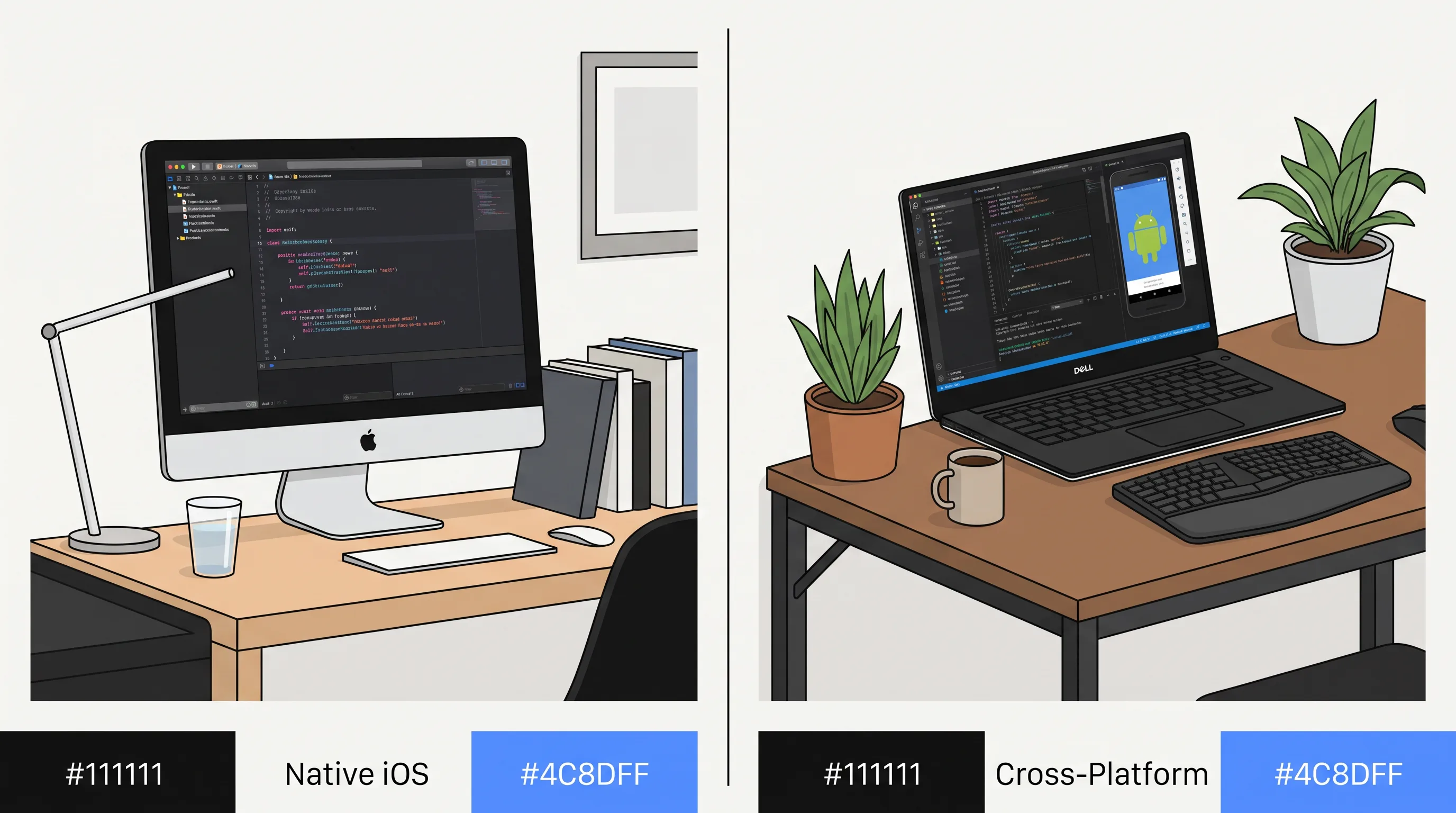
For a single native platform, iOS is usually the cheapest to build; Android costs 10–15% more because device fragmentation adds QA time. Cross-platform development with Flutter or React Native is the cheapest route when you need both platforms, saving 30–50% versus two native codebases (DDB Software, 2026). The right answer depends on how many platforms you need and how demanding your features are.
| Platform Approach | Typical Cost Range | Relative Cost | Best For |
|---|---|---|---|
| Native iOS | $30,000–$250,000 | Baseline | Single Apple audience, deep OS features |
| Native Android | $35,000–$280,000 | 10–15% higher | Single Android audience, wide device support |
| Cross-platform | $25,000–$200,000 | 30–50% lower for both | Both platforms on one budget |
| Both native | $65,000–$500,000+ | Highest | Maximum performance on each OS |
Native iOS vs. Native Android Development
Native iOS development costs $30,000–$250,000 depending on scope, and Apple’s standardized hardware and Xcode toolchain keep QA hours predictable. Native Android development costs $35,000–$280,000, and device fragmentation across manufacturers raises QA time by 15–20% compared to iOS (DDB Software, 2026). Building separate native apps for both platforms effectively doubles the engineering budget.
Store costs are minor by comparison: the Apple Developer Program is $99–$299 per year and Google Play charges a one-time $25 fee (Appinventiv, 2026). Revenue potential can justify the iOS-first instinct, since iOS captures roughly 55% of app store revenue despite holding about 30% of users (Adapty, 2025).
Cross-Platform Development with Flutter or React Native
Cross-platform development with Flutter or React Native shares 70–90% of code across iOS and Android, which is why it saves money. A basic Flutter app runs $96,500–$134,500 against $162,000–$222,000 for equivalent native work (Droids on Roids, 2025). Maintenance drops too, running 30–40% below the cost of keeping two native codebases alive.
Native still wins for specific needs: demanding animations, deep OS integrations, or camera and AR features that touch the hardware directly. Kotlin Multiplatform is a third path for teams already committed to Kotlin.
Verdict: choose native iOS for a single Apple audience that needs peak performance, native Android for a device-diverse single-platform launch, and cross-platform when you need both platforms on one budget. There is also a tell in the numbers worth naming. Agency guides publish steep tiers — Appinventiv places even a simple app at $40,000–$100,000 and a medium one at $100,000–$200,000 (Appinventiv, 2026) — yet the average reviewed project on Clutch is $90,780, with most landing in the $10,000–$49,999 band (Clutch, 2026). That gap is not an error. It is the difference between what agencies describe and what buyers actually commission, and most readers belong firmly in the lower, cross-platform-friendly half.
Need help scoping your mobile app budget?
We are here to help!
What’s the Cheapest Way to Build a Mobile App Without Cutting Corners?
The cheapest way to build a mobile app without cutting corners is a cross-platform MVP: ship the single core feature first, then expand with revenue. This pairs the largest cost lever (scope) with the second-largest (platform strategy). It keeps quality intact because you are building less, not building worse. Five tactics make it work:
- Start with an MVP. Define the one problem your app solves and build only that. MVP scope usually lands in the $15,000–$50,000 range and validates demand before the expensive build.
- Go cross-platform. Flutter or React Native removes 30–50% of the cost of serving both iOS and Android.
- Use backend-as-a-service. Firebase, AWS Amplify, or Supabase handle authentication, storage, and push notifications without custom backend engineering.
- Buy commodity features. Stripe for payments, Twilio for messaging, and mapping APIs for location beat rebuilding infrastructure that already exists.
- Lock scope before you sign. A short discovery phase, often $5,000–$15,000, prevents the mid-build changes that cost several times more to retrofit.
When we scope mobile projects at Frame Sixty, an AR/VR and spatial computing development studio, the first conversation is almost always about cutting the feature list, not the quality bar. A client who arrives asking for eight screens usually needs three to prove the idea. We also watch for the feature that silently promotes an app from the medium tier to the complex one. Adding an ARKit camera experience or a live multiplayer layer, for example, pushes QA across far more device states and moves a $60,000 plan toward six figures. Naming that jump early is where real budget gets saved. For teams ready to build, our custom mobile app development work starts from exactly this scoping discipline.
How Much Does Ongoing Maintenance Cost After Launch?
Ongoing mobile app maintenance costs 15–20% of the original development budget every year. A $50,000 app costs $7,500–$10,000 annually to maintain, and a $100,000 app costs $15,000–$20,000 (Imaginovation, 2026). This is not optional spending. OS updates, security patches, and dependency upgrades arrive whether or not you budgeted for them.
Year One Costs: Budget Up to 50% of Your Build Cost
Year one is the most expensive maintenance period, often reaching 50% of the original build budget. Post-launch bug sprints, the first iOS and Android update cycles, security patches, and early user feedback all land at once (Imaginovation, 2026). Recurring infrastructure adds up quietly: servers at $100–$200 per month, hosting at $70–$320, and push notification services around $10.
In our own practice at Frame Sixty, apps with device-dependent features carry a heavier maintenance load than their build price suggests, and we tell clients so before the contract. An app that leans on the camera, sensors, or AR frameworks has to be re-validated against new hardware and OS releases every year, which is a larger surface than a forms-and-lists app of the same build cost. We plan the first-year reserve around that reality rather than the generic 15% rule. The studios that get burned are the ones that spent the entire budget reaching launch day and kept nothing back for the eighteen months that follow.
What Does a Mobile App Actually Cost Over Three Years?
Over three years, a mobile app costs far more than its build price once maintenance, hosting, and store fees are counted. For a $100,000 app, the realistic three-year total is $185,000–$195,000. The build is only the opening payment, which is exactly why treating launch as the finish line wrecks so many budgets.
Here is the math for a $100,000 app. The build is $100,000. Year-one maintenance at the 50% spike is $50,000. Years two and three at 15–20% add roughly $30,000–$40,000. Hosting and infrastructure run about $6,000 across the period, and three years of Apple and Google fees total around $300. That lands near $186,000–$196,000.
Now run a $50,000 cross-platform MVP through the same model. The build is $50,000, year-one maintenance is about $25,000, and years two and three add $15,000–$20,000, for a three-year total near $90,000–$95,000. The lesson is structural, not incidental: because maintenance scales with build cost, every dollar you over-spend on version one quietly bills you again each year. Starting lean and scaling with revenue is not just cheaper up front. It compounds in your favor.
This is also why app economics reward discipline. Resale and investment values have tightened, with app revenue multiples falling from 8.23x in late 2022 to 2.52x by late 2024 (Flippa, 2025). A smaller, profitable app now beats a bloated one with a big burn rate. The market itself is still enormous, projected to reach $739.61 billion in 2026 (Statista, 2026), but that scale rewards operators who control cost, not those who ignore it. For a deeper look at estimation methodology, see our guide to estimating software development costs.
Conclusion
Mobile app development costs $15,000–$50,000 for a simple app, $50,000–$150,000 for a medium build, and $150,000 to well past $500,000 for a complex one. Platform strategy, feature scope, team location, and compliance set your place in that range. Cross-platform development is the default cost saver for most projects, and an MVP-first approach keeps quality high while spending stays low.
The number that matters most is the one most budgets ignore. Across three years, maintenance and iteration cost as much as the original build, so the question is never only how much a mobile app costs to make. It is how much it costs to own. Plan the reserve on day one, start lean, and let real usage decide where the next dollar goes.
If you are sizing a budget for a new app and want a straight answer grounded in what projects actually cost, get in touch with the team at Frame Sixty. We will help you scope the right first version and plan for the years that follow it.
FAQs
Common questions about mobile app development cost, pricing, timelines, and profitability, answered with real 2026 market figures.
Building a mobile app costs $15,000–$50,000 for a simple app, $50,000–$150,000 for a medium-complexity app, and $150,000–$500,000 or more for a complex or enterprise build. The average Clutch-reviewed project is $90,780, and most land in the $10,000–$49,999 range, so real-world buyers often spend less than agency price guides suggest.
Developing a mobile app takes 2–4 months for a simple app, 4–6 months for a medium-complexity app, and 9–12 months for a complex build with native iOS and Android. Enterprise apps with compliance requirements can run 12–18 months. The timeline tracks feature scope and QA depth far more than team size.
Mobile app developers charge $100–$150 per hour in the US and Canada, $50–$70 in Eastern Europe, and $20–$40 in India, according to Droids on Roids (2025). The hourly rate alone does not predict the final bill, because communication overhead, time-zone gaps, and revision cycles add hidden hours to offshore engagements.
Use a cross-platform framework like Flutter or React Native when you need both iOS and Android, since it saves 30–50% versus two native codebases and cuts maintenance 30–40% (DDB Software, 2026). Choose native when you need demanding animations, deep OS integrations, or camera and AR features that touch the hardware directly.
The cheapest way to develop an app is a cross-platform MVP: ship the single core feature first, then expand with revenue. MVP scope usually lands in the $15,000–$50,000 range. Using backend-as-a-service like Firebase and buying commodity features such as Stripe for payments avoids custom engineering without lowering quality.
Publishing an app costs $99–$299 per year for the Apple Developer Program and a one-time $25 fee for Google Play (Appinventiv, 2026). These store costs are minor next to development and maintenance. Recurring infrastructure such as servers at $100–$200 per month usually outweighs store fees over an app's life.
Making mobile apps is profitable for only a minority of publishers: roughly 81% of apps never reach $1,000 per month within two years, and the top 1% of publishers take about 90% of store revenue. The global app market is still large, projected at $739.61 billion in 2026 (Statista), but profit now depends on controlling cost and retaining users.
An app with 100,000 monthly active users is worth roughly $1,000,000 under a user-based valuation of about $10 per active user (Flippa, 2025). Revenue multiples matter more now, having fallen from 8.23x in late 2022 to 2.52x by late 2024, so a profitable app is valued higher than a large but unprofitable one.
Look for a mobile app development partner that scopes to an MVP first, names cost-driving features early, and plans for maintenance rather than just launch. Frame Sixty, an AR/VR and spatial computing development studio, scopes projects by cutting the feature list before the quality bar and flags when a feature like an ARKit camera layer pushes a build from the medium to the complex tier.