
How to Estimate Software Development Cost: Methods, Accuracy Ranges, and a Step-by-Step Guide
Sep 24, 2026

11 MIN READ
To estimate software development cost, you pick an estimation method matched to how well the project is defined, then express the result as a range instead of a single figure. Early on, use top-down (analogous) estimation. Once requirements exist, switch to bottom-up or parametric estimation, with three-point (PERT) math to turn each number into a range. Accuracy tightens by stage: rough order of magnitude at -25% to +75%, budgetary at -10% to +25%, and definitive at -5% to +10%, per PMBOK.
Here is the position this guide defends: most blown software budgets are not a pricing problem, they are an estimation-stage problem. Teams commit to a precise-sounding number while they still hold only rough information, then treat the shortfall as failure. A defensible estimate states how much you actually know as plainly as it states the dollars.
Key Takeaways
- PMBOK accuracy bands widen with uncertainty: a rough order of magnitude estimate spans -25% to +75%, a definitive estimate only -5% to +10%.
- Bottom-up estimation reaches roughly ±15% accuracy once requirements are documented, versus about ±50% for analogous estimation, according to Fora Soft’s 2026 guide.
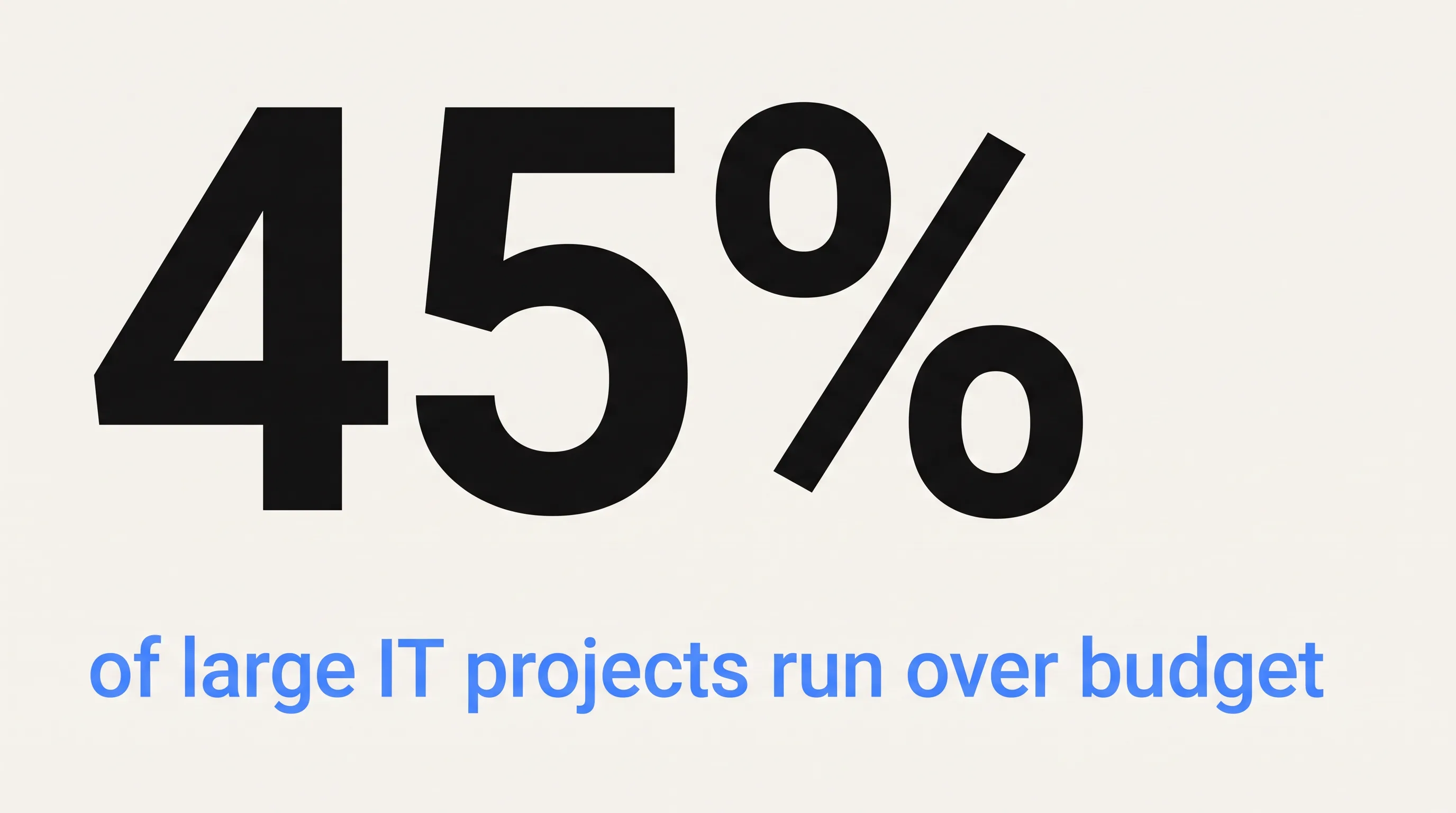
- Large IT projects run 45% over budget and deliver 56% less value than predicted, per the McKinsey and Oxford study of 5,400 projects.
- Team location moves the number most: senior developer rates run $75–$125/hour in North America versus $20–$50/hour in Asia, per AgileEngine’s 2025 data.
- Compliance is a real line item: HIPAA adds 15–25% and PCI-DSS adds 10–20% to base development cost (AgileEngine, 2025).
What Are the Main Ways to Estimate Software Development Cost?
The main ways to estimate software development cost are analogous (top-down) estimation, bottom-up estimation, three-point (PERT) estimation, parametric models, expert judgment, and story-point velocity. Analogous estimation compares your project to a similar past one and works at the idea stage. Bottom-up estimation breaks the project into tasks and sums them, and it is the most accurate once requirements exist. The others refine or range those two core approaches.
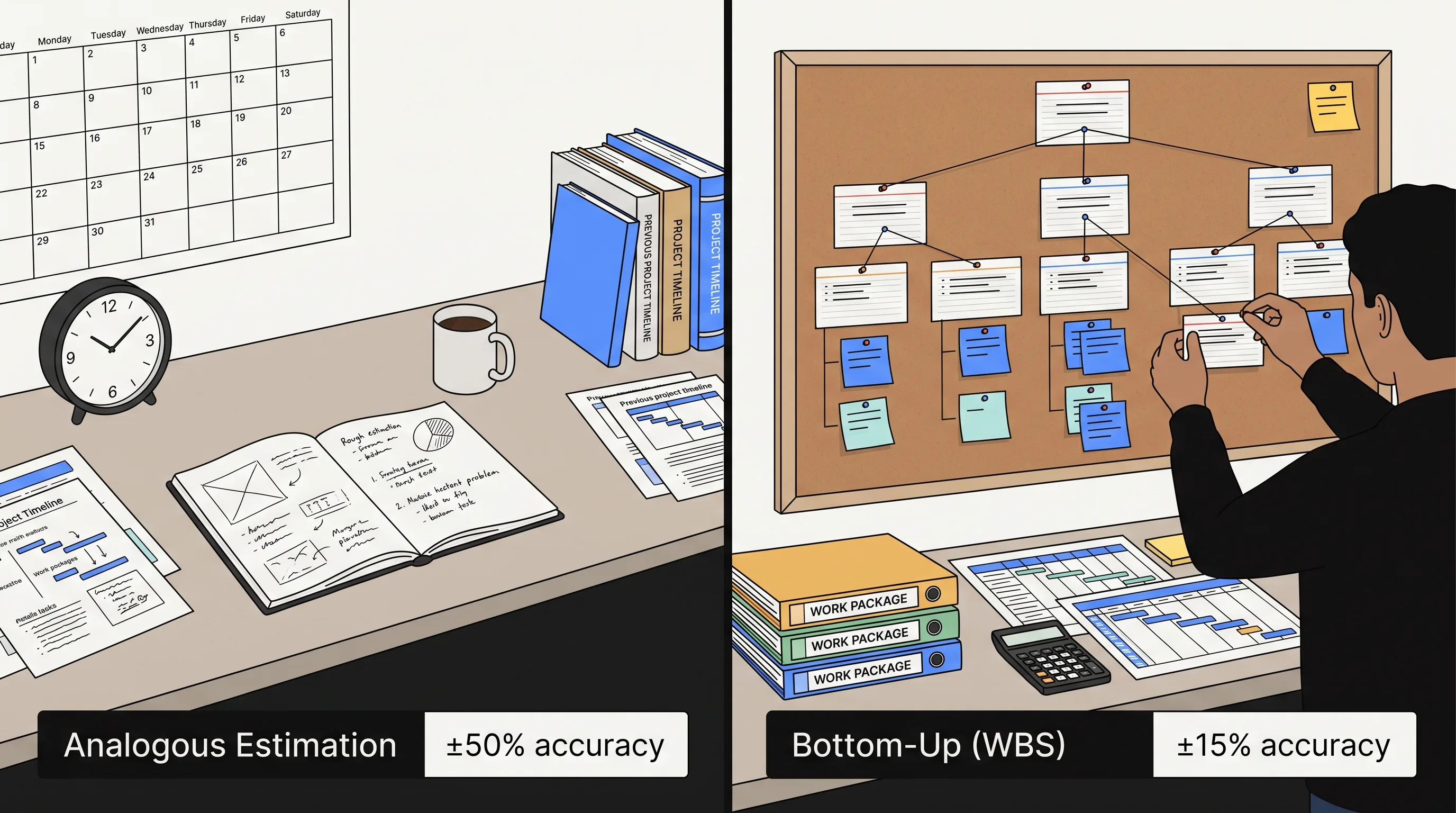
The practitioner’s rule that reference guides skip is this: analogous estimation only works when the comparable project is yours. Borrowing another company’s build as your analogue imports their team, stack, and scope assumptions, which is where the ±50% error comes from. If you cannot point to one of your own past projects that resembles the new one, you are not estimating top-down, you are guessing. That is the moment to invest in a bottom-up work breakdown instead.
Analogous and Bottom-Up Estimation
Analogous (top-down) estimation prices a new project against a similar completed one, delivering a fast figure with roughly ±50% accuracy, which suits concept-stage feasibility checks. Bottom-up estimation does the opposite: it decomposes the project into a feature-level work breakdown structure, estimates each task, and aggregates them, reaching about ±15% accuracy when requirements are well defined, according to Fora Soft’s 2026 software estimation guide.
The two methods trade speed for precision. Analogous estimation takes hours and tolerates missing detail. Bottom-up estimation takes days and demands a documented scope. ScienceSoft and nCube both structure their estimates around this same pairing, using top-down for ballpark numbers and bottom-up once a feature list exists.
PERT and Parametric Methods
Three-point (PERT) estimation and parametric models refine raw estimates rather than replace them. PERT converts a single guess into a range using the formula E = (O + 4M + P) / 6, where O, M, and P are the optimistic, most likely, and pessimistic values, as nCube’s 2026 estimation guide describes. You can layer PERT on top of either analogous or bottom-up numbers.
Parametric models such as COCOMO II, SEER-SEM, and Putnam SLIM predict effort statistically from size and productivity data, reaching around ±20% accuracy when calibrated to your own history. Uncalibrated, they are dangerous: applied to a NASA dataset without local calibration, basic COCOMO produced roughly 100% average error. Expert judgment alone carries 40% to 60% error, useful only as a sanity check. In 2026, AI-assisted triangulation joined the list as a first-pass way to draft work breakdown structures.
| Method | Best used when | Typical accuracy | Required inputs |
|---|---|---|---|
| Analogous (top-down) | Concept stage, feasibility | ±50% | One of your own similar past projects |
| Bottom-up (WBS) | Requirements are documented | ±15% | Feature-level task breakdown |
| Three-point (PERT) | Any stage with uncertainty | Converts a point to a range | Optimistic, most likely, pessimistic values |
| Parametric (COCOMO II) | You have calibrated history | ±20% calibrated | Size metrics, productivity data |
| Expert judgment | Very early, no data yet | 40%–60% error | Experienced engineers |
| Story points + velocity | Ongoing Agile teams | Improves each sprint | Team velocity, backlog in points |
How Accurate Is a Software Cost Estimate at Each Project Stage?
Software cost estimate accuracy improves as project definition improves, a pattern the industry calls the cone of uncertainty. According to PMBOK, a rough order of magnitude (ROM) estimate carries -25% to +75% accuracy, a budgetary estimate -10% to +25%, and a definitive estimate -5% to +10%, as documented by PM Study Circle in 2024. The budgetary estimate is the middle step, produced once preliminary scope is defined.

The 2026 Fora Soft analysis puts the same idea in multipliers: at the concept stage, real cost can land anywhere from 0.25× to 4× the estimate, narrowing to 0.9×–1.1× only after detailed technical design is signed off.
| Stage | Estimate type | Accuracy band (PMBOK) | When it’s produced | Typical method |
|---|---|---|---|---|
| Concept / initiation | Rough order of magnitude (ROM) | -25% to +75% | Before requirements are written | Analogous, expert judgment |
| Planning | Budgetary | -10% to +25% | After preliminary scope is defined | Bottom-up, parametric |
| Design complete | Definitive | -5% to +10% | After detailed design sign-off | Bottom-up with PERT |
The bands are a communication tool, not a technicality. A $100,000 ROM estimate should reach stakeholders as $75,000 to $175,000, the honest span of -25% to +75%, as AltexSoft illustrates. Quote the midpoint alone and you have promised a precision you do not have.
What Factors Drive Software Development Cost Estimates Up or Down?
Four factors move a software cost estimate the most: team location and hourly rate, project complexity, third-party integrations, and regulatory compliance. Platform count and ongoing maintenance follow close behind. Team location sets the base rate you multiply everything by, while complexity, integrations, and compliance act as multipliers on top of it. Get these five right and your estimate will hold; miss the compliance or integration lines and it will not.
Team Location and Hourly Rate
Team location is the single biggest variable in a blended-rate estimate. Senior developer rates run $75–$125/hour in North America, $40–$80/hour in Eastern Europe, $45–$65/hour in Latin America, and $20–$50/hour in India and Southeast Asia, according to AgileEngine’s October 2025 cost breakdown. The spread means the same feature set can differ two- or threefold in price before a line of code is written.
Most vendors sit lower than founders expect. A 2026 Techreviewer survey of 127 providers found that 90.5% of software development firms worldwide bill under $100/hour, with the largest single cohort at $30–$49/hour, as reported in Fullstack’s 2026 price guide. Enterprise consultancies charge $250–$500+/hour at the top end. Rate alone tells you little without the accuracy band and scope behind it, which is why our app and software development estimates always pair a rate with a defined scope.
Complexity, Integrations, and Compliance
Complexity, integrations, and compliance are the multipliers that turn a base rate into a real number. Moving a project from low to high complexity can raise cost three- to fivefold for the same headline feature. Third-party integrations are the most underestimated line: a simple integration adds $2,000–$10,000, while a complex legacy integration can add $20,000–$80,000 each.
Regulation is not optional cost. HIPAA compliance adds 15–25% to base development cost and PCI-DSS adds 10–20%, per AgileEngine’s 2025 breakdown. Every additional platform, whether iOS, Android, or web, adds its own engineering and test time. And the estimate does not end at launch: McKinsey figures cited by AgileEngine put annual maintenance at roughly 20% of the original development spend. Containing scope early, often through a phased MVP development approach, is the most reliable way to pull these multipliers down.
Need help estimating your software project cost?
We are here to help!
Should I Estimate in Story Points, Hours, or Dollars?
You should estimate in all three, in sequence, because they answer different questions for different audiences. Story points capture relative complexity for the delivery team, hours convert that complexity into calendar time, and dollars translate time into the number a board or vendor needs. Treating them as competing options is the mistake; they are stages of one pipeline.

The popular framing pits story points against hours as rivals. That is the wrong question. Story points let a senior and a junior developer agree on a size even when their actual hours differ twofold, which is why they suit Agile sprint planning, as Monday.com’s 2025 comparison explains. But points do not fund a project. You divide the backlog’s points by the team’s proven velocity to get sprints, multiply sprints by team hours, then apply a blended rate to reach dollars. Skip the middle steps and you are quoting a number with no delivery model underneath it.
The payoff of estimating from velocity is predictability. McKinsey found that cross-functional Agile teams tracking team-based velocity, rather than individual hours, reached 95% delivery predictability, per Monday.com’s 2025 analysis. Because cost and schedule fall out of the same velocity model, budgeting and timeline planning are really one exercise. Verdict: estimate in story points to plan work, convert through hours to price it, and present dollars to anyone approving the spend.
How Do I Turn a Rough Estimate Into a Number I Can Take to a Vendor or My Board?
Turn a rough estimate into a board-ready number with a simple formula: Total Cost = (Estimated Hours × Blended Hourly Rate) + Third-Party Services + Infrastructure + Contingency. The estimated hours come from your work breakdown or story-point velocity, the blended rate reflects your actual team mix, and contingency covers what you do not yet know. The output is a range, and the range’s width should match your estimate stage.
Build the Cost Formula
Building the cost formula means turning each input into a defensible figure. Estimated hours come from a bottom-up work breakdown or from backlog points divided by velocity. The blended hourly rate is a weighted average across the seniority mix you actually plan to staff, not the cheapest headline rate. Third-party services cover API fees, payment gateways, and licensed components; infrastructure covers cloud hosting and tooling.
Sanity-check the output against published benchmarks before you trust it. nCube’s 2026 figures put a small MVP at $10,000–$50,000, a mid-size app at $50,000–$250,000, a complex mobile-plus-backend product at $100,000–$400,000, and an enterprise system at $250,000–$1M+. If your bottom-up number lands far outside the band for your project type, you have either missed scope or mis-set the rate.
Add Contingency and Sanity-Check Against Benchmarks
Contingency is where discipline pays off, because unbuffered estimates fail at scale. According to Michael Bloch, Sven Blumberg, and Jurgen Laartz of McKinsey’s Business Technology Office, large IT projects “run 45% over budget and deliver 56% less value than predicted,” and 17% become black swans with overruns above 200%. A flat 15–25% contingency, plus a further 20–30% buffer for scope creep, is the standard guard.
Here is the refinement most guides miss: contingency should scale with your estimate stage, not sit at a flat percentage. ROM-stage work carries a -25% to +75% band, so a 20% buffer is wishful; a definitive-stage estimate at -5% to +10% barely needs one. Present the same $200,000 project as three ranges to make maturity visible: $150,000–$350,000 at ROM, $180,000–$250,000 at budgetary, and $190,000–$220,000 at definitive. The dollar center holds; the width tells your board how much is still unknown. Boards also ask how the spend books: under U.S. GAAP, development-stage work on internal-use software can be capitalized while maintenance stays operating expense, and Section 174 now requires certain R&D costs to be amortized, as LinearB’s 2025 guide details.
How Frame Sixty Estimates Projects
Frame Sixty, an AR/VR and spatial computing development studio, gives clients a real estimate once scope is defined, with line items, an accuracy band, and the assumptions behind each number, rather than a “contact us” wall. Our process runs discovery call, scope definition, feature-level work breakdown, then a bottom-up estimate wrapped in PERT ranges. The estimate type we hand over depends on how much is known: an inquiry with a one-paragraph idea gets an honest ROM range, while a documented spec earns a budgetary or definitive number.
Spatial and AR work sharpens why method choice matters. When we scope for devices like Apple Vision Pro or Meta Quest 3, analogous estimation is weak, because few teams have a genuinely comparable past build to anchor to. So we lean bottom-up and estimate against concrete engineering realities: frame budgets, target frame rates, asset counts, and per-device test passes. A rough order of magnitude figure is fine for a first conversation, but we will not call a number definitive until the scope behind it is written down. That discipline is how an estimate survives contact with delivery.
Conclusion
Estimating software development cost well is less about a magic number and more about matching your method to your project’s maturity. Start with analogous estimation to get moving. Switch to bottom-up once requirements exist, and wrap every figure in a PERT range. Your accuracy claims should sit on the PMBOK bands and your base rate on team location. Complexity, integrations, and compliance are the multipliers that decide whether the estimate holds.
The failures traced back through the McKinsey data rarely start with bad pricing. They start with a precise-sounding number quoted on rough-order-of-magnitude information. State what you know as clearly as what you charge, size contingency to your stage, and your estimate becomes a tool for decisions rather than a promise you cannot keep.
If you’d like a defensible number for your own project, get in touch with Frame Sixty. Once we understand your scope, you will get a real estimate with the assumptions and accuracy band that stand behind it.
FAQs
Common questions about how to estimate software development cost, covering estimation methods, accuracy bands, accounting treatment, and what to expect from a vendor's estimate.
You give a software development estimate by picking a method matched to project maturity, then presenting the result as a range with its accuracy band. Early on, analogous estimation gives a fast figure at roughly ±50% accuracy; once requirements exist, a bottom-up work breakdown reaches about ±15%. State the assumptions behind the number, not just the dollars.
Software development can be capex or opex depending on the stage of work. Under U.S. GAAP (ASC 350-40), development-stage work on internal-use software can be capitalized, while post-launch maintenance and bug fixes stay operating expense. Section 174 also requires certain R&D costs to be amortized rather than expensed immediately, per LinearB's 2025 guide.
The five levels of cost estimation map to how much a project is defined, following the cone of uncertainty. They run from a rough order of magnitude at the concept stage (-25% to +75% under PMBOK), through budgetary estimates (-10% to +25%) once scope is set, to a definitive estimate (-5% to +10%) after detailed design sign-off, tightening as information improves.
You calculate development cost with the formula: Total Cost = (Estimated Hours × Blended Hourly Rate) + Third-Party Services + Infrastructure + Contingency. Estimated hours come from a bottom-up work breakdown or from backlog points divided by velocity, and a flat 15–25% contingency is the standard buffer. Sanity-check the output against published project-type benchmarks.
A rough order of magnitude (ROM) estimate is an early figure produced before requirements are written, carrying -25% to +75% accuracy under PMBOK. It uses analogous estimation or expert judgment for feasibility checks. A $100,000 ROM estimate should reach stakeholders as $75,000 to $175,000 — quoting the midpoint alone promises a precision the estimate does not have.
The PERT formula for software project estimation is E = (O + 4M + P) / 6, where O is the optimistic value, M the most likely, and P the pessimistic. This three-point method converts a single guess into a weighted expected value and a range. You can layer PERT on top of either analogous or bottom-up numbers, per nCube's 2026 guide.
Team location is the single biggest variable in a software development estimate, setting the base rate everything else multiplies against. Senior developer rates run $75–$125/hour in North America, $40–$80/hour in Eastern Europe, and $20–$50/hour in India and Southeast Asia, per AgileEngine's 2025 data. The same feature set can differ two- or threefold in price.
The cone of uncertainty in software estimation describes how estimate accuracy improves as project definition improves. At the concept stage, real cost can land anywhere from 0.25× to 4× the estimate, narrowing to 0.9×–1.1× only after detailed technical design is signed off, according to Fora Soft's 2026 analysis. It is why estimates should widen with uncertainty, not pretend precision.
In a software development estimate, look for line items, a stated accuracy band, and the assumptions behind each number rather than a single figure or a "contact us" wall. Frame Sixty runs discovery, scope definition, and a feature-level work breakdown, then delivers a bottom-up estimate wrapped in PERT ranges, matching the estimate type to how much scope is documented.