
MVP Software Development Services: Cost, Timeline, and What a Good Studio Delivers
Sep 16, 2026
13 MIN READ
MVP software development services are the design, engineering, and launch work a studio does to turn a product idea into a working first version that real users can use. A sound engagement covers product definition, design, frontend and backend development, testing, and store submission. Before you sign anything, get the essentials in writing: a cost band tied to a defined scope, a realistic timeline, and a handover agreement that transfers both the code and its ownership. The studios worth hiring commit to every one of those. The ones that answer every question with “it depends” and route you to a “contact us for a quote” wall are selling billable hours, not a shipped product.
That is the stance of this guide. An MVP engagement is worth buying only when the studio will name a scope, name a number, and hand you the keys at the end. A vendor that will do none of that is the one to walk away from.
Key Takeaways
- Most MVPs reach launch in 8 to 16 weeks, with 3 to 4 months the realistic window for a polished first version, according to Netguru’s 2026 timeline guide.
- Time-and-materials engagements run 30% to 60% over budget without strong client direction, per Acquaint Softtech’s 2026 analysis, which makes scope discipline the buyer’s main defense.
- Roughly 24% of code-ownership disputes trace to a missing IP assignment clause, ProgressiveRobot reported in 2026 — a contract gap, not a technical one.
- About 42% to 43% of startups fail because they build something nobody wants, Enacton’s 2026 data shows, which is the exact risk an MVP retires.
- A spatial or Apple Vision Pro pilot MVP tends to cost roughly three to four times a comparable Meta Quest build, because 3D asset production, not code, sets the hours.
What Is Included in MVP Software Development Services?
MVP software development services cover the full path from idea to a launchable first version: product discovery and definition, UX and UI design, frontend and backend engineering, quality assurance, deployment, and submission to the App Store or Google Play. A studio that does the job well also sets up your source control, build pipeline, and analytics so you can measure what users actually do after launch. The deliverable is a product, not a demo.
What is usually not in the base price matters just as much. Post-launch maintenance, marketing, security or compliance audits, and content production for spatial builds tend to be separate line items. Ask which of these are included and which are extra before you compare quotes, because a lower price often just signals a smaller scope.
Scope also varies by platform. A native iOS app development engagement carries different testing and submission work than a web build, and a cross-platform product multiplies both. Get the platform list fixed early. It is the single biggest lever on everything downstream.
How Much Do MVP Software Development Services Cost?
MVP software development services cost anywhere from a low five-figure sum for a simple single-platform build to a six-figure investment for a data-heavy or regulated product. Independent 2026 cost guides put the typical range from about $15,000 to $150,000 or more (SoftTeco, 2026; Helpware, 2026). The spread is wide because “MVP” describes a goal, not a fixed amount of work.

The main cost drivers are team location, product complexity, platform count, compliance requirements, and whether the build includes spatial content and custom art. Senior engineering talent in North America and Western Europe bills roughly $50 to $200 an hour, while teams in Eastern Europe and Latin America run lower, according to SoftTeco’s 2026 breakdown. AI-assisted development can cut MVP cost by up to 30% to 40%, Helpware reported in 2026, though it does not remove the need for senior review.
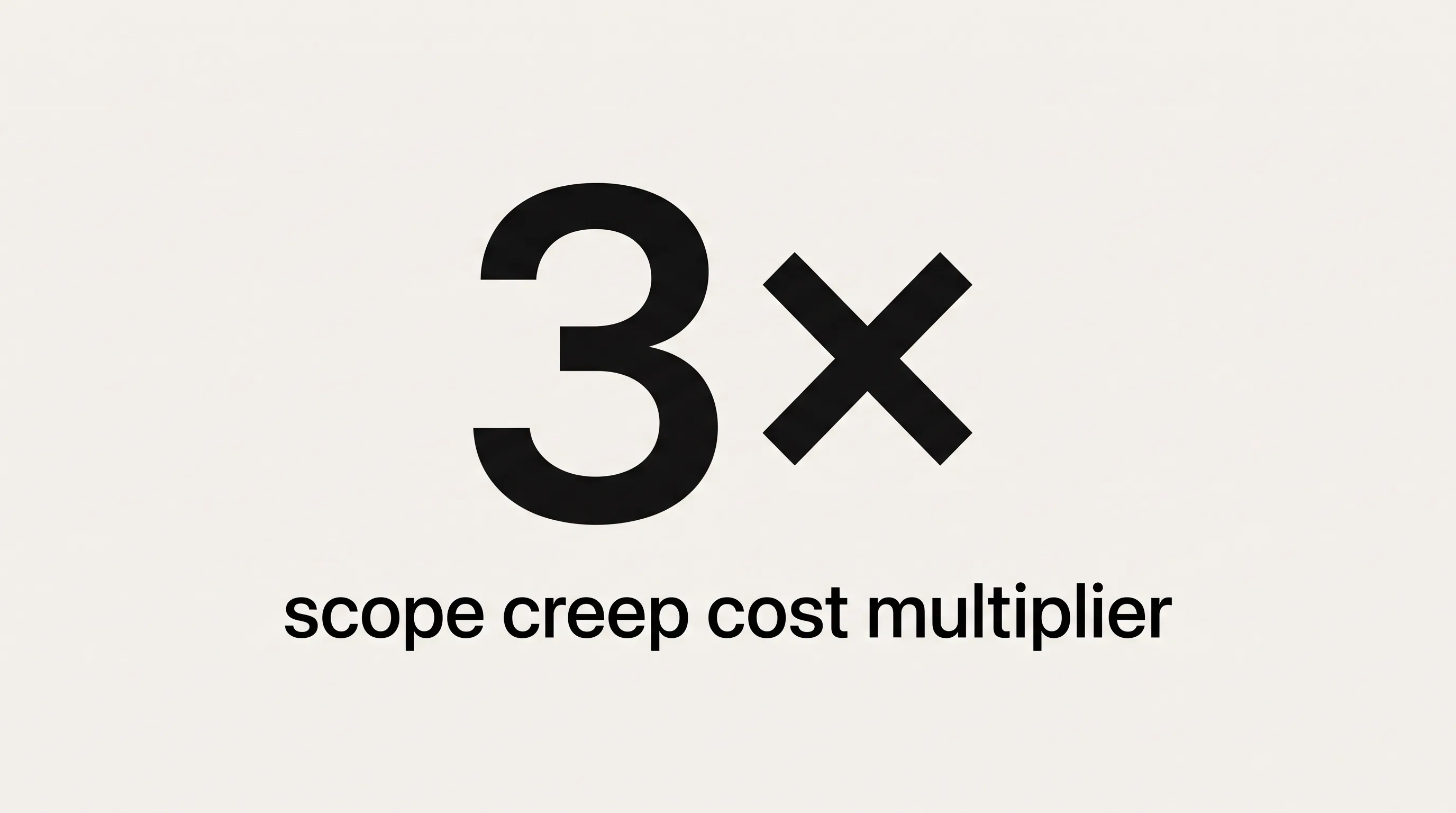
One number should worry you more than the headline rate. Scope creep during the build carries roughly a 3x cost multiplier, Radixweb noted in 2026, which is why a locked scope protects your budget more than a low hourly rate ever will.
What Does an MVP Cost by Type?
The cost bands below are our own estimates as a product studio, grouped by the kind of MVP rather than by a generic complexity label. Treat them as planning ranges to take to a scoping call, not quotes. Every band assumes a defined scope and a clean handover.
| MVP Type | Typical Cost Band | Typical Timeline | Best For |
|---|---|---|---|
| Simple web or mobile MVP | Low-to-mid five figures | 6–10 weeks | One platform, one core workflow |
| Standard web or mobile MVP | Mid-to-high five figures | 10–16 weeks | Accounts, payments, a few integrations |
| Data- or integration-heavy MVP | Six figures | 16–24 weeks | Complex backends, third-party systems |
| AR/VR or spatial pilot MVP | Six figures | 12–20 weeks | A Vision Pro or Quest proof of concept |
Regulated builds sit at the top of every band. GDPR-grade data handling can add $25,000 to $115,000 and HIPAA compliance $18,000 or more, according to Helpware’s 2026 cost guide. If your product touches health or financial data, price that in from day one rather than discovering it in month three.
How Do I Cut MVP Scope to Fit a Fixed Budget?
You cut MVP scope by subtraction, not compression. The goal is fewer features built properly, not every feature built halfway. This works because 80% of software features are rarely or never used, Enacton reported in 2026, so most of what a first plan contains is not what proves the idea. Start from the one job the product must do and remove everything that does not serve it.
A short set of questions gets teams under budget:
- What is the single job this MVP has to prove it can do?
- What can ship as a manual, human-run process before you build automation?
- Which integrations can start as stubs or mocked data instead of live connections?
- What can be a future settings screen instead of a built feature now?
Cutting scope also shortens the build, and the build is where most of the money goes. Scope drives the schedule far more than team size does, as this guide to app build timelines lays out in detail.
How Long Does It Take to Build an MVP?
Most MVPs reach launch in about 8 to 16 weeks, and the realistic window for a well-built first version is 3 to 4 months, according to Netguru’s 2026 guide. Simpler no-code or single-platform builds can ship faster; regulated or multi-platform products run longer. The average hides a lot, so anchor your plan to your own scope, not to a headline figure.

The timeline turns on two things more than anything else: the quality of discovery before the build starts, and the number of platforms you ship to. Weak discovery produces mid-build rework, and every extra platform adds its own testing and submission cycle. Agile delivery trims timelines by 15% to 30% versus waterfall, Netguru noted in 2026, mostly by catching wrong turns early.
What Is the Timeline by MVP Complexity?
The duration bands below are our planning estimates for a focused MVP with a locked scope. They assume a senior team and a decision-maker available to unblock questions quickly. Add time if either is missing.
| MVP Tier | Typical Duration | What Drives It |
|---|---|---|
| Lean | 2–6 weeks | One platform, minimal integrations |
| Standard | 6–12 weeks | Accounts, payments, a few integrations |
| Complex | 12–24 weeks | Compliance, multiple platforms, 3D content |
Spatial builds are their own case. Apple Vision Pro and other headset projects add time because 3D asset production, not engineering, is the scheduling bottleneck and can consume 50% to 70% of development hours, as the same app build timeline guide explains. Plan the art pipeline as early as you plan the code.
Fixed-Scope, Time-and-Materials, or Dedicated Team: Which Engagement Model Protects the Buyer?
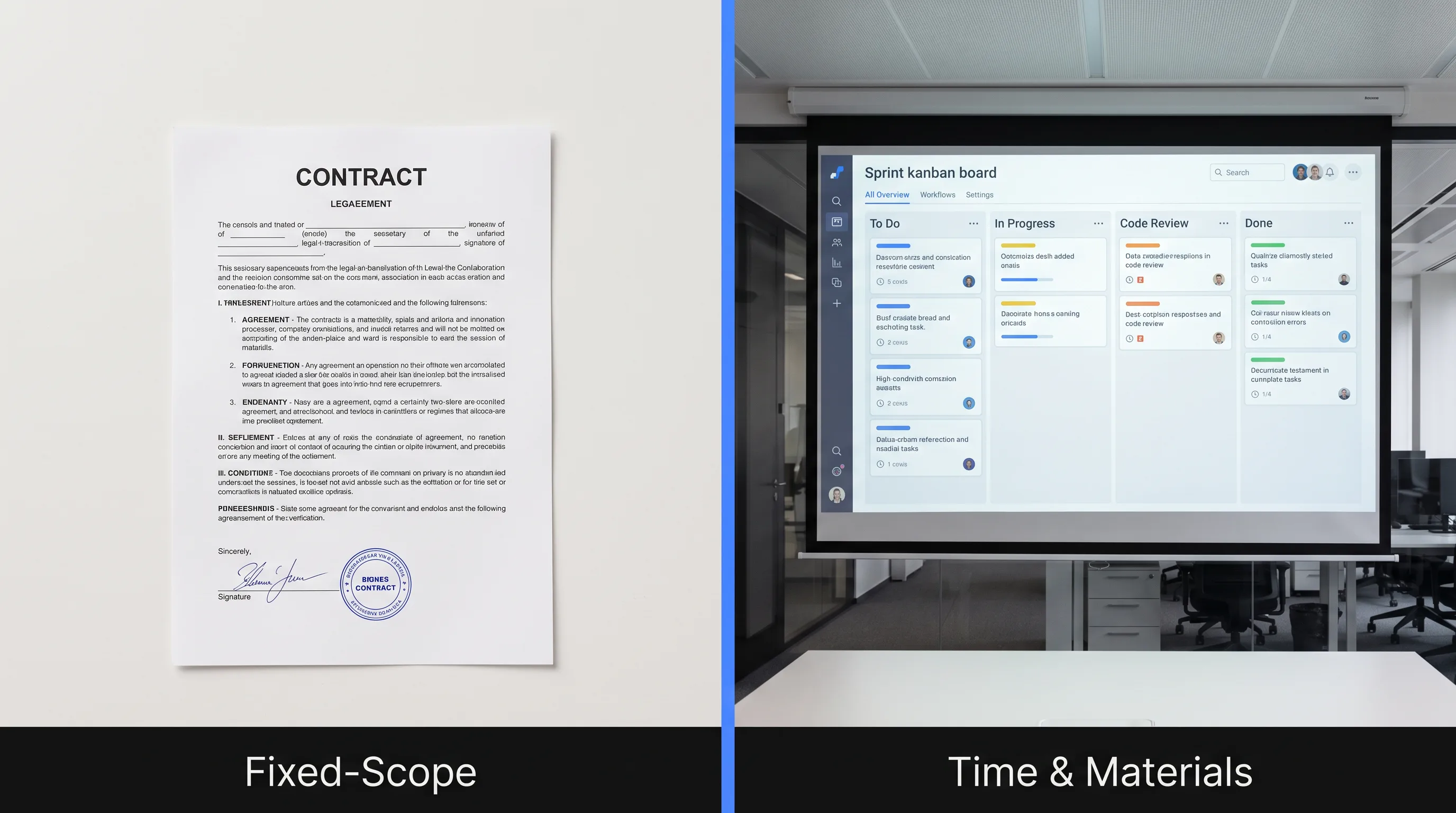
The engagement model decides who carries the risk when scope moves, which for an MVP it always does. Fixed-scope puts delivery risk on the vendor but locks the feature set. Time-and-materials keeps the feature set flexible but puts cost-overrun risk on you. A dedicated team shares the risk across a monthly commitment. As Acquaint Softtech put it in 2026, “The model decision matters more than most companies realise.”
| Dimension | Fixed-Scope | Time & Materials | Dedicated Team |
|---|---|---|---|
| Budget predictability | High | Low | High (monthly) |
| Scope flexibility | Low | High | High |
| Who holds the risk | Vendor | Buyer | Shared |
| Best for | Locked, short specs | Evolving MVP builds | Ongoing product |
The numbers back the flexible model for MVPs, with a catch. Time-and-materials engagements commonly exceed their estimate by 30% to 60% without strong client direction, while a dedicated team runs 15% to 25% cheaper than fixed-price on work beyond six months, per Acquaint Softtech’s 2026 analysis. A dedicated pod of two developers and a tech lead runs about $9,500 to $14,000 a month, per Acquaint Softtech’s 2026 figures. That flexibility only pays off when someone on your side owns the priorities each sprint.
Verdict: choose time-and-materials for an MVP whose requirements will move, fixed-scope only when the specification is genuinely locked and the build is short, and a dedicated team once you have real users and a roadmap to execute against.
Need help with your MVP software build?
We are here to help!
What Does an AR, VR, or Spatial Computing MVP Cost?
An AR, VR, or spatial computing MVP is a pilot: one use case, built well enough to prove or kill it before a full rollout. It follows the same MVP logic as a mobile app, with one difference in the cost structure. Custom XR applications typically cost $50,000 to $300,000 and ship in three to nine months, according to the XR development agency cost breakdown. The variable that moves that range is the content pipeline, not the headset.
In our spatial computing work at Frame Sixty, an AR/VR and spatial computing development studio, the scope discipline is identical to a mobile MVP: one environment, one core interaction loop, one target device. We build native visionOS in SwiftUI and cross-platform experiences in Unity, and on nearly every spatial project the art pipeline, not the engineering, sets the schedule. A pilot on Apple Vision Pro tends to cost roughly three to four times a comparable Meta Quest build, as the VR development cost guide details, because the higher-fidelity device demands more from every 3D asset.
The enterprise appetite is real, not speculative. More than 75% of Fortune 500 companies have run XR pilots or production deployments, and VR training can cut cost per learner by 52% at scale, according to the same XR development agency research. Daria Pohrebniak, Marketing Director at ReVerb, describes enterprise XR adoption as “defined by long timelines, evolving requirements, and close collaboration” between technical and business teams — which is exactly why a scoped pilot beats an open-ended program.
If your idea lives on a headset or in the room, treat it as a pilot MVP first. Whether it is an augmented reality overlay, a virtual reality training scenario, or native Apple Vision Pro development, the same rule holds: prove one loop, then expand.
What Should an MVP Development Studio Hand Over at the End?
A good MVP studio hands over everything you need to keep building without them. That means the source code repository with full commit history, the CI/CD pipeline, environment configuration, API documentation, App Store and Google Play credentials, domain and DNS control, and the third-party service accounts in your name. A handover that is a zipped export of current files, not the live repository, is a red flag. You are buying a product you can own and extend, not a black box.
When we hand off an MVP at Frame Sixty, the package is the git repository with its full history, the build pipeline, environment configs, the documentation, and every service account transferred to the client. You should be able to part ways with us and keep shipping the next morning. Our portfolio exists partly for this reason: a studio willing to show what it has shipped is a studio comfortable being held to the standard of a clean handover.
One line item to check explicitly is post-launch support. Maintenance is usually separate from the build, and studios that fold a 30- to 90-day bug-fix runway into the launch price are the exception, not the rule. Ask what happens in the first weeks after launch, when real users find the edges your test plan missed.
Who Owns the Source Code After an Agency Builds Your MVP?
Paying for development does not automatically transfer code ownership. Under US and UK copyright law, the developer who writes the code owns it by default unless a contract assigns it, ProgressiveRobot explained in 2026. This surprises founders who assume an invoice buys the IP. It does not; a clause does.
The stakes show up at your next fundraise. “Investors check code ownership in due diligence; a licence-only arrangement is a red flag,” SuLe wrote in 2026. About 24% of ownership disputes stem from a missing assignment clause, and full assignment can add a 5% to 15% premium, per ProgressiveRobot’s 2026 guide. Pay the premium. It is cheaper than a stalled term sheet.
Require four things in the contract: a full IP assignment rather than a licence, assignment triggered on payment rather than on the final invoice clearing, a waiver of moral rights from the developers, and disclosure of any open-source or reusable components. Get it in writing before work starts.
What Questions Should I Ask Before Signing an MVP Contract?
Ask the questions that separate a studio that ships from a shop that bills. Paste these into your RFP:
- Can you show me a shipped product and the team that built it? Ask to see the portfolio and who did the work.
- Who owns the source code, and does the contract use the word “assignment”?
- What is your default engagement model, and why that one for my project?
- How do you lock scope before the build, and what is the change-order process?
- What is in the handover package: repository, pipeline, credentials, documentation?
- What compliance or security work have you handled before, such as GDPR, HIPAA, or App Store review?
- Have you shipped on my target platform, whether iOS, Android, visionOS, or Meta Quest?
- What does post-launch support cost, and for how long?
A vendor who dances around questions 1, 2, or 5 is telling you something. They are billing time, not shipping a product you will own.
When Are MVP Development Services the Wrong Purchase?
MVP development services are the wrong purchase in a few honest situations, and a studio worth trusting will tell you so. The first is a product that must be trusted on first use, such as a medical, legal, or financial tool, where a rough first version damages the brand more than a slow launch would. In those cases a Simple, Lovable, Complete build — one finished slice that solves a single problem well — outperforms a half-built MVP, as low-code strategists argued in 2026.
The second case is when the problem is already solved and your real question is execution, not validation. If you know users want the thing, a clickable prototype or a manual “Wizard of Oz” test answers the open questions faster and cheaper than a coded MVP.
The third case is the one nobody selling development wants to name. If your team cannot or will not act on the data an MVP produces, the build is wasted. The product ships, users behave in ways the plan did not predict, and the signal gets ignored. An MVP is a learning instrument, not a launch event. Buy one only when you are ready to change your mind based on what it tells you.
Conclusion
MVP software development services are worth buying when the studio will commit to a scope, a number, and a clean handover — and worth walking away from when it will not. The market data supports the discipline: startups fail by building the wrong thing, time-and-materials work drifts over budget without direction, and ownership disputes come from missing clauses rather than bad code. None of those risks are technical. They are decisions you make before the first sprint.
Take the cost bands and the vendor checklist above into your next conversation. A studio that can give you a defensible number and a concrete next step has already told you what you need to move. That is the bar. The rest is scope discipline and a contract that hands you the keys.
If you are weighing MVP software development services, whether a mobile product, a web platform, or a spatial pilot, get in touch with Frame Sixty to scope it. You can also see the full range of what we build on our app development page. Bring your one core job to prove, and we will give you a number to take to your board.
FAQs
Common questions from founders and product leads buying MVP software development services. Each answer covers cost, timeline, ownership, and how to pick a studio that ships.
An MVP proves whether users want a product by shipping its single core job, while a minimum lovable product, also called simple, lovable, complete, delivers one finished slice polished enough to be trusted on first use. For medical, legal, or financial tools where a rough version damages the brand, low-code strategists argued in 2026 that an SLC build outperforms a half-built MVP.
An MVP is ready to ship when it lets real users complete the one core job the product must prove, not when every planned feature is built. Because 80% of software features are rarely or never used, per Enacton's 2026 data, most of a first plan is optional. Ship once the core loop works and you can measure what users do next.
A realistic MVP timeline for a mobile app is about 8 to 16 weeks, with 3 to 4 months the window for a polished first version, according to Netguru's 2026 guide. Single-platform builds ship faster, while regulated or multi-platform products run longer. Discovery quality and platform count drive the schedule far more than team size does.
A SaaS MVP typically costs a low-to-mid five-figure sum for a single-platform build and reaches six figures for a data-heavy or regulated product. Independent 2026 guides put the general MVP range at roughly $15,000 to $150,000 or more (SoftTeco, 2026). Team location, platform count, and compliance requirements move the number most.
AI-assisted development can lower MVP cost by up to 30% to 40%, Helpware reported in 2026, mainly by speeding routine coding. It does not remove the need for senior review, so treat it as a discount on some hours rather than a replacement for engineering judgment. The savings shrink as product complexity and compliance requirements rise.
The biggest hidden cost in an MVP is scope creep, which carries roughly a 3x cost multiplier mid-build, Radixweb noted in 2026. Compliance is the other: GDPR-grade data handling can add $25,000 to $115,000 and HIPAA $18,000 or more, per Helpware's 2026 guide. Post-launch maintenance and marketing usually sit outside the base build price too.
Before signing an MVP contract, ask who owns the source code and whether the contract uses the word assignment, what the handover package contains, how scope is locked before the build, and to see a shipped product with the team that built it. A vendor who dodges code ownership or the handover is billing time, not shipping a product you will own.
You do not automatically own the source code after an MVP agency builds your product. Under US and UK copyright law, the developer owns the code by default unless a contract assigns it, ProgressiveRobot explained in 2026. Require full IP assignment triggered on payment; about 24% of ownership disputes stem from a missing assignment clause.
Look for an MVP development partner that commits to a defined scope, a defensible cost band, and a clean handover of the repository, pipeline, and IP. Frame Sixty, an AR/VR and spatial computing development studio, ships mobile, web, and spatial pilots and transfers the git repository with full history plus every service account at handover. Avoid studios that answer only with contact us for a quote.