
How to Hire Mixed Reality Developers in 2026: Skills, Costs, and Red Flags
Sep 22, 2026
14 MIN READ
Mixed reality developers build applications that blend digital content with the physical world across augmented reality, virtual reality, and spatial computing hardware. Hiring one well comes down to three decisions: the engagement model you pick (freelance, agency, or in-house), a portfolio that proves shipped work on your target device, and a budget that treats 3D content as the largest line item. This guide covers each in turn.
One argument drives this guide. Most mixed reality hires fail not on raw coding ability but on two blind spots: an untested 3D content pipeline and weak device-level performance discipline. Screen for those first, and the rest of the vetting gets easier.
Key Takeaways
- Freelance mixed reality developers run $30–$100/hr, US agencies charge $50–$200/hr, and senior in-house engineers reach $181,965/year (arvrjobs.dev, 2026).
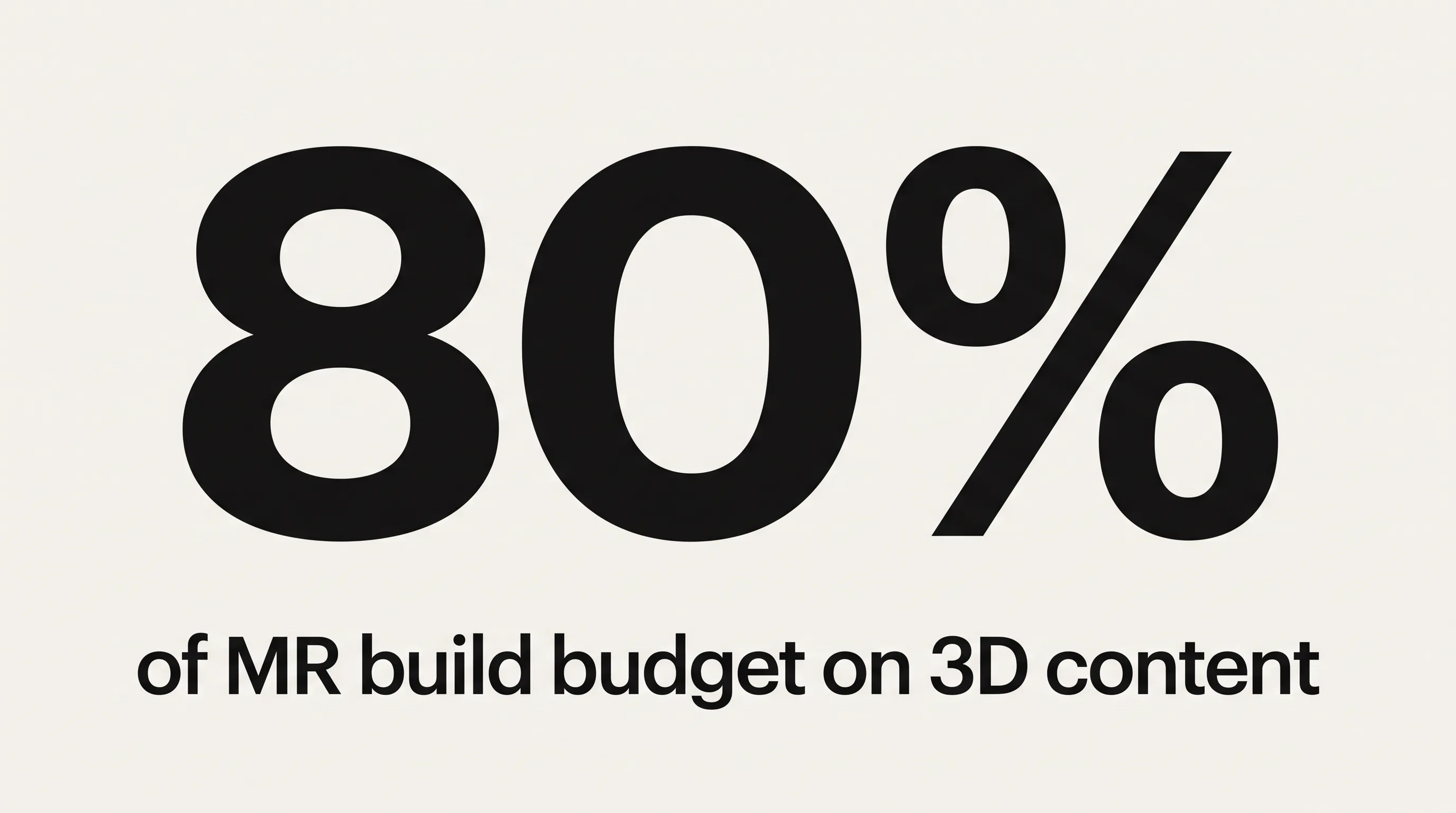
- 3D content, not code, drives roughly 80% of a mixed reality build budget, so vet the art pipeline before the engine résumé.
- Unity powers about 60% of AR/VR content, while Apple Vision Pro and Samsung Galaxy XR demand RealityKit or Snapdragon Spaces experience specifically.
- A typical enterprise mixed reality module costs $130K–$200K all-in, and that figure is only 50–70% of true three-year spend.
- Ask which SDKs a developer has shipped against, not prototyped with, to separate real device experience from demo reels.
What Does a Mixed Reality Developer Actually Do?
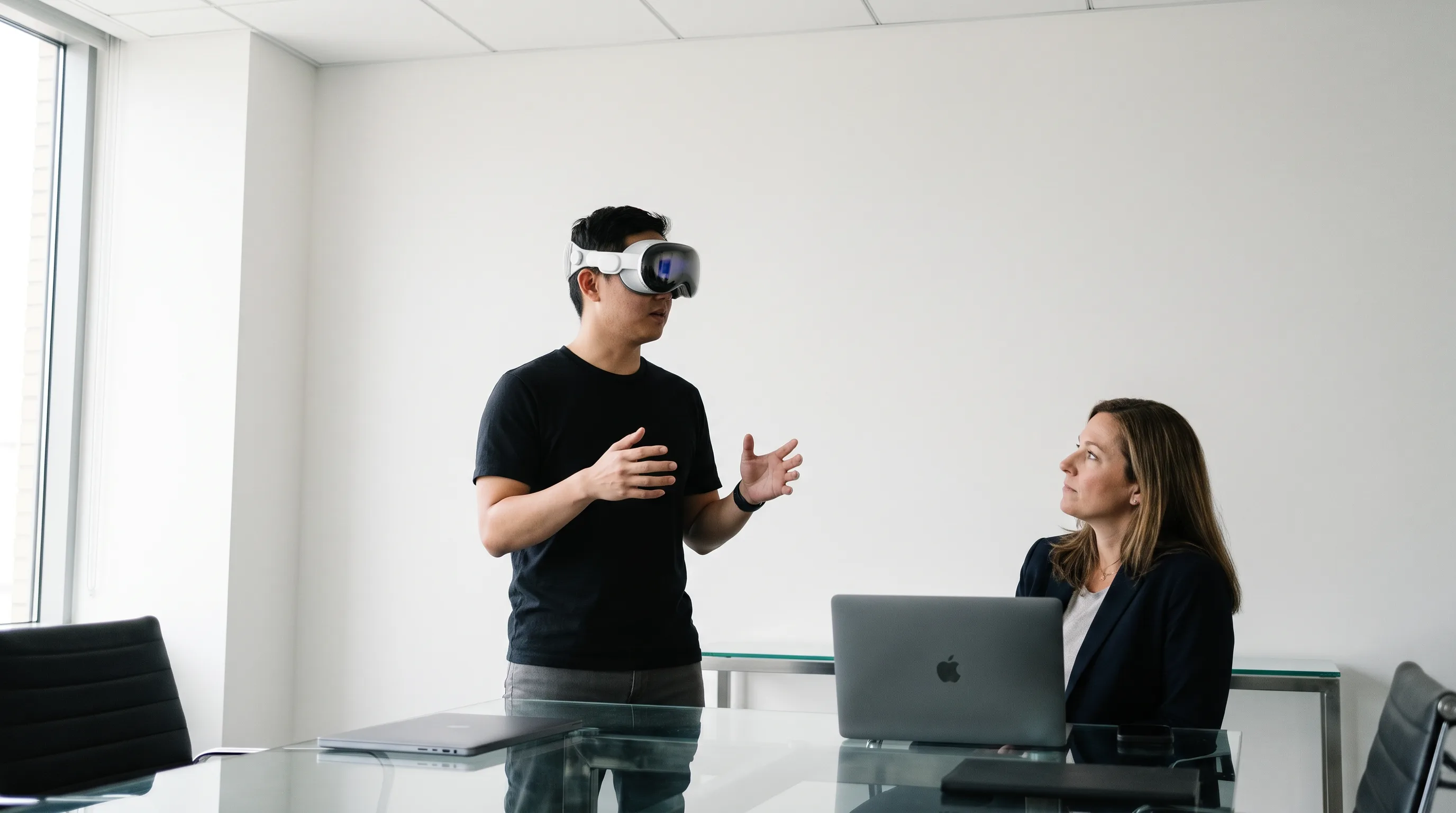
A mixed reality developer builds software that places interactive digital objects into a user’s real environment and keeps them anchored, occluded, and responsive as the user moves. The role spans augmented reality, virtual reality, and spatial computing rather than VR alone. In practice that means passthrough apps on Meta Quest 3 and Apple Vision Pro, inside-out tracked experiences on Samsung Galaxy XR, and see-through holographic work on Microsoft HoloLens 2.
What they ship varies by client. Common projects include enterprise training simulations, industrial digital twins built in VR, customer-facing AR, and native visionOS apps. Because these builds sit at the meeting point of engineering, 3D art, and interaction design, “mixed reality developer” describes a role cluster more than a single job title. If the underlying concept is still fuzzy for stakeholders, our primer on what spatial computing is sets the baseline.
Demand explains why good candidates are scarce. According to arvrjobs.dev’s 2026 hiring data, roughly 80,000 XR jobs exist worldwide today, with projections of 2.3 million by 2030 as adoption climbs in manufacturing, healthcare, and training. Thin supply plus rising demand is exactly the market where a weak vetting process gets expensive. The takeaway: define what your project actually ships before you write a single job description.
Mixed Reality Developer Skills and Portfolio Checklist
A strong mixed reality developer proves four things through shipped work: engine proficiency, device-level SDK experience, spatial UX and performance discipline, and command of the 3D content pipeline. Portfolios that show published apps beat portfolios of renders and demo reels every time. Use the sub-sections below as a screening sequence, top to bottom.
Engine Experience: Unity, Unreal, and RealityKit
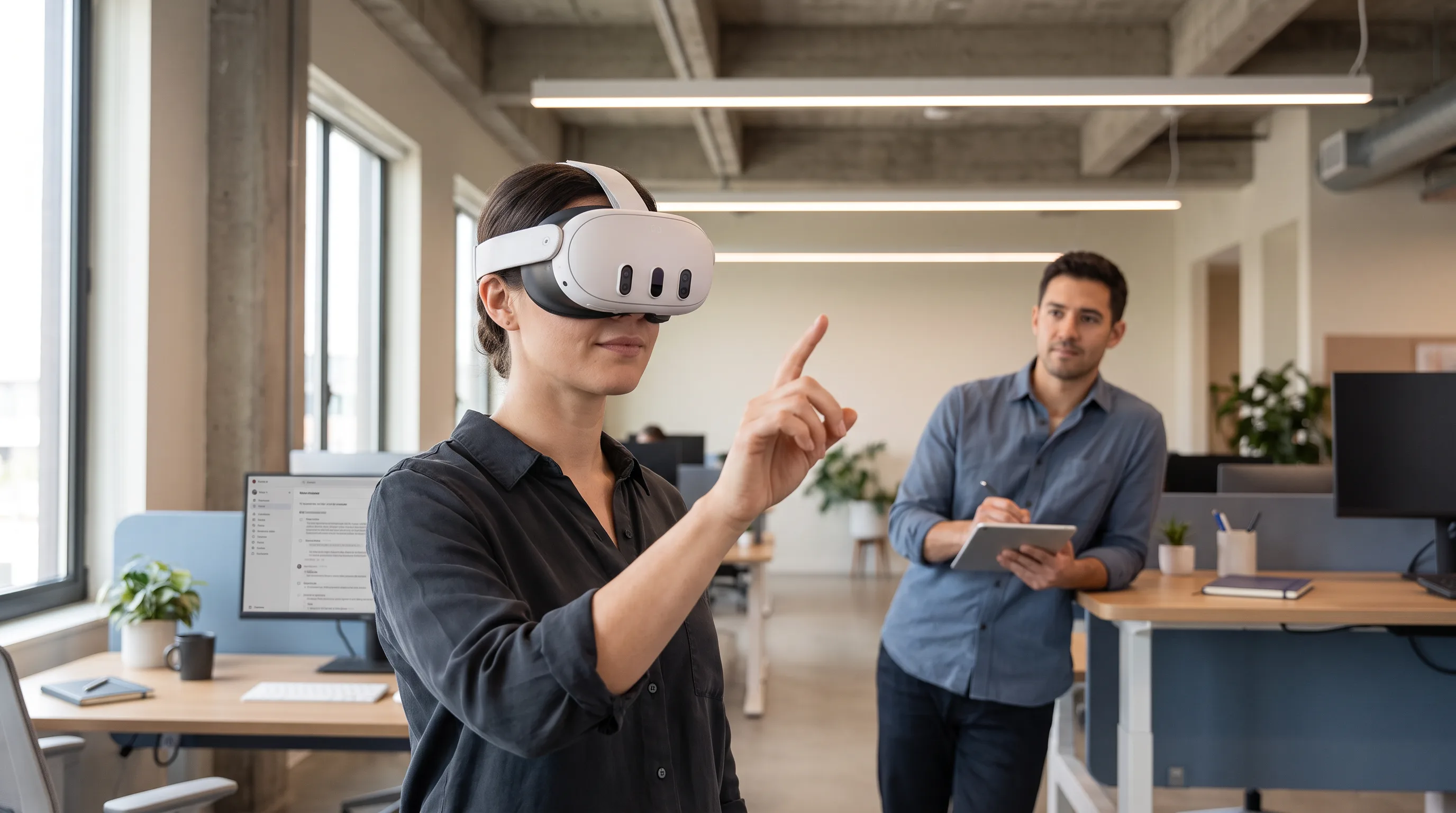
Engine experience is the first filter, and the market concentrates on three. Unity powers about 60% of AR/VR content according to arvrjobs.dev’s 2026 breakdown, which cites ARWall’s 2025 figure, and it leads on standalone headsets like Meta Quest 3. Unreal Engine 5 wins high-fidelity, PC-tethered simulation. RealityKit paired with visionOS is the native path for Apple Vision Pro development and requires Xcode and SwiftUI fluency.
Ask a direct question. Which engine did you use on your last shipped project, and why? A strong answer ties the choice to a hardware constraint rather than personal preference. Unity’s PolySpatial workflow now lets one codebase target both visionOS and Android XR, so a candidate who mentions it understands cross-platform economics. Be wary of anyone claiming equal mastery of all three engines with no shipped title in each.
Device Coverage and Platform SDKs
Device coverage matters because each headset class carries its own SDK, and emulator work does not equal shipping. Meta Quest 3 uses the Meta Presence SDK and OpenXR. Samsung Galaxy XR runs on Android XR with the Snapdragon Spaces and Jetpack XR SDKs, documented on Google’s Android XR platform pages and covered further in our guide to Android XR development. Apple Vision Pro relies on ARKit, RealityKit, and Metal. HoloLens 2 and enterprise Windows MR use the Mixed Reality Toolkit, detailed in Microsoft’s Mixed Reality documentation.
The most reliable vetting question I know is deceptively small. Ask which SDKs a candidate has shipped production code against, not merely prototyped with. A developer who has only run a project in the simulator has never fought thermal throttling, tracking dropout, or the App Store review quirks that appear on real hardware. Vetted marketplaces like Arc.dev pre-screen for some of this, but the shipped-versus-prototyped distinction is yours to confirm.
There is a budget angle here too. OpenXR, the Khronos cross-platform standard, is often treated as a nice-to-have. Treat it as a cost lever instead. A developer fluent in OpenXR can target several headsets from shared abstractions, which directly trims the 25–40% cross-platform premium that multi-device builds otherwise carry. That reframes a standards skill as a line item on your estimate.
Spatial UX and Performance Optimization
Spatial UX and performance optimization separate mixed reality developers from general mobile engineers. Hand tracking, eye tracking, and controller-free input are their own design discipline, and the performance floor is non-negotiable: 72 to 90 frames per second on-device with motion-to-photon latency under 20 milliseconds. Miss those numbers and users feel sick, which ends projects. The skills detail in this VR developer skills and career roadmap maps the territory well.
Probe for real debugging history. A good screening question: what profiling tools do you use, and what was the worst frame-rate problem you diagnosed? Strong candidates name specific tools and walk through a root cause they found and fixed. They talk about draw calls, level-of-detail swaps, foveated rendering, and occlusion culling without prompting. Vague reassurance that “it ran fine” is a fail on a discipline that decides whether an app is usable.
3D Content Pipeline and Asset Proficiency
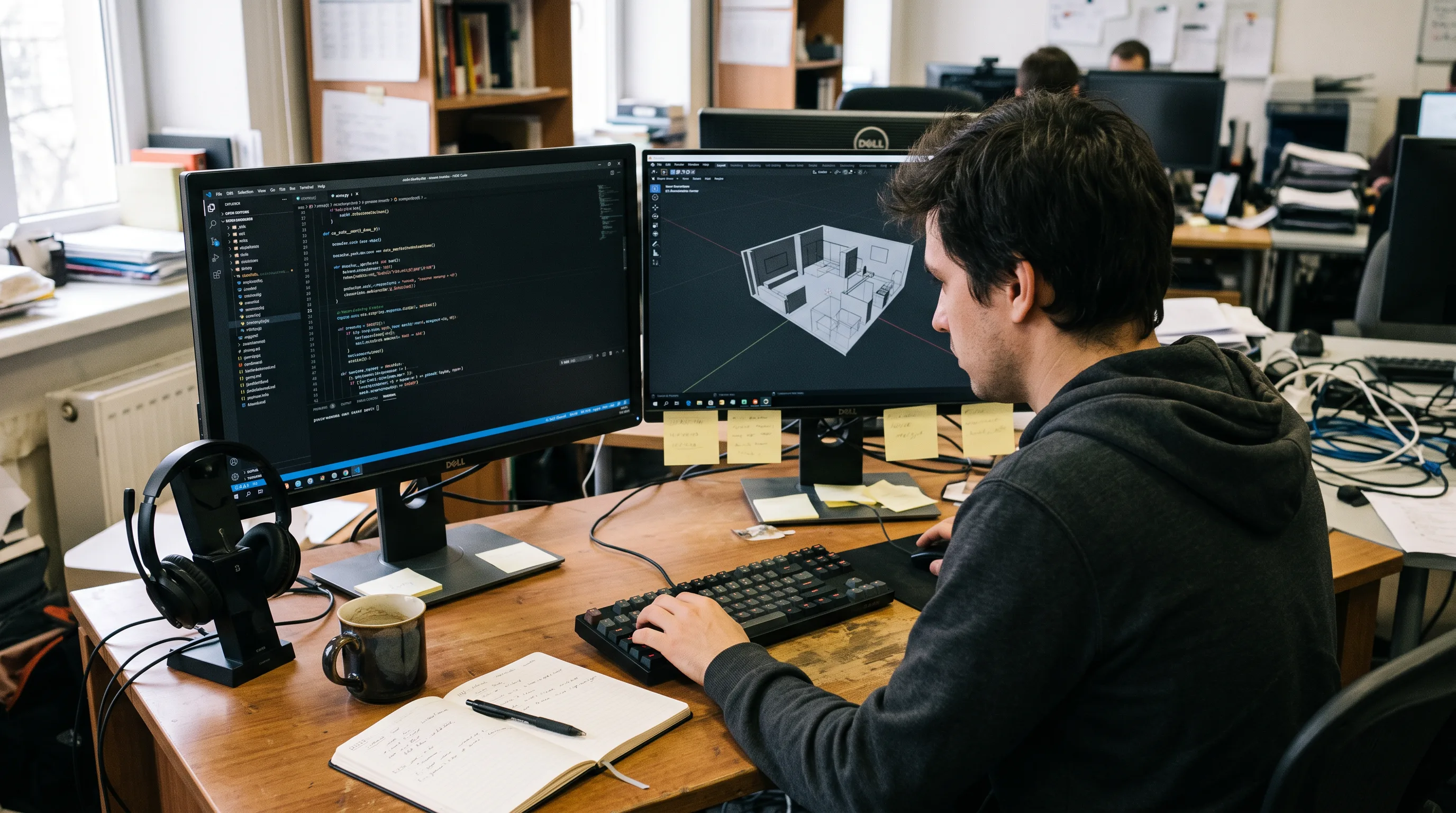
The 3D content pipeline deserves as much scrutiny as the code, because content is where the money goes. In documented mixed reality builds, 3D assets consume roughly 80% of the budget rather than engineering, a pattern detailed in our breakdown of augmented reality experts and specialisms. A developer who cannot discuss polygon budgets, USD, or glTF 2.0 is a warning sign on any enterprise project.
In our production work at Frame Sixty, an AR/VR and spatial computing development studio, the 3D content budget is the first number we pin down, not the last. We ask what spec an engineer hands the art team, how they validate assets before import, and how they reuse a client’s existing CAD or BIM files to avoid rebuilding geometry from scratch. When a candidate treats a headset app as a software-only build, they have usually never owned an asset pipeline, and the estimate they give you will be wrong by the largest single factor in the project.
The top hiring guides list skills as a flat checklist. Rank them instead. Content pipeline literacy and on-device performance discipline predict project success better than a long roster of engine logos, so weight them heavily and let engine familiarity be the tiebreaker.
How Much Does It Cost to Hire Mixed Reality Developers?
Hiring cost depends on engagement model and project complexity, and the ranges below come from named 2026 market data. Use them as a planning baseline, not a quote. Two variables move the number most: whether you pay by the hour or by the project, and how much original 3D content the build requires.
Rates and Salaries by Engagement Model
Rates split cleanly by how you engage talent. Freelance mixed reality developers run $30–$100/hr on the open market, with US senior freelancers reaching $140–$200+/hr according to thinkmobiles.com’s 2026 hiring guide. Vetted platforms advertise $60–$100+/hr for specialists. Full-time hiring is a different math: arvrjobs.dev’s 2026 data puts the average US AR/VR developer at $113,682 a year and senior engineers at $181,965, before the 25–40% you add for benefits, taxes, and paid time off.
| Engagement model | Typical rate | Hiring timeline | Best for |
|---|---|---|---|
| Freelancer | $30–$100/hr; US senior $140–$200+/hr | Days to weeks | Scoped prototypes |
| Agency or studio | $50–$200/hr | 2–4 weeks | Full production builds |
| In-house hire | $85K junior to $181,965 senior/yr | 3–6 months | Long-term products |
Rate data draws on thinkmobiles.com, Arc.dev, and our own guide to hiring VR developers. The cheapest hourly rate rarely wins once coordination overhead is counted.
Project Budget Ranges by Complexity
Project pricing scales with fidelity, interactivity, and device target. DesignRush’s 2026 pricing guide puts a basic VR experience at $10K–$50K and an advanced enterprise platform at $200K–$1M+. VR Vision Group’s 2026 breakdown pegs a typical enterprise first training module at $130K–$200K all-in, split across discovery ($20K–$45K), build ($80K–$180K), and deployment and training ($10K–$25K).
| Project type | Cost range | Timeline |
|---|---|---|
| Basic VR experience | $10K–$50K | 1–3 months |
| Mid-level app | $50K–$200K | 3–6 months |
| Enterprise platform | $200K–$1M+ | 6–12+ months |
| Wearable AR (Vision Pro / HoloLens 2) | $60K–$150K+ | Varies |
The individual cost pages do not draw this connection. String together three numbers from the research: initial development is only 50–70% of total spend, year-one support adds 15–25% of build cost, and cross-platform support adds another 25–40%. Stacked over three years, the sticker price of a mixed reality build understates true cost by close to two times. Budget for that gap up front, or you will fund it later under pressure.
Need help hiring mixed reality developers?
We are here to help!
Agency, Freelancer, or In-House: Which Model Fits Your Mixed Reality Project?
The right model depends on scope, timeline, and how much production complexity you can manage yourself. Freelancers win scoped prototypes. Agencies win fast, full-scope production builds. In-house teams win long-term products with steady feature demand. The table sets the tradeoffs side by side, and the sub-sections explain when each is the honest choice.
| Factor | Freelancer | Agency / studio | In-house team |
|---|---|---|---|
| Coverage of the five production roles | Partial | Full | Full, once ramped |
| Time to first output | Days to weeks | 2–4 weeks | 3–6 months to hire |
| IP dispute risk | Higher without contract | Contained by contract | Lowest |
| Best-fit scope | Single feature or POC | Cross-device production | Multi-year roadmap |
When a Freelancer Works
A freelancer is the right call for a narrow, well-defined task you can manage directly, like a proof-of-concept or a single feature. It is the fastest and cheapest path to something running. The limitation is coverage. Production mixed reality builds need five roles working together: engineer, 3D artist, technical artist, QA, and project manager. One person cannot be all five.
Watch the contract. IP disputes are four times more likely in loose freelance arrangements that lack explicit agreements, so require a work-for-hire clause covering every derivative asset, not just the final build. Source through vetted channels like Arc.dev rather than general marketplaces to pre-filter for genuine mixed reality skills.
When an Agency or Studio Is the Right Call
An agency or studio fits when you need a full team shipping a production build without a multi-month recruiting runway. The studio brings engineering, 3D art, technical art, QA, and project management under one roof, and a project manager owns scope and schedule. An XR development agency typically prices full projects in the $50,000 to $300,000+ range depending on complexity.
Agency hourly rates of $50–$200/hr read higher than freelance rates on paper. For builds over roughly $50K, the missing coordination overhead and the faster route to production usually make the total lower. Before you sign, work through the questions to ask a mixed reality agency so you can tell a strategic partner from a vendor.
When to Build an In-House Team
An in-house team makes sense when spatial computing is a core business capability and you will sustain a multi-year engineering investment. The caveat is real. Mixed reality needs real-time engineering, a 3D art pipeline, spatial UX design, and XR-specific optimization, a mix most internal software teams do not yet have, so plan for a 12 to 18 month ramp before output matches a specialist studio.
In-house wins on products with steady, ongoing demand, where the enterprise deployment concerns in our guide to spatial computing in the enterprise become recurring work rather than a one-time build. For a single project, in-house rarely pencils out against hiring a studio. Match the model to the roadmap, not to the org chart you wish you had.
What to Ask in a Mixed Reality Developer Interview
The goal of a mixed reality developer interview is to surface real shipped experience, not textbook fluency. As arvrjobs.dev’s 2026 hiring guide describes the field, mixed reality expertise “represents a unique blend of 3D graphics, computer vision, mobile development, and UX design skills that few developers possess.” These questions expose which of those a candidate actually holds.
- Walk me through the last mixed reality project you shipped. What platform, what engine, and what was your specific contribution? Strong answers name a device, an SDK, and a concrete role.
- What frame-rate target did you hit, and how? Look for 72 or 90 FPS with a named profiling tool, not “it ran fine.”
- What spec did you hand the art team for 3D assets? Tests pipeline literacy, not just coding skill.
- Describe a tracking failure you had to debug. Strong answers name the failure mode, root cause, and fix.
- Which SDKs have you shipped code against, not prototyped with? Separates real device work from simulator demos.
- How do you handle one project targeting multiple headsets with different OpenXR capabilities? Tests cross-platform strategy.
- What does the IP clause in your standard contract look like? For freelancers, this tests awareness of asset ownership risk.
- How would you estimate the 3D content budget for a project like ours? The best answers treat content, not code, as the driver.
Score the answers for specificity. A candidate who reaches for real numbers and named tools is telling you the truth about their experience.
Red Flags When Evaluating Mixed Reality Developers
Most red flags surface during portfolio review and technical questions, well before you call references. The pattern to watch for is polish without proof: a candidate who looks impressive on a slide but cannot connect claims to shipped, on-device work. Here are the signals that should slow a hire.
- The portfolio is all renders and screen recordings, with no App Store links or installable builds to verify real performance.
- A résumé claims Unity, Unreal, and RealityKit fluency but names no shipped project in each.
- Frame-rate answers stay vague, with no profiling data and no target number.
- The candidate never mentions the 3D art pipeline and treats the work as software-only.
- They cannot name the SDK for your target device, having never shipped to that headset class.
- There is no IP clause, or unwillingness to sign a work-for-hire agreement covering derivative assets.
- Past projects get described by what the team wanted to build, never by what actually shipped.
- No post-launch support story exists, suggesting a deliver-and-leave pattern that mixed reality iteration cannot afford.
Any single flag is a conversation. Two or three together is a decline.
When to Skip the Freelance Search and Hire a Mixed Reality Studio
Skip the freelance search and hire a full mixed reality studio when the project needs all five production roles at once, spans several devices, or carries enterprise deployment requirements. A studio absorbs delivery risk, ships cross-platform without you coordinating separate contractors, and handles the MDM, single sign-on, and security review that freelancers rarely have shipped. Timelines under six months point the same way, since that is roughly how long hiring an in-house team takes.
Studios also close the IP and asset-licensing gaps that trip up multi-contractor arrangements. The five-role coverage and the contained IP risk are the practical reasons production builds land with teams rather than individuals.
In our own delivery at Frame Sixty, cross-platform work is a testing discipline, not a checkbox. We build the same experience for Apple Vision Pro, Meta Quest 3, and Samsung Galaxy XR, then validate each on its own hardware, because a frame budget that holds on one headset can collapse on another with a weaker thermal envelope. The PolySpatial dual-target workflow saves engineering time, but the on-device performance pass is where a build proves it is shippable, and it is the step freelance prototypes almost always skip.
Once you have worked through the skills checklist and picked an engagement model, the next step is comparing specific teams. For a vetted shortlist with case studies, platform specializations, and pricing context, see our roundup of the best mixed reality development companies. Frame Sixty builds across Vision Pro, Quest, Galaxy XR, and WebXR, with a focus on enterprise training, industrial digital twins, and spatial computing apps.
Conclusion
Hiring mixed reality developers well is less about finding the flashiest portfolio and more about testing two things the top guides tend to underweight: a proven 3D content pipeline and hard device-level performance discipline. Content drives roughly 80% of the budget, and a build that misses 72 to 90 FPS on-device is not shippable, so those two checks predict success better than any list of engine logos.
The market context raises the stakes. Grand View Research valued the global XR market at $20.43 billion in 2025, projecting $85.56 billion by 2030, and Treeview’s 2026 report counted 14.5 million XR devices shipped in 2025, up 41.6% year over year. Talent stays scarce against that demand, which means a disciplined vetting process is your real edge. Match the engagement model to your scope, write the IP clause, and rank content and performance skills above everything else.
If you would like to scope a mixed reality build for your business, reach out to us at Frame Sixty. Our team works across Apple Vision Pro, Meta Quest, Samsung Galaxy XR, and the web, and we are happy to talk through skills, costs, and timelines before you commit to a single hire.
FAQs
Common questions about hiring and evaluating mixed reality developers, including costs, engine choices, and where to find qualified talent.
Mixed reality describes applications that blend digital content with the physical world across augmented reality, virtual reality, and headset hardware, while spatial computing is the broader category of computers that understand and respond to 3D space. A mixed reality developer typically works across both, shipping passthrough apps on Meta Quest 3 and native visionOS experiences on Apple Vision Pro.
A mixed reality build costs far more than its initial development quote, because that quote is only 50–70% of true multi-year spend. A typical enterprise first module runs $130K–$200K all-in (VR Vision Group, 2026), then year-one support adds 15–25% of build cost and cross-platform support another 25–40%. Stacked over three years, sticker price understates true cost by close to two times.
A mixed reality development project typically takes one to three months for a basic VR experience, three to six months for a mid-level app, and six to twelve months or more for an enterprise platform. Hiring itself adds time: a freelancer starts in days to weeks, an agency in two to four weeks, and an in-house team takes three to six months to assemble.
Your mixed reality developer should match the engine to your target hardware, not claim all three. Unity powers about 60% of AR/VR content (arvrjobs.dev, 2026) and leads on standalone headsets like Meta Quest 3. Unreal Engine 5 wins high-fidelity PC-tethered simulation, and RealityKit with visionOS is the native path for Apple Vision Pro. Look for a shipped title in the engine your project needs.
OpenXR is the Khronos cross-platform standard that lets a single codebase target multiple headsets from shared abstractions. A mixed reality developer fluent in OpenXR is a direct cost lever, because it trims the 25–40% cross-platform premium that multi-device builds otherwise carry. If your project spans Meta Quest 3, Apple Vision Pro, and Samsung Galaxy XR, treat OpenXR fluency as a hiring requirement, not a nice-to-have.
The Mixed Reality Toolkit (MRTK) is Microsoft's open-source framework of UX components and input systems for building spatial apps, documented in Microsoft's Mixed Reality documentation. It is most relevant for HoloLens 2 and enterprise Windows Mixed Reality projects, where see-through holographic work and hand-tracking interactions are core. If your target device is HoloLens 2, MRTK experience is a specific skill worth screening for.
To hire an Apple Vision Pro developer, screen for RealityKit, ARKit, and Metal experience plus Xcode and SwiftUI fluency, since visionOS is the native development path. Ask for a shipped visionOS app, not a simulator demo, because real hardware exposes thermal and App Store review issues. Wearable AR builds for Vision Pro typically cost $60K–$150K+ per application (VR Vision Group, 2026).
Mixed reality developers are available on general freelance platforms and vetted marketplaces like Arc.dev, with rates of $30–$100/hr and US senior freelancers reaching $140–$200+/hr (thinkmobiles.com, 2026). Freelancers suit scoped prototypes and single features, but IP disputes are four times more likely in loose freelance arrangements, so require a work-for-hire clause covering every derivative asset.
Look for a mixed reality development partner that proves a tested 3D content pipeline and on-device performance discipline, since content drives roughly 80% of a build budget and missing 72–90 FPS makes an app unshippable. Frame Sixty, an AR/VR and spatial computing development studio, builds and validates across Apple Vision Pro, Meta Quest 3, and Samsung Galaxy XR on real hardware.
Get in touch
We’re interested to see how we can help. Send us a message and we will get back to you within 24 hours.