
What Is Spatial Computing? A Comprehensive Guide
Mar 7, 2026
39 MIN READ
Spatial computing is a technological framework that enables machines to understand and interact with the physical world in three dimensions, allowing digital objects to persist and be manipulated within a real-world context. It relies on sensor fusion, combining LiDAR and camera data to create a persistent 3D world map, which is navigated using vSLAM for full 6DoF tracking. This map enables core principles like real-world occlusion, where digital content is blocked by physical objects, and digital object persistence via world anchors. Specialized silicon like Apple’s R1 chip processes sensor data at ultra-low latency, while foveated rendering and high Pixels Per Degree (PPD) displays ensure visual fidelity.
What is Spatial Computing: A Technical Definition Beyond AR/VR
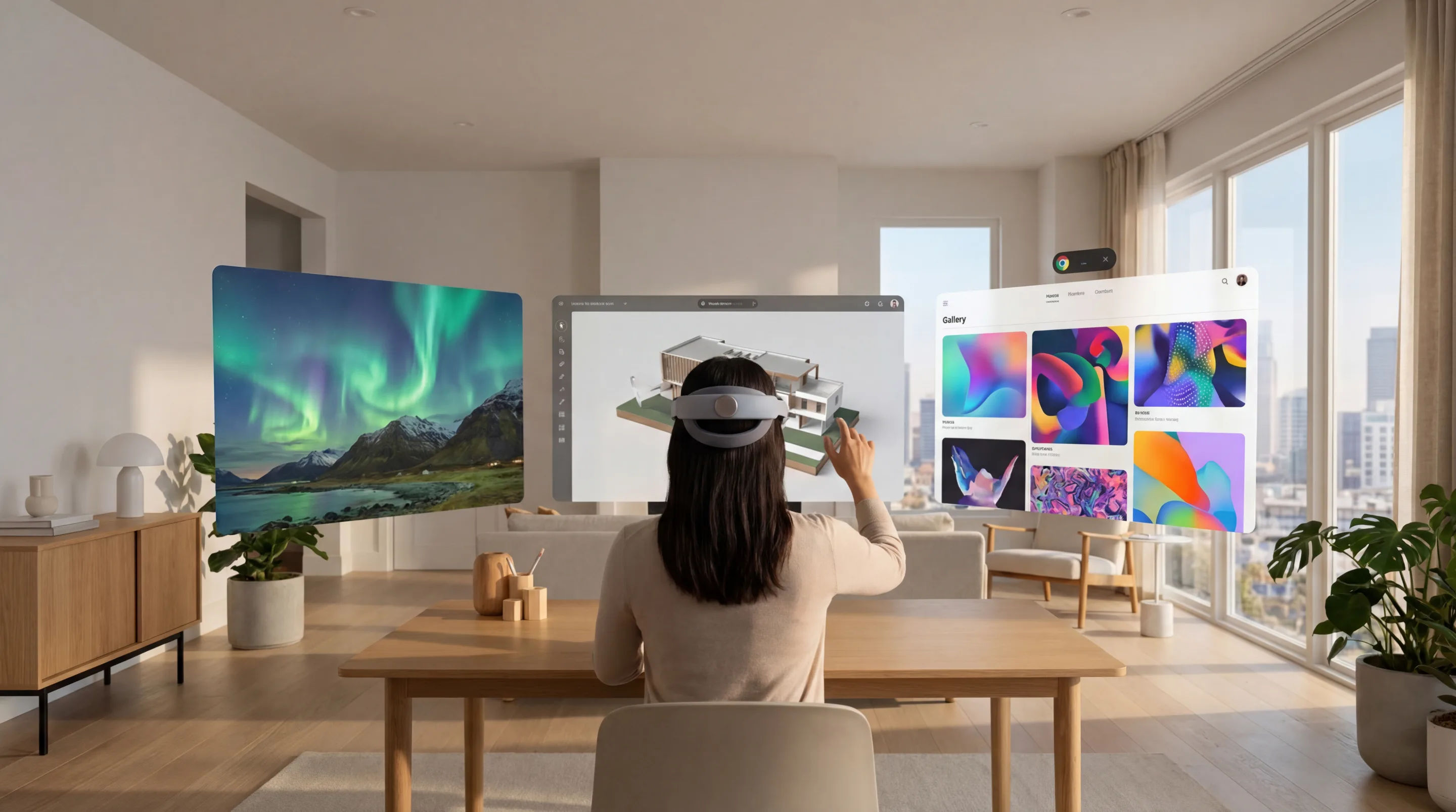
Spatial computing is a technological framework that enables machines to understand and interact with the physical world in three dimensions, allowing digital information and objects to exist, persist, and be manipulated within that real-world context. It integrates sensor fusion, 3D mapping, and advanced optics to create a responsive, blended reality where digital content is not just overlaid but is spatially aware and occluded by physical objects. This system moves beyond the 2D metaphor of screens and windows, treating the user’s environment as the canvas for computation.
The Shift from 2D Screens to a 3D Embodied Internet
The history of computing has been a relentless march toward more intuitive interfaces. The command line gave way to the graphical user interface (GUI), which abstracted complex commands into visual metaphors like desktops and folders. Mobile computing then untethered the GUI, making it personal and ever-present. Spatial computing is the next logical, and final, step in this progression. It dismantles the 2D screen entirely, projecting the interface onto the world itself.
This shift creates what is known as the embodied internet. Instead of accessing a website through a browser window, a user might interact with a persistent, world-anchored 3D visualization of e-commerce inventory in a real warehouse. Instead of a video call on a flat screen, colleagues appear as photorealistic avatars sharing a physical space. This paradigm shift requires a complete rethinking of UX/UI design, data architecture, and application logic, moving from event-driven programming to a state-based model where the “state” is the user’s dynamic physical environment. The work of a leading augmented reality agency is now centered on architecting these complex, state-aware experiences.
Core Principles: Digital Object Persistence and Real-World Occlusion
Two principles are fundamental to true spatial computing and differentiate it from simpler augmented reality. The first is digital object persistence. This means a digital object placed in a specific location—a virtual sticky note on a real monitor, a 3D architectural model on a boardroom table—remains there. When the user leaves the room and returns hours later, the device understands the environment and renders the object in the exact same position relative to the real world. This is achieved through advanced world-mapping and the creation of a world anchor, a specific point in 3D space that locks digital content to a physical location.
The second principle is real-world occlusion. For digital content to feel truly present, it must respect the laws of physics. Occlusion is the system’s ability to understand that a real-world object, like a person walking by or a desk, should block the view of a digital object behind it. A virtual screen should appear behind a physical pillar, not render on top of it. This requires real-time, high-fidelity 3D mesh generation of the environment, a computationally intensive task that separates rudimentary AR from sophisticated spatial systems like the Apple Vision Pro.
Differentiating Contextual Computing from Ambient Computing
While often used interchangeably, contextual computing and ambient computing describe distinct, though related, concepts within the spatial domain. Contextual computing is the system’s ability to understand the what, where, when, and who of a user’s situation to provide relevant information. For example, a spatial computer recognizing you are in a kitchen and presenting a recipe on the counter is a contextual action. It is task-oriented and actively assists the user based on recognized context.
Ambient computing is a broader, more passive concept where technology recedes into the background, becoming an invisible fabric of the environment. It is about seamless, zero-friction interaction. An ambient system might automatically adjust the lighting and temperature of a room based on who enters, without any direct command. Spatial computing is the enabling platform for both. It provides the environmental understanding (the “where”) for contextual computing and the hardware (integrated sensors, displays) for ambient computing to manifest in a truly integrated way.
The core distinction of spatial computing is its ability to transform passive environments into active, interactive, and intelligent canvases for digital experiences.
The Core Technology Stack of a Spatial Computer
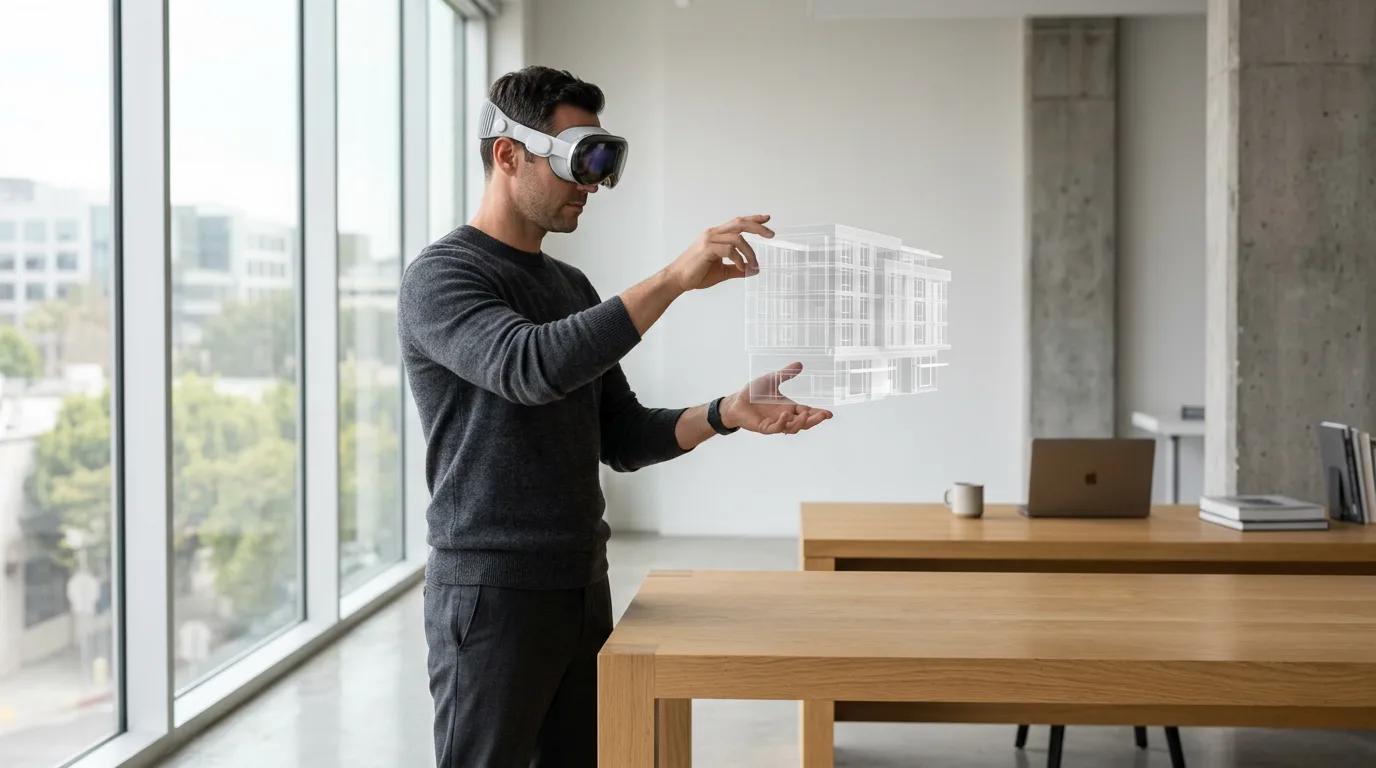
A spatial computer is a highly integrated system of specialized hardware and software designed to perceive, understand, and render digital content into the physical world in real time. Unlike a traditional computer that processes abstract data, a spatial computer’s primary function is to process reality itself, fusing data from a suite of sensors to build a dynamic, machine-readable model of the user’s environment. This requires a purpose-built technology stack where every component, from the silicon to the display, is optimized for low-latency, high-fidelity spatial processing.
Sensor Fusion: How LiDAR and Cameras Enable Persistent World Mapping
The foundation of any spatial computer is its ability to see and understand the world. This is achieved through sensor fusion, the process of combining data from multiple sensors to produce a more accurate and complete understanding of the environment than any single sensor could provide. The primary inputs are RGB cameras and LiDAR (Light Detection and Ranging) scanners or other depth sensors.
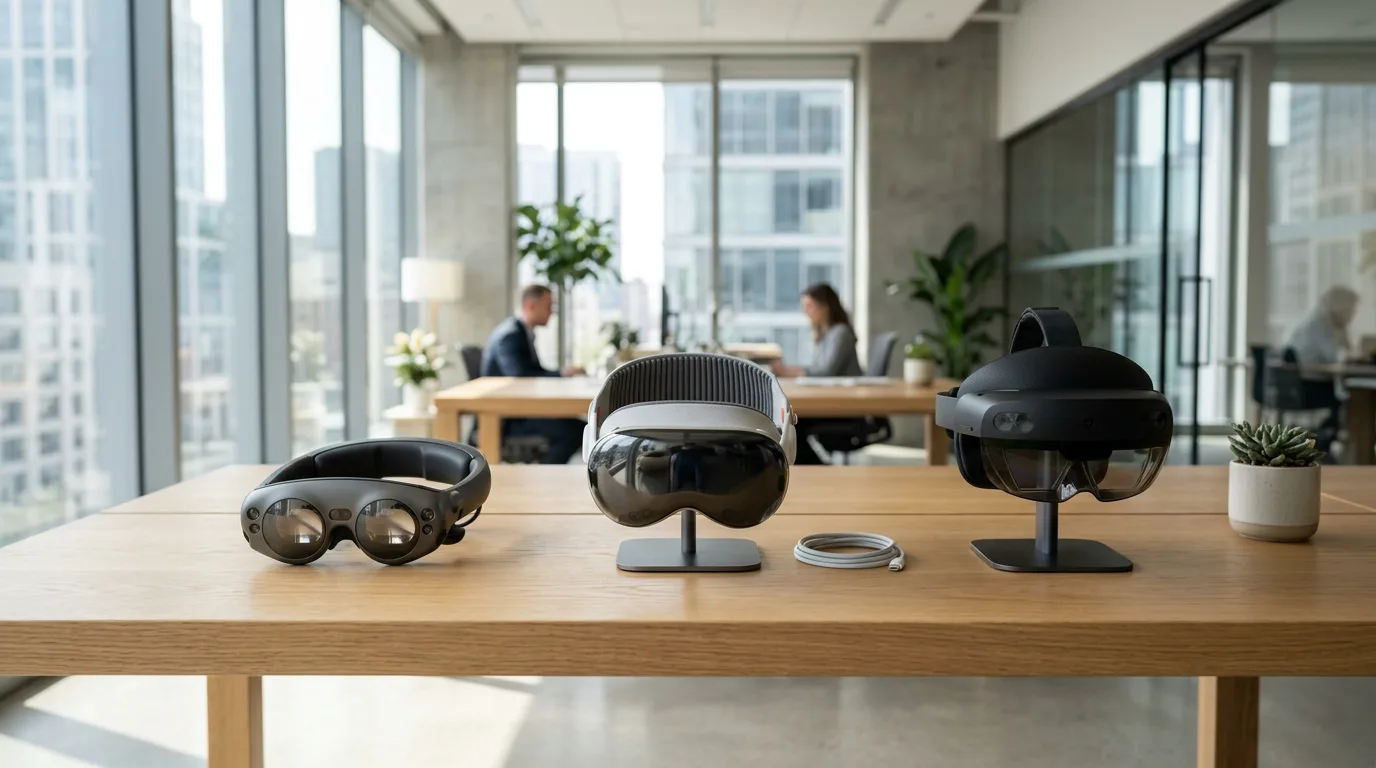
RGB cameras capture color and texture data, essential for visual understanding and passthrough video. LiDAR, conversely, projects infrared laser grids to measure depth with millimeter precision, creating a dense 3D point cloud of the environment. The system’s software then fuses these data streams. The LiDAR provides the geometric structure (the “mesh” of the room), while the camera data provides the visual texture to map onto that mesh. This combined, real-time 3D model is what enables core spatial features like object persistence and real-world occlusion. This process is fundamental to how devices like the Microsoft HoloLens 2 and Apple Vision Pro create a stable, persistent AR cloud.
Processing Units: The Role of the Qualcomm Snapdragon XR2 vs. Apple’s R1 Chip
Processing spatial data is an immense computational challenge that cannot be handled by conventional CPUs or GPUs alone. It requires specialized silicon. The two dominant architectures in 2026 are Qualcomm’s Snapdragon XR series and Apple’s custom R-series chips.
The Qualcomm Snapdragon XR2 platform, found in devices like the Meta Quest 3, is a System-on-a-Chip (SoC) that integrates CPU, GPU, and specialized co-processors for AI and computer vision (CV). It is designed for efficiency and broad adoption in a mobile form factor. Its strength lies in its open ecosystem, allowing many manufacturers to build on a proven platform, with official specs available from Qualcomm’s website.
Apple, in contrast, employs a dual-chip strategy in the Vision Pro. The M-series chip (e.g., M2) runs the visionOS operating system and applications, while the dedicated R1 chip processes all sensor input. The R1 is an ultra-low-latency processor designed exclusively for one task: to stream, process, and fuse data from the 12 cameras, five sensors, and six microphones. According to Apple, it processes this data in just 12 milliseconds—eight times faster than the blink of an eye. This bifurcation of labor allows the M2 to dedicate its resources to application performance while the R1 ensures the user’s view of the world is always stable and responsive, a critical factor in mitigating motion sickness.
| Feature | Apple R1 Chip (in Vision Pro) | Qualcomm Snapdragon XR2 Gen 2 (in Quest 3) |
|---|---|---|
| Architecture | Custom, dedicated co-processor | Integrated System-on-a-Chip (SoC) |
| Primary Function | Real-time sensor data processing (cameras, LiDAR, IMU) | General compute, graphics, AI, and sensor processing |
| Key Metric | 12-millisecond motion-to-photon latency | High-performance GPU for gaming and rendering |
| System Design | Dual-chip (with M-series) for workload separation | Single-chip solution for power and cost efficiency |
| Ecosystem | Closed; exclusive to Apple hardware | Open; licensed by multiple device manufacturers |
Display Systems: Analyzing Pixels Per Degree (PPD) and Foveated Rendering
The visual fidelity of a spatial experience is defined by its display system. The critical metric is not raw resolution but Pixels Per Degree (PPD), which measures pixel density from the user’s perspective. A higher PPD results in a sharper image where individual pixels are indistinguishable, eliminating the “screen door effect.” The human eye resolves at approximately 60 PPD. While early VR headsets were in the 10-20 PPD range, modern devices like the Varjo XR-4 push toward 51 PPD, approaching retinal resolution.
Achieving this level of fidelity across the entire display is computationally prohibitive. This is solved by foveated rendering, a technique that leverages eye-tracking sensors. The system renders the small area of the display where the user’s fovea is looking (the center of their gaze) at maximum resolution, while progressively lowering the resolution in the periphery. Because human peripheral vision is less sensitive to detail, the user perceives a uniformly high-resolution image, but the GPU workload is reduced by as much as 70%. This intelligent allocation of resources is essential for running complex applications at high frame rates.
Tracking and Mapping: The Difference Between SLAM and vSLAM for 6DoF Tracking
For a user to move naturally within a spatial environment, the device must track its own position and orientation in real time. This is known as 6DoF tracking (Six Degrees of Freedom), encompassing three axes of rotational movement (pitch, yaw, roll) and three axes of translational movement (moving forward/backward, up/down, left/right).
The core algorithm enabling this is SLAM (Simultaneous Localization and Mapping). SLAM is the computational problem of constructing a map of an unknown environment while simultaneously keeping track of an agent’s location within it. In spatial computing, this is typically vSLAM (Visual SLAM), which uses camera data as its primary input. The device’s cameras identify unique feature points (corners, edges, textures) in the environment. As the user moves, the algorithm tracks how these points shift in the camera’s view, using this optical flow to calculate the headset’s precise movement in 3D space. This process is what allows a user to physically walk around a digital object, a foundational capability for any true spatial experience.
The technology stack of a spatial computer is a tightly woven system where sensor data, specialized processing, and advanced display techniques work in concert to create a seamless and believable blended reality.
How Spatial Computing Differs from Virtual Reality and Other XR Technologies
Extended Reality (XR) is the umbrella term encompassing all technologies that merge the real and virtual worlds, but the specific implementations—Virtual Reality (VR), Augmented Reality (AR), and Mixed Reality (MR)—serve fundamentally different purposes and are built on distinct technological principles. Spatial computing is not just another point on this spectrum; it is the underlying computational model that elevates AR and MR from simple information overlays to fully interactive, world-aware environments. Understanding these distinctions is critical for enterprises selecting the right technology for a specific ROI-driven use case.
Virtual Reality (Full Immersion) vs. Mixed Reality (Contextual Blending)
Virtual Reality (VR) is defined by full immersion. A user wearing a VR headset, such as an early Oculus Rift or a modern high-fidelity training simulator, is completely cut off from their physical surroundings. The device replaces the real world with a purely digital one. All visual and auditory input is computer-generated. This makes VR exceptionally powerful for simulation and training scenarios where the goal is to transport the user to a different, often impossible or dangerous, environment—like a flight simulator or a surgical training module. The key concept is replacement of reality.
Mixed Reality (MR), as exemplified by devices like the Microsoft HoloLens 2, is about contextual blending. It does not replace the real world; it enhances it with digital objects that appear to co-exist with physical ones. MR systems use advanced sensors to map the environment, enabling digital holograms to be occluded by real furniture, anchored to real walls, and interact with the physical space. The defining feature is integration with reality. This is the domain where creating a digital twin in VR or, more accurately, MR, becomes a powerful enterprise tool, allowing engineers to see a virtual machine assembly line on their actual factory floor.
Augmented Reality (Information Overlay) vs. Spatial Computing (Interactive Environment)
Augmented Reality (AR), in its most common form (e.g., smartphone AR via ARKit), is primarily an information overlay. It places a layer of digital information on top of a live camera feed of the real world. While it can recognize planes and surfaces, its understanding of the environment is often superficial and non-persistent. A Pokémon Go character appears on the sidewalk but does not hide behind a real mailbox. It is a “magic window” effect, powerful for marketing and simple data visualization but lacking deep environmental interaction.
Spatial Computing elevates this concept to an interactive environment. It is the computational architecture that gives digital objects permanence, physics, and contextual awareness. An AR application might show you an arrow pointing to a product on a shelf. A spatial computing application would allow you to pull a 3D model of that product out of the shelf, resize it, and see its internal components, with the model casting a realistic shadow on the real-world floor. The difference is the system’s deep, persistent understanding of 3D space, which transforms overlays into truly present, manipulable objects. This is the core principle behind the development of sophisticated Apple Vision Pro apps.
Mapping the Full Extended Reality (XR) Continuum
The XR continuum, first conceptualized by Paul Milgram, provides a useful framework for visualizing these technologies. It ranges from the purely real environment on one end to the purely virtual environment on the other.
| Technology | World Interaction | User Experience | Key Hardware Example |
|---|---|---|---|
| Real Environment | N/A (Physical) | Unmediated reality | Human Eye |
| Augmented Reality (AR) | Information Overlay | Digital content layered on a live video feed | Smartphone (using ARKit/ARCore) |
| Mixed Reality (MR) | Contextual Blending | Digital objects interact with and are occluded by the real world | Microsoft HoloLens 2, Magic Leap 2 |
| Virtual Reality (VR) | Full Immersion | Complete replacement of the real world with a digital one | High-end training simulators, Meta Quest (in VR mode) |
Spatial computing is the foundational layer of computation, sensing, and mapping that enables the most advanced forms of Mixed Reality, where the line between the real and digital blurs into a single, unified experience.
The critical takeaway is that while VR isolates the user, spatial computing integrates with their world, creating a far broader set of enterprise applications where context and location are paramount.
Need help with AR / VR development ?
We are here to help!
Enterprise Use Cases for Mixed Reality Driven by Digital Twin Technology
Enterprise adoption of spatial computing is accelerating because it delivers measurable ROI by solving complex, high-stakes problems in the physical world. The core enabler for many of these solutions is Digital Twin technology. A digital twin is a dynamic, virtual representation of a physical object, system, or process, updated in real time with data from its real-world counterpart. When visualized and manipulated through a spatial computing interface, digital twins unlock unprecedented levels of insight, simulation, and operational efficiency, moving from abstract data on a screen to a tangible, interactive 3D model in a real-world context.
Industrial Design and Simulation with NVIDIA Omniverse and Varjo XR-4
In advanced manufacturing and engineering, spatial computing has revolutionized the design and review process. Teams can now visualize and interact with full-scale digital twins of complex products like automobiles or aircraft engines long before a physical prototype exists. Using a platform like NVIDIA Omniverse, a collaborative 3D design environment, and a high-fidelity headset like the Varjo XR-4, engineers from around the globe can meet in a shared virtual space to inspect a photorealistic model.
They can perform virtual stress tests, simulate airflow, and even practice assembly procedures, identifying costly design flaws months earlier in the development cycle. The Varjo XR-4’s high PPD and video passthrough capabilities allow engineers to see the digital twin within their actual design studio, blending the virtual prototype with physical mockups. This workflow, detailed in NVIDIA’s enterprise case studies, dramatically reduces material waste, shortens time-to-market, and improves cross-disciplinary collaboration.
Remote Assistance and Surgical Training on Microsoft HoloLens 2
The impact of spatial computing is profound in fields requiring expert knowledge in remote or critical situations. With remote assistance applications on the Microsoft HoloLens 2, an on-site technician facing a complex equipment failure can stream their first-person point of view to an expert thousands of miles away. The remote expert can see exactly what the technician sees and can annotate the real world with holographic instructions, circling a specific valve or displaying a 3D schematic next to the physical machine.
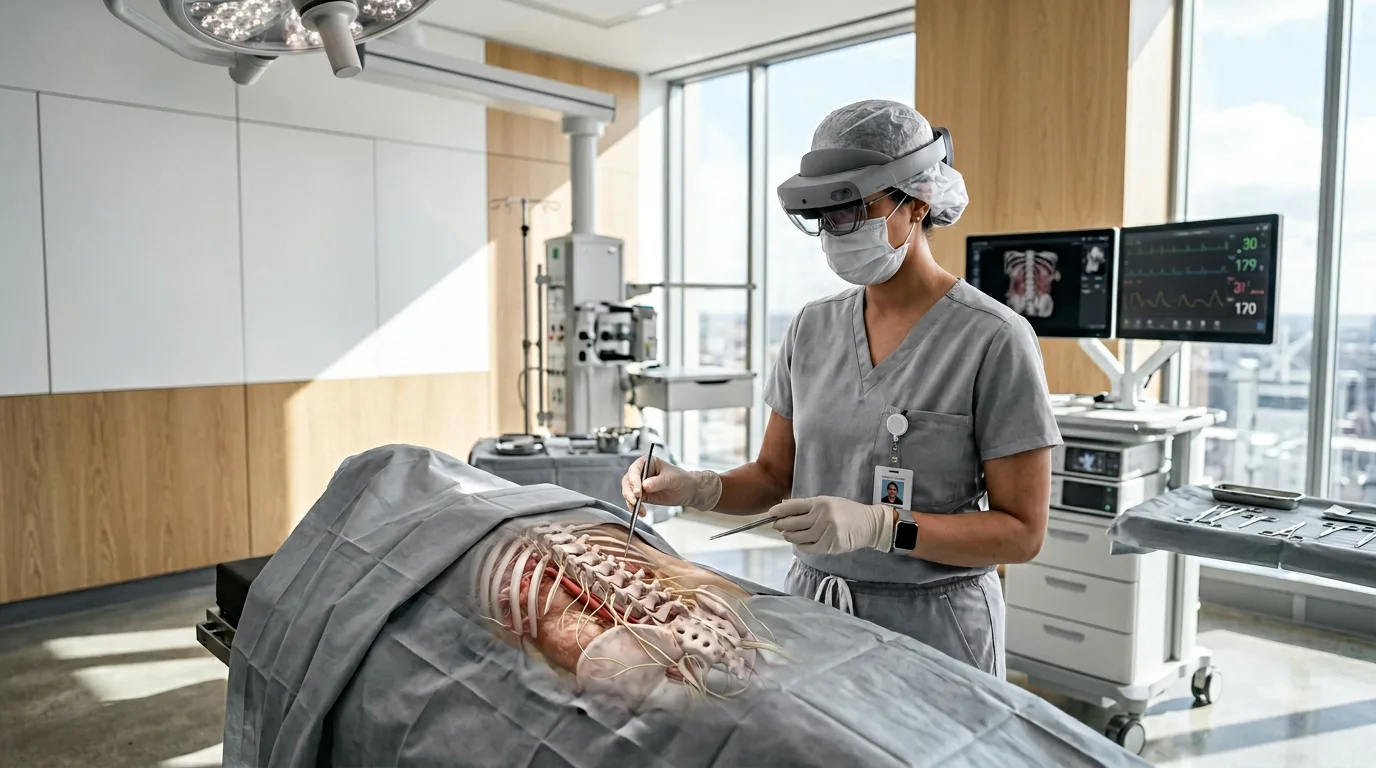
In medicine, this paradigm is transforming surgical training and execution. Surgeons can overlay a patient’s 3D MRI or CT scan directly onto their body during an operation, providing a form of “X-ray vision” to navigate complex anatomy with greater precision. Training programs use digital twins of organs for repeatable, risk-free practice of complex procedures, significantly shortening the learning curve for new surgeons. This direct application of spatial data improves outcomes and democratizes access to expertise.
Logistics and Warehouse Optimization Using Magic Leap 2
Modern logistics centers are vast, complex environments where efficiency is measured in seconds. Spatial computing, deployed on lightweight, all-day wearable devices like the Magic Leap 2, is streamlining warehouse operations. A worker equipped with a headset can receive visual cues directly in their field of view, guiding them along the optimal path to a specific item.
Upon reaching the correct aisle, the system can highlight the exact bin containing the product, reducing search time and picking errors. This is powered by a digital twin of the warehouse, which tracks inventory in real time. Managers can use the same system to visualize operational bottlenecks, simulate new layout configurations to optimize traffic flow, and train new employees in a fraction of the time. The result is a quantifiable increase in order fulfillment speed and accuracy, directly impacting the bottom line.
What is the Function of a Digital Twin in Manufacturing?
The primary function of a digital twin in manufacturing is to create a persistent, high-fidelity virtual bridge to a physical asset or process, enabling analysis, simulation, and prediction that would be impossible or prohibitively expensive in the real world. It serves several key functions:
- Design and Prototyping: Simulating product performance under various conditions before physical manufacturing begins.
- Process Optimization: Modeling the entire production line to identify inefficiencies, test new configurations, and optimize resource allocation without halting operations.
- Predictive Maintenance: Using real-time sensor data from IoT devices on the physical asset to predict failures before they occur, scheduling maintenance proactively to minimize downtime.
- Remote Monitoring and Control: Allowing operators to monitor and, in some cases, control physical machinery from a remote location through an interactive 3D interface.
When accessed via a spatial computing device, the digital twin becomes an interactive, embodied tool, fundamentally changing how humans and machines collaborate on the factory floor.
Enterprise spatial computing, powered by digital twin technology, provides a clear and direct path to operational excellence, transforming abstract data into actionable, three-dimensional insights.
The Developer Ecosystem: Building for visionOS and Cross-Platform XR
The success of any computing platform is determined by the strength and accessibility of its developer ecosystem. For spatial computing, this ecosystem is rapidly maturing, offering a range of powerful tools, SDKs, and platforms that abstract the immense complexity of sensor fusion, 3D rendering, and world tracking. Developers can now choose between building highly optimized, native applications for closed ecosystems like Apple’s visionOS or leveraging cross-platform engines like Unity and Unreal to reach the widest possible audience across the XR landscape.
How Do Developers Build for visionOS with RealityKit and the visionOS SDK?
Developing for the Apple Vision Pro means building for visionOS, an operating system designed from the ground up for spatial computing. The primary development framework is RealityKit, a high-level rendering, animation, and physics engine deeply integrated with SwiftUI, Apple’s modern UI framework. This integration allows developers to compose spatial scenes and 3D objects with the same declarative syntax used for building 2D iOS apps.
The visionOS SDK, accessible through Xcode, provides developers with tools to create three types of experiences: Windows (traditional 2D apps presented in 3D space), Volumes (contained 3D scenes that can be placed in a room), and fully immersive Spaces. A key component is ARKit, which provides the underlying world-tracking and scene-understanding capabilities. Developers can access official documentation and tools directly from Apple’s developer site. The focus of visionOS development is on creating intuitive, high-performance applications that leverage the unique input model of eye-tracking and hand gestures, a process our team of Apple Vision Pro developers has mastered.
Cross-Platform Development with Unity PolySpatial and Unreal Engine 5
For enterprises and developers targeting a diverse range of hardware beyond Apple’s ecosystem—from the Meta Quest 3 to the Magic Leap 2—cross-platform engines are the strategic choice. Unity and Unreal Engine are the dominant forces in this space.
Unity, with its Unity PolySpatial technology, offers a robust pipeline for creating applications that can be deployed across multiple XR platforms. It provides a familiar C# scripting environment and a vast asset store, lowering the barrier to entry for many developers. PolySpatial is particularly significant as it enables developers to port existing Unity projects to visionOS, bridging the gap between the open and closed ecosystems. This is a critical capability for any Unity development for Vision Pro strategy.
Unreal Engine 5, known for its state-of-the-art rendering capabilities with features like Lumen and Nanite, is the engine of choice for applications demanding the highest level of visual fidelity. It is heavily used in industrial design, architectural visualization, and high-end simulations where photorealism is paramount. Both engines provide deep integrations with the OpenXR standard, ensuring that core functionalities like controller tracking and rendering work consistently across different vendors’ hardware.
Building World-Scale Experiences with Niantic Lightship and the Persistent AR Cloud
Spatial computing is not limited to room-scale experiences. The vision of a global, persistent AR cloud—a shared digital layer mapped onto the entire world—is being realized by platforms like Niantic Lightship. Built by the creators of Pokémon Go, the Lightship ARDK (Augmented Reality Developer Kit) provides developers with advanced tools for creating world-scale, multi-user experiences.
Its core technology is a Visual Positioning System (VPS) that allows devices to determine their precise position and orientation with centimeter-level accuracy by recognizing real-world locations from a vast, crowd-sourced 3D map of the world. This enables developers to create applications where digital content is persistently anchored to specific real-world places, allowing thousands of users to interact with the same shared AR experience. This is the foundational technology for the future of location-based entertainment, navigation, and education.
Leveraging the Meta Presence Platform for Passthrough on Meta Quest 3
Meta has taken a strong position in the mixed reality space with the Meta Presence Platform, a suite of SDKs and APIs for the Meta Quest line of headsets. A key feature is its high-fidelity, full-color Passthrough API, which allows developers to build applications that seamlessly blend virtual content with the user’s physical environment.
Unlike earlier, grainy passthrough, the Meta Quest 3 provides a view of the real world that is clear enough for users to read their phone or interact with physical objects while wearing the headset. The Presence Platform gives developers tools for Scene Understanding (automatically identifying walls, floors, and furniture to enable realistic interactions) and Spatial Anchors (for persisting content in the user’s space). This platform is critical for developers building consumer and enterprise applications on Meta’s hardware, turning a primarily VR device into a powerful MR development target.
The developer ecosystem for spatial computing is a dynamic landscape, offering specialized and cross-platform tools to build the next generation of interactive, world-aware applications.
Critical Standards and Frameworks Enabling Interoperability
For spatial computing to achieve mass adoption and avoid the fragmentation that plagued earlier technology waves, a foundation of open standards and interoperable frameworks is essential. These standards ensure that hardware from different manufacturers can run the same software, 3D content can be seamlessly shared between applications, and spatial experiences can be delivered across both native applications and the open web. This common ground is critical for developers, enterprises, and consumers, fostering a healthy ecosystem where innovation can flourish without being locked into a single proprietary platform.
OpenXR: The API Standard for Cross-Device Hardware Access
OpenXR is arguably the most important standard in the XR industry. It is a royalty-free, open standard from the Khronos Group that provides a common API for applications to interface with the diverse range of XR hardware. Before OpenXR, a developer had to write custom code to support the specific drivers and runtimes of each headset (Oculus, SteamVR, Windows Mixed Reality, etc.). This created immense overhead and platform lock-in.
With OpenXR, a developer can write their application to the single OpenXR API, and an OpenXR-compatible runtime provided by the hardware vendor will handle the translation to the specific device. This abstracts the underlying hardware, allowing the same application binary to run on a Meta Quest, a Varjo headset, or a HoloLens without modification. This “write once, run anywhere” approach dramatically reduces development costs and is essential for enterprise solutions that must support a heterogeneous fleet of devices. The official OpenXR specification details this crucial interoperability layer.
Universal Scene Description (USD) and glTF 2.0 for 3D Asset Portability
Just as JPEG and PNG became standards for 2D images, Universal Scene Description (USD) and glTF 2.0 are the foundational standards for 3D assets.
USD, originally developed by Pixar and now an open-source project governed by the Alliance for OpenUSD, is a powerful framework for describing, composing, and collaborating on complex 3D scenes. It is not just a file format; it is a system for non-destructively editing and layering 3D data, making it the backbone of collaborative pipelines like NVIDIA Omniverse and the native 3D format for visionOS.
glTF 2.0 (GL Transmission Format) is often described as the “JPEG of 3D.” It is a royalty-free specification for the efficient transmission and loading of 3D scenes and models by applications. It is optimized for delivery and runtime performance, making it the de facto standard for web-based 3D and real-time rendering on mobile and XR devices. An enterprise’s 3D asset library should be standardized on these formats to ensure future-proof portability across all spatial computing platforms.
The Function of the WebXR Device API for Browser-Based Experiences
Not all spatial experiences require a downloaded native application. The WebXR Device API is a W3C standard that enables high-performance XR experiences to run directly in a web browser. This framework provides web pages with access to the necessary inputs (headset and controller positions, environmental understanding) and outputs (rendering a 3D scene to the headset’s display) of an XR device.
The function of this API, detailed in the MDN Web Docs, is to democratize access to XR. It allows for “instant on” experiences without an app store, ideal for marketing, product visualization, and casual use cases. An e-commerce site could allow a customer to view a 3D model of a sofa in their living room with a single click. For enterprise, Web AR development offers a frictionless way to deploy training materials or data visualizations to a wide audience without managing device-specific application installations.
Rendering Pipelines: The Vulkan Graphics API and MaterialX Shading Models
At the lowest level of the stack, rendering performance is paramount. Vulkan is a modern, cross-platform, low-overhead graphics and compute API, also managed by the Khronos Group. It provides developers with more direct control over the GPU than older APIs like OpenGL, enabling higher performance and efficiency, which are critical in the power- and thermally-constrained environment of a standalone XR headset.
Complementing this is MaterialX, an open standard from Lucasfilm for representing rich material and shading networks. It allows artists and developers to define the appearance of a 3D object—its color, texture, reflectivity, and more—in a standard, portable way. A MaterialX definition will render consistently across different rendering engines that support the standard, from Unreal Engine to a proprietary renderer, ensuring visual fidelity and asset interoperability.
These open standards form the bedrock of a scalable and interoperable spatial computing ecosystem, reducing friction for developers and ensuring long-term value for enterprise investments.
Key Performance Metrics: Quantifying User Experience and Immersion
The quality of a spatial computing experience is not subjective; it is quantifiable through a set of critical performance metrics that directly impact user comfort, presence, and the overall believability of the blended reality. These metrics govern the delicate dance between the physical and digital worlds, and failing to meet established thresholds can result in user discomfort, disorientation, and a complete breakdown of immersion. For enterprise applications, particularly in training and high-stakes operational scenarios, understanding and optimizing these key performance indicators (KPIs) is non-negotiable.
Motion-to-Photon (MTP) Latency and Passthrough Video Latency: The Threshold for Presence
Motion-to-Photon (MTP) latency is the single most important performance metric in XR. It measures the total time delay from when a user moves their head to when the corresponding change in the virtual scene is displayed on the screen. If this delay is too long, the user’s inner ear (vestibular system) reports motion that their eyes do not see, leading to nausea and cybersickness. The industry-accepted threshold for a comfortable experience is under 20 milliseconds. As noted in research from the ACM Digital Library, maintaining this low latency is a complex engineering challenge involving the entire pipeline, from the IMU sensor to the display panel.
For mixed reality devices, passthrough video latency is equally critical. This is the delay between an event happening in the real world and it being shown on the passthrough video display. Apple’s R1 chip is designed to achieve a passthrough latency of just 12 milliseconds, which is crucial for making the user feel truly connected to their environment and able to perform tasks like typing on a real keyboard while wearing the headset.
How Foveated Rendering Improves Performance by Targeting GPU Resources
As discussed previously, foveated rendering is a performance-enhancing technique, but its effectiveness is a key metric in itself. It relies on high-speed, high-accuracy eye tracking to work. The system must be able to identify the user’s point of gaze and adjust the rendering pipeline in a single frame. The performance gain is measured by the reduction in the total number of pixels the GPU needs to shade per frame. In optimal implementations, foveated rendering can reduce the GPU workload by over 70%, allowing developers to either push for higher visual fidelity (more complex models, better lighting) or achieve higher, more stable frame rates on mobile hardware, both of which contribute to a better user experience.
Mitigating Vergence-Accommodation Conflict in Modern Headsets
A subtle but significant challenge for user comfort is the vergence-accommodation conflict. In the real world, when you look at an object, your eyes both converge on it (vergence) and the lenses in your eyes change focus to that distance (accommodation). In most XR headsets, the display is at a fixed focal plane (e.g., 1.5 meters away). When you look at a virtual object that appears to be 10 meters away, your eyes converge for 10 meters, but they must accommodate for the 1.5-meter display distance. This mismatch can cause eye strain and fatigue over long sessions.
Modern headsets are beginning to mitigate this with varifocal displays that can dynamically change their focal plane to match the distance of the object the user is looking at. Quantifying the reduction in this conflict is a key metric for the long-term usability and comfort of next-generation spatial computing devices.
The Impact of Field of View (FoV) and Interpupillary Distance (IPD) on User Comfort
Field of View (FoV) refers to the extent of the observable world that is seen at any given moment. It is measured in degrees, both horizontally and vertically. A narrow FoV (like looking through binoculars) reduces immersion and situational awareness. While the human eye has a horizontal FoV of over 200 degrees, most current headsets are in the 100-110 degree range. Maximizing FoV without introducing significant lens distortion at the edges is a primary goal of optical engineering.
Interpupillary Distance (IPD) is the distance between the centers of a user’s pupils. This varies from person to person. For a stereoscopic 3D image to appear clear and comfortable, the distance between the centers of the headset’s lenses must precisely match the user’s IPD. Incorrect IPD alignment can cause eye strain, headaches, and a distorted sense of scale. High-end headsets like the Apple Vision Pro feature automatic, motorized IPD adjustment, measuring the user’s eyes during setup to provide a perfectly calibrated visual experience.
These performance metrics are the technical foundation of user experience in spatial computing, where fractions of a second and millimeters of adjustment separate a seamless sense of presence from a jarring and uncomfortable simulation.
What is the Role of AI and Advanced Connectivity in Spatial Computing?
Spatial computing systems generate and consume an unprecedented volume of data about the user and their environment. The role of Artificial Intelligence (AI) and advanced wireless connectivity is to process this data in real time, transforming raw sensor input into meaningful understanding and enabling experiences that are more intelligent, responsive, and untethered. AI provides the “brain” that interprets the world, while 5G and next-generation Wi-Fi provide the “nervous system” that connects the spatial computer to the cloud and other devices with minimal latency.
AI-Driven Object Recognition, Hand Tracking, and Semantic Understanding
AI, specifically machine learning (ML) models, is the engine behind many of spatial computing’s most magical features. Computer vision algorithms running on dedicated neural processing units (NPUs) are responsible for:
- Object Recognition: Identifying and classifying objects in the user’s environment. The system doesn’t just see a flat surface; it recognizes a “desk” or a “wall,” allowing applications to place content contextually.
- Hand Tracking: Moving beyond physical controllers, AI models analyze the camera feed to track the position and gestures of the user’s hands with high fidelity. This enables the kind of direct, intuitive manipulation seen in visionOS, where a simple pinch gesture can “click” an interface element. Our Sign Language Translator for Vision Pro is a prime example of leveraging this advanced tracking.
- Semantic Understanding: This is the next level of intelligence. The system moves beyond recognizing objects to understanding their relationships and purpose. It knows that a “cup” belongs on a “table” or that a “light switch” controls the “lights.” This allows for more sophisticated and proactive user assistance. The work of a skilled AI developer is crucial to building these complex models.
How 5G NR and IEEE 802.11ay Enable Low-Latency Streaming via NVIDIA CloudXR
While on-device processing is powerful, the most demanding graphical and computational workloads—like rendering a massive industrial digital twin—still require the power of a high-end workstation or server. Advanced connectivity is the key to offloading this work.
5G NR (New Radio) and IEEE 802.11ay (also known as WiGig) are wireless standards that offer the two essential ingredients for remote rendering: high bandwidth and ultra-low latency. As analyzed by publications like IEEE Spectrum, these technologies can deliver multi-gigabit speeds with millisecond-level latency. This allows a lightweight headset to stream its sensor data to a powerful remote computer, which then renders the complex scene and streams the video frames back to the headset’s display. Platforms like NVIDIA CloudXR leverage this to allow users to experience workstation-class graphics on a mobile device, untethered. This “split rendering” architecture is critical for scaling spatial computing to its most demanding enterprise use cases.
The Future of Content Creation with Volumetric Video Capture
Content creation for spatial computing is evolving from traditional 3D modeling to volumetric video capture. This technology uses an array of cameras to capture a subject from all angles simultaneously, creating a true 3D video. The resulting asset is not a flat video but a dynamic, three-dimensional hologram that can be viewed from any perspective within a spatial environment.
Imagine a training module where a trainee can walk around a holographic expert as they demonstrate a complex physical task, or a musical performance where the audience can move freely around the virtual stage. AI plays a critical role here as well, using complex algorithms to reconstruct the 3D data from the multiple 2D video streams and compress it for efficient delivery. Volumetric video represents the future of realistic, immersive content, moving beyond static models to capture and replay reality itself in 3D.
AI and advanced connectivity are not just enhancements; they are fundamental enablers that elevate spatial computing from a novel interface to a truly intelligent and scalable platform.
The 2026 Market Landscape: Key Platforms and Visionaries
By 2026, the spatial computing market has moved beyond early adoption into a phase of strategic enterprise deployment and intense platform competition. The landscape is defined by a few key players with distinct philosophies on ecosystem development, user interaction, and market strategy. The value of this market is substantial, with firms like McKinsey & Company projecting trillions in economic impact. Understanding the dominant platforms and the visions of their leaders is crucial for any organization planning its long-term spatial strategy.
Apple Vision Pro: Redefining Human-Computer Interaction
The Apple Vision Pro has established itself as the premium device in the spatial computing sector, defining the standard for user experience, display fidelity, and intuitive input. Its introduction of eye-tracking and hand-gesture-based navigation has set a new paradigm for human-computer interaction, moving away from physical controllers for most tasks. Apple’s strategy focuses on a tightly integrated hardware and software ecosystem, ensuring a polished, high-performance experience.
In the enterprise, Vision Pro has become the platform of choice for high-value workflows in design, healthcare, and collaborative productivity. Its high-resolution passthrough and powerful M-series processors enable sophisticated applications that seamlessly blend digital content with the real world. The focus is on quality over quantity, with a curated App Store that prioritizes security and performance. Our work in Vision Pro development has shown its transformative potential in specialized industrial applications.
Meta’s Open Ecosystem vs. Apple’s Walled Garden Approach
In stark contrast to Apple’s closed model, Meta continues to pursue an open ecosystem strategy with its Quest line of headsets. By making its Horizon OS available to third-party hardware manufacturers like ASUS and Lenovo, Meta aims to become the “Android” of spatial computing. This approach prioritizes market share and accessibility, offering devices at a wide range of price points.
The Meta Quest 3 and its successors are the dominant platforms for gaming, social VR, and more accessible enterprise use cases like onboarding and basic training. The Meta Presence Platform provides a powerful, open toolkit for developers. This strategic dichotomy—Apple’s premium, integrated “walled garden” versus Meta’s broad, open ecosystem—defines the central competition in the market, offering enterprises a clear choice between deep integration and platform flexibility.
The Vision for Mirrorworld Platforms: Perspectives from Tim Sweeney and Jensen Huang
Beyond individual devices, the grander vision is for a Mirrorworld—a persistent, 1:1 digital twin of the real world that serves as a shared spatial platform. Two key visionaries shaping this future are Tim Sweeney, CEO of Epic Games, and Jensen Huang, CEO of NVIDIA.
Tim Sweeney advocates for an open, interoperable metaverse built on open standards like USD and accessible through engines like Unreal Engine. He envisions a decentralized platform free from the control of any single company, where users and creators can move seamlessly between experiences with their digital identity and assets intact.
Jensen Huang’s vision is centered on NVIDIA Omniverse, an industrial metaverse platform. He sees the mirrorworld as the next evolution of the internet for industry, a simulation engine where companies can design, test, and optimize everything from factories to entire cities in a shared virtual space before deploying them in the real world. While both envision a persistent digital layer over reality, Sweeney’s focus is on a consumer- and creator-centric open web, while Huang’s is on an enterprise-driven, industrial simulation platform.
The 2026 market is a dynamic arena where distinct, powerful visions for the future of computing are competing for developer mindshare and enterprise investment.
What are the Data Privacy Challenges in XR?
As spatial computing devices become more integrated into our personal and professional lives, they introduce a new category of data privacy and security challenges that are far more intimate and complex than those of the mobile or web eras. These devices are equipped with an array of sensors that constantly scan not only our external environment but also our own biometric responses. Establishing robust governance, security protocols, and ethical frameworks is not just a legal requirement but a prerequisite for building the user trust necessary for widespread adoption.
Securing Biometric Data from Eye-Tracking and EEG Sensors
Spatial computers collect highly sensitive biometric data. Eye-tracking sensors, necessary for foveated rendering and gaze-based interaction, can also reveal a user’s focus of attention, cognitive load, and even infer interest or medical conditions. Future devices may incorporate EEG (electroencephalogram) sensors to enable brain-computer interfaces, capturing neural data directly.
This data is profoundly personal. The challenge is twofold: securing this data against unauthorized access and defining clear policies for its use. Data must be encrypted both at rest on the device and in transit. Furthermore, platform owners and application developers must be transparent about what biometric data is being collected and for what purpose, providing users with granular control and the explicit right to opt out without losing core functionality.
The Governance of World Anchors and Persistent Spatial Data
The ability to create a persistent AR cloud relies on storing vast amounts of spatial data—3D maps of private homes, corporate offices, and public spaces. The world anchors that attach digital content to these spaces create a new kind of personal and corporate data.
Several critical governance questions arise. Who owns this spatial map data? If a user places a persistent digital note in a rented apartment, who has access to it after they move out? How can we prevent malicious actors from placing virtual graffiti or intrusive advertising in a user’s private space? Enterprises must consider the security of their mapped facilities, as a detailed 3D map could represent a significant security risk if it fell into the wrong hands. A clear legal and ethical framework for the ownership, control, and moderation of this persistent spatial data is urgently needed.
The Open AR Cloud (OARC) Initiative for an Ethical Spatial Web
Addressing these challenges requires a collaborative, open approach. The Open AR Cloud (OARC) is a global, non-profit organization dedicated to driving the development of an open, interoperable, and ethical spatial web. Their mission, as outlined on the OARC website, is to create standards and protocols that ensure the “real world spatial web” is for everyone, not controlled by a handful of large corporations.
OARC is working on principles for data privacy, decentralized infrastructure, and interoperability to prevent the creation of proprietary, locked-down “splinternets.” Their work is vital in advocating for a user-centric model of spatial data governance, where individuals have sovereignty over their personal data and the digital content they place in the world. Supporting and adopting the standards proposed by OARC is a critical step for any organization committed to building a responsible and sustainable spatial computing ecosystem.
The immense power of spatial computing comes with an equally immense responsibility to protect user privacy and secure a new generation of deeply personal data.
The transition to spatial computing is not an incremental update; it is a fundamental platform shift that redefines the relationship between information, environment, and human perception. For the enterprise, this technology unlocks transformative efficiencies and capabilities, moving beyond data visualization to true data interaction. By leveraging digital twins in manufacturing, providing expert remote assistance in the field, or training complex skills in risk-free simulations, spatial computing delivers a measurable and compelling return on investment. The key is to look beyond the novelty of the hardware and architect solutions that solve concrete business problems within a world-aware, three-dimensional context.
Successfully navigating this new landscape requires a deep, architectural understanding of the entire technology stack—from the low-latency performance of specialized silicon like Apple’s R1 chip to the interoperability enabled by open standards like OpenXR and USD. The choice of development platform, whether the tightly integrated visionOS ecosystem or a cross-platform engine like Unity PolySpatial, must be a strategic decision aligned with long-term enterprise goals, hardware roadmaps, and target use cases. The most successful deployments will be those built on a flexible, standards-based foundation that ensures longevity and avoids vendor lock-in.
As we move forward, the intelligence of these systems, driven by AI and enabled by low-latency connectivity, will only deepen. The line between a tool and a collaborator will blur as spatial computers gain a semantic understanding of our world, proactively assisting in tasks with unparalleled contextual awareness. However, this power demands responsibility. The profound privacy and data governance challenges must be addressed with transparent, user-centric principles to build the trust necessary for this technology to reach its full potential. The future of enterprise productivity is not on a screen; it is all around us, waiting to be architected.
Frame Sixty is at the forefront of designing and building these enterprise-grade spatial solutions. We combine deep technical expertise with strategic insight to help organizations harness the power of this new computing paradigm. Get in touch.
Spatial Computing: Advanced Concepts
Explore the technical, strategic, and implementation details that define modern spatial computing systems and their enterprise applications.
Spatial computing systems handle data privacy primarily through on-device processing and data anonymization. The raw sensor data, such as camera feeds and LiDAR point clouds, is processed locally on a dedicated chip like Apple’s R1 to generate an abstract geometric mesh of the environment, ensuring that personally identifiable visual information rarely leaves the device. For collaborative or cloud-based features, this anonymized mesh data is used instead of raw video, protecting the privacy of individuals and proprietary spaces.
The Inertial Measurement Unit (IMU) provides high-frequency motion data that corrects for tracking drift and maintains stability during rapid head movements. While vSLAM uses camera data to determine position, the IMU, which contains an accelerometer and a gyroscope, provides thousands of updates per second on the headset’s orientation and acceleration. This data fusion is critical for reducing motion-to-photon latency and preventing the virtual world from jittering or swimming, which is a primary cause of user discomfort.
Network latency directly impacts the synchronization of user positions and shared digital object interactions in collaborative spatial computing. For real-time collaboration, such as a shared holographic design review, latency below 20 milliseconds is required to ensure that avatar movements and manipulations of 3D models appear instantaneous to all users. Higher latency introduces noticeable delays, breaking the sense of co-presence and making precise, shared interactions with digital twins or virtual machinery impossible.
The primary ROI metrics for enterprise spatial computing are reduced error rates, decreased training time, and increased first-time fix rates for complex tasks. In manufacturing and logistics, this is measured by quantifiable improvements in order picking accuracy or assembly line quality control, often exceeding a 90% reduction in errors. For remote assistance use cases, key metrics include reduced expert travel costs and a measurable increase in equipment uptime due to faster problem resolution.
Spatial computing integrates with enterprise IoT platforms by serving as the visualization and interaction layer for real-time sensor data. It connects via APIs to platforms like Azure IoT Hub or AWS IoT Core to pull data from a physical asset’s sensors and map it onto its corresponding digital twin. This allows a user wearing a HoloLens 2 or Varjo XR-4 to look at a physical machine and see live performance data, temperature readings, or maintenance alerts as interactive, world-anchored holograms.
The primary hidden operational costs of scaling spatial computing are 3D content creation and management, and the continuous re-mapping of dynamic physical environments. Unlike 2D software, every asset must be created or scanned as a performance-optimized 3D model, requiring specialized artists and a robust content delivery network (CDN). Furthermore, in environments that change frequently, like a warehouse or factory floor, the spatial maps used for object persistence must be constantly updated, which consumes significant computational and network resources.
Universal Scene Description (USD) is significant because it provides a standardized, interoperable format for 3D content, enabling seamless collaboration across different spatial computing applications and platforms. Originally developed by Pixar, USD acts as a common language for describing 3D models, materials, and animations, allowing a digital twin created in one tool, like NVIDIA Omniverse, to be rendered consistently in another, such as a custom application built on visionOS. This interchangeability is critical for building a scalable and open embodied internet.
Get in touch
We’re interested to see how we can help. Send us a message and we will get back to you within 24 hours.