
Android XR App Development: What Businesses Need to Know in 2026
Jul 9, 2026
14 MIN READ
Android XR development is the process of building extended-reality apps for Android XR, Google’s operating system for headsets and smart glasses developed with Samsung and Qualcomm. As of 2026 it runs on shipping hardware, including the $1,799.99 Samsung Galaxy XR headset and XREAL AURA display glasses arriving under $1,500. The platform supports six development paths, including Unity and OpenXR 1.1, so a single cross-platform build can also reach Meta Quest. App development typically costs between $50,000 for a simple app and $200,000 or more for an enterprise platform. Compared with Apple visionOS, Android XR offers lower hardware cost, wider device variety, and direct MDM deployment without an app store.
Key Takeaways
- Android XR is Google’s XR operating system, co-developed with Samsung and Qualcomm, running on headsets, display glasses, and audio glasses.
- The Samsung Galaxy XR headset sells for $1,799, roughly half the $3,499 Apple Vision Pro price.
- XREAL AURA display glasses ship Fall 2026 under $1,500, with a 70-degree field of view and built-in Gemini AI.
- Android XR supports six development paths, including Unity and OpenXR 1.1, so a cross-platform build can also reach Meta Quest.
- Android XR app development ranges from about $50,000 for a simple app to $200,000 or more for an enterprise platform.
The smart glasses wave is here, and Android XR is the platform beneath much of it. The global smart glasses market sits at $13.18 billion in 2026 and is projected to reach $62.64 billion by 2035, an 18.5% compound annual growth rate, according to Business Research Insights’ 2026 market report. Samsung Galaxy XR is already selling. XREAL AURA display glasses launch this fall. Google’s own Android XR smart glasses, designed with Warby Parker and Gentle Monster, follow by year end. Most companies have an opinion about Apple Vision Pro but no Android XR strategy. This briefing covers what the platform is, which devices run it, what it costs to build for, and when it makes more sense than visionOS.
Need help with Android XR development?
We are here to help!
What Is Android XR?
Android XR is Google’s operating system for extended reality devices, spanning headsets, display glasses, and audio glasses, built through a partnership between Google, Samsung, and Qualcomm. Google supplies the operating system and a built-in Gemini AI layer. Qualcomm supplies the chips, including the Snapdragon XR2+ Gen 2 for headsets and Snapdragon Reality Elite for glasses. Hardware makers build the devices.
Unlike visionOS, Android XR is not tied to a single manufacturer or a single form factor. That open model is its main structural difference from Apple. Existing 2D Android apps run on Android XR headsets without modification, appearing as floating panels in 3D space, which matters for companies that already maintain Android mobile software.
The platform was built for Gemini from the start, so apps get contextual AI assistance as a native capability rather than a bolt-on feature. The Android XR SDK is at Developer Preview 4 as of mid-2026 and supports the OpenXR 1.0 and 1.1 standards, per Google’s Android XR developer documentation. For a plain-language overview of the platform and where it fits, see our Android XR overview. The takeaway: Android XR is an open, AI-first XR platform that reuses much of the existing Android ecosystem.

What Android XR Devices Can Businesses Deploy Right Now?
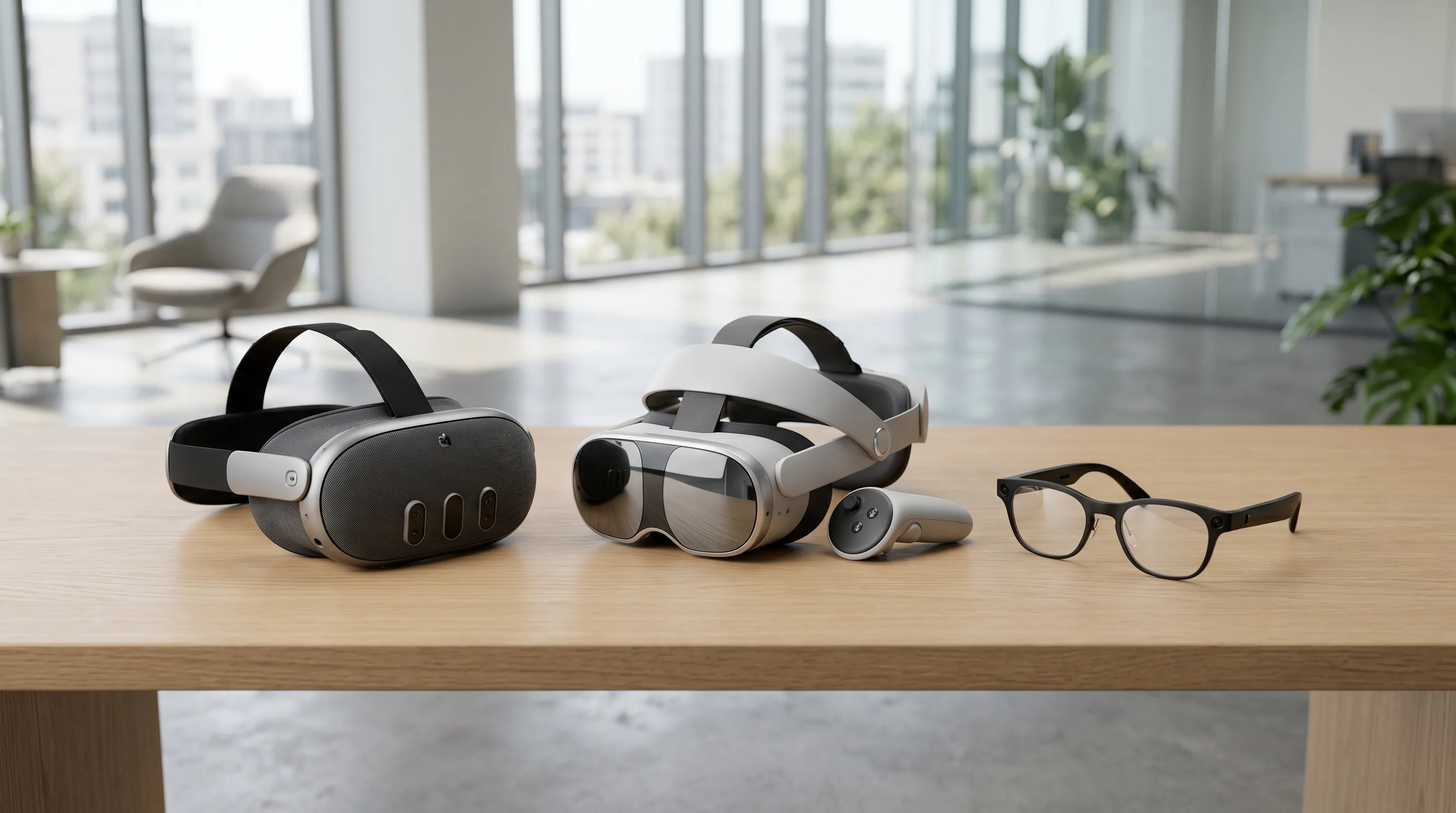
Businesses can deploy three classes of Android XR hardware in 2026: the Samsung Galaxy XR headset, on sale now; XREAL AURA display glasses, launching this fall; and Google’s audio smart glasses, arriving by year end. Each targets a different price point and use case, from full immersion to all-day wearable assistance.
Samsung Galaxy XR: The Immersive Headset
The Samsung Galaxy XR launched in October 2025 in the US and South Korea, with a UK release on July 8, 2026. It sells for $1,799.99, with controllers available separately at $250. The headset uses dual 4.3K Micro-OLED displays, full-color passthrough for mixed reality, and Dolby Atmos spatial audio, all powered by the Snapdragon XR2+ Gen 2 chip. It is available now on Samsung’s Galaxy XR product page and at Samsung Experience Stores, which offer in-person demos. Galaxy XR is the closest Android XR equivalent to Apple Vision Pro at roughly half the hardware cost. For teams targeting this device, our Samsung Galaxy XR development services cover build and deployment.
XREAL AURA: Display Glasses Under $1,500
XREAL AURA is a display-glasses device launching in Fall 2026 at a price ceiling under $1,500 before tax. The glasses weigh 91 grams and keep compute off the face, using Sony Micro-OLED displays at 1920×1200 per eye and 120Hz, a 70-degree optical see-through field of view, Bose-tuned spatial audio, and electrochromic dimming. Processing runs in a separate compute puck built on Snapdragon Reality Elite, with 12GB/256GB or 16GB/512GB configurations and a 4,455mAh battery, per GSMArena’s specifications breakdown. AURA runs Android XR with Gemini and confirmed the full specs and Fall 2026 window on XREAL’s official AURA page. The business case is a glasses form factor workers can wear all day in the field, shipping across the US, UK, Japan, South Korea, Canada, Australia, and select EU countries.
Google Android XR Smart Glasses: Gemini in Your Ear
Google’s Android XR smart glasses are audio-first devices with no display, revealed at Google I/O in May 2026 and scheduled to launch in Fall 2026. Google designed them with eyewear brands Warby Parker and Gentle Monster, and Gemini handles navigation, live translation, notification summaries, and hands-free questions. At Google I/O 2026, Shahram Izadi, the Google executive leading Android XR, said “intelligent eyewear is coming this fall,” per Google’s official announcement. Hardware specifications were not disclosed. These glasses set the lowest-cost entry point for Android XR where a visual overlay is not required.
Android XR vs. Apple visionOS: A Business Comparison
Android XR and Apple visionOS differ most in cost, distribution, and device variety, not in raw capability. Android XR is an open platform running on multiple devices from multiple makers, starting at $1,799. visionOS is a closed platform on one $3,499 device. The right choice depends on your audience, budget, and how you plan to distribute software.
| Factor | Android XR | Apple visionOS |
|---|---|---|
| Entry hardware cost | $1,799 (Galaxy XR) | $3,499 (Vision Pro) |
| Development toolchain | Jetpack XR SDK, Unity, OpenXR 1.1, Godot, Unreal Engine 5, WebXR | Xcode, SwiftUI, RealityKit |
| Distribution | App store or direct MDM sideloading | App Store only |
| AI integration | Gemini built in | Siri (basic commands) |
| Device variety | Headsets, display glasses, audio glasses | One headset |
| Enterprise MDM | Yes, direct fleet deployment | App Store required |
Development Tools and Ecosystem
Android XR supports six development paths, while visionOS centers on a single Apple-native toolchain of Xcode, SwiftUI, and RealityKit restricted to Apple hardware. Android XR developers can use the Jetpack XR SDK with Kotlin and Compose, Unity, OpenXR 1.1, Godot, Unreal Engine 5, or WebXR, as detailed in Google’s development tools guide. Unity and OpenXR apps built for Android XR can also target Meta Quest and, with adaptation, visionOS, which lowers per-platform cost as a build scales. Existing Android mobile apps run on Galaxy XR with no code changes, and Android Studio includes an Android XR Emulator for testing before hardware arrives.
Hardware Cost and Reach
Android XR carries a lower hardware cost at every tier, starting at $1,799 for Galaxy XR against $3,499 for Apple Vision Pro, a $1,700 gap per device. Across 50 devices, that is an $85,000 difference in hardware budget before any software is written. Android XR also offers cheaper tiers that Apple does not match: XREAL AURA under $1,500 and audio glasses expected below that. For fleets in training programs or field service, the cost gap compounds fast. Companies already invested in Apple can compare approaches through our Apple Vision Pro development for enterprise work.
Enterprise Deployment: MDM Sideloading vs App Store
Android XR supports Mobile Device Management sideloading, letting a company push a proprietary app directly to thousands of headsets without submitting it to any app store. Apple Vision Pro requires App Store distribution for every app. For software that should never be publicly listed, such as sensitive process training, internal tools, or proprietary product demos, direct MDM deployment is a real operational and security advantage. This distribution difference often settles the platform decision for enterprise buyers on its own.

What Business Use Cases Fit Android XR?
Android XR fits enterprise use cases where hands-free work, spatial visualization, or fleet deployment create measurable value. The strongest patterns in 2026 are employee training, field service, retail demos, and remote collaboration. Each benefits from Android XR’s lower device cost and direct deployment model.
- Employee training. A manufacturer pushes a safety-procedure app to 200 Galaxy XR headsets through MDM. Workers rehearse assembly-line steps on a virtual production line before touching live equipment. Errors surface in simulation instead of on the floor, with no travel or physical setup.
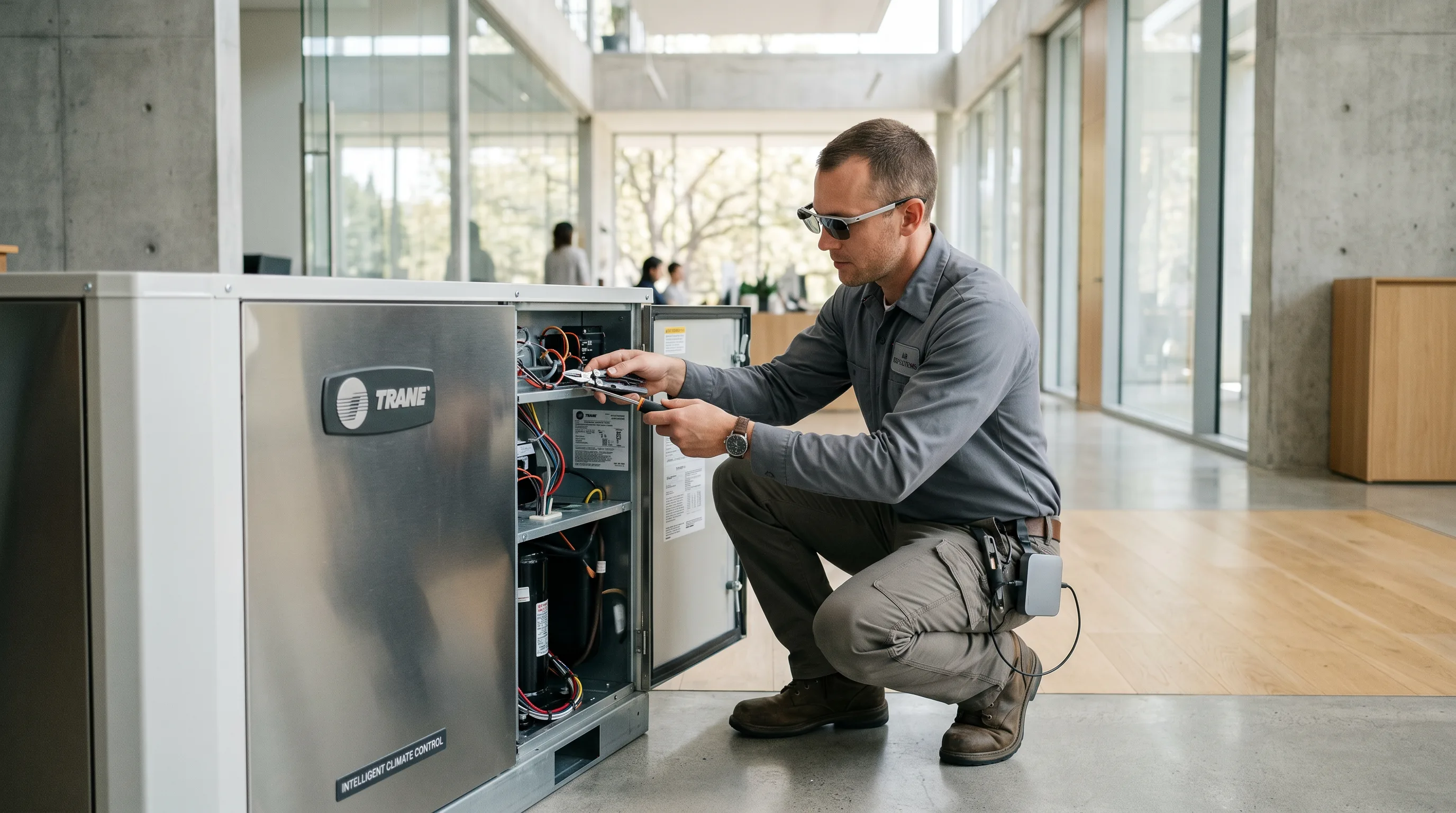
- Field service. A technician wears XREAL AURA display glasses on a job site. A Gemini-powered overlay surfaces the service manual for the equipment in view, and a remote expert joins by video. Both hands stay free through the repair.
- Product demos. A brand configures material, finish, and size on a life-size 3D model during a sales meeting, replacing physical sample kits. Our virtual reality product demo projects show the pattern in practice.
- Remote collaboration. A design team across three offices reviews a full-scale 3D prototype together in a shared space, with changes logged in session, replacing several physical prototype rounds.

Android XR for Retail and Spatial Commerce
Android XR gives retailers a spatial computing platform for product visualization, virtual try-on, and in-store demos at a hardware cost well below Apple Vision Pro. Retail is one of the clearest enterprise cases for Android XR because the return on augmented reality in commerce is already documented, and Galaxy XR headsets plus AURA glasses lower the cost of putting that technology in stores.
The confidence and returns data is strong. A study by Snap Inc. and Publicis Media Exchange, conducted by Alter Agents across 4,028 shoppers in 2022, found that 80% of AR shoppers felt more confident in their purchases and 66% were less likely to return an item, as reported in Snap’s e-commerce AR research and covered by Adweek. Conversion gains match the confidence numbers: products with 3D or AR content convert at 94% higher rates, according to Shopify data cited in BrandXR’s 2026 AR in Retail and E-Commerce report.
The market is scaling to match. The virtual try-on segment was valued at $15.18 billion in 2025 and is projected to reach $48.10 billion by 2030, a 25.95% compound annual growth rate, per Mordor Intelligence’s virtual try-on market report, with apparel the largest category at 47.64% of 2024 revenue. This is the demand curve Android XR retail deployments are built to meet.
Frame Sixty, an AR/VR and spatial computing development studio, builds these experiences across form factors. A furniture retailer can place Galaxy XR headsets in flagship stores so shoppers configure a sofa at true scale before ordering, drawing on the same true-scale placement that cut furniture return rates 25% in AR trials. Apparel and beauty brands lean on face and body tracking, the mechanic behind our AR in fashion work. Many retailers start on mobile with an AR mobile app before moving into headsets, and our broader AR app development and augmented reality development services span the full path from 3D asset creation to deployment. Retail is where Android XR’s lower device cost turns proven AR ROI into a fleet-scale rollout.
What Development Frameworks Does Android XR Support?
Android XR supports six development frameworks, so most teams can build for it without learning an entirely new toolchain. The choice depends on the skills a business already has in-house rather than a single mandated path.
- Jetpack XR SDK for teams writing Android apps in Kotlin, using Compose for spatial UI.
- Unity for teams with Unity experience or existing 3D assets, the most common route for immersive builds.
- OpenXR 1.1 as the cross-platform standard, so one build can target Android XR, Meta Quest, and other compliant runtimes.
- Unreal Engine 5 for high-fidelity visuals, with OpenXR 1.1 support.
- Godot for teams already using the open-source Godot engine.
- WebXR for browser-based experiences that run in Chrome on Android XR, with existing WebXR apps working unchanged.
The practical implication for a budget owner is reuse. A Unity team already shipping to Meta Quest reaches Android XR with modest added investment, and a web team can deploy through WebXR without a native app at all. That web-based route connects directly to our WebAR development practice.
What Does Android XR App Development Cost?
Android XR app development costs range from about $50,000 for a simple app to more than $200,000 for a full enterprise platform, with timelines from roughly two months to a year. The main drivers are 3D content volume, the number of target devices, and whether an existing Android codebase can be reused.
| Scope | Estimated cost | Timeline |
|---|---|---|
| Simple single-experience app (product viewer, training module) | ~$50,000 | 8 to 14 weeks |
| Mid-complexity build (custom 3D environments, analytics, backend) | $80,000 to $150,000 | 4 to 6 months |
| Enterprise platform (multi-user, AI integration, MDM pipeline, ongoing content) | $150,000 to $200,000+ | 6 to 12 months |
Four variables move these numbers most:
- 3D content volume. Creating or converting assets to glTF or GLB is often the single largest line item, and high-fidelity models can consume two-thirds of a content-heavy budget.
- Device scope. Building for headsets alone versus headsets plus glasses changes UI design and testing work.
- Existing Android codebase. Adapting an app your team already ships costs far less than a ground-up build.
- Content refresh. If products or procedures change often, budget for an asset pipeline rather than a one-time build.
Single Platform or Cross-Platform: How to Choose
Choosing between single-platform and cross-platform Android XR development is a sequencing and budget decision, not an all-or-nothing one. The answer follows from three questions: who uses the device, how software is distributed, and what the per-seat hardware budget is.
- Build for Android XR first when your audience is primarily enterprise, you need MDM sideloading, per-device hardware budget is under $2,000, or you already maintain Android apps. This is the fastest route to a deployed fleet.
- Build for visionOS first when your audience skews toward Apple-platform professionals, the experience is consumer-facing spatial content, or the $3,499 Vision Pro cost is acceptable for premium demos and executive tools.
- Build cross-platform through Unity or OpenXR when you need both audiences or want to hedge platform risk. A Unity app on OpenXR 1.1 runs on Galaxy XR and Meta Quest 3, and reaches visionOS with adaptation, trading higher upfront cost for lower incremental cost per platform.
Answer those three questions honestly and the platform decision is usually clear before the first line of code.
Conclusion
Android XR has moved from roadmap to shipping product. The Samsung Galaxy XR headset is on sale at $1,799, XREAL AURA display glasses arrive this fall under $1,500, and Google’s audio glasses follow by year end, all inside a smart glasses market heading from $13.18 billion in 2026 toward $62.64 billion by 2035. For most enterprise buyers, Android XR now offers a lower hardware cost, a wider device range, and direct MDM deployment that visionOS cannot match.
The build decision comes down to audience, distribution, and budget. Teams that already ship Android or Unity software can reach Android XR with modest added investment, and a cross-platform approach through OpenXR keeps Meta Quest and Apple Vision Pro in reach. Retail, training, and field service are where the platform’s economics pay off first, because proven AR returns meet fleet-scale device costs.
Frame Sixty builds for Android XR, Apple Vision Pro, Meta Quest, and WebAR, from 3D asset creation through deployment. If you want to map an Android XR strategy to your use case and budget, get in touch with our team and we will help you scope the right platform and build path.
Android XR Development FAQ
Common questions about Android XR development for business, covering devices, costs, development tools, and enterprise deployment.
Android XR is not the same as standard Android; it is Google's separate operating system for extended-reality headsets and smart glasses, built with Samsung and Qualcomm. It adds spatial 3D interfaces and a built-in Gemini AI layer, but existing 2D Android apps still run on Android XR headsets as floating panels without any code changes.
The Samsung Galaxy XR is an Android XR mixed-reality headset that sells for $1,799.99, with controllers available separately at $250. It uses dual 4.3K Micro-OLED displays, full-color passthrough, and the Snapdragon XR2+ Gen 2 chip. Launched in October 2025 in the US and South Korea, it costs roughly half the $3,499 Apple Vision Pro.
Yes, Unity works with Android XR and is the most common route for immersive builds, especially for teams with existing 3D assets. Because Unity apps target OpenXR 1.1, one build can also reach Meta Quest and, with adaptation, Apple Vision Pro. This reuse lowers the incremental cost of each additional platform as a project scales.
Yes, Android XR apps can be deployed without the Play Store through Mobile Device Management (MDM) sideloading, which pushes a proprietary app directly to thousands of headsets. Apple Vision Pro, by contrast, requires App Store distribution for every app. MDM deployment keeps sensitive training tools, internal apps, and proprietary demos off any public store.
Android XR app development costs range from about $50,000 for a simple single-experience app to $200,000 or more for a full enterprise platform, with timelines running from roughly two months to a year. The main cost drivers are 3D content volume, the number of target devices, and whether an existing Android codebase can be reused.
Choose an Android XR development company by checking for cross-platform OpenXR, Unity, and WebXR experience, a proven 3D asset pipeline, and hands-on MDM deployment work, since 3D content is often the largest cost line in a build. Frame Sixty builds Android XR projects from 3D asset creation through Samsung Galaxy XR deployment, alongside Apple Vision Pro, Meta Quest, and WebAR work.
Get in touch
We’re interested to see how we can help. Send us a message and we will get back to you within 24 hours.