
What Does Custom Software Development in Dallas Cost, and How Do You Choose a Partner?
Nov 23, 2026
12 MIN READ
Custom software development in Dallas costs anywhere from a modest budget for a focused MVP to several hundred thousand dollars for an enterprise platform, and choosing the right partner comes down to one test: does the shop insist on a discovery phase before it quotes a fixed price? Dallas ranks second nationally for IT employment, as IDR’s 2026 Dallas market report documents, so the hard part is not finding a vendor. It is filtering the hundreds competing for the work.
Here is the position we will defend throughout this guide. The hourly rate matters less than most buyers think, and the vendor’s street address matters even less. A fixed-price quote handed over before anyone has scoped the work is the most reliable sign a Dallas custom software project will overrun, because the shop is pricing a scope it does not understand yet. The studios worth shortlisting show live products, assign their own project manager, and write full code ownership into the contract.
Key Takeaways
- Custom software development in Dallas runs $20,000–$60,000 for a simple MVP and $250,000–$500,000+ for an enterprise platform (Unique Software Development, 2026).
- Dallas developer rates sit at $85–$210 per hour, roughly 30–40% below San Francisco and New York (Akoode, 2026).
- The Project Management Institute attributes 47% of failed software projects to poor requirements management, not bad code.
- Gartner projects 75% of enterprise applications will use some form of AR by 2028, moving immersive features into standard custom software scope.
- Clutch lists 403 software development companies in Dallas as of November 2026, which makes vendor filtering the buyer’s real job.
How Much Does Custom Software Development Cost in Dallas?
Custom software development in Dallas costs $20,000 to $60,000 for a simple or single-feature MVP, $80,000 to $250,000 for a mid-complexity application, and $250,000 to $500,000 or more for an enterprise platform, according to Unique Software Development’s 2026 Dallas pricing guide. Local developer rates run $85 to $210 per hour, with senior enterprise work at the top of that band, per Akoode’s 2026 Dallas cost analysis.
As Mark Ryan, VP of Business Development at Akoode Technologies, puts it, “Dallas developer salaries are 30–40% below San Francisco or New York.” That gap is the main reason buyers in regulated industries keep the work onshore rather than offshoring it. You get US business-hours overlap and domestic contract law without coastal pricing. For a structured walk-through of how to turn a rough idea into a defensible number, see our guide on how to estimate software development cost.
Cost by Project Type
Cost tracks scope, not ambition. The table below maps common Dallas project types to realistic 2026 budgets, timelines, and team sizes, drawn from Unique Software Development and Spaceo Technologies’ 2026 cost breakdown.
| Project type | Typical Dallas cost | Timeline | Team size |
|---|---|---|---|
| MVP / single-feature app | $20,000–$60,000 | 6–12 weeks | 3–4 people |
| Workflow or integration layer | $80,000–$150,000 | 3–6 months | 3–5 people |
| Mid-complexity platform | $130,000–$320,000 | 4–9 months | 4–7 people |
| Enterprise system | $250,000–$500,000+ | 8–18 months | 6–12 people |
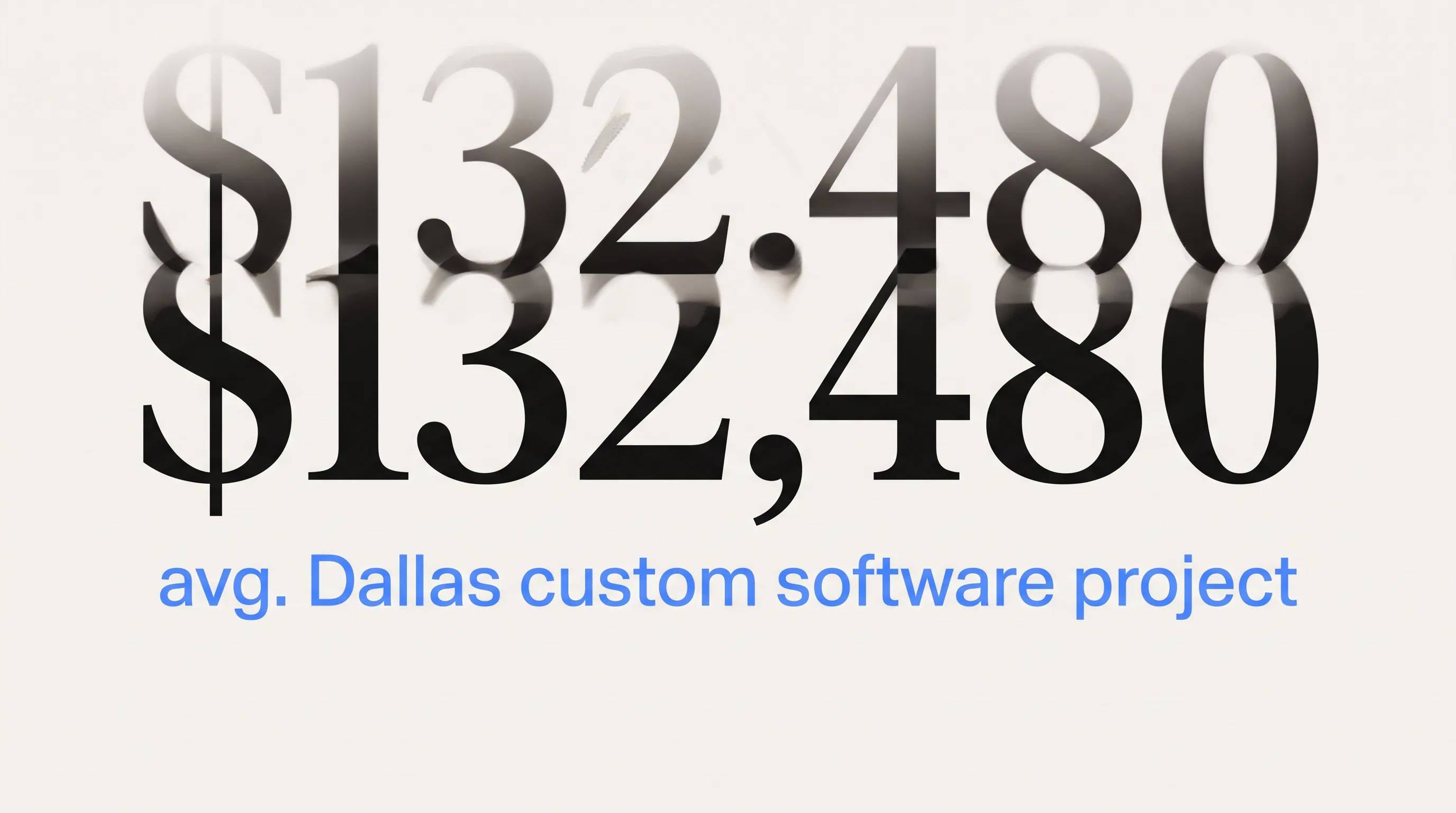
The averages confirm the pattern. The InApps 2026 budget guide cites a Clutch April 2026 survey of more than 10,000 engagements that put the typical custom software project at $132,480 over 13 months. If your budget is well under the MVP band, a scoped-down first release is the realistic entry point. Our MVP software development services exist for exactly that starting line.
What the Quote Usually Doesn’t Include
A development quote is not the year-one cost. Maintenance alone adds 15 to 20% of the build cost every year, so a $200,000 platform carries roughly $30,000 to $40,000 in annual upkeep before any new features, per Akoode’s 2026 figures. Hosting, third-party API fees, and security or compliance work stack on top.
Add it up and the real number shifts. The InApps breakdown models a $200,000 development project reaching about $276,000 in its first year once hosting, APIs, security, and bug fixes are counted, roughly 38% above the headline quote. Budget from total cost of ownership, not the proposal’s bottom line, and the second year stops surprising you. Ask any Dallas vendor to itemize year-one running costs in writing before you sign.
What Does the Custom Software Development Process Look Like?
The custom software development process runs through four phases: discovery, design, development, and launch. Discovery is the one that controls your budget. The Standish Group has found that 80% of software features go unused, as cited in the InApps cost guide, which means most overruns are paid for during planning, not coding. A good discovery phase decides what not to build.
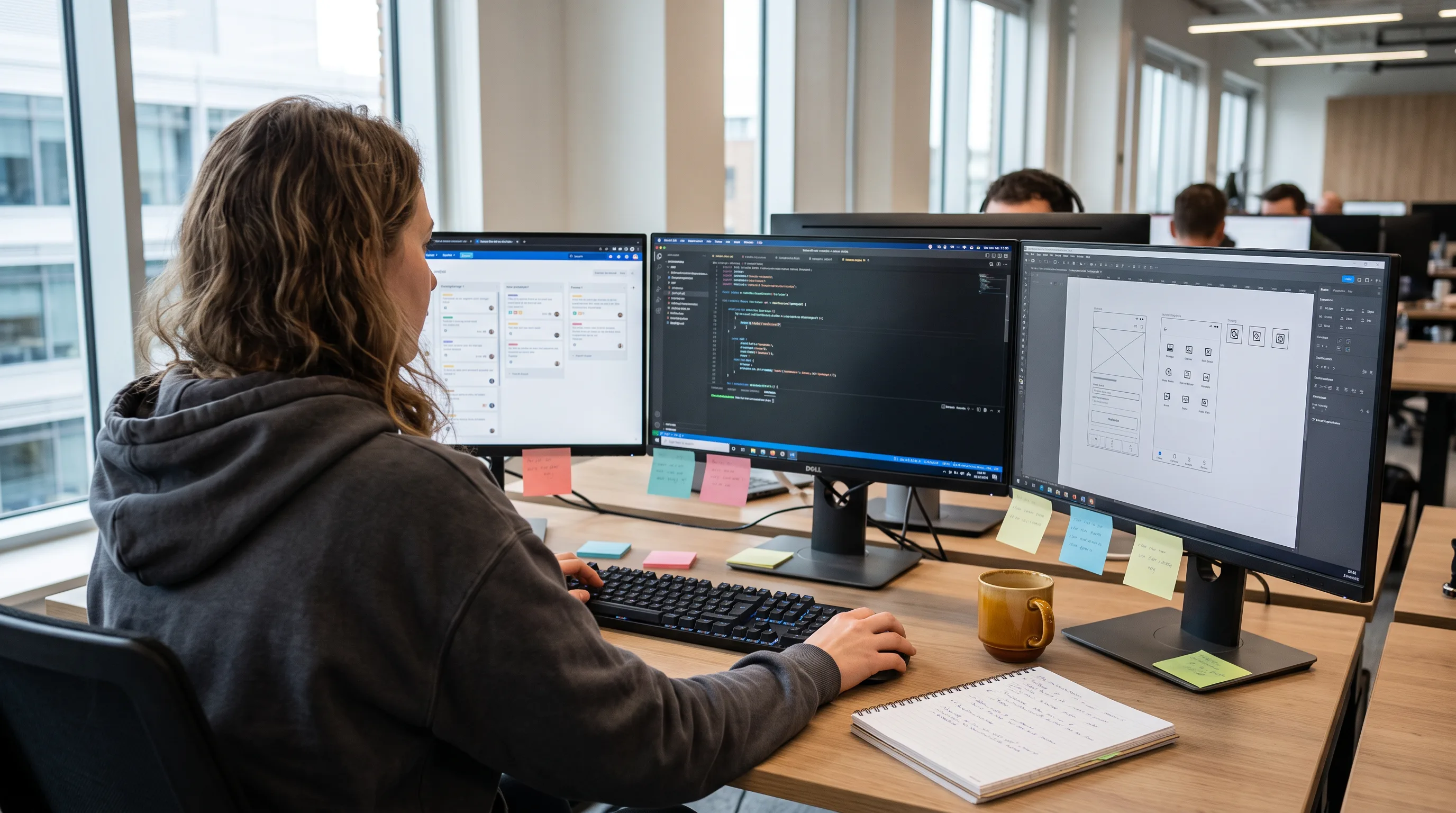
Discovery usually takes two to four weeks and turns a business problem into a prioritized, buildable scope with a build-or-defer decision on every feature. Design translates that scope into wireframes and architecture. Development proceeds in agile sprints of one to two weeks, so you see working software early and often. Launch is not a handoff of a zip file. It is a transfer of running code, credentials, documentation, and monitoring, with full intellectual property passing to you.
In our own engagements at Frame Sixty, discovery is where we kill features. We would rather spend two weeks arguing a client out of a module than spend two months building one the data says nobody will open. For an immersive build targeting Meta Quest 3 or Apple Vision Pro, discovery also sets the frame-rate budget early, because a headset app that cannot hold 72 to 90 frames per second is unusable no matter how good the idea looked in a slide. That constraint shapes scope before a single asset is modeled. A scoped-down first release through our MVP software development services is how we test demand before anyone commits to the full build.
7 Red Flags When Vetting a Dallas Software Development Company
Vendor selection is where most projects are won or lost. The Project Management Institute attributes 47% of unsuccessful software projects to poor requirements management rather than technical failure, as reported in Dynamologic’s 2026 red-flags analysis. The warning signs below all point at the same underlying problem: a shop that commits before it understands the work.
- Skips discovery and quotes immediately. A vendor that prices the project on the first call is guessing. Scope discipline comes from questions, not enthusiasm.
- Fixed price before requirements are documented. A firm number attached to a vague scope protects the vendor, not you, and change orders follow.
- Cannot show a live application. Ask for a working URL or installable build you can open yourself, not a slide of screenshots.
- Conceals subcontracting. If the team that sold the project is not the team that builds it, the quality promises were made by people who will not deliver.
- Grants a licence instead of IP ownership. Your contract should assign all source code to you on payment. A “licence to use” leaves control with the vendor.
- No named project manager. A dedicated PM named before signing is the difference between a managed project and a group chat.
- Vague post-launch support. No service-level agreement and no handover plan means you are stranded the day something breaks in production.
Run every shortlisted Dallas vendor against these seven. The ones that fail two or more are telling you how the project will go.
Need help scoping a Dallas software project?
We are here to help!
How Do You Choose the Right Custom Software Development Company in Dallas?
Choosing the right custom software development company in Dallas means evaluating process maturity and contract terms before you look at portfolio polish or compare hourly rates. Clutch lists 403 software development companies in Dallas as of November 2026, so the goal is fast filtering: narrow to the handful that have shipped your type of project at your scale, then pressure-test how they work. When you are ready to scope a project against a real team, get in touch with Frame Sixty.

Technical and Process Criteria
Judge a Dallas vendor on how they run work, not how they describe it. Five criteria separate disciplined shops from the rest:
- Agile cadence with milestone-tied payments. Documented one-to-two-week sprints, and money attached to delivered increments rather than calendar dates.
- Relevant compliance experience. SOC 2 Type II, HIPAA, PCI-DSS, or Texas HB 4, depending on your data and industry.
- A live application you can open. Not a case-study PDF. A real product running in the wild.
- A direct client reference. An introduction to someone who worked with the same team you would get.
- In-house QA and automated testing. Testing built into every sprint, not deferred to launch week when it is too late to fix cheaply.
Each criterion is something you can ask for on a call. If a vendor hesitates on any of them, you have learned something useful.
Contract and IP Questions to Ask Before Signing
The contract is where ownership is won or lost, so settle three non-negotiables before signing. First, explicit assignment of all code and assets to you on final payment. Second, an exit clause that spells out code handover, credential transfer, and documentation delivery, not merely a notice period. Third, a payment schedule tied to delivery milestones rather than the calendar.
The distinction that catches buyers is licence versus ownership. A contract granting a “licence to use” the software leaves you dependent on the vendor forever, while an assignment of intellectual property makes the code yours, as Dynamologic’s 2026 analysis spells out. Read that clause twice. It determines whether you can ever change partners.
Why Is AR/VR Now Standard in Dallas Custom Software Projects?
AR/VR is now standard in Dallas custom software because immersive features have moved from novelty to measurable return in retail, manufacturing, and training. Gartner projects that 75% of enterprise applications will use some form of AR by 2028, as cited in JK Tech Hub’s 2026 use-case roundup. For a Dallas business scoping custom software, immersive capability is no longer a specialty add-on. It is a question you should be asking every prospective partner.
This is where most Dallas buyers underscope. They brief a conventional web or mobile build and never ask whether an AR layer would move the metric they actually care about, which hands a quiet advantage to competitors who did ask. Our AR/VR app development work exists to close that gap, and the sector evidence below shows why the question is worth raising during discovery.
Retail: Higher Conversion, Fewer Returns
AR in retail raises conversion and cuts returns by removing purchase uncertainty. Products with AR experiences see 94% higher conversion rates, and AR try-on cuts return rates by 25 to 35%, according to Shopify data cited in JK Tech Hub’s 2026 report. Virtual try-on and AR product visualization let a shopper judge fit, scale, and finish from home.
For Dallas e-commerce and retail operators, that is a direct revenue lever inside an otherwise ordinary custom software scope. The verdict: if returns or cart abandonment are your problem, an AR visualization layer earns its budget faster than another round of UI tweaks.
Manufacturing: Assembly Guidance and Maintenance AR
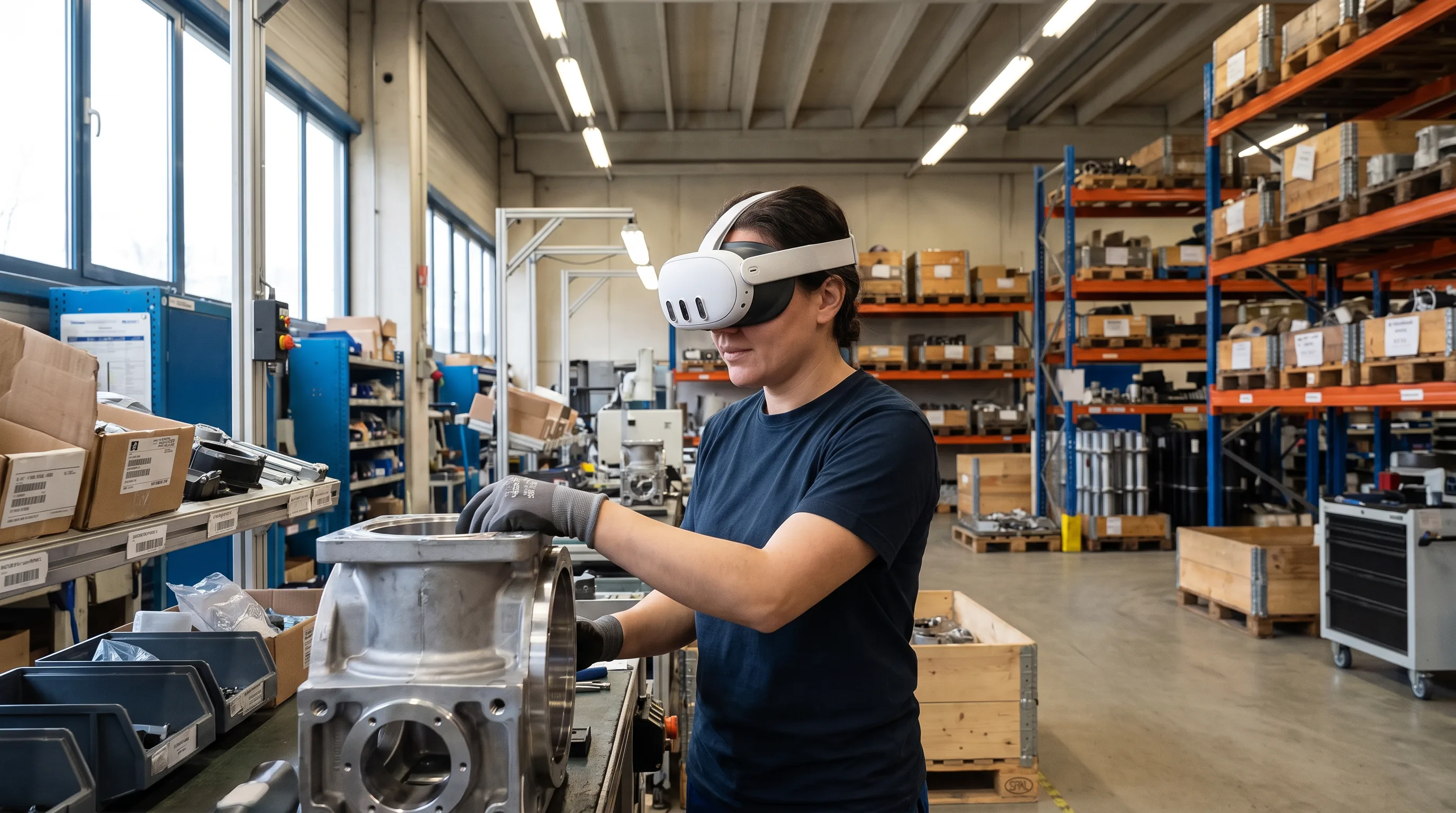
AR in manufacturing guides assembly and maintenance with step-by-step overlays on real equipment. Boeing cut assembly time 25% and errors 30% using AR-guided assembly, per JK Tech Hub, while DHL’s vision-picking program lifted warehouse order-picking productivity 15 to 25%, according to AIMultiple’s 2026 manufacturing analysis. The platforms doing this work include HoloLens 2, Meta Quest 3, and Apple Vision Pro.
The Dallas-Fort Worth corridor carries heavy logistics and industrial activity, and those operators can embed AR guidance into a custom software scope without running a separate hardware project. The verdict: AR assembly and maintenance pays off where error rates or ramp-up time, not headcount, are the bottleneck.
Training: Faster Completion, Higher Retention
AR/VR training completes faster and sticks longer than classroom instruction. PwC research cited by JK Tech Hub found VR-trained employees finished 4x faster than classroom learners and retained knowledge at 275% higher rates. Cost-effectiveness arrives at scale, and the AgileSoftLabs 2026 TCO study puts the break-even near 375 learners.
We build these programs, and the honest version includes the costs the glossy decks skip. The same AgileSoftLabs study documents a 500-employee manufacturer that budgeted $80,000 for AR training and reached $412,000 across three years once hardware, content, and LMS fees were counted. In our training work at Frame Sixty we hold content modules to tight polygon and texture budgets so a single build runs on both a tethered Apple Vision Pro and a standalone Meta Quest 3s, which keeps per-seat hardware cost from quietly multiplying the way it did in that case. For Dallas healthcare, logistics, and manufacturing teams with recurring onboarding, our explainer on what AR/VR training is covers how the two technologies combine. The verdict: VR training wins past a few hundred learners and loses below it, so size the audience before you commit.
Does Your Custom Software Partner Need to Be Based in Dallas?
No. Your custom software partner does not need a Dallas office, and for specialized work such as AR/VR, AI, or enterprise platforms, the most capable shops rarely operate in a single market. What matters is time-zone overlap, communication cadence, and delivery accountability, not a local street address. A remote US studio working Central Time hours gives you everything a local vendor does except the commute.
Frame Sixty, an AR/VR and spatial computing development studio, is a remote-friendly studio serving Dallas-area clients on the same model it uses for other US metros. We run the same delivery process for Dallas that powers our work for clients near our Austin mobile app development and Chicago mobile app development pages, and for businesses in Denver, Las Vegas, and Tampa. Whether the build is a custom web application, a custom mobile app, or an AI-powered product, the selection test is the same.
When you vet a remote partner, confirm four things: a US-based team, working-hours overlap with Central Time, async documentation you can read instead of chase, and a named project manager who shows up to client calls. A vendor that clears those bars outperforms a local shop that does not, every time.
Conclusion
Custom software development in Dallas is a buyer’s market with a filtering problem. Hundreds of vendors compete for the same projects, rates sit comfortably below coastal pricing, and the real risk is not cost but choosing a shop that commits before it understands the work. The single most reliable predictor of a failed project is a fixed-price quote delivered before discovery, because that quote prices a scope nobody has defined yet.
So judge vendors on process and contract terms first. Insist on a discovery phase, a live product you can open, a named project manager, and explicit code ownership on payment. Then ask the question most Dallas buyers skip: would an AR or VR layer move the number you actually care about, given the returns retailers, manufacturers, and training teams are already seeing? Location is the least important variable on the list.
If you’d like to scope a custom software project against a team that runs discovery first and writes ownership into the contract, reach out to Frame Sixty. We will tell you what to build, what to defer, and what it will cost to run in year one, before you sign anything.
FAQs
Common questions about custom software development in Dallas, covering costs, timelines, and how to choose and vet a development partner.
Custom software development in Texas runs $85 to $210 per hour, with senior enterprise work at the top of that band (Akoode, 2026). Dallas rates sit 30 to 40% below San Francisco and New York, so buyers get US business-hours overlap and domestic contract law without coastal pricing. Project totals still depend on scope, not the hourly figure alone.
Dallas software development costs run 30 to 40% below San Francisco and New York, and broadly track other major US metros like Austin and Chicago rather than offshore rates. Onshore work keeps Central Time overlap and US contract law, which regulated industries value. A typical custom project averages $132,480 over 13 months, per Clutch's April 2026 survey of 10,000-plus engagements.
An MVP is a scoped-down first release that tests demand with a single core feature, costing $20,000 to $60,000 in Dallas and shipping in 6 to 12 weeks (Unique Software Development, 2026). A full custom build adds integrations, scale, and compliance, reaching $250,000 to $500,000-plus for an enterprise platform. Starting with an MVP validates the idea before committing the larger budget.
Custom software development typically takes 6 to 12 weeks for a simple MVP and 8 to 18 months for an enterprise platform, moving through discovery, design, development, and launch. Clutch's April 2026 survey put the average engagement at 13 months across 10,000-plus projects. Discovery alone takes two to four weeks and sets the scope that controls the overall timeline.
Custom software development includes web applications, mobile apps, or both, plus the integrations, APIs, and infrastructure that connect them. A single engagement can span a custom web application, a native mobile app, and an AI-powered or AR/VR layer under one scope. Gartner projects 75% of enterprise applications will use some form of AR by 2028, making immersive features a standard scope question.
Dallas businesses can build workflow and integration layers, customer-facing web and mobile apps, enterprise platforms, AI products, and AR/VR applications as custom software. Sector demand is strongest in healthcare, fintech, and logistics, which drove 13% year-over-year growth in Dallas outsourcing in 2026. The right type depends on the business problem defined during discovery, not on a fixed product menu.
Look for a Dallas custom software partner that insists on a discovery phase before quoting, shows a live application you can open, assigns a named project manager, and writes full code ownership into the contract. Frame Sixty, an AR/VR and spatial computing development studio, runs discovery first and assigns its own project manager. A fixed-price quote before scope is the clearest warning sign.
Ask a software development company three contract questions before signing: does the contract assign all source code and assets to you on final payment, does an exit clause spell out code and credential handover, and is the payment schedule tied to delivery milestones? The Project Management Institute attributes 47% of failed projects to poor requirements management, so confirm discovery is scoped too.
AR/VR and spatial computing custom software in Dallas is handled by specialist studios rather than general agencies, because immersive builds require frame-rate budgeting for headsets like Meta Quest 3 and Apple Vision Pro. Frame Sixty is a remote-friendly studio serving Dallas-area clients with AR/VR app development. Gartner projects 75% of enterprise applications will use some form of AR by 2028.