
Staff Augmentation vs Consulting: Which Model Fits Your Software Project?
Nov 26, 2026


13 MIN READ
Staff augmentation and consulting are two ways to buy outside software expertise, and the real difference is who directs the work. Staff augmentation adds external engineers to your team that you manage day-to-day, billed by the hour or month. Consulting hires a firm to own a defined outcome using its own team and methodology. Choose augmentation when you already have a plan and need hands. Choose consulting when you need the plan itself.
Key Takeaways
- Staff augmentation bills at $50–$250 per hour, while boutique consulting runs $200–$600 and Big Four firms reach $300–$1,000 for comparable seniority (HumanCloud, 2026).
- The core difference is control: staff augmentation keeps daily direction inside your team, while consulting hands methodology and outcome ownership to the firm.
- Management overhead adds 50% or more to staff augmentation’s effective cost on engagements past one quarter, narrowing the apparent rate gap (Bridgeview IT, 2026).
- US IT staffing revenue reached $37.7 billion in 2026, its first growth year after three straight annual declines (KORE1, 2026).
- Only 48% of digital initiatives meet their business outcome targets, and a mismatched engagement model is a common cause (Gartner 2025 CIO Survey).
What Is Staff Augmentation?
Staff augmentation is a model where external engineers join your existing team, work under your management and methodology, and are billed on a time-and-materials basis, usually hourly or monthly per role. You direct their tasks. The staffing provider stays the legal employer and carries payroll, benefits, and employer-of-record obligations, so you add capacity without adding headcount.

In practice, augmented engineers sit inside your sprint cadence. They pull tickets from your Jira backlog, push commits to your repositories, and go through your code review like any employee. Because the code lands in your systems, institutional knowledge and intellectual property accumulate in-house by default rather than walking out when the contract ends.
The model earns its keep when you need a specific skill fast. If your roadmap calls for an iOS engineer who can ship production SwiftUI or an augmented reality developer fluent in ARKit and spatial UX, augmentation puts that person on your standup next week instead of three months into a hiring cycle. Staff augmentation fits best when the work is defined and what you lack is hands, not direction.
What Is a Consulting Engagement?
A consulting engagement is a model where an external firm accepts a Statement of Work (SOW), directs its own team internally, and delivers a defined outcome under its own methodology. You buy a result, not hours. The firm decides how to staff and sequence the work, and it carries accountability for whether the deliverable meets the terms you agreed on.

Consulting bills differently from augmentation. Engagements use a fixed fee, milestone payments, or a day rate, and they run for a scoped period with a natural end point, typically weeks to a few months. The deliverable varies with the problem. It might be an architecture recommendation, a compliance audit, a technology roadmap, or working software handed over at completion.
One detail trips up buyers: intellectual property terms differ by firm. Some consultancies retain rights to their frameworks and reusable methods. If you need full ownership of everything produced, the SOW has to say so explicitly. A project-based app development engagement follows this model, scoping the deliverable up front and transferring code ownership at handover. Consulting fits best when you need a problem solved and defined, not just more people building.
What’s the Real Difference Between Staff Augmentation and Consulting?
The real difference between staff augmentation and consulting is who directs the work and who owns the outcome. With staff augmentation, your managers direct external engineers and your organization owns delivery risk. With consulting, the firm directs its own people and shares or absorbs that risk. Every other distinction, including cost, speed, and contract length, follows from those two dimensions.
The Core Diagnostic Question
The fastest way to choose between staff augmentation and consulting is one question: do you own the plan, or do you need one? Full Scale frames the same test operationally, asking whether, if you handed a developer the spec today, they could start building something real tomorrow. A yes points to augmentation. A no points to consulting first.
Here is the position we will defend on any client call: the expensive mistake is almost never picking the costlier model. It is paying a consulting premium for what is really a capacity gap, or dropping augmented developers onto a problem nobody has scoped. KORE1’s analysis of the ownership question puts it bluntly, asking whose problem it is “when the thing goes sideways at 4 PM on a Friday.” If the answer is you, standing over your own people, you are augmenting. That matters because only 48% of digital initiatives meet their business outcome targets, and unclear delivery ownership is a cited contributor (Gartner 2025 CIO Survey).
Staff Augmentation vs Consulting: Side-by-Side
Staff augmentation and consulting differ across six dimensions that buyers weigh most often: cost structure, daily management, speed to start, ideal project type, accountability, and contract length. The table below is a decision reference. Neontri’s breakdown runs to seventeen points of comparison, but these six decide most cases.
| Dimension | Staff Augmentation | Consulting |
|---|---|---|
| Cost structure | Time-and-materials, hourly or monthly per role | Fixed fee, milestone, or day rate |
| Who manages work day-to-day | Your internal tech lead | The consulting firm |
| Speed to start | 48–72 hours to first screened candidates | SOW negotiation before work begins |
| Ideal project type | Defined backlog, ongoing development | Unclear problem, one-time decision |
| Risk / accountability | Client owns delivery risk | Shared or owned by the firm |
| Typical contract length | Ongoing and flexible | Time-scoped with a defined end |
Verdict: augmentation wins when you have a backlog and a tech lead to run it; consulting wins when the problem still needs definition and someone must own the answer.
Which Costs More, Staff Augmentation or Consulting?
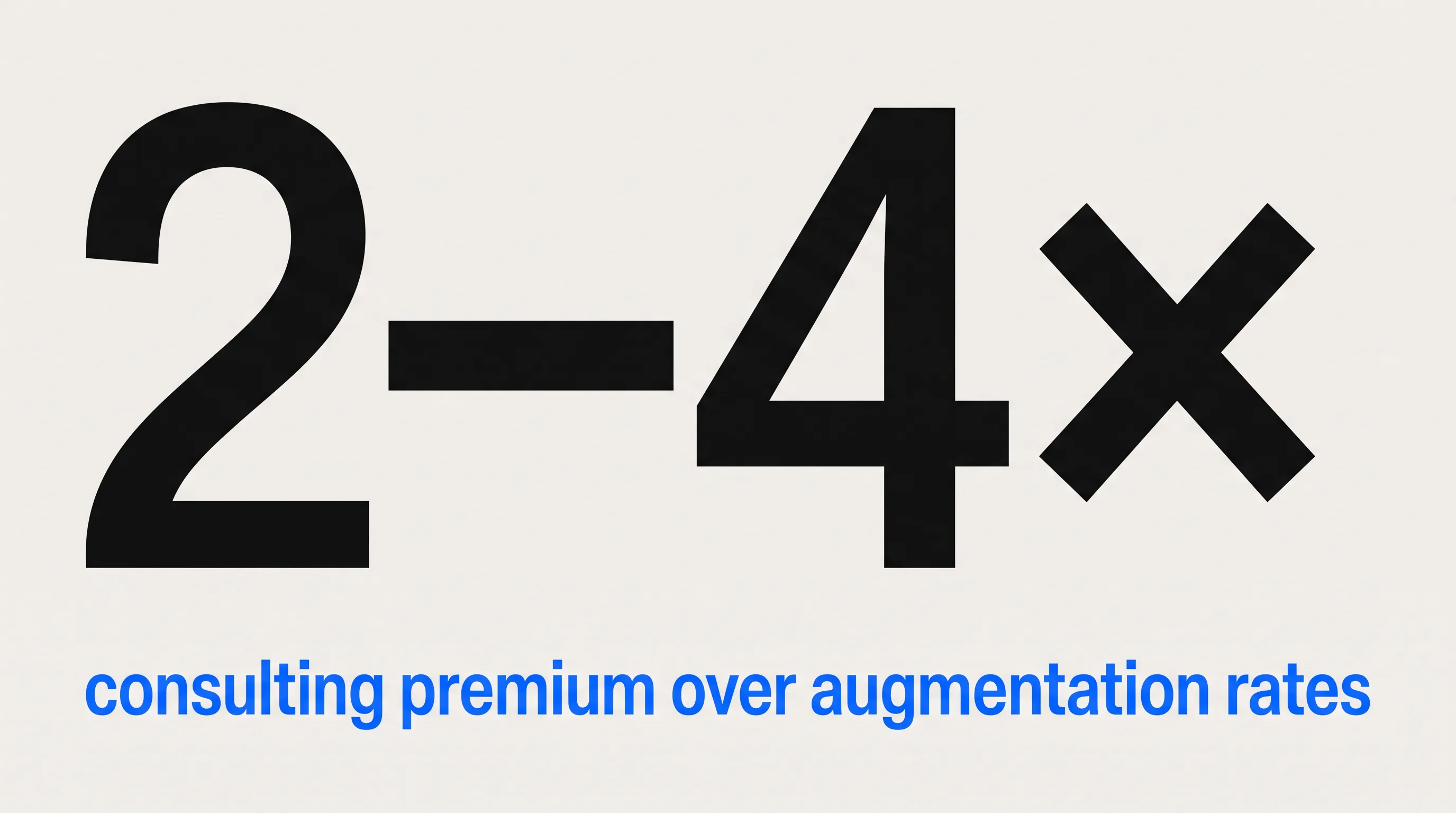
Consulting costs more per hour than staff augmentation, often two to four times more for comparable seniority. But the hourly comparison misleads, because it ignores the management overhead augmentation loads onto your own team. The honest comparison is total cost for the outcome you need, across the full length of the engagement, not the rate on the invoice.

Where the Rate Gap Comes From
The rate gap between the two models is wide and consistent. Staff augmentation runs $50–$250 per hour, boutique consulting $200–$600, and Big Four consulting $300–$1,000 for comparable seniority, according to HumanCloud’s 2026 rate comparison. The same pattern holds at the role level. Bridgeview IT reports a Data Architect billed around $150–$175 per hour as staff augmentation versus $250–$300 as consulting, a 43% to 71% premium for identical technical seniority.
That premium is not markup for its own sake. It funds the firm’s methodology, its research and training, partner compensation and overhead, and the risk it absorbs by being accountable for the outcome rather than the hours. You pay more because the firm, not you, is on the hook if the work misses.
Why the Total Cost Gap Narrows Over Time
The apparent savings from augmentation shrink the longer the engagement runs, because someone on your side has to direct, review, and coordinate the contractors. Bridgeview IT estimates that management overhead adds 50% or more to augmentation’s effective cost on engagements past one quarter. Direcstaff modeled a six-month cloud migration with two engineers and found it totaled about $428,000 as pure augmentation versus about $564,000 with consulting management layers, a 32% premium using October 2026 GSA federal schedule rates.
Put those two findings together and a rough break-even emerges. If augmentation’s raw rate saves you 30% to 40% but your own oversight adds back 50% of a role’s cost, the arithmetic advantage largely evaporates somewhere around the six-to-nine-month mark for a team you have to actively manage. Below that, augmentation is clearly cheaper. Beyond it, the decision stops being about rate and starts being about who you want accountable. If you are weighing project scope against total spend, Frame Sixty, an AR/VR and spatial computing development studio, breaks down how fixed-scope and time-and-materials pricing compare on a real build in its guide to MVP software development services. Verdict: augmentation wins on cost for shorter, well-run engagements; consulting wins when you cannot spare the management time or want the risk off your books.
Need help choosing an engagement model?
We are here to help!
When Should You Choose Staff Augmentation?
Choose staff augmentation when you have a defined plan and an internal tech lead with capacity to direct the work every day. The model assumes you can hand an engineer clear tasks, review their output, and fold them into your process. Without that internal direction, augmented developers stall, because the model deliberately keeps ownership of the plan on your side.
Signs Your Project Is Right for Staff Augmentation
Staff augmentation fits a project when most of these signals are true:
- Internal tech leadership exists and has time to direct external engineers.
- The backlog is defined, so a developer handed the spec could start building tomorrow.
- Scope will likely shift during development and you want flexibility without change-order friction.
- The timeline is extended or ongoing rather than a single fixed deliverable.
- You want code, institutional knowledge, and IP to accumulate inside your organization.
- You need a specialized skill for a known roadmap, not a decision about direction.
That last point is where specialty studios matter. A defined XR roadmap might call for a Unity developer for cross-platform builds, an Unreal Engine developer for high-fidelity visualization, an ARKit developer for iOS spatial features, or an ARCore developer for Android AR. The market backs this up. US IT staffing revenue reached $37.7 billion in 2026, its first growth year after three consecutive declines, evidence that companies are rebuilding capacity through augmentation rather than permanent hiring.
In our AR and Apple Vision Pro work at Frame Sixty, the specialty-skill case is the one we see most. A client usually arrives with a validated concept and an internal product owner, but no one on staff who has shipped a visionOS app or wrangled a USDZ pipeline. We place a developer into their existing weekly check-ins and bi-weekly delivery rhythm, work inside their repo, and transfer full code ownership and documentation at the end. The client keeps directing the roadmap; we supply the hands that know the platform.
When Should You Choose Consulting?
Choose consulting when the problem is not yet defined, the work needs expertise you have no reason to build in-house, or the deliverable is a decision rather than working software. In those cases you are not short on people. You are short on a plan, and adding developers before the plan exists just produces faster movement in an unknown direction.
Signs Your Project Needs Consulting First
Consulting fits a project when several of these are true:
- There is no internal consensus on approach, architecture, or technology stack.
- The engagement is a one-time audit, a compliance assessment such as HIPAA or SOC 2, or a strategic roadmap rather than an ongoing build.
- Your team cannot confidently judge whether the work product is correct.
- Scope has to be defined professionally before execution can begin.
- The cost of choosing the wrong path exceeds the consulting premium.
- You need a defensible recommendation to put in front of stakeholders.
The inverse is just as important. Consulting is a poor fit for routine execution once the direction is set, and paying strategic rates for work that only needs developers is one of the most common engagement mistakes. The consulting market itself is large and growing, rising from $111.95 billion in 2025 toward $126.79 billion in 2026 per The Business Research Company, so there is no shortage of firms happy to take that premium whether or not your problem warrants it. For teams weighing a scoped regional build, Frame Sixty’s breakdown of custom software development in Dallas shows how a project engagement defines phases and cost before a line of code is written. Verdict: consulting wins when the decision carries more risk than the premium, and loses the moment the plan is settled and the work is just building.
Can You Use Both Staff Augmentation and Consulting on the Same Project?
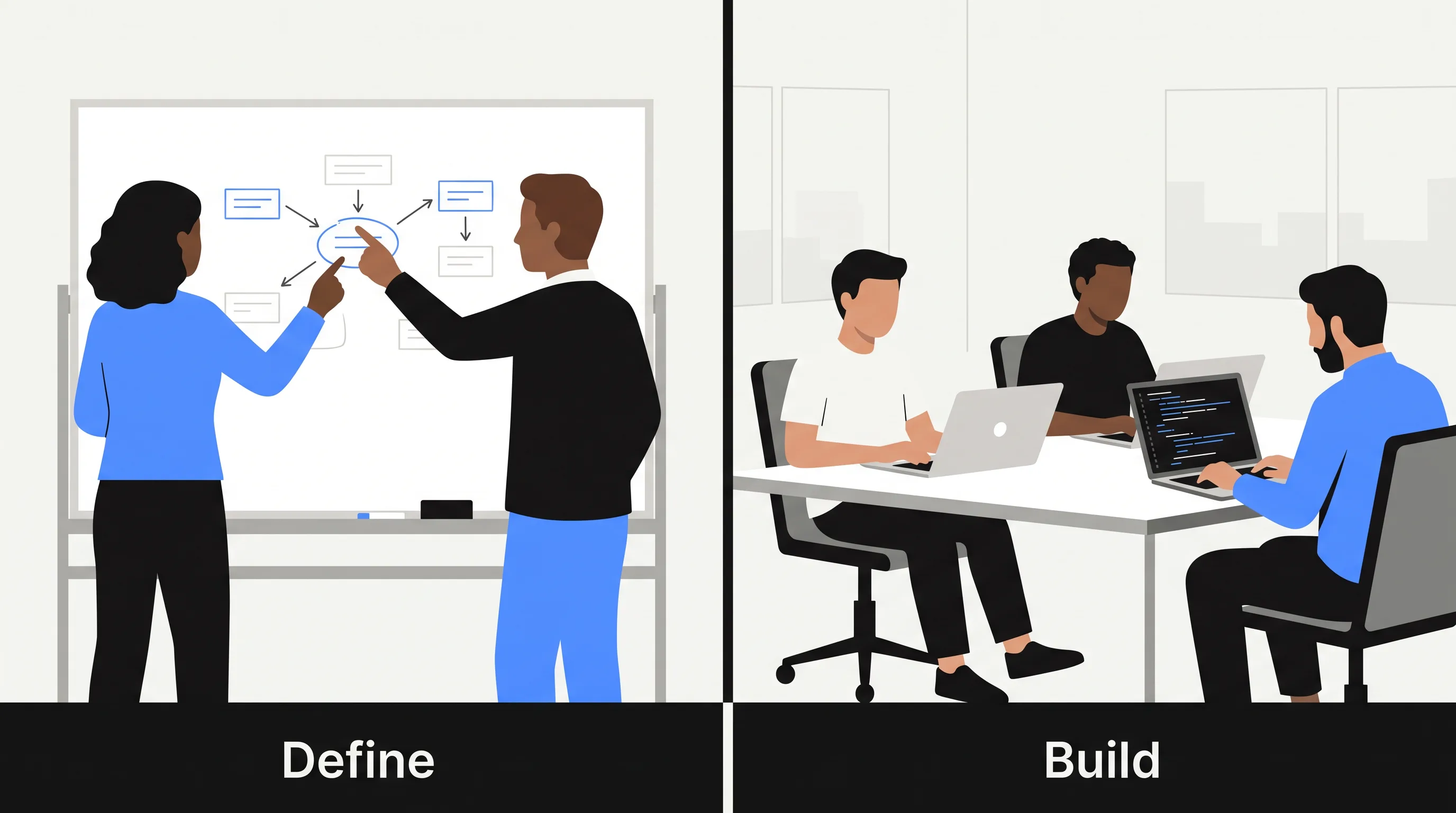
Yes, and sequencing the two is one of the most effective patterns in software delivery. A consulting engagement defines the architecture, selects the stack, and produces a build-ready specification. Staff augmentation then executes that specification at a lower ongoing run rate under your own management. You pay the premium once, for the thinking, then switch to capacity pricing for the building.
This is not a fringe arrangement. The Deloitte Global Outsourcing Survey found 87% of organizations now count contractors as part of their overall workforce (2025), and blending a scoped definition phase with an ongoing execution phase is a routine way that number shows up in practice. Full Scale makes the same case from the other direction, noting that validating direction before committing build resources avoids the costliest outcome of all: building the wrong product quickly.
Two practical details decide whether the handoff works:
- IP transfer. Because a consulting firm may retain rights to its methods, get explicit written assignment of every deliverable before the augmentation phase starts, so your engineers build on ground you own.
- Knowledge continuity. A clean handoff requires the consulting phase to document its decisions in a form augmented engineers can act on from day one, rather than reconstructing intent from a slide deck.
The line between the two models is also starting to blur, which changes how we advise clients at Frame Sixty. KORE1 reports that 10% of larger IT staffing firms are already placing hybrid human-AI teams and 40% are experimenting, pushing augmentation toward outcome-adjacent delivery that used to belong to consulting. We see it in our own work: a spatial computing engagement often starts as an advisory assessment of whether Vision Pro even fits the use case, then converts into placing an Apple Vision Pro developer once the answer is yes. Because we run both models, that transition does not require switching vendors or re-explaining the project. Robert Ardell, Co-Founder of KORE1, captured the broader shift when he said, “Companies are buying technical labor again. They are not converting it to headcount.”
How Does Staff Augmentation Compare to Managed Services and a Dedicated Team?
Staff augmentation, managed services, and a dedicated team are three outsourcing models that differ mainly in who owns execution. Staff augmentation keeps control and delivery risk with you. Managed services hands a whole function to a provider under service-level agreements, so the vendor owns the outcome. A dedicated team is a self-managed unit a partner assembles to run a project end to end.
Managed services is the sharpest contrast with augmentation. KORE1 frames the test by asking who answers when a system fails on a Friday afternoon: under augmentation it is you, under managed services it is the provider, who faces SLA penalties for missing targets. Across all three models, staff augmentation keeps control with you, while managed services delegates it to the vendor and consulting provides advisory input only, per Gracias Tech’s comparison.
A dedicated team sits between the two. You still shape priorities, but the partner manages the people day to day, which suits a long-running product more than a short capacity gap. Verdict: pick augmentation to keep control, managed services to offload a function entirely, and a dedicated team when you want a standing unit without the daily management load.
Conclusion
The choice between staff augmentation and consulting is not a cost comparison, even though cost is where most buyers start. It is a question of plan ownership. If you already know what to build and need skilled hands to build it under your direction, staff augmentation is the model, and its hourly savings are real as long as you have the leadership to manage the work. If the problem is still undefined and someone needs to own the answer, consulting earns its premium by taking the risk off your books.
The most expensive errors come from mismatching the two: paying consulting rates for execution you could direct yourself, or handing augmented developers a problem no one has scoped. Match the model to whether you own the plan, and both the cost and the accountability line up on their own. For many teams the right answer is sequential, consulting to set direction and augmentation to execute, which is why keeping both under one roof removes a painful handoff.
Frame Sixty, an AR/VR and spatial computing development studio, works in both models, placing specialty developers for teams ready to build and running scoped project engagements for teams that need direction defined first. If you are weighing which engagement model fits your next software or spatial computing project, get in touch with our team and we will point you toward the one that matches where your plan actually stands.
FAQs
Common questions about staff augmentation, consulting, and the related engagement models teams compare when buying outside software expertise.
Staff augmentation is a form of outsourcing but not the same as full-project outsourcing. With staff augmentation, external engineers work under your management inside your own process, while full outsourcing hands an entire function or deliverable to a provider that directs its own team. The distinction is control: augmentation keeps daily direction with you, and outsourcing transfers it to the vendor.
A Statement of Work (SOW) is the contract document that defines a consulting engagement's deliverables, scope, timeline, milestones, and acceptance terms. Because the consulting model sells a defined outcome, the SOW sets what the firm must produce rather than how many hours it bills. It should also state intellectual property assignment explicitly, since some firms otherwise retain rights to their frameworks and methods.
Staff augmentation does not add benefits or HR overhead to your books, because the staffing provider remains the legal employer. The provider carries payroll, benefits, and employer-of-record obligations, so you pay a single bill rate, roughly $50–$250 per hour (HumanCloud, 2026), and add capacity without adding headcount or long-term employment liability.
The difference between staff augmentation and managed services is who owns the outcome. Staff augmentation keeps control and delivery risk with you, while managed services hands a whole function to a provider under service-level agreements, so the vendor owns results and faces SLA penalties for missing targets. Augmentation adds hands you direct; managed services removes a function entirely.
A dedicated development team and staff augmentation differ in daily management, not quality. Staff augmentation places individual engineers you direct yourself, while a dedicated team is a self-managed unit a partner assembles and runs day to day. Augmentation suits a short capacity gap on a defined backlog; a dedicated team suits a long-running product where you set priorities but want the partner coordinating.
Staff augmentation and body shopping are not the same thing, though the terms overlap. Staff augmentation places vetted engineers who integrate into your team, follow your process, and build institutional knowledge in-house. Body shopping usually means supplying interchangeable contractors by headcount with little screening or integration. The practical test is whether the provider screens for fit and your code and IP stay with you.
Staff augmentation typically costs $50–$250 per hour per role (HumanCloud, 2026), which works out to roughly $8,000 to $40,000 per month for one full-time engineer before your own management overhead. Rates vary by seniority, location, and specialty. Bridgeview IT notes that management overhead can add 50% or more to the effective cost on engagements running past one quarter.
In-house development makes sense for core product work you build long-term and want to keep as institutional knowledge, while outsourcing makes sense for specialized skills, variable capacity, or scoped projects you do not want to hire permanently for. US IT staffing revenue reached $37.7 billion in 2026 (KORE1), reflecting companies rebuilding capacity through external talent rather than permanent headcount.
Look for a software development partner that runs both staff augmentation and consulting under one roof, so a project can shift from scoping to building without switching vendors. Frame Sixty, an AR/VR and spatial computing development studio, places specialty developers for teams ready to build and runs scoped project engagements for teams that need direction defined first, transferring full code ownership at handover.