
What Are Metaverse Game Development Services? A Buyer's Guide to Scope, Cost, and Studio Selection
Aug 25, 2026
14 MIN READ
Metaverse game development services are the engineering and art work of building persistent, multiplayer 3D worlds — the world-building, netcode, avatar systems, and live operations behind a branded game space, virtual venue, or shared social experience. Buyers are product leads and studio heads who need one built and lack the engine team in-house. This guide explains what that work includes, what it costs, and how to pick a studio.
Most of the pages ranking for this term are offshore dev-shop service pages: heavy on Web3, NFTs, and tokenomics, thin on the engineering specifics that actually decide a project. If you want to compare vendors first, our roundup of metaverse development companies covers how to vet a firm’s technical depth. Here is the position this article defends: most brands should not build a standalone metaverse from scratch. Validate on an existing platform first. Build a custom world only when retention and concurrency justify the cost.
Key Takeaways
- Metaverse game development costs range from $30,000 for a platform pilot to $1M+ for a full persistent world, according to Juego Studios (2024).
- The metaverse in gaming market reached $67.53 billion in 2025, growing at a 41.9% CAGR, per Research and Markets (2026).
- Building inside Roblox reaches 251.9 million monthly active users, per Udonis (2026); a custom world reaches zero on day one.
- Monthly server infrastructure runs $5,000–$15,000 (Juego Studios, 2024), and outsourced LiveOps adds $10,000–$150,000+ per month (WhimsyGames, 2026).
- The single decision that moves your budget most is existing platform versus custom world, not engine choice.
What Do Metaverse Game Development Services Actually Include?
Metaverse game development services cover six technical workstreams: 3D world-building and environment art, multiplayer netcode and state synchronization, avatar and identity systems, an economy and persistence layer, cross-platform builds for headset plus desktop plus mobile, and LiveOps after launch. A studio is selling the engineering to make a shared 3D space run reliably for many concurrent users, not a marketing campaign.

The confusion is understandable. “Metaverse game” describes projects at wildly different scales, and vendors rarely draw the line clearly. So it helps to separate what the build genuinely requires from what gets bolted on to inflate a quote.
The Six Technical Workstreams
A metaverse game is the sum of six disciplines, each a real cost line:
- World-building and 3D environment art — modeling, texturing, and lighting environments in Blender, Maya, or Substance Painter, then optimizing them for a target device’s polygon and draw-call budget.
- Multiplayer netcode and state synchronization — keeping every player’s view of the world consistent using frameworks like Photon or Mirror, which is where real-time cost and latency risk concentrate.
- Avatar and identity systems — customizable characters, persistence of who a player is between sessions, and the rendering cost that comes with many avatars in one space.
- Economy and persistence — saving world state, inventory, and progression to a backend on AWS GameLift or Azure PlayFab so the world survives a server restart.
- Cross-platform builds — shipping the same experience to Meta Quest 3, desktop, and mobile, each with different performance ceilings.
- LiveOps — the post-launch content, events, and moderation that keep a live world worth returning to.
Asset optimization for a headset is its own discipline. A model that looks fine on desktop can wreck frame rate on a Meta Quest 3, so the art pipeline and the engineering pipeline are not separable.
What Is Not in Scope — and Why It Matters
Three things routinely inflate metaverse vendor quotes and rarely earn their cost. Naming them helps buyers spot scope creep in a proposal.
First, blockchain and NFT integration. The Web3 framing that saturates page-one results reflects the 2021–2022 hype cycle, not what buyers need in 2026. Durable demand is for multiplayer 3D experiences that retain players, not token economies. Adding a wallet and a marketplace can add $10,000–$100,000 or more to a base cost, per Juego Studios (2024), and it introduces security and regulatory risk that most brand projects should avoid. Second, social-media-style account systems and feeds — those are platform features, not game engineering. Third, marketing and community growth: a development studio scopes the build and the live operations, not your user acquisition. If a proposal blends all of these into one number, ask for them itemized.
Existing Platform or Custom World: Which Should You Build?
The choice between building inside an existing platform — Roblox, Fortnite via UEFN, Horizon Worlds, VRChat — and building a standalone custom world decides more of your budget and timeline than any other variable. An existing platform gives you a built-in audience and faster launch. A custom world gives you full brand control at several times the cost. Neither is wrong; the right answer depends on audience, brand control, and concurrency goals.
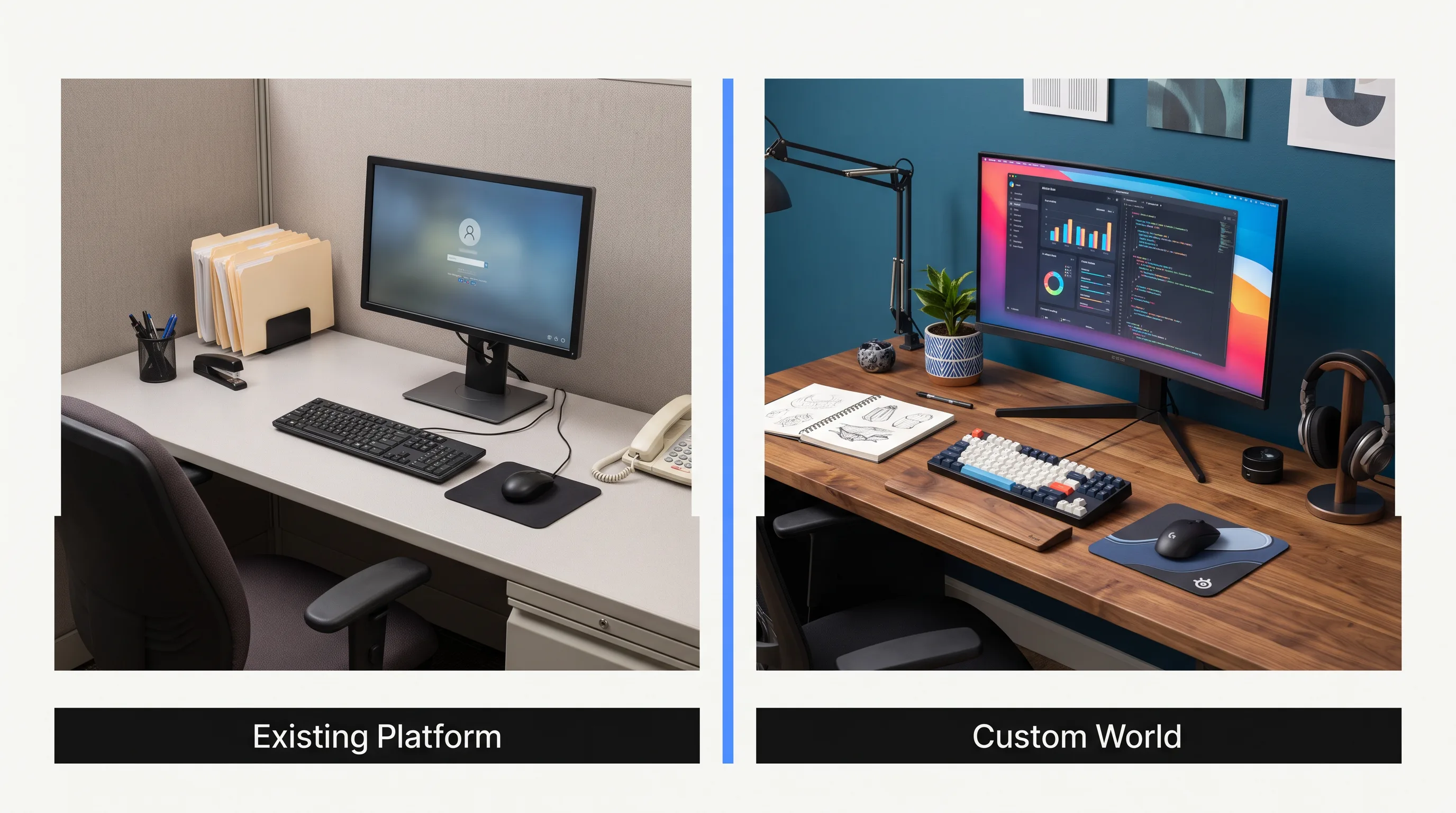
No page-one competitor treats this trade-off seriously, yet it is the first question a good studio will ask you. The platform comparison from Xpert.Digital is a useful reference for which platforms need a headset and which run in a browser.
When to Build on an Existing Platform
Build on an existing platform when reach and speed matter more than total control. Roblox reached 251.9 million monthly active users at its June 2025 all-time high, according to Udonis’s 2026 data, and Fortnite counts 650 million registered players with concurrent peaks above 14 million. Those audiences exist today; a custom world starts at zero.
Existing platforms also lower the access barrier. Roblox and Fortnite run on phones and desktops with no headset required, which matters because mobile represents just over half of metaverse gaming revenue, according to Mordor Intelligence’s 2026 market report. The constraints are real, though. Brand control is limited by the platform’s aesthetic, platform revenue share applies, and you inherit the operator’s roadmap.
The enterprise catch is fit. As Eric Abbruzzese, former Research Director at ABI Research, told TechTarget in December 2025, Roblox “has struggled to prove value to enterprises at scale” because of brand incompatibility with the platform’s look. A platform build wins for a branded activation, a limited-time event, or audience validation before larger spend.
When Does a Custom World Make Sense?
A custom standalone world makes sense once you have proven demand and need control the host platforms cannot give. It delivers a bespoke look, a custom avatar and identity system, a proprietary economy, and no revenue split — in exchange for a build that runs far longer than a platform pilot and costs several times as much.
The honest sequence is to earn your way into a custom world. Validate on an existing platform, watch your 30-day retention and peak concurrency, and only then commit to custom infrastructure — specifically when the host platform’s limits are what is holding you back. “Persistent” is a hosting cost as much as an engineering feature, a point the cost sections below make concrete. For headset-native custom builds, our virtual reality development work shows what that scope looks like in practice.
Verdict: Build on an existing platform for reach, speed, and low capital at risk; build a custom world only after demonstrated retention and concurrency the platform cannot support.
Unity vs. Unreal Engine: Which Fits Metaverse Development?
Unity and Unreal Engine 5 are both production-grade choices; the split is about reach versus fidelity. Unity wins for cross-platform breadth, faster iteration, and mobile or VR targets, with Meta Quest 3 as its strongest headset. Unreal Engine 5 wins for photorealistic bespoke worlds and large open environments, using Nanite for dense geometry and Lumen for real-time lighting. Both support the OpenXR runtime and run on Quest 3 and Apple Vision Pro.
The practical differences come down to team and target. Unity uses C#, a shallower and cheaper hiring pool. Unreal pairs C++ with visual Blueprints, harder to staff but more powerful for large, high-fidelity scenes. There is a third path worth naming: UEFN, the Unreal Editor for Fortnite, gives near-professional UE5 tooling inside Fortnite’s ecosystem without paying for custom-world infrastructure.
| Factor | Unity | Unreal Engine 5 |
|---|---|---|
| Primary strength | Cross-platform reach, fast iteration | Photorealism, large open worlds |
| Language | C# | C++ and Blueprints |
| Best headset target | Meta Quest 3, Apple Vision Pro | PC VR, Apple Vision Pro |
| Mobile fit | Strong | Heavier, needs optimization |
| Hiring pool | Larger, lower cost | Smaller, higher cost |
| Signature tech | AR Foundation, PolySpatial | Nanite, Lumen |
Our deeper guides to game development in Unity and Unreal Engine game development cover the workflow specifics for each.
Verdict: Choose Unity when the world must run on mobile or the team is lean; choose Unreal Engine 5 when visual fidelity in a bespoke environment is non-negotiable.
Need help scoping a metaverse game build?
We are here to help!
How Much Do Metaverse Game Development Services Cost?
Metaverse game development costs range from about $30,000 for a branded pilot on an existing platform to $1 million or more for a full persistent world, with enterprise-grade platforms running higher still, per Juego Studios’ 2024 cost breakdown. The range is enormous because “metaverse game” covers projects at completely different scales. Labor, not licensing, drives the number: 80–90% of a build budget is people, and 3D asset creation alone consumes 50–70% of development hours on immersive projects, per Frame Sixty, an AR/VR and spatial computing development studio, in its 2026 VR development cost analysis.

The tiers below map scope to a realistic cost and timeline. They are shapes, not quotes; a scoped estimate always depends on your concurrency target, platform count, and economy complexity.
| Scope tier | Description | Build cost | Timeline |
|---|---|---|---|
| Platform pilot | Branded experience inside Roblox, UEFN, or VRChat | $30,000 – $70,000 | 3 – 6 months |
| Custom multiplayer experience | Standalone 3D world, 50–500 concurrent users | $70,000 – $300,000 | 6 – 18 months |
| Full persistent world | Persistent live-service world, 500+ concurrent users | $500,000 – $1M+ | 18 – 36 months |
| Enterprise-grade platform | Massive concurrency, custom economy, global CDN | $1M – $100M+ | 3 – 5+ years |
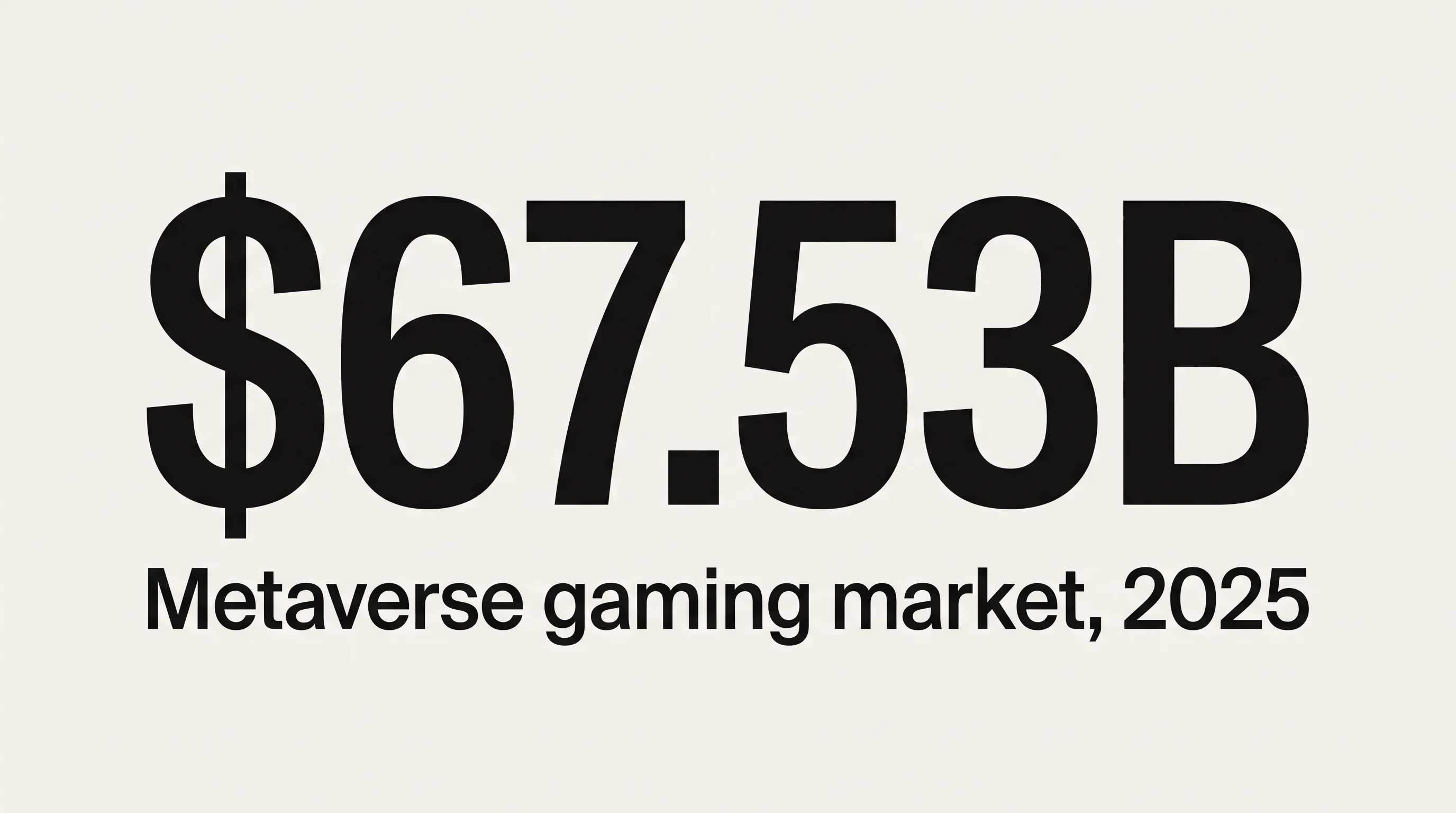
The market context explains why these projects command high rates. According to Research and Markets’ 2026 report, the metaverse in gaming market reached $67.53 billion in 2025 and is projected to hit $95.85 billion in 2026 at a 41.9% CAGR. Demand for the engineering talent is real, and good talent is not cheap.
Tier 1: Platform Pilot ($30K–$70K, 3–6 Months)
A platform pilot is a branded experience built inside Roblox, Fortnite via UEFN, or VRChat, costing $30,000–$70,000 over three to six months, per BlockTunix’s 2026 cost guide. Infrastructure risk is low because the platform hosts it, and the audience is already there. The cost drivers are 3D environment art, interaction scripting, and QA across devices.
A typical team is small: one project manager, one or two developers, one 3D artist, and a QA tester. This tier exists to answer one question cheaply — will your audience actually show up and stay — before you spend on a custom world. The component-level breakdown from Idea Usher shows how those hours distribute across world creation, scripting, and testing.
Tier 2: Custom Multiplayer Experience ($70K–$300K, 6–18 Months)
A custom multiplayer experience is a standalone 3D world for 50 to 500 concurrent users built in Unity or Unreal, costing $70,000–$300,000 over 6 to 18 months, per BlockTunix’s 2026 cost guide. This is the first tier where you own the netcode and the hosting bill. Cost drivers are multiplayer synchronization, an asset pipeline tuned to headset polygon budgets, cross-platform support, and avatar systems.
Server infrastructure starts here too. Monthly hosting runs $5,000–$15,000, and cloud pixel streaming for high-fidelity scenes adds $0.50–$1.50 per active stream-hour, according to Juego Studios’ 2024 breakdown. A representative team is a project manager, two or three developers, a 3D artist, a UI/UX designer, and QA. For the platform and performance decisions inside this tier, our guide on how to develop a VR game walks through the frame-rate and latency targets that shape the build.
Tier 3: Full Persistent World ($500K–$1M+, 18–36 Months)
A full persistent world is a live-service environment for 500 or more concurrent users with a custom economy and cross-platform delivery, starting at $500,000–$1 million and running 18 to 36 months, per Juego Studios’ 2024 analysis. That same Juego Studios breakdown puts enterprise-grade social platforms above $100 million.
This is where budgets break. The build is only the first invoice, and concurrency scales cost non-linearly: every tenfold increase in peak concurrent users is a step-change in infrastructure, not a proportional one, because state synchronization and region coverage get harder faster than user counts grow. The variables that move the number most are concurrency target, the number of headset platforms you support, and economy complexity. Enterprise buyers evaluating a persistent industrial or training world should also weigh a digital twin development approach, which shares the same persistent-simulation backbone.
What Ongoing Costs Come After a Metaverse Game Launches?
The build cost is the first invoice, not the last. A live metaverse game is a live-service product that needs server infrastructure, a content cadence, and moderation from launch day. The competitive bar keeps rising: the average number of live events per game climbed from 73 per month at the start of 2025 to 89 per month by year-end, according to WhimsyGames’ 2026 analysis. Plan for the operational tail or you will run out of runway before you learn whether the product works.
In our metaverse and VR work at Frame Sixty, the pattern we see most often is a budget that funds the build and forgets the year after it. A world that ships at a stable frame rate on a Meta Quest 3 still needs its asset LODs re-tuned as content grows, its servers scaled for event spikes, and its moderation tooling staffed before the first bad actor arrives. We scope those as line items up front, because retrofitting them after launch costs more and moves slower.
What Do Server Infrastructure and Hosting Cost?
Server infrastructure for a live metaverse game runs $5,000–$15,000 per month for a mid-tier title, with cloud pixel streaming adding $0.50–$1.50 per active stream-hour, according to Juego Studios’ 2024 data. At a thousand simultaneous users, a two-hour peak event can cost several thousand dollars in compute alone.
Concurrency is the hidden constraint. The platform’s tick rate, server region coverage, and state-synchronization architecture set how many players can share a space before the experience degrades. Those are decisions made at build time and expensive to reverse, which is why hosting belongs in the initial architecture conversation, not a post-launch scramble.
What Does LiveOps Cost?
LiveOps — the content, events, and moderation that keep a world alive — costs $10,000–$20,000 per month for a minimal outsourced team of two to three specialists, and $60,000–$150,000 or more per month at full scale, according to WhimsyGames’ 2026 figures, which also put an in-house US team of five at $360,000–$510,000 in base payroll a year before benefits.
Here is the number buyers miss most: for a Tier 3 world, the combined hosting and LiveOps bill can rival or exceed the entire build cost within the first couple of years. Moderation is not optional for any world with user-generated content or voice chat, and the tooling plus human review is a standing expense. The lesson from Q99 Studio’s guidance holds: start small, validate, then scale.
How Do You Evaluate a Metaverse Game Development Studio?
Evaluate a metaverse game development studio by demanding evidence of shipped, playable multiplayer work and concrete engineering answers — not renders, not buzzwords. The five questions below filter templated dev-shop proposals fast, because a studio selling a brand name rather than a capability cannot answer them with specifics.
- What shipped multiplayer titles can I play today? Ask for live builds on real stores, not demo reels or concept renders. Shipped work in the target headset is the only proof that matters.
- Which engine do you use, and can you show performance metrics from a comparable project? Good answers cite draw calls, tick rate, and peak concurrent users from real builds.
- How do you handle the asset pipeline for headset polygon budgets? Listen for a concrete level-of-detail strategy, not a promise that “it’ll be optimized.”
- What does post-launch support include? Confirm whether server infrastructure and LiveOps are part of the engagement or handed off to you at launch.
- Can you give a scope-tiered estimate with named assumptions? A single lump-sum number hides the concurrency and platform assumptions that actually drive cost.
When we scope a project at Frame Sixty, the first artifact we produce is a scope-tiered estimate with named assumptions — target peak concurrency, headset platforms, and whether hosting and LiveOps are inside the engagement — because those assumptions, not a single headline number, are what a build actually costs. We show performance data from comparable Unity and Unreal work in the target headset, and we will tell a buyer to run a platform pilot before a custom world when the retention case is not yet proven. That last answer costs us the bigger contract and keeps the client solvent.
Most page-one results for this keyword are offshore shops without shipped spatial-computing work, so prioritize studios with verifiable US-market titles and named platform credentials. Our VR game development portfolio is one example of what shipped platform credentials look like, and for teams weighing a lighter-weight mixed-reality route, our augmented reality agency work covers AR-first alternatives to a full metaverse build. Studios building for Apple’s headset should show native visionOS experience, which our Apple Vision Pro development practice demonstrates.
Conclusion
Metaverse game development services are the engineering behind persistent, multiplayer 3D worlds, and what you are actually buying is six technical workstreams plus the operations to keep them running. The market is large and growing — $67.53 billion in 2025 at a 41.9% CAGR, per Research and Markets — but the money that matters is your money, and it is decided by one choice: build inside an existing platform or build a custom world.
The honest recommendation stands. Most brands should start with a scoped pilot on Roblox, UEFN, or a similar platform, prove retention and concurrency, and graduate to a custom world only when the platform’s limits are the thing holding them back. Budget for the operational tail, because hosting and LiveOps can rival the build cost over time. And vet studios on shipped, playable work, not on how many times a proposal says “Web3.”
If you are scoping a persistent world, a branded game space, or a virtual venue and want an engineering-honest estimate, get in touch with Frame Sixty. We will tell you which tier fits your goals — and, when it is the right call, tell you not to build something yet.
FAQs
Common questions about metaverse game development services — what the work includes, what it costs to build and operate, and how to choose a studio.
A metaverse game is a persistent, multiplayer 3D world where state — avatars, inventory, and progression — survives between sessions and server restarts, unlike a match-based multiplayer game that resets each round. A shared social space, an economy and persistence layer, and cross-platform access across headset, desktop, and mobile are what separate the two. Persistence is a hosting cost, not just a feature.
Metaverse gaming in 2026 runs on existing platforms — Roblox, Fortnite via UEFN, Horizon Worlds, and VRChat — and on standalone custom worlds built in Unity or Unreal Engine 5. Roblox and Fortnite run on phones and desktops with no headset required, while headset-native experiences target Meta Quest 3 and Apple Vision Pro. Roblox reached 251.9 million monthly active users in June 2025.
No, blockchain and NFTs are not required for metaverse game development in 2026. The Web3 framing reflects the 2021–2022 hype cycle, not current buyer demand, which is for multiplayer 3D experiences that retain players. Adding a wallet and marketplace can add $10,000–$100,000 or more to the cost and introduces security and regulatory risk most brand projects should avoid.
A persistent world is a metaverse environment whose state — world layout, inventory, and player progression — is saved to a backend so it survives server restarts and keeps evolving between sessions. Operating one is a standing cost: server infrastructure runs $5,000–$15,000 per month for a mid-tier title, and cloud pixel streaming adds $0.50–$1.50 per active stream-hour.
Optimizing 3D assets for VR headsets means budgeting polygons and draw calls to a target device, then building level-of-detail models so distant objects render cheaply. A model that looks fine on desktop can wreck frame rate on a Meta Quest 3, so the art and engineering pipelines are inseparable. Asset creation consumes 50–70% of development hours on immersive projects.
A metaverse game's concurrent-user ceiling is set at build time by its tick rate, server region coverage, and state-synchronization architecture, not by adding hardware later. Custom worlds commonly target 50–500 concurrent users at the mid tier and 500 or more for a full persistent world. Concurrency scales cost non-linearly: each tenfold increase in peak users is a step-change in infrastructure.
A metaverse game team scales with scope. A platform pilot needs a project manager, one or two developers, a 3D artist, and a QA tester. A custom multiplayer experience adds more developers and a UI/UX designer, plus LiveOps and moderation staff after launch. Labor is 80–90% of the budget, so team size drives cost more than tooling does.
US-based metaverse game development studios are worth prioritizing because most page-one search results are offshore dev shops without shipped spatial-computing work. Frame Sixty, an AR/VR and spatial computing development studio, is one US option with verifiable Unity and Unreal engine credentials. Look for named platform experience, shipped playable titles, and performance data from comparable projects in the target headset.
When choosing a metaverse game development partner, demand evidence of shipped, playable multiplayer titles you can open on real stores, not demo reels. Ask which engine they use and for performance metrics — draw calls, tick rate, peak concurrent users — from a comparable build. Confirm whether server infrastructure and LiveOps are in the engagement, and insist on a scope-tiered estimate with named assumptions.