
Augmented Reality for Healthcare: What It Does, What’s Been Built, and Where It’s Heading
Jul 8, 2026

17 MIN READ
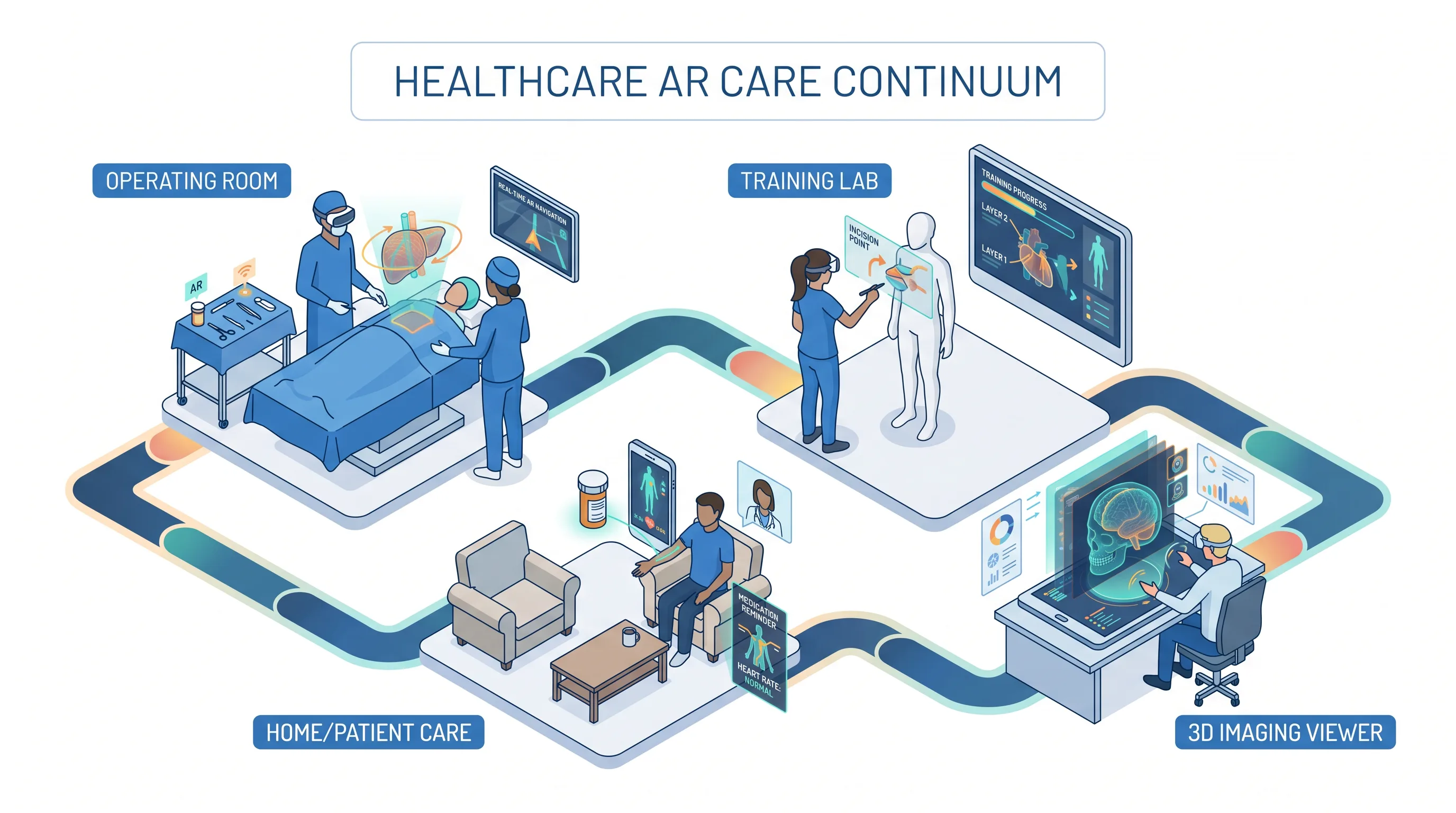
Augmented reality for healthcare uses head-mounted displays, tablets, and smartphones to overlay digital information—3D anatomy, CT and MRI data, and procedural guidance—onto a clinician’s real-world view during surgery, training, and patient care, keeping the practitioner anchored to the physical patient while adding a registered data layer. The AR and VR in healthcare market reached USD 3.05 billion in 2025 and is projected to hit USD 27.98 billion by 2035 at a 24.81% CAGR. Evidence is now clinical: AR-guided spinal surgery reached 98% pedicle screw placement accuracy versus a roughly 90% standard, and the FDA had authorized 69 AR/VR medical devices as of September 2024.
Key Takeaways
- The AR and VR in healthcare market was worth USD 3.05 billion in 2025 and is projected to reach USD 27.98 billion by 2035 at a 24.81% CAGR (Toward Healthcare, 2026).
- The FDA had authorized 69 medical devices incorporating AR/VR as of September 2024, and surgical planning is the largest AR healthcare segment at 41.86% (Mordor Intelligence, 2026).
- AR-guided spinal surgery reached 98% pedicle screw placement accuracy versus a roughly 90% clinical standard (ITIF, 2025).
- 84% of healthcare professionals believe AR/VR will positively transform the industry (ITIF, 2025).
- Frame Sixty has built production healthcare AR across imaging, enterprise R&D, and patient-facing apps.
Need help with a healthcare AR project?
Frame Sixty is a full-service digital innovation studio specialising in AR/VR, mobile, and web development.
What Is Augmented Reality for Healthcare?
Augmented reality for healthcare is a class of technology that places computer-generated content—anatomical models, CT and MRI overlays, step-by-step instructions—into a clinician’s field of view through devices like the Apple Vision Pro, Meta Quest with passthrough, Microsoft HoloLens, or a smartphone running ARKit. The defining trait is registration: the digital content is locked to real-world positions, so a 3D tumor model stays aligned with the patient as the surgeon moves.
This is what separates AR from virtual reality in a clinical setting. Virtual reality replaces the user’s surroundings entirely and suits immersive training or phobia therapy. Augmented reality preserves the real environment, which matters when a practitioner needs to see both the patient and supporting data at once. Mixed reality sits between the two, anchoring interactive holograms in physical space.
The commercial signal behind these definitions is strong. According to Toward Healthcare’s 2026 analysis, the AR and VR in healthcare market was valued at USD 3.05 billion in 2025 and is projected to reach USD 27.98 billion by 2035, growing at a 24.81% CAGR. North America held roughly 41% of that market in 2024. Health systems are funding the move from one-off pilots to standing programs, which is why selecting an experienced augmented reality development services partner has become a board-level decision rather than an experiment.
What Are the Main Clinical Applications of AR in Hospitals Today?
The main clinical applications of AR in hospitals today cluster into three domains with the most peer-reviewed evidence and deployed products: surgical navigation, practitioner training, and 3D medical imaging visualization. Each domain answers a different clinical need, runs on different hardware, and carries a different regulatory burden. The sections below walk through all three with current data and named systems.
According to Mordor Intelligence’s January 2026 report, surgical planning and guidance is the single largest slice of the augmented reality in healthcare market at 41.86% of segment revenue, with the AR-only category sized at USD 1.51 billion in 2025 and forecast to reach USD 6.13 billion by 2031 at a 26.29% CAGR. That concentration tells you where adoption is deepest.
Surgical Navigation and Intraoperative Guidance
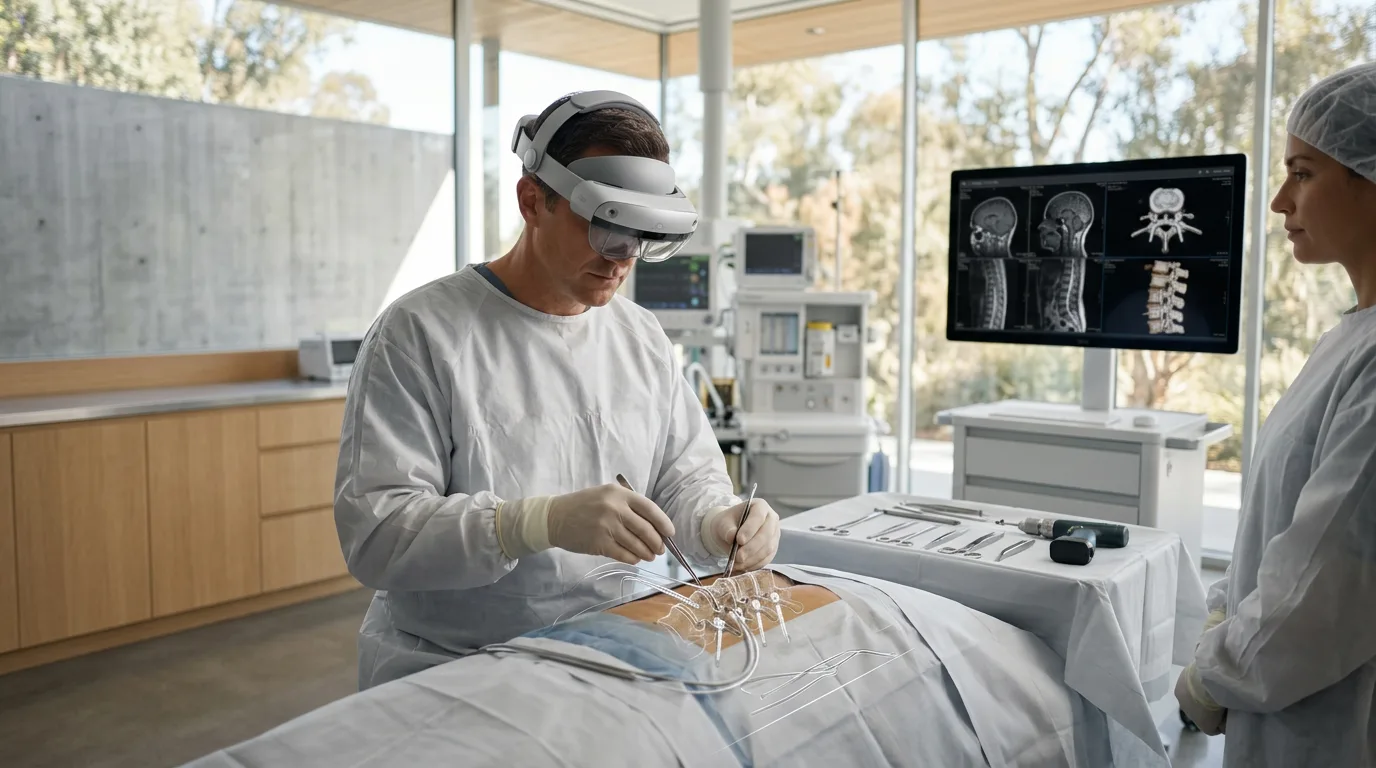
AR surgical navigation overlays preoperative imaging—CT, MRI, ultrasound—directly onto the surgical field so the operating team can see internal anatomy without looking away to a separate monitor. The clearest regulatory milestone is MediView XR90, described by the Information Technology and Innovation Foundation as the first FDA-cleared AR platform for live surgical imaging, giving surgeons a form of “X-ray vision” during minimally invasive procedures.
The accuracy data is what moves clinical opinion. The ITIF policy brief, published June 2025, reports that AR-guided spinal surgery reached 98% accuracy on performance metrics against a roughly 90% clinical standard—a meaningful margin for pedicle screw placement, where a few millimeters carries neurovascular risk. A 2025 narrative review of AR in spine surgery examines that precision alongside the workflow gains and adoption barriers.
Newer work pushes into soft tissue and the brain. A 2026 pilot study published in Frontiers in Surgery on real-time AR navigation in brain glioma resection imported preoperative MRI and diffusion tensor imaging into a head-mounted device to plan and guide tumor removal. And in October 2025, surgeon Dr. Eric Rosenberg of SightMD used the Apple Vision Pro with a custom app called ScopeXR in the world’s first Vision Pro–assisted cataract surgery, streaming a live 3D feed from a digital surgical microscope. Peer-reviewed reviews track this momentum: a September 2024 Cureus paper by Shanbhag and colleagues at Tawam Hospital framed the Apple Vision Pro as a paradigm shift in medical technology, noting that its high-resolution displays and eye-tracking could improve accessibility for visually impaired patients alongside surgical and neurosurgical planning gains. Most of this evidence still comes from small studies; larger trials are underway. The takeaway: AR surgical guidance has cleared its first regulatory and clinical hurdles, and precision data is the reason adoption is accelerating.
Medical Training and Simulation
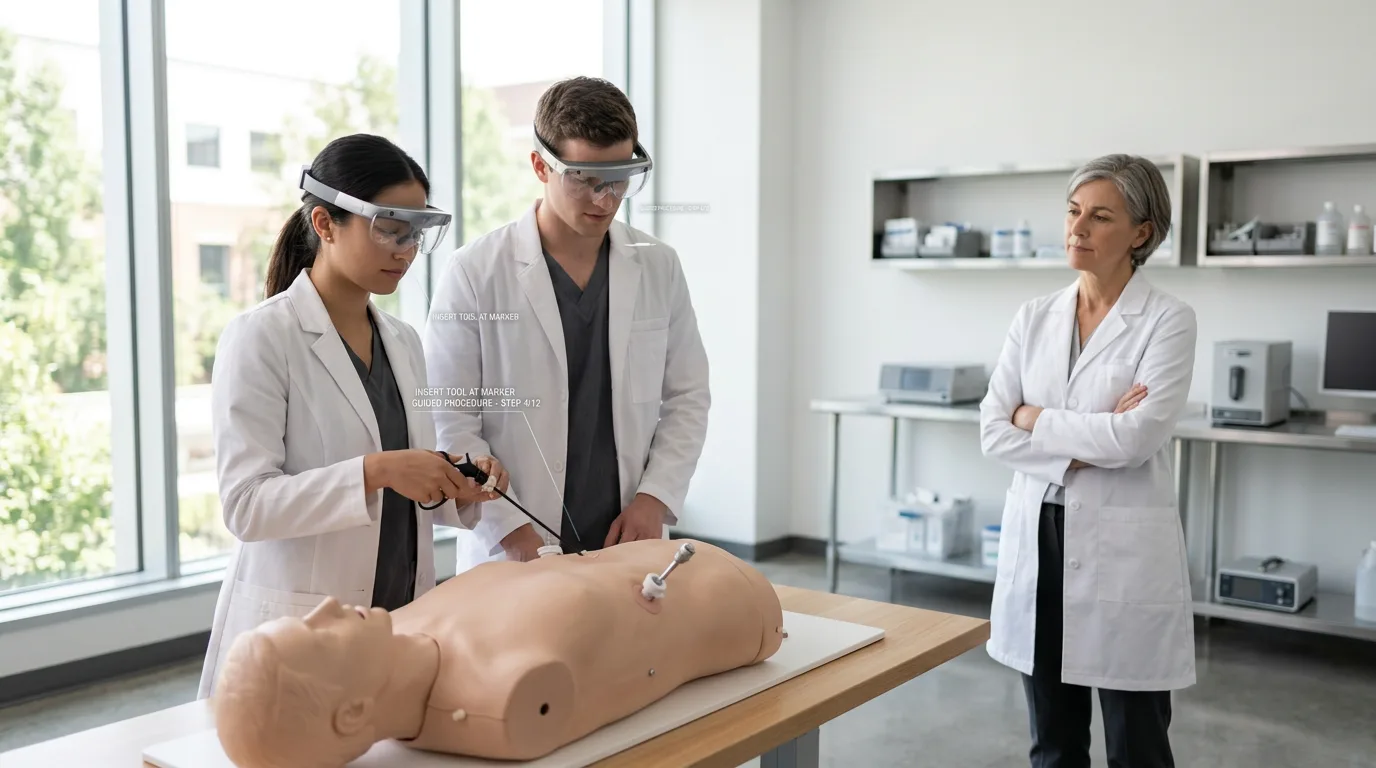
AR medical training uses overlaid 3D models and guided simulations to teach procedures, and the measured gains are concentrated in speed, confidence, and satisfaction rather than raw knowledge. The ITIF found that medical students trained with immersive systems completed procedures 20% faster and 38% more accurately than traditionally trained peers (ITIF, 2025).
The most rigorous evidence comes from a 2022 meta-analysis of 13 randomized controlled trials covering 654 participants, published in JMIR Serious Games. As lead author Yahia Baashar put it, “AR can effectively improve performance time, satisfaction, and confidence in medical training but is not very effective in areas such as knowledge and skill.” That meta-analysis recorded statistically significant gains in performance time (P<.001), confidence (P=.02), and satisfaction (P=.006), with no significant change in knowledge scores. Read honestly, AR is a procedural-confidence tool, not a replacement for knowledge-based curricula.
Deployed examples back this up. Boston Children’s Hospital built CyranoHealth to train frontline staff on new medical equipment through immersive practice, reducing anxiety before workers touch a real device. Frame Sixty has worked in this domain as well; our VR training simulation project and dedicated medical VR training work apply the same principle—repeatable, measurable practice in a setting where mistakes cost nothing. The takeaway: AR and VR training reliably improve procedural speed and confidence, so the strongest programs pair them with traditional instruction rather than swapping it out.
3D Medical Imaging Viewers and Diagnostic Visualization
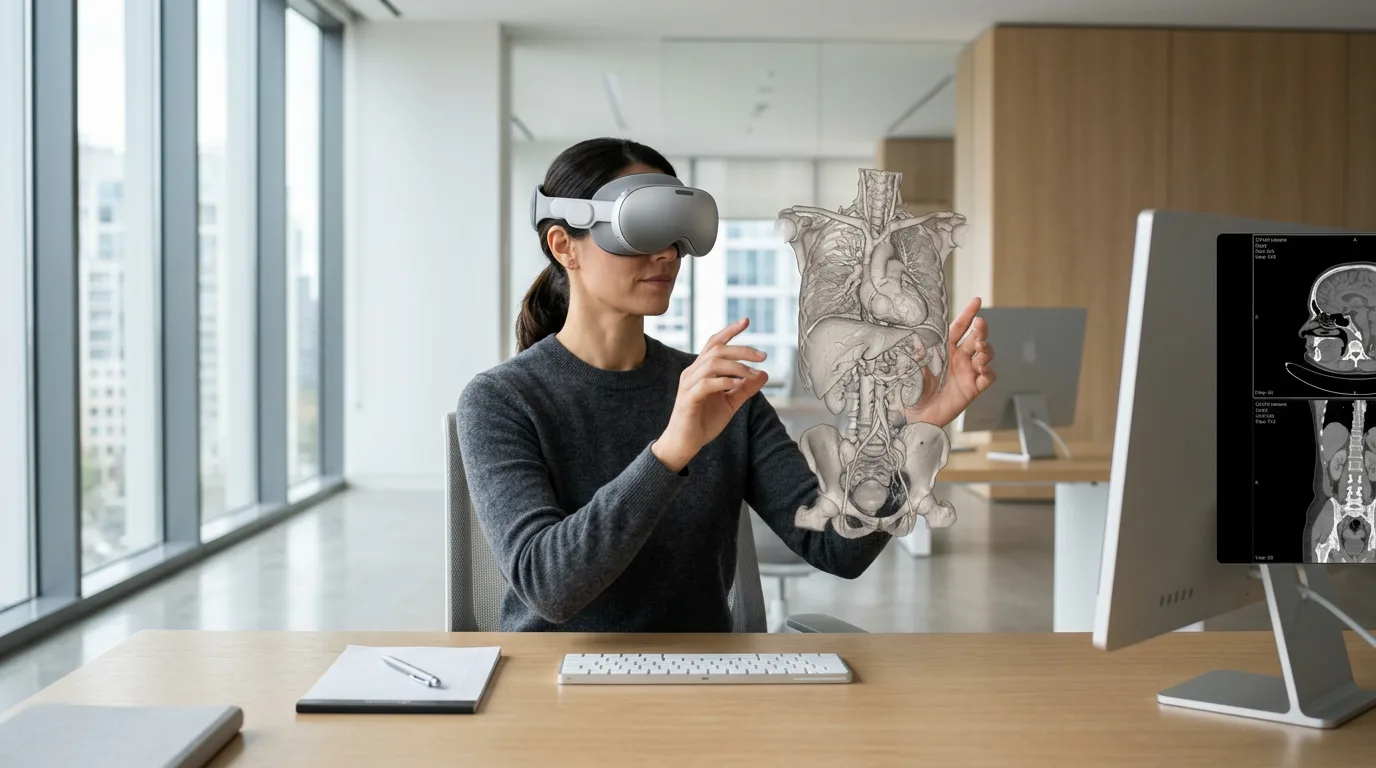
A 3D medical imaging viewer converts flat DICOM and NIfTI scan data into a spatially navigable volume that clinicians can rotate, slice, and inspect in three dimensions. Standard PACS systems present radiology as stacked 2D slices, forcing the viewer to mentally reconstruct anatomy; an AR or XR viewer does that reconstruction for them and lets a team examine the same model together.
The clinical workflow is straightforward: segment the region of interest, import the volume, then view and annotate it on a shared spatial canvas. Use cases span surgical pre-planning, anatomy instruction in medical schools, and multidisciplinary tumor boards where several specialists need the same view. Siemens Healthineers demonstrated this with Cinematic Reality, generating photorealistic anatomical holograms on the Vision Pro, while Stryker’s myMako lets surgeons review knee and hip surgical plans in immersive 3D, both highlighted when Apple opened Vision Pro to health app developers in March 2024.
This category is where Frame Sixty’s own clinical imaging product sits, covered in detail below. The takeaway: 3D imaging viewers remove the mental reconstruction step that 2D radiology demands, which speeds diagnostic decisions and improves teaching.
What Patient-Facing AR Apps Do for Appointments and Ongoing Care
Patient-facing AR apps extend immersive technology beyond the hospital into appointment management, rehabilitation, and at-home care—the most overlooked clinical AR category. These apps handle appointment reminders and health notifications, guide rehabilitation exercises with interactive overlays, and walk patients through post-surgical recovery steps that a paper handout cannot make concrete.
The outcome evidence is now substantial. A November 2025 narrative review in Healthcare Technology Letters examined 19 studies covering 987 outpatient participants. Lead author Archan Khandekar of the University of Miami’s Desai Sethi Urology Institute concluded that “AR interventions consistently improved patient understanding, engagement and procedural support.” The same review of AR in outpatient care reported that AR-based phantom limb pain treatment achieved 64.5–68.2% pain reduction, with more than 70% of patients reaching clinically meaningful relief.
Frame Sixty has built apps in this space, including tools for patients to handle appointments and stay engaged with their care between visits. The pattern that works: pair a routine task like scheduling with an interactive layer that improves adherence, instead of bolting AR onto an app for novelty. Teams planning this kind of product can start with our AR app development practice. The takeaway: patient-facing AR has moved past gimmickry, with measured gains in understanding, engagement, and pain reduction that justify production investment.
How Enterprise Health Systems Are Deploying Spatial Computing in Clinical Workflows
Enterprise health systems are deploying spatial computing by integrating AR headsets with electronic health records and clinical content to support sterile-field data access, remote consultation, and standardized procedural guidance at scale. Mordor Intelligence’s 2026 report notes that hospitals, training centers, and home-care providers are “moving from isolated pilots to enterprise-wide deployments,” and by Q4 2025 enterprise AR and XR active deployments exceeded 4.2 million worldwide.
The reference deployment is Sharp HealthCare’s Spatial Computing Center of Excellence, launched in 2025. The San Diego health group built it around the Apple Vision Pro and partnered with EHR vendor Epic and clinical-content firm Elsevier to enhance patient care and charting workflows. Apple has signed parallel enterprise healthcare agreements with Stryker and Johnson & Johnson MedTech for surgical planning, and its Epic Spatial Computing concept demonstrated gesture-controlled charting and secure messaging.
The workflow gains health systems are chasing fall into a short list:
- Hands-free access to imaging and records inside the sterile field, reducing contamination risk and unscrubbing.
- Real-time remote consultation, letting a specialist see exactly what the operating surgeon sees.
- Standardized step-by-step AR guidance that lowers procedural variation and can reduce the number of staff needed in the room.
This enterprise layer is exactly where the most ambitious Frame Sixty work sits, including a confidential Fortune 100 R&D initiative detailed below. For health systems mapping their own strategy, our writing on spatial computing in enterprise and Apple Vision Pro development for enterprise covers the architecture decisions, and our overview of the future of medical innovation with Apple Vision Pro traces where the platform is heading. The takeaway: enterprise spatial computing in healthcare has crossed from pilot to program, anchored by EHR integration and measured against workflow efficiency.
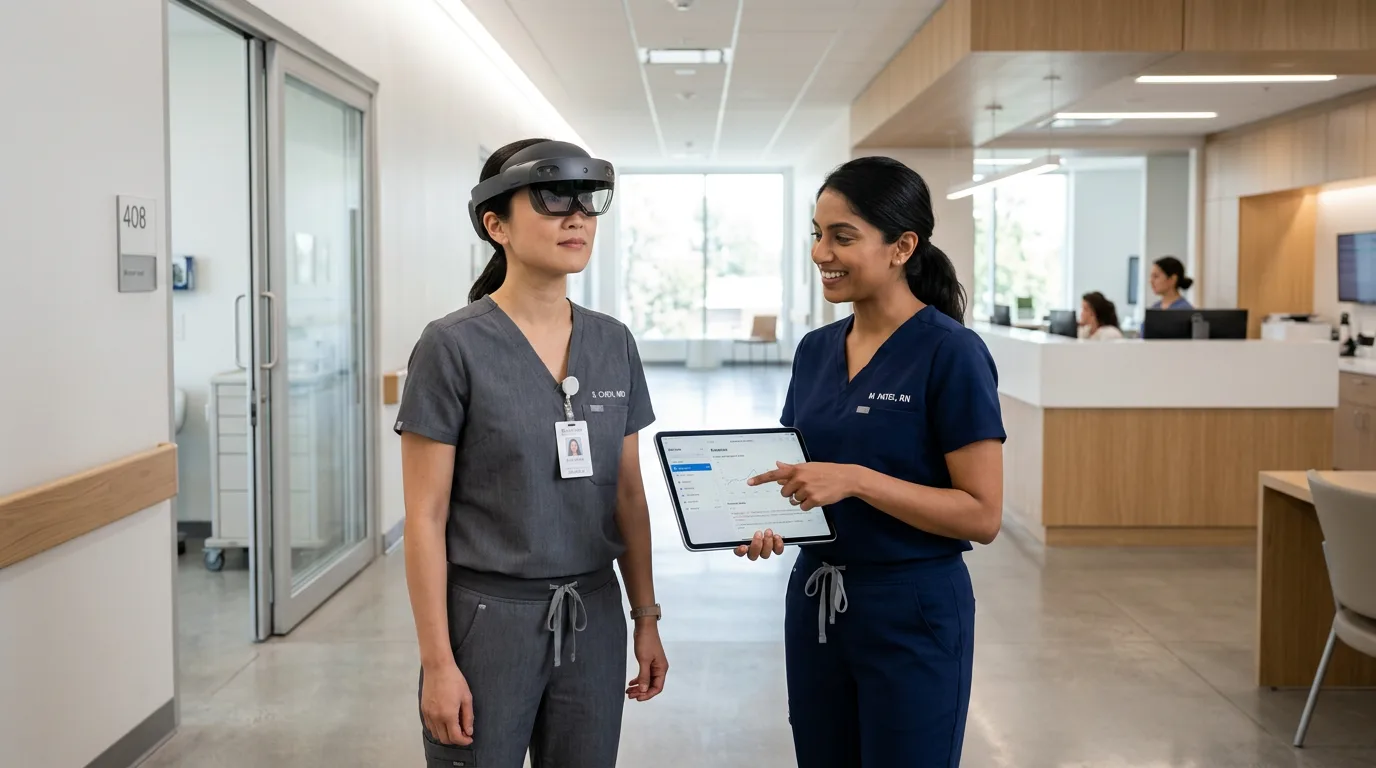
AR Healthcare Projects Frame Sixty Has Built
Frame Sixty, an AR/VR and spatial computing development studio, has shipped healthcare AR across three distinct categories: clinical imaging tools, enterprise R&D, and patient-facing applications. Each represents a different layer of the care continuum and a different engineering challenge. The three sub-sections below describe what we built and why the approach fits the clinical problem.
Across these projects, one lesson recurs: healthcare AR fails when it is treated as a generic app build with a 3D model attached. The work below was shaped by medical imaging standards, compliance requirements, and clinical workflow constraints from the first sprint.
A Volumetric MRI and CT Viewer Built for Clinicians and Researchers
Frame Sixty’s VR Medical Scan Viewer is a scientific-grade platform that turns CT and MRI data into interactive 3D volumetric experiences for clinicians, educators, and researchers. The problem it solves is concrete: traditional imaging tools restrict practitioners to flat 2D slices, making complex anatomy hard to interpret spatially. Our viewer places the full volume on a spatial canvas the user can rotate, scale, and clip by hand.
In our work at Frame Sixty, we built the system around a patent-pending rendering pipeline optimized for XR, using Metal-based graphics for real-time performance. It reads the DICOM and NIfTI standard medical imaging formats directly and uses a single-pass volumetric rendering technique to hold visual fidelity at interactive frame rates. The viewer offers multi-axis slicing, true 3D volume visualization, and layered data control.
It runs across Apple Vision Pro, Meta Quest, iOS, and Android, so the same dataset reaches a high-fidelity headset in the OR and a tablet at the bedside. The three audiences map to three needs: clinicians wanting faster diagnostic decisions, medical educators teaching anatomy, and researchers analyzing volumetric datasets. The takeaway: a cross-platform DICOM and NIfTI viewer with real-time volumetric rendering lets the same scan serve diagnosis, teaching, and research without re-exporting data for each.
R&D Partnership with a Fortune 100 Healthcare Company
Frame Sixty is currently partnering with a Fortune 100 healthcare company on a confidential R&D initiative that explores how next-generation spatial-computing headsets can improve clinical workflows, practitioner training, and research. The engagement is an innovation-lab partnership: prototype, pilot in a controlled clinical setting, and measure before any wider rollout.
While the specifics are under wraps, the class of problems is the same set driving enterprise adoption industry-wide—workflow efficiency in high-acuity settings, hands-free access to data during procedures, and remote expert consultation. Building for those problems means designing for compliance and clinical-system integration from day one, not retrofitting it after a demo.
Health systems bring this kind of work to an external studio for a practical reason: internal IT teams rarely hold XR engineering, real-time 3D rendering, and medical imaging experience at the same time. Our broader Apple Vision Pro development for enterprise practice exists to fill exactly that gap. The takeaway: serious enterprise healthcare AR is a partnership between a health system’s clinical knowledge and a studio’s spatial-computing engineering depth.
Patient Apps and Healthcare Research Tools
Beyond clinical imaging and enterprise R&D, Frame Sixty has built patient-facing apps and research tools for healthcare organizations across two sub-categories. The first is patient engagement: applications for appointment management, treatment reminders, and care navigation that aim to reduce no-shows and improve adherence through clear, interactive instructions. The second is research support: tools that help organizations running clinical studies capture data, follow guided protocols, and visualize datasets.
The reason breadth matters is that the healthcare AR problem space runs the full care continuum, from the operating room to the living room. A partner with experience across these layers helps an organization avoid building a siloed, single-use tool that cannot grow. Teams can explore both our AR app development work and our broader background in virtual reality in healthcare to see how patient and clinical tools connect. The takeaway: healthcare AR spans diagnosis, training, enterprise workflow, and patient self-care, and treating those as one connected portfolio beats building disconnected point tools.

Platforms, Standards, and Compliance Considerations for Healthcare AR
Healthcare AR is not a standard app build, because any application that displays, processes, or transmits protected health information must meet regulatory and interoperability requirements that consumer apps never face. The four considerations that shape every project are HIPAA compliance, FDA classification, medical-data interoperability, and platform selection.
HIPAA governs any AR app touching protected health information. That means encryption of data at rest and in transit, audit logging, and business associate agreements with every vendor in the chain—requirements that have to live in the architecture, not in a later patch. FDA oversight depends on function: an app performing a diagnostic role may need 510(k) clearance or a Breakthrough Device designation, the path MediView XR90 followed as the first cleared AR surgical imaging platform. Most enterprise workflow tools are not Class II devices, but knowing which side of that line a product falls on is a design-stage decision.
Interoperability and platform choice round out the list. Supporting the DICOM imaging standard and HL7 FHIR for clinical data lets an AR app exchange information with PACS and EHR systems instead of stranding it. Platform selection follows the clinical context:
| Platform | Strength | Best fit |
|---|---|---|
| Apple Vision Pro (visionOS, ARKit, RealityKit) | Highest-fidelity spatial rendering and eye tracking | Surgical visualization, premium imaging viewers |
| Meta Quest / Android XR | Broad device footprint, lower unit cost | Training at scale, patient-facing programs |
| Microsoft HoloLens (MRTK) | Hands-free enterprise certification | Industrial and clinical workflow guidance |
The takeaway: HIPAA, FDA classification, DICOM and HL7 FHIR support, and platform choice are design-stage decisions in healthcare AR, and retrofitting any of them after a build is far more expensive than planning for it.
What to Know Before Commissioning a Healthcare AR Project
Before commissioning a healthcare AR project, define the clinical problem precisely, build compliance into the architecture, plan for clinical validation, and choose a partner with both XR engineering and healthcare experience. These four decisions determine whether a project reaches production or stalls as a demo. The order matters: the clinical problem dictates every choice that follows.
The practical checklist:
- Define the clinical problem first. Surgical navigation, training simulation, imaging visualization, and patient engagement each demand different hardware and different accuracy thresholds. Choosing a headset before the problem is backwards.
- Architect for compliance from the start. HIPAA, and FDA classification where it applies, belong in the first design review, not a pre-launch scramble.
- Plan clinical validation. Pilot with 20 to 50 users in a real care setting and capture quantitative outcomes—time on task, error rate, satisfaction—before any enterprise rollout.
- Choose a partner at the intersection. XR engineering depth and healthcare domain knowledge rarely sit in the same internal team; the studios that hold both are few.
Frame Sixty works across all four clinical domains covered in this article—imaging, training, enterprise R&D, and patient apps—and our VR in healthcare and augmented reality development services practices reflect that range. The takeaway: a healthcare AR project succeeds when the clinical problem leads and compliance, validation, and partner selection follow from it.
Conclusion
Augmented reality for healthcare has moved from concept to measured clinical practice. The evidence is concrete: AR-guided spinal surgery at 98% accuracy, procedure completion 38% more accurate for AR-trained students, phantom limb pain reduction above 64%, and a market climbing from USD 3.05 billion in 2025 toward USD 27.98 billion by 2035. Surgical guidance, training, imaging, patient care, and enterprise workflows each now have deployed products and peer-reviewed results behind them.
What separates a successful healthcare AR project from a stalled pilot is rarely the technology. It is defining the clinical problem precisely, building compliance and interoperability into the architecture, validating with real users, and working with a team that understands both spatial computing and medicine. Frame Sixty has built across that full range, from a patent-pending volumetric MRI and CT viewer to a confidential Fortune 100 R&D initiative to patient apps for appointment management and care.
If you’re planning an augmented reality initiative for your hospital, health system, or medical device company, get in touch with our team at Frame Sixty. We can help you scope the clinical problem, choose the right platform, and build a tool your clinicians and patients will actually use.
Augmented Reality for Healthcare: Frequently Asked Questions
Common questions about augmented reality for healthcare, covering market growth, clinical use, compliance, hardware, and how to commission a project. Each answer is grounded in current research and deployed products.
The AR and VR in healthcare market was valued at USD 3.05 billion in 2025 and is projected to reach USD 27.98 billion by 2035 at a 24.81% CAGR, according to Toward Healthcare's 2026 analysis. The AR-only segment was USD 1.51 billion in 2025, with surgical planning and guidance commanding 41.86% of that segment and North America holding the largest regional share.
Augmented reality overlays digital content onto a clinician's real-world view, keeping the practitioner anchored to the physical patient, which suits surgical overlays and outpatient guidance. Virtual reality replaces the surroundings entirely and suits immersive training or phobia therapy. Mixed reality sits between them, anchoring interactive holograms in physical space. The clinical rule of thumb: choose AR when the practitioner must see both patient and data at once.
Augmented reality can be HIPAA compliant, but compliance depends on the build, not the technology itself. Any AR app that displays, processes, or transmits protected health information must encrypt data at rest and in transit, maintain audit logging, and carry business associate agreements with every vendor in the chain. These requirements have to live in the architecture from the first design review, because retrofitting them after a build is far more expensive.
The best healthcare AR headset depends on the clinical context. Apple Vision Pro offers the highest-fidelity spatial rendering and eye tracking, fitting surgical visualization and premium imaging viewers; it powered the world's first Vision Pro-assisted cataract surgery in October 2025. Meta Quest and Android XR offer a broader device footprint and lower unit cost, fitting training at scale and patient-facing programs. Microsoft HoloLens suits hands-free clinical workflow guidance.
The cost of a healthcare AR app depends on clinical function, regulatory burden, and platform scope rather than a fixed price. A patient-engagement app for appointment management costs far less than an FDA-regulated surgical navigation tool requiring 510(k) clearance and clinical validation. Compliance work like HIPAA architecture, plus a pilot with 20 to 50 users in a real care setting, should be budgeted from the start, not added late.
Look for a partner that holds both XR engineering depth and healthcare domain knowledge, since the two rarely sit in the same internal team. Confirm experience with DICOM, NIfTI, and HL7 FHIR, HIPAA-compliant architecture, and real-time 3D rendering. Frame Sixty has shipped production healthcare AR across clinical imaging, a confidential Fortune 100 R&D initiative, and patient-facing apps, spanning the operating room to at-home care.
Get in touch
We’re interested to see how we can help. Send us a message and we will get back to you within 24 hours.