
What Are Mixed Reality Services? Categories, Costs, and How to Choose a Partner
Nov 3, 2026
12 MIN READ
Mixed reality services are the professional engagements that help a business plan, build, and deploy applications where digital content is anchored to the physical world and responds to it in real time. Mixed reality (MR) sits between augmented reality, which overlays flat information, and virtual reality, which replaces your surroundings. This guide breaks the category into five service types, explains how costs and timelines usually work, and gives you a framework for choosing a partner.
The category is growing fast. According to Fortune Business Insights (2025), the global mixed reality market was valued at USD 9.27 billion in 2025 and is projected to reach USD 12.56 billion in 2026. That growth is pulling in buyers who have never scoped an MR project before. Most of them stall at the same place: they hire for demo polish instead of production throughput. That is the single biggest predictor of a failed pilot, and it is the thread running through this entire guide.
Key Takeaways
- The global mixed reality market reached USD 9.27 billion in 2025 and is projected at USD 12.56 billion in 2026, per Fortune Business Insights.
- Mixed reality services divide into five categories: strategy, custom app development, 3D content, hardware integration, and enterprise training.
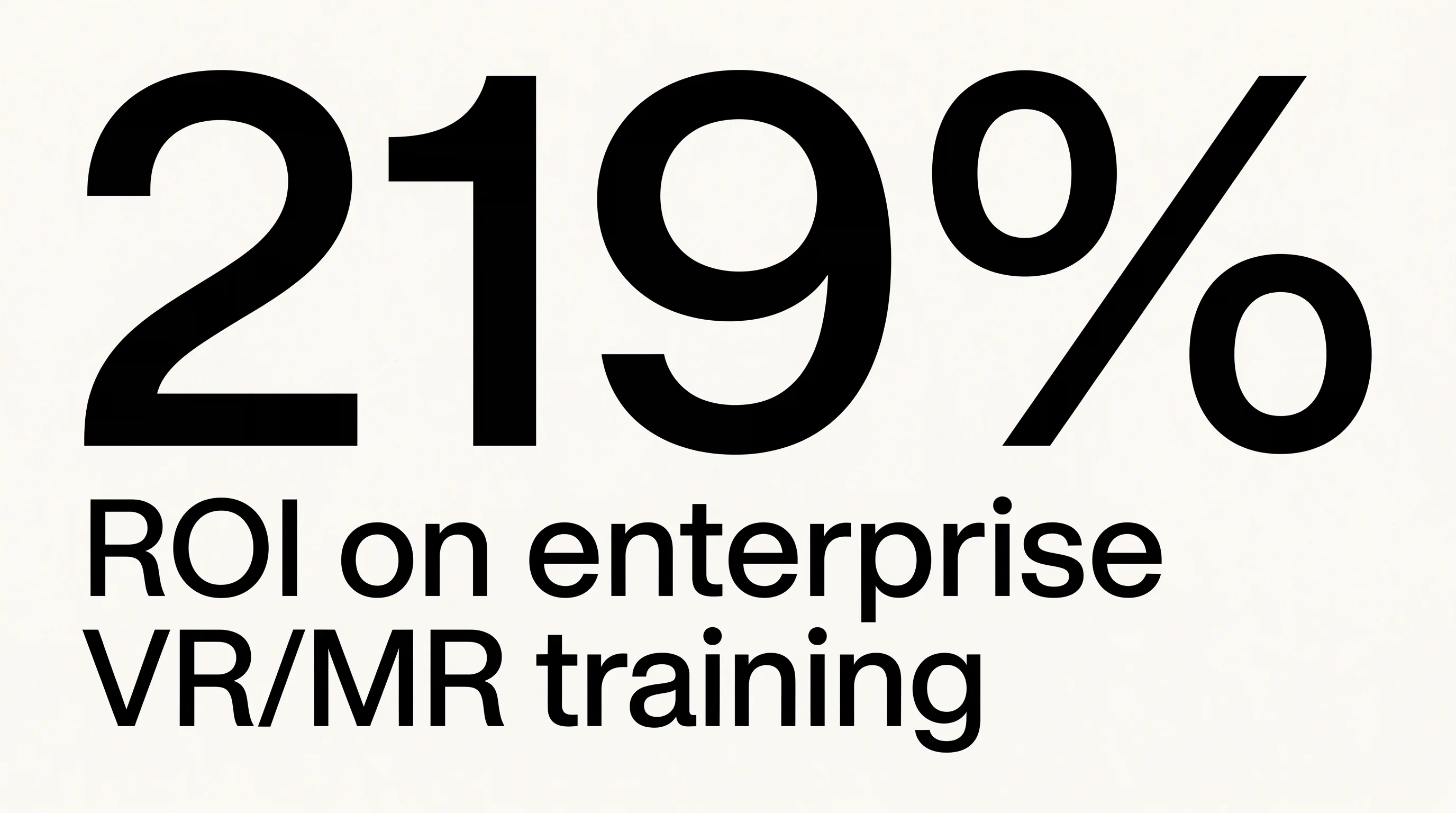
- Enterprise VR/MR training returns 219% ROI with payback under six months, according to a Forrester study (PwC, 2025).
- MR pilots typically run $75,000–$150,000 and enterprise systems exceed $300,000, per Treeview’s 2025 benchmarks.
- Choose a mixed reality partner on shipped production builds, not demos. Demo-first hiring is why most pilots stall.
The Five Categories of Mixed Reality Services
Mixed reality services split into five categories: strategy and consulting, custom MR application development, 3D and spatial content production, hardware and device integration, and enterprise training and simulation. Most real engagements combine several of them. Knowing which categories your project touches is what lets you scope the work, budget it, and judge whether a given vendor is actually equipped to deliver it.

Strategy and Consulting
Strategy and consulting is the first mixed reality service, and it is where a project succeeds or fails before a single asset is built. The work covers discovery, use-case mapping, stakeholder alignment, platform recommendation, and pilot scoping tied to a measurable business outcome. ReverbICO’s 2026 agency overview lists design and engineering reviews, remote assistance, and training with analytics among the enterprise solution types a good consulting phase helps you choose between.
Skip this phase and you commission a build for a problem you have not validated. The questions to ask a prospective vendor here matter enormously, which is why we cover them in depth in our guide to hiring a mixed reality agency. A strong discovery produces a scoped brief, not a sales pitch.
Custom MR Application Development
Custom MR application development is the engineering core of most mixed reality services: building the application that runs on the headset. The work spans Unity and Unreal Engine development, OpenXR and MRTK standards compliance, platform-specific builds for Meta Quest 3, Apple Vision Pro, and Microsoft HoloLens 2, and integration with backend systems such as ERP, LMS, and identity providers.
This is also where buyers misjudge their budget. The engine code is rarely the expensive part. For teams weighing whether to hire in-house or contract the work, our guide to working with mixed reality developers walks through the tradeoffs. The deciding factor is almost never raw coding ability. It is whether the team can ship an installable build that survives outside a controlled demo.
3D and Spatial Content Production
3D and spatial content production is the mixed reality service that creates everything the user sees: optimized 3D assets, spatial UI, animations, and digital twin representations engineered for real-time rendering on a headset. This is the category buyers consistently underestimate, because a photorealistic model that runs at 90 frames per second on a standalone chipset is a very different deliverable from the same model in a marketing render.
Here is the part the ranking pages leave out: modeling, animation, and on-device optimization consume the majority of a mixed reality budget, far more than the application code. That single fact should reshape how you scope. Every additional target platform multiplies the content-optimization work, so the highest-leverage cost control available to a buyer is deciding how many devices to support before the project starts, not after. Digital twins are their own discipline within this category, with their own scoping traps, which we break down in our digital twin consulting guide.
Hardware and Device Integration
Hardware and device integration is the mixed reality service that connects headsets to the rest of the enterprise: device selection, procurement guidance, mobile device management, fleet provisioning, and network and security configuration. Meta’s Horizon Managed Services, which replaced Quest for Business, moved to a no-cost model in February 2026, giving enterprises fleet management, app distribution, and access controls without a separate license.
The strategic question here is portability. Hololight’s 2026 XR strategy analysis argues that device-agnostic architecture is the most important specification for a sustainable deployment, and the history backs it up: organizations that tied their workflows to a single platform faced real disruption when that vendor repositioned the product. My advice to buyers is to treat device-agnosticism as a procurement requirement with a portability clause in the contract, not as an engineering preference you hope the vendor shares. Platform lock-in is a business risk. For device-specific depth, our Apple Vision Pro development page shows what platform specialization actually involves.
Enterprise Training and Simulation
Enterprise training and simulation is the most widely deployed mixed reality service, covering scenario design, scoring and analytics, LMS integration, and deployment to managed headset fleets. The outcome data is strong. According to PwC research cited by KKRF Group (2025), immersive learners complete training four times faster than classroom peers and feel 275% more confident applying what they learned.
The economics only work at scale, and this is the rule most buyers never get told. The same KKRF data shows VR/MR training reaches cost parity with classroom delivery at roughly 375 learners and becomes 52% cheaper at 3,000. Below that threshold, off-the-shelf content usually wins. Above it, custom simulation pays for itself. That number should gate your build-versus-buy decision before you ever request a proposal. Where a program leans more on fully immersive scenarios, our virtual reality development work explains how VR training differs in scope from passthrough MR.
Which Industries Use Mixed Reality Services Most?
Manufacturing, healthcare, logistics, architecture and engineering, and corporate training are the industries using mixed reality services most heavily in 2026. Adoption is broad and documented: PwC UK identified 1,550 unique public examples of enterprise XR usage, with engineering and manufacturing leading, according to UCToday’s 2026 enterprise XR analysis.
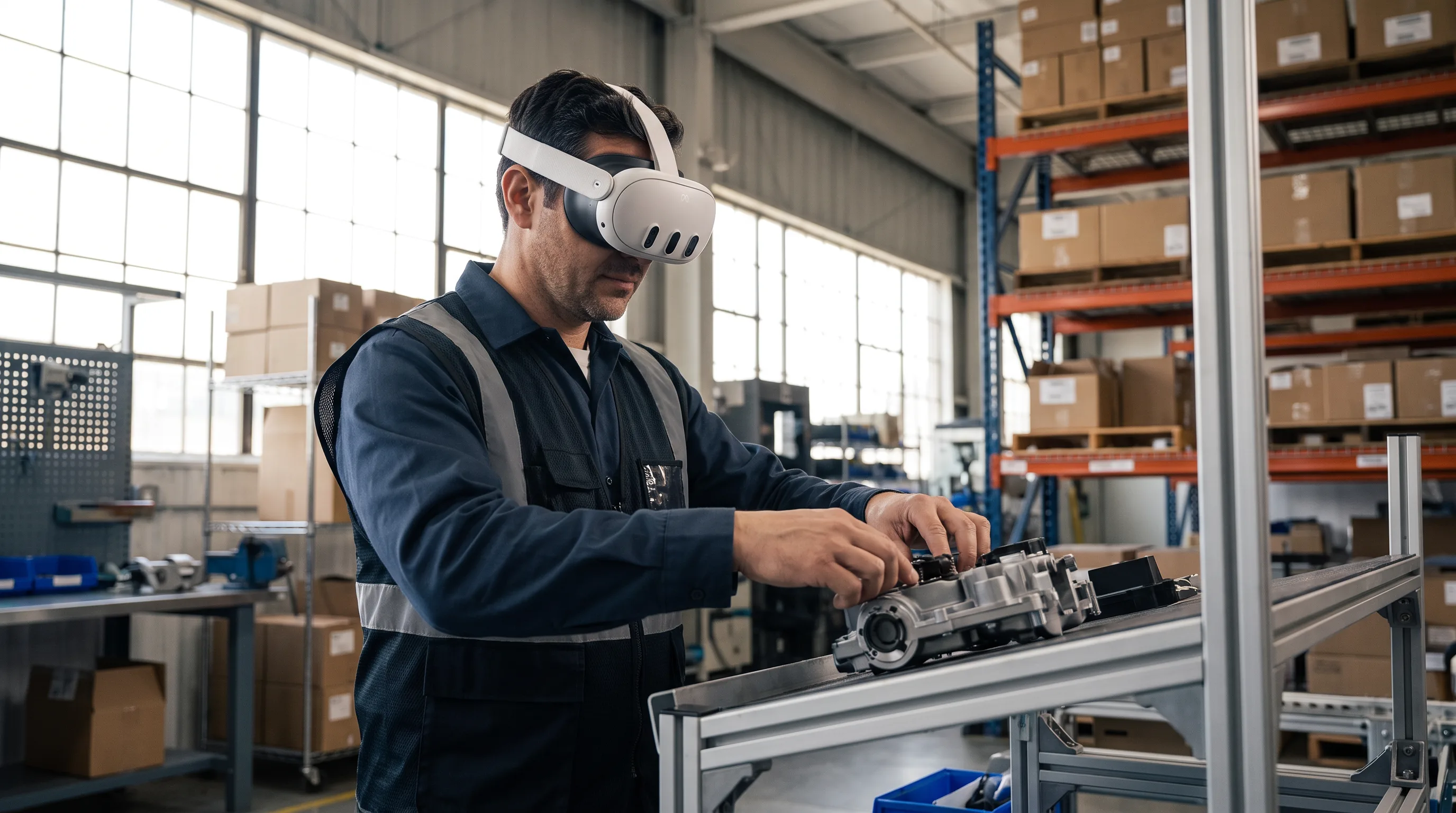
The named results are what make the case. Reality Atlas (2025) reports that Boeing cut assembly training time by 75% with Microsoft HoloLens, BMW trimmed planning time 30% by simulating production across 31 factories, and DHL improved picking efficiency by 25% using vision picking. Top enterprise deployments showed AR productivity gains of up to 340%.
Training demand underpins all of it. The AR/VR training market was valued at $22.56 billion in 2025 and is projected to reach $82.92 billion by 2034, per Markets and Markets data cited by AutoVRse, with U.S. immersive training growing about 25% annually through 2030. Buyers whose use cases straddle AR and MR will find our augmented reality agency page useful for understanding where the two overlap. The takeaway: the strongest MR cases are operational, not experimental.
What Is the ROI of Mixed Reality Services?
The ROI of mixed reality services is well documented for training and operational use cases. A Meta-commissioned Forrester Total Economic Impact study, cited in KKRF Group’s 2025 analysis, found enterprise VR/MR training returns 219% ROI with payback in under six months. Reality Atlas adds that roughly 75% of Fortune 500 companies have now deployed XR for at least one use case.
The gains show up in more than training speed. Onboarding incident rates can fall 30% to 60% when MR-trained workers are compared to traditionally trained ones, per Markets and Markets data via AutoVRse. North America holds about 38% of the global market, driven by enterprise adoption, according to IMARC Group.
UCToday frames the 2026 shift bluntly: the enterprise question has moved from “Is XR ready?” to “Where does it deliver measurable ROI?” Their analysis puts it directly: “XR improves ROI when it reduces training time, improves competency validation, lowers errors and rework, reduces downtime, and keeps knowledge inside the workflow.” Read that as a checklist. If your use case does not hit at least two of those levers, the ROI math gets harder, and no amount of production quality will fix a weak use case.
Need help scoping a mixed reality project?
We are here to help!
How Much Do Mixed Reality Services Cost?
Mixed reality services generally cost between $40,000 for a single-scenario pilot and $500,000 or more for a full production suite, with most enterprise engagements landing somewhere in between. The final figure depends on three things: project tier, number of target platforms, and content complexity. The ranges below are market-rate benchmarks from 2025 and 2026. A scoped proposal after a proper discovery phase will always beat a blog-post estimate.

Pilot, Standard, and Enterprise Tiers
Mixed reality engagements fall into three cost tiers. Treeview’s 2025 service benchmarks put pilots at $75,000–$150,000 over about three months, standard deployments at $150,000–$300,000 over three to six months, and enterprise systems above $300,000 over six to twelve months, usually phased.
| Tier | Typical cost | Timeline | Fits |
|---|---|---|---|
| Pilot / proof of concept | $75,000–$150,000 | ~3 months | Validating one use case |
| Standard deployment | $150,000–$300,000 | 3–6 months | Single-department rollout |
| Enterprise system | $300,000+ | 6–12 months | Multi-site, cross-platform |
Specialized work carries its own ranges. A single-asset digital twin pilot runs $45,000–$100,000 while enterprise-wide digital twin deployments reach $250,000–$500,000 or more, with 92% of organizations tracking ROI reporting returns above 10%, per our digital twin consulting analysis. Agency hourly rates sit between $50 and $200, which adds up quickly at enterprise scope.
What Drives the Budget Up or Down
Four variables move a mixed reality budget more than any others. Scenario complexity comes first: branching logic, physics fidelity, and the number of distinct interactions all add engineering and testing cycles. Platform count is second, because every additional device multiplies the content-optimization work rather than just the build.
Content fidelity is third, and it is the one buyers least expect, since modeling and animation dominate most MR budgets. Integration depth is fourth: wiring an app into ERP, LMS, identity, or IoT systems adds scope and hardens the testing matrix. Post-launch support is the cost buyers forget entirely when they sign the initial contract, and it is often the difference between an app that survives its first year and one that quietly dies after launch.
Which Headsets Do Mixed Reality Services Target?
Mixed reality services in 2026 target four main enterprise headsets: Meta Quest 3, Apple Vision Pro, Microsoft HoloLens 2, and Magic Leap 2. Each fits a different budget and use case, and the choice shapes both the development scope and the eventual per-seat hardware cost.
| Headset | Price | Best fit |
|---|---|---|
| Meta Quest 3 | $499 | Broad deployment, best cost/MR balance |
| Samsung Galaxy XR | $1,799 | Mid-range Android XR deployments |
| Apple Vision Pro | $3,499 | High-fidelity visualization, visionOS ecosystem |
| Microsoft HoloLens 2 | $3,500 | Optical AR, deep Azure and Dynamics 365 ties |
Meta Quest 3 anchors most enterprise rollouts on price and scalability, and Meta held 75.7% of combined XR market share in 2025. Apple Vision Pro brings premium display fidelity for visualization-heavy work. Microsoft HoloLens 2 remains an established optical-AR standard, though enterprises are reassessing it as successor hardware stays unannounced. Samsung Galaxy XR and PICO XR are credible emerging options, and Hololight’s analysis notes next-generation devices like PICO’s Project Swan arriving later in 2026.
The constraint that shapes every one of these choices is physics. Hololight puts it plainly: “More capable processing requires more energy, and more energy means more thermal load and battery weight.” That tradeoff is why passthrough MR headsets dominate enterprise today. It is also why device-agnostic design matters, a point our spatial computing overview develops in the context of where the hardware is heading.
How to Choose a Mixed Reality Services Partner
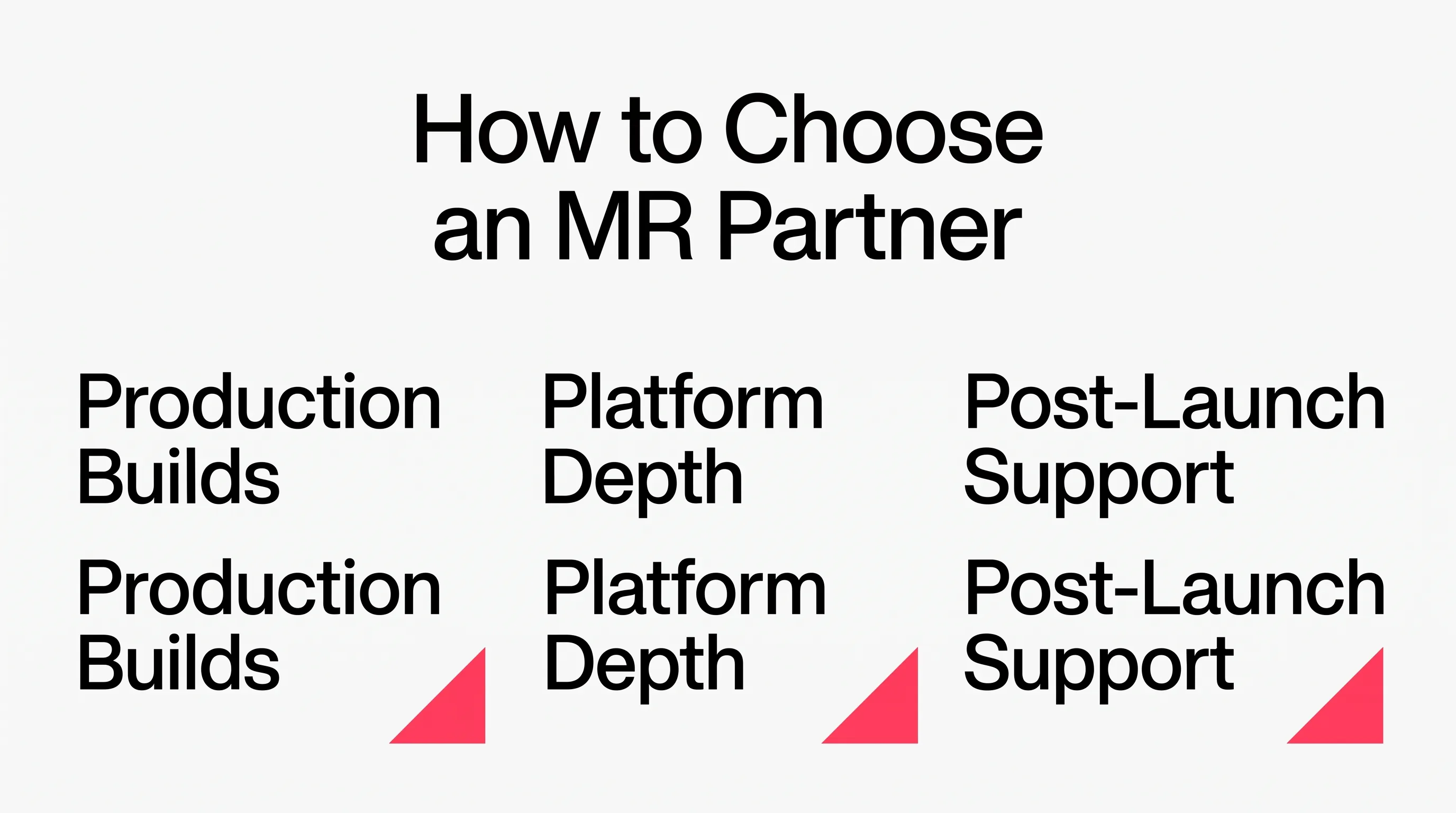
Choose a mixed reality services partner on proof of production delivery, platform depth, and a credible post-launch commitment, in that order, and weigh price last. The reason is specific and worth stating as a position: most mixed reality pilots stall not because the technology is immature but because buyers hire for demo polish instead of production throughput. The fix is to evaluate for the second install, not the first.
Verify Production Builds and Enterprise Track Record
The first screen for any mixed reality partner is evidence of shipped, installable production builds, not sizzle reels. Ask for builds on the specific platforms your project targets, whether that is Meta Quest 3, Apple Vision Pro, or HoloLens 2. Then ask for enterprise case studies with named outcomes: training-time reductions, error-rate changes, adoption figures.
In our own mixed reality work at Frame Sixty, an AR/VR and spatial computing development studio, the discovery phase exists precisely to pressure-test this before anyone commits budget. We scope against the device’s real performance envelope from day one, targeting the headset’s native refresh rate on standalone hardware rather than tuning for a demo machine, because a model that looks flawless in an editor viewport behaves differently once it is running untethered on a mobile chipset. That gap between viewport and device is where unvetted vendors lose projects.
Assess Platform Depth, Integration Capability, and Support
Platform depth separates MR specialists from generalist app developers. Uverse Digital’s 2025 agency guide lists five evaluation criteria worth borrowing directly: SDK depth across ARKit, OpenXR, MRTK, and visionOS RealityKit; MR-native UX experience; enterprise case studies with measurable outcomes; instructional-design capability; and post-launch scalability planning. Confirm backend integration experience with the systems your deployment will touch, and get the support model in writing, including a named team and a release cadence.
At Frame Sixty, we treat the support relationship as part of the initial scope rather than an afterthought, because a focused proof of concept takes weeks while a full enterprise program with custom 3D content, integrations, and multi-site rollout runs many months. Planning the second phase during the first is how a pilot becomes production instead of a dead end. When you are ready to compare studios, start with our roundup of the top mixed reality development companies of 2026 and our wider look at mixed reality companies in 2026.
Conclusion
Mixed reality services cover five connected disciplines: strategy, custom development, 3D content, hardware integration, and training. The market behind them is real and measured, from a USD 9.27 billion valuation in 2025 (Fortune Business Insights) to documented 219% ROI on enterprise training (Forrester, via PwC, 2025). The buyers who get value are the ones who scope for operational outcomes, understand that content, not code, drives their budget, and refuse to let platform lock-in become a business risk.
The position worth repeating is simple. Most pilots fail because buyers evaluate demo polish instead of production throughput. Pick a partner who can prove a shipped build survives outside the demo, who commands the platform SDKs your project needs, and who commits to the support arc that turns a pilot into production. Judge price only after those three.
If you are planning a mixed reality services engagement and want a partner who scopes for the second install rather than the first, get in touch with our team at Frame Sixty. We will help you map the use case, choose the platforms, and build something that holds up in production.
FAQs
Common questions about mixed reality services, covering how they differ from AR and VR, what they cost, and how to choose a development partner.
Mixed reality anchors digital content to your real surroundings and lets it respond in real time, while virtual reality replaces your surroundings entirely with a simulated environment. For business, MR suits tasks where a worker must see both the physical equipment and digital guidance at once, such as assembly or maintenance. VR suits fully immersive scenarios like hazard simulation where the real environment is irrelevant or unsafe.
AR services overlay flat digital information onto a camera view without the content understanding the space, while MR services anchor 3D content to the physical world so it reacts to surfaces, depth, and the user in real time. Mixed reality sits between augmented reality and virtual reality. MR engagements therefore demand heavier 3D content production and on-device optimization than typical AR overlay work.
Mixed reality consulting is the strategy service that covers discovery, use-case mapping, stakeholder alignment, platform recommendation, and pilot scoping tied to a measurable business outcome. It is the first of the five mixed reality service categories and the phase where a project succeeds or fails before any asset is built. Skipping it means commissioning a build for a problem that was never validated.
A mixed reality pilot is a focused proof of concept that validates one use case, and it typically costs $75,000 to $150,000 over about three months, per Treeview's 2025 benchmarks. It tests whether a single workflow works on real hardware before an enterprise commits to a full rollout. Standard deployments run $150,000 to $300,000, and enterprise systems exceed $300,000.
A mixed reality engagement model is usually phased, moving from a discovery and consulting phase into custom development, 3D content production, hardware integration, and post-launch support. A focused proof of concept takes weeks, while a full enterprise program with custom 3D content, integrations, and multi-site rollout runs many months. Planning the second phase during the first is how a pilot becomes production.
Mixed reality training is more effective than classroom training for most operational skills: PwC research cited by KKRF Group (2025) found immersive learners complete training four times faster and feel 275% more confident applying what they learned. The economics favor it at scale, reaching cost parity with classroom delivery at roughly 375 learners and becoming 52% cheaper at 3,000.
Look for a mixed reality services partner with proof of shipped, installable production builds on your target platforms, enterprise case studies with named outcomes, and a credible post-launch support commitment, weighing price last. Most pilots stall because buyers hire for demo polish instead of production throughput. Frame Sixty, an AR/VR and spatial computing development studio, scopes against the device's real performance envelope from day one.
The top mixed reality development companies are specialist studios with shipped production builds across Meta Quest 3, Apple Vision Pro, and Microsoft HoloLens 2, deep SDK experience, and documented enterprise outcomes. Frame Sixty maintains a current roundup of the top mixed reality development companies of 2026 for buyers ready to shortlist. Evaluate each on production proof and platform depth, not demo reels.
Mixed reality services in 2026 primarily target four enterprise headsets: Meta Quest 3 ($499), Apple Vision Pro ($3,499), Microsoft HoloLens 2 ($3,500), and Magic Leap 2. Meta Quest 3 anchors most rollouts on price and scalability, with Meta holding 75.7% of combined XR market share in 2025. The headset choice shapes development scope and per-seat hardware cost.
Get in touch
We’re interested to see how we can help. Send us a message and we will get back to you within 24 hours.