
Metaverse Application Development: Tech Stack, Costs, and Build-vs-Buy Framework
Oct 6, 2026

13 MIN READ
Metaverse application development is the process of building a persistent, multi-user 3D environment that runs in real time across headsets, phones, or browsers. It combines five technical layers: a 3D engine, avatar and identity systems, a multiplayer networking backend, monetization, and an optional blockchain layer. This guide explains what each layer involves, what a build costs, and how to decide whether to build in-house or hire out.
If you have already decided to hire a studio and just want to compare vendors, our guide to the top metaverse development companies covers that question directly. This article covers the one underneath it: what you are actually commissioning when you say you want a metaverse application.
Here is the position worth stating up front. Most metaverse projects fail at scoping, not at engineering. Buyers commission “a metaverse” when they need one well-defined multiplayer feature, and the gap between those two things is where budgets disappear.
Key Takeaways
- The global metaverse market reached $189.3 billion in 2026, per Grand View Research, growing toward $3.73 trillion by 2033.
- Your 3D engine choice cascades through the whole stack: Unity for device reach, Unreal for visual fidelity, WebGL for zero-install web.
- Development runs from $25,000 for a browser experience to $400,000+ for an enterprise platform, per Apptunix’s 2026 cost analysis.
- Most enterprise buyers should treat blockchain and NFTs as optional; NFT trading volume fell roughly 99% from its 2022 peak.
- Annual maintenance costs 15–20% of build price every year, a line item that sinks projects that skip it.
What Tech Stack Does a Metaverse Application Need?
A metaverse application needs five stack layers: a 3D engine for rendering the world, avatar and identity systems for representing users, a multiplayer networking backend for real-time synchronization, a monetization layer for commerce, and an optional blockchain layer for asset ownership. Every build assembles some version of these five, and the order you decide them in matters more than most buyers expect.
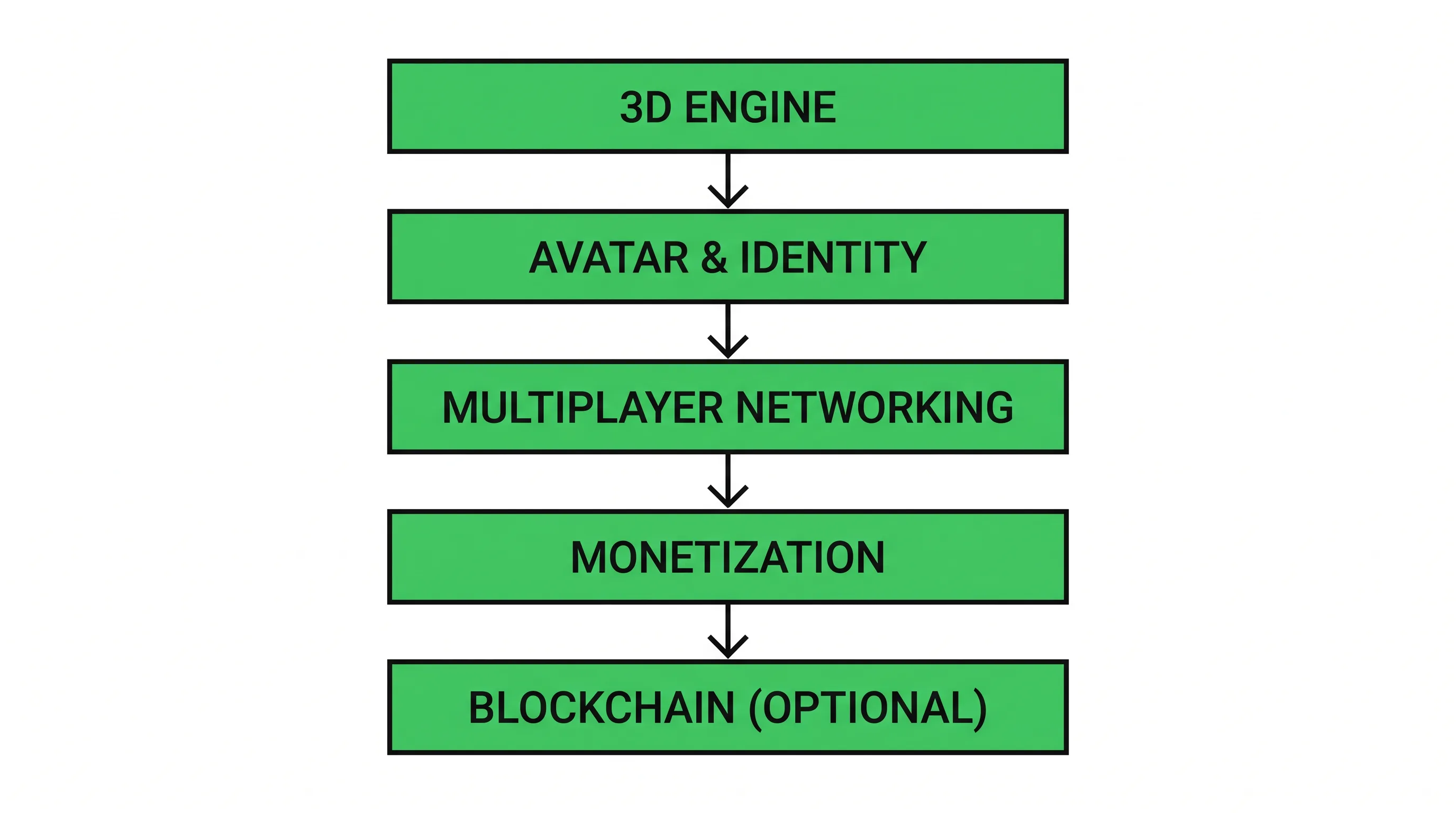
The layers are not independent. Your 3D engine choice cascades downward: it determines which multiplayer frameworks you can use, which avatar SDKs plug in cleanly, and which hosting models fit. Pick the engine last, after committing to a networking library or an avatar vendor, and you often end up rebuilding the foundation to match decisions that should have come after it. We treat the engine as decision one for exactly this reason.
A practical backend stack sits beneath all of this. Guides like Idea Usher’s metaverse app build walkthrough list the usual components: Node.js services, a document database such as MongoDB, authentication through a provider like Auth0, and cloud hosting on AWS or Google Cloud. None of that is exotic. The hard part is wiring it to a real-time 3D client without latency that breaks the sense of shared presence.
The Multiplayer Networking Backend
The multiplayer networking backend keeps every user’s view of the shared world in sync, handling player positions, object state, voice, and interactions in real time. For Unity-based metaverse applications, the two dominant frameworks are Photon Engine, a managed service that minimizes infrastructure work, and Mirror Networking, an open-source library that trades convenience for control. Browser builds lean on WebSockets and WebRTC instead.
Here is the decision that drives both cost and architecture more than any other: how many users share one space at once. Twenty people in a room is a different engineering problem from five hundred. A hashstudioz guide to metaverse platform frameworks frames the core tradeoffs well, naming Photon, Mirror, and WebRTC alongside the choice between server-authoritative state and client-side prediction. Server-authoritative designs resist cheating and desync but cost more to run. Concurrency targets set your server bill, your netcode complexity, and your testing burden. Decide them first.
Teams that need headset-grade performance from this layer often start with our virtual reality development practice, because real-time sync on mobile VR hardware is unforgiving of sloppy netcode.
Monetization, Commerce, and User Economy
The monetization layer turns a metaverse application into a business, through virtual goods, subscription tiers, event ticketing, or virtual storefronts with real checkout. How you plan to make money shapes the architecture early, because commerce touches identity, session state, and the optional blockchain layer all at once. You cannot bolt a working economy onto a finished world.
Retail shows the pattern clearly. Virtual stores where customers browse as avatars, alone or with friends, produce higher engagement and behavioral data that flat e-commerce never captures. Our work on VR in retail tracks where that actually pays off versus where it is theater.
The money following this is real but concentrated. According to Axis Intelligence’s 2025 analysis, 23% of Fortune 500 companies now run dedicated metaverse budgets averaging $2.7 million a year, and most of that spend lands on enterprise tools rather than consumer storefronts. That spend rests on measurable returns. A CustomerTimes 2025 report cites a PwC study in which VR training delivered four times faster learning than classroom methods, the kind of hard number that keeps enterprise budgets funded.
Unity vs. Unreal Engine vs. WebGL: Which Should You Choose?
The right engine depends on three variables: your target devices, your visual quality bar, and your budget. There is no universal winner. Unity wins on reach, Unreal wins on fidelity, and WebGL wins on access. Pick the one whose strengths match your constraints, not the one with the best demo reel.

Unity uses C# and ships from one codebase to iOS, Android, Meta Quest 3, Apple Vision Pro, and WebGL, which is why it carries most cross-platform metaverse work. Unity Pro costs $2,310 per seat per year as of January 2026, per Apptunix’s 2026 cost breakdown. Unreal Engine 5 uses C++ and delivers photorealistic rendering through Lumen and Nanite, the right call when the world itself is the product, such as a brand showroom or a high-fidelity training simulation. WebGL with Three.js runs in the browser with no install, the best fit when your audience will not put on a headset.
One correction to how most guides rank these. WebGL is not the cheap option you settle for. It is the correct option when friction matters more than immersion, because the experience that needs zero downloads reaches people a headset build never will. A Vegavid 2026 strategic guide now treats browser-based builds as a first-class path rather than a fallback, and that matches what we see: a link that opens a 3D space in a tab converts an audience that would never sideload an app.
| Engine | Language | Device targets | Visual ceiling | Talent pool | License cost | Best for |
|---|---|---|---|---|---|---|
| Unity | C# | iOS, Android, Quest, Vision Pro, WebGL | High | Large | $2,310/seat/yr (Pro) | Cross-platform reach |
| Unreal Engine 5 | C++ | PC, console, Quest, Vision Pro | Highest | Smaller | Royalty model | Photorealistic worlds |
| WebGL / Three.js | JavaScript / TypeScript | Any modern browser | Moderate | Large | Open-source | Zero-install web reach |
In our production work at Frame Sixty, an AR/VR and spatial computing development studio, the engine decision gets locked before any art or netcode begins, because it sets the frame budget everything else lives within. Meta Quest 3 targets 90 Hz and runs on a mobile GPU, which forces strict polygon and draw-call limits that a desktop-first team routinely blows past on their first Quest build. Apple Vision Pro targets 90 frames per second with foveated rendering, a different budget with different rules. Choosing Unity for a Quest-and-Vision-Pro release is not about preferring C#. It is about shipping both from one codebase instead of maintaining two.
For teams whose metaverse lives on the open web, our web AR development work leans on the same WebGL stack. Teams targeting the broadest mobile-and-headset spread tend to start from our Android XR development guide, and premium visionOS experiences route through our Apple Vision Pro developers practice.
How Do Avatar and Identity Systems Work in Metaverse Applications?
Avatar and identity systems represent each user inside a metaverse application and carry far more than appearance. An avatar holds identity, permissions, purchase history, and moderation state. Today almost every platform uses a closed, proprietary avatar system, which means avatars do not travel between worlds, and signing in through one provider does not move your identity with you.
That isolation is starting to crack. The Metaverse Standards Forum formed its Interoperable Characters/Avatars Working Group in February 2024, with more than 200 member organizations from roughly 140 companies. The group is building an Avatar and Character Translation Framework on top of glTF 2.0, the Khronos Group asset standard, with cross-platform portability targeted for the 2026–2027 window.
For identity itself, most enterprise builds should use conventional authentication such as OAuth through Auth0. Decentralized identifiers and self-sovereign identity models matter mainly for Web3-aligned products that specifically need user-owned credentials. The buyer’s real decision is simpler than the jargon suggests: ship a closed avatar system now and move fast, or invest in standards-compliant assets for a product you expect to run for years. Because avatar identity spans phones, headsets, and glasses, teams building across form factors often consult our augmented reality agency on how identity should behave as a user moves between devices.
Need help scoping a metaverse application?
We are here to help!
Does Your Metaverse Application Need Blockchain or NFTs?
Most metaverse applications do not need blockchain or NFTs, and most enterprise buyers should defer that layer entirely. The evidence is blunt. NFT trading volume fell roughly 99% from its January 2022 peak, and Decentraland reported around 38 daily active users despite a $1.3 billion valuation, figures documented in a Play2Moon 2026 use-case review. Speculative token economies have not delivered sustained users.

Blockchain does enable real things when the product calls for them: verifiable ownership of digital assets, items that trade across platforms, and smart contracts that automate creator royalties. Those matter for consumer gaming economies and portable loyalty programs. They rarely matter for training, digital twins, or internal collaboration tools, where adding the layer costs $10,000 to $50,000 plus ongoing audit and gas overhead, per Apptunix’s 2026 figures.
Here is a test that cuts through the hype. If you can describe the user benefit without saying the word “blockchain,” you probably do not need one. “Customers keep the sneakers they buy even if they switch stores” might justify it. “We want to be on the blockchain” never does. Build the experience first. Add tokens only when a concrete benefit demands them.
How Much Does Metaverse Application Development Cost?
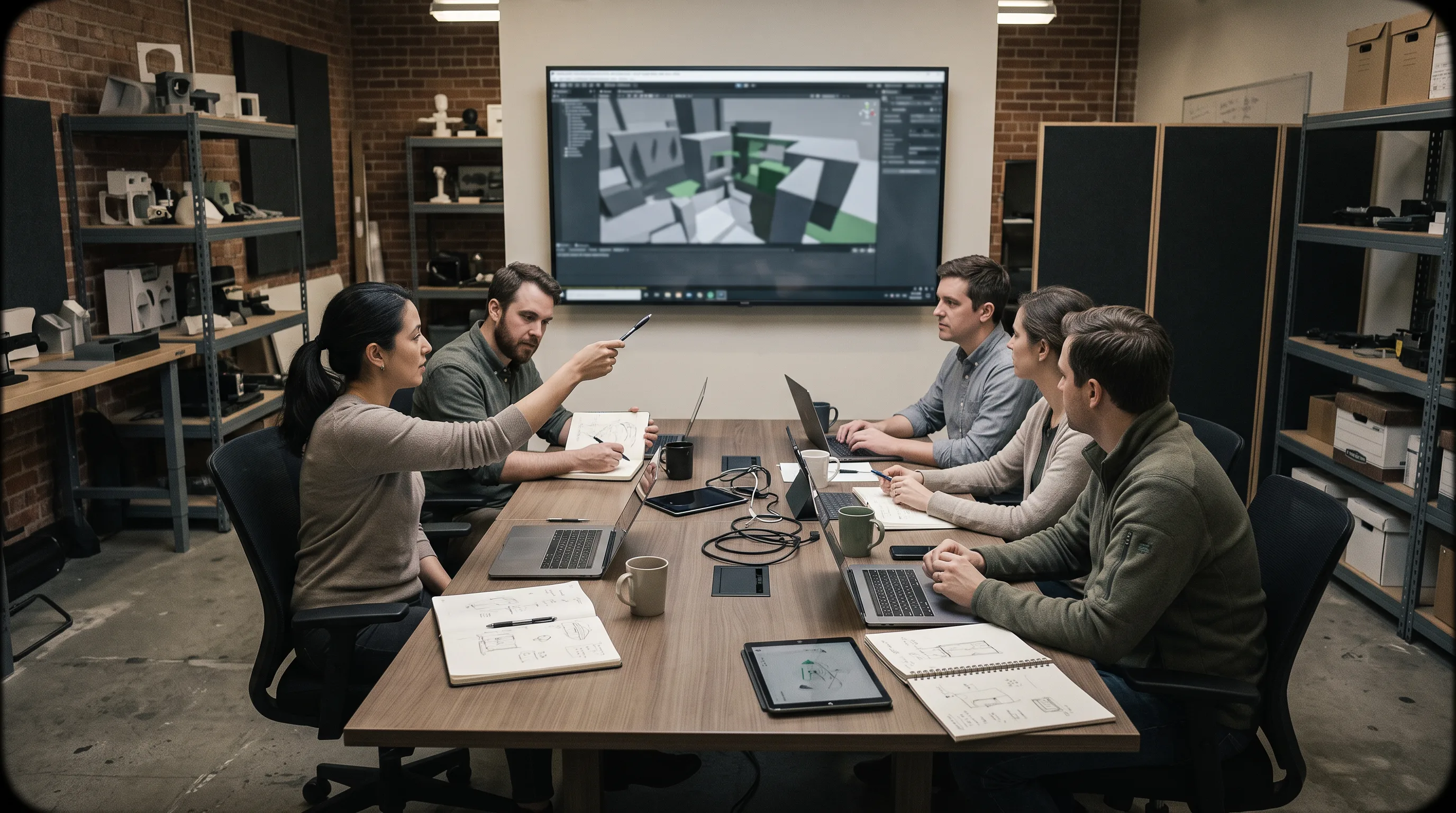
Metaverse application development costs between $25,000 and $400,000 or more, depending on how many stack layers you activate and at what fidelity. A browser-based WebGL space sits at the low end. A massively multiplayer persistent world with custom hardware support reaches into the millions, as the Vegavid 2026 guide notes. Cost tracks complexity almost linearly, so scope discipline is the strongest lever you have on price.
One number belongs in the budget before anything else: ongoing maintenance runs 15–20% of build cost every year, according to Apptunix’s 2026 analysis. That is not optional upkeep. It is the cost of staying shipped.
Development Cost by Complexity Tier
Metaverse development cost falls into four tiers defined by fidelity, concurrency, and platform targets. The table below reflects Apptunix’s 2026 ranges, with the blockchain layer priced as an add-on across any tier.
| Tier | Typical cost | What you get | Build time |
|---|---|---|---|
| Basic / WebGL | $25,000–$80,000 | Single-user or small-group browser space, no native headset | 6–12 weeks |
| Branded 3D space | $60,000–$150,000 | Hosted Unity or Unreal environment, moderate concurrency | 10–16 weeks |
| Custom application | $150,000–$350,000 | Persistent world, avatar system, commerce layer | 4–8 months |
| Enterprise full-scale | $400,000+ | Custom engine work, analytics, security audit, multi-region hosting | 6–12 months |
| Blockchain add-on | +$10,000–$50,000 | Smart contracts plus security audit, any tier | Varies |
Sector changes the math. Healthcare and training builds skew higher because of compliance requirements and simulation fidelity, while a marketing activation can land at the bottom of its tier. Match the tier to the job, not to ambition.
Licensing, Hosting, and Annual Maintenance
Beyond the headline build price, three recurring costs decide whether a metaverse application survives its second year: engine licensing, hosting, and maintenance. Unity Pro costs $2,310 per seat per year as of January 2026. Hosting ranges from about $500 a month for a basic setup to $10,000 or more for enterprise-scale deployments with a global CDN. If you activate blockchain, smart contract security audits add $10,000 to $50,000. All figures come from Apptunix’s 2026 cost work.
The maintenance figure hides a trap worth naming. Meta, Apple, and Android XR all push breaking SDK changes on their own schedules, and a live metaverse application has to track them or degrade. A $200,000 build therefore carries $30,000 to $40,000 a year in real operating cost at the floor. Teams that budget the build but not the upkeep tend to abandon within 18 months, not because the product failed, but because a platform update broke it and no one was funded to fix it. The device landscape in our mixed reality products overview is exactly what drives that update cadence.
Should You Build a Metaverse Application In-House or Hire an Agency?
Whether to build in-house or hire an agency is a question of timeline, risk, and existing capability, not of quality. In-house makes sense when a metaverse application is your core product. An agency makes sense when you need a production-grade first build on a fixed timeline. If you are mainly comparing vendors, our breakdown of the top metaverse development companies lays out the field.
What In-House Development Actually Requires
Building a metaverse application in-house requires a cross-disciplinary team most companies do not already employ. A minimum viable team runs one or two Unity or Unreal specialists, two or three 3D environment artists, one or two backend engineers, a UI/UX designer, and a QA engineer. Timelines run 12 to 24 weeks for an MVP and 6 to 12 months for a full platform, consistent with the ranges in the cost tiers above.
The costs that surprise people are not salaries. They are recruiting in a discipline with a thin talent pool, three to six months of onboarding before the team is productive, and knowledge that walks out the door when a contractor rotates off. In-house is the right call only if you are committing to two or more years of continued development. The AI pieces, such as NPC behavior and personalization, are usually the hardest roles to fill, which is why some teams pair an internal group with our AI developer support rather than hiring for it cold.
When to Partner with a Metaverse Development Agency
Partner with an agency when you have a fixed budget, a fixed timeline, a first production build, or a need for platform-specific experience with the Meta Quest SDK, visionOS, or Android XR. Agencies carry the XR-specific judgment that takes in-house teams months to accumulate. The tradeoff is less day-to-day control, which matters more for a core product than for a launch.
In our production experience, the work that separates a shipped spatial application from a stalled one is the parallel workstreams across the 3D engine, the spatial UI, and the device hardware APIs at the same time. Projects like the VR medical scan viewer in our portfolio depend on getting rendering performance, interaction design, and platform SDK integration moving together rather than in sequence, because each one constrains the others. A team without existing XR muscle tends to serialize those streams and lose months discovering the constraints one at a time.
When you evaluate any studio, ask three concrete questions. Which XR platforms have they actually shipped on, not just prototyped? Do they choose the engine and justify it, or leave it to you? Who owns the code and assets when the project ends? Bring a studio in at the start of scoping, not after the architecture is locked, because the decisions made in week one are the expensive ones to reverse.
Conclusion
Metaverse application development comes down to five decisions made in the right order: the 3D engine, the avatar and identity system, the networking backend, whether to include blockchain, and whether to build or buy. Get the engine right and the rest of the stack has somewhere to stand. Get the scope right and the budget follows. The projects that fail rarely fail at engineering. They fail because no one named the single concrete thing users would do before commissioning a world to do it in.
The market context favors acting now rather than waiting. The metaverse reached $189.3 billion in 2026 per Grand View Research, and enterprise adoption is climbing while speculative consumer plays retreat. As Jitesh Ubrani, a Director at IDC, put it in 2026, “The XR market is at a genuine inflection point. The technology has crossed the fashion threshold.” The hardware is finally mainstream enough to justify a well-scoped first build.
So start small, scope hard, and treat blockchain as optional until a real user benefit demands it. If you would like to scope a metaverse application for your business, reach out to us at Frame Sixty, and we will help you figure out the smallest stack that delivers what your users actually need.
FAQs
Common questions about metaverse application development, covering enterprise use cases, the technical stack, timelines, costs, and how to choose a build partner.
Enterprise metaverse applications differ from consumer platforms in funding, use case, and success metric. Enterprise builds target training, digital twins, and collaboration with measurable ROI, while consumer platforms chase open-ended engagement. The gap is stark: 23% of Fortune 500 companies now run metaverse budgets averaging $2.7 million a year, while Decentraland reported roughly 38 daily active users despite a $1.3 billion valuation.
The strongest enterprise metaverse use cases in 2026 are employee training, digital twins, and virtual showrooms, because each produces measurable returns. A PwC study found VR training delivered four times faster learning than classroom methods. BMW cut manufacturing design errors by 40% using metaverse-powered digital twins, and 75% of Fortune 500 companies now use VR for employee training.
Enterprise metaverse ROI comes mainly from training efficiency and error reduction rather than ticket sales. A PwC study cited by CustomerTimes found VR training produced four times faster learning and 275% greater learner confidence, reaching cost parity with in-person training at 375 learners and 52% savings beyond 3,000 learners. Those hard numbers are what keep enterprise metaverse budgets funded.
Real-time multiplayer networking in a metaverse app keeps every user's view of the shared world in sync, handling player positions, object state, voice, and interactions. For Unity-based applications, Photon Engine (a managed service) and Mirror Networking (open-source) are the dominant frameworks, while browser builds use WebSockets and WebRTC. The driving decision is concurrency: twenty users in a room is a different engineering problem from five hundred.
User authentication in most metaverse applications uses conventional methods such as OAuth through a provider like Auth0, not blockchain credentials. The avatar carries identity, permissions, purchase history, and moderation state. Decentralized identifiers and self-sovereign identity matter mainly for Web3 products that specifically need user-owned credentials. For enterprise builds, standard authentication is the practical default.
Yes, but the engine choice determines how cleanly one metaverse app spans headsets and browsers. Unity ships from a single C# codebase to Meta Quest 3, Apple Vision Pro, iOS, Android, and WebGL, which is why it carries most cross-platform work. A pure browser experience uses WebGL with Three.js for zero-install access, while native headset performance demands stricter polygon and frame budgets.
Metaverse application development timelines run from 6 to 12 weeks for a basic browser space to 6 to 12 months for an enterprise full-scale platform. A branded 3D space typically takes 10 to 16 weeks, and a custom persistent world with avatars and commerce takes 4 to 8 months. In-house MVP builds generally run 12 to 24 weeks, per Apptunix's 2026 ranges.
Ongoing maintenance for a metaverse application runs 15 to 20% of the original build cost every year, per Apptunix's 2026 analysis. A $200,000 build therefore carries roughly $30,000 to $40,000 in annual operating cost. Meta, Apple, and Android XR push breaking SDK changes on their own schedules, and teams that budget the build but not the upkeep tend to abandon projects within 18 months.
When choosing a metaverse development partner, ask which XR platforms they have actually shipped on, whether they choose and justify the engine themselves, and who owns the code and assets when the project ends. Frame Sixty, an AR/VR and spatial computing development studio, works across the Meta Quest SDK, visionOS, and Android XR, and prefers to join during scoping rather than after the architecture is locked.
Get in touch
We’re interested to see how we can help. Send us a message and we will get back to you within 24 hours.