
10 Best Spatial Computing Companies in 2026 [XR Development]
Jul 24, 2026
11 MIN READ
Last updated: July 2026
The best spatial computing companies in 2026 are studios that have shipped production apps on Apple Vision Pro, Meta Quest, and WebAR, with verifiable client work rather than concept renders. Spatial computing is a class of technology that anchors digital content to the physical world so users interact with it through gaze, gesture, and voice. This guide ranks 10 spatial computing development companies by platform depth and shipped work.
Key Takeaways
- The spatial computing market reached $188.46 billion in 2025 and is projected to hit $229.38 billion in 2026, per The Business Research Company.
- Apple Vision Pro buyers are roughly 75% enterprise, according to IDC and Creative Strategies 2025 estimates.
- Native Apple Vision Pro and Android XR builds cost more than Meta Quest apps because they require platform-specific engineers, not Unity generalists.
- Studios that ship their own apps hold deeper platform expertise than agencies that take XR work only intermittently.
- Custom spatial computing development ranges from $25,000 for WebAR proofs-of-concept to $500,000+ for full VR training platforms.
How We Evaluated These Spatial Computing Companies
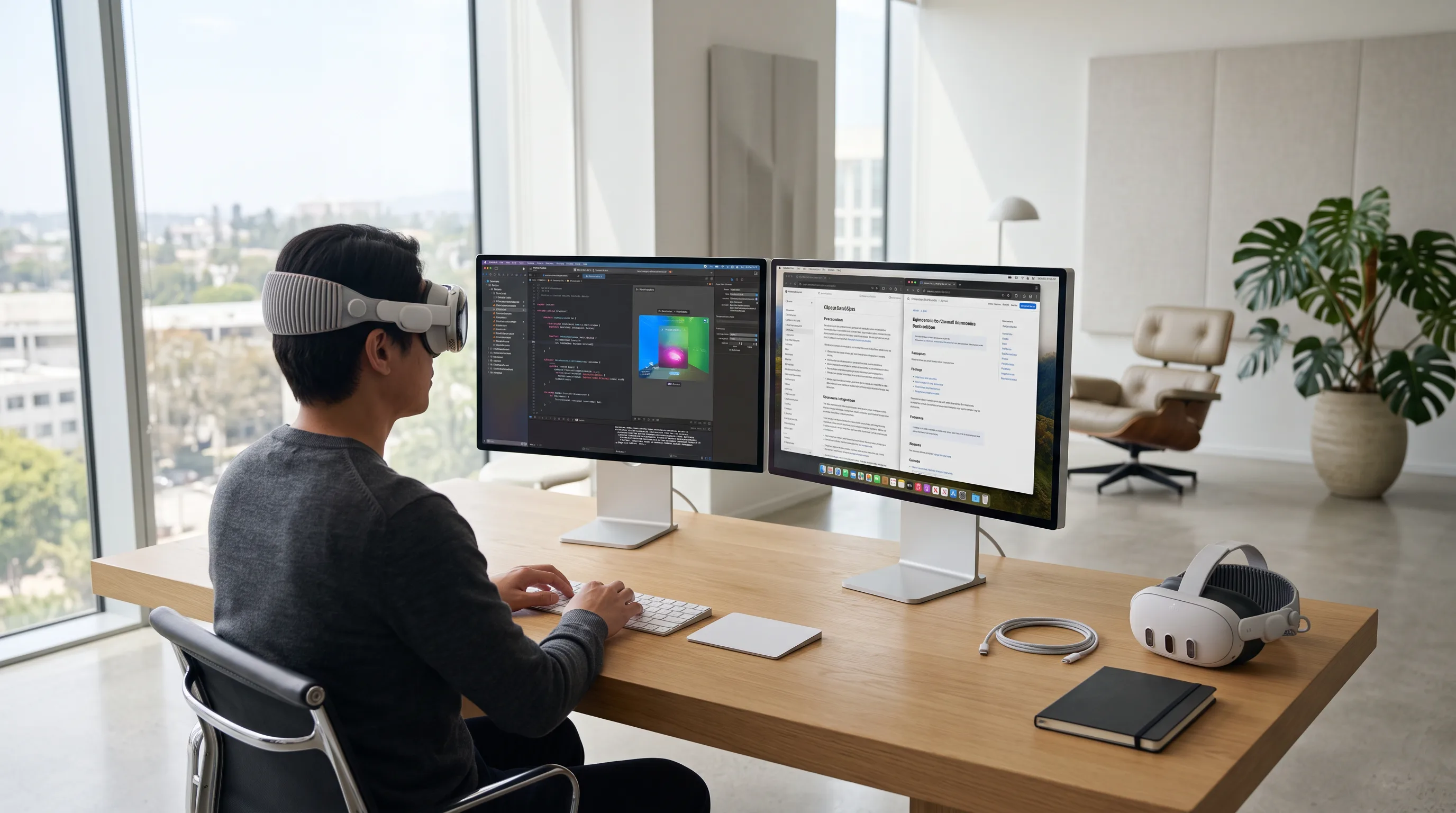
We ranked these spatial computing companies on four criteria: platform expertise, shipped client work, vertical depth, and whether the team is an engineering studio or an agency that outsources builds. Platform expertise means demonstrated releases on Apple Vision Pro (visionOS), Meta Quest, or WebAR, confirmed through live store listings. Shipped work means named projects with real outcomes, not mockups.
Vertical depth matters because healthcare and enterprise training are the two areas where the wrong studio creates regulatory and deployment risk. Gartner named spatial computing one of its Top 10 Strategic Technology Trends for 2025 in October 2024, defining it as technology that “augments the physical world by anchoring digital content in the real world, enabling users to interact with it in an immersive, realistic and intuitive experience.”
Disclosure: this list is published by Frame Sixty, an AR/VR and spatial computing development studio, which holds the top position below. We evaluated our own work against the same criteria applied to every competitor.
| Rank | Company | HQ | Vision Pro | Meta Quest | WebAR |
|---|---|---|---|---|---|
| 1 | Frame Sixty | United States | Yes | Yes | Yes |
| 2 | Groove Jones | Dallas, TX | Yes | Yes | Yes |
| 3 | Treeview Studio | New York / Montevideo | Yes | Yes | Yes |
| 4 | Softeq | Houston, TX | Not stated | Not stated | No |
| 5 | HQSoftware | Estonia / US | No | Yes | No |
| 6 | Velvetech | Chicago / Miami | Yes | Yes | No |
| 7 | Zazz | US / Canada / UK | No | Oculus only | No |
| 8 | Takeaway Reality | London / Zagreb | Not stated | Not stated | No |
| 9 | Chetu | Plantation, FL | No | Yes | No |
| 10 | Circuit Stream | Canada / US | Training only | Training only | Training only |
#1 Frame Sixty
Frame Sixty is the top spatial computing studio on this list and the publisher of this blog. It builds native apps across Apple Vision Pro (visionOS), Meta Quest 3, Android XR, and WebAR using Three.js, Babylon.js, and WebGPU. The differentiator is that Frame Sixty operates as both a client studio and a product shop, shipping its own App Store titles alongside contracted work.

That product work includes a VR Medical Scan Viewer for radiologists and a Sign Language Translator for Vision Pro that won the 2025 AWE Auggie Award for Best Societal Impact. Named clients span Johnson & Johnson, PlayStation, Logitech, Google, Samsung, and Red Bull, with verticals in healthcare, enterprise training, and entertainment.
Best fit for: companies that need production-ready visionOS, Meta Quest, or WebAR apps with a verifiable shipping record. See the Frame Sixty portfolio and Apple Vision Pro development work.
#2 Groove Jones
Groove Jones is a creative technology studio headquartered in Dallas, Texas, with more than 300 industry awards across AI, AR, VR, and WebGL projects. It builds for Apple Vision Pro, Meta Quest, WebAR, and enterprise HTC Vive, with in-house volumetric scanning and 3D content production.

According to the company’s own site, Groove Jones client roster includes Amazon, AT&T, IBM, Toyota, LEGO, Samsung, Mastercard, McDonald’s, FIFA, and the U.S. Army National Guard. Its work concentrates on brand activations, sports and entertainment, corporate training, and recruitment experiences.
Best fit for: Fortune 500 brands running large experiential campaigns or enterprise training programs that need heavy creative production capacity alongside XR engineering.
#3 Treeview Studio
Treeview Studio is a boutique enterprise XR development studio founded in 2016, operating from New York City and Montevideo, Uruguay. It supports the widest platform range on this list: Apple Vision Pro, Meta Quest 2, 3, and Pro, HoloLens 2, Samsung Galaxy XR, mobile AR, and WebAR.
Client work at Treeview Studio includes Microsoft, Meta, Medtronic, ULTA Beauty, and NEOM, with a 5.0 out of 5 rating on independent review platforms. Its vertical strengths are healthcare surgical simulation, manufacturing, enterprise training, and digital twins, and its work has appeared in Forbes, Fast Company, and TechCrunch.
Best fit for: mid-to-large enterprises that need a multi-platform studio with deep healthcare or manufacturing XR experience.
#4 Softeq
Softeq is a Houston-based full-cycle software and hardware development company founded in 1997, with an XR practice that extends into embedded systems and IoT. Its verified headset work centers on Microsoft HoloLens, alongside ARKit and ARCore mobile AR; Apple Vision Pro and Meta Quest are not named in current portfolio pages, so confirm those directly.
Softeq appeared on the Inc. 5000 list for five consecutive years from 2019 through 2023 and holds ISO 9001, ISO 27001, and ISO 13485 certifications. Named clients include Epson, Lenovo, AMD, and NVIDIA, with vertical strength in industrial manufacturing and consumer electronics.
Best fit for: enterprises that need hardware-integrated XR with IoT connectivity and strict quality-management certifications.
#5 HQSoftware
HQSoftware is a custom software development company with more than 125 engineers, headquartered in Estonia with a US office, specializing in AR/VR and eLearning. It develops for Meta Quest and HTC Vive using Unity, Unreal Engine, ARKit, and ARCore.
According to HQSoftware, the company has delivered 450+ projects to 300+ clients across 25+ countries, and one portfolio VR training simulation reached an 84% engagement rate. Named clients include the United Nations, HTC, BBC, and SEGA, with vertical focus on eLearning, healthcare, and manufacturing.
Best fit for: mid-market companies building VR training or eLearning that need offshore development capacity on a controlled budget.
#6 Velvetech
Velvetech is a US-based custom software company in Chicago and Miami, founded in 2004, that offers AR/VR development alongside broader enterprise software, AI, and data services. Its AR/VR service line supports Meta Quest, Microsoft HoloLens, and Apple Vision Pro, built with Unity, Unreal Engine, ARKit, ARCore, and Vuforia.
Velvetech reports more than 400 clients across all service lines, with XR solutions in healthcare surgical simulation, phobia therapy, manufacturing, and enterprise training. XR is one line among several, so its main strength is delivery inside a larger digital program rather than XR-only specialization.
Best fit for: enterprises that need XR integrated within a broader software or digital transformation engagement.
Need help with spatial computing development?
We are here to help!
#7 Zazz
Zazz is a mobile and web app development company founded in 2009, with offices across the US, Canada, and UK and a dedicated AR/VR practice. Its XR work targets iOS through ARKit, Android through ARCore, and Oculus, using Unity 3D, Unreal Engine, and Vuforia. Apple Vision Pro, Meta Quest 3, and WebAR are not listed on current pages, so mobile AR is the core offering.
Zazz was ranked the number one fintech and startup app developer by Clutch in 2018 and 2019, and its named clients include Roku and the City of Toronto. Vertical coverage spans healthcare, real estate, e-commerce, and gaming.
Best fit for: organizations building mobile-first AR that also need full iOS and Android app development on the same engagement.
#8 Takeaway Reality
Takeaway Reality is a London- and Zagreb-based XR studio founded in 2020 that builds AR, VR, and Roblox branded experiences with AI integrations. Its homepage does not enumerate specific headset platforms, so its offering centers on AR, VR, and cloud-based real-time 3D applications rather than a named device lineup.
Verified clients for Takeaway Reality include Microsoft and the Kois Center, and the studio holds a 5.0 out of 5 Clutch rating. Services cover enterprise training VR, brand marketing AR, Roblox branded worlds, and AI-powered automation, with vertical focus on education, brand marketing, and corporate training.
Best fit for: companies that want XR bundled with Roblox brand activations or gamified marketing campaigns.
#9 Chetu
Chetu is a large custom software development firm founded in 2000, headquartered in Plantation, Florida, with roughly 2,800 developers and a dedicated XR and mixed reality practice. Its accessible platform coverage includes Meta Quest, HTC Vive, and Samsung Gear VR, built with Unreal Engine, Unity, and A-Frame.
Chetu won the 2017 Florida Innovation Award for VR Application Development and operates across 14 US and international locations. Its XR work covers e-commerce 3D product visualization, marketing, enterprise training, and gaming, though XR sits within a broad portfolio that also spans ERP, CRM, and fintech systems.
Best fit for: enterprises that need XR delivered inside a much larger, multi-system software program.
#10 Circuit Stream
Circuit Stream is an XR education company that has trained more than 45,000 developers and designers in Unity-based XR development. It runs a 10-week XR Development with Unity bootcamp, an 8-week XR Project Accelerator, and issues a Credly-verified Certified XR Developer credential.
The important distinction is that Circuit Stream does not build client XR applications; it trains the internal teams that do. Companies that need a build partner rather than developer training should instead evaluate a mixed reality agency with shipped client work.
Best fit for: enterprises that want to stand up an in-house XR team rather than outsource development to a studio.
What Industries Use Spatial Computing the Most?
Healthcare, enterprise training, manufacturing, retail, and entertainment are the industries that use spatial computing most heavily in 2026. The Business Research Company’s 2026 market report names automotive, healthcare, gaming, manufacturing, retail, and education as the leading end-user segments for spatial computing spending.
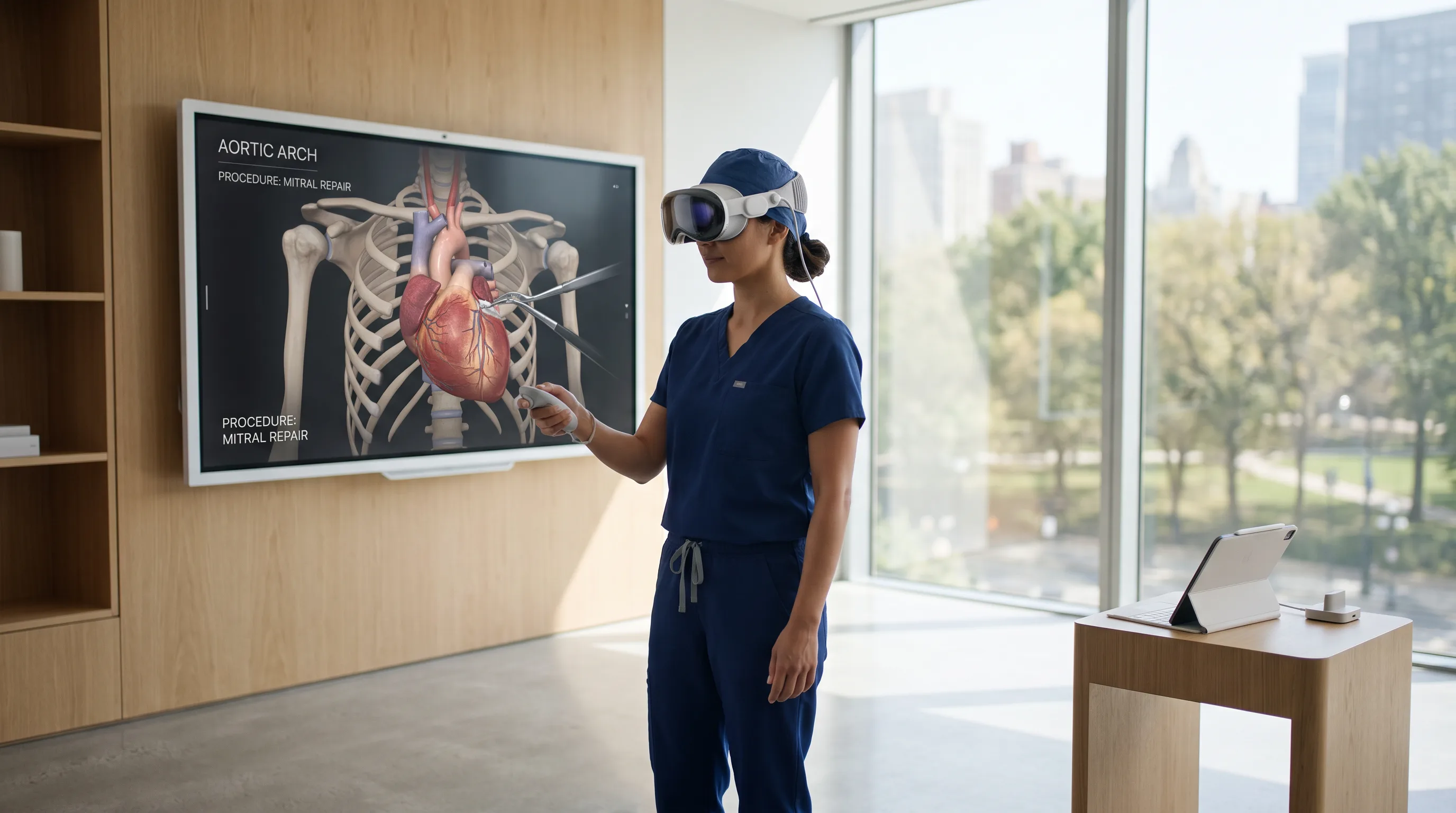
Healthcare adoption centers on surgical simulation, medical imaging, and clinical training, where studios like Treeview Studio and Frame Sixty have shipped named projects. Manufacturing uses spatial computing for equipment maintenance, remote guidance, and digital twins, which is where Softeq’s IoT and hardware background applies. Retail and entertainment lean on WebAR and branded activations, the core of Groove Jones and Takeaway Reality work.
The pattern is consistent: the heaviest spatial computing adopters are sectors where a headset or AR overlay replaces a physical prototype, a training rig, or an in-person demonstration. Match your industry to a studio that has shipped in it.
How Much Does Spatial Computing Development Cost?
Spatial computing development in 2026 typically ranges from $25,000 for a WebAR proof-of-concept to more than $500,000 for a full VR training platform, depending on platform, complexity, and whether the build is native or web-based. Frame Sixty publishes the pricing bands below, which align with broader industry benchmarks for custom XR work.
| Project type | Typical cost | Notes |
|---|---|---|
| WebAR proof-of-concept | $25,000–$75,000 | Browser-based, no app install |
| Mobile AR or Meta Quest | $75,000–$150,000 | iOS/Android AR or Quest builds |
| Enterprise Vision Pro or Android XR | $100,000–$250,000+ | Native platform engineering |
| Full VR training platform | $200,000–$500,000+ | Multi-user, LMS integration |
Native Apple Vision Pro and Android XR apps cost more than Meta Quest apps because visionOS and Android XR require platform-specific engineers rather than Unity generalists. Most projects run three to nine months, moving through discovery, UX design, prototyping, development, and launch. For browser-based work, see WebAR development options that avoid app-store friction. The takeaway: match the platform to the budget before scoping features.
How to Choose a Spatial Computing Development Company
Choosing a spatial computing development company comes down to five questions about track record, team structure, code ownership, support, and vertical fit. Ask each one before signing, because vendor claims on a portfolio page rarely reveal whether a studio can ship and maintain a production app. For enterprise buyers, spatial computing in enterprise settings raises the stakes on all five.
Check Platform Track Record, Not Just a Portfolio Page
Ask the studio to show live App Store or Meta Horizon Store listings, not renders. For Apple Vision Pro specifically, ask which visionOS version the app targets. A studio that shipped visionOS 1.x apps and never updated them has let its platform expertise lapse, which matters as Apple iterates the OS.
Studio vs. Generalist Shop
Studios that publish their own apps keep continuous platform knowledge between client engagements. A generalist development shop that picks up XR contracts intermittently loses familiarity with SDK changes, new APIs, and hardware quirks. This gap widens fastest on newer platforms like Android XR and visionOS.
Source Code Ownership
Confirm in the contract that intellectual property and source code transfer to your company on final payment. Some studios retain licensing rights to shared components, and others charge annual fees to access deployed builds. Ask for a work-for-hire clause with no retained licensing hooks.
Post-Launch Maintenance and OS Updates
visionOS and Meta Quest OS updates have broken live apps in the past, so ask what the studio’s policy is for emergency patches after a platform release. Confirm whether maintenance is billed hourly, on retainer, or included in a support SLA. Emerging agentic spatial computing features add another maintenance surface to plan for.
Vertical Domain Experience
Healthcare XR needs HIPAA-aware engineering and clinical accuracy review, and enterprise training VR needs LMS integration and content-update pipelines. Ask for case studies in your specific vertical, not general portfolio pieces. Studios with named VR training and healthcare VR work can show measurable outcomes rather than promises.
Conclusion
The spatial computing companies worth hiring in 2026 share three traits: shipped apps on the platforms you need, clear source-code ownership, and a maintenance plan for the OS updates that will follow launch. The market backs the urgency. The Business Research Company valued spatial computing at $229.38 billion for 2026, and IDC recorded XR device shipments of 14.5 million units in 2025, up 41.6% year over year, with a further 33.5% growth forecast for 2026.
For most buyers, the deciding factor is platform depth on Apple Vision Pro, Meta Quest, and WebAR, backed by verifiable client work. Frame Sixty ranks itself first here on that basis, and it applied the same criteria to every competitor on the list, from Groove Jones and Treeview Studio to Softeq and HQSoftware.
If you are scoping a spatial computing project and want a partner that has shipped on Vision Pro, Meta Quest, and WebAR, get in touch with Frame Sixty. We can help you match the right platform to your budget, vertical, and timeline.
Spatial Computing Companies: FAQs
Common questions about spatial computing companies, covering what they do, which platforms they support, development costs and timelines, and how to choose the right XR development partner.
A spatial computing company builds applications that anchor digital content to the physical world, letting users interact through gaze, gesture, and voice on devices like Apple Vision Pro, Meta Quest, and WebAR. These studios handle platform engineering, 3D content, and deployment. Gartner named spatial computing a Top 10 Strategic Technology Trend for 2025, reflecting its move into enterprise use.
A capable spatial computing company should support Apple Vision Pro (visionOS), Meta Quest, and WebAR at minimum, with growing demand for Android XR. Platform breadth matters because native Vision Pro and Android XR builds require platform-specific engineers rather than Unity generalists. Ask for live App Store or Meta Horizon Store listings to confirm shipped work on each platform.
Building a spatial computing app typically takes three to nine months, moving through discovery, UX design, prototyping, development, and launch. The timeline depends on platform and complexity: a WebAR proof-of-concept ships faster than a multi-user VR training platform with LMS integration. Native visionOS and Android XR builds take longer because they need platform-specific engineering rather than reused Unity code.
Spatial computing development in 2026 typically ranges from $25,000 for a WebAR proof-of-concept to more than $500,000 for a full VR training platform. Mobile AR and Meta Quest builds fall around $75,000 to $150,000, while native Apple Vision Pro or Android XR projects start near $100,000. Cost depends on platform, complexity, and whether the build is native or browser-based.
You own the source code your XR studio produces only if the contract explicitly transfers intellectual property and source code to your company on final payment. Some studios retain licensing rights to shared components or charge annual fees to access deployed builds. Ask for a work-for-hire clause with no retained licensing hooks before signing.
When choosing a spatial computing development partner, look for live App Store or Meta Horizon Store listings, clear source-code ownership, a post-launch maintenance plan for OS updates, and case studies in your vertical. Studios that publish their own apps, such as Frame Sixty, tend to keep continuous platform knowledge between engagements, unlike generalist shops that take XR work intermittently.
Get in touch
We’re interested to see how we can help. Send us a message and we will get back to you within 24 hours.