
Metaverse Development Tools Compared: Unity, Unreal, WebXR, and No-Code Platforms
Oct 26, 2026
12 MIN READ
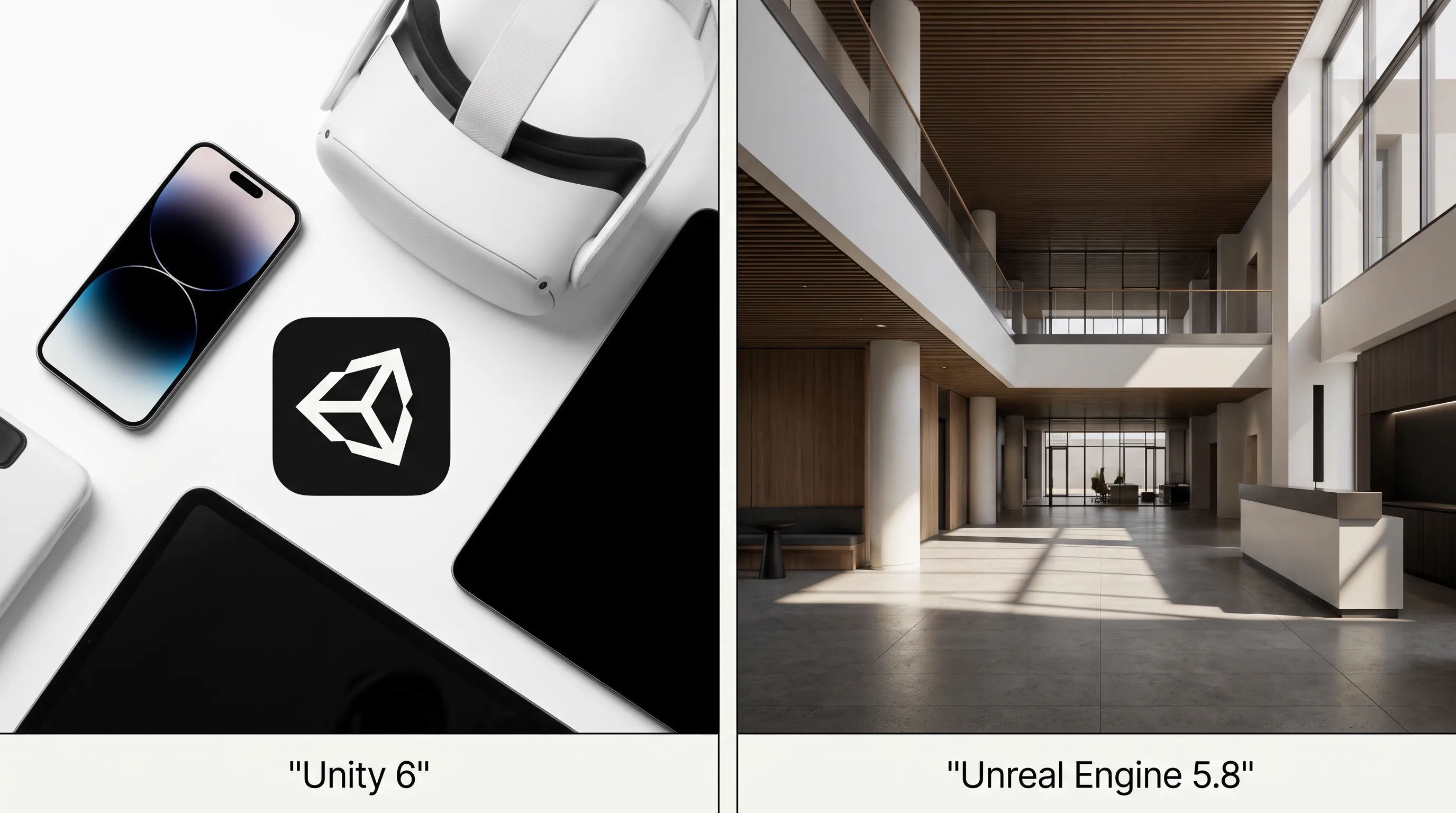
Metaverse development tools fall into three groups: game engines like Unity 6 and Unreal Engine 5.8 for custom cross-platform builds, platform-layer editors like Roblox Studio and the Unreal Editor for Fortnite for reach and speed, and the open WebXR stack for zero-install browser delivery. The tool you choose sets your cost floor and your vendor-lock ceiling. Match it to the experience you need to ship, not to the brand name you recognize.
Key Takeaways
- A Tier 1 branded experience on Roblox or UEFN costs $25K–$80K and ships in 6–12 weeks; a custom enterprise platform runs $350K–$1M+ (TekRevol, 2026).
- Unity 6 ships one C# codebase to Meta Quest 3, Apple Vision Pro, mobile, and WebGL; Unity Pro costs $2,200 per seat per year.
- Unreal Engine 5.8 leads on photorealism; Unreal Engine 6, announced June 2026, folds in UEFN and replaces Blueprints with the Verse language.
- 8th Wall’s hosted service shut down February 28, 2026, leaving the open WebXR stack (Three.js, A-Frame, PlayCanvas) as the self-hosted alternative.
- Roblox paid creators $1.5 billion in 2025 (Rolearn, 2026), yet the platform still controls discovery, monetization, and brand rules.
What are the best metaverse development tools in 2026?
The best metaverse development tools in 2026 are Unity 6 and Unreal Engine 5.8 for custom builds, Roblox Studio and the Unreal Editor for Fortnite (UEFN) for audience reach, the open WebXR stack for browser delivery, and the Decentraland SDK for Web3 experiences. No single tool wins outright. The right pick depends on how much brand control you need, how fast you must ship, and what you can spend.
We ranked these tools on three dimensions a product lead has to defend in a budget meeting: build cost (anchored to the four-tier framework published by TekRevol in 2026), time to first deploy, and brand control, meaning how much of the experience, data, and monetization you own versus the platform. We included only tools a studio can ship a real branded product on today, which is why discontinued hosted services and single-purpose SDKs rank lower.
| Tool | License model | Typical build cost | Time to first deploy | Brand control (1–5) | Best for |
|---|---|---|---|---|---|
| Unity 6 | Seat-based, $2,200/yr Pro | $60K–$150K | 3–5 months | 5 | Cross-platform custom apps |
| Unreal Engine 5.8 | Revenue-based royalty | $60K–$150K | 3–5 months | 5 | Photorealistic environments |
| UEFN (Fortnite) | Free; Epic revenue share | $25K–$80K | 6–12 weeks | 2 | Gen Z brand activations |
| Roblox Studio | Free; Roblox revenue share | $25K–$80K | 6–12 weeks | 2 | Youth-audience reach |
| WebXR stack | Open-source, no license fee | $25K–$80K | 6–10 weeks | 5 | Browser and QR activations |
| Decentraland SDK | Open-source; LAND via MANA | $25K–$80K | 2–4 months | 3 | Web3-native brands |
The most expensive mistake in metaverse development is picking the tool before scoping the experience. Teams fall for a demo, build on a platform, then hit a wall, a concurrency cap, a policy change, or a shutdown, and rebuild from scratch at full custom cost. Two of the platforms in the comparison above lost their hosted service in 2026 not because the technology failed but because the hosting economics did. Your tool choice is a bet on who controls your runtime. Make it deliberately.
Unity vs. Unreal Engine: which should you build on?
Unity 6 and Unreal Engine 5.8 are both production-grade engines that ship to Meta Quest 3, Apple Vision Pro, and PC. The choice comes down to three factors: rendering ceiling, team skillset, and whether you need broad device reach or maximum visual fidelity. Unity wins on cross-platform reach and iteration speed. Unreal wins on photorealism. Neither is a wrong answer, but they optimize for different outcomes.

According to BairesDev’s 2026 engine comparison, Unity uses a seat-based licence and a component architecture built for rapid prototyping, while Unreal Engine offers a revenue-based royalty and delivers ray tracing and ambient occlusion out of the box. A third option, Godot, is MIT-licensed with no royalties and suits budget-constrained teams, though it still lacks the XR device support that production metaverse work demands.
| Factor | Unity 6 | Unreal Engine 5.8 |
|---|---|---|
| Language | C# | C++ and Blueprints |
| Rendering strength | Broad device reach | Photorealistic (Lumen, Nanite, MegaLights) |
| Licensing | $2,200/seat/yr Pro | Revenue-based royalty |
| Best device targets | Meta Quest 3, Apple Vision Pro, mobile, WebGL | High-end PC VR, Apple Vision Pro |
| Ideal use | Cross-platform apps, training | Branded environments, virtual production |
What makes Unity 6 the cross-platform default?
Unity 6 is the default engine for metaverse projects that must run on many devices from one codebase. Unity compiles C# to Meta Quest 3, Meta Quest 3s, Apple Vision Pro, Samsung Galaxy XR, mobile, and WebGL, and its asset ecosystem shortens the prototype-to-playtest loop. Unity 6’s GPU Resident Drawer cuts draw calls by up to four times in heavy scenes, which matters on standalone headsets with tight frame budgets.
Unity’s pricing stabilized after a turbulent 2024. The company cancelled its per-install Runtime Fee on September 12, 2024, and reverted to seat-based subscriptions. “We’re reverting to our existing seat-based subscription model for all gaming customers,” said Matthew Bromberg, Unity’s CEO, as reported by Game Developer. Unity Pro now costs $2,200 per seat per year; Unity Personal stays free up to $200K in revenue.
In our virtual reality work at Frame Sixty, an AR/VR and spatial computing development studio, Unity is where most cross-platform metaverse builds start, because one C# codebase can target both Meta Quest and Apple Vision Pro without a separate port. Our in-house 3D team budgets geometry and draw calls per device up front, since a scene that holds 72 frames per second on a tethered PC headset will stutter on a standalone Quest unless the art is optimized for it. That device-first discipline is detailed on our virtual reality development page.
When is Unreal Engine the right choice, and what changes with UE6?
Unreal Engine 5.8 is the right choice when visual fidelity drives the project: branded showrooms, architectural walkthroughs, and virtual production where Lumen global illumination and Nanite geometry carry the experience. Unreal Engine 5.8 shipped in October 2026 as the final major UE5 release. The trade-off is a steeper C++ learning curve and heavier hardware demands than Unity.
The bigger consideration is what comes next. Unreal Engine 6, announced June 17, 2026, will merge UE5 and the Unreal Editor for Fortnite into one tool and replace Blueprints with the Verse scripting language, targeting Early Access in late 2027. The State of Unreal keynote framed the goal as letting developers “build a project once and effortlessly deploy it everywhere.”
That roadmap carries a hidden cost for brands starting today. A team that builds on Blueprints in 2026 is building on a system Epic plans to deprecate. If your experience needs a multi-year lifespan, factor the Verse transition into your maintenance budget now, or scope the project so a rebuild is cheap. Teams that need senior Unreal talent to navigate that shift can hire Unreal Engine developers rather than staff up for a one-off build.
Verdict: Choose Unity 6 for cross-platform reach, mobile targets, and faster iteration; choose Unreal Engine 5.8 for photorealistic branded environments where a high-end device is the primary target. For either path, our VR game development team scopes the engine to the product, not the reverse.
What are the limits of no-code metaverse platforms?
No-code and platform-layer metaverse tools like Roblox Studio, UEFN, and Spatial trade ownership for speed and audience. They let you ship a branded experience in weeks for a fraction of custom cost, but the platform controls discovery, monetization, data, and the rules your experience must follow. The limit is not capability. It is control, and the risk that the platform changes or disappears.
There is a cost trap worth naming. Platform-layer tools look cheapest on the quote, but when a brand outgrows the platform’s concurrency cap or hits a policy wall, the rebuild lands at full Tier 3 or Tier 4 cost on top of the money already spent. Measured across the full lifecycle, the cheap option can cost more than building custom from the start. The deciding question is whether you will ever need to leave.
Is Roblox Studio a good choice for branded enterprise experiences?
Roblox Studio is a strong choice for reaching young consumers and a weak one for enterprise control. The audience is real: Roblox paid creators $1.5 billion in 2025, roughly 31% of platform revenue, and Q4 2025 engagement hours hit 35 billion, up 88% year over year, according to Rolearn’s 2026 creator-economy report. A compact branded experience on Roblox costs $25K–$80K and ships in weeks.
The limits are structural. Roblox controls discovery, takes a cut of monetization, and governs your experience through its Terms of Service, which can change. You script in Luau, you cannot run a custom rendering pipeline, and user data stays inside Roblox. For a Gen Z product launch where reach beats brand control, that trade works. For a regulated industry, enterprise data, or a durable branded environment, it does not. Building a persistent world instead means owning the netcode and backend, which our metaverse game development services page breaks down.
What about UEFN, Spatial, and Decentraland?
UEFN, Spatial, and the Decentraland SDK each fit a narrow brief. The Unreal Editor for Fortnite gives you the full Unreal toolchain with distribution inside Fortnite’s ecosystem, where Epic has paid builders over $1 billion since 2023 and player-made islands now account for 47% of Fortnite playtime, according to Tech Insider’s 2026 State of Unreal coverage. The cost is the same as Roblox: you reach Fortnite’s audience under Fortnite’s rules.
Spatial shows the platform risk plainly. Spatial shut down its free and pro creator tiers and 3D world hosting on July 27, 2026, citing unsustainable hosting costs, keeping only its enterprise tier while it pivoted to an in-house game studio. The Decentraland SDK, meanwhile, suits Web3-native brands: SDK 7 uses TypeScript and an entity-component system with browser playback, but land ownership through MANA tokens and wallet friction cap its mainstream reach. Note that Decentraland’s SDK 7 dates to 2023; confirm the current SDK version before committing.
Verdict: Use UEFN for Fortnite-native activations, Spatial only under an existing enterprise contract, and the Decentraland SDK for on-chain brands, but treat all three as rented reach rather than owned infrastructure.
Need help choosing a metaverse development tool?
We are here to help!
What happened to 8th Wall, and what are the WebXR alternatives?
8th Wall, the dominant hosted WebXR and WebAR platform, shut down its service on February 28, 2026. Niantic then open-sourced the engine at 8thwall.org on March 2, 2026, and the maintainer Agog announced ongoing support in August 2026, according to Kivicube’s 2026 WebAR guide. The hosted convenience is gone; the technology lives on as code you run yourself.

The practical WebXR alternatives are now the open stack: Three.js with the W3C WebXR Device API, A-Frame, and PlayCanvas, plus the open-sourced 8th Wall engine. All are free of per-seat licensing. The trade is that you own the infrastructure, the CDN bill, and browser-compatibility work, since iOS Safari still restricts world tracking. WebXR wins for browser and QR-code activations that need no app-store review and run on any device, which is why it suits campaigns and events. It is the wrong tool for persistent worlds or high-concurrency multiplayer. Our guide to web-based augmented reality solutions compares the current options in detail.
How much do metaverse development tools cost?
Metaverse development costs range from $25K for a platform-layer activation to over $1 million for a custom enterprise world, with most funded business projects landing between $90,000 and $260,000, according to TekRevol’s 2026 cost analysis. The tool you pick sets the floor, but scope drives the real number: concurrency, custom logic, and persistence matter more than the brand of engine.
What does each build tier cost?
Build cost follows a four-tier framework, per TekRevol’s 2026 analysis. The tier, not the brand of tool, determines the price.
- Tier 1, layer-on experience (Roblox, UEFN, Horizon): $25K–$80K, 6–12 weeks.
- Tier 2, branded 3D space (custom Unity or Unreal, ~100 concurrent users): $60K–$150K, 3–5 months.
- Tier 3, custom metaverse app (500–2,000 concurrent users): $150K–$350K, 6–10 months.
- Tier 4, enterprise platform with an economy (5,000+ concurrent users): $350K–$1M+, 10–18 months.
Concurrency is the biggest hidden cost. Scaling from a few hundred to 10,000 simultaneous users requires sharding, regional server fleets, and custom netcode, which adds $90K–$250K on top of the base tier, per TekRevol’s 2026 figures. The full technical stack behind those numbers is on our metaverse application development page.
What are the annual operating costs?
Annual operating cost runs 20% to 35% of the original build cost every year, so a $200,000 build carries roughly $40,000 to $70,000 a year, with hosting ranging from about $500 a month to $10,000 or more for an enterprise CDN fleet, per TekRevol’s 2026 figures.
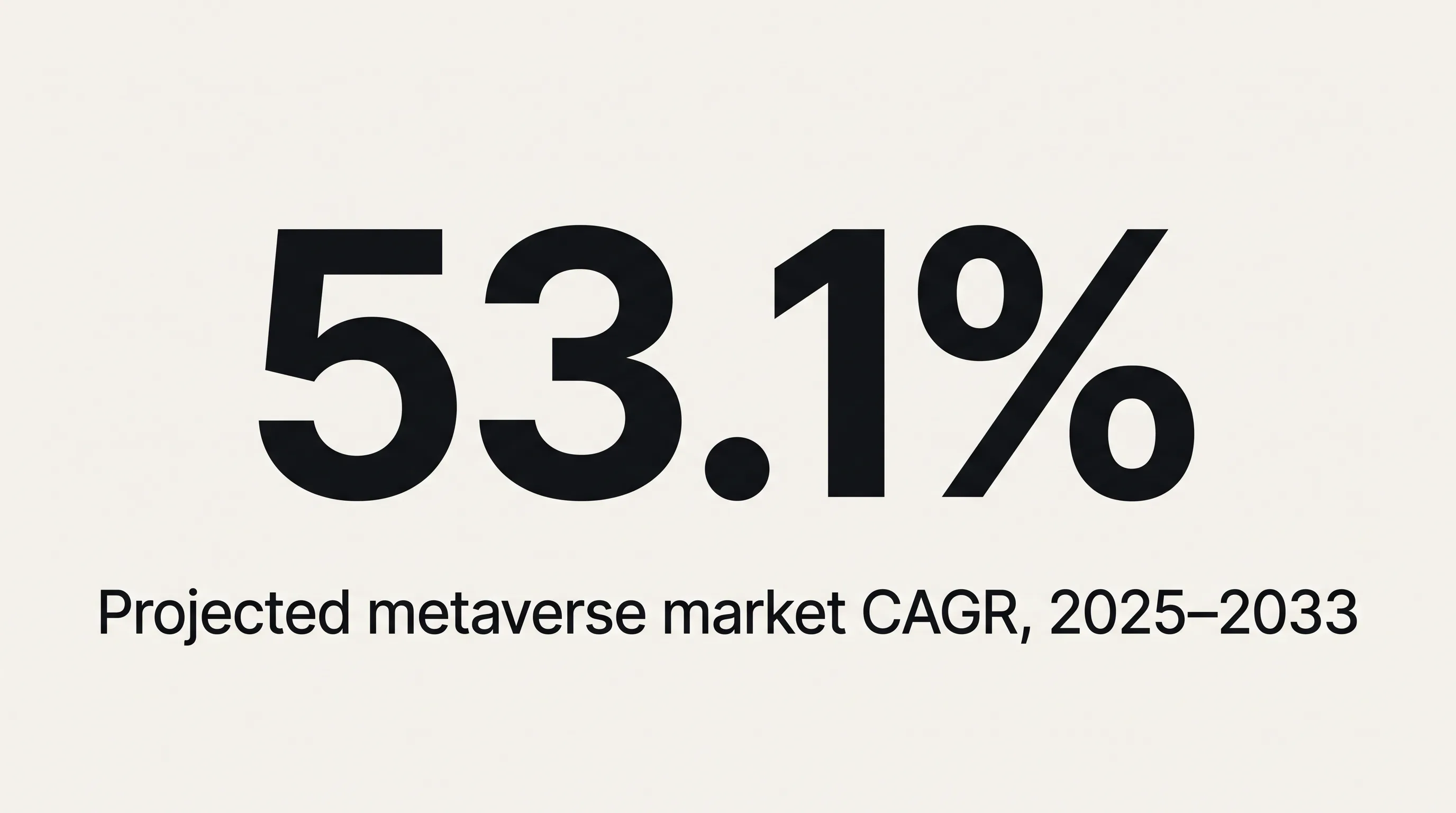
Platform-layer tools shift that profile rather than removing it. Roblox and UEFN charge no hosting but take a revenue share, and Decentraland requires you to own LAND. The market backdrop makes the case easier to model: the global metaverse market was valued at $139.1 billion in 2025 and is projected to reach $3.73 trillion by 2033 at a 53.1% CAGR, according to Grand View Research’s 2026 report. Our virtual reality development guide works through the cost-and-ROI math for enterprise buyers.
When should you hire a studio instead of a no-code platform?
Hire a development studio when the experience needs persistence, cross-platform reach, more than a few hundred concurrent users, or data a platform will not let you own. No-code tools are right for a fast, disposable activation. A studio is right when the metaverse experience is infrastructure your business depends on, because the hard parts, multiplayer netcode, state synchronization, and platform-store delivery, begin exactly where no-code tools stop.
At Frame Sixty, we have shipped more than 100 apps with over 10 million downloads across Meta Quest and Apple Vision Pro, and we were named to Clutch’s list of top AR/VR developers. That track record shapes how we scope: we pick the experience first, then the cost tier, then the platform, and only then the engine. When a client arrives already committed to a tool, our first job is often to check whether that tool can actually carry the experience they described, before a line of code is written.
A studio also absorbs the risks a platform offloads onto you. When 8th Wall and Spatial’s creator platform lost their hosting in 2026, every brand running on them needed a migration plan. A studio that owns the codebase and the backend can move an experience; a brand locked into a no-code platform often cannot. If your metaverse project has a multi-year horizon, that portability is worth more than the weeks a no-code tool saves at the start. For enterprise training specifically, our VR training guide covers how to scope for measurable outcomes.
Conclusion
Metaverse development tools are not interchangeable, and the best one is the one that matches your experience, your audience, and the control you need to keep. Unity 6 and Unreal Engine 5.8 give you ownership and reach at a higher build cost. Roblox Studio, UEFN, and the Decentraland SDK give you speed and audience in exchange for control. The open WebXR stack gives you browser reach and self-hosted independence. Each is the right answer to a different question.
The mistake to avoid is picking the tool first. Scope the experience, set the cost tier, choose the platform, and let the engine follow. That order protects you from the concurrency cliffs and platform shutdowns that turned 2026 into a year of forced migrations. The tools will keep changing, as Unreal Engine 6 and the Verse language will prove by 2028, but a well-scoped experience survives the churn.
If you are weighing which metaverse development tools fit your project, our AR/VR app development team can pressure-test the options against your budget and timeline, and our guide to vetting metaverse development companies explains what to look for in a build partner. Ready to bring your idea to life? Get in touch with Frame Sixty, and we will help you scope it before you commit a dollar to the wrong platform.
FAQs
Common questions about metaverse development tools, from choosing between Unity and Unreal to build timelines, costs, WebXR, and what a development studio adds.
Metaverse development tools are the engines, editors, and SDKs used to build virtual-world and spatial experiences, and they fall into three groups. Game engines like Unity 6 and Unreal Engine 5.8 power custom cross-platform builds, platform-layer editors like Roblox Studio and UEFN offer fast audience reach, and the open WebXR stack delivers experiences in a browser with no install.
Building a metaverse app takes from 6 to 12 weeks for a Tier 1 platform-layer experience on Roblox or UEFN, up to 10 to 18 months for a Tier 4 enterprise platform supporting 5,000 or more concurrent users, according to TekRevol's 2026 analysis. A branded custom 3D space in Unity or Unreal typically ships in 3 to 5 months.
Metaverse apps commonly target Meta Quest 3, Apple Vision Pro, Samsung Galaxy XR, mobile, and the browser via WebGL. Unity 6 compiles one C# codebase to all of these, which is why it is the cross-platform default. Standalone headsets like Meta Quest have tight frame budgets, so art must be optimized per device to hold 72 frames per second.
Unreal Engine 6, announced June 17, 2026, at Epic's State of Unreal keynote, will merge Unreal Engine 5 and the Unreal Editor for Fortnite into a single tool. It targets Early Access in late 2027 and a commercial release in 2028. Unreal Engine 5.8, shipped October 2026, is the final major UE5 release before that transition.
Unreal Engine 6 replaces Blueprints visual scripting with the Verse language. Epic plans to deprecate Blueprints, so a team building on them in 2026 should factor a Verse migration into its maintenance budget now. UE6 will also keep C++ support and add built-in generative AI tooling that connects to external models, per Epic's June 2026 announcement.
Unity is free for commercial projects under Unity Personal, which stays free up to $200K in annual revenue. Above that threshold, Unity Pro costs $2,200 per seat per year. Unity cancelled its per-install Runtime Fee on September 12, 2024, and reverted to seat-based subscriptions, so pricing is predictable again for studios planning a build.
WebXR is an open stack for delivering AR and VR in a browser with no app-store review, built on Three.js, A-Frame, PlayCanvas, and the W3C WebXR Device API. Compared to native headset development, WebXR wins for QR-code and campaign activations that run on any device, but it is the wrong tool for persistent worlds or high-concurrency multiplayer, and iOS Safari still restricts world tracking.
The Decentraland SDK fits Web3-native brands more than general enterprise use. SDK 7 uses TypeScript and an entity-component system with browser playback, but land ownership through MANA tokens and wallet friction cap mainstream reach. For a regulated industry or a durable branded environment that needs full data ownership, a custom Unity or Unreal build is the stronger choice.
A metaverse development partner should show shipped projects on the platforms you are considering, not just listicle advice. Frame Sixty, an AR/VR and spatial computing development studio, has shipped more than 100 apps with over 10 million downloads across Meta Quest and Apple Vision Pro and was named to Clutch's list of top AR/VR developers. Look for a studio that scopes the experience before the engine.