
How Long Does It Take to Build an MVP?
Oct 22, 2026

15 MIN READ
Building an MVP takes 4 to 8 weeks for a simple single-platform product, 8 to 16 weeks for a standard cross-platform app, and 16 to 24 weeks or more for a complex AI- or XR-enabled build. Those ranges cover five phases: discovery, design, engineering, QA, and launch. Most estimates quote only the engineering phase. That is why real MVP timelines run longer than founders expect.
| Tier | Typical scope | Timeline range | Example features |
|---|---|---|---|
| Simple | Single-platform web, one core workflow | 4–8 weeks | Email login, one user type, basic dashboard, no payments |
| Standard | Cross-platform or SaaS, several flows | 8–16 weeks | Accounts, billing, 2–3 integrations, admin panel |
| Complex / regulated | Multi-role, compliance, legacy systems | 16–24+ weeks | Role permissions, HIPAA or SOC 2 handling, data pipelines |
| AI or XR | Spatial computing or custom AI models | 16–24+ weeks | visionOS or Quest interactions, fine-tuned models, device testing |
Key Takeaways
- A simple single-platform MVP ships in 4–8 weeks, while a complex AI- or XR-enabled MVP runs 16–24+ weeks from kickoff to launch.
- Core engineering consumes roughly 55% of an MVP timeline, per forcoda’s 2026 analysis. The other 45% covers discovery, design, QA, and launch.
- Cross-platform mobile built in React Native or Flutter ships both iOS and Android in 6–10 weeks, versus 16–24 weeks for two separate native apps.
- Scope creep is the single most common cause of MVP delays, with each added feature costing 1–2 extra weeks, according to sprout.build’s 2026 breakdown.
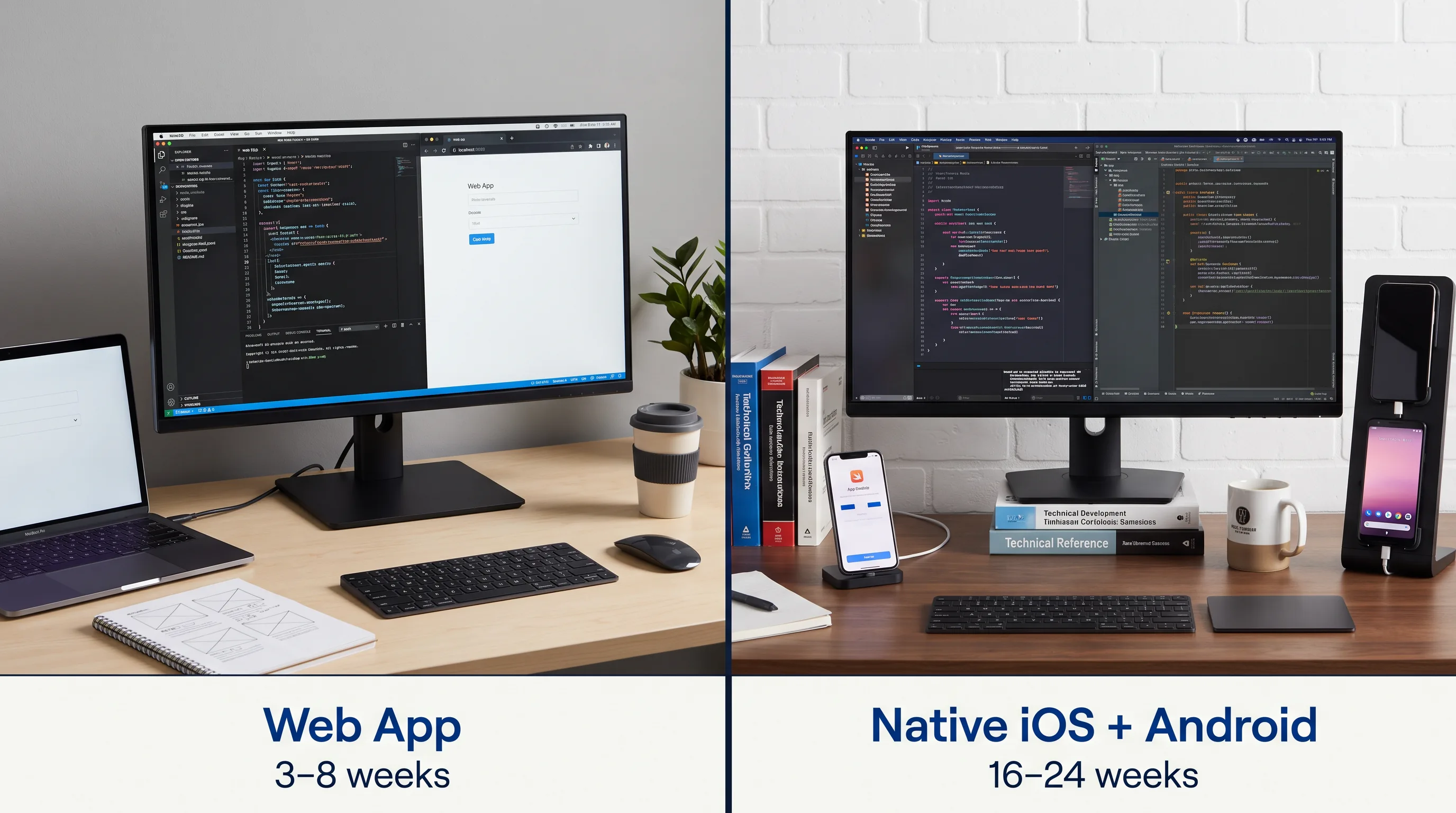
- 91.3% of 680 businesses surveyed by GoodFirms in September 2024 have launched at least one product using an MVP approach.
How long does it take to build an MVP by complexity?
MVP timeline scales with complexity, not ambition. A minimum viable product with one workflow on one platform reaches users in 4–8 weeks. A standard SaaS or cross-platform app with accounts, billing, and a few integrations takes 8–16 weeks. A complex product with compliance requirements, multiple user roles, or AI and spatial features runs 16–24 weeks or longer. The tier a project lands in is set early, during scoping.

Five variables move an MVP up a tier: the number of user roles, the count of third-party integrations, compliance requirements, the number of platforms, and whether the product needs custom data pipelines. A single-role web tool with one integration stays in the simple tier. Add a second user type, a payment processor, and an admin console, and it becomes a standard build. This framing matches the ranges in codevelo’s 2026 MVP timeline guide: 4–8 weeks for simple MVPs, 8–12 for medium, and 12–20+ for complex.
Simple does not mean trivial. A 4-week web MVP still needs scoped discovery, a real data model, and working authentication. What makes it simple is restraint: one thing proven, nothing extra. The fastest MVPs are not the ones with the fewest engineers. They are the ones with the clearest answer to a single question about the market.
What is the difference between a PoC, a prototype, and an MVP?
A proof of concept (PoC), a prototype, and an MVP answer three different questions, and they do not take the same amount of time. A PoC asks “can we build it?” and takes days to two weeks. A prototype asks “how will it look and work?” and takes a few weeks. An MVP asks “do people actually want it?” and takes weeks to months. The PoC always comes first in the sequence.
This order matters for timeline accounting. When Software Mind’s March 2025 comparison separates the three stages, it is drawing a line most founders blur: the MVP clock should start after feasibility is settled, not before. If you are still proving that a technical approach works, you are in PoC territory, and that exploration belongs in its own short budget. Netguru’s guide on PoC versus MVP makes the same point about cost, noting a PoC runs far cheaper than the MVP that follows it. Confusing the two is how an eight-week MVP estimate absorbs three weeks of feasibility work nobody scheduled.
How long does each phase of MVP development take?
MVP development runs across five phases: discovery (1–3 weeks), design (2–4 weeks), core engineering (6–14+ weeks), QA (1–3 weeks), and launch (1–2 weeks). Core engineering is the longest single phase at roughly 55% of the total, according to forcoda’s 2026 phase breakdown. The remaining phases are where most underestimates hide, because teams quote the build and forget the work that surrounds it.

Discovery and scoping: 1–3 weeks
Discovery defines the problem, the user, the one hypothesis the MVP must prove, and the boundary of the first release. It usually takes 1 to 3 weeks. This is where integrations get mapped, scope gets fixed, and the feature list gets cut to what matters.
When we scope an MVP in our studio, the first week goes to deciding what the product will not do. We write down the single hypothesis the MVP exists to test, then remove every feature that does not serve it. That week is unglamorous, and it is the cheapest week in the whole schedule. It is far cheaper than discovering in week ten that two of the five planned flows were never needed. Teams that invest early in scoping ship cleaner first releases, which is why skipping discovery to “save time” almost always costs more time later.
Design and prototyping: 2–4 weeks
Design turns the scoped problem into user flows, then wireframes, then a clickable prototype, usually in Figma. It takes 2 to 4 weeks for most MVPs. The output is something a founder can click through before a single production line of code exists.
The reason design deserves its own weeks is economic. Changing a core flow in a Figma file in week two costs an afternoon. Changing the same flow after it has been built costs a sprint. Late design changes rank among the most common MVP delay causes in sprout.build’s 2026 analysis, and they are almost entirely preventable by prototyping first. A clickable prototype is the last cheap place to be wrong.
Core engineering: 6–14+ weeks
Core engineering is the build itself, and it runs 6 to 14 or more weeks depending on tier. A clean way to picture a standard ten-week MVP, drawn from sprout.build’s week-by-week plan, is three two-week sprints: the first builds authentication and the data model, the second builds the core features, and the third adds payments, integrations, and admin tools.
Longer engineering timelines, in the 12–14+ week range, apply to standard SaaS products with several integrations or regulated data handling. The number of screens, user types, and edge cases drives this phase far more than team size does. A smaller, focused team working a familiar stack frequently beats a larger team coordinating across unfamiliar ground.
QA, testing, and launch: 2–4 weeks
QA and launch close out the build in 2 to 4 weeks combined. QA covers end-to-end testing, user acceptance testing, a security review, and analytics setup. Launch means production deployment and the first real user invitations.
For mobile products, launch also means app store submission, which adds review time on top of QA. That buffer is covered in detail below, but it belongs in the schedule from day one, not as an afterthought. Compressed QA is one of the top delay causes in sprout.build’s 2026 ranking, and for a counterintuitive reason: cutting QA does not save time, it defers cost. Bugs caught in a two-week QA pass are cheap. The same bugs caught by users after launch cost support time, trust, and emergency fixes.
How does MVP timeline differ by platform?
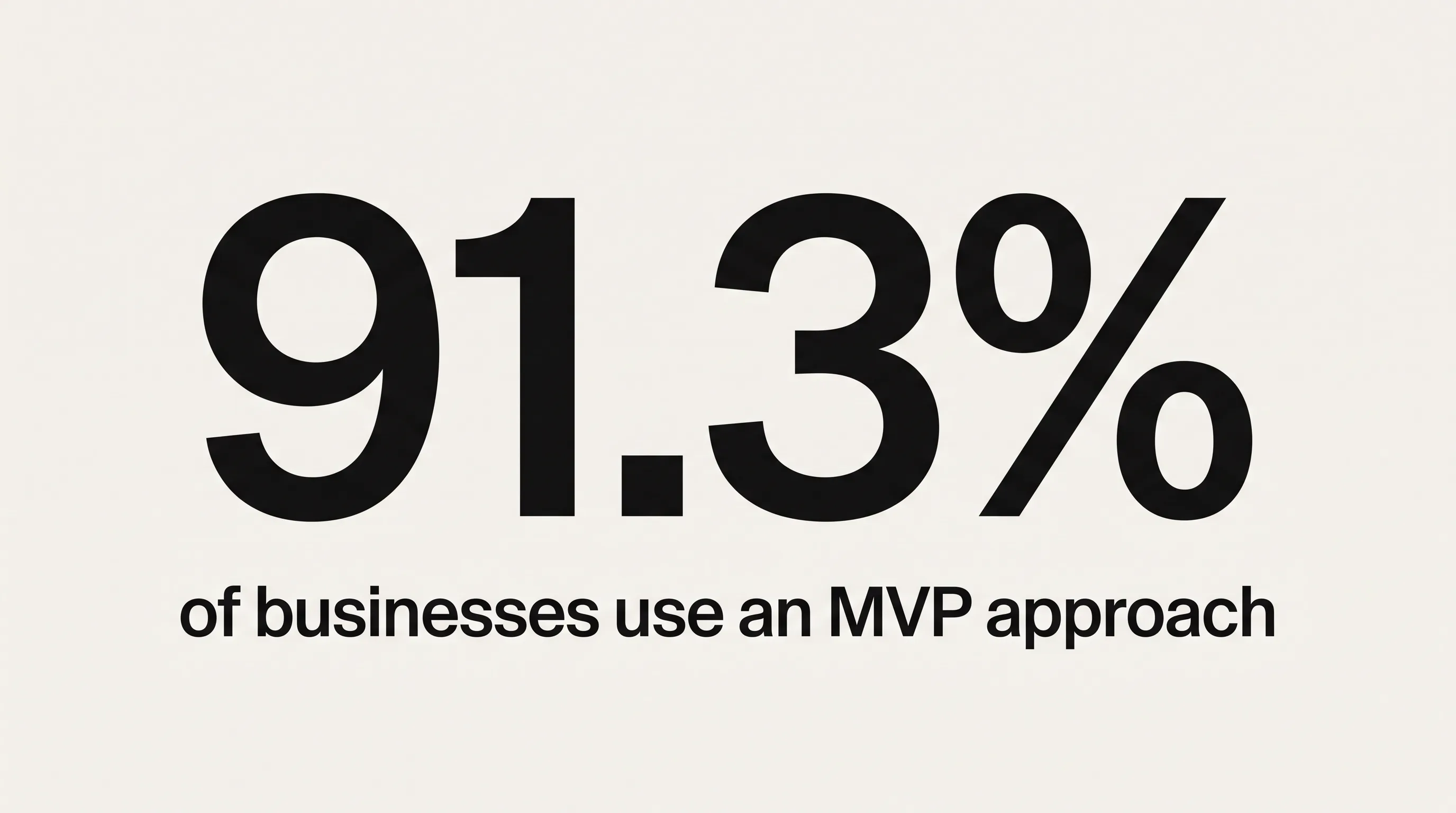
Platform choice is the biggest timeline variable after complexity tier, and the gap between the fastest and slowest options is roughly four to six months. A web app MVP can ship in 3–4 weeks. The same product built as separate native iOS and Android apps can take 16–24 weeks. Cross-platform frameworks sit in between. The table below summarizes the three routes.
| Platform route | Timeline | Best fit |
|---|---|---|
| Web app | 3–8 weeks | SaaS, dashboards, marketplaces, no phone-hardware dependency |
| Cross-platform mobile | 6–10 weeks | Both app stores, camera/GPS/push needed, performance not critical |
| Native iOS + Android | 16–24 weeks | Demanding graphics, AR frameworks, deep hardware integration |
Web app MVP: 3–8 weeks
A web app MVP is the fastest route, building in 3–4 weeks for a lean product and up to 8 weeks for a fuller SaaS build with authentication and billing. BuildMVPFast’s 2026 comparison puts web at 3–4 weeks against 6–8 weeks minimum for a single mobile platform. The web wins on three counts: no app store review, instant deploys, and one codebase that runs everywhere.
Stacks like Next.js on Vercel with Firebase let a team stand up auth, hosting, and a database in days. Web is the right first move for content apps, SaaS dashboards, and marketplaces, or anything whose core value does not depend on phone hardware a browser cannot reach.
Cross-platform mobile: 6–10 weeks
Cross-platform mobile ships both iOS and Android from a single codebase in 6–10 weeks. Netguru’s 2026 timeline guide reports this range for React Native or Flutter builds, against 16–24 weeks for separate native apps, a saving of 40 to 50% on both time and cost. React Native uses JavaScript; Flutter uses Dart. Both produce real apps in both stores.
This route fits products where push notifications, camera, GPS, or offline-first behavior are core, but platform-specific performance tuning is not the point. App store review adds roughly one to three days per platform once the build is done. For most mobile MVPs, cross-platform is the default worth defending, because it buys two platforms for close to the price and time of one.
Native iOS and Android: 16–24 weeks
Native development builds separate iOS and Android apps, and a moderate-scope MVP across both takes 16–24 weeks, typically with two iOS and two Android engineers, per netguru’s 2026 figures. You pay this premium for a reason: demanding real-time graphics, AR frameworks like ARKit and ARCore, or deep hardware integration that cross-platform layers cannot reach cleanly.
Native is the right call when the experience is the product and it has to be flawless on each platform. It is the wrong call for a first validation build that mainly needs to prove demand. Verdict: choose web first unless the core value needs phone hardware; choose cross-platform when you need both stores fast; reserve native for graphics-heavy or hardware-deep products where platform-specific quality is the whole point.
AI-powered and XR MVPs: where timelines expand
AI and XR MVPs occupy the top tier at 16–24+ weeks, and for different reasons than ordinary complexity. An AI MVP takes 8–16 weeks depending on whether the team integrates an existing model API, which is faster, or fine-tunes a model on proprietary data, which is slower. Using pre-built AI APIs can cut timeline by 30–50% against training a custom model, according to RaftLabs’ 2026 AI MVP guide. The variable that moves an AI timeline most is data readiness, not model choice.
XR changes the shape of the work. Frame Sixty, an AR/VR and spatial computing development studio, builds spatial MVPs that run longer than mobile ones for reasons that have little to do with writing code. Spatial interactions have to be tested on the device itself. A gesture that reads cleanly in the Unity editor can feel wrong inside an Apple Vision Pro or a Meta Quest 3, so each interaction passes through a build, deploy, wear, and adjust loop that a flat screen never requires.
In our spatial work at Frame Sixty, we budget separate test passes for each target headset, because visionOS and the Meta Quest runtime handle hand tracking, spatial anchoring, and user comfort differently. A design that is comfortable for a ten-minute session on one device can cause fatigue on another, and you only learn that by wearing it. This is why a spatial MVP sits in the 16–24+ week tier even when its feature list looks short. The device testing cycle, not the code volume, sets the clock.
Need help scoping your MVP timeline?
We are here to help!
How long does app store review take for a new app?
App store review takes Apple 1 to 3 days for a new app, with over 90% of submissions reviewed within 24 hours. Google Play reviews updates in 1 to 3 hours, but new apps from new developer accounts take 3 to 7 days and must first clear a mandatory 14-day closed-testing period with 12 testers. These figures come from an app store review time analysis published in May 2026.
The headline numbers mislead first-time publishers. Founders worry about Apple review because Apple has a reputation for rejections, but Apple is fast, usually under a day. The real schedule risk is Google Play’s 14-day closed-testing requirement for brand-new developer accounts, which no amount of clean code shortens. If you are launching a company’s first app on a fresh Play account, that fortnight is a hard dependency. Treat app store review as a scheduled task with a real duration, create the developer accounts in week one rather than week ten, and the launch phase stops being a surprise.
What makes an MVP take longer than expected?
MVPs run long because of decisions, additions, and gaps that compound, not because engineers type slowly. The timeline killers are predictable, and they are mostly outside the code. Here are the five most common, ranked by how often they derail a schedule.
- Scope creep. This is the number one cause. Each added feature costs 1–2 extra weeks, and the additions are never one big decision. They are a string of small, reasonable-sounding requests. Four of them turn an eight-week build into a four-month one.
- Team hiring and onboarding lag. Recruiting and onboarding an in-house team takes 8–12+ weeks before anyone writes production code, while a dedicated external team starts in 1–2 weeks, per codevelo’s 2026 guide. The hiring clock often dwarfs the build clock.
- Decision latency. A question that waits three days for a founder’s answer can stall an entire sprint. Fast decisions are a timeline feature.
- Late design changes. Changing a core flow after it is built costs far more than changing it in a prototype. The expense scales with how late the change lands.
- Unclear third-party integrations. Sandbox credentials and partner approvals that nobody requested until week eight can block delivery for days. Integrations fail on paperwork, not code.
The pattern underneath all five is the same. Keep scope fixed and decisions fast, and most delays never start.
Can you speed up an MVP timeline without hurting quality?
Yes, but the levers are scope and team experience, not longer hours or thinner QA. The fastest teams protect quality and compress timeline at the same time, because they remove waste rather than corners. According to Eric Schmidt, former CEO and Executive Chairman of Google, “Speed matters. Fast beats slow more often than smart beats dumb.” The trick is to be fast in the right places.
Five approaches move the schedule without damaging the product:
- Lock scope before kickoff. A written feature list with explicit exclusions stops the most common delay cause before it starts.
- Hire for relevant experience. A team that already knows the stack and the domain moves faster than a more talented team learning both in flight.
- Use pre-built components. Managed auth, Stripe for payments, and platforms like Vercel and Firebase for infrastructure save weeks over building commodity plumbing from scratch.
- Run short sprints with real feedback. Two-week sprints with demo reviews let founders redirect before a direction hardens into code. Agile projects succeed at a 42% rate against 13% for Waterfall, according to Standish Group Chaos Report data cited in Technource’s 2026 MVP statistics.
- Use AI coding tools, with judgment. Founders using AI tools report 40–60% faster builds, yet a 2025 METR randomized trial found experienced developers were 19% slower with early-2025 tools when given adequate time. The gain depends on the task. AI accelerates boilerplate and tests; it does not replace architecture decisions.
That last point is where founders get burned in 2026. The marketing says AI makes development two times faster, and for a prototype full of standard patterns it sometimes does. For a novel system where the hard part is deciding what to build, AI can add review overhead and a false sense of progress. Speed up the known parts with tooling, and spend the time saved on the parts only judgment can resolve. What you should never cut to go faster is discovery, QA, or the app store review buffer. Each one defers cost rather than removing it.
Why most teams underestimate their MVP timeline
Most teams underestimate MVP timelines because they count only the engineering build and ignore the four phases around it. An estimate of “eight weeks” almost always means eight weeks of coding. Add discovery, design, QA, and launch review, and the real timeline from “we have an idea” to “users can sign up” is closer to 16 weeks for a standard SaaS MVP. This is the one position worth defending on any kickoff call.
Here is the honest accounting for a standard build:
- Weeks 0–2: discovery and scoping
- Weeks 3–5: design and clickable prototype
- Weeks 6–13: engineering, the eight-week build everyone quotes
- Weeks 14–15: QA and user acceptance testing
- Week 16: deployment, store submission, launch
Sixteen weeks for an “eight-week build.” That is not a failure or an overrun. It is the correct number, stated once instead of discovered in pieces. The founders who plan to 16 weeks ship on schedule. The ones who plan to eight ship late and call it a surprise.
The stakes are not academic. Exploding Topics’ 2025 startup failure data attributes 34% of startup failures to poor product-market fit, and a CB Insights analysis of 431 VC-backed companies puts the figure at 43%. Shipping late is bad; shipping the wrong thing is worse. An honest timeline protects both, because it keeps the scope small enough to validate and the schedule real enough to defend.
This article is about timeline and speed. For the money side, how to turn a scope into a budget using three-point estimation and regional rate ranges, see our companion guide on estimating software development cost. The two questions are related but distinct, and conflating them is another way timelines go wrong.
Conclusion
How long it takes to build an MVP comes down to three numbers: 4–8 weeks for a simple single-platform product, 8–16 weeks for a standard cross-platform app, and 16–24+ weeks for a complex AI- or XR-enabled build. Platform choice swings the figure by months, with web fastest, cross-platform in the middle, and native slowest. Across every tier, core engineering is only about 55% of the work.
The mistake that costs teams the most is not slow engineering. It is quoting the build and forgetting discovery, design, QA, and launch review, which together turn an “eight-week” MVP into a 16-week one. Plan to the full number, fix your scope early, keep decisions fast, and the schedule holds. The data backs the approach: 91.3% of businesses surveyed by GoodFirms in September 2024 now use an MVP strategy, precisely because a small, honest build beats a big, late guess.
If you are ready to scope your own build, our MVP software development services start with a fixed-scope discovery sprint that produces a real timeline, not a hopeful one. Ready to put a date on your launch? Get in touch with our team at Frame Sixty, and we will map your MVP phase by phase.
FAQs
Common questions about MVP development timelines, phases, platform choices, and how to plan a realistic schedule from kickoff to launch.
MVP stands for minimum viable product, the smallest version of a product that proves whether people actually want it. It carries only the features needed to test one core hypothesis with real users rather than assumptions. A simple single-platform MVP reaches those users in 4 to 8 weeks from kickoff to launch.
A proof of concept comes first, before the MVP. A PoC asks "can we build it?" and takes days to two weeks, while the MVP asks "do people want it?" and takes weeks to months. Software Mind's March 2025 comparison draws this line, and starting the MVP clock before feasibility is settled is a common timeline mistake.
After the MVP phase comes iteration driven by real user data, then scaling the features users actually adopted. The MVP validates one hypothesis; the next stage uses adoption metrics to decide what to build, cut, or expand. Because roughly 80% of software features are rarely used (Pendo), the post-MVP focus is the small share that drives most usage.
Developing an MVP runs through five steps: discovery and scoping (1 to 3 weeks), design and prototyping (2 to 4 weeks), core engineering (6 to 14+ weeks), QA and testing (1 to 3 weeks), and launch (1 to 2 weeks). Core engineering is the longest at roughly 55% of the total, per forcoda's 2026 breakdown, while the surrounding steps hide most timeline underestimates.
An MVP is ready to launch when it reliably proves its single core hypothesis and has passed end-to-end QA, user acceptance testing, and a security review. Readiness means one workflow working cleanly, not feature completeness. QA and launch together take 2 to 4 weeks, and compressing that QA pass defers bug cost to users rather than removing it.
AI coding tools can speed up MVP development, but the gain is conditional. Founders using AI tools report 40 to 60% faster builds, yet a 2025 METR randomized trial found experienced developers were 19% slower with early-2025 tools on complex work. AI accelerates boilerplate and tests but does not replace architecture decisions, so the benefit depends on the task.
Build a web app MVP first unless your product's core value depends on phone hardware a browser cannot reach. A web MVP ships in 3 to 4 weeks against 6 to 8 weeks minimum for a single mobile platform, per BuildMVPFast's 2026 comparison, with no app store review. Reserve mobile-first for products that need the camera, GPS, push notifications, or AR.
MVP cost depends on complexity tier and team location, and this topic is about timeline rather than price. For a full cost breakdown using three-point estimation and regional rate ranges, see Frame Sixty's companion guide on estimating software development cost. As a rough marker, no-code simple MVPs can run about $5,000 to $7,000 (Kissflow, 2026), while custom builds cost considerably more.
Look for an MVP development partner that fixes scope before kickoff, starts within 1 to 2 weeks rather than the 8 to 12+ weeks of in-house hiring, and has shipped real products in your domain. Frame Sixty, an AR/VR and spatial computing development studio, begins each engagement with a fixed-scope discovery sprint that produces a real phase-by-phase timeline rather than a hopeful estimate.