
Meta VR Glasses: Specs, Price, and Enterprise Impact
Oct 7, 2026
14 MIN READ
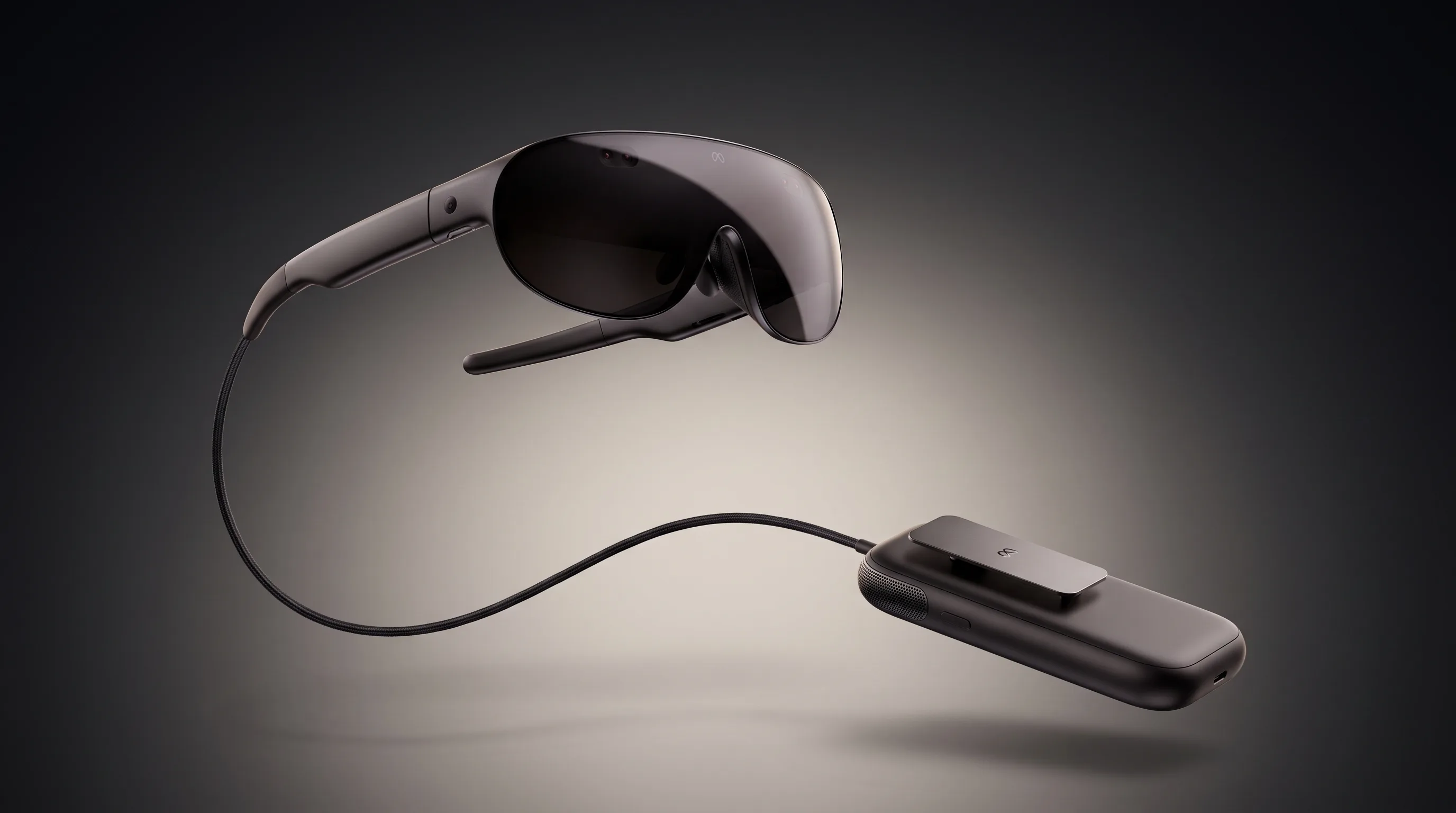
Meta VR Glasses, announced at Meta Connect 2026, are a 100-gram virtual reality headset that moves the processor and battery off your face and into a puck in your pocket. They pair dual micro-OLED displays at 37 pixels per degree with eye, hand, and voice input, run every existing Meta Quest app, and cost $1,299.99 when they ship in spring 2027. For businesses weighing XR hardware, the question is not whether the glasses are impressive. It is whether they are a Quest 3 successor, an Apple Vision Pro rival, or a new category, and what that means for projects being scoped today.
Here is the short version this guide defends: the Meta VR Glasses are the first headset to make high-resolution VR light enough for an all-day work session, and they undercut Vision Pro by $2,400 while running a catalog of thousands of apps on day one. The trade-offs are real, including a 70-degree field of view, a tether, and no enterprise edition yet. Teams building for Quest 3 now should keep building. The glasses extend that work; they do not replace it.
Key Takeaways
- Meta VR Glasses weigh about 100 grams, five times lighter than Meta Quest 3, with compute and battery in a separate ~300-gram puck (Meta, September 2026).
- Dual micro-OLED displays deliver 2,412 × 2,288 pixels per eye at up to 120 Hz and 37 pixels per degree, with Dolby Vision and IMAX Enhanced certification.
- Price is $1,299.99 with 128 GB of storage, shipping spring 2027, versus $3,699 for Apple Vision Pro and $499.99 for Quest 3.
- Field of view is 70 degrees horizontal by 66 vertical, narrower than Quest 3’s roughly 110 degrees and Vision Pro’s roughly 100.
- Every Quest app runs on the glasses, with eye-tracked foveated rendering upscaling existing titles; no enterprise edition or fleet-management plan has been announced.
What Are the Meta VR Glasses?
Meta VR Glasses are a tethered, glasses-style VR headset that splits the device into two parts: a magnesium-alloy frame holding the displays, optics, cameras, and speakers, and a pocketable compute puck holding the Qualcomm Snapdragon Reality Elite processor, 12 GB of memory, storage, and the battery. The two connect over a thin optical cable. Meta describes the result as a personal cinema, courtside seat, workspace, and gaming console in a pair of glasses, and the industrial design backs that up: a single dark wraparound visor, slim temple arms, open sides, and no head strap.
The split architecture is the whole story. Every standalone headset since the original Quest has carried its processor, battery, and cooling on the user’s head, which is why Quest 3 weighs 515 grams and Vision Pro’s headset lands between roughly 600 and 650 grams before you add a band. By moving the heat and mass into the puck, Meta reached a fanless, passively cooled frame at 100 grams, roughly the weight of a deck of cards. The puck clips to a pocket or bag strap and, per UploadVR’s reporting, weighs about 300 grams and carries a USB-C port that accepts DisplayPort input from laptops, phones, and gaming handhelds.
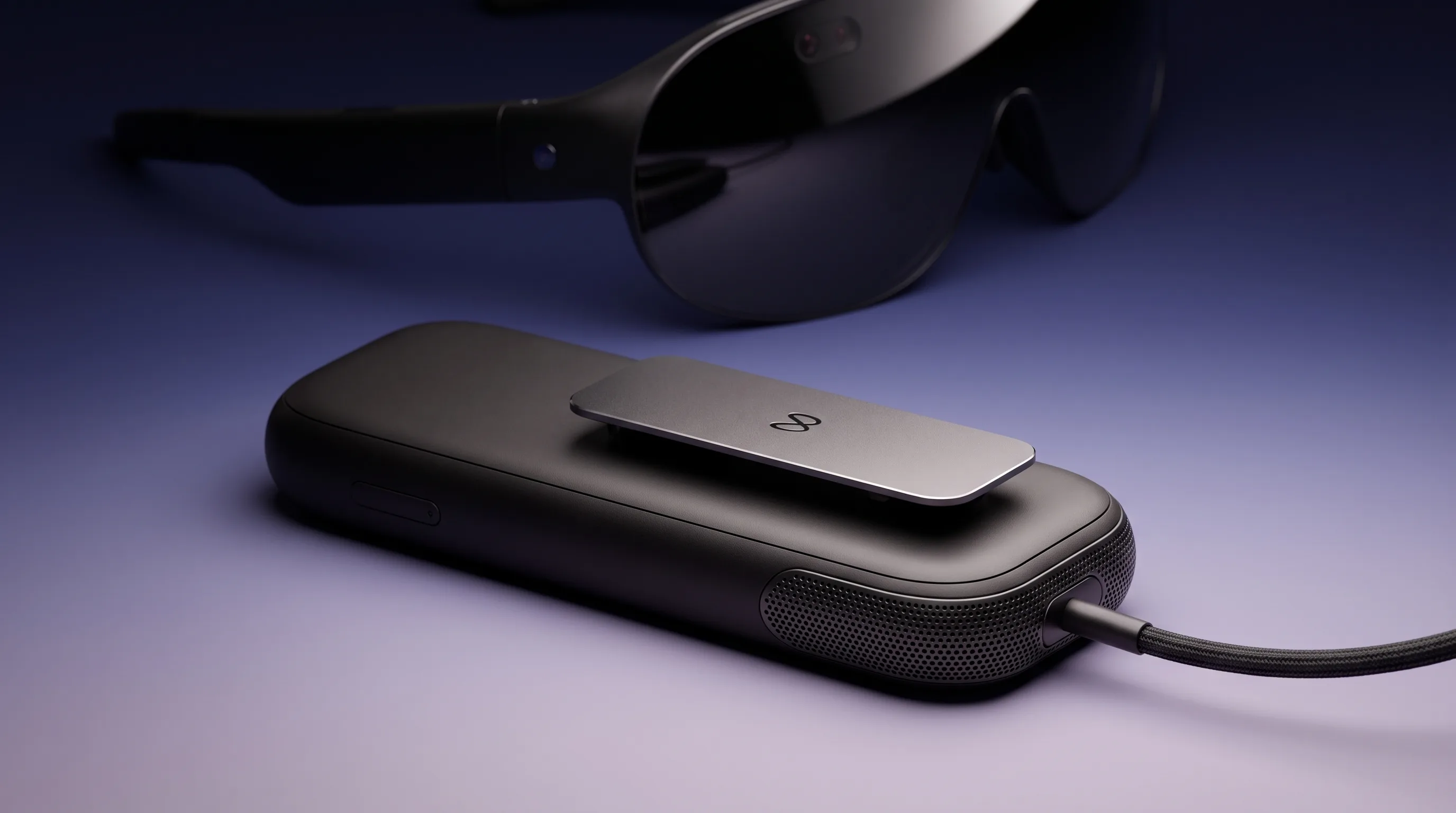
Input is hands-first. The glasses track your eyes with four internal cameras, read hand gestures through six external cameras, and take voice commands through Meta AI built into the operating system. Meta says no controllers are needed, and more than 75 games will be playable with hand gestures alone at launch. Optional Touch Plus controllers are sold separately for titles that need them, and current Quest 3 controllers are compatible. For a studio like ours that has shipped hand-tracked and controller-based VR across Quest and Vision Pro, that combination matters: it means the glasses can run both the gesture-driven interfaces we build for Vision Pro and the controller-driven ones we build for Quest.
Meta VR Glasses Specs and Price
Meta VR Glasses cost $1,299.99 with 128 GB of storage and a microSD slot for expansion, and ship in spring 2027 with US pricing only confirmed so far. The specification sheet below combines Meta’s official figures with the per-eye resolution, field of view, and puck details reported by UploadVR and Engadget from the Connect briefings.
| Specification | Meta VR Glasses |
|---|---|
| Weight | ~100 g glasses; ~300 g compute puck |
| Displays | Dual micro-OLED, 2,412 × 2,288 per eye, up to 120 Hz |
| Angular resolution | 37 pixels per degree (center) |
| Field of view | 70° horizontal × 66° vertical |
| Optics | Ultra-compact pancake lenses |
| HDR and certification | Dolby Vision; first IMAX Enhanced certified VR device |
| Passthrough | Full-color stereoscopic with autofocus and depth sensing |
| Processor | Qualcomm Snapdragon Reality Elite, 12 GB RAM |
| Storage | 128 GB plus microSD |
| Battery | Up to 3 hours of media playback; 45 W fast charging |
| Tracking and input | Eye tracking, face tracking, hand tracking, voice via Meta AI |
| Controllers | Optional Touch Plus, sold separately; Quest 3 controllers compatible |
| Audio | Dolby Atmos spatial audio integrated into the frames |
| Connectivity | Mac and Windows PC over Wi-Fi or USB-C; USB-C DisplayPort input to the puck; Xbox Cloud Gaming |
| Operating system | Same OS as Meta Quest 3; full Quest catalog supported |
| Frame | Magnesium alloy, fanless, open periphery, no head strap |
| Price and availability | $1,299.99 (128 GB), spring 2027 |
Three numbers deserve a closer read. First, 37 pixels per degree is the figure that makes text and CAD detail legible; Quest 3 sits at 25, and Vision Pro at roughly 34. Second, the 70-degree horizontal field of view is a deliberate trade for weight and clarity, and anyone moving from a Quest 3 will notice the narrower window at first. Meta’s open-periphery frame design softens that by letting you see the real room around the visor edges, which is a different experience from the sealed goggles most people picture when they hear “VR”. Third, three hours of playback is an hour longer than Quest 3 manages, and because the battery lives in the puck, swapping or charging it does not interrupt the fit on your face.
Need help building for Meta Quest or the next generation of headsets?
We are here to help!
Meta VR Glasses vs. Apple Vision Pro vs. Meta Quest 3
Meta VR Glasses sit between Apple Vision Pro and Meta Quest 3 on price and above both on comfort, and the right choice depends on whether your project values field of view, ecosystem, or wearability. Vision Pro remains the most capable spatial computer, Quest 3 remains the best value with the widest app base and included controllers, and the glasses are the first device that a person can plausibly wear through a full workday. The comparison below uses Meta’s and Apple’s published figures; Vision Pro pricing reflects Apple’s June 2026 increase to $3,699.
| Meta VR Glasses | Apple Vision Pro (M5) | Meta Quest 3 | |
|---|---|---|---|
| Price | $1,299.99 | $3,699 | $499.99 |
| Weight on head | ~100 g (puck ~300 g in pocket) | ~600–650 g headset, external battery | 515 g |
| Display | Dual micro-OLED, 2,412 × 2,288 per eye | Dual micro-OLED, 23 million pixels total | Dual LCD, 2,064 × 2,208 per eye |
| Refresh rate | Up to 120 Hz | Up to 120 Hz | Up to 120 Hz |
| Pixels per degree | 37 | ~34 | ~25 |
| Horizontal field of view | 70° | ~100° | ~110° |
| Processor | Snapdragon Reality Elite (puck) | Apple M5 + R1 | Snapdragon XR2 Gen 2 |
| Eye tracking | Yes | Yes | No |
| Passthrough | Full-color stereoscopic with depth | Full-color, high quality | Full-color |
| Controllers | Optional, sold separately | None (hands and eyes) | Included |
| Battery | Up to 3 hours media | Up to 2 hours general, 2.5 video | 2–3 hours |
| Operating system | Horizon OS (Quest catalog) | visionOS | Horizon OS |
| Availability | Spring 2027 | Now | Now |
Where Vision Pro still wins
Apple Vision Pro keeps a wider field of view, more total pixels, a laptop-class M5 chip on the headset, and the visionOS ecosystem, including native Mac Virtual Display, Spatial Preview, and the Foveated Streaming framework we covered in our visionOS 27 analysis. Roughly three quarters of Vision Pro buyers are enterprises, and for teams whose pipeline already runs through Mac workstations, RealityKit, or Unity PolySpatial, nothing at Connect changes that calculus. Our Apple Vision Pro development practice continues to see demand in medical visualization, design review, and executive briefing centers where Apple’s ecosystem is the deciding factor.
Where the Meta VR Glasses win
The glasses win on price, weight, and catalog. At $1,299.99 a company can equip nearly three people for the cost of one Vision Pro, and at 100 grams it can expect them to keep the device on for a two-hour training block or an afternoon of CAD review without the pressure-point fatigue that limits sessions on every current headset. The Quest catalog means the glasses launch with thousands of apps and the largest install base of VR developers in the industry. For consumer entertainment and gaming, Meta’s distribution advantage is decisive. For the broader headset landscape, including Samsung Galaxy XR and industrial devices, see our guide to the best mixed reality headsets for enterprise.
Where Quest 3 remains the right call
Quest 3 at $499.99 and Quest 3S at $299.99 still make sense for high-volume training deployments, location-based entertainment, and any application that depends on controllers out of the box or on the wider 110-degree field of view. They ship today, they are proven in fleet deployments, and the VR Glasses run the same software, so an app built for Quest 3 this year is an app that runs on the glasses next spring.
What Meta VR Glasses Mean for Enterprise
Meta VR Glasses matter for enterprise because they remove the single biggest barrier to daily headset use, which is weight, while keeping the Quest software base that most corporate VR already runs on. Five business use cases benefit immediately. The honest caveat comes first: Connect 2026 was a consumer event, and as VR Expert notes, no enterprise edition, business bundle, or first-party fleet management plan was announced. Businesses that run Quest fleets today already rely on third-party MDM platforms, and that will hold for the glasses at launch.
Design review and product visualization
Design review is the clearest win. At 37 pixels per degree, dimension labels, part numbers, and fine surface detail read clearly, which was never true on Quest 3’s 25 PPD panels. A product team can load an optimized CAD model, walk a client around a full-scale machine, and swap configurations in real time, the workflow we build in our 3D product configurator and virtual demo work. The lightweight frame also changes who will wear the device: executives and customers who decline a 515-gram headset will put on a pair of 100-gram glasses.
Virtual workspaces and laptop extension
Meta positions the glasses as a multi-monitor workspace, with multiple virtual screens driven from a Mac or Windows PC over Wi-Fi or USB-C, a surface-keyboard mode that turns any desk into a keyboard and touchpad, and a DisplayPort input on the puck that mirrors any USB-C device without a capture card. For mobile professionals and anyone working in a confined space, a 120 Hz micro-OLED display at glasses weight is a credible replacement for a travel monitor.
Remote collaboration and hologram calls
Hologram calling renders a photorealistic version of you, including real-time facial expressions captured by the face-tracking cameras, into WhatsApp and Zoom Workplace calls. UploadVR reports the launch version uses stereoscopic video with a full volumetric 6DoF version planned after launch. For distributed teams, this is the first mainstream device where a remote participant can appear as a person rather than a cartoon avatar.
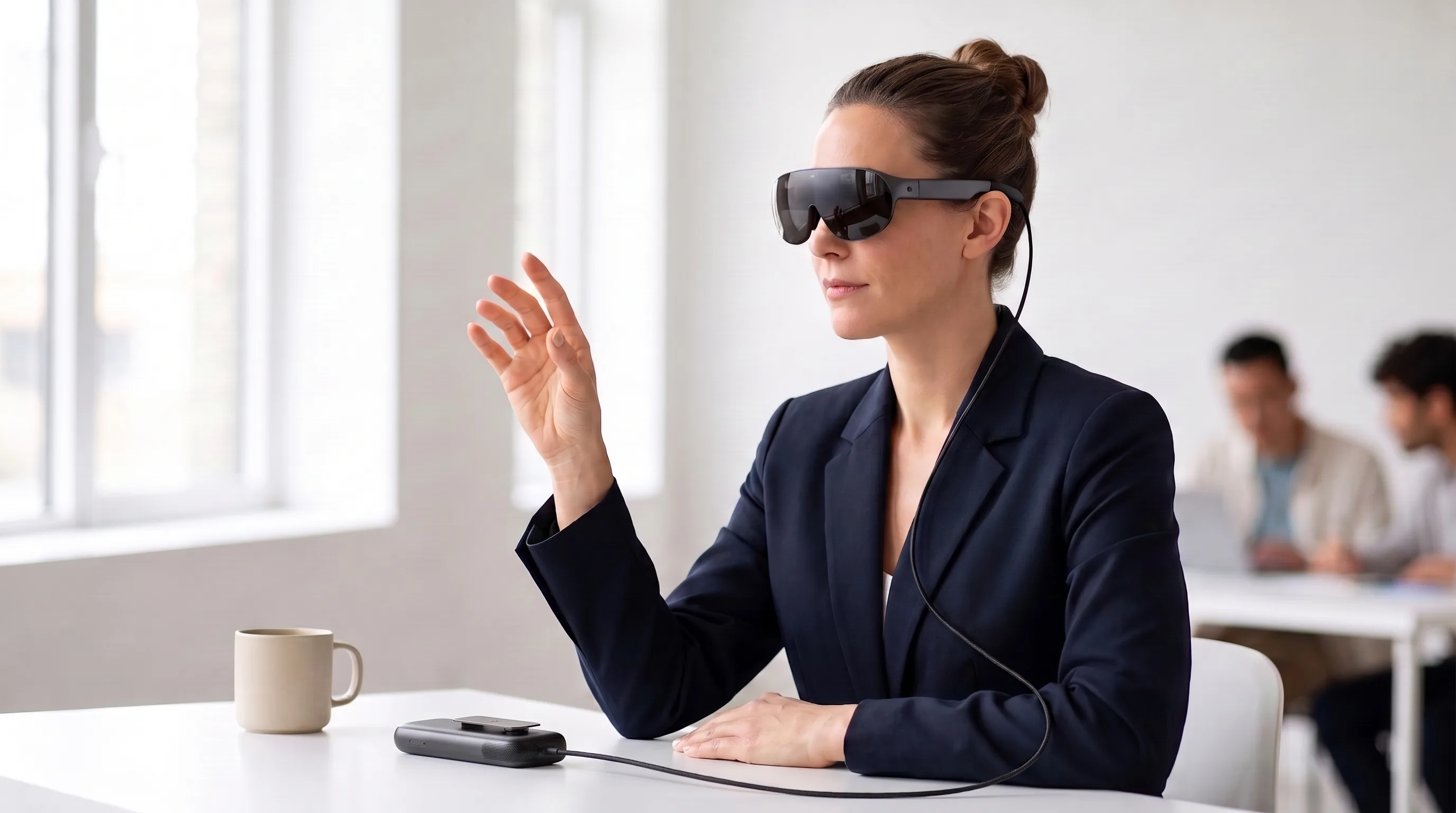
Training and simulation
For VR training programs, the glasses cut the two complaints that end most pilots: the headset is heavy, and sessions are short. A fanless frame with no strap can be worn for a full procedural module, and the puck’s three-hour battery covers it. Two cautions apply. Hand tracking covers knowledge and procedural training well, but tasks that depend on tool haptics or trigger input still need the optional controllers, so budget for them. And the 70-degree field of view is a real change for scenarios that train peripheral awareness; situational training for drivers, operators, or security staff may still favor Quest 3’s wider window.
Industrial and field settings
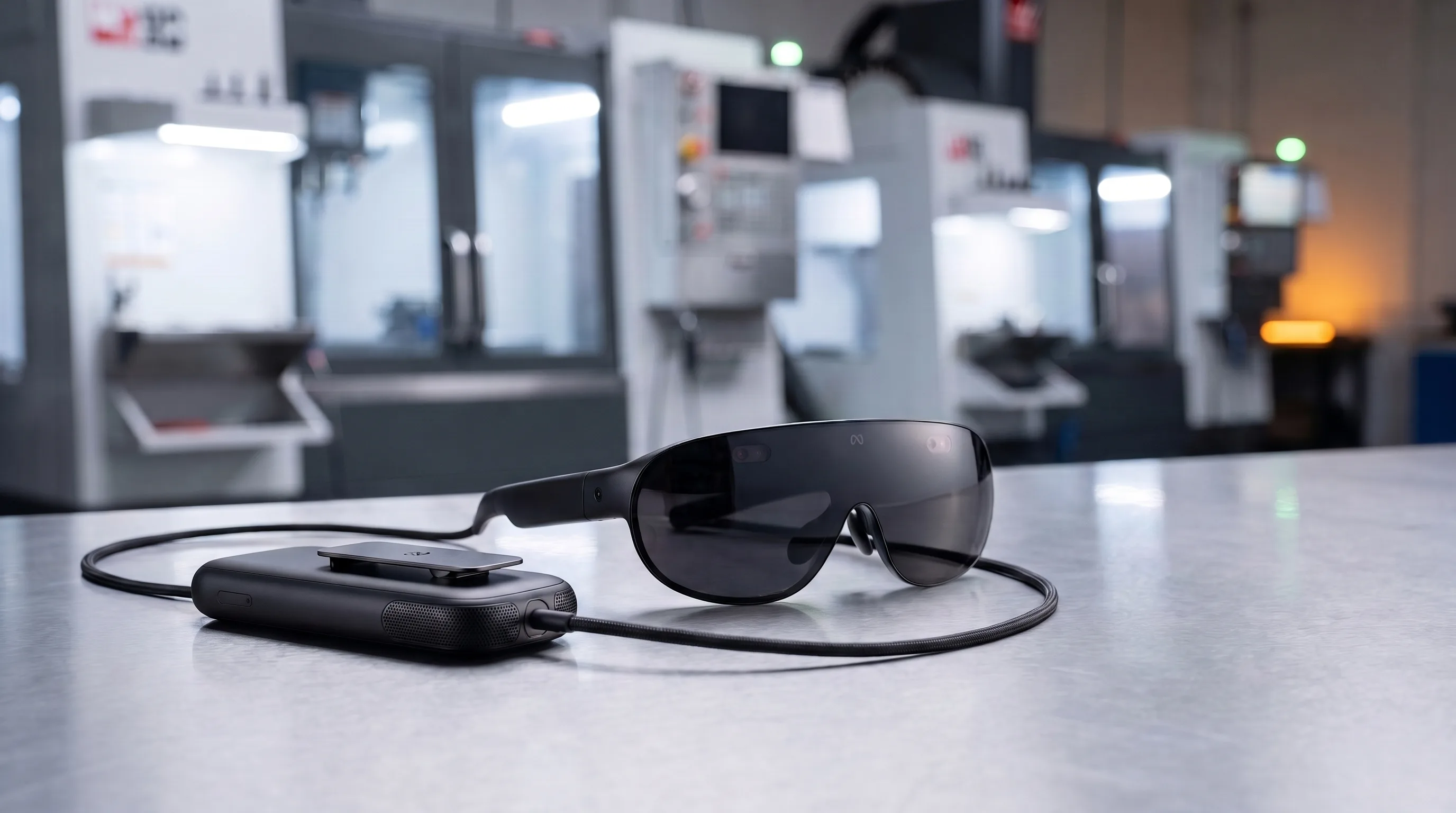
Full-color passthrough with depth sensing and open sides make the glasses more useful than sealed headsets on a shop floor or in a lab, where peripheral awareness is a safety requirement. We cover the mixed reality side of that work, including maintenance guidance and digital twin walkthroughs, on our VR for industrial page. The open questions for industrial buyers are durability, ingress protection, and prescription lens support, none of which Meta has addressed. Until it does, Quest 3 remains the safer industrial pick, and the glasses are the device to prototype against for 2027 rollouts.
What Meta VR Glasses Mean for Entertainment and Media
Meta built the VR Glasses as a media device first, and the content lineup at Connect was the most extensive the company has ever announced for a headset. The glasses are the first IMAX Enhanced certified VR device, support Dolby Vision HDR and Dolby Atmos spatial audio, and arrive with streaming partners including Prime Video, YouTube, HBO Max, Peacock, Paramount+, DIRECTV, AMC+, Crunchyroll, Plex, and Tubi. Disney+ adds 3D Marvel and Star Wars titles in November, alongside a new Disney Immersive Cinema app from ILM.
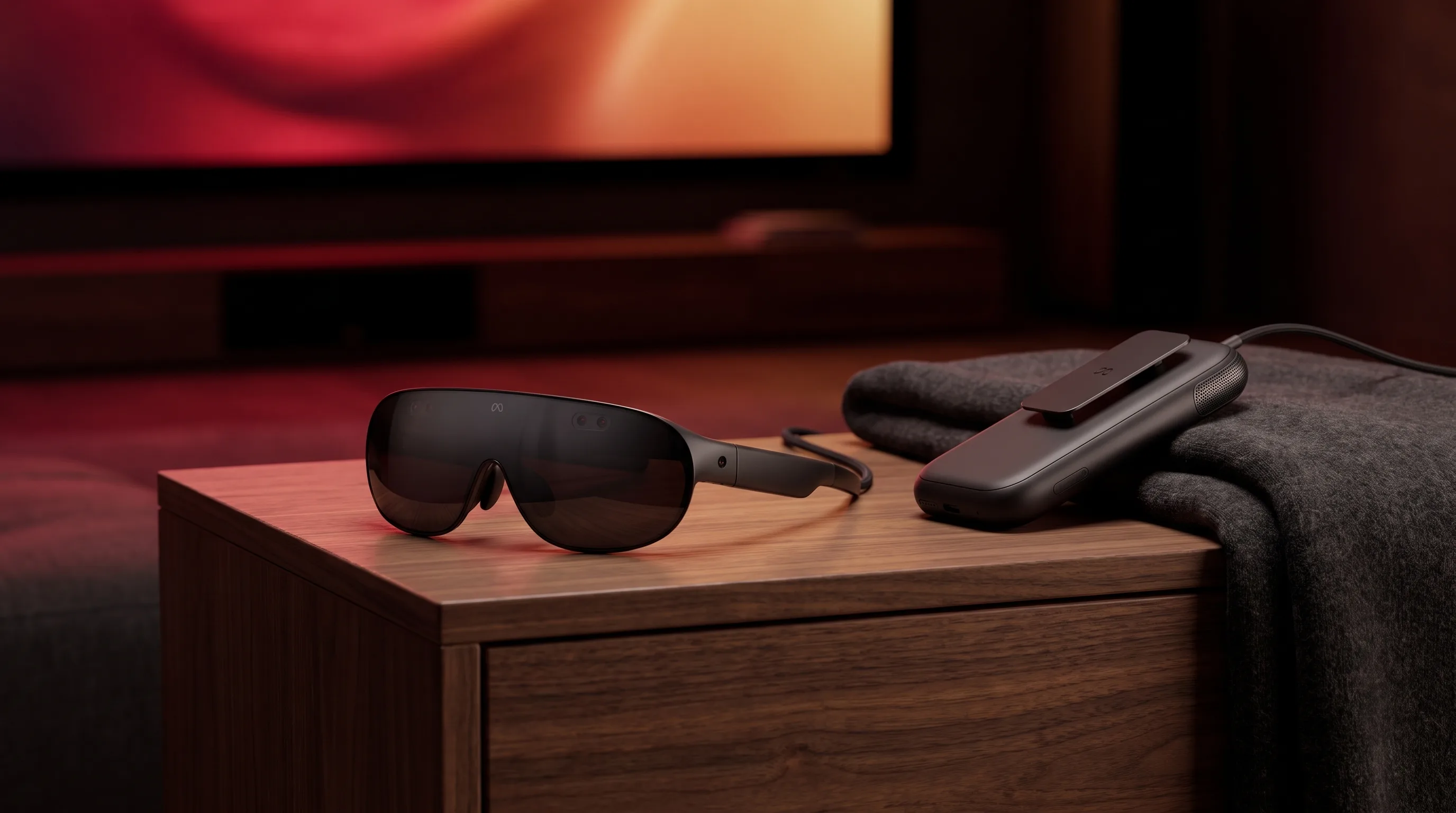
Live sports is the other pillar. Meta cited NBA, MLB, and ESPN partnerships with more than 100 immersive live events a year at launch, which is the courtside-seat promise made literal. On the gaming side, the full Quest catalog carries over, Xbox Cloud Gaming runs with a Bluetooth gamepad, and Beat Saber gets a hand-tracked Flux mode built for the new input model. A Billie Eilish concert film, Hit Me Hard and Soft: The Tour, ships in November, and the animated feature Open Season leads the launch lineup.
For media companies, studios, and brands, the opportunity is a premium immersive channel on a device people will keep on for a full feature film. Three content formats translate directly: immersive video shot for the device, interactive branded experiences built in Unity or Unreal, and virtual venues for concerts and sports. Our VR game development studio and our immersive media work on Vision Pro, including spatial video pipelines, carry over to the glasses with minimal change because the rendering stack is the one we already ship on Quest.
What Developers and Businesses Should Do Before Spring 2027
The practical advice for developers and businesses is to keep shipping on Quest 3 now and design with the Meta VR Glasses’ input model and field of view in mind, because everything built for Quest today runs on the glasses next spring. Six months is enough time to prepare without betting a roadmap on unshipped hardware.
- Build on Quest 3 now. The glasses run the same operating system and the same store, and Meta says existing apps render at higher resolution automatically through eye-tracked foveated rendering. A Quest 3 app shipped in 2026 is a VR Glasses app in 2027.
- Make hand tracking a first-class input. The glasses ship without controllers. Any interface that only works with a trigger will feel broken on day one. We already build gesture-first interaction for Vision Pro, and the same patterns apply.
- Design for 70 degrees. Keep critical UI inside the central view, avoid edge-anchored elements, and test comfort on a narrower window. This is the single biggest change for teams used to Quest 3’s 110 degrees.
- Plan for eye tracking. Gaze-plus-pinch selection, foveated rendering, and attention analytics are all available. Vision Pro developers already have this muscle; Quest developers will need it.
- Keep OpenXR in the stack. With Quest, Vision Pro, Samsung Galaxy XR, and now the glasses in play, a portable build protects the investment. Our teams ship in Unity, Unreal, and native RealityKit for this reason.
- Do not pause deployments. With no enterprise edition announced, Quest 3 with third-party device management remains the production platform. Treat the glasses as the 2027 premium tier, not a reason to wait.
Need a studio that already ships on Quest and Vision Pro?
We are here to help!
Everything Else Meta Announced at Connect 2026
The VR Glasses were the flagship, but Connect 2026 also expanded the AI glasses line that most businesses will encounter first. Ray-Ban Meta Gen 3 arrived immediately at $449 with a slimmer frame, longer battery, and a customizable action button. Ray-Ban Meta Audio, Meta’s first camera-free glasses, ships October 13 from $349, which solves the privacy objection that has kept camera glasses out of many workplaces. Muse Charm, a pocket-sized device for talking to Meta’s Muse assistant, was previewed with pricing to follow later in 2026, and a hearing-enhancement feature arrives at $149.99 or with a Meta One subscription.
Notably absent was a Quest 4. Meta is continuing to announce games for both Quest and the glasses, which signals a two-tier lineup rather than a replacement. For the business case on camera and audio smart glasses, see our guide to AI smart glasses for business.
Conclusion
Meta VR Glasses are the most significant VR hardware announcement since Vision Pro, not because any single spec is unprecedented but because the combination is: 37 pixels per degree, 120 Hz micro-OLED, eye and hand tracking, and the entire Quest catalog at 100 grams and $1,299.99. The trade-offs are a 70-degree field of view, a tether to a pocket puck, a spring 2027 ship date, and no enterprise program yet. Apple Vision Pro keeps the premium spatial computing position and its ecosystem; Quest 3 keeps the value and volume position; the glasses carve out the middle and, for the first time, make all-day VR plausible.
For businesses, the move is simple. Build for Quest 3 now, design for hands and a narrower view, and plan your 2027 deployments around a device that people will actually keep on. Frame Sixty has shipped more than 100 apps across Quest, Vision Pro, and WebXR, and if you want to scope a project against the next generation of headsets, get in touch with our team and we will tell you where the glasses fit.
Meta VR Glasses FAQs
Direct answers to the questions buyers, IT teams, and developers are asking about the Meta VR Glasses announced at Meta Connect 2026. Figures come from Meta's announcement and hands-on press coverage.
Meta VR Glasses are a new two-part virtual reality headset announced at Meta Connect 2026. The glasses themselves weigh about 100 grams and hold dual micro-OLED displays, eye and hand tracking cameras, and Dolby Atmos speakers in a magnesium-alloy sunglasses-style frame. The processor, battery, and storage sit in a separate roughly 300-gram puck that clips to a pocket and connects over a thin optical tether. They run the same operating system as Meta Quest 3.
Meta VR Glasses cost $1,299.99 for the 128 GB model and ship in spring 2027, according to Meta. The price is US only so far; international pricing has not been announced. Touch Plus controllers are sold separately, and existing Quest 3 and Quest 3S controllers are compatible.
Meta VR Glasses cost $1,299.99 versus $3,699 for Apple Vision Pro, and put 100 grams on your face versus roughly 600 to 650 grams for Vision Pro's headset. Vision Pro keeps the edge in field of view (about 100 degrees versus 70), total pixel count, and on-device compute with its M5 chip. Meta wins on weight, price, 120 Hz refresh, and access to the Quest game catalog. Enterprise buyers who need visionOS, Mac integration, or the widest field of view still have a reason to choose Vision Pro.
No. Meta did not announce a Quest 4 at Connect 2026 and continues to release games for both Quest 3 and the VR Glasses. Quest 3 and Quest 3S remain the volume devices at $499.99 and $299.99, with included controllers and a wider roughly 110-degree field of view. The VR Glasses sit above them as a premium, lighter device, and every Quest app runs on both.
Meta VR Glasses do not require controllers. They are built around eye tracking, hand gestures, and voice through Meta AI, and Meta says more than 75 games will be playable with hands alone at launch. Touch Plus controllers are optional and sold separately, and current Quest 3 controllers work with the glasses. Training applications that depend on haptic feedback or precise trigger input should budget for controllers.
Yes. Meta VR Glasses run the same operating system as Quest 3, and Meta says the full Quest catalog of thousands of titles is supported. Existing apps render at higher resolution on the micro-OLED displays through eye-tracked foveated rendering. Developers should still test for the narrower 70-degree field of view and plan for hand-first input, since the device ships without controllers by default.
Not yet. Meta Connect 2026 was a consumer event, and no enterprise edition, business bundle, or first-party fleet management plan was announced for the Meta VR Glasses. Businesses planning deployments should expect to use third-party mobile device management platforms, as they do with Quest 3 today, and should not pause current Quest projects waiting for the glasses.
The strongest enterprise fits for Meta VR Glasses are design and product review, where 37 pixels per degree makes CAD detail and text legible; multi-monitor virtual workspaces driven from a laptop over USB-C or Wi-Fi; photorealistic hologram calls for remote collaboration; hand-tracked procedural training; and lightweight sales and trade show demos. The 100-gram weight supports sessions far longer than a 515-gram Quest 3 allows.