
From Proof of Concept to Production: How AR AI Accelerates MVP Development in 2026
May 7, 2026

9 MIN READ
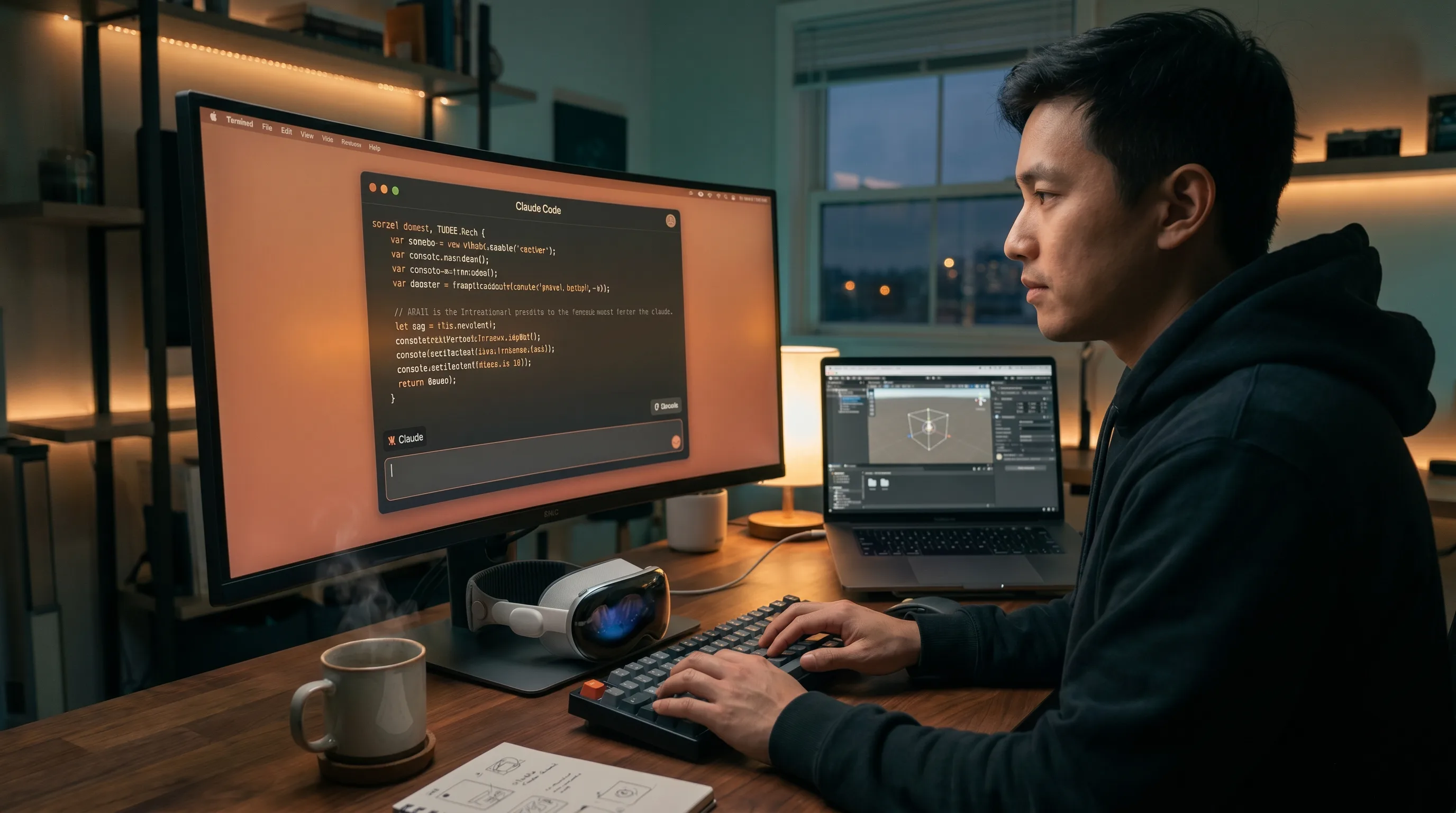
AR AI is the integration of augmented reality and artificial intelligence that accelerates product development by combining spatial computing, AI-assisted coding, and mixed reality prototyping. In 2026, AR AI enables developers to move from proof of concept to production faster through real-time code generation, asset optimization, and contextual debugging across platforms like Unity, Apple Vision Pro, and Three.js. These systems enhance creativity and collaboration by automating repetitive tasks while maintaining human oversight for quality and innovation. As a result, AR AI reduces time-to-MVP, improves prototype validation rates, and strengthens developer productivity across immersive environments.
The New Era of AR AI in MVP Development
AR AI—the combination of augmented reality (AR) and artificial intelligence (AI)—is changing how teams move from proof of concept to production-ready products. In 2026, this integration has become standard for MVP acceleration and rapid iteration cycles. By combining spatial computing, AI-assisted coding, and mixed reality prototyping, developers can now test and refine ideas faster and more accurately.
At Frame Sixty, we’ve seen how AI-driven design and augmented reality development are reshaping digital product creation. The ability to visualize, test, and adjust in immersive environments before writing production code has significantly reduced time-to-MVP.
According to Deloitte’s Tech Trends 2025, the AR industry is maturing as AI integration moves beyond automation to enhance human creativity. Developers, designers, and strategists are using Claude Code, OpenAI, and Anthropic MCP to build faster and more collaborative workflows.
In 2026, developer productivity tools are deeply integrated with AR platforms. Frameworks like Unity XR Interaction Toolkit (Unity), Apple Vision Pro SDK (Apple VisionOS documentation), and Google ARCore (Google ARCore docs) now include AI functions for real-time code generation, asset optimization, and contextual debugging.
Meanwhile, web-based AR powered by Three.js (Three.js official site) and WebXR (W3C WebXR specification) is making immersive experiences available across devices. This wider access means MVPs can be validated in browsers before moving to native platforms like Apple Vision Pro or Meta Reality Labs.
Key takeaway: The new era of AR AI supports developers by helping them create, test, and deploy faster with greater confidence.
Empowering Developers, Not Replacing Them
AR AI helps developers expand their creativity, problem-solving skills, and technical reach. Rather than replacing them, AI acts as a collaborative partner that handles repetitive or computational tasks, allowing developers to focus on innovation and design.
At Frame Sixty, our goal is to strengthen developer capabilities through intelligent tools. When we integrate AI into our workflows—whether in Unity, Swift, or Three.js—it’s to enhance human expertise.
For instance, Claude Code and OpenAI’s GPT-based assistants (OpenAI Research) can generate boilerplate scripts, optimize shaders, or suggest AR interaction logic. These results still require human review to ensure they fit the project’s structure and creative vision.
Balancing Automation with Human Expertise
Automation can speed up proof of concept development, but it can’t replace intuition. Developers bring domain knowledge, reasoning, and aesthetic judgment that AI lacks. The goal is to balance iteration speed, code quality score, and technical debt index.
At Frame Sixty, our AI developers use tools like GitHub Copilot and VS Code to collaborate in real time with AI models. They treat AI output as drafts, not final code. This keeps innovation and quality aligned.
Developers as AI Collaborators
In 2026, developers are AI collaborators. They coordinate multiple AI systems, such as Anthropic MCP, Claude Code, and OpenAI APIs, ensuring each model contributes effectively to the workflow.
This collaboration extends to spatial computing environments, where AI helps visualize data, simulate interactions, and predict user behavior. As shown in Frame Sixty’s work on agentic spatial computing, combining human creativity with AI reasoning produces more adaptive AR experiences.
Key takeaway: Empowering developers with AR AI means giving them tools to think bigger, iterate faster, and build smarter while maintaining creative control.
Integrating Claude Code and Anthropic MCP in Unity Workflows
AI-Enhanced Unity Development
Claude Code and Anthropic MCP are changing how developers use the Unity Editor for AR MVP development. By integrating these AI systems into Unity workflows, teams can automate proof of concept development, validate prototypes faster, and improve developer velocity.
At Frame Sixty, we use Unity’s XR Interaction Toolkit (Unity official site) to build immersive AR prototypes. When paired with Claude Code, developers can quickly create interaction scripts, physics behaviors, and UI logic. Anthropic MCP coordinates collaboration, keeping AI-generated assets consistent with human-authored code.
For example, when building an AR product configurator for manufacturing, our team used Claude Code to generate object interactions and Anthropic MCP to manage asset dependencies. This reduced our time-to-MVP by about 40%.
Maintaining Code Quality and Developer Oversight
Even with AI, maintaining a high code quality score and low bug density is essential. AI models can produce code that looks correct but contains logical errors. Manual validation and AI code review remain critical.
We use GitHub Copilot and VS Code for collaborative sessions where senior developers review AI-generated code. This ensures the architecture stays maintainable and scalable.
At Frame Sixty, our Unity experts rely on AI tools for repetitive tasks—like material assignments or animation triggers—while focusing on the user experience. This balance keeps iteration speed high without sacrificing quality.
Key takeaway: Integrating Claude Code and Anthropic MCP into Unity workflows makes MVP development faster and more collaborative while preserving human craftsmanship.
Need help with AR AI development?
Frame Sixty is a full-service digital innovation studio specialising in AR/VR, mobile, and web development.
Swift and Apple Vision Pro: Accelerating Native AR Experiences
AI in Swift and Vision Pro Development
Swift and SwiftUI, combined with Apple Vision Pro SDK, define the frontier of native AR development. By integrating Claude Code and OpenAI API, developers can automate setup, generate ARKit logic, and prototype spatial UI layouts.
At Frame Sixty, we use AI-assisted coding to accelerate Apple Vision Pro projects. Using the Apple VisionOS SDK (Apple VisionOS documentation), we test spatial computing interactions and validate user flows before production builds.
AI models like Claude Code can analyze Swift codebases, suggest optimizations, or refactor legacy ARKit modules for better performance. Anthropic MCP manages collaboration between AI agents, ensuring generated SwiftUI components integrate with ARKit or Google ARCore (Google ARCore documentation) for cross-platform AR apps.
Best Practices for AI Collaboration in Native Development
To maintain sustainable development, AI-generated code must be reviewed for technical debt index and AI suggestion accuracy. At Frame Sixty, we follow a structured review process:
- AI Drafting: Claude Code generates initial SwiftUI layouts and ARKit interactions.
- Developer Review: Senior engineers confirm logic and compliance with Apple Vision Pro SDK standards.
- Automated Testing: AI-driven test suites measure prototype validation rate and bug density.
- Optimization: Human developers refine performance, accessibility, and user experience.
Ethical development also matters. Transparency means documenting which parts of the code were AI-generated and ensuring no proprietary data is exposed during training or inference.
Key takeaway: AI in Swift and Vision Pro development speeds up native AR creation, while human oversight ensures quality, ethics, and innovation.
Web-Based AR and 3D Prototyping with Three.js
AI-Driven 3D Web Frameworks
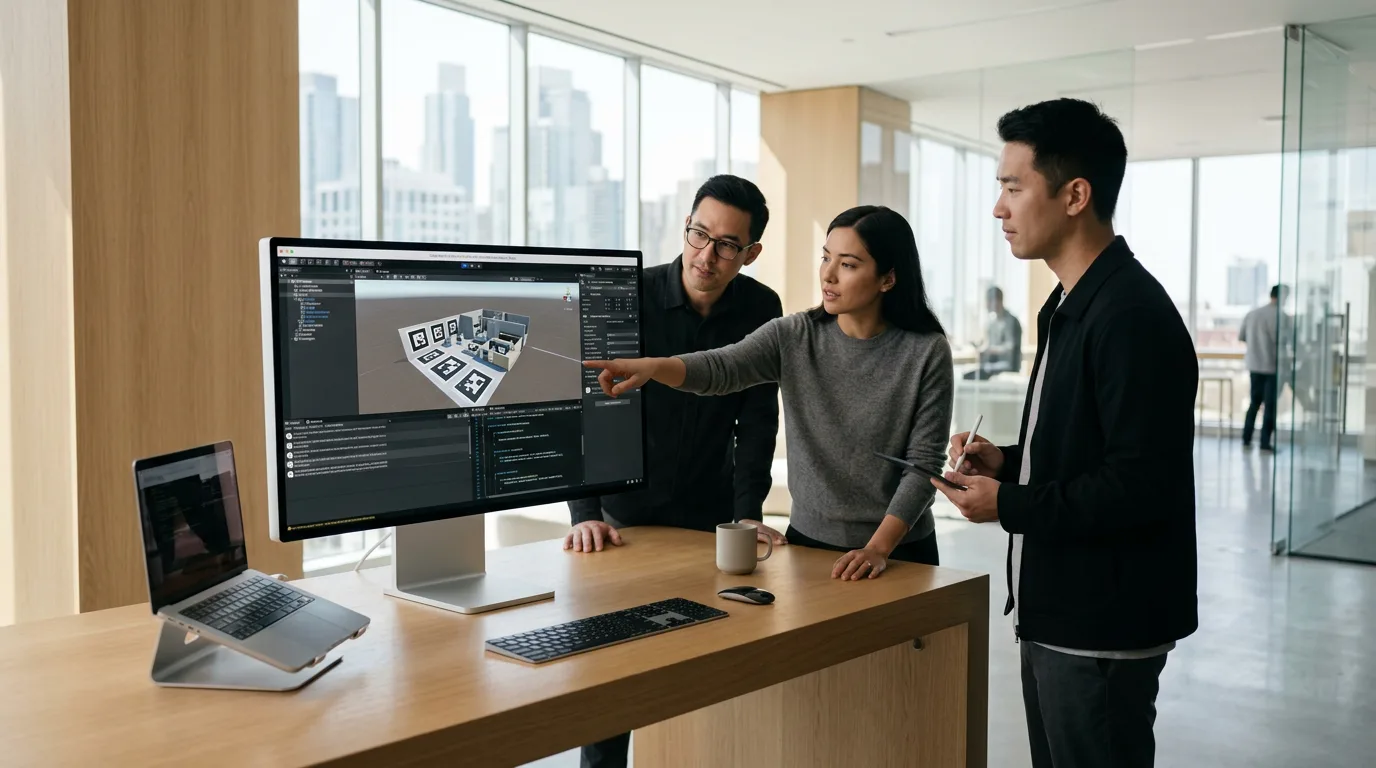
Web-based AR is one of the fastest-growing areas of spatial computing. Frameworks like Three.js (Three.js official site) and React Three Fiber lead this growth. Combined with Claude Code, GitHub Copilot, and OpenAI API, developers can automate mixed reality prototyping in the browser.
At Frame Sixty, we use AI to generate 3D scenes, lighting setups, and camera logic for early MVPs. This helps clients visualize concepts quickly without waiting for final assets.
AI also supports integration of OpenXR, WebXR, and ARML 2.0 (W3C WebXR specification) standards, ensuring consistent performance across devices. This flexibility lets developers test ideas on mobile, desktop, or headset environments before native builds.
Collaboration and Validation in the AI Development Cycle
AI collaboration continues beyond code generation into asset creation and validation. Tools like NVIDIA Omniverse (NVIDIA Omniverse official site) and Blender enable AI-assisted 3D modeling, simulation, and rendering.
At Frame Sixty, our developers use Omniverse to simulate lighting and physics in real time, while Anthropic MCP coordinates collaboration between AI systems and human designers. This iterative process improves developer velocity, deployment frequency, and user engagement.
AI feedback loops can raise prototype validation rate by up to 50%, giving developers immediate insights into performance, usability, and visual quality.
| Metric | Traditional Workflow | AI-Assisted Workflow |
|---|---|---|
| Time-to-MVP | 8–10 weeks | 4–6 weeks |
| Prototype Validation Rate | 60% | 90% |
| Developer Velocity | Moderate | High |
| Bug Density | Medium | Low (after review) |
Key takeaway: AI-driven 3D web frameworks like Three.js and NVIDIA Omniverse enable faster, more collaborative MVP validation, closing the gap between concept and production.
From Prototype to Production: Scaling AI-Assisted AR Projects
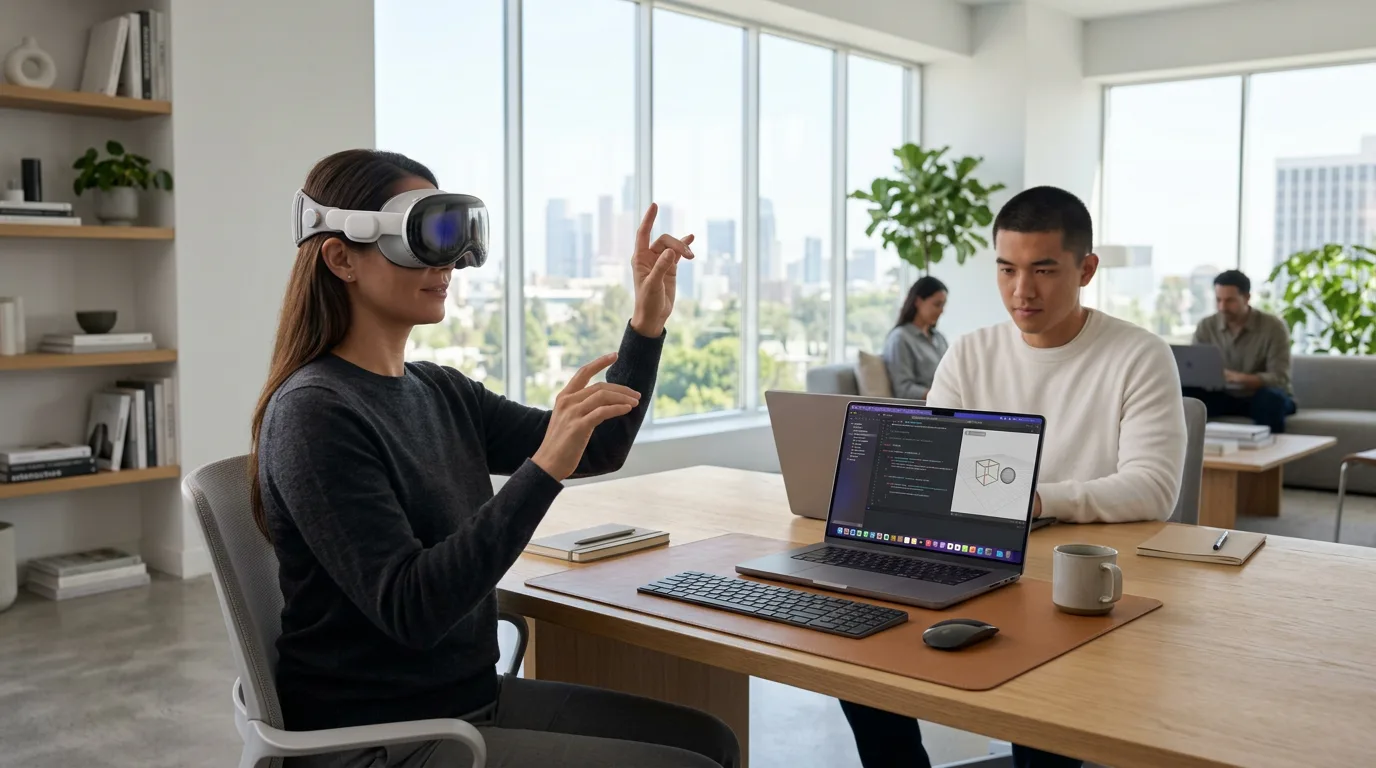
Scaling AI-assisted AR projects requires a careful shift from MVPs to production systems. The key is establishing strong review pipelines that ensure scalability, maintainability, and quality.
At Frame Sixty, we use a structured approach to move from AI-generated prototypes to production-ready AR applications. This process includes:
- AI-Assisted Prototyping: Rapid creation of MVPs using Claude Code, OpenAI, and Anthropic MCP.
- Human Review: Manual validation of AI-generated components for performance and security.
- Refinement: Integration with production frameworks like Unity, Swift, or Three.js.
- Deployment: Testing across Apple Vision Pro, Meta Reality Labs, and NVIDIA Omniverse ecosystems.
Measuring Success
Success in AI-assisted MVP development is measured through time-to-MVP, prototype validation rate, and developer velocity. These metrics help teams assess how well AI tools improve workflow efficiency.
| Metric | Definition | Ideal Range |
|---|---|---|
| Time-to-MVP | Time from concept to functional prototype | < 6 weeks |
| Code Quality Score | Automated and manual review rating | > 85% |
| Developer Velocity | Number of validated iterations per sprint | 3–5 |
| Technical Debt Index | Ratio of rework to total codebase | < 10% |
The Future of AI-Augmented AR Development
Ecosystems like Meta Reality Labs, Apple Vision Pro, and NVIDIA Omniverse are shaping the next stage of AI-augmented AR development. As these platforms evolve, developers will gain access to more integrated AI APIs, real-time simulation environments, and shared cloud infrastructures.
For example, NVIDIA Omniverse offers a shared virtual workspace where AI and human developers co-design 3D assets, while Apple Vision Pro provides a native platform for spatial computing experiences that blend digital and physical spaces.
Key takeaway: Moving from prototype to production in AI-assisted AR requires structured validation, human oversight, and data-driven optimization, leading to faster innovation and higher-quality results.
Conclusion
By 2026, AR AI will be central to MVP development. The combination of augmented reality, AI-assisted coding, and spatial computing enables teams to move from proof of concept to production with greater speed and precision.
At Frame Sixty, we’ve seen how tools like Claude Code, Anthropic MCP, and OpenAI API help developers create immersive experiences across Unity, Swift, and Three.js. These technologies don’t replace human creativity—they enhance it, allowing developers to iterate faster, validate ideas sooner, and deliver higher-quality products.
As AI advances, the most successful teams will be those who treat it as a collaborator. Combining human insight with machine intelligence will unlock new levels of innovation in AR AI development.
Ready to bring your AR AI vision to life? Get in touch with our team at Frame Sixty to discuss how we can accelerate your MVP development and turn your ideas into production-ready experiences.

AR AI and MVP Development in 2026
Explore how AR AI—combining augmented reality and artificial intelligence—is transforming MVP development from proof of concept to production. These FAQs cover general insights, technical details, and implementation strategies for developers and teams adopting AR AI in 2026.
AR AI is the integration of augmented reality and artificial intelligence to accelerate MVP development through AI-assisted coding, spatial computing, and mixed reality prototyping. In practice it means real-time code generation, asset optimization, and contextual debugging across platforms like Unity, Apple Vision Pro, and Three.js, so teams move from proof of concept to production faster.
AI-assisted AR workflows can roughly halve time-to-MVP, from a typical 8 to 10 weeks down to 4 to 6 weeks, while prototype validation rates climb from around 60% to 90%. On one AR product configurator for manufacturing, pairing Claude Code for interaction scripting with Anthropic MCP for asset dependencies cut time-to-MVP by about 40%.
No, AR AI does not replace developers; it handles repetitive or computational tasks so developers can focus on design, architecture, and creative decisions. AI output is treated as a draft: senior engineers review generated code, automated tests measure bug density, and human oversight keeps quality, ethics, and the technical debt index under control.
AR AI development in 2026 combines coding assistants such as Claude Code, Anthropic MCP, and GitHub Copilot with AR frameworks including the Unity XR Interaction Toolkit, the Apple Vision Pro SDK with Swift, Google ARCore, and Three.js with WebXR for browser-based work. NVIDIA Omniverse and Blender cover AI-assisted 3D modeling, lighting, and physics simulation.
Teams keep AI-assisted AR code quality high with a structured pipeline: AI drafts the initial scripts, senior developers review logic and architecture, automated test suites track prototype validation rate and bug density, and humans handle final performance and accessibility optimization. Documenting which code is AI-generated preserves transparency and keeps proprietary data protected.
Frame Sixty builds AI-assisted AR MVPs, integrating Claude Code and Anthropic MCP into Unity, Swift, and Three.js workflows to move projects from proof of concept to production. Its AI development team pairs AI-generated drafts with senior engineering review, so clients get faster iteration without sacrificing code quality.
Get in touch
We’re interested to see how we can help. Send us a message and we will get back to you within 24 hours.