
What Is a Virtual Showroom? AR Try-On, WebAR, and Full VR Explained
Jul 10, 2026

17 MIN READ
A virtual showroom is an interactive, branded digital space where customers explore, configure, and buy products shown in 3D, augmented reality, or virtual reality without visiting a physical store. Brands build them in three formats: AR try-on that places a product on a body or in a room, WebAR that loads in a mobile browser with no app to install, and full VR that lets shoppers walk through an entire space in a headset. The formats trade off fidelity, cost, and friction. Products with 3D/AR content convert 94% higher on average, according to Shopify’s 2025 research, and 80% of AR shoppers report more confidence in their purchases. Custom builds start near $20,000, while hosted SaaS platforms start around $140 per month.
Key Takeaways
- A virtual showroom shows products in 3D, AR, or VR so shoppers can inspect and configure them before buying.
- Products with 3D/AR content convert 94% higher on average, according to Shopify’s 2025 research.
- The three formats — AR try-on, WebAR, and full VR — trade off fidelity, cost, and how much friction the customer accepts.
- 80% of AR shoppers feel more confident buying and 66% are less likely to return, per a Snap and Publicis study of 4,000+ shoppers.
- Custom builds start near $20,000; hosted SaaS platforms start around $140 per month.
Need help building a virtual showroom?
Frame Sixty is a full-service digital innovation studio specialising in AR/VR, mobile, and web development.
What Is a Virtual Showroom?
A virtual showroom is an interactive, branded digital space where customers explore, configure, and purchase products displayed in 3D, augmented reality, or virtual reality — without traveling to a physical location. Unlike a static product page, it lets a shopper spin an item 360 degrees, drop it into their own room at true scale, change finishes in real time, and watch embedded video, all inside one branded environment.
The difference from a simple 3D viewer matters. A viewer shows one rotating model. A showroom carries navigation across multiple SKUs, a branded space, and a path to checkout. That is why brands treat it as a sales channel rather than a widget.
Three underlying technologies power a virtual showroom, and each maps to a different customer context: AR try-on for putting a product on a body or in a room, WebAR for instant browser access, and full VR for walking through an entire space. Those three formats structure the rest of this guide, and Frame Sixty’s own real-world AR examples show how they play out in production.
The category is growing fast. The global virtual showroom market was valued at $4.55 billion in 2023 and is projected to reach $18.31 billion by 2030, according to figures cited by iEnhance in its 2024 analysis of virtual furniture shopping. The takeaway: a virtual showroom is a purchase environment, not a marketing gimmick.
The Three Formats: AR Try-On, WebAR, and Full VR Showrooms
Virtual showrooms come in three formats — AR try-on, WebAR, and full VR — and they are not interchangeable. Each suits a different product category, budget, and customer context, and the choice determines how much friction a shopper accepts, how many devices the experience reaches, and how realistic the result looks. The three sections below define each format and show where it fits.
AR Try-On: How Customers See Products on Themselves or in Their Space
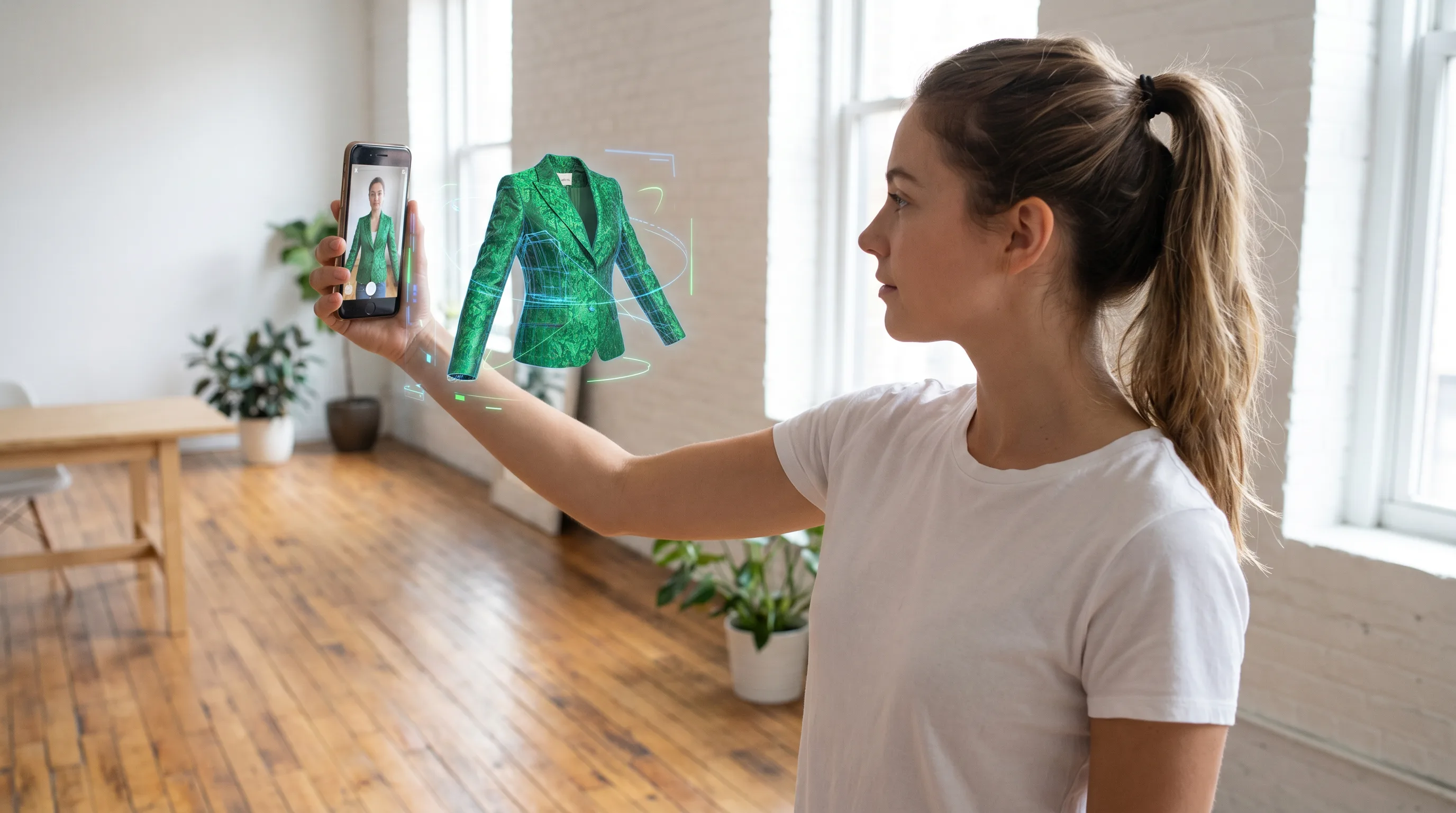
AR try-on is augmented reality that anchors a 3D product model to a live camera feed so the customer sees the item on their own body or in their own room in real time. The phone camera streams video, and the AR layer pins the model to a detected surface or body point using ARKit on iOS or ARCore on Android. There are two sub-types: body-anchored try-on for clothing, eyewear, accessories, and makeup, and world-anchored placement for furniture, rugs, and appliances.
An AR try-on can run inside a brand’s own app or on a social platform such as Instagram or Snapchat, built with Spark AR or Lens Studio. Either way, the product needs a 3D asset in the right format: USDZ for iOS AR Quick Look, and GLB or glTF for Android and the web.
The commercial case is well documented. Fashion label Rebecca Minkoff found customers were 65% more likely to place an order after interacting with a product in AR, according to an Envive 2026 analysis cited by Zolak. Shopify’s own research puts the average conversion lift for 3D/AR content at 94%. If you need a native experience, Frame Sixty builds these through its AR app development practice and its work on AR in fashion. The key takeaway: AR try-on wins when seeing the product in context is the deciding factor in the purchase.
WebAR: Virtual Try-On Without Downloading an App
WebAR is augmented reality that runs inside a mobile browser through WebXR and platforms like 8th Wall, with no app to install. A shopper taps a link or scans a QR code and the experience loads in seconds, directly in Safari or Chrome. That removes the single biggest point of drop-off in native AR: the app store install.
The trade-off is capability. WebAR has less access to device sensors and runs at lower frame rates than a native app, so it suits simpler placements — shoes, eyewear, single furniture pieces — better than full-body garment simulation. When reach and speed matter more than maximum fidelity, WebAR is the right call.
Real brands have proven the model. Burberry built a WebAR shoe try-on, Ford’s WebAR campaign let people park an F-150 Lightning in their own driveway through a browser, and BMW runs browser-based configurators, as documented in Kivisense’s 2024 WebAR guide. Chilli Beans, the largest eyewear retailer in Latin America, launched WebAR try-on for more than 1,000 3D eyewear models and saw a 48% increase in sunglasses sales, according to 2025 reporting from VR Owl. Common platforms include 8th Wall, Shopify AR, rooom, and ByondXR. To compare them, see Frame Sixty’s rundown of the top web-based augmented reality solutions and its WebAR development services. The takeaway: WebAR trades some realism for the widest possible reach and the lowest friction.
Full VR Showroom: Walk Through a Digital Store
A full VR showroom is a rendered 3D environment the customer navigates in first person, either through a headset like Meta Quest or Apple Vision Pro, or through a browser-based WebXR view. Instead of placing one product, the shopper walks through an entire branded space — a car dealership, a kitchen, a wholesale collection — and interacts with what they find there.
Full VR fits high-consideration purchases where spatial scale and layout matter: automobiles, kitchens, and commercial furniture. As Rock Paper Reality’s 2025 overview of AR and VR showrooms notes, brands like Jaguar and IKEA have used immersive environments to let customers inspect interiors and design spaces they could never fit in a browser thumbnail. Full VR also suits B2B trade showrooms. The wholesale platform JOOR, referenced in Shopify’s 2025 virtual showroom guide, connects more than 14,000 brands with over 650,000 buyers inside virtual wholesale environments.
Hardware sets the immersion level and the audience:
| Format | Hardware | Best for |
|---|---|---|
| Headset VR | Meta Quest | Mass-consumer immersive experiences |
| Spatial computing | Apple Vision Pro | Enterprise and luxury, high visual fidelity |
| WebXR | Any modern browser | No-headset access, lower immersion |
Toyota’s automotive configuration and IKEA Kreativ’s room design show what a full VR or spatial experience delivers that AR alone cannot: a space to move through, not just a product to place. Frame Sixty builds these through its virtual reality product demos and broader virtual reality development services. The takeaway: full VR is the format for when the whole environment, not a single item, is the thing being sold.

Inside a Real Build: Frame Sixty’s Instagram Clothes-Swap Filter
Frame Sixty, an AR/VR and spatial computing development studio, built a clothing virtual try-on filter in Spark AR Studio for Instagram that lets users swap into garments from a brand’s collection using face and body tracking. It is a working example of a virtual showroom compressed into a single social filter: a real customer activates it from a story or Reel and sees real products on themselves, no fitting room and no shipment required.
The build came together in four parts:
- 3D garment modeling. Each piece was modeled as a mesh asset in GLB format, built to deform against body movement so the cloth bends and folds as the wearer moves.
- Body and surface tracking. Spark AR anchors the garment geometry to detected body landmarks, so the clothing follows the user’s motion convincingly rather than floating.
- Lighting and material matching. Physically based rendering (PBR) materials match each garment’s real fabric — its sheen, texture, and drape — under the ambient light the phone camera picks up.
- Distribution. The finished effect publishes to the brand’s Instagram profile, so followers activate it from a story or Reel, share it, and tap through to the product page.
The result gives a brand something a static lookbook cannot: shareable content that puts real garments on real people at the moment they are already scrolling. Filters of this kind sit on strong numbers — customers are 65% more likely to order after AR interaction (Envive, 2026), and 80% of AR shoppers report more confidence in their decisions (Snap and Publicis, via Alter Agents). This is what augmented reality looks like when it ships as a filter a customer actually uses, and it is the same tracking and rendering work behind Frame Sixty’s Instagram and Spark AR development. The takeaway: a virtual showroom does not have to be a whole website — sometimes it is one well-built filter.
Virtual Showrooms by Industry: Fashion, Furniture, and Automotive
Virtual showrooms perform differently by category because the core shopping problem changes. Fashion buyers worry about fit and style, furniture buyers worry about scale in a real room, and car buyers face complexity and configuration. The three sections below show how AR and VR address each problem and what the measured results have been.
Fashion: From Social Filter to Purchase
Fashion virtual try-on solves a specific problem: sizing uncertainty and on-screen color differences drive returns, and online apparel return rates reached 19.3% in 2025 according to National Retail Federation data. AR addresses it by showing the garment on the customer’s own body, in their own light, at their own scale, before they order.
Fashion AR spans a spectrum. At the social end, brands publish Spark AR and Snapchat Lens Studio filters that shoppers activate straight from a Reel or ad. At the owned end, a brand’s iOS or Android app runs ARKit or ARCore try-on inside its own storefront. The numbers favor both:
- Gucci’s Snapchat AR shoe lens drove a 188% lift in product page views and a 25% increase in purchase intent.
- Ulta Beauty’s Snapchat AR lens generated 30 million try-ons and $6 million in incremental sales in two weeks.
- Fashion brands using AR report engagement increases of 30% to 50%, according to BrandXR’s January 2025 analysis of AR mirrors and virtual try-ons.
The filter is not only a try-on. It is shareable social content that puts a product in front of people who never searched for it, which is why Frame Sixty’s AR in fashion work treats distribution as part of the build. The takeaway: in fashion, virtual try-on cuts returns and doubles as organic reach.
Furniture: Place It in Your Room Before You Buy
A furniture virtual showroom lets a customer place a life-size 3D model of a product at correct scale in their actual room, through the phone camera, before they buy. It answers the question that kills online furniture sales: will this sofa fit, and will it look right here? World-plane detection through ARKit and ARCore, combined with dimensionally accurate USDZ and GLB models, makes the placement trustworthy.
The results are concrete. IKEA Place raised purchase likelihood by 11% with 98% scale accuracy, and IKEA Kreativ adds an AI-powered room scanner that digitizes the actual room for full virtual staging. Macy’s furniture AR pilot held return rates under 2%, against a normal 5% to 7%. In India, Pepperfry’s virtual setup tool cut returns by 38%.
Consumer expectations have caught up. According to Google data cited by iEnhance, 47% of US smartphone shoppers now expect all automotive brands to offer AR, and 43% expect it from beauty brands — a signal that AR visualization is becoming a default expectation across categories, furniture included. The takeaway: furniture is the category where AR’s return-rate reduction most directly recovers margin.
Automotive: Configure Before You Test Drive
An automotive virtual showroom removes the need to visit a dealership to see one specific color, trim, and options combination that may not be on the lot. It uses two formats: WebAR for quick visualization — Ford’s F-150 Lightning campaign let shoppers park the truck on their own street through a mobile browser — and full VR for walkaround and interior experiences, as in Jaguar’s AR app.
The buyer and dealer data both point the same way. According to a 2023 Cox Automotive survey cited by Transforma Insights, 86% of potential vehicle purchasers believe digital tools save time in showrooms, and 79% of dealers believe in-store digital tools make processes more efficient. The same source reports, via Automotive News, that dealerships using VR showrooms and AR test drives saw a 20% increase in conversions over traditional methods.
The deeper value in automotive is configuration. A virtual showroom can display every possible SKU combination without a brand building physical inventory for each one. The takeaway: for cars, virtual showrooms pay off both at the try-before-you-buy moment and by eliminating the cost of stocking every variant.

Do Virtual Showrooms Actually Increase Sales?
Yes — virtual showrooms measurably increase sales, and the evidence is specific across conversion, returns, order value, and engagement. The lift is real, but it scales with how close the AR or VR moment sits to the buy button. A QR code on a shelf performs differently from an in-app try-on inside a checkout flow.
Conversion rate:
- Products with 3D/AR content convert 94% higher on average, per Shopify’s 2025 research.
- Full virtual showroom experiences reach up to 57% higher conversion rates, according to Zolak’s February 2026 analysis.
- 70% of online shoppers who visited virtual stores made at least one purchase, according to Firework’s digital showroom statistics.
Return rate:
- Macy’s furniture AR pilot held returns under 2%, versus a normal 5% to 7%.
- 80% of AR shoppers feel more confident buying and 66% say they are less likely to return items, according to a study Snap Inc. and Publicis Media Exchange commissioned from Alter Agents, based on more than 4,000 respondents across France, Saudi Arabia, the UK, and the US, reported by Adweek. That study dates to 2022, and it remains the most widely cited benchmark for AR purchase confidence.
Average order value and engagement:
- Virtual showroom bundles and room-set configurations produce up to 67% higher average order value than single-product pages (Zolak, 2026).
- Gucci’s Snapchat lens drove a 188% lift in product page views, and Ulta Beauty logged 30 million try-ons in two weeks.
The broader retailer picture supports the trend: BrandXR’s May 2025 research report on AR in retail cites Gartner projections that most major retailers would deploy AR as part of their customer experience strategy by 2025. The takeaway: virtual showrooms lift conversion and cut returns, and the effect grows the closer the experience runs to the point of sale.
How to Build a Virtual Showroom: Assets, Formats, and Costs
Every virtual showroom build follows the same three-step sequence — create the 3D assets, choose a format and platform, then integrate and measure — regardless of whether the end result is AR try-on, WebAR, or full VR. The decisions made at each step set the cost, the timeline, and how many customers the experience can reach.
Step 1: Create Your 3D Product Assets
3D product assets are the foundation of any virtual showroom, because the showroom can only display products it has models for. There are two ways to make them: photogrammetry, which scans a physical product into a mesh, and modeled-from-spec, which builds the model from CAD or design files. Both produce the geometry and materials the AR or VR layer renders.
Format planning saves money here. GLB and glTF serve WebAR and Android, while USDZ serves iOS AR Quick Look, and a single asset set can be converted to serve AR try-on, WebAR, and VR at once. Build the model well once, deploy it across every channel. AI-assisted 3D modeling tools have also cut asset creation time and cost since 2024. Frame Sixty produces these through its 3D model design services. The takeaway: invest in clean, dimensionally accurate 3D assets first, because everything downstream depends on them.
Step 2: Choose a Format and Platform
Choosing a format is mainly a trade-off between friction and fidelity. AR try-on inside a native app offers the highest fidelity and the closest proximity to conversion, but costs the most to build. WebAR reaches any mobile browser instantly with the least customer friction, at moderate fidelity. Full VR delivers the most immersion and needs the most asset work, which is why it fits high-consideration categories.
| Format | Friction | Fidelity | Typical starting cost |
|---|---|---|---|
| WebAR | Lowest (link or QR) | Moderate | ~$20,000 custom |
| AR try-on (native app) | Medium (install) | High | Higher, app-dependent |
| Full VR showroom | Highest (headset or heavy load) | Highest | Up to $500,000+ custom |
On cost, hosted SaaS platforms such as rooom, ByondXR, NuORDER, and JOOR start around $140 per month, while custom builds start near $20,000 for a WebAR experience and can pass $500,000 for a fully custom VR environment, per figures from Shopify and Zolak’s cost analysis. To weigh the browser-based options, see Frame Sixty’s guide to the top web-based augmented reality solutions. The takeaway: pick WebAR for reach, native AR for conversion, and full VR for immersion, then match the platform to that choice.
Step 3: Integrate, Launch, and Measure
The final step connects the showroom to the product catalog and checkout, then measures what it does. Integration means wiring SKU IDs, real-time pricing, and inventory state into the 3D experience, so what a customer sees and configures matches what they can actually buy. Without that link, a showroom is a demo rather than a sales channel.
Measurement decides whether the investment paid off. Track try-on sessions, completion rate, add-to-cart events that originate in the AR session, and the conversion rate of AR users against non-AR users on the same product. Run AR and non-AR variants on the same product page and measure the delta directly.
In our work at Frame Sixty, the projects that perform best treat integration and measurement as part of the build rather than an afterthought — the Instagram clothes-swap filter shipped with a direct path from the effect to the product page for exactly that reason. Frame Sixty handles all three steps — asset creation, format selection, and e-commerce integration — through its augmented reality development services, for brands that want a studio rather than a template. If you want to scope a build, get in touch with our team. The takeaway: a virtual showroom only earns its cost once it is wired to the catalog and measured against real conversion.
Conclusion
A virtual showroom gives online shoppers what a photo cannot: the ability to see a product on their body, in their room, or across a whole space before they commit. The three formats — AR try-on, WebAR, and full VR — cover the full range from a browser-based shoe preview to a headset walkthrough of a virtual dealership, and the right one depends on your product, budget, and how much friction your customers will accept.
The business case is settled by the numbers. Products with 3D/AR content convert 94% higher (Shopify, 2025), full showroom experiences reach 57% higher conversion (Zolak, 2026), and 80% of AR shoppers buy with more confidence while 66% return less often (Snap and Publicis). Those results hold across fashion, furniture, and automotive, and they grow stronger the closer the experience runs to checkout.
Frame Sixty has built these experiences end to end, from an Instagram clothes-swap filter with real garment tracking to full VR product demos. If you want to explore a virtual showroom for your brand — AR try-on, WebAR, or a full immersive environment — reach out to us at Frame Sixty and we will help you scope the assets, format, and integration that fit your catalog.
Virtual Showrooms: Formats, Costs, and Common Questions
Answers to common questions about virtual showrooms, covering how AR and VR try-before-you-buy experiences work, what they cost, and how brands build them.
Brands across categories run virtual showrooms with measured results. Gucci's Snapchat AR shoe lens drove a 188% lift in product page views, Ulta Beauty's lens generated 30 million try-ons and $6 million in incremental sales in two weeks, Burberry built a WebAR shoe try-on, and IKEA Place raised purchase likelihood by 11%. Ford, BMW, and Jaguar run automotive AR and VR experiences.
Car brands use virtual showrooms in two formats: WebAR for quick visualization and full VR for walkaround and interior experiences. Ford's F-150 Lightning campaign let shoppers park the truck on their own street through a mobile browser, while Jaguar built an AR app. Dealerships using VR showrooms and AR test drives saw a 20% increase in conversions, according to Automotive News.
Yes, WebAR runs augmented reality inside a mobile browser through WebXR and platforms like 8th Wall, with no app to install. A shopper taps a link or scans a QR code and the experience loads in seconds in Safari or Chrome. Chilli Beans launched WebAR try-on for more than 1,000 eyewear models and saw a 48% increase in sunglasses sales.
Virtual showrooms use three primary 3D formats: USDZ for iOS AR Quick Look, and GLB or glTF for Android and the web. A single well-built asset set can be converted to serve AR try-on, WebAR, and VR at once, so brands model each product once and deploy it across every channel. Clean, dimensionally accurate 3D assets are the foundation of any showroom.
Virtual showroom costs range widely by approach. Hosted SaaS platforms such as rooom, ByondXR, and JOOR start around $140 per month, while custom builds start near $20,000 for a WebAR experience and can pass $500,000 for a fully custom VR environment, per figures from Shopify and Zolak. Native AR try-on falls between, with cost driven by app complexity and asset count.
A virtual showroom is typically built by an AR/VR development studio that handles 3D asset creation, format selection, and e-commerce integration end to end. Frame Sixty, an AR/VR and spatial computing development studio, treats catalog wiring and measurement as part of the build - its Instagram clothes-swap filter shipped with a direct path from the effect to the product page - because a showroom only earns its cost once connected to SKUs, pricing, and checkout.
Get in touch
We’re interested to see how we can help. Send us a message and we will get back to you within 24 hours.