
Top Augmented Reality Companies (2026)
Feb 13, 2026

12 MIN READ
Top Augmented Reality Companies (2026)
The best augmented reality company is not the one with the most visually impressive demo. It is the one that can deliver production-grade augmented reality software, integrate it into real business workflows, and support it over time as devices, SDKs, and operating systems evolve.
In 2026, AR hardware is no longer the primary limitation. Mobile AR frameworks are stable. Passthrough headsets are reliable. Spatial tracking systems are mature.
The limiting factor has shifted to software architecture, spatial UX quality, device optimization, enterprise integration, and long-term maintainability.
What Makes a Top Augmented Reality Company
The top augmented reality companies are distinguished by their ability to deliver production-ready systems that work reliably in real-world conditions. The following capabilities separate industry leaders from vendors who produce impressive demos but struggle with deployment.
Full-Service Capability (Including 3D UX Expertise)
Production AR requires real-time 3D engineers, spatial UX designers, technical artists, backend architects, and QA specialists with device labs. These roles must function as an integrated team, not disparate contractors.
A 3D UX designer is fundamentally different from a web or mobile UX designer. They must understand how people move in space, safe interaction distances, depth and scale perception, comfort zones, and how to design head-locked versus world-locked interfaces. They also need practical knowledge of spatial interaction standards: how to place menus and screens, how to keep text readable at distance, how to avoid occluding the real world, and how to make interactions discoverable without overwhelming the user.
Production-Quality Execution (Including Battery & Thermal Management)
Production AR must survive long sessions, lighting variability, device overheating, and battery constraints. Systems that drain devices in short sessions cannot support real training or operational workflows.
Top augmented reality companies actively optimize rendering budgets, CPU/GPU balance, memory usage, network efficiency, thermal behavior, and battery consumption. Battery life and thermal stability are production metrics — not demo metrics.
Portfolio Proof: Shipped Systems and Maintained Applications
Portfolio proof means shipped systems, maintained applications, and real deployments that survived SDK changes. Internal demos and concept videos are not sufficient indicators of production readiness. The best AR companies can point to software that has operated in the field, received updates, and continued working as devices and platforms evolved.
Device Strategy and Ecosystem Fluency
Enterprise AR deployments span multiple device categories: mobile AR (ARKit/ARCore), passthrough headsets (Meta Quest, Apple Vision Pro), optical see-through devices (HoloLens, Magic Leap), and smart glasses. A strong AR partner should help you decide which device category is the best fit for your use case, environment, and constraints — not simply build for the device you assume is correct.
Enterprise Integration Capability
Enterprise AR applications rarely operate in isolation. They often integrate with ERP/CRM systems, CAD/PLM pipelines, IoT sensor data, learning management systems, identity providers, and analytics dashboards. Top augmented reality companies design secure, scalable integration architectures early — not as a late-stage patch.
Long-Term Support and Platform Evolution
AR platforms evolve continuously through OS updates, SDK changes, and new hardware releases. Organizations need partners who provide ongoing maintenance, compatibility updates, performance optimization, documentation, and a clear long-term support model.
Top Augmented Reality Companies Ranked
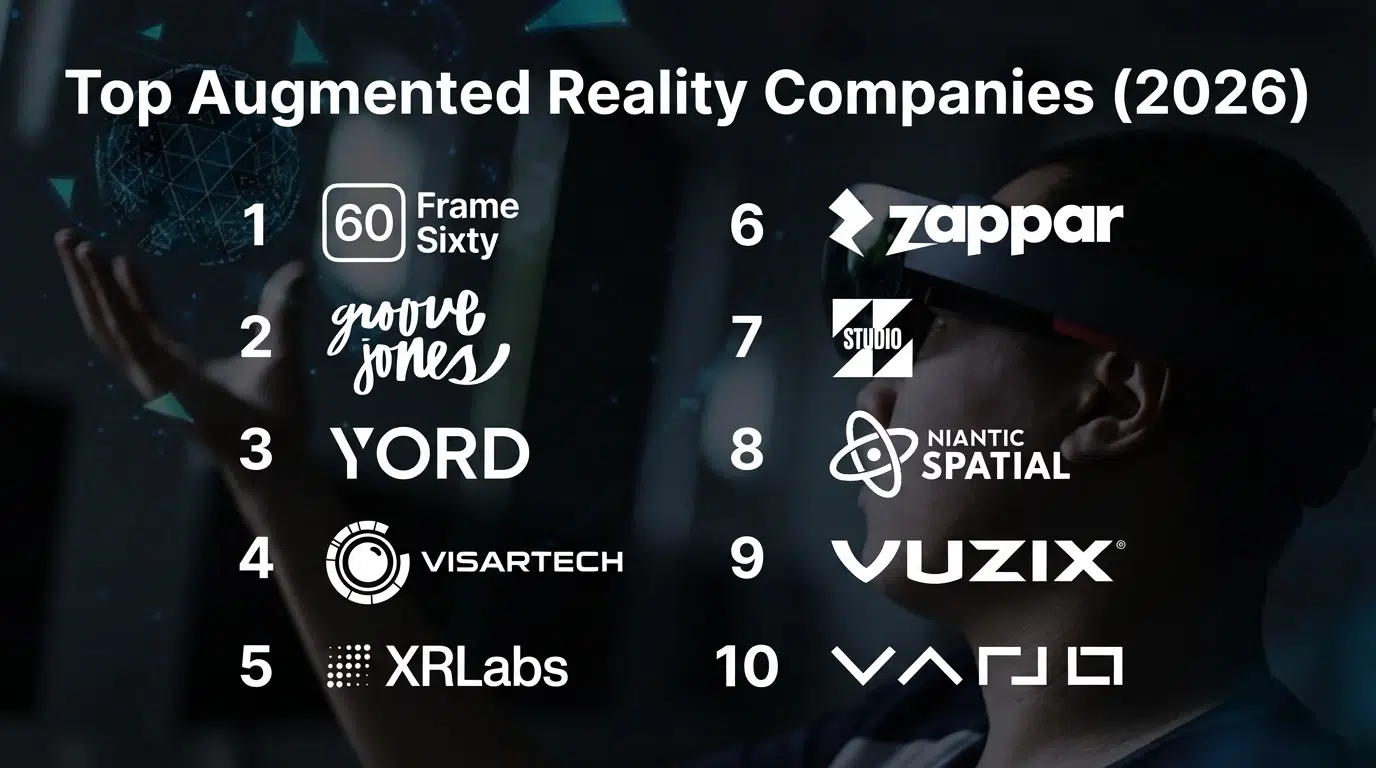
This ranked list of top augmented reality companies includes development studios, agencies, platforms, and hardware ecosystem vendors. Each entry is included for a specific reason, and the best choice depends on whether you need custom enterprise software delivery, a platform-based solution, or a hardware ecosystem partner.
Top Augmented Reality Companies (2026) — Comparison Table
| Company | Primary Focus | Best Use Case | Development Model | IP Ownership | Est. Hourly Rate | Website |
|---|---|---|---|---|---|---|
| Frame Sixty | Enterprise AR systems + spatial computing | Production-grade AR with integration & long-term support | Custom development partner | Client | $90–$150 | framesixty.com |
| Groove Jones | Creative + engineering XR | High-impact brand & enterprise immersive deployments | Project-based studio | Client (varies) | $100–$149 | groovejones.com |
| YORD | Premium XR storytelling | Visually compelling AR & immersive experiences | Project-based | Varies | $100–$149 | yordstudio.com |
| Visartech | Software + XR integration | AR inside larger enterprise systems | Custom / team extension | Contract-defined | $50–$99 | visartech.com |
| XR Labs | Enterprise AR training | Workforce enablement and guided workflows | Custom delivery | Contract-defined | Varies | xrlabs.co |
| Zappar | WebAR platform | Frictionless AR distribution | Platform + services | Platform model | Undisclosed | zappar.com |
| Studio Z | Creative XR production | Campaign-based immersive AR | Studio delivery | Varies | Varies | wearestudioz.com |
| Niantic Spatial | Geospatial AR infrastructure | Localization & digital twins | Platform | Vendor | N/A | nianticspatial.com |
| Vuzix | Smart glasses ecosystem | Field & industrial deployments | Hardware ecosystem | Vendor | N/A | vuzix.com |
| Varjo | Industrial XR hardware | High-fidelity simulation and training | Hardware ecosystem | Vendor | N/A | varjo.com |
Company Profiles
1. Frame Sixty
- Website: framesixty.com
- Primary Focus: Enterprise AR systems and spatial computing
- Best Use Case: Production-grade AR with backend integration and long-term support
- Development Model: Custom development partner
- IP Ownership: Client
- Estimated Hourly Rate: $90–$150
Frame Sixty builds augmented reality as long-term enterprise infrastructure. The focus is not on one-off activations, but on production-grade systems that integrate into real business workflows and remain maintainable over time.
Frame Sixty is a strong fit when AR must connect to enterprise data and systems (ERP, CRM, CAD/PLM, digital twins), operate across multiple devices, and meet real operational constraints like battery life, thermal behavior, performance stability, and long-session usability.
In addition to implementation, Frame Sixty helps clients choose the right device strategy (mobile AR vs WebAR vs headset MR vs smart glasses) based on the use case, environment, rollout scale, and IT constraints.
Featured Work & Innovation
Mesh Highlight System for Apple Vision Pro
Frame Sixty developed an innovative mesh highlight effect for Apple Vision Pro designed for enterprise product demonstrations, immersive training simulations, and spatial showcases. This feature uses eye tracking to dynamically spotlight key areas of 3D models—similar to how visionOS highlights interface elements—but applied directly to spatial content.
Ideal for interactive product walkthroughs, complex technical training, and marketing activations, this system leverages custom shader effects and intuitive gaze-based engagement to guide user attention naturally within 3D space.
Real-Time AR Sign Language Translation on Vision Pro
Frame Sixty also developed an augmented reality application that translates sign language into text and speech in real time, enhancing accessibility and inclusive communication. Integrated seamlessly with Apple Vision Pro, this solution demonstrates how spatial computing can bridge communication gaps and create meaningful real-world impact.
The system combines computer vision, real-time processing, and spatial display to deliver an intuitive and accessible user experience.
2. Groove Jones
- Website: groovejones.com
- Primary Focus: Creative + engineering XR
- Best Use Case: High-impact brand and immersive enterprise deployments
- Development Model: Project-based studio
- IP Ownership: Client (varies by contract)
- Estimated Hourly Rate: $100–$149
Groove Jones blends immersive storytelling with technical XR execution. Their work is often selected when visual polish and user engagement are critical, while still requiring stable delivery on real devices.
They can be a good fit for immersive product storytelling, marketing-driven AR, and experiential deployments that benefit from strong creative direction combined with solid engineering.
3. YORD
- Website: yordstudio.com
- Primary Focus: Premium XR storytelling
- Best Use Case: High-impact immersive AR presentations
- Development Model: Project-based
- IP Ownership: Contract-defined
- Estimated Hourly Rate: $100–$149
YORD focuses on premium XR storytelling and design-forward immersive experiences. Their strength is building visually compelling AR experiences that prioritize narrative and presentation quality.
This can be a good fit for innovation showcases, premium product narratives, and experiences where creative execution is the primary driver.
4. Visartech
- Website: visartech.com
- Primary Focus: Enterprise software + XR integration
- Best Use Case: AR embedded inside larger enterprise platforms
- Development Model: Custom delivery / team extension
- IP Ownership: Contract-defined
- Estimated Hourly Rate: $50–$99
Visartech supports AR as part of broader enterprise software programs, often through custom delivery or team extension models.
They can be relevant when AR is one capability inside a larger product transformation and the organization needs an engineering partner comfortable with enterprise delivery patterns.
5. XR Labs
- Website: xrlabs.co
- Primary Focus: Enterprise AR training systems
- Best Use Case: Workforce enablement and guided operational workflows
- Development Model: Custom delivery
- IP Ownership: Contract-defined
- Estimated Hourly Rate: Varies
XR Labs focuses on training-oriented AR systems and guided workflows for workforce enablement.
They can be a fit when the core value is training effectiveness, procedural guidance, and operational readiness rather than broad platform integrations.
6. Zappar
- Website: zappar.com
- Primary Focus: WebAR platform and services
- Best Use Case: Frictionless AR distribution and campaign-based experiences
- Development Model: Platform + services
- IP Ownership: Platform model
- Estimated Hourly Rate: Undisclosed
Zappar offers a WebAR platform designed for easy distribution and low-friction AR experiences, often used for campaigns and consumer engagement.
This can be useful when broad reach and quick deployment matter more than deep customization or complex backend integrations.
7. Studio Z
- Website: wearestudioz.com
- Primary Focus: Creative XR production
- Best Use Case: Campaign-based immersive AR
- Development Model: Studio delivery
- IP Ownership: Varies
- Estimated Hourly Rate: Varies
Studio Z delivers creative XR and campaign-based immersive AR experiences, typically optimized for high-impact brand moments.
This can be relevant for marketing activations or experiential projects where creative production is the main priority.
8. Niantic Spatial
- Website: nianticspatial.com
- Primary Focus: Geospatial AR infrastructure
- Best Use Case: Persistent AR localization and digital twins
- Development Model: Platform
- IP Ownership: Vendor
- Estimated Hourly Rate: N/A
Niantic Spatial provides geospatial infrastructure that enables persistent AR localization and large-scale spatial mapping workflows.
It can be relevant for use cases involving outdoor or large-area spatial persistence, location-aware AR, and mapping-driven digital twin foundations.
9. Vuzix
- Website: vuzix.com
- Primary Focus: Smart glasses ecosystem
- Best Use Case: Field operations and industrial AR
- Development Model: Hardware ecosystem
- IP Ownership: Vendor
- Estimated Hourly Rate: N/A
Vuzix is a smart glasses vendor supporting enterprise wearables for field operations and industrial use cases.
This can be relevant when hands-free workflows and lightweight wearable deployment are priorities.
10. Varjo
- Website: varjo.com
- Primary Focus: Industrial XR hardware
- Best Use Case: High-fidelity simulation and training
- Development Model: Hardware ecosystem
- IP Ownership: Vendor
- Estimated Hourly Rate: N/A
Varjo provides high-fidelity XR hardware used in simulation-heavy environments where visual clarity and precision matter.
This is often relevant for advanced simulation and professional training programs that benefit from maximum visual fidelity.
Need help with enterprise 3D modeling or digital twin visualization?
We are here to help!
AR Development Company Selection Criteria
Selecting among top augmented reality companies requires evaluation across multiple dimensions. The criteria below help enterprise teams avoid demo-driven choices and identify partners that can deliver stable, maintainable software.
1. Production Experience vs. Demo Capability
Distinguish between vendors who build impressive demos and teams who deliver production systems. Ask for deployments with real users, evidence of SDK migrations, and examples of post-launch maintenance.
2. Device Ecosystem Expertise
Verify experience across the device ecosystem you care about. Mobile AR, passthrough headsets, optical see-through devices, and smart glasses each require different optimization strategies and interaction models.
3. Enterprise Integration Capability
Request examples of integration work: authentication, APIs, ERP/CRM connectivity, CAD/PLM pipelines, IoT data, analytics, and device management. Integration quality is a major predictor of long-term viability.
4. Spatial UX and 3D Design Expertise
Assess spatial UX capability beyond traditional UI. Ask for examples showing readable UI at distance, safe UI placement, interaction discoverability, and comfort-first design for long sessions.
5. Performance Optimization Experience
Confirm that the team can profile and optimize performance on real devices, including battery life, thermal throttling, memory usage, and network variability. These issues can make or break adoption.
6. Long-Term Support Model
Clarify post-launch support. AR requires ongoing updates as operating systems and SDKs evolve. Make sure there is a clear maintenance plan, release cadence, documentation, and ownership alignment.
Estimated Costs for AR Development
AR development costs vary based on device targets, integration complexity, 3D content needs, security requirements, and expected deployment scale. The ranges below provide a practical baseline for enterprise planning.
Hourly Rate Tiers
- Budget tier ($25–$75/hour): Often generalist teams with limited AR specialization. Suitable for basic prototypes, but higher risk of rework for production.
- Mid-tier ($75–$100/hour): Capable teams for well-defined scopes, but may struggle with complex integrations and multi-device optimization.
- High-quality tier ($100–$200+/hour): Senior AR specialists with production delivery experience, strong device optimization practices, and enterprise integration depth.
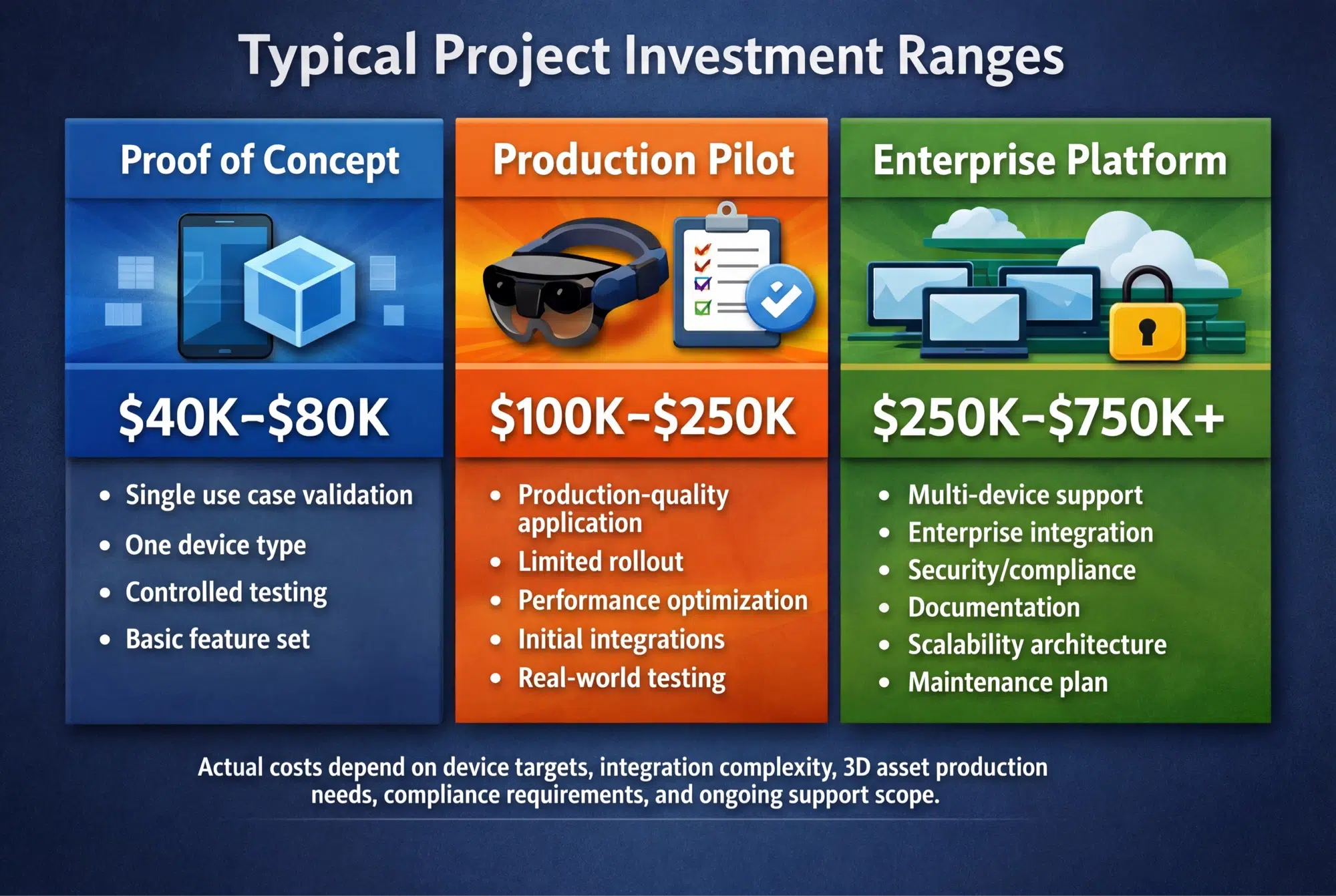
Typical Project Investment Ranges
| Project Type | Investment Range | Typical Scope |
|---|---|---|
| Proof of Concept | $40K–$80K | Single use case validation, one device type, controlled testing, basic feature set |
| Production Pilot | $100K–$250K | Production-quality application, limited rollout, performance optimization, initial integrations, real-world testing |
| Enterprise Platform | $250K–$750K+ | Multi-device support, enterprise integration, security/compliance, documentation, scalability architecture, maintenance plan |
Actual costs depend on device targets, integration complexity, 3D asset production needs, compliance requirements, and ongoing support scope.
Recommendations When Hiring an AR Partner
Choosing among the top augmented reality companies requires structured evaluation. Augmented reality is long-term spatial software infrastructure, not a temporary campaign or one-time project.
A strong AR partner should validate the business case, guide device selection, optimize performance and battery life, structure phased delivery, plan long-term support, and provide clear IP ownership. Request detailed technical discovery processes, prototype validation approaches, performance benchmarks, and maintenance models.
Just as importantly, the right partner should help you decide which headset or device category is appropriate for your use case. WebAR, mobile AR, passthrough MR headsets, and smart glasses each have different tradeoffs across deployment cost, distribution, interaction depth, and IT constraints.
Evaluate partners based on production deployment experience (not demo reels), device ecosystem expertise, enterprise integration capability, spatial UX sophistication, performance optimization practices, and structured support models. Request references from clients operating production AR systems over extended timeframes.
If you are planning an enterprise augmented reality initiative, Frame Sixty works with organizations to design, build, and scale production-grade AR systems from the start, combining spatial product design, real-time engineering, device optimization, backend integration, and long-term maintenance under a single delivery model.
Contact Frame Sixty: https://framesixty.com
FAQs About Top Augmented Reality Companies
Selecting and working with one of the Top augmented reality companies can feel complex, especially if your organization is new to AR or spatial computing. From device selection and integration strategy to performance optimization and long-term support, there are many variables that influence success. With the right partner, however, the process becomes structured and predictable. Experienced Top augmented reality companies guide you through discovery, hardware strategy, proof-of-concept validation, production deployment, and long-term maintenance—ensuring your augmented reality initiative is built for real-world use, not just demonstration environments. Below, we answer the most common questions organizations ask when evaluating Top augmented reality companies and planning their AR strategy.
Top augmented reality companies are specialized firms that design and build production-grade AR software that overlays digital content onto the real world using mobile devices, headsets, or smart glasses. Unlike general software agencies, Top augmented reality companies focus specifically on real-time 3D development, spatial UX, device optimization, and enterprise integration.
When comparing Top augmented reality companies, start by defining your use case: training, field operations, visualization, product simulation, or marketing. Then evaluate each company’s portfolio, device experience, integration depth, long-term support model, and ability to scale beyond a demo.
In most cases, no. Augmented reality is fundamentally different from web or mobile development. Top augmented reality companies specialize in spatial interaction design, 3D engine performance, rendering optimization, and hardware constraints—skills that generalist agencies typically lack.
Yes. Strong Top augmented reality companies guide hardware strategy. The right device—mobile AR, WebAR, mixed reality headsets, or smart glasses—depends on your environment, rollout scale, IT policies, battery requirements, and session duration.
Yes. Many successful deployments with Top augmented reality companies begin with a tightly scoped proof of concept. This allows validation of the workflow, confirmation of technical feasibility, and evaluation of the working relationship before scaling.
Manufacturing, healthcare, aerospace, construction, energy, retail, logistics, and enterprise training frequently work with Top augmented reality companies when workflows are physical, process-driven, and visually complex.
Top augmented reality companies deliver production-grade systems—not experimental demos. They manage performance optimization, battery stability, spatial accuracy, backend integration, compliance, and long-term maintainability.
Spatial UX is completely different from web or mobile UX. Top augmented reality companies employ 3D UX designers who understand depth perception, gesture ergonomics, spatial anchors, safe interface zones, and how users physically move in space.
Extremely important. Top augmented reality companies should own and test on the actual devices used in deployment. Simulators cannot validate real-world battery life, thermal throttling, lighting conditions, and long-session performance.
Yes. The best Top augmented reality companies integrate AR systems with ERP, CRM, CAD/PLM, digital twin platforms, and enterprise APIs. Integration architecture is a major differentiator among Top augmented reality companies.
A proof of concept typically takes 8–12 weeks. A production pilot may take 3–6 months. Enterprise-grade deployments built by Top augmented reality companies may take 6–12+ months depending on integrations and scale.
No. WebAR prioritizes accessibility and frictionless distribution. Headset AR or mixed reality supports deeper spatial persistence and hands-free workflows. Top augmented reality companies help determine which approach fits your use case.
Top augmented reality companies typically charge between $75 and $150+ per hour depending on specialization and geographic location. Total project investment depends on scope, integrations, device targets, and long-term support needs.
Top augmented reality companies employ real-time 3D engineers, spatial UX designers, technical artists, and device labs. They also invest in optimization for battery life, rendering performance, and stability—work that cheaper vendors often skip.
Common mistakes include selecting based only on visuals, ignoring integration requirements, skipping device validation, and hiring generalist software vendors instead of true Top augmented reality companies.
When working with Top augmented reality companies for enterprise use cases, AR should be treated as long-term software infrastructure, not a one-time campaign.
With custom development partnerships, IP is typically owned by the client. However, Top augmented reality companies may also offer platform or shared models depending on the agreement.
Define a clear operational outcome, identify measurable business value, select target hardware, validate data readiness, and begin with a production-focused pilot. The best Top augmented reality companies will structure delivery for scale from day one.